Sugar and the Hot Drinks Revolution (Not So Sweet)
Sugar - or rather, the great commodity market which arose demanding it - has been one of the massive demographic forces in world history. Because of it, literally millions of enslaved Africans reached the New World, particularly the American South, the Caribbean and its littorals, the Guianas and Brazil.
Yum, Yums and Dumb, Dumbs Plant is a member of the grass family (grows back when cut) Grows 9’-10’ in height One acre of sugar has a  caloric equivalent to twelve  acres of wheat
Sugar  Sugar is “one of the massive demographic forces in world history” says Sidney W. Mintz, responsible for the uprooting, resettling, and enslaving of millions of people employed in its cultivation
Why is Sugar Interesting? 1)  Sugar has almost always been produced by  laborers working under some degree of  compulsion 2)  Sugar is grown far away from Europe and  was still controlled by Europeans 3) Economic organization of sugar plantations 4)  Wide-ranging global impacts
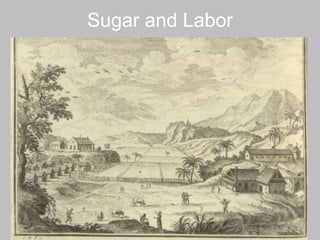
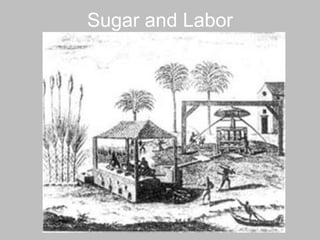
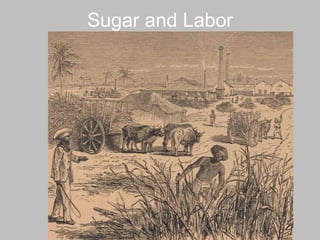
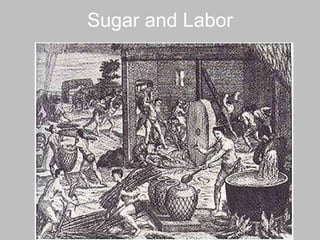
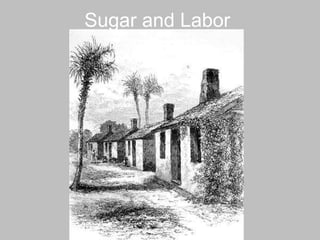
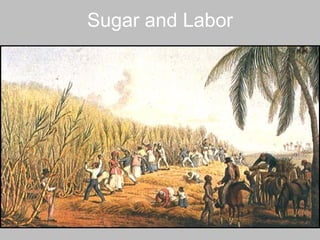
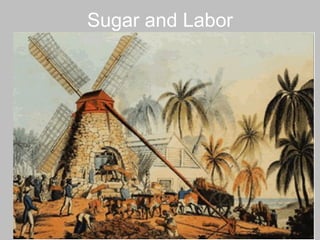
Sugar and Labor Extremely labor intensive (one labor per acre) Irrigation  Harvest - sugar in the sap begins declining as soon as it is cut Hot, humid, conditions, machetes  Processing - crushing cane, extracting juice, boiling  This usually took place 24 hours a day during a harvest Conditions were very dangerous: crushing equipment, boiling houses were hot and filled with sticky juice Refining - removing the molasses that both flavors and colors less refined sugars  Today’s brown sugar is refined sugar w/ molasses added
Sugar and Labor
Sugar and Labor
Sugar and Labor
Sugar and Labor
Sugar and Labor
Sugar and Labor
Sugar and Labor
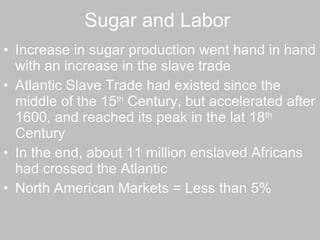
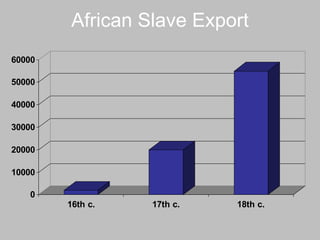
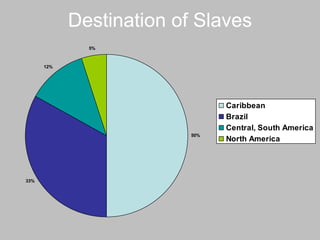
Sugar and Labor  Increase in sugar production went hand in hand with an increase in the slave trade Atlantic Slave Trade had existed since the middle of the 15 th  Century, but accelerated after 1600, and reached its peak in the lat 18 th  Century In the end, about 11 million enslaved Africans had crossed the Atlantic North American Markets = Less than 5%
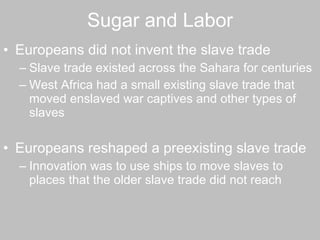
Sugar and Labor Europeans did not invent the slave trade Slave trade existed across the Sahara for centuries  West Africa had a small existing slave trade that moved enslaved war captives and other types of slaves  Europeans reshaped a preexisting slave trade  Innovation was to use ships to move slaves to places that the older slave trade did not reach
Sugar and Labor  How did the Europeans acquire African slaves?
African Slave Export
Destination of Slaves
Sugar Plantation By the late 15 th  century, plantations were fully developed trying to meet the demand for sugar People used sugar for  Spice in food To show wealth and status (wrapped in silver/gold) Medicinal purposes Such as toothpaste (pure white)
Distilled Drinks Revolution Rum Fermented molasses  Gin
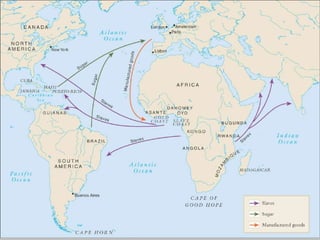
Triangular Trade 1. European manufactured goods (especially firearms) sent to Africa 2. African slaves purchased and sent to Americas 3. Cash crops purchased in Americas and returned to Europe
 
Bean Town

Sugar

  • 1.
    Sugar and theHot Drinks Revolution (Not So Sweet)
  • 2.
    Sugar - orrather, the great commodity market which arose demanding it - has been one of the massive demographic forces in world history. Because of it, literally millions of enslaved Africans reached the New World, particularly the American South, the Caribbean and its littorals, the Guianas and Brazil.
  • 3.
    Yum, Yums andDumb, Dumbs Plant is a member of the grass family (grows back when cut) Grows 9’-10’ in height One acre of sugar has a caloric equivalent to twelve acres of wheat
  • 4.
    Sugar Sugaris “one of the massive demographic forces in world history” says Sidney W. Mintz, responsible for the uprooting, resettling, and enslaving of millions of people employed in its cultivation
  • 5.
    Why is SugarInteresting? 1) Sugar has almost always been produced by laborers working under some degree of compulsion 2) Sugar is grown far away from Europe and was still controlled by Europeans 3) Economic organization of sugar plantations 4) Wide-ranging global impacts
  • 6.
    Sugar and LaborExtremely labor intensive (one labor per acre) Irrigation Harvest - sugar in the sap begins declining as soon as it is cut Hot, humid, conditions, machetes Processing - crushing cane, extracting juice, boiling This usually took place 24 hours a day during a harvest Conditions were very dangerous: crushing equipment, boiling houses were hot and filled with sticky juice Refining - removing the molasses that both flavors and colors less refined sugars Today’s brown sugar is refined sugar w/ molasses added
  • 7.
  • 8.
  • 9.
  • 10.
  • 11.
  • 12.
  • 13.
  • 14.
    Sugar and Labor Increase in sugar production went hand in hand with an increase in the slave trade Atlantic Slave Trade had existed since the middle of the 15 th Century, but accelerated after 1600, and reached its peak in the lat 18 th Century In the end, about 11 million enslaved Africans had crossed the Atlantic North American Markets = Less than 5%
  • 15.
    Sugar and LaborEuropeans did not invent the slave trade Slave trade existed across the Sahara for centuries West Africa had a small existing slave trade that moved enslaved war captives and other types of slaves Europeans reshaped a preexisting slave trade Innovation was to use ships to move slaves to places that the older slave trade did not reach
  • 16.
    Sugar and Labor How did the Europeans acquire African slaves?
  • 17.
  • 18.
  • 19.
    Sugar Plantation Bythe late 15 th century, plantations were fully developed trying to meet the demand for sugar People used sugar for Spice in food To show wealth and status (wrapped in silver/gold) Medicinal purposes Such as toothpaste (pure white)
  • 20.
    Distilled Drinks RevolutionRum Fermented molasses Gin
  • 21.
    Triangular Trade 1.European manufactured goods (especially firearms) sent to Africa 2. African slaves purchased and sent to Americas 3. Cash crops purchased in Americas and returned to Europe
  • 22.
  • 23.