2/12/2015 SUDAN REPORT PRESENTATION 1
SUDAN
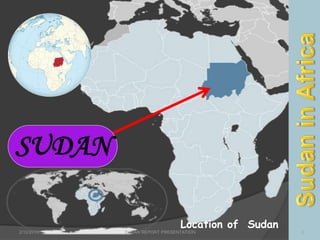
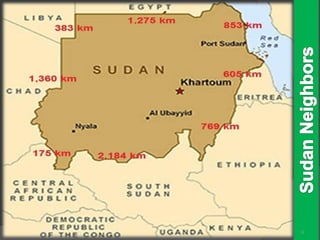
Location of Sudan
2/12/2015 SUDAN REPORT PRESENTATION 2
2/12/2015 SUDAN REPORT PRESENTATION 3
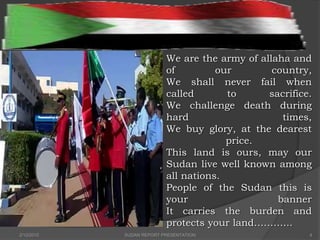
We are the army of allaha and
of our country,
We shall never fail when
called to sacrifice.
We challenge death during
hard times,
We buy glory, at the dearest
price.
This land is ours, may our
Sudan live well known among
all nations.
People of the Sudan this is
your banner
It carries the burden and
protects your land………...
2/12/2015 SUDAN REPORT PRESENTATION 4
1. Sudan Introduction
5
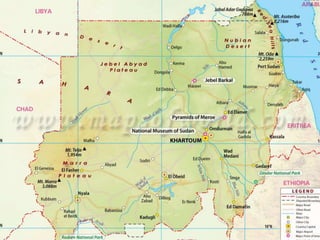
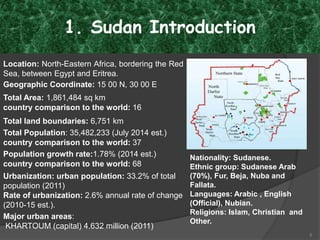
Location: North-Eastern Africa, bordering the Red
Sea, between Egypt and Eritrea.
Geographic Coordinate: 15 00 N, 30 00 E
Total Area: 1,861,484 sq km
country comparison to the world: 16
Total land boundaries: 6,751 km
Total Population: 35,482,233 (July 2014 est.)
country comparison to the world: 37
Population growth rate:1.78% (2014 est.)
country comparison to the world: 68
Urbanization: urban population: 33.2% of total
population (2011)
Rate of urbanization: 2.6% annual rate of change
(2010-15 est.).
Major urban areas:
KHARTOUM (capital) 4.632 million (2011)
Nationality: Sudanese.
Ethnic group: Sudanese Arab
(70%), Fur, Beja, Nuba and
Fallata.
Languages: Arabic , English
(Official), Nubian.
Religions: Islam, Christian and
Other.
2/12/2015 SUDAN REPORT PRESENTATION 6
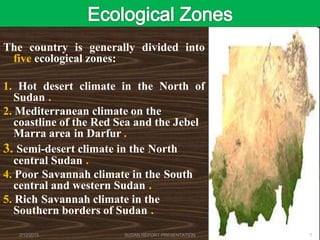
The country is generally divided into
five ecological zones:
1. Hot desert climate in the North of
Sudan .
2. Mediterranean climate on the
coastline of the Red Sea and the Jebel
Marra area in Darfur .
3. Semi-desert climate in the North
central Sudan .
4. Poor Savannah climate in the South
central and western Sudan .
5. Rich Savannah climate in the
Southern borders of Sudan .
2/12/2015 SUDAN REPORT PRESENTATION 7
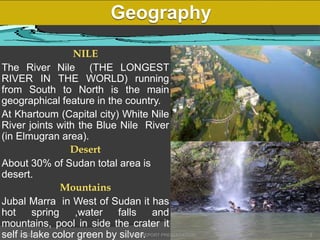
Geography
NILE
The River Nile (THE LONGEST
RIVER IN THE WORLD) running
from South to North is the main
geographical feature in the country.
At Khartoum (Capital city) White Nile
River joints with the Blue Nile River
(in Elmugran area).
Desert
About 30% of Sudan total area is
desert.
Mountains
Jubal Marra in West of Sudan it has
hot spring ,water falls and
mountains, pool in side the crater it
self is lake color green by silver.2/12/2015 SUDAN REPORT PRESENTATION 8
2/12/2015 SUDAN REPORT PRESENTATION 9
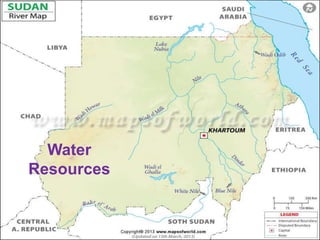
Water
Resources
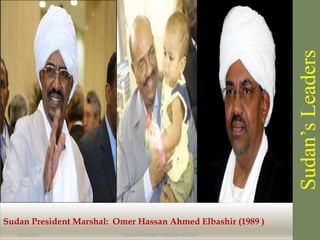
Sudan President Marshal: Omer Hassan Ahmed Elbashir (1989 )
2/12/2015 SUDAN REPORT PRESENTATION 10
Sudan’sLeaders
2/12/2015 SUDAN REPORT PRESENTATION 11
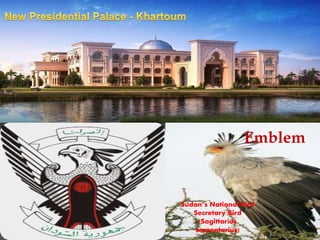
Sudan’s National Bird
Secretary Bird
(Sagittarius
serpentarius)
Emblem
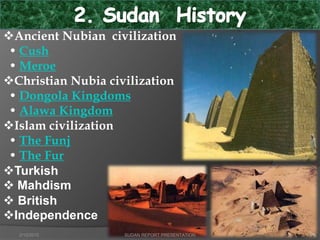
Ancient Nubian civilization
• Cush
• Meroe
Christian Nubia civilization
• Dongola Kingdoms
• Alawa Kingdom
Islam civilization
• The Funj
• The Fur
Turkish
 Mahdism
 British
Independence
2/12/2015 SUDAN REPORT PRESENTATION 12
2/12/2015 SUDAN REPORT PRESENTATION 13
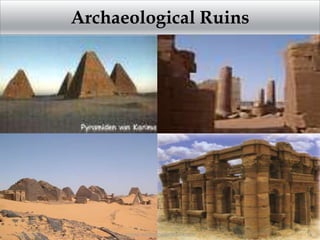
Archaeological Ruins
2/12/2015 SUDAN REPORT PRESENTATION 14
2/12/2015 SUDAN REPORT PRESENTATION 15
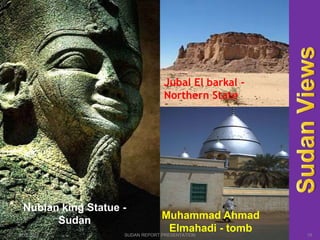
Muhammad Ahmad
Elmahadi - tomb
Jubal El barkal -
Northern State
Nubian king Statue -
Sudan
2/12/2015 16
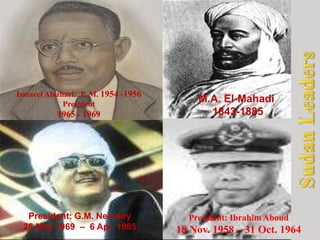
President: Ibrahim Aboud
18 Nov. 1958 – 31 Oct. 1964
M.A. El-Mahadi
1843-1885
President: G.M. Nemairy
25 May 1969 – 6 Apr. 1985
Ismaeel Alazhari: P. M. 1954 -1956
President
1965 - 1969
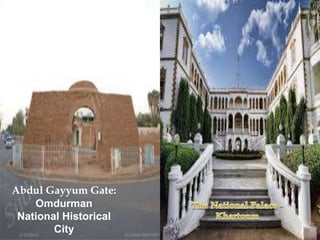
Abdul Gayyum Gate:
Omdurman
National Historical
City2/12/2015 SUDAN REPORT PRESENTATION 17
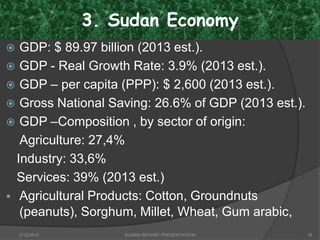
3. Sudan Economy
 GDP: $ 89.97 billion (2013 est.).
 GDP - Real Growth Rate: 3.9% (2013 est.).
 GDP – per capita (PPP): $ 2,600 (2013 est.).
 Gross National Saving: 26.6% of GDP (2013 est.).
 GDP –Composition , by sector of origin:
Agriculture: 27,4%
Industry: 33,6%
Services: 39% (2013 est.)
 Agricultural Products: Cotton, Groundnuts
(peanuts), Sorghum, Millet, Wheat, Gum arabic,
2/12/2015 SUDAN REPORT PRESENTATION 18
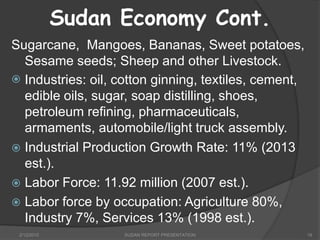
Sudan Economy Cont.
Sugarcane, Mangoes, Bananas, Sweet potatoes,
Sesame seeds; Sheep and other Livestock.
 Industries: oil, cotton ginning, textiles, cement,
edible oils, sugar, soap distilling, shoes,
petroleum refining, pharmaceuticals,
armaments, automobile/light truck assembly.
 Industrial Production Growth Rate: 11% (2013
est.).
 Labor Force: 11.92 million (2007 est.).
 Labor force by occupation: Agriculture 80%,
Industry 7%, Services 13% (1998 est.).
2/12/2015 SUDAN REPORT PRESENTATION 19
Sudan Economy Cont.
 Export: $ 4.145 billion (2013 est.).
 Export Commodities: Gold; Oil and Petroleum
products; Cotton, Sesame, Livestock, Groundnuts,
Gum arabic, Sugar.
 Export Partners: UAE 63.2%, Saudi Arabia 9.2%,
Ethiopia 5.3% (2012).
 Import: $ 5.941 billion (2013 est.).
 Import Commodities: foodstuffs, manufactured
goods, refinery and transport equipment, medicines
and chemicals, textiles, wheat.
 Import Partners: Macau 18.1%, India 8.8%, Saudi
Arabia 7.9%, Egypt 6.7%, UAE 5.2% (2012).
2/12/2015 SUDAN REPORT PRESENTATION 20
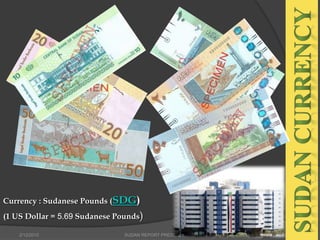
Currency : Sudanese Pounds (SDG)
(1 US Dollar = 5.69 Sudanese Pounds)
2/12/2015 SUDAN REPORT PRESENTATION 21
2/12/2015 SUDAN REPORT PRESENTATION 22
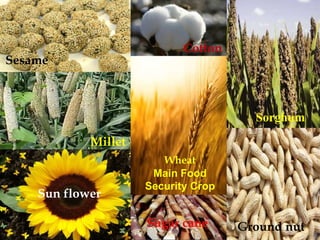
Sorghum
Sugar cane Ground nut
Sesame
Cotton
Millet
Sun flower
Wheat
Main Food
Security Crop
2/12/2015 SUDAN REPORT PRESENTATION 23
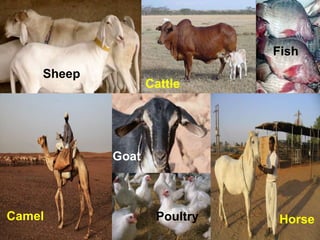
Cattle
Sheep
Goat
Camel
Fish
Poultry Horse
2/12/2015 SUDAN REPORT PRESENTATION 24
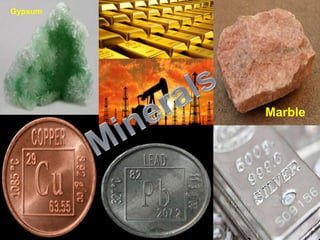
Marble
Gypsum
2/12/2015 SUDAN REPORT PRESENTATION 25
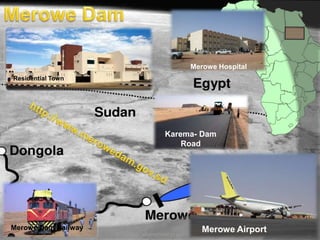
Residential Town
Karema- Dam
Road
Merowe Dam Railway Merowe Airport
Merowe Hospital
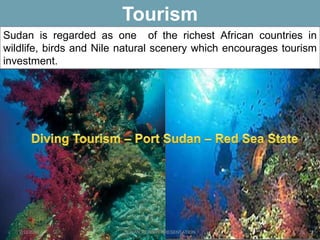
Tourism
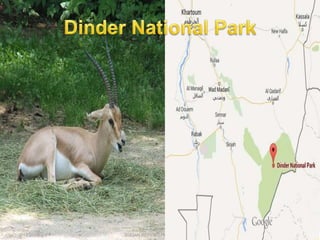
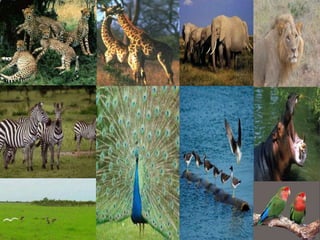
Sudan is regarded as one of the richest African countries in
wildlife, birds and Nile natural scenery which encourages tourism
investment.
2/12/2015 SUDAN REPORT PRESENTATION 26
2/12/2015 SUDAN REPORT PRESENTATION 27
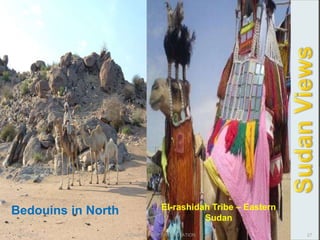
Bedouins in North El-rashidah Tribe – Eastern
Sudan
2/12/2015 SUDAN REPORT PRESENTATION 28
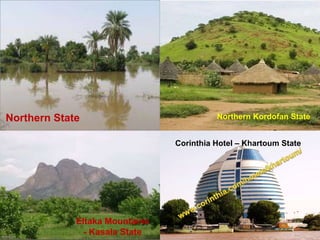
Northern State Northern Kordofan State
Eltaka Mountains
- Kasala State
Corinthia Hotel – Khartoum State
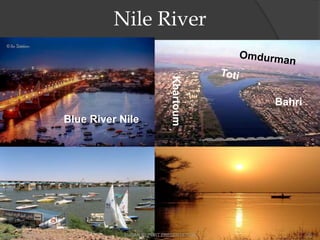
Nile River
Bahri
Khartoum
Blue River Nile
2/12/2015 SUDAN REPORT PRESENTATION 29
2/12/2015 SUDAN REPORT PRESENTATION 30
2/12/2015 SUDAN REPORT PRESENTATION 31
2/12/2015 SUDAN REPORT PRESENTATION 32
2/12/2015 SUDAN REPORT PRESENTATION 33
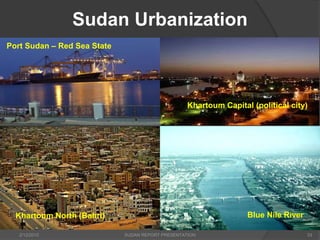
Sudan Urbanization
Khartoum Capital (political city)
Blue Nile RiverKhartoum North (Bahri)
Port Sudan – Red Sea State
2/12/2015 SUDAN REPORT PRESENTATION 34
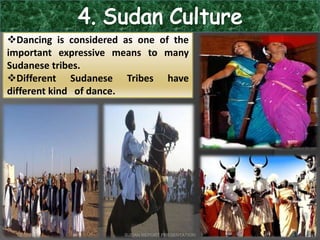
Dancing is considered as one of the
important expressive means to many
Sudanese tribes.
Different Sudanese Tribes have
different kind of dance.
2/12/2015 SUDAN REPORT PRESENTATION 35
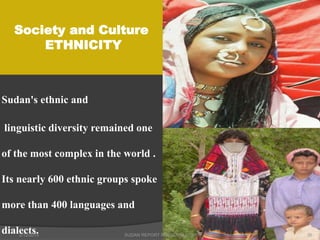
Sudan's ethnic and
linguistic diversity remained one
of the most complex in the world .
Its nearly 600 ethnic groups spoke
more than 400 languages and
dialects.2/12/2015 SUDAN REPORT PRESENTATION 36
Society and Culture
ETHNICITY
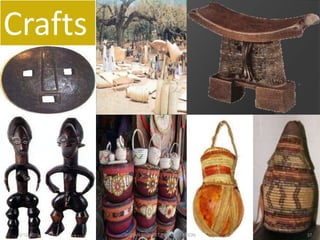
Crafts
2/12/2015 SUDAN REPORT PRESENTATION 37
2/12/2015 SUDAN REPORT PRESENTATION 38
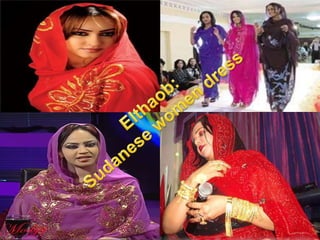
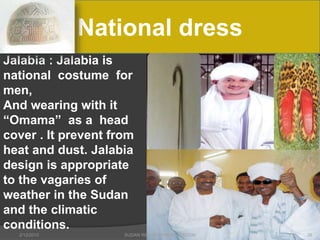
National dress
Jalabia : Jalabia is
national costume for
men,
And wearing with it
“Omama” as a head
cover . It prevent from
heat and dust. Jalabia
design is appropriate
to the vagaries of
weather in the Sudan
and the climatic
conditions.
2/12/2015 SUDAN REPORT PRESENTATION 39
2/12/2015 SUDAN REPORT PRESENTATION 40
2/12/2015 SUDAN REPORT PRESENTATION 41
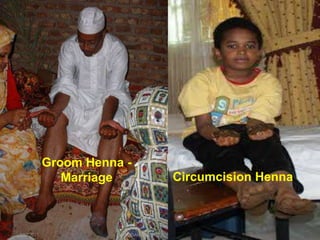
Groom Henna -
Marriage Circumcision Henna
2/12/2015 SUDAN REPORT PRESENTATION 42
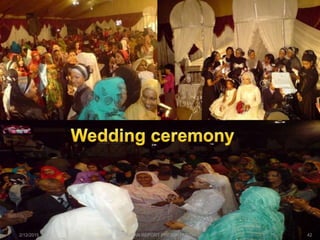
2/12/2015 SUDAN REPORT PRESENTATION 43
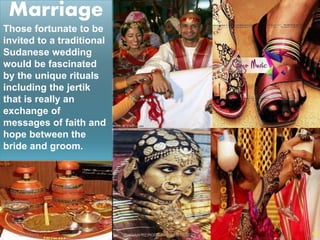
Marriage
Those fortunate to be
invited to a traditional
Sudanese wedding
would be fascinated
by the unique rituals
including the jertik
that is really an
exchange of
messages of faith and
hope between the
bride and groom.
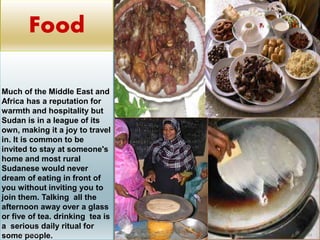
Much of the Middle East and
Africa has a reputation for
warmth and hospitality but
Sudan is in a league of its
own, making it a joy to travel
in. It is common to be
invited to stay at someone's
home and most rural
Sudanese would never
dream of eating in front of
you without inviting you to
join them. Talking all the
afternoon away over a glass
or five of tea. drinking tea is
a serious daily ritual for
some people.2/12/2015 SUDAN REPORT PRESENTATION 44
Food
452/12/2015 SUDAN REPORT PRESENTATION 45
2/12/2015 SUDAN REPORT PRESENTATION 46

Sudan Report Presentation

  • 1.
    2/12/2015 SUDAN REPORTPRESENTATION 1
  • 2.
    SUDAN Location of Sudan 2/12/2015SUDAN REPORT PRESENTATION 2
  • 3.
    2/12/2015 SUDAN REPORTPRESENTATION 3
  • 4.
    We are thearmy of allaha and of our country, We shall never fail when called to sacrifice. We challenge death during hard times, We buy glory, at the dearest price. This land is ours, may our Sudan live well known among all nations. People of the Sudan this is your banner It carries the burden and protects your land………... 2/12/2015 SUDAN REPORT PRESENTATION 4
  • 5.
    1. Sudan Introduction 5 Location:North-Eastern Africa, bordering the Red Sea, between Egypt and Eritrea. Geographic Coordinate: 15 00 N, 30 00 E Total Area: 1,861,484 sq km country comparison to the world: 16 Total land boundaries: 6,751 km Total Population: 35,482,233 (July 2014 est.) country comparison to the world: 37 Population growth rate:1.78% (2014 est.) country comparison to the world: 68 Urbanization: urban population: 33.2% of total population (2011) Rate of urbanization: 2.6% annual rate of change (2010-15 est.). Major urban areas: KHARTOUM (capital) 4.632 million (2011) Nationality: Sudanese. Ethnic group: Sudanese Arab (70%), Fur, Beja, Nuba and Fallata. Languages: Arabic , English (Official), Nubian. Religions: Islam, Christian and Other.
  • 6.
    2/12/2015 SUDAN REPORTPRESENTATION 6
  • 7.
    The country isgenerally divided into five ecological zones: 1. Hot desert climate in the North of Sudan . 2. Mediterranean climate on the coastline of the Red Sea and the Jebel Marra area in Darfur . 3. Semi-desert climate in the North central Sudan . 4. Poor Savannah climate in the South central and western Sudan . 5. Rich Savannah climate in the Southern borders of Sudan . 2/12/2015 SUDAN REPORT PRESENTATION 7
  • 8.
    Geography NILE The River Nile(THE LONGEST RIVER IN THE WORLD) running from South to North is the main geographical feature in the country. At Khartoum (Capital city) White Nile River joints with the Blue Nile River (in Elmugran area). Desert About 30% of Sudan total area is desert. Mountains Jubal Marra in West of Sudan it has hot spring ,water falls and mountains, pool in side the crater it self is lake color green by silver.2/12/2015 SUDAN REPORT PRESENTATION 8
  • 9.
    2/12/2015 SUDAN REPORTPRESENTATION 9 Water Resources
  • 10.
    Sudan President Marshal:Omer Hassan Ahmed Elbashir (1989 ) 2/12/2015 SUDAN REPORT PRESENTATION 10 Sudan’sLeaders
  • 11.
    2/12/2015 SUDAN REPORTPRESENTATION 11 Sudan’s National Bird Secretary Bird (Sagittarius serpentarius) Emblem
  • 12.
    Ancient Nubian civilization •Cush • Meroe Christian Nubia civilization • Dongola Kingdoms • Alawa Kingdom Islam civilization • The Funj • The Fur Turkish  Mahdism  British Independence 2/12/2015 SUDAN REPORT PRESENTATION 12
  • 13.
    2/12/2015 SUDAN REPORTPRESENTATION 13
  • 14.
  • 15.
    2/12/2015 SUDAN REPORTPRESENTATION 15 Muhammad Ahmad Elmahadi - tomb Jubal El barkal - Northern State Nubian king Statue - Sudan
  • 16.
    2/12/2015 16 President: IbrahimAboud 18 Nov. 1958 – 31 Oct. 1964 M.A. El-Mahadi 1843-1885 President: G.M. Nemairy 25 May 1969 – 6 Apr. 1985 Ismaeel Alazhari: P. M. 1954 -1956 President 1965 - 1969
  • 17.
    Abdul Gayyum Gate: Omdurman NationalHistorical City2/12/2015 SUDAN REPORT PRESENTATION 17
  • 18.
    3. Sudan Economy GDP: $ 89.97 billion (2013 est.).  GDP - Real Growth Rate: 3.9% (2013 est.).  GDP – per capita (PPP): $ 2,600 (2013 est.).  Gross National Saving: 26.6% of GDP (2013 est.).  GDP –Composition , by sector of origin: Agriculture: 27,4% Industry: 33,6% Services: 39% (2013 est.)  Agricultural Products: Cotton, Groundnuts (peanuts), Sorghum, Millet, Wheat, Gum arabic, 2/12/2015 SUDAN REPORT PRESENTATION 18
  • 19.
    Sudan Economy Cont. Sugarcane,Mangoes, Bananas, Sweet potatoes, Sesame seeds; Sheep and other Livestock.  Industries: oil, cotton ginning, textiles, cement, edible oils, sugar, soap distilling, shoes, petroleum refining, pharmaceuticals, armaments, automobile/light truck assembly.  Industrial Production Growth Rate: 11% (2013 est.).  Labor Force: 11.92 million (2007 est.).  Labor force by occupation: Agriculture 80%, Industry 7%, Services 13% (1998 est.). 2/12/2015 SUDAN REPORT PRESENTATION 19
  • 20.
    Sudan Economy Cont. Export: $ 4.145 billion (2013 est.).  Export Commodities: Gold; Oil and Petroleum products; Cotton, Sesame, Livestock, Groundnuts, Gum arabic, Sugar.  Export Partners: UAE 63.2%, Saudi Arabia 9.2%, Ethiopia 5.3% (2012).  Import: $ 5.941 billion (2013 est.).  Import Commodities: foodstuffs, manufactured goods, refinery and transport equipment, medicines and chemicals, textiles, wheat.  Import Partners: Macau 18.1%, India 8.8%, Saudi Arabia 7.9%, Egypt 6.7%, UAE 5.2% (2012). 2/12/2015 SUDAN REPORT PRESENTATION 20
  • 21.
    Currency : SudanesePounds (SDG) (1 US Dollar = 5.69 Sudanese Pounds) 2/12/2015 SUDAN REPORT PRESENTATION 21
  • 22.
    2/12/2015 SUDAN REPORTPRESENTATION 22 Sorghum Sugar cane Ground nut Sesame Cotton Millet Sun flower Wheat Main Food Security Crop
  • 23.
    2/12/2015 SUDAN REPORTPRESENTATION 23 Cattle Sheep Goat Camel Fish Poultry Horse
  • 24.
    2/12/2015 SUDAN REPORTPRESENTATION 24 Marble Gypsum
  • 25.
    2/12/2015 SUDAN REPORTPRESENTATION 25 Residential Town Karema- Dam Road Merowe Dam Railway Merowe Airport Merowe Hospital
  • 26.
    Tourism Sudan is regardedas one of the richest African countries in wildlife, birds and Nile natural scenery which encourages tourism investment. 2/12/2015 SUDAN REPORT PRESENTATION 26
  • 27.
    2/12/2015 SUDAN REPORTPRESENTATION 27 Bedouins in North El-rashidah Tribe – Eastern Sudan
  • 28.
    2/12/2015 SUDAN REPORTPRESENTATION 28 Northern State Northern Kordofan State Eltaka Mountains - Kasala State Corinthia Hotel – Khartoum State
  • 29.
    Nile River Bahri Khartoum Blue RiverNile 2/12/2015 SUDAN REPORT PRESENTATION 29
  • 30.
    2/12/2015 SUDAN REPORTPRESENTATION 30
  • 31.
    2/12/2015 SUDAN REPORTPRESENTATION 31
  • 32.
    2/12/2015 SUDAN REPORTPRESENTATION 32
  • 33.
    2/12/2015 SUDAN REPORTPRESENTATION 33 Sudan Urbanization Khartoum Capital (political city) Blue Nile RiverKhartoum North (Bahri) Port Sudan – Red Sea State
  • 34.
    2/12/2015 SUDAN REPORTPRESENTATION 34 Dancing is considered as one of the important expressive means to many Sudanese tribes. Different Sudanese Tribes have different kind of dance.
  • 35.
    2/12/2015 SUDAN REPORTPRESENTATION 35
  • 36.
    Sudan's ethnic and linguisticdiversity remained one of the most complex in the world . Its nearly 600 ethnic groups spoke more than 400 languages and dialects.2/12/2015 SUDAN REPORT PRESENTATION 36 Society and Culture ETHNICITY
  • 37.
  • 38.
    2/12/2015 SUDAN REPORTPRESENTATION 38 National dress Jalabia : Jalabia is national costume for men, And wearing with it “Omama” as a head cover . It prevent from heat and dust. Jalabia design is appropriate to the vagaries of weather in the Sudan and the climatic conditions.
  • 39.
    2/12/2015 SUDAN REPORTPRESENTATION 39
  • 40.
    2/12/2015 SUDAN REPORTPRESENTATION 40
  • 41.
    2/12/2015 SUDAN REPORTPRESENTATION 41 Groom Henna - Marriage Circumcision Henna
  • 42.
    2/12/2015 SUDAN REPORTPRESENTATION 42
  • 43.
    2/12/2015 SUDAN REPORTPRESENTATION 43 Marriage Those fortunate to be invited to a traditional Sudanese wedding would be fascinated by the unique rituals including the jertik that is really an exchange of messages of faith and hope between the bride and groom.
  • 44.
    Much of theMiddle East and Africa has a reputation for warmth and hospitality but Sudan is in a league of its own, making it a joy to travel in. It is common to be invited to stay at someone's home and most rural Sudanese would never dream of eating in front of you without inviting you to join them. Talking all the afternoon away over a glass or five of tea. drinking tea is a serious daily ritual for some people.2/12/2015 SUDAN REPORT PRESENTATION 44 Food
  • 45.
    452/12/2015 SUDAN REPORTPRESENTATION 45
  • 46.
    2/12/2015 SUDAN REPORTPRESENTATION 46