
ANALYSI S OF SUDAN BY
    AWAI S AHMAD
CI I T/ FA09-MBA-027/ LHR
LOCATION AND GEOGRAPHY:
TRADE:


 •Port Sudan in the North
 •Destroyed Infrastructure
 •Civil War
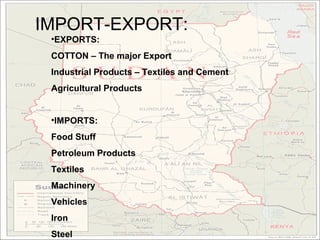
IMPORT-EXPORT:
 •EXPORTS:
 COTTON – The major Export
 Industrial Products – Textiles and Cement
 Agricultural Products


 •IMPORTS:
 Food Stuff
 Petroleum Products
 Textiles
 Machinery
 Vehicles
 Iron
 Steel
MARKET CONDITION:

•   Major Markets – China, Japan, Indonesia, Egypt,
    UAE, Saudi Arabia, Malaysia, South Korea
•   Major Suppliers - European Union, China, Malaysia,
    Saudi Arabia, Egypt, United Arab Emirates, and India
•   Market Condition is weak
•   Conflict between Tribes and Government
•   Civil War
•   A high Export of Agricultural Products
•   One of the 25 poorest countries in the world
LAWS RELATED TO TRADE:


•   Exports $8.464 billion
•   Imports $6.823 billion
•   Trade depends on production
•   Production depends on the rainfall which is rare
•   International Trade passes through Port Sudan – the
    North
POLITICAL AND ECONOMIC
INSTABILITY:
•   Civil War – 1955 – 1972 (2 billion deaths)
•   British failure to ensure equity for both North and
    South
•   Independent South Sudan movement by South
•   Inadequate Infrastructure and limited source of
    Investment Financing
•   Darfur Conflict (Representation of Non-Arab agrarian
    farmers in Politics by SLM/A VS JEM)
•   Bribery in Parliament
•   Classes and Caste System
•   Division in almost 25 states
•   Gender-based discrimination
•   Transfer of property to elder son
POLITICAL AND ECONOMIC
INSTABILITY:
•   Low Literacy Rate – 48% (58% Men, 36% women)
•   Drought and Irrigation problem
•   Lack of interest towards Industrial and Govt. sectors
    (80% agricultural, 10% industrial, 6% Govt labour force,
    4% unemployed)
•   Darfur Conflict - Sudan Liberation Movement/Army
    (SLM/A) VS Justice and Equality Movement (JEM)
•   High crime rate due to political instability
•   Military – 92000 (Army 90000, Navy 1700, Air force 300)
•   Free medical facilities but inaccessible by the people
•   Poor Health Care and lack of contribution by Govt
    towards Medical Facilities
MAJOR POLITIACAL
PARITES & THEIR LEADERS:
UP (The Umma Party)
Al-Sadiq Al-Mahdi
P. Minister: 1966 – 1967, P. Minister: 1986 - 1989
DUP (The Democratic Unionist Party)
Ahmed Ali Al-Mirahani
President, 1986 - 1989
NIF (The National Islamic Front)
Omer Hassan Abdullah Al-Turabi
President, 1989
SPLM (Sudanese People’s Liberation Movement)
RB (The Republication Brothers)
SCP (The Sudanese Communist Paries)
BP (The Bath Party)
CURRENT GOVERNMENT:

•   Provisional Government established by the
    Comprehensive Peace Agreement (CPA) signed in
    January 2005
•   President – Umar Hassan Ahmad Al-Bashir
•   1st Vice President - Salva Kiir Mayardit
•   Vice President - Ali Osman Taha
•   Governor Central Bank of Sudan - Muhammad Al-
    Hasan Sabir
•   Minister of Foreign Trade - James Kok Rew
•   Minister of Agriculture - Zubeir Beshir Taha
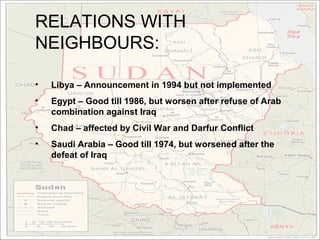
RELATIONS WITH
NEIGHBOURS:

•   Libya – Announcement in 1994 but not implemented
•   Egypt – Good till 1986, but worsen after refuse of Arab
    combination against Iraq
•   Chad – affected by Civil War and Darfur Conflict
•   Saudi Arabia – Good till 1974, but worsened after the
    defeat of Iraq
BIZ CULTURE:


•   Lack of interest by New Businessmen within the
    region
•   Political and Economic Instability discourage them
•   Poor Market Condition
•   Less Production
EFFECTS ON WTO:
•   In the process of accession (Expected Changes,
    Should build links with LDCs (Least Developed
    Countries), also include:
•   Afghanistan
•   Bhutan
•   Cape Verde
•   Ethiopia
•   Laos
•   Samoa
•   Sao Tome & Principe
•   Sudan
•   Vanuatu and Yemen
ECONOMIC CYCLE:


•   Economy is based on Agriculture
•   Agricultural Products are exported
•   Machinery, Steel, Iron and food items are imported
•   Industrial sector deals with soap distilling, textiles and
    cement
SWOT ANALYSIS:


•   Strengths:
    1. Largest country of Africa
    2. A major exporter of Cotton
    3. Takes part in International Trade
    4. Port Sudan – most of international trade passes
    5. Cheap Labour
    6. Oil producing country
    7. Unique Geographical Location
SWOT ANALYSIS:
•   Weaknesses:
    1.   One of the 25 poorest countries
    2. Civil War
    3. Low Literacy Rate
    4. Poor Health and Medical Care
    5. Lack of Human Rights
    6. High Inflation Rate
    7. Underdeveloped Infrastructure
    8. Lack of Rule of Law
    9. Lack of Proper Irrigation system
    10. Non-availability of Safe Water
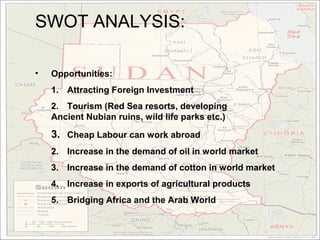
SWOT ANALYSIS:

•   Opportunities:
    1. Attracting Foreign Investment
    2. Tourism (Red Sea resorts, developing
    Ancient Nubian ruins, wild life parks etc.)

    3. Cheap Labour can work abroad
    2. Increase in the demand of oil in world market
    3. Increase in the demand of cotton in world market
    4. Increase in exports of agricultural products
    5. Bridging Africa and the Arab World
SWOT ANALYSIS:

•   Threats:
    1. Increase in the price of food items in world market
       as it is the major importer of food items
    2. Increase in the price of Industrial Products in world
       market.
    3. China hindering democratic progress
    4. Sharing endless border with 9 countries
    5. Al-Qaeda
ANY QUERIES?
GOOD LUCK

Economic and Political Analysis of Sudan

  • 1.
    ANALYSI S OFSUDAN BY AWAI S AHMAD CI I T/ FA09-MBA-027/ LHR
  • 2.
  • 3.
    TRADE: •Port Sudanin the North •Destroyed Infrastructure •Civil War
  • 4.
    IMPORT-EXPORT: •EXPORTS: COTTON– The major Export Industrial Products – Textiles and Cement Agricultural Products •IMPORTS: Food Stuff Petroleum Products Textiles Machinery Vehicles Iron Steel
  • 5.
    MARKET CONDITION: • Major Markets – China, Japan, Indonesia, Egypt, UAE, Saudi Arabia, Malaysia, South Korea • Major Suppliers - European Union, China, Malaysia, Saudi Arabia, Egypt, United Arab Emirates, and India • Market Condition is weak • Conflict between Tribes and Government • Civil War • A high Export of Agricultural Products • One of the 25 poorest countries in the world
  • 6.
    LAWS RELATED TOTRADE: • Exports $8.464 billion • Imports $6.823 billion • Trade depends on production • Production depends on the rainfall which is rare • International Trade passes through Port Sudan – the North
  • 7.
    POLITICAL AND ECONOMIC INSTABILITY: • Civil War – 1955 – 1972 (2 billion deaths) • British failure to ensure equity for both North and South • Independent South Sudan movement by South • Inadequate Infrastructure and limited source of Investment Financing • Darfur Conflict (Representation of Non-Arab agrarian farmers in Politics by SLM/A VS JEM) • Bribery in Parliament • Classes and Caste System • Division in almost 25 states • Gender-based discrimination • Transfer of property to elder son
  • 8.
    POLITICAL AND ECONOMIC INSTABILITY: • Low Literacy Rate – 48% (58% Men, 36% women) • Drought and Irrigation problem • Lack of interest towards Industrial and Govt. sectors (80% agricultural, 10% industrial, 6% Govt labour force, 4% unemployed) • Darfur Conflict - Sudan Liberation Movement/Army (SLM/A) VS Justice and Equality Movement (JEM) • High crime rate due to political instability • Military – 92000 (Army 90000, Navy 1700, Air force 300) • Free medical facilities but inaccessible by the people • Poor Health Care and lack of contribution by Govt towards Medical Facilities
  • 9.
    MAJOR POLITIACAL PARITES &THEIR LEADERS: UP (The Umma Party) Al-Sadiq Al-Mahdi P. Minister: 1966 – 1967, P. Minister: 1986 - 1989 DUP (The Democratic Unionist Party) Ahmed Ali Al-Mirahani President, 1986 - 1989 NIF (The National Islamic Front) Omer Hassan Abdullah Al-Turabi President, 1989 SPLM (Sudanese People’s Liberation Movement) RB (The Republication Brothers) SCP (The Sudanese Communist Paries) BP (The Bath Party)
  • 10.
    CURRENT GOVERNMENT: • Provisional Government established by the Comprehensive Peace Agreement (CPA) signed in January 2005 • President – Umar Hassan Ahmad Al-Bashir • 1st Vice President - Salva Kiir Mayardit • Vice President - Ali Osman Taha • Governor Central Bank of Sudan - Muhammad Al- Hasan Sabir • Minister of Foreign Trade - James Kok Rew • Minister of Agriculture - Zubeir Beshir Taha
  • 11.
    RELATIONS WITH NEIGHBOURS: • Libya – Announcement in 1994 but not implemented • Egypt – Good till 1986, but worsen after refuse of Arab combination against Iraq • Chad – affected by Civil War and Darfur Conflict • Saudi Arabia – Good till 1974, but worsened after the defeat of Iraq
  • 12.
    BIZ CULTURE: • Lack of interest by New Businessmen within the region • Political and Economic Instability discourage them • Poor Market Condition • Less Production
  • 13.
    EFFECTS ON WTO: • In the process of accession (Expected Changes, Should build links with LDCs (Least Developed Countries), also include: • Afghanistan • Bhutan • Cape Verde • Ethiopia • Laos • Samoa • Sao Tome & Principe • Sudan • Vanuatu and Yemen
  • 14.
    ECONOMIC CYCLE: • Economy is based on Agriculture • Agricultural Products are exported • Machinery, Steel, Iron and food items are imported • Industrial sector deals with soap distilling, textiles and cement
  • 15.
    SWOT ANALYSIS: • Strengths: 1. Largest country of Africa 2. A major exporter of Cotton 3. Takes part in International Trade 4. Port Sudan – most of international trade passes 5. Cheap Labour 6. Oil producing country 7. Unique Geographical Location
  • 16.
    SWOT ANALYSIS: • Weaknesses: 1. One of the 25 poorest countries 2. Civil War 3. Low Literacy Rate 4. Poor Health and Medical Care 5. Lack of Human Rights 6. High Inflation Rate 7. Underdeveloped Infrastructure 8. Lack of Rule of Law 9. Lack of Proper Irrigation system 10. Non-availability of Safe Water
  • 17.
    SWOT ANALYSIS: • Opportunities: 1. Attracting Foreign Investment 2. Tourism (Red Sea resorts, developing Ancient Nubian ruins, wild life parks etc.) 3. Cheap Labour can work abroad 2. Increase in the demand of oil in world market 3. Increase in the demand of cotton in world market 4. Increase in exports of agricultural products 5. Bridging Africa and the Arab World
  • 18.
    SWOT ANALYSIS: • Threats: 1. Increase in the price of food items in world market as it is the major importer of food items 2. Increase in the price of Industrial Products in world market. 3. China hindering democratic progress 4. Sharing endless border with 9 countries 5. Al-Qaeda
  • 19.
  • 20.