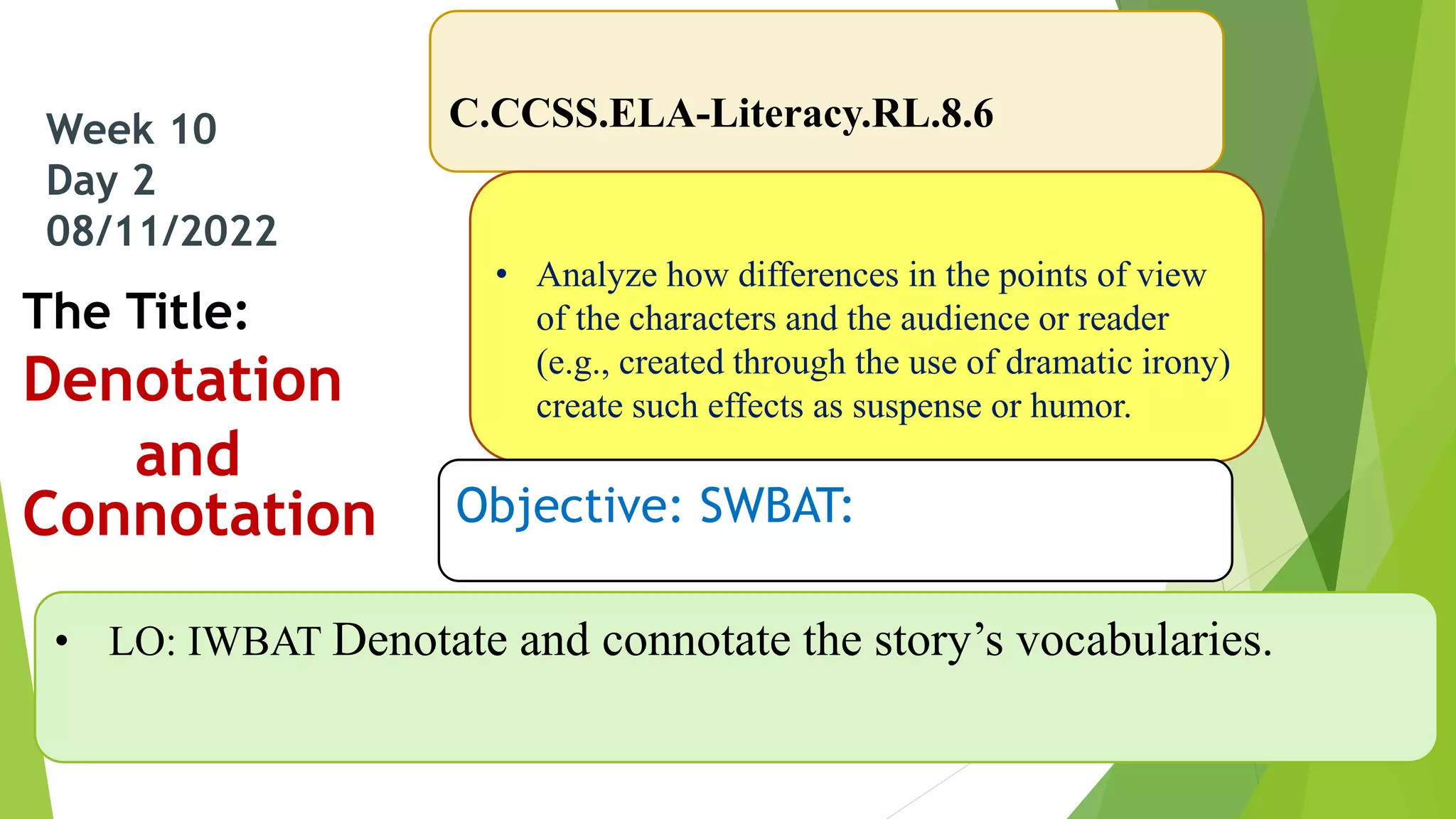
Week 10
Day 2
08/11/2022
The Title:
Denotation
and
Connotation
C.CCSS.ELA-Literacy.RL.8.6
• Analyze how differences in the points of view
of the characters and the audience or reader
(e.g., created through the use of dramatic irony)
create such effects as suspense or humor.
Objective: SWBAT:
• LO: IWBAT Denotate and connotate the story’s vocabularies.
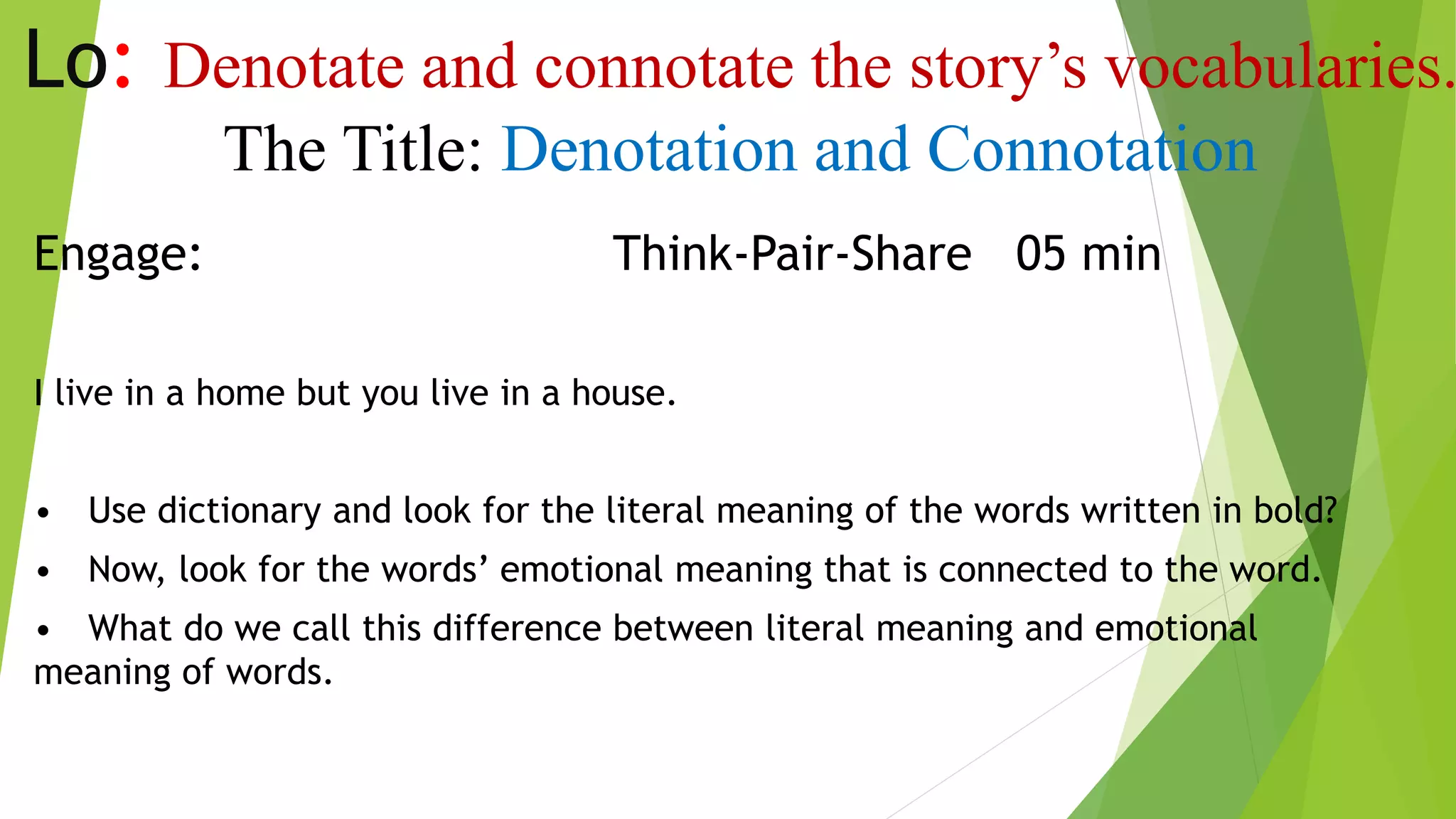
Lo: Denotate and connotate the story’s vocabularies.
The Title: Denotation and Connotation
Engage: Think-Pair-Share 05 min
I live in a home but you live in a house.
• Use dictionary and look for the literal meaning of the words written in bold?
• Now, look for the words’ emotional meaning that is connected to the word.
• What do we call this difference between literal meaning and emotional
meaning of words.
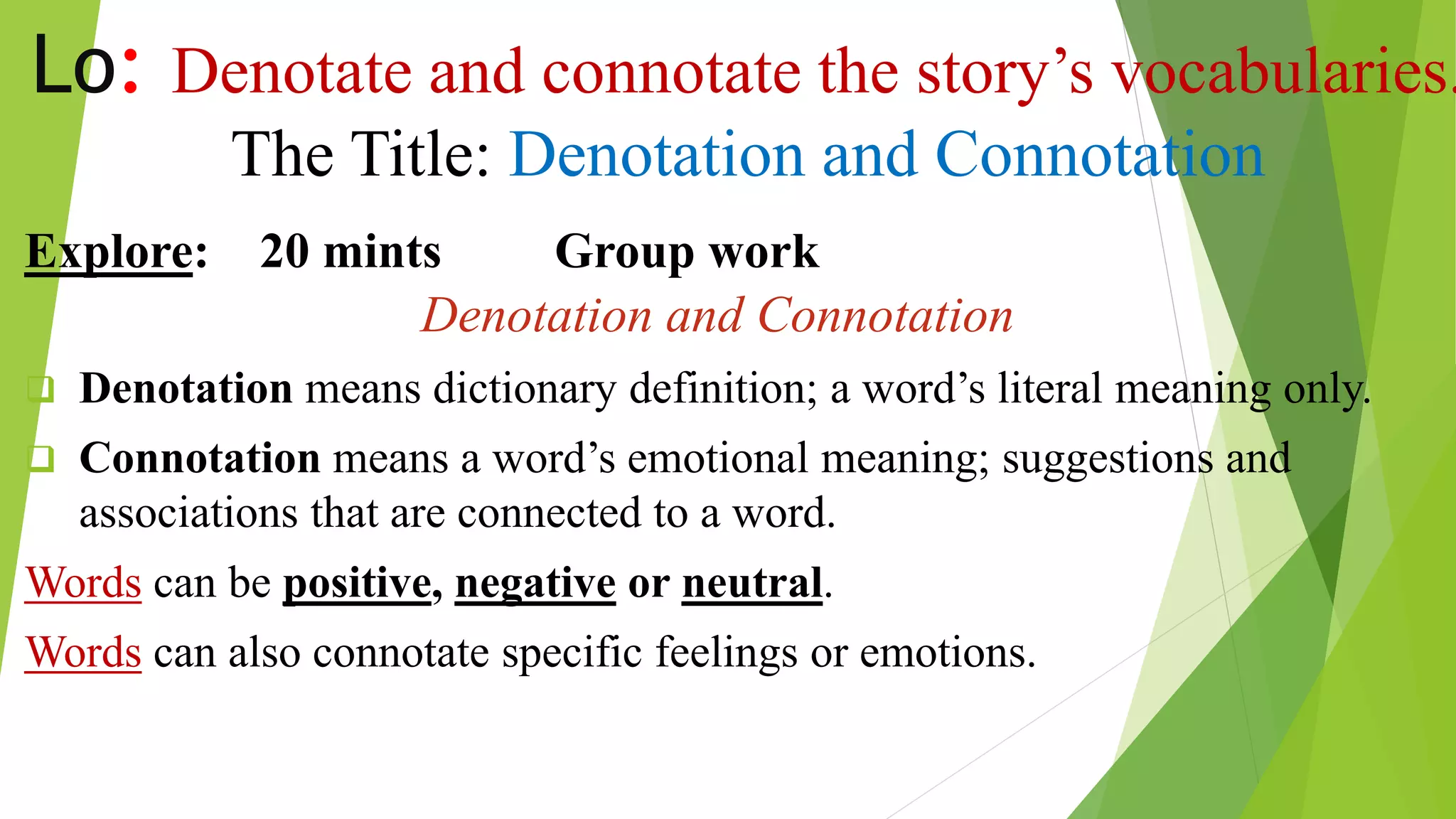
Lo: Denotate and connotate the story’s vocabularies.
The Title: Denotation and Connotation
Explore: 20 mints Group work
Denotation and Connotation
 Denotation means dictionary definition; a word’s literal meaning only.
 Connotation means a word’s emotional meaning; suggestions and
associations that are connected to a word.
Words can be positive, negative or neutral.
Words can also connotate specific feelings or emotions.
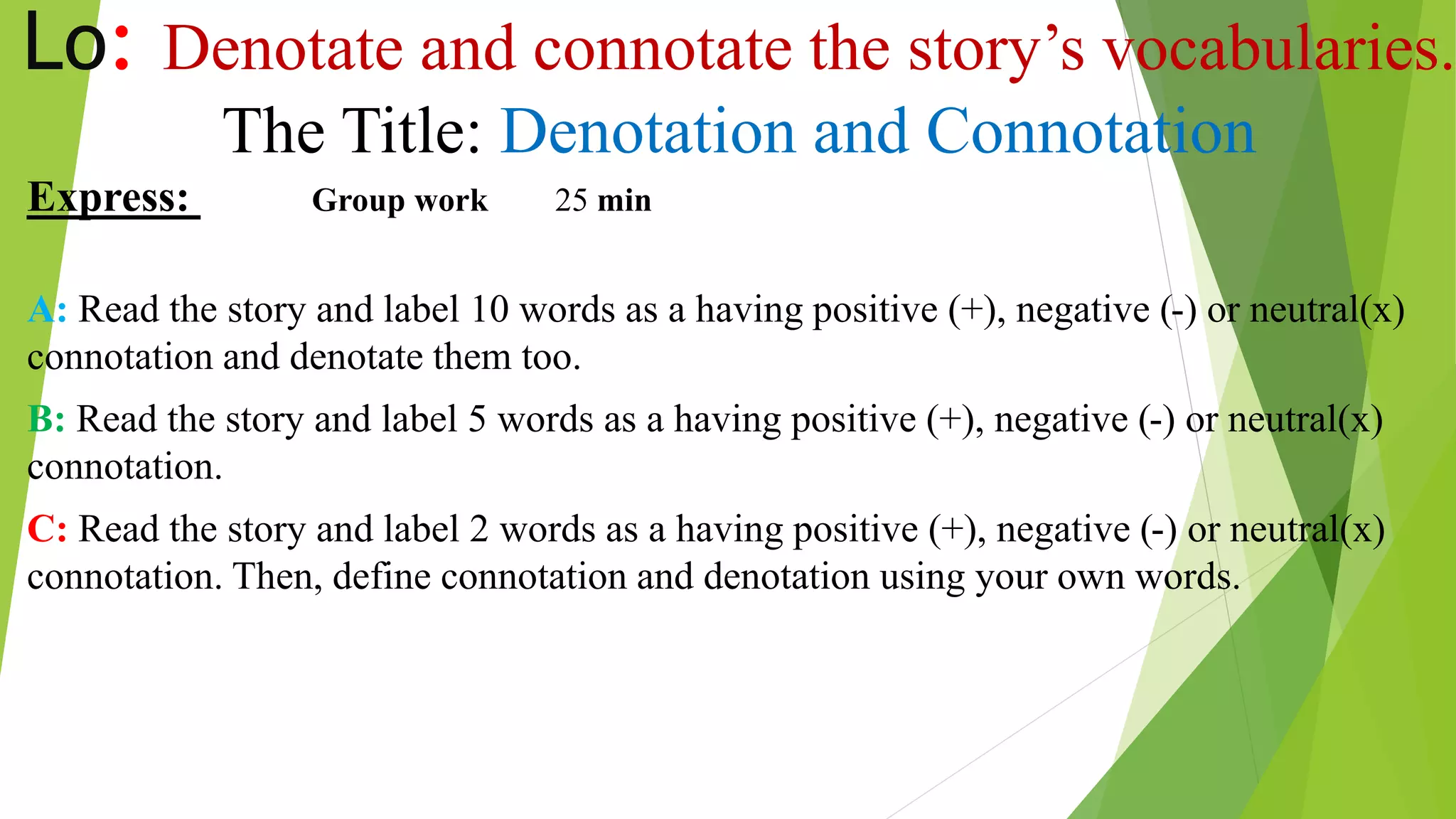
Lo: Denotate and connotate the story’s vocabularies.
The Title: Denotation and Connotation
Express: Group work 25 min
A: Read the story and label 10 words as a having positive (+), negative (-) or neutral(x)
connotation and denotate them too.
B: Read the story and label 5 words as a having positive (+), negative (-) or neutral(x)
connotation.
C: Read the story and label 2 words as a having positive (+), negative (-) or neutral(x)
connotation. Then, define connotation and denotation using your own words.
Lo: Denotate and connotate the story’s vocabularies.
The Title: Denotation and Connotation
Evaluate: 05 min
Exit Ticket: How have you find the lesson and which rank are you in?
Recap:
Why is it important to know about denotation and connotation?

Denotation and connotation.pptx

  • 1.
    Week 10 Day 2 08/11/2022 TheTitle: Denotation and Connotation C.CCSS.ELA-Literacy.RL.8.6 • Analyze how differences in the points of view of the characters and the audience or reader (e.g., created through the use of dramatic irony) create such effects as suspense or humor. Objective: SWBAT: • LO: IWBAT Denotate and connotate the story’s vocabularies.
  • 2.
    Lo: Denotate andconnotate the story’s vocabularies. The Title: Denotation and Connotation Engage: Think-Pair-Share 05 min I live in a home but you live in a house. • Use dictionary and look for the literal meaning of the words written in bold? • Now, look for the words’ emotional meaning that is connected to the word. • What do we call this difference between literal meaning and emotional meaning of words.
  • 3.
    Lo: Denotate andconnotate the story’s vocabularies. The Title: Denotation and Connotation Explore: 20 mints Group work Denotation and Connotation  Denotation means dictionary definition; a word’s literal meaning only.  Connotation means a word’s emotional meaning; suggestions and associations that are connected to a word. Words can be positive, negative or neutral. Words can also connotate specific feelings or emotions.
  • 4.
    Lo: Denotate andconnotate the story’s vocabularies. The Title: Denotation and Connotation Express: Group work 25 min A: Read the story and label 10 words as a having positive (+), negative (-) or neutral(x) connotation and denotate them too. B: Read the story and label 5 words as a having positive (+), negative (-) or neutral(x) connotation. C: Read the story and label 2 words as a having positive (+), negative (-) or neutral(x) connotation. Then, define connotation and denotation using your own words.
  • 5.
    Lo: Denotate andconnotate the story’s vocabularies. The Title: Denotation and Connotation Evaluate: 05 min Exit Ticket: How have you find the lesson and which rank are you in? Recap: Why is it important to know about denotation and connotation?