THE READING
PROCESS
Ms.Marry Queenie M. Gonzales
The reading process
■ Reading= it is a cognitive process of decoding
symbols to derive meaning from a text.
■ It is an interaction between the author or the
text and the reader.
■ Reading can be improved through consistent
practice.
Effective reading strategies
■ Getting an overview of the text
■ Using of context clues
■ Using connotation and
denotation
Getting an overview of the text
1. Previewing= looking at readily visible parts of the text, like
titles and subtitles, and also visuals and graphs, pictures and
charts.
= It will help you to be familiarized with the
contents of the selection and the important information of the
text.
= To preview the text properly, first identify your
purpose of reading. Next, examine the titles and subtitles of
the text. Afterward, browse the introduction and the
conclusion of the text. Finally, look at the visual elements of
the text. Take note of the things that interests you better
understand the text later.
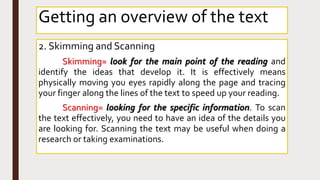
2. Skimming and Scanning
Skimming= look for the main point of the reading and
identify the ideas that develop it. It is effectively means
physically moving you eyes rapidly along the page and tracing
your finger along the lines of the text to speed up your reading.
Scanning= looking for the specific information. To scan
the text effectively, you need to have an idea of the details you
are looking for. Scanning the text may be useful when doing a
research or taking examinations.
Getting an overview of the text
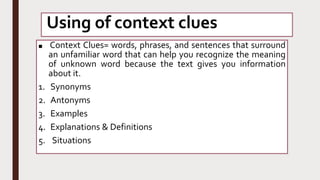
Using of context clues
■ Context Clues= words, phrases, and sentences that surround
an unfamiliar word that can help you recognize the meaning
of unknown word because the text gives you information
about it.
1. Synonyms
2. Antonyms
3. Examples
4. Explanations & Definitions
5. Situations
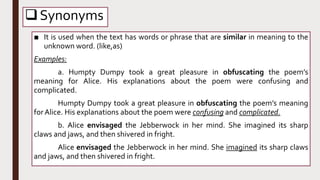
Synonyms
■ It is used when the text has words or phrase that are similar in meaning to the
unknown word. (like,as)
Examples:
a. Humpty Dumpy took a great pleasure in obfuscating the poem’s
meaning for Alice. His explanations about the poem were confusing and
complicated.
Humpty Dumpy took a great pleasure in obfuscating the poem’s meaning
forAlice. His explanations about the poem were confusing and complicated.
b. Alice envisaged the Jebberwock in her mind. She imagined its sharp
claws and jaws, and then shivered in fright.
Alice envisaged the Jebberwock in her mind. She imagined its sharp claws
and jaws, and then shivered in fright.
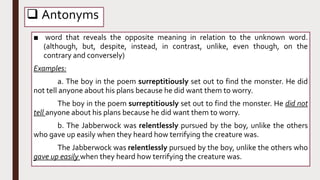
 Antonyms
■ word that reveals the opposite meaning in relation to the unknown word.
(although, but, despite, instead, in contrast, unlike, even though, on the
contrary and conversely)
Examples:
a. The boy in the poem surreptitiously set out to find the monster. He did
not tell anyone about his plans because he did want them to worry.
The boy in the poem surreptitiously set out to find the monster. He did not
tell anyone about his plans because he did want them to worry.
b. The Jabberwock was relentlessly pursued by the boy, unlike the others
who gave up easily when they heard how terrifying the creature was.
The Jabberwock was relentlessly pursued by the boy, unlike the others who
gave up easily when they heard how terrifying the creature was.
Examples
■ specific details in a text that are used to clarify the meaning of the word.
Examples:
a. The boy’s father was ecstatic when he found out that the Jebberwock was
conquered by his son. His behavior included laughing, cheering and hugging his
son.
The boy’s father was ecstatic when he found out that the Jebberwock was
conquered by his son. His behavior included laughing, cheering and hugging his son.
b. Only the few weapons are truly nifty in hunting monsters, like the vorpal
sword.
Only the few weapons are truly nifty in hunting monsters, like the vorpal
sword.
Explanations and definitions
■ may be given as clue to describe an unknown term.
(because, that is, is, means, is defined as, refers to)
Examples:
a. Hearing someone “outgrabe” – which means he is
whistling, bellowing, and sneezing all the once – can be a
funny sight.
b. Alice thought that “toves” were curious creatures,
since they were part-badger, part-lizard and part corkscrew.
 Situations
■ The situation in which a word is used can also be helpful in
determining the meaning of the word.
Examples:
1. The boy wondered if he should have brought some back up, in
case he could not take on the Jabberwock by himself. (part of the idiom
“in case” which means if it should happen)
2. The hero’s conquest of the Jabberwock is an exemplary case of
bravery. (case pertains to an instance of the occurrence)
3. The hero is lucky that the murder of the Jabberwock does not
merit a case in court. (case pertains to charges raised in court for a crime)
Using connotation and denotation
■ Denotation= is the basic, precise, literal
meaning of the word that can be found in the
dictionary.
■ Connotation= is the positive, negative, or
neutral feelings, attitudes, ideas or association
with a word.
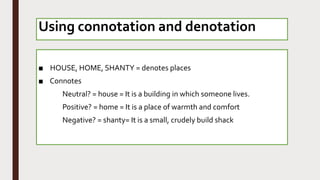
■ HOUSE, HOME, SHANTY = denotes places
■ Connotes
Neutral? = house = It is a building in which someone lives.
Positive? = home = It is a place of warmth and comfort
Negative? = shanty= It is a small, crudely build shack
Using connotation and denotation
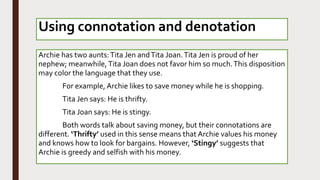
Archie has two aunts:Tita Jen andTita Joan.Tita Jen is proud of her
nephew; meanwhile, Tita Joan does not favor him so much.This disposition
may color the language that they use.
For example, Archie likes to save money while he is shopping.
Tita Jen says: He is thrifty.
Tita Joan says: He is stingy.
Both words talk about saving money, but their connotations are
different. ‘Thrifty’ used in this sense means that Archie values his money
and knows how to look for bargains. However, ‘Stingy’ suggests that
Archie is greedy and selfish with his money.
Using connotation and denotation
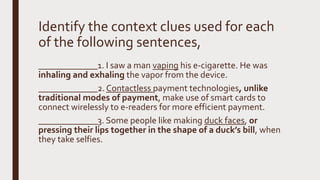
Identify the context clues used for each
of the following sentences,
_____________1. I saw a man vaping his e-cigarette. He was
inhaling and exhaling the vapor from the device.
_____________2.Contactless payment technologies, unlike
traditional modes of payment, make use of smart cards to
connect wirelessly to e-readers for more efficient payment.
_____________3. Some people like making duck faces, or
pressing their lips together in the shape of a duck’s bill, when
they take selfies.

Lesson 1, reading process

  • 1.
  • 2.
    The reading process ■Reading= it is a cognitive process of decoding symbols to derive meaning from a text. ■ It is an interaction between the author or the text and the reader. ■ Reading can be improved through consistent practice.
  • 3.
    Effective reading strategies ■Getting an overview of the text ■ Using of context clues ■ Using connotation and denotation
  • 4.
    Getting an overviewof the text 1. Previewing= looking at readily visible parts of the text, like titles and subtitles, and also visuals and graphs, pictures and charts. = It will help you to be familiarized with the contents of the selection and the important information of the text. = To preview the text properly, first identify your purpose of reading. Next, examine the titles and subtitles of the text. Afterward, browse the introduction and the conclusion of the text. Finally, look at the visual elements of the text. Take note of the things that interests you better understand the text later.
  • 5.
    2. Skimming andScanning Skimming= look for the main point of the reading and identify the ideas that develop it. It is effectively means physically moving you eyes rapidly along the page and tracing your finger along the lines of the text to speed up your reading. Scanning= looking for the specific information. To scan the text effectively, you need to have an idea of the details you are looking for. Scanning the text may be useful when doing a research or taking examinations. Getting an overview of the text
  • 6.
    Using of contextclues ■ Context Clues= words, phrases, and sentences that surround an unfamiliar word that can help you recognize the meaning of unknown word because the text gives you information about it. 1. Synonyms 2. Antonyms 3. Examples 4. Explanations & Definitions 5. Situations
  • 7.
    Synonyms ■ It isused when the text has words or phrase that are similar in meaning to the unknown word. (like,as) Examples: a. Humpty Dumpy took a great pleasure in obfuscating the poem’s meaning for Alice. His explanations about the poem were confusing and complicated. Humpty Dumpy took a great pleasure in obfuscating the poem’s meaning forAlice. His explanations about the poem were confusing and complicated. b. Alice envisaged the Jebberwock in her mind. She imagined its sharp claws and jaws, and then shivered in fright. Alice envisaged the Jebberwock in her mind. She imagined its sharp claws and jaws, and then shivered in fright.
  • 8.
     Antonyms ■ wordthat reveals the opposite meaning in relation to the unknown word. (although, but, despite, instead, in contrast, unlike, even though, on the contrary and conversely) Examples: a. The boy in the poem surreptitiously set out to find the monster. He did not tell anyone about his plans because he did want them to worry. The boy in the poem surreptitiously set out to find the monster. He did not tell anyone about his plans because he did want them to worry. b. The Jabberwock was relentlessly pursued by the boy, unlike the others who gave up easily when they heard how terrifying the creature was. The Jabberwock was relentlessly pursued by the boy, unlike the others who gave up easily when they heard how terrifying the creature was.
  • 9.
    Examples ■ specific detailsin a text that are used to clarify the meaning of the word. Examples: a. The boy’s father was ecstatic when he found out that the Jebberwock was conquered by his son. His behavior included laughing, cheering and hugging his son. The boy’s father was ecstatic when he found out that the Jebberwock was conquered by his son. His behavior included laughing, cheering and hugging his son. b. Only the few weapons are truly nifty in hunting monsters, like the vorpal sword. Only the few weapons are truly nifty in hunting monsters, like the vorpal sword.
  • 10.
    Explanations and definitions ■may be given as clue to describe an unknown term. (because, that is, is, means, is defined as, refers to) Examples: a. Hearing someone “outgrabe” – which means he is whistling, bellowing, and sneezing all the once – can be a funny sight. b. Alice thought that “toves” were curious creatures, since they were part-badger, part-lizard and part corkscrew.
  • 11.
     Situations ■ Thesituation in which a word is used can also be helpful in determining the meaning of the word. Examples: 1. The boy wondered if he should have brought some back up, in case he could not take on the Jabberwock by himself. (part of the idiom “in case” which means if it should happen) 2. The hero’s conquest of the Jabberwock is an exemplary case of bravery. (case pertains to an instance of the occurrence) 3. The hero is lucky that the murder of the Jabberwock does not merit a case in court. (case pertains to charges raised in court for a crime)
  • 12.
    Using connotation anddenotation ■ Denotation= is the basic, precise, literal meaning of the word that can be found in the dictionary. ■ Connotation= is the positive, negative, or neutral feelings, attitudes, ideas or association with a word.
  • 13.
    ■ HOUSE, HOME,SHANTY = denotes places ■ Connotes Neutral? = house = It is a building in which someone lives. Positive? = home = It is a place of warmth and comfort Negative? = shanty= It is a small, crudely build shack Using connotation and denotation
  • 14.
    Archie has twoaunts:Tita Jen andTita Joan.Tita Jen is proud of her nephew; meanwhile, Tita Joan does not favor him so much.This disposition may color the language that they use. For example, Archie likes to save money while he is shopping. Tita Jen says: He is thrifty. Tita Joan says: He is stingy. Both words talk about saving money, but their connotations are different. ‘Thrifty’ used in this sense means that Archie values his money and knows how to look for bargains. However, ‘Stingy’ suggests that Archie is greedy and selfish with his money. Using connotation and denotation
  • 16.
    Identify the contextclues used for each of the following sentences, _____________1. I saw a man vaping his e-cigarette. He was inhaling and exhaling the vapor from the device. _____________2.Contactless payment technologies, unlike traditional modes of payment, make use of smart cards to connect wirelessly to e-readers for more efficient payment. _____________3. Some people like making duck faces, or pressing their lips together in the shape of a duck’s bill, when they take selfies.