BY: VENUS B. MORALES, DM
RESOURCE PERSON
GENERAL OBJECTIVES:
1. Discuss the nature and importance of the
marketing function in an enterprise.
2. Explain the various items in a marketing plan.
3. Write your individual group’s marketing plan for
the identified project idea.
LESSONS
Lesson 1 – The Marketing Function of an
Enterprise
Lesson 2 – Marketing Plan: Guide and
Example
 SPECIFIC OBJECTIVES:
1. Explain Marketing, Marketing Management
and Marketing Strategy;
2. Identify and Explain the responsibilities of
the marketing manager, and,
3. List down and discuss the variables in
marketing mix
4. Discuss the major steps in developing the
firm’s marketing strategy.
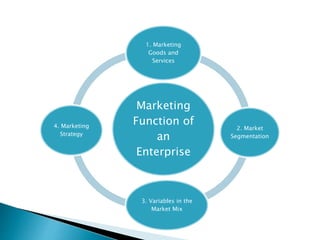
Marketing
Function of
an
Enterprise
1. Marketing
Goods and
Services
2. Market
Segmentation
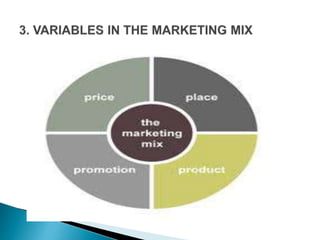
3. Variables in the
Market Mix
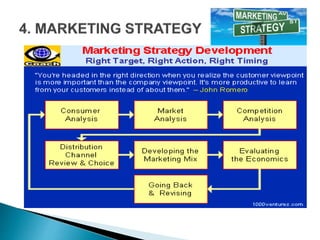
4. Marketing
Strategy
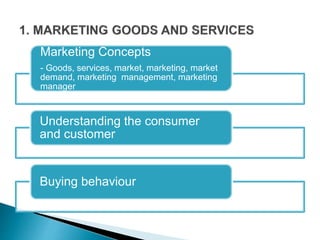
Marketing Concepts
- Goods, services, market, marketing, market
demand, marketing management, marketing
manager
Understanding the consumer
and customer
Buying behaviour
 a good is something that is intended to satisfy some wants or needs of a
consumer and thus has economic utility.
 a service is an intangible commodity. More specifically, services are an
intangible equivalent of economic goods.
 Market- refers to the consumers and customers for the goods and services
produce by the enterprise.
 Marketing – may be defined as all activities involved in providing customer
satisfaction by facilitating the exchange of goods and services from where they
are produced by the ultimate consumers.
 Market Demand- exists when there are buyers for the product in which products
are made because there is a market that needs or wants them.
 Marketing Management- is a business discipline which is focused on the
practical application of marketing techniques and the management of a
firm's marketing resources and activities.
 Marketing managers- are often responsible for influencing the level,
timing, and composition of customer demand. The managers has the
responsibility of analyzing and interpreting the consumer/customer
needs and wants after which he prepares the projected demand for the
firm’s products and services for a given period.
 Consumer- is the one who uses the product.
 Customer- is the one who buys the product.
 “The customer and the consumer may be the
same person. However, it is also possible that
the customer is different from the consumer”.
 An entrepreneur who wants to understand his
market must first understand man’s motivation
for buying a particular product or products.
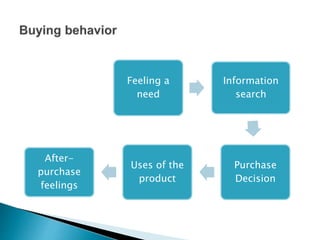
Feeling a
need
Information
search
Purchase
Decision
Uses of the
product
After-
purchase
feelings
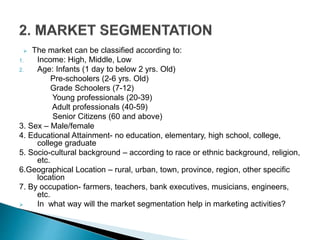
 The market can be classified according to:
1. Income: High, Middle, Low
2. Age: Infants (1 day to below 2 yrs. Old)
Pre-schoolers (2-6 yrs. Old)
Grade Schoolers (7-12)
Young professionals (20-39)
Adult professionals (40-59)
Senior Citizens (60 and above)
3. Sex – Male/female
4. Educational Attainment- no education, elementary, high school, college,
college graduate
5. Socio-cultural background – according to race or ethnic background, religion,
etc.
6.Geographical Location – rural, urban, town, province, region, other specific
location
7. By occupation- farmers, teachers, bank executives, musicians, engineers,
etc.
 In what way will the market segmentation help in marketing activities?
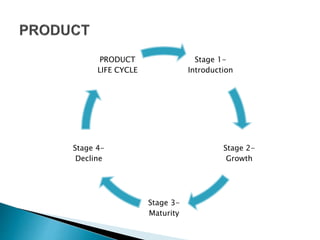
Stage 1-
Introduction
Stage 2-
Growth
Stage 3-
Maturity
Stage 4-
Decline
PRODUCT
LIFE CYCLE
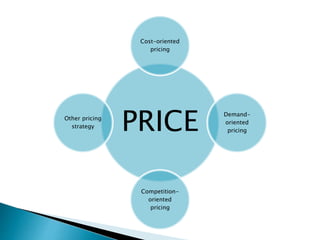
PRICE
Cost-oriented
pricing
Demand-
oriented
pricing
Competition-
oriented
pricing
Other pricing
strategy
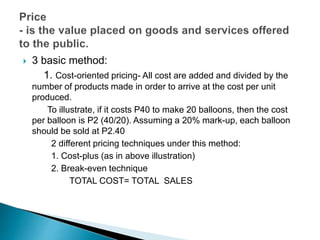
 3 basic method:
1. Cost-oriented pricing- All cost are added and divided by the
number of products made in order to arrive at the cost per unit
produced.
To illustrate, if it costs P40 to make 20 balloons, then the cost
per balloon is P2 (40/20). Assuming a 20% mark-up, each balloon
should be sold at P2.40
2 different pricing techniques under this method:
1. Cost-plus (as in above illustration)
2. Break-even technique
TOTAL COST= TOTAL SALES
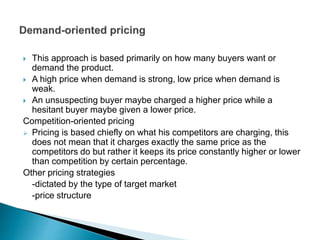
 This approach is based primarily on how many buyers want or
demand the product.
 A high price when demand is strong, low price when demand is
weak.
 An unsuspecting buyer maybe charged a higher price while a
hesitant buyer maybe given a lower price.
Competition-oriented pricing
 Pricing is based chiefly on what his competitors are charging, this
does not mean that it charges exactly the same price as the
competitors do but rather it keeps its price constantly higher or lower
than competition by certain percentage.
Other pricing strategies
-dictated by the type of target market
-price structure
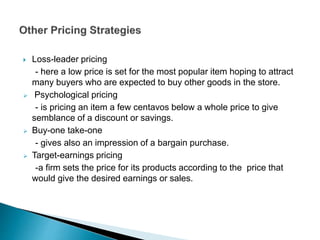
 Loss-leader pricing
- here a low price is set for the most popular item hoping to attract
many buyers who are expected to buy other goods in the store.
 Psychological pricing
- is pricing an item a few centavos below a whole price to give
semblance of a discount or savings.
 Buy-one take-one
- gives also an impression of a bargain purchase.
 Target-earnings pricing
-a firm sets the price for its products according to the price that
would give the desired earnings or sales.
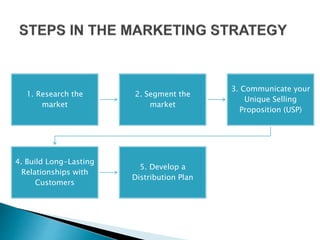
1. Research the
market
2. Segment the
market
3. Communicate your
Unique Selling
Proposition (USP)
4. Build Long-Lasting
Relationships with
Customers
5. Develop a
Distribution Plan
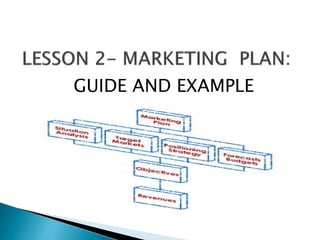
GUIDE AND EXAMPLE
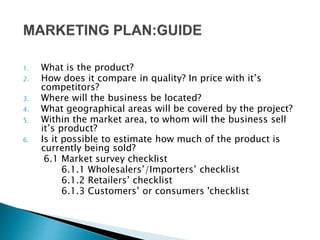
1. What is the product?
2. How does it compare in quality? In price with it’s
competitors?
3. Where will the business be located?
4. What geographical areas will be covered by the project?
5. Within the market area, to whom will the business sell
it’s product?
6. Is it possible to estimate how much of the product is
currently being sold?
6.1 Market survey checklist
6.1.1 Wholesalers’/Importers’ checklist
6.1.2 Retailers’ checklist
6.1.3 Customers’ or consumers 'checklist
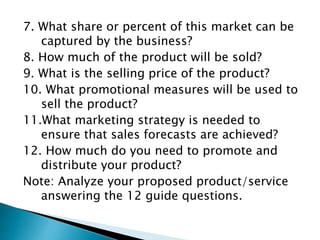
7. What share or percent of this market can be
captured by the business?
8. How much of the product will be sold?
9. What is the selling price of the product?
10. What promotional measures will be used to
sell the product?
11.What marketing strategy is needed to
ensure that sales forecasts are achieved?
12. How much do you need to promote and
distribute your product?
Note: Analyze your proposed product/service
answering the 12 guide questions.
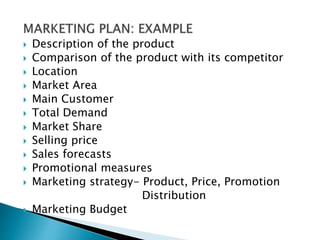
 Description of the product
 Comparison of the product with its competitor
 Location
 Market Area
 Main Customer
 Total Demand
 Market Share
 Selling price
 Sales forecasts
 Promotional measures
 Marketing strategy- Product, Price, Promotion
Distribution
 Marketing Budget
THANK
YOU
FOR
LISTENING

MARKETING: Function, Guide and Example

  • 1.
    BY: VENUS B.MORALES, DM RESOURCE PERSON
  • 2.
    GENERAL OBJECTIVES: 1. Discussthe nature and importance of the marketing function in an enterprise. 2. Explain the various items in a marketing plan. 3. Write your individual group’s marketing plan for the identified project idea. LESSONS Lesson 1 – The Marketing Function of an Enterprise Lesson 2 – Marketing Plan: Guide and Example
  • 3.
     SPECIFIC OBJECTIVES: 1.Explain Marketing, Marketing Management and Marketing Strategy; 2. Identify and Explain the responsibilities of the marketing manager, and, 3. List down and discuss the variables in marketing mix 4. Discuss the major steps in developing the firm’s marketing strategy.
  • 4.
    Marketing Function of an Enterprise 1. Marketing Goodsand Services 2. Market Segmentation 3. Variables in the Market Mix 4. Marketing Strategy
  • 5.
    Marketing Concepts - Goods,services, market, marketing, market demand, marketing management, marketing manager Understanding the consumer and customer Buying behaviour
  • 6.
     a goodis something that is intended to satisfy some wants or needs of a consumer and thus has economic utility.  a service is an intangible commodity. More specifically, services are an intangible equivalent of economic goods.  Market- refers to the consumers and customers for the goods and services produce by the enterprise.  Marketing – may be defined as all activities involved in providing customer satisfaction by facilitating the exchange of goods and services from where they are produced by the ultimate consumers.  Market Demand- exists when there are buyers for the product in which products are made because there is a market that needs or wants them.  Marketing Management- is a business discipline which is focused on the practical application of marketing techniques and the management of a firm's marketing resources and activities.  Marketing managers- are often responsible for influencing the level, timing, and composition of customer demand. The managers has the responsibility of analyzing and interpreting the consumer/customer needs and wants after which he prepares the projected demand for the firm’s products and services for a given period.
  • 7.
     Consumer- isthe one who uses the product.  Customer- is the one who buys the product.  “The customer and the consumer may be the same person. However, it is also possible that the customer is different from the consumer”.  An entrepreneur who wants to understand his market must first understand man’s motivation for buying a particular product or products.
  • 9.
  • 10.
     The marketcan be classified according to: 1. Income: High, Middle, Low 2. Age: Infants (1 day to below 2 yrs. Old) Pre-schoolers (2-6 yrs. Old) Grade Schoolers (7-12) Young professionals (20-39) Adult professionals (40-59) Senior Citizens (60 and above) 3. Sex – Male/female 4. Educational Attainment- no education, elementary, high school, college, college graduate 5. Socio-cultural background – according to race or ethnic background, religion, etc. 6.Geographical Location – rural, urban, town, province, region, other specific location 7. By occupation- farmers, teachers, bank executives, musicians, engineers, etc.  In what way will the market segmentation help in marketing activities?
  • 12.
    Stage 1- Introduction Stage 2- Growth Stage3- Maturity Stage 4- Decline PRODUCT LIFE CYCLE
  • 13.
  • 14.
     3 basicmethod: 1. Cost-oriented pricing- All cost are added and divided by the number of products made in order to arrive at the cost per unit produced. To illustrate, if it costs P40 to make 20 balloons, then the cost per balloon is P2 (40/20). Assuming a 20% mark-up, each balloon should be sold at P2.40 2 different pricing techniques under this method: 1. Cost-plus (as in above illustration) 2. Break-even technique TOTAL COST= TOTAL SALES
  • 15.
     This approachis based primarily on how many buyers want or demand the product.  A high price when demand is strong, low price when demand is weak.  An unsuspecting buyer maybe charged a higher price while a hesitant buyer maybe given a lower price. Competition-oriented pricing  Pricing is based chiefly on what his competitors are charging, this does not mean that it charges exactly the same price as the competitors do but rather it keeps its price constantly higher or lower than competition by certain percentage. Other pricing strategies -dictated by the type of target market -price structure
  • 16.
     Loss-leader pricing -here a low price is set for the most popular item hoping to attract many buyers who are expected to buy other goods in the store.  Psychological pricing - is pricing an item a few centavos below a whole price to give semblance of a discount or savings.  Buy-one take-one - gives also an impression of a bargain purchase.  Target-earnings pricing -a firm sets the price for its products according to the price that would give the desired earnings or sales.
  • 20.
    1. Research the market 2.Segment the market 3. Communicate your Unique Selling Proposition (USP) 4. Build Long-Lasting Relationships with Customers 5. Develop a Distribution Plan
  • 23.
  • 24.
    1. What isthe product? 2. How does it compare in quality? In price with it’s competitors? 3. Where will the business be located? 4. What geographical areas will be covered by the project? 5. Within the market area, to whom will the business sell it’s product? 6. Is it possible to estimate how much of the product is currently being sold? 6.1 Market survey checklist 6.1.1 Wholesalers’/Importers’ checklist 6.1.2 Retailers’ checklist 6.1.3 Customers’ or consumers 'checklist
  • 25.
    7. What shareor percent of this market can be captured by the business? 8. How much of the product will be sold? 9. What is the selling price of the product? 10. What promotional measures will be used to sell the product? 11.What marketing strategy is needed to ensure that sales forecasts are achieved? 12. How much do you need to promote and distribute your product? Note: Analyze your proposed product/service answering the 12 guide questions.
  • 26.
     Description ofthe product  Comparison of the product with its competitor  Location  Market Area  Main Customer  Total Demand  Market Share  Selling price  Sales forecasts  Promotional measures  Marketing strategy- Product, Price, Promotion Distribution  Marketing Budget
  • 28.

Editor's Notes

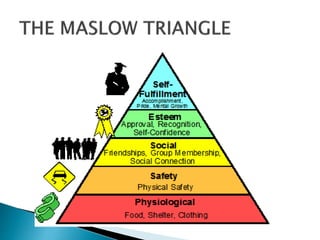
  • #9 How will this knowledge of the levels of needs help the entrepreneur or the marketing manager? He must realize that a product of services is bought not for what it can do to satisfy the varied needs and wants of the customer/consumer. Different types of customers have different levels of needs.
  • #14 Cost-oriented pricing- 2 types, cost-plus, Break-even technique Other pricing strategy- the price level of the product in the market, price structure for a product line, price structure or price differential