Strengthening Health Systems to improve Maternal, Neonatal & Child Health Outcomes A Framework Alex Ergo Nirali Shah Core Fall Meeting September 14, 2010
 
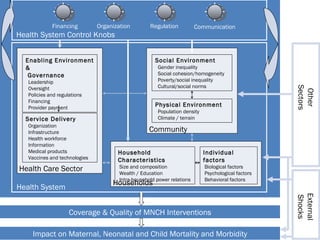
Impact on Maternal, Neonatal and Child Mortality and Morbidity Financing Organization Regulation Communication Health System Control Knobs Coverage & Quality   of MNCH Interventions Community Physical Environment Population density Climate / terrain Social Environment Gender inequality Social cohesion/homogeneity Poverty/social inequality Cultural/social norms Health Care Sector Enabling Environment &  Governance Leadership Oversight Policies and regulations Financing  Provider payment Service Delivery Organization Infrastructure  Health workforce Information Medical products Vaccines and technologies Households Household Characteristics Size and composition Wealth / Education Intra-household power relations Individual factors Biological factors Psychological factors Behavioral factors Other Sectors External Shocks Health System
Impact on Maternal, Neonatal and Child Mortality and Morbidity Financing Organization Regulation Communication Health System Control Knobs Coverage & Quality   of MNCH Interventions Community Physical Environment Population density Climate / terrain Social Environment Gender inequality Social cohesion/homogeneity Poverty/social inequality Cultural/social norms Health Care Sector Enabling Environment &  Governance Leadership Oversight Policies and regulations Financing  Provider payment Service Delivery Organization Infrastructure  Health workforce Information Medical products Vaccines and technologies Households Household Characteristics Size and composition Wealth / Education Intra-household power relations Individual factors Biological factors Psychological factors Behavioral factors Other Sectors External Shocks Health System 1. “What is” – Elements of the HS
Impact on Maternal, Neonatal and Child Mortality and Morbidity Financing Organization Regulation Communication Health System Control Knobs Coverage & Quality   of MNCH Interventions Community Physical Environment Population density Climate / terrain Social Environment Gender inequality Social cohesion/homogeneity Poverty/social inequality Cultural/social norms Health Care Sector Enabling Environment &  Governance Leadership Oversight Policies and regulations Financing  Provider payment Service Delivery Organization Infrastructure  Health workforce Information Medical products Vaccines and technologies Households Household Characteristics Size and composition Wealth / Education Intra-household power relations Individual factors Biological factors Psychological factors Behavioral factors Other Sectors External Shocks Health System 2. Tools - HSS
Strengthening the Health System Interventions within the health system Health System Strengthening Initiatives Scope and degree of policy-change involved
Impact on Maternal, Neonatal and Child Mortality and Morbidity Financing Organization Regulation Communication Health System Control Knobs Coverage & Quality   of MNCH Interventions Community Physical Environment Population density Climate / terrain Social Environment Gender inequality Social cohesion/homogeneity Poverty/social inequality Cultural/social norms Health Care Sector Enabling Environment &  Governance Leadership Oversight Policies and regulations Financing  Provider payment Service Delivery Organization Infrastructure  Health workforce Information Medical products Vaccines and technologies Households Household Characteristics Size and composition Wealth / Education Intra-household power relations Individual factors Biological factors Psychological factors Behavioral factors Other Sectors External Shocks Health System Dynamic Perspective
Impact on Maternal, Neonatal and Child Mortality and Morbidity Financing Organization Regulation Communication Health System Control Knobs Coverage & Quality   of MNCH Interventions Community Physical Environment Population density Climate / terrain Social Environment Gender inequality Social cohesion/homogeneity Poverty/social inequality Cultural/social norms Health Care Sector Enabling Environment &  Governance Leadership Oversight Policies and regulations Financing  Provider payment Service Delivery Organization Infrastructure  Health workforce Information Medical products Vaccines and technologies Households Household Characteristics Size and composition Wealth / Education Intra-household power relations Individual factors Biological factors Psychological factors Behavioral factors Other Sectors External Shocks Health System
 
2000 2010 Snapshot 1 Snapshot 2 Health Systems Strengthening initiatives Changes Main challenges Actions taken Remaining challenges Possible actions Other sectors and external shocks Improvements
Malawi - national perspective Used HSS framework to get overview of Malawi context Specifically looked at MNCH indicators Key points of concern in 2000: MMR=1120, having risen 80% since 1992 CPR = 21% Less than 2% of facilities able to provide BEmOC
Malawi - national perspective Delve deeper into reasons driving the indicators Service Delivery:  Severe human resource shortage High rates of hospital infections Household: High HIV prevalence (12-15%) Large household size (TFR > 6) Difficulty to access health facility during pregnancy
Rose dies Henderson in nursing school Zandile attempts   abortion SWAp Emergency HR program Pre-service training plan SLA’s with CHAM facilities Decentralization act CHAM salary MOU New president;  Decentralization progress improves Community based MNH TBA role change EHP developed Infection Prevention interventions IP becomes govt program SBM-R for MNH National RH strategy Road map for MNH Global fund HSS grant ART provided for free HSAs provide DMPA Gladys gives birth Health System Strengthening Initiatives: Timeline  2010 2000 2004 2008 2006 2002
Malawi - national perspective Resulting interventions: Emergency Human Resource Program, incl. HSA Regulation which changed role of TBA Financing mechanism (SWAp) for health
Impact on Maternal, Neonatal and Child Mortality and Morbidity Financing Organization Regulation Communication Health System Control Knobs Coverage & Quality   of MNCH Interventions Community Physical Environment Population density Climate / terrain Social Environment Gender inequality Social cohesion/homogeneity Poverty/social inequality Cultural/social norms Health Care Sector Enabling Environment &  Governance Leadership Oversight Policies and regulations Financing  Provider payment Service Delivery Organization Infrastructure  Health workforce Information Medical products Vaccines and technologies Households Household Characteristics Size and composition Wealth / Education Intra-household power relations Individual factors Biological factors Psychological factors Behavioral factors Other Sectors External Shocks Health System
Malawi - community perspective National strategies and constraints impact community based interventions Regulatory change banning TBA assisted delivery Health worker shortage leads to culture of mistrust of health facilities in community Decentralization gives more power to district health management teams Adaptation of community based interventions to work within changing context Knowledge of national context allows for effective design of local initiatives
MCHIP community based interventions Community based maternal and neonatal health care Extended role of Health Surveillance Assts (HSA) Community action groups for maternal health Household provision of Depo-Provera by HSA Addressed: Social norms, transportation constraints, knowledge of appropriate care practices, intra-household power dynamics,
Impact on Maternal, Neonatal and Child Mortality and Morbidity Financing Organization Regulation Communication Health System Control Knobs Coverage & Quality   of MNCH Interventions Community Physical Environment Population density Climate / terrain Social Environment Gender inequality Social cohesion/homogeneity Poverty/social inequality Cultural/social norms Health Care Sector Enabling Environment &  Governance Leadership Oversight Policies and regulations Financing  Provider payment Service Delivery Organization Infrastructure  Health workforce Information Medical products Vaccines and technologies Households Household Characteristics Size and composition Wealth / Education Intra-household power relations Individual factors Biological factors Psychological factors Behavioral factors Other Sectors External Shocks Health System
Community initiatives impact policy MCHIP demonstrated effect of each initiative, through survey, case study, and ongoing evaluations Highlighted ability of HSA and community to work around systemic constraints Led to adoption of community MNH and FP provision by HSA at the national level
Kenya - community perspective Social environment: creation of care groups in community Service delivery organization: changed role of dispensary health committee from administration to management External factor: Security problems in the border district Other sectors: involved district security council in health activities
Kenya - national policies impact community Financing: User fees abolished, leading to drug and nurse shortage Financing: Constituency development fund, allows regional decision making on development activities Organization: Kenya Essential Package for Health gave community-based care a more prominent place and created new paid CHW cadre Regulation: Changed treatment protocol for malaria, leading to change in planned project activity
Impact on Maternal, Neonatal and Child Mortality and Morbidity Financing Organization Regulation Communication Health System Control Knobs Coverage & Quality   of MNCH Interventions Community Physical Environment Population density Climate / terrain Social Environment Gender inequality Social cohesion/homogeneity Poverty/social inequality Cultural/social norms Health Care Sector Enabling Environment &  Governance Leadership Oversight Policies and regulations Financing  Provider payment Service Delivery Organization Infrastructure  Health workforce Information Medical products Vaccines and technologies Households Household Characteristics Size and composition Wealth / Education Intra-household power relations Individual factors Biological factors Psychological factors Behavioral factors Other Sectors External Shocks Health System
Usefulness of HSS framework Assessment tool - use while defining problems Programming tool - use while planning interventions Evaluation and research tool - use while designing evaluation Advocacy tool - Community interventions can impact “control knobs”
Your task If you were to design a community based intervention to improve maternal and neonatal health in the country, what do you think would be the main health systems challenges you would face? How are these captured in the framework? What type of health systems strengthening initiatives could address these challenges? Under what control knobs do they fall?
Impact on Maternal, Neonatal and Child Mortality and Morbidity Financing Organization Regulation Communication Health System Control Knobs Coverage & Quality   of MNCH Interventions Community Physical Environment Population density Climate / terrain Social Environment Gender inequality Social cohesion/homogeneity Poverty/social inequality Cultural/social norms Health Care Sector Enabling Environment &  Governance Leadership Oversight Policies and regulations Financing  Provider payment Service Delivery Organization Infrastructure  Health workforce Information Medical products Vaccines and technologies Households Household Characteristics Size and composition Wealth / Education Intra-household power relations Individual factors Biological factors Psychological factors Behavioral factors Other Sectors External Shocks Health System
The preceding slides were presented at the CORE Group 2010 Fall Meeting Washington, DC To see similar presentations, please visit: www.coregroup.org/resources/meetingreports

Ergo shah framework

  • 1.
    Strengthening Health Systemsto improve Maternal, Neonatal & Child Health Outcomes A Framework Alex Ergo Nirali Shah Core Fall Meeting September 14, 2010
  • 2.
  • 3.
    Impact on Maternal,Neonatal and Child Mortality and Morbidity Financing Organization Regulation Communication Health System Control Knobs Coverage & Quality of MNCH Interventions Community Physical Environment Population density Climate / terrain Social Environment Gender inequality Social cohesion/homogeneity Poverty/social inequality Cultural/social norms Health Care Sector Enabling Environment & Governance Leadership Oversight Policies and regulations Financing Provider payment Service Delivery Organization Infrastructure Health workforce Information Medical products Vaccines and technologies Households Household Characteristics Size and composition Wealth / Education Intra-household power relations Individual factors Biological factors Psychological factors Behavioral factors Other Sectors External Shocks Health System
  • 4.
    Impact on Maternal,Neonatal and Child Mortality and Morbidity Financing Organization Regulation Communication Health System Control Knobs Coverage & Quality of MNCH Interventions Community Physical Environment Population density Climate / terrain Social Environment Gender inequality Social cohesion/homogeneity Poverty/social inequality Cultural/social norms Health Care Sector Enabling Environment & Governance Leadership Oversight Policies and regulations Financing Provider payment Service Delivery Organization Infrastructure Health workforce Information Medical products Vaccines and technologies Households Household Characteristics Size and composition Wealth / Education Intra-household power relations Individual factors Biological factors Psychological factors Behavioral factors Other Sectors External Shocks Health System 1. “What is” – Elements of the HS
  • 5.
    Impact on Maternal,Neonatal and Child Mortality and Morbidity Financing Organization Regulation Communication Health System Control Knobs Coverage & Quality of MNCH Interventions Community Physical Environment Population density Climate / terrain Social Environment Gender inequality Social cohesion/homogeneity Poverty/social inequality Cultural/social norms Health Care Sector Enabling Environment & Governance Leadership Oversight Policies and regulations Financing Provider payment Service Delivery Organization Infrastructure Health workforce Information Medical products Vaccines and technologies Households Household Characteristics Size and composition Wealth / Education Intra-household power relations Individual factors Biological factors Psychological factors Behavioral factors Other Sectors External Shocks Health System 2. Tools - HSS
  • 6.
    Strengthening the HealthSystem Interventions within the health system Health System Strengthening Initiatives Scope and degree of policy-change involved
  • 7.
    Impact on Maternal,Neonatal and Child Mortality and Morbidity Financing Organization Regulation Communication Health System Control Knobs Coverage & Quality of MNCH Interventions Community Physical Environment Population density Climate / terrain Social Environment Gender inequality Social cohesion/homogeneity Poverty/social inequality Cultural/social norms Health Care Sector Enabling Environment & Governance Leadership Oversight Policies and regulations Financing Provider payment Service Delivery Organization Infrastructure Health workforce Information Medical products Vaccines and technologies Households Household Characteristics Size and composition Wealth / Education Intra-household power relations Individual factors Biological factors Psychological factors Behavioral factors Other Sectors External Shocks Health System Dynamic Perspective
  • 8.
    Impact on Maternal,Neonatal and Child Mortality and Morbidity Financing Organization Regulation Communication Health System Control Knobs Coverage & Quality of MNCH Interventions Community Physical Environment Population density Climate / terrain Social Environment Gender inequality Social cohesion/homogeneity Poverty/social inequality Cultural/social norms Health Care Sector Enabling Environment & Governance Leadership Oversight Policies and regulations Financing Provider payment Service Delivery Organization Infrastructure Health workforce Information Medical products Vaccines and technologies Households Household Characteristics Size and composition Wealth / Education Intra-household power relations Individual factors Biological factors Psychological factors Behavioral factors Other Sectors External Shocks Health System
  • 9.
    Impact on Maternal,Neonatal and Child Mortality and Morbidity Financing Organization Regulation Communication Health System Control Knobs Coverage & Quality of MNCH Interventions Community Physical Environment Population density Climate / terrain Social Environment Gender inequality Social cohesion/homogeneity Poverty/social inequality Cultural/social norms Health Care Sector Enabling Environment & Governance Leadership Oversight Policies and regulations Financing Provider payment Service Delivery Organization Infrastructure Health workforce Information Medical products Vaccines and technologies Households Household Characteristics Size and composition Wealth / Education Intra-household power relations Individual factors Biological factors Psychological factors Behavioral factors Other Sectors External Shocks Health System
  • 10.
  • 11.
    2000 2010 Snapshot1 Snapshot 2 Health Systems Strengthening initiatives Changes Main challenges Actions taken Remaining challenges Possible actions Other sectors and external shocks Improvements
  • 12.
    Malawi - nationalperspective Used HSS framework to get overview of Malawi context Specifically looked at MNCH indicators Key points of concern in 2000: MMR=1120, having risen 80% since 1992 CPR = 21% Less than 2% of facilities able to provide BEmOC
  • 13.
    Malawi - nationalperspective Delve deeper into reasons driving the indicators Service Delivery: Severe human resource shortage High rates of hospital infections Household: High HIV prevalence (12-15%) Large household size (TFR > 6) Difficulty to access health facility during pregnancy
  • 14.
    Rose dies Hendersonin nursing school Zandile attempts abortion SWAp Emergency HR program Pre-service training plan SLA’s with CHAM facilities Decentralization act CHAM salary MOU New president; Decentralization progress improves Community based MNH TBA role change EHP developed Infection Prevention interventions IP becomes govt program SBM-R for MNH National RH strategy Road map for MNH Global fund HSS grant ART provided for free HSAs provide DMPA Gladys gives birth Health System Strengthening Initiatives: Timeline 2010 2000 2004 2008 2006 2002
  • 15.
    Malawi - nationalperspective Resulting interventions: Emergency Human Resource Program, incl. HSA Regulation which changed role of TBA Financing mechanism (SWAp) for health
  • 16.
    Impact on Maternal,Neonatal and Child Mortality and Morbidity Financing Organization Regulation Communication Health System Control Knobs Coverage & Quality of MNCH Interventions Community Physical Environment Population density Climate / terrain Social Environment Gender inequality Social cohesion/homogeneity Poverty/social inequality Cultural/social norms Health Care Sector Enabling Environment & Governance Leadership Oversight Policies and regulations Financing Provider payment Service Delivery Organization Infrastructure Health workforce Information Medical products Vaccines and technologies Households Household Characteristics Size and composition Wealth / Education Intra-household power relations Individual factors Biological factors Psychological factors Behavioral factors Other Sectors External Shocks Health System
  • 17.
    Malawi - communityperspective National strategies and constraints impact community based interventions Regulatory change banning TBA assisted delivery Health worker shortage leads to culture of mistrust of health facilities in community Decentralization gives more power to district health management teams Adaptation of community based interventions to work within changing context Knowledge of national context allows for effective design of local initiatives
  • 18.
    MCHIP community basedinterventions Community based maternal and neonatal health care Extended role of Health Surveillance Assts (HSA) Community action groups for maternal health Household provision of Depo-Provera by HSA Addressed: Social norms, transportation constraints, knowledge of appropriate care practices, intra-household power dynamics,
  • 19.
    Impact on Maternal,Neonatal and Child Mortality and Morbidity Financing Organization Regulation Communication Health System Control Knobs Coverage & Quality of MNCH Interventions Community Physical Environment Population density Climate / terrain Social Environment Gender inequality Social cohesion/homogeneity Poverty/social inequality Cultural/social norms Health Care Sector Enabling Environment & Governance Leadership Oversight Policies and regulations Financing Provider payment Service Delivery Organization Infrastructure Health workforce Information Medical products Vaccines and technologies Households Household Characteristics Size and composition Wealth / Education Intra-household power relations Individual factors Biological factors Psychological factors Behavioral factors Other Sectors External Shocks Health System
  • 20.
    Community initiatives impactpolicy MCHIP demonstrated effect of each initiative, through survey, case study, and ongoing evaluations Highlighted ability of HSA and community to work around systemic constraints Led to adoption of community MNH and FP provision by HSA at the national level
  • 21.
    Kenya - communityperspective Social environment: creation of care groups in community Service delivery organization: changed role of dispensary health committee from administration to management External factor: Security problems in the border district Other sectors: involved district security council in health activities
  • 22.
    Kenya - nationalpolicies impact community Financing: User fees abolished, leading to drug and nurse shortage Financing: Constituency development fund, allows regional decision making on development activities Organization: Kenya Essential Package for Health gave community-based care a more prominent place and created new paid CHW cadre Regulation: Changed treatment protocol for malaria, leading to change in planned project activity
  • 23.
    Impact on Maternal,Neonatal and Child Mortality and Morbidity Financing Organization Regulation Communication Health System Control Knobs Coverage & Quality of MNCH Interventions Community Physical Environment Population density Climate / terrain Social Environment Gender inequality Social cohesion/homogeneity Poverty/social inequality Cultural/social norms Health Care Sector Enabling Environment & Governance Leadership Oversight Policies and regulations Financing Provider payment Service Delivery Organization Infrastructure Health workforce Information Medical products Vaccines and technologies Households Household Characteristics Size and composition Wealth / Education Intra-household power relations Individual factors Biological factors Psychological factors Behavioral factors Other Sectors External Shocks Health System
  • 24.
    Usefulness of HSSframework Assessment tool - use while defining problems Programming tool - use while planning interventions Evaluation and research tool - use while designing evaluation Advocacy tool - Community interventions can impact “control knobs”
  • 25.
    Your task Ifyou were to design a community based intervention to improve maternal and neonatal health in the country, what do you think would be the main health systems challenges you would face? How are these captured in the framework? What type of health systems strengthening initiatives could address these challenges? Under what control knobs do they fall?
  • 26.
    Impact on Maternal,Neonatal and Child Mortality and Morbidity Financing Organization Regulation Communication Health System Control Knobs Coverage & Quality of MNCH Interventions Community Physical Environment Population density Climate / terrain Social Environment Gender inequality Social cohesion/homogeneity Poverty/social inequality Cultural/social norms Health Care Sector Enabling Environment & Governance Leadership Oversight Policies and regulations Financing Provider payment Service Delivery Organization Infrastructure Health workforce Information Medical products Vaccines and technologies Households Household Characteristics Size and composition Wealth / Education Intra-household power relations Individual factors Biological factors Psychological factors Behavioral factors Other Sectors External Shocks Health System
  • 27.
    The preceding slideswere presented at the CORE Group 2010 Fall Meeting Washington, DC To see similar presentations, please visit: www.coregroup.org/resources/meetingreports

Editor's Notes

  • #2 Strengthening Health Systems to Improve Maternal, Neonatal and Child Health Outcomes: A Framework