
Md.Mehedi Hassan
Programmer
Export Promotion Bureau
Ministry of commerce
•
•
•
•
•
•
• The process of dividing a single network into multiple sub networks.
• It increases routing efficiency, which helps to enhance the security of
the network and reduces the size of the broadcast domain.
Big network Division of network into 4 subnets
Subnetting
Subnets
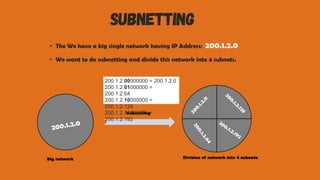
• The We have a big single network having IP Address: 200.1.2.0
• We want to do subnetting and divide this network into 4 subnets.
Subnetting
Division of network into 4 subnets
200.1.2.00000000 = 200.1.2.0
200.1.2.01000000 =
200.1.2.64
200.1.2.10000000 =
200.1.2.128
200.1.2.11000000 =
200.1.2.192
Big network
•
•
•
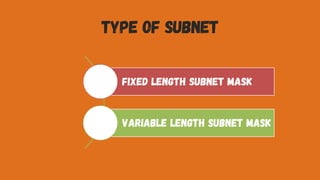
• Fixed length subnetting also called
as classful subnetting
• All the subnets are of same size.
• All the subnets have equal number
of hosts.
• All the subnets have same subnet
mask
A=100
255.255.255.0
B=100
255.255.255.0
C=100
255.255.255.0
D=100
255.255.255.0
• Fixed length subnetting also called
as classless subnetting
• All the subnets are not same size.
• All the subnets do not have equal
number of hosts.
• All the subnets do not have same
subnet mask
A=4000
255.255.240.0
B=500
255.255.254.0
C=1000
255.255.252.0
D=200
255.255.255.0
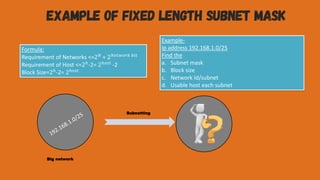
Formula:
Requirement of Networks <=2𝑁 = 2𝑁𝑒𝑡𝑤𝑜𝑟𝑘 𝑏𝑖𝑡
Requirement of Host <=2ℎ-2= 2ℎ𝑜𝑠𝑡 -2
Block Size=2ℎ-2= 2ℎ𝑜𝑠𝑡
Example-
Ip address 192.168.1.0/25
Find the
a. Subnet mask
b. Block size
c. Network Id/subnet
d. Usable host each subnet
Big network
Subnetting
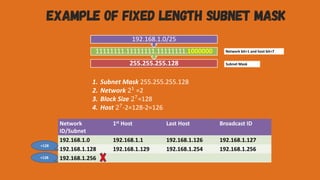
255.255.255.128
11111111.11111111.11111111.1000000
192.168.1.0/25
Network bit=1 and host bit=7
Subnet Mask
1. Subnet Mask 255.255.255.128
2. Network 21
=2
3. Block Size 27
=128
4. Host 27
-2=128-2=126
Network
ID/Subnet
1st Host Last Host Broadcast ID
192.168.1.0 192.168.1.1 192.168.1.126 192.168.1.127
192.168.1.128 192.168.1.129 192.168.1.254 192.168.1.256
192.168.1.256
+128
+128
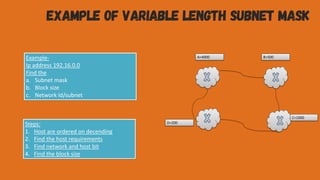
Example-
Ip address 192.16.0.0
Find the
a. Subnet mask
b. Block size
c. Network Id/subnet
Steps:
1. Host are ordered on decending
2. Find the host requirements
3. Find network and host bit
4. Find the block size
A=4000 B=500
C=1000
D=200
255.255.240.0
11111111.11111111.11110000.0000000
Host bit 12
Host bit 12
1. Ordering host descending A=4000, D=1000,
B=500 and C=200
• Host A=4000
• Host requirements=𝟐𝟏𝟏
-2=2046≪ 𝟒𝟎𝟎𝟎
• Host requirements=𝟐𝟏𝟐
-2=4094≅ 𝟒𝟎𝟎𝟎
• Host bit is 12.
• Network id 172.16.0.0/20
• Subnet Mask 255.255.240.0
Network bit 20
Subnet
md.mehedi hassan
mehedi.ict08@gmail.com

Subnetting.pptx

  • 1.
  • 2.
  • 3.
    • The processof dividing a single network into multiple sub networks. • It increases routing efficiency, which helps to enhance the security of the network and reduces the size of the broadcast domain. Big network Division of network into 4 subnets Subnetting Subnets
  • 4.
    • The Wehave a big single network having IP Address: 200.1.2.0 • We want to do subnetting and divide this network into 4 subnets. Subnetting Division of network into 4 subnets 200.1.2.00000000 = 200.1.2.0 200.1.2.01000000 = 200.1.2.64 200.1.2.10000000 = 200.1.2.128 200.1.2.11000000 = 200.1.2.192 Big network
  • 5.
  • 7.
    • Fixed lengthsubnetting also called as classful subnetting • All the subnets are of same size. • All the subnets have equal number of hosts. • All the subnets have same subnet mask A=100 255.255.255.0 B=100 255.255.255.0 C=100 255.255.255.0 D=100 255.255.255.0
  • 8.
    • Fixed lengthsubnetting also called as classless subnetting • All the subnets are not same size. • All the subnets do not have equal number of hosts. • All the subnets do not have same subnet mask A=4000 255.255.240.0 B=500 255.255.254.0 C=1000 255.255.252.0 D=200 255.255.255.0
  • 9.
    Formula: Requirement of Networks<=2𝑁 = 2𝑁𝑒𝑡𝑤𝑜𝑟𝑘 𝑏𝑖𝑡 Requirement of Host <=2ℎ-2= 2ℎ𝑜𝑠𝑡 -2 Block Size=2ℎ-2= 2ℎ𝑜𝑠𝑡 Example- Ip address 192.168.1.0/25 Find the a. Subnet mask b. Block size c. Network Id/subnet d. Usable host each subnet Big network Subnetting
  • 10.
    255.255.255.128 11111111.11111111.11111111.1000000 192.168.1.0/25 Network bit=1 andhost bit=7 Subnet Mask 1. Subnet Mask 255.255.255.128 2. Network 21 =2 3. Block Size 27 =128 4. Host 27 -2=128-2=126 Network ID/Subnet 1st Host Last Host Broadcast ID 192.168.1.0 192.168.1.1 192.168.1.126 192.168.1.127 192.168.1.128 192.168.1.129 192.168.1.254 192.168.1.256 192.168.1.256 +128 +128
  • 11.
    Example- Ip address 192.16.0.0 Findthe a. Subnet mask b. Block size c. Network Id/subnet Steps: 1. Host are ordered on decending 2. Find the host requirements 3. Find network and host bit 4. Find the block size A=4000 B=500 C=1000 D=200
  • 12.
    255.255.240.0 11111111.11111111.11110000.0000000 Host bit 12 Hostbit 12 1. Ordering host descending A=4000, D=1000, B=500 and C=200 • Host A=4000 • Host requirements=𝟐𝟏𝟏 -2=2046≪ 𝟒𝟎𝟎𝟎 • Host requirements=𝟐𝟏𝟐 -2=4094≅ 𝟒𝟎𝟎𝟎 • Host bit is 12. • Network id 172.16.0.0/20 • Subnet Mask 255.255.240.0 Network bit 20 Subnet
  • 13.