SUBJECTIVE ASSESSMENT:
Objectives
at the end of this lecture the students should be
able to record:
 Chief complain
 Present illness
 Past medical history
 Systemic enquiry
 Family history
 Drug history
 Social history
05/12/2025 2
Physical examination
05/12/2025 3
What is subjective assessment ???
05/12/2025 4
Components of history
 The present complaint
 The history of the
present complaint
 Remaining questions
of abnormal system
 Review of systems
 Past medical history
 Past surgical history
 Drug history
 Immunizations
 Family history
 Social history & habits
05/12/2025 5
Importance of history taking
 Obtaining an accurate history is the critical first
step in determing the etiology of a patient
problem
 it direct the therapist assess a particular area
 It also direct that what type of assessment
should be carried out
05/12/2025 6
General Approach
 Introduce yourself.
 Note – never forget patient names
 Create patient appropriately in a friendly relaxed way.
 Confidentiality and respect patient privacy.
 Try to see things from patient point of view.
Understand patient underneath mental status, anxiety,
irritation or depression. Always exhibit neutral
position.
 Listening
 Questioning: simple/clear/avoid medical terms/open,
leading, interrupting, direct questions and
summarizing
05/12/2025 7
Taking the history & Recording
 Always record personal details:
NASEOMADR.
 Name,
 Age,
 Address,
 Sex,
 Ethnicity
 Occupation,
 Religion,
 Marital status.
 Date of examination
05/12/2025 8
Complete History Taking
 Chief complaint
 History of present illness
 Past medical /surgical history
 Systemic review
 Family history
 Drug /blood transfusion history
 Social history
 Gyn/obs history.
05/12/2025 9
Chief Complaint
 The main reason push the pt. to seek for
visiting a physician or for help
 Usually a single symptoms, occasionally more
than one complaints eg: chest pain, palpitation,
shortness of breath, ankle swelling etc
 The patient describe the problem in their own
words.
 It should be recorded in pt’s own words.
 What brings your here? How can I help you?
What seems to be the problem?
05/12/2025 10
Chief Complaint
Cheif Complaint (CC):
 Short/specific in one clear sentence communicating
present/major problem/issue. As:
 Timing – fever for last two weeks or since Monday
 Recurrent –recurring episode of abdominal
pain/cough
 Any major disease important e.g. DM, asthma, HT,
pregnancy, IHD:
 Note: CC should be put in patient language.
05/12/2025 11
History of Present Illness - Tips
 Elaborate on the chief complaint in detail
 Ask relevant associated symptoms
 Have differential diagnosis in mind
 Lead the conversation & thoughts
 Decide & weight the importance of minor
complaints
05/12/2025 12
History of Present Illness - Tips
 Avoid medical terminology & make use of a
descriptive language that is familiar to them
05/12/2025 13
Pain (OPQRST)
Position/site
Severity – how it affects daily work/physical activities. Wakes
him up at night, cannot sleep/do any work.
Relationship to anything or other bodily function/position.
Radiation: where moved to
Relieving or aggravating factors – any activities or position
Quality, nature, character – burning sharp, stabbing, crushing; also
explain depth of pain – superficial or deep.
Timing – mode of onset (abrupt or gradual), progression
(continuous or intermittent – if intermittent ask frequency/
nature.)
Treatment received or/and outcome.
Onset of disease
Are there any associated symptoms? .
05/12/2025 14
Past Medical /Surgical History
 Start by asking the patient if they have any medical problems
 IHD/Heart Attack/DM/Asthma/HT/RHD, TB/Jaundice/Fits :E.g. if
diabetic- mention time of diagnosis/current medication/clinic check up
 Past surgical/operation history
 E.g. time/place/ what type of operation.
 Note any blood transfusion / blood grouping.
 H/O dental extractions/circumcision & any exessive bleeding during
these procedures.
 History of trauma/accidents
 E.g. time/place/ and what type of accident
 Any minor operations or procedures including endoscopies, dental
interventions, biopsies.
05/12/2025 15
Drug History
 Drug History (DH)
 Always use generic name or put trade name in
brackets with dosage, timing &how long.
 Example: Ranitidine 150 mg BD PO
 Note: do not forget to mention:
OTC/Vitamins/Traditional /Herbal medicine &
alternative medicine as cupping or acupuncture.
 Blood transfusion.
05/12/2025 16
Drug History
 bd (Bis die) - Twice daily (usually morning and night)
 tds (ter die sumendus)/tid (ter in die) = Three times a day
mainly 8 hourly
 qds (quarter die sumendus)/qid (quarter in die) = four
times daily mainly 6 hourly
 Mane/(om – omni mane) = morning
 Nocte/(on – omni nocte) = night
 ac (ante cibum) = before food
 pc (post cibum) = after food
 po (per orum/os) = by mouth
 stat – statim = immediately as initial dose
 Rx (recipe) = treat with
05/12/2025 17
Family History
 Any familial disease/running in families e.g. breast
cancer, IHD, DM, schizophrenia, Developmental
delay, asthma, albinism.
 Infections running in families as TB, Leprosy.
 Cholera, typhoid in case of epidemics.
05/12/2025 18
Social History
 Smoking history - amount, duration & type.
 A strong risk factor for IHD
 Alcohol history - amount, duration & type.
 Occupation, social & education background, ADL, family
social support& financial situation.
 Social class.
 Home conditions as:
 Water supply.
 Sanitation status in his home & surrounding.
 Animals / birds in his/her house.
05/12/2025 19
Social History: smoking
 The most important cause of preventable diseases.
 Smoking history - amount, duration & type.
 Amount: pack”year calculations.
 Duration: continuous or interrupted.
 Any trials of quitting & how many.
 Deep inhalation or superficial.
 Active or passive smoker.
 Type: packs, self-made, Cigars, Shesha , chewing etc.
05/12/2025 20
Social History: smoking
 Ask the smoker whether he is willing to quit or not.
 Do not forget to encourage the smoker to quit
whenever contacting a smoker as it is proved to
increase quitting rate.
 If he is willing to quit, but can not, help him by NRT
05/12/2025 21
Social History: alcohol.
 Note: Do not advice patients or
individuals , to drink for health, because
of:
 Religious & cultural reasons.
 Possibility of addiction with its known
health problems.
05/12/2025 22
Other Relevant History
 Gyane/Obstetric history if female
 Gravida, para, abortions, SZ sections, antenatal care
& screens as for Hep B & C.
05/12/2025 23
Other Relevant History
 Immunization if small child
 Note: Look for the child health card.
 Note:
 If small child, obtain the history from the care giver.
Make sure; talk to right care giver.
 If some one does not talk to your language, get an
interpreter(neutral not family friend or member also
familiar with both language). Ask simple & straight
question but do not go for yes or no answer.
05/12/2025 24
System Review (SR)
This is a guide not to miss anything
Any significant finding should be moved to HPC or
PMH depending upon where you think it belongs.
Do not forget to ask associated symptoms of PC with
the System involved
When giving verbal reports, say no significant finding
on systems review to show you did it. However when
writing up patient notes, you should record the systems
review so that the relieving doctors know what system
you covered.
05/12/2025 25
System Review
General
•Weakness
•Fatigue
•Anorexia
•Change of weight
•Fever/chills
•Lumps
•Night sweats
05/12/2025 26
System Review
Cardiovascular
•Chest pain
•Paroxysmal Nocturnal Dyspnoea
•Orthopnoea
•Short Of Breath(SOB)
•Cough/sputum (pinkish/frank blood)
•Swelling of ankle(SOA)
•Palpitations
•Cyanosis
05/12/2025 27
System Review
Gastrointestinal/Alimentary
•Appetite (anorexia/weight change)
•Diet
•Nausea/vomiting
•Regurgitation/heart burn
•Difficulty in swallowing
•Abdominal pain/distension
•Change of bowel habit
• melaena,
•Jaundice
05/12/2025 28
System Review
Respiratory System
•Cough(productive/dry)
•Sputum (colour, amount, smell)
•Haemoptysis
•Chest pain
•SOB/Dyspnoea
•Tachypnoea
•Hoarseness
•Wheezing
05/12/2025 29
System Review
Urinary System
•Frequency
•Dysuria
•Urgency
•Hesitancy
•Terminal dribbling
•Nocturia
•Incontinence
•Character of urine:color/ amount (polyuria) &
timing
•Fever
05/12/2025 30
System Review
Nervous System
•Visual/Smell/Taste/Hearing/Speech problem
•Head ache
•Fits/Faints/Black outs/loss of consciousness(LOC)
•Muscle weakness/numbness/paralysis
•Abnormal sensation
•Tremor
•Change of behaviour or psyche.
•Pariesis.
05/12/2025 31
System Review
Musculoskeletal System
•Pain – muscle, bone, joint
•Swelling
•Weakness/movement
•Deformities
•Gait
05/12/2025 32
Subjective Assessment
 Main Problem
 Pain
 Stiffness
 Giving way
 Instability
 Weakness
 Loss of function
 Post Trauma
05/12/2025 33
Subjective Assessment
 Pain
 Use Body Chart
05/12/2025 34
Subjective Assessment
 Area of current symptom:
 Where exactly your pain is?
 P1 vs P2 – relate them
 Relationship of symptoms
 Check relevant areas
 Intensity of pain
 Quality of pain i.e. sharp, dull, burning, tingling, excruciating
 Radiating or Non radiating
 Deep or Superficial
 Abnormal sensation:
 paraesthesia, analgesia, neurogenic (central,peripheral)
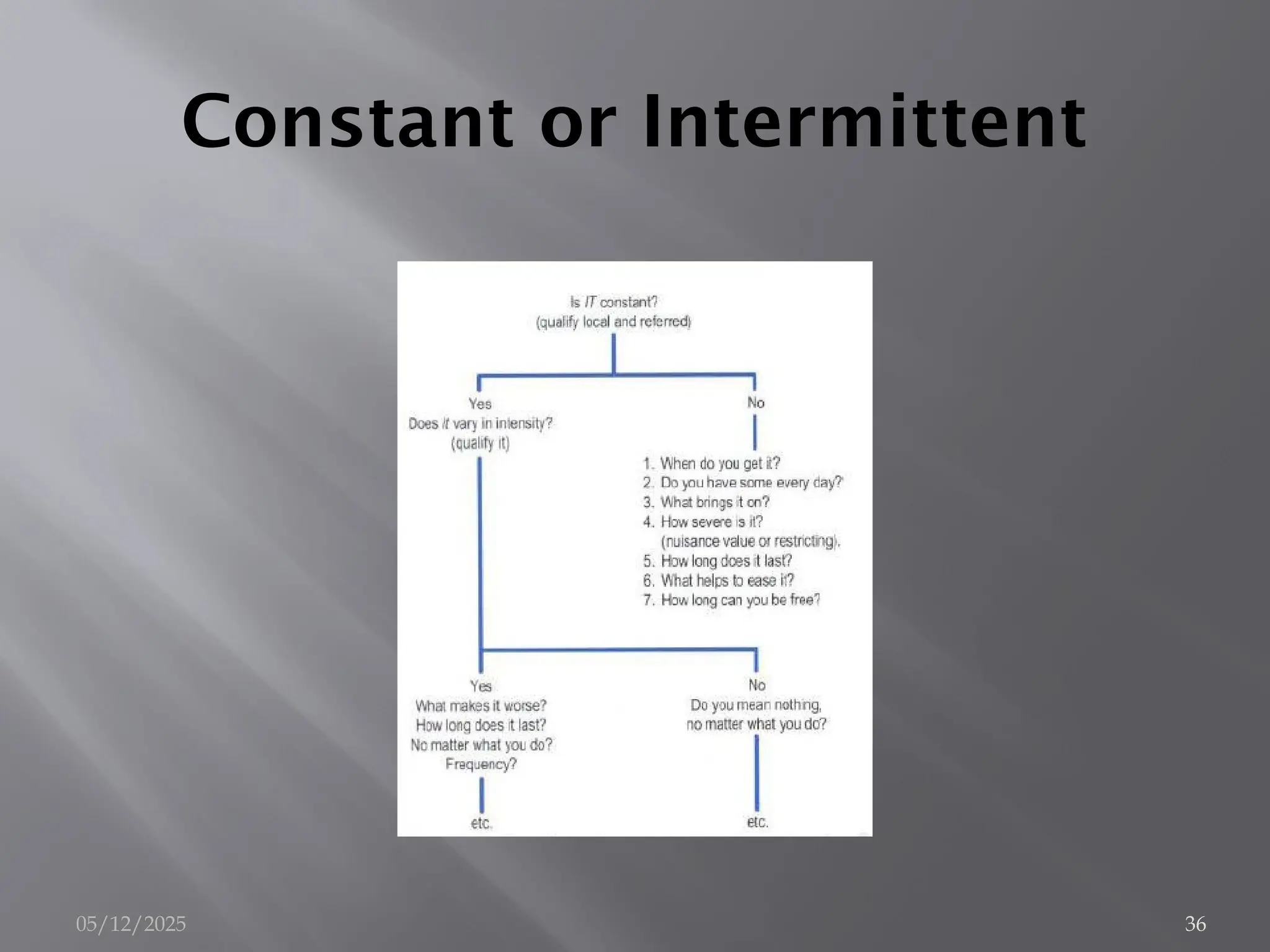
 Constant or Intermittent
05/12/2025 35
Constant or Intermittent
05/12/2025 36
Subjective Assessment
 Special question
 Spine
 P&N
 Numbness
 Headaches – rule out Migraine
 VBI signs
 Cord signs
 CE signs
05/12/2025 37
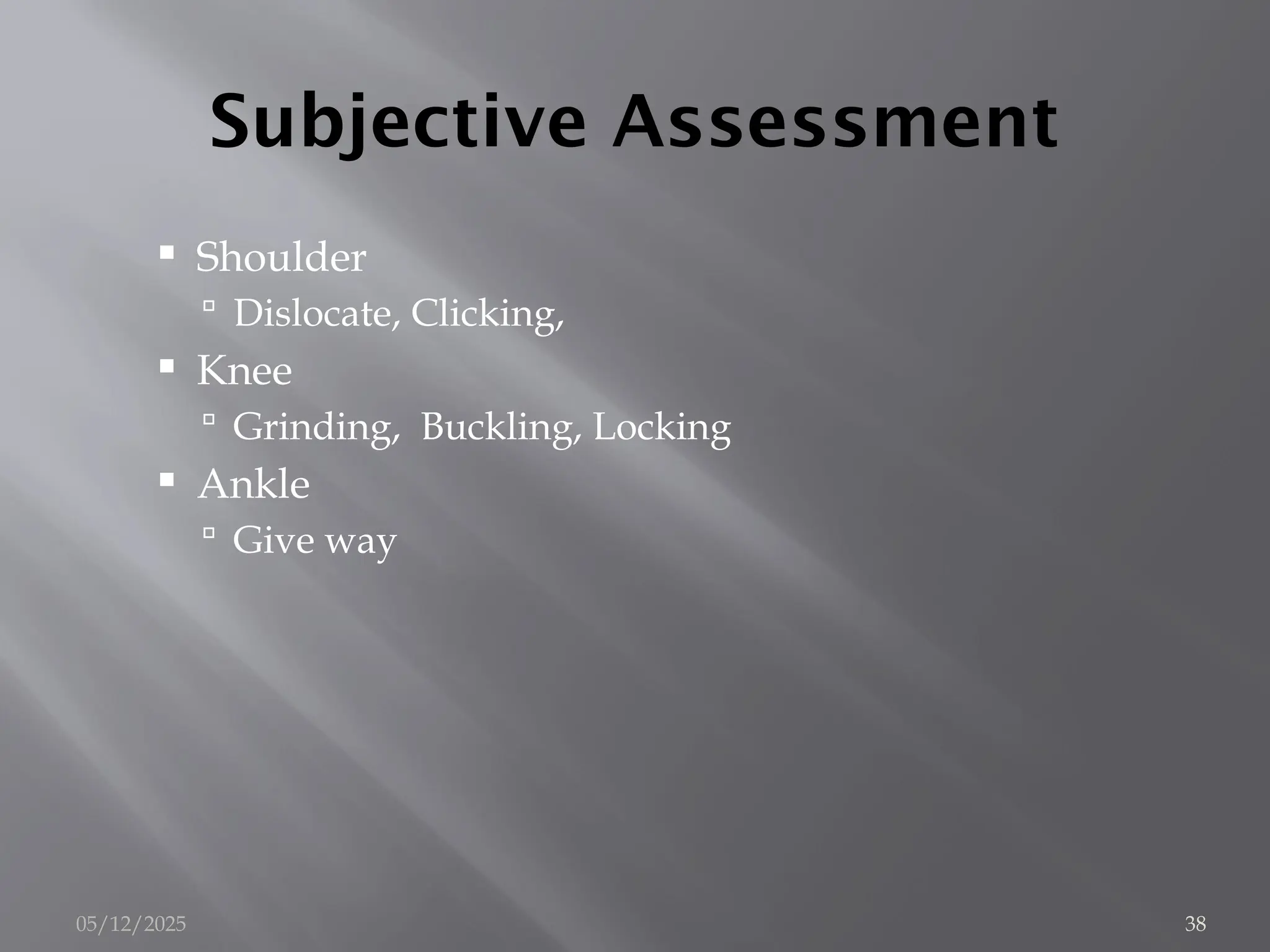
Subjective Assessment
 Shoulder
 Dislocate, Clicking,
 Knee
 Grinding, Buckling, Locking
 Ankle
 Give way
05/12/2025 38
Subjective Assessment
 Is the Disorder Irritable?
 Provoking activity and Severity
 Degree and quality of increased symptoms
 How long it takes to increase and ease
 Aggravating and Relieving factors
05/12/2025 39
Subjective Assessment
 24/24
 Am : inflamation vs degeneration
 Pm : mechanical stress vs degenerative process
 Night :
 difficulty going to sleep
 Comfortable and uncomfortable position of sleep
 Does movement or position wake him up
 How many times does he wake up in night
 What type of pillow and mattress is used
05/12/2025 40
Subjective Assessment
 onset
 How long have you had it?
 Sudden
 Incident – Stuck (mechanism/ swelling), Not stuck
 No incident- wakened with, During am/ pm
 Gradual
 What did you notice first? – from predisposing activities
 Unusual, heavy, sustained posture, over tired, cold/ damp
 PMH-
 first bout in detail- cause, duration, treatment
 Successive bouts- frequency, ease of cause
05/12/2025 41
Current History/ Past Medical
History
05/12/2025 42
Activity!
05/12/2025 43
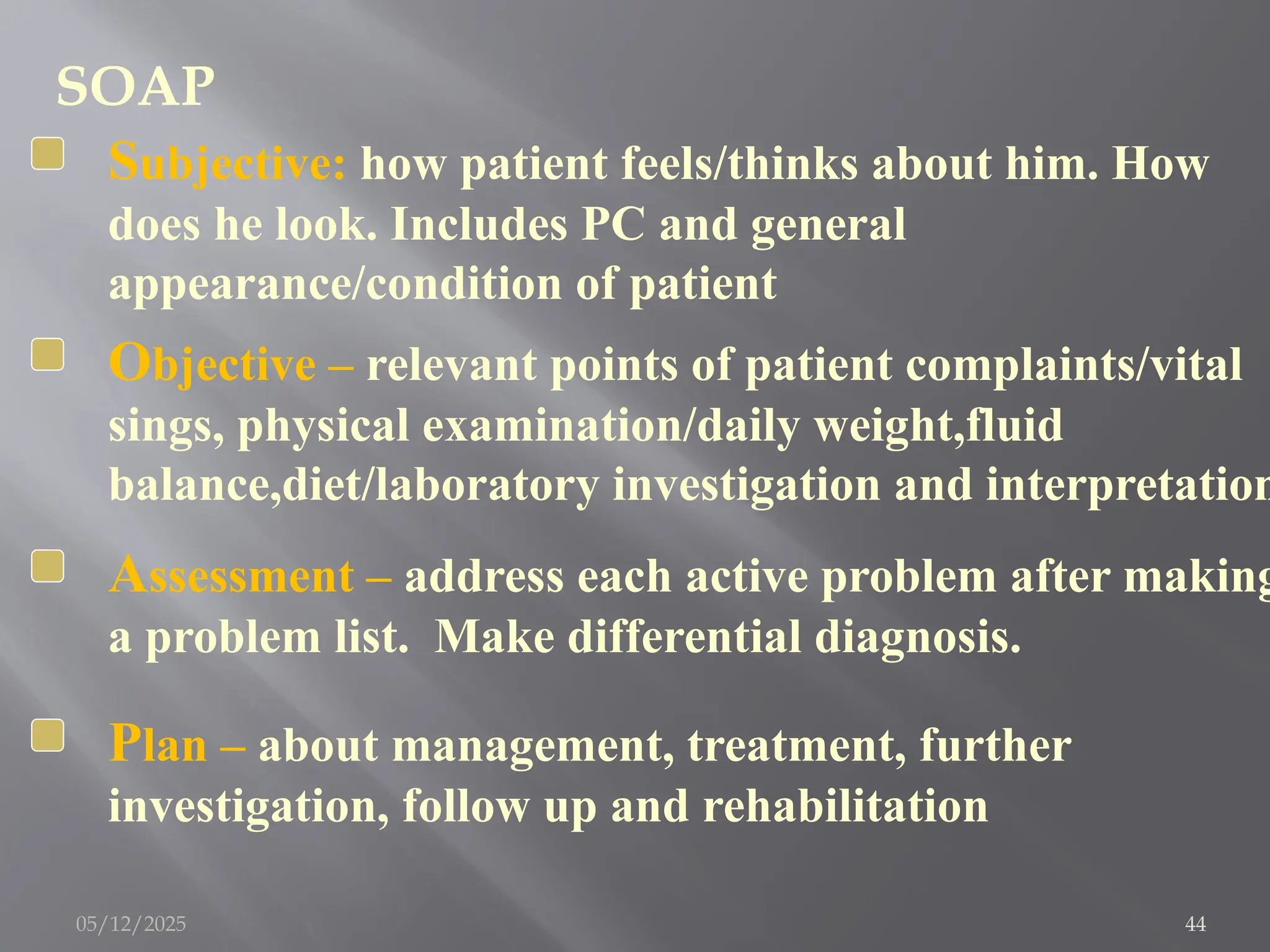
SOAP
Subjective: how patient feels/thinks about him. How
does he look. Includes PC and general
appearance/condition of patient
Objective – relevant points of patient complaints/vital
sings, physical examination/daily weight,fluid
balance,diet/laboratory investigation and interpretation
Plan – about management, treatment, further
investigation, follow up and rehabilitation
Assessment – address each active problem after making
a problem list. Make differential diagnosis.
05/12/2025 44
Summery
05/12/2025 45
Social History: alcohol.
 Whether drinking alcohol or not.
 If drinking know whether it is healthy or not.
 Healthy alcohol use:
 Men: 14 units/week, not > 4 units/session.
 Women: 7 units/week, not > 2 units/session.
 Don’t forget that healthy alcohol use is associated
with less IHD & Ischemic CVA.
 Unhealthy alcohol use is associated with
cardiomyopathy, CVA, Myopathies, liver cirrhosis &
CPNS dysfunction.
05/12/2025 46
05/12/2025 47
05/12/2025 48
05/12/2025 49
 ADLs (Activities of Daily Living) and IADLs (Instrumental Activities of Daily Living) are two
types of daily activities that are essential for independent living.
 # ADLs (Activities of Daily Living)
 - Basic self-care activities that are necessary for daily living
 - Examples:
 - Bathing/Showering
 - Dressing
 - Grooming
 - Toileting
 - Feeding/Eating
 - Transferring (e.g., from bed to chair)
 # IADLs (Instrumental Activities of Daily Living)
 - More complex activities that require cognitive and physical abilities
 - Examples:
 - Managing finances
 - Shopping for groceries or personal items
 - Preparing meals
 - Doing laundry
 - Managing medications
 - Using the telephone
05/12/2025 50
 Key differences:
 - ADLs focus on basic self-care, while IADLs focus
on more complex tasks that require cognitive and
physical abilities.
 - ADLs are typically more essential for daily
survival, while IADLs are important for
maintaining independence and quality of life.
 Healthcare professionals often assess ADLs and
IADLs to evaluate an individual's ability to live
independently and to identify areas where
assistance may be needed.
05/12/2025 51
05/12/2025 52
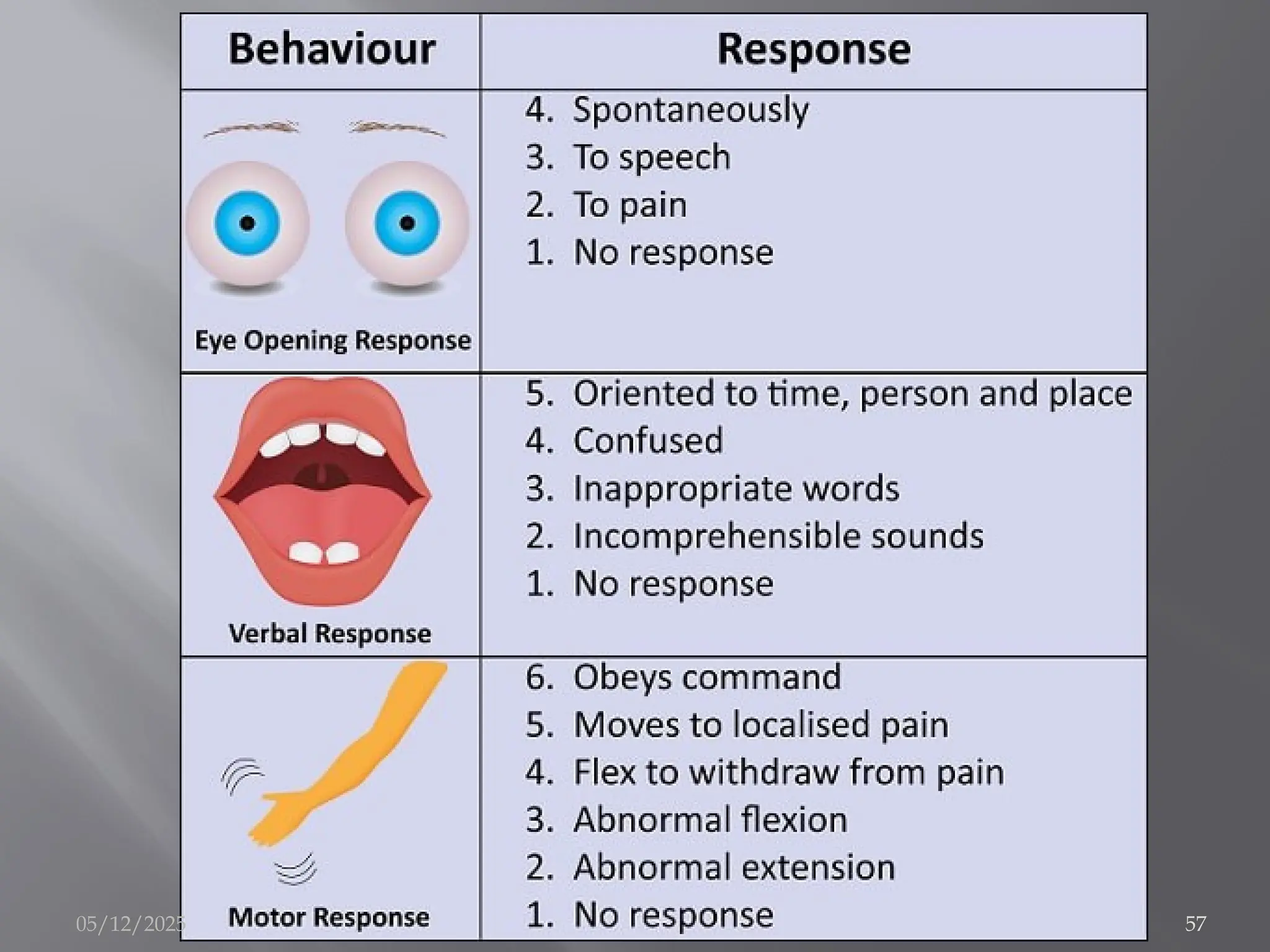
 # Inappropriate Words
 - Words that are offensive, insensitive, or unacceptable in a particular context or culture
 - Examples:
 - Profanity or swear words
 - Racist or sexist slurs
 - Insults or derogatory terms
 - These words can be understood, but their use is considered impolite, hurtful, or
unprofessional.
 # Incomprehensible Words
 - Words that are difficult or impossible to understand due to their complexity,
ambiguity, or lack of clarity
 - Examples:
 - Technical jargon or specialized terminology
 - Words with multiple meanings or connotations
 - Words that are misspelled, mispronounced, or used incorrectly
 - These words can be confusing, even for people with strong language skills.
 Key differences:- Inappropriate words are clear in meaning but unacceptable in context.
 - Incomprehensible words are unclear or confusing, making it hard to understand their
intended meaning.
05/12/2025 53
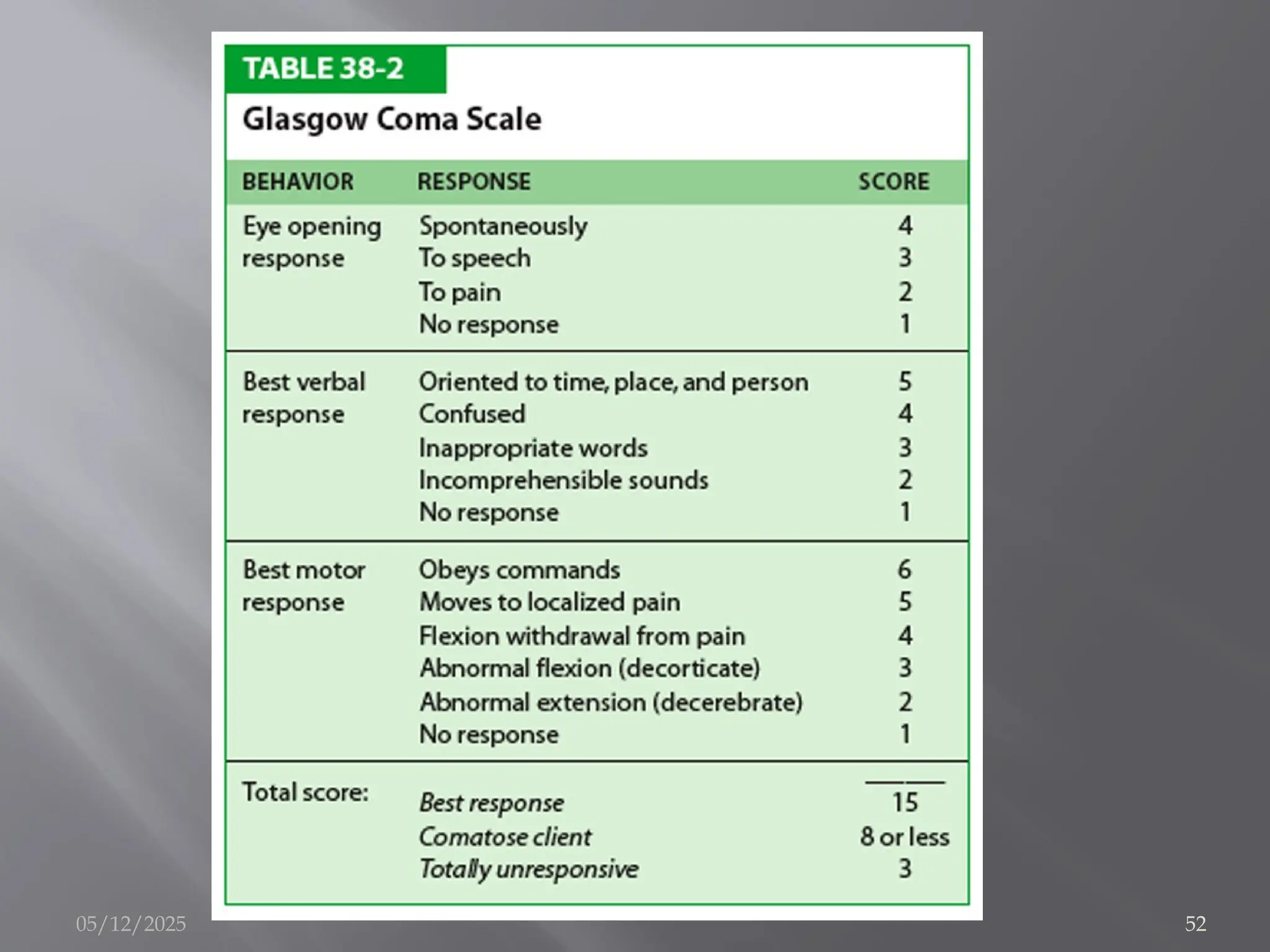
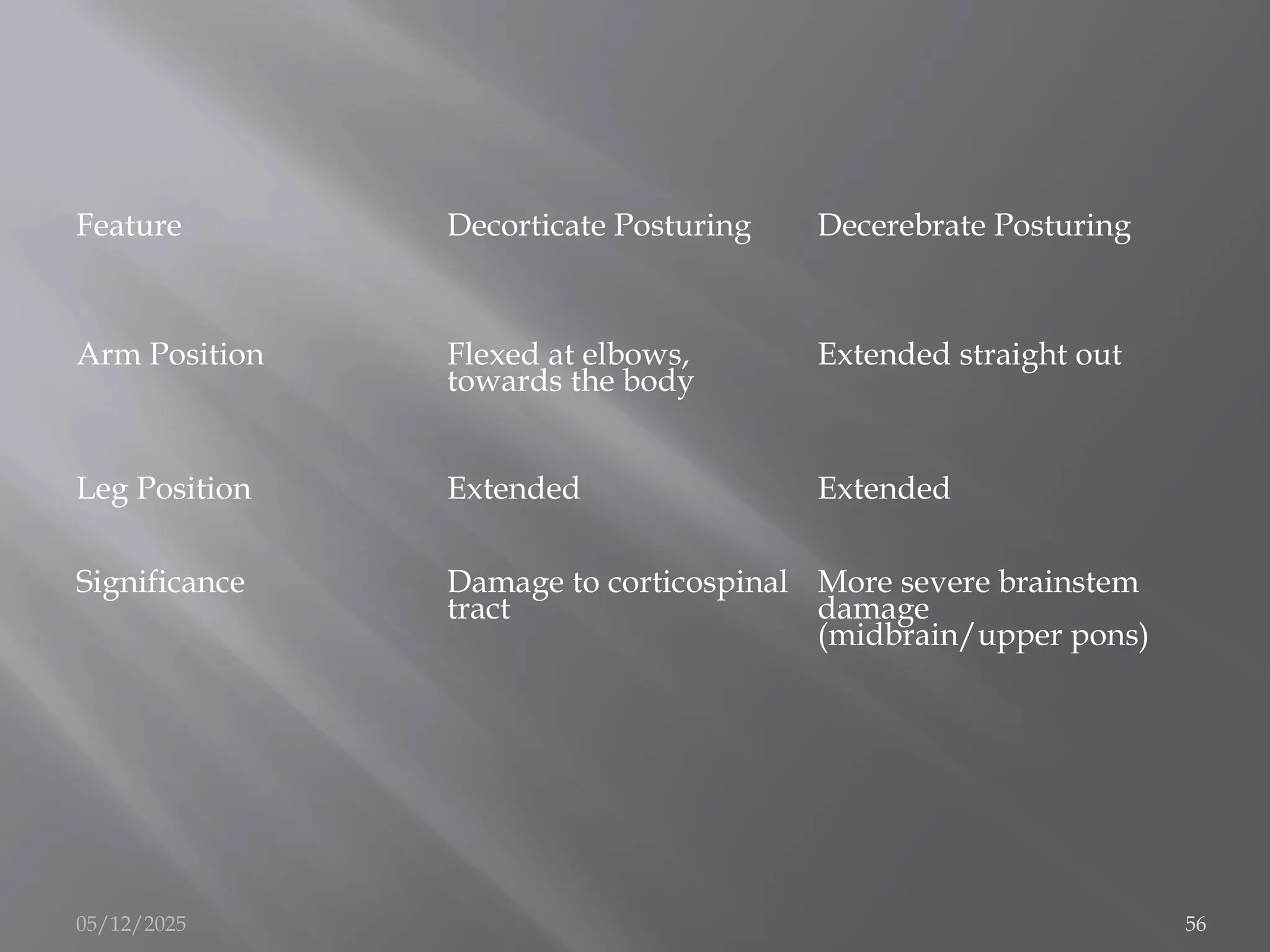
 In the context of the Glasgow Coma Scale (GCS), abnormal flexion
and abnormal extension refer to two types of abnormal posturing:
 # Abnormal Flexion (Decorticate Posturing)
 - A patient exhibits flexion of the upper limbs (bending of the
arms) and extension of the lower limbs (straightening of the legs)
 - Indicates a severe brain injury, but with some preservation of
brainstem function
 - Score: 3 (out of 6) in the Motor component of the GCS
 # Abnormal Extension (Decerebrate Posturing)
 - A patient exhibits extension of both upper and lower limbs
(straightening of the arms and legs)
 - Indicates a more severe brain injury, with loss of brainstem
function
 - Score: 2 (out of 6) in the Motor component of the GCS
05/12/2025 54
 In summary:
 - Abnormal flexion (decorticate posturing) indicates
a severe brain injury, but with some preservation of
brainstem function.
 - Abnormal extension (decerebrate posturing)
indicates a more severe brain injury, with loss of
brainstem function.
 The GCS is a widely used system to assess the level
of consciousness in patients with brain injuries
05/12/2025 55
Feature Decorticate Posturing Decerebrate Posturing
Arm Position Flexed at elbows,
towards the body
Extended straight out
Leg Position Extended Extended
Significance Damage to corticospinal
tract
More severe brainstem
damage
(midbrain/upper pons)
05/12/2025 56
05/12/2025 57
 These terms refer to the three main body types or somatotypes, as introduced by
American psychologist William H. Sheldon:
 *Ectomorph*
 - Characterized by a slender, lean, and delicate body build
 - Typically have:
 - Narrow bone structure
 - Small muscles
 - Fast metabolism
 - Difficulty gaining weight
 - Often described as "thin" or "lean"
 *Mesomorph*
 - Characterized by a muscular, athletic, and well-proportioned body build
 - Typically have:
 - Wide bone structure
 - Large muscles
 - Medium metabolism
 - Easy to gain muscle mass
 - Often described as "muscular" or "athletic"
05/12/2025 58
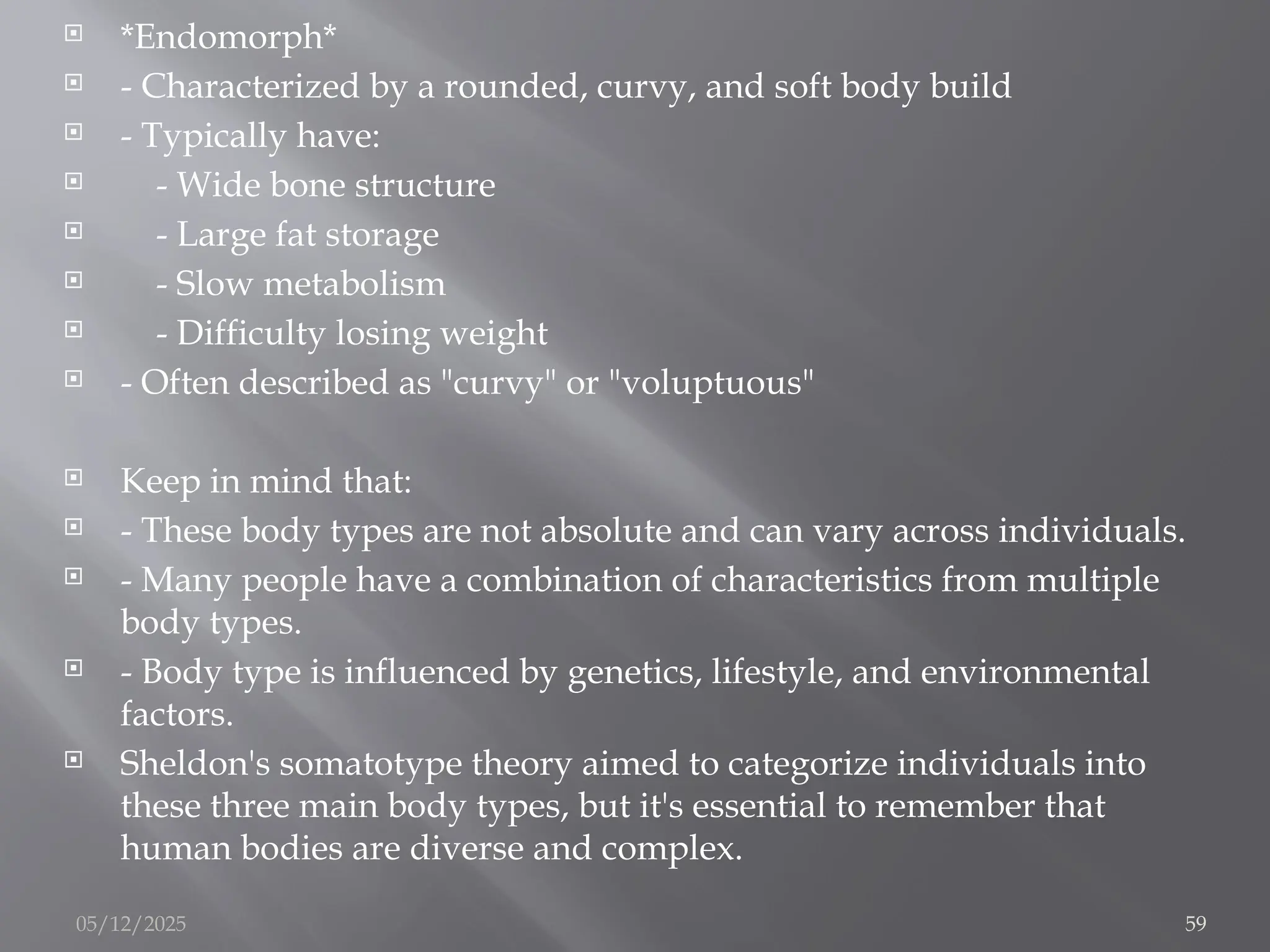
 *Endomorph*
 - Characterized by a rounded, curvy, and soft body build
 - Typically have:
 - Wide bone structure
 - Large fat storage
 - Slow metabolism
 - Difficulty losing weight
 - Often described as "curvy" or "voluptuous"
 Keep in mind that:
 - These body types are not absolute and can vary across individuals.
 - Many people have a combination of characteristics from multiple
body types.
 - Body type is influenced by genetics, lifestyle, and environmental
factors.
 Sheldon's somatotype theory aimed to categorize individuals into
these three main body types, but it's essential to remember that
human bodies are diverse and complex.
05/12/2025 59
05/12/2025 60
05/12/2025 61
05/12/2025 62
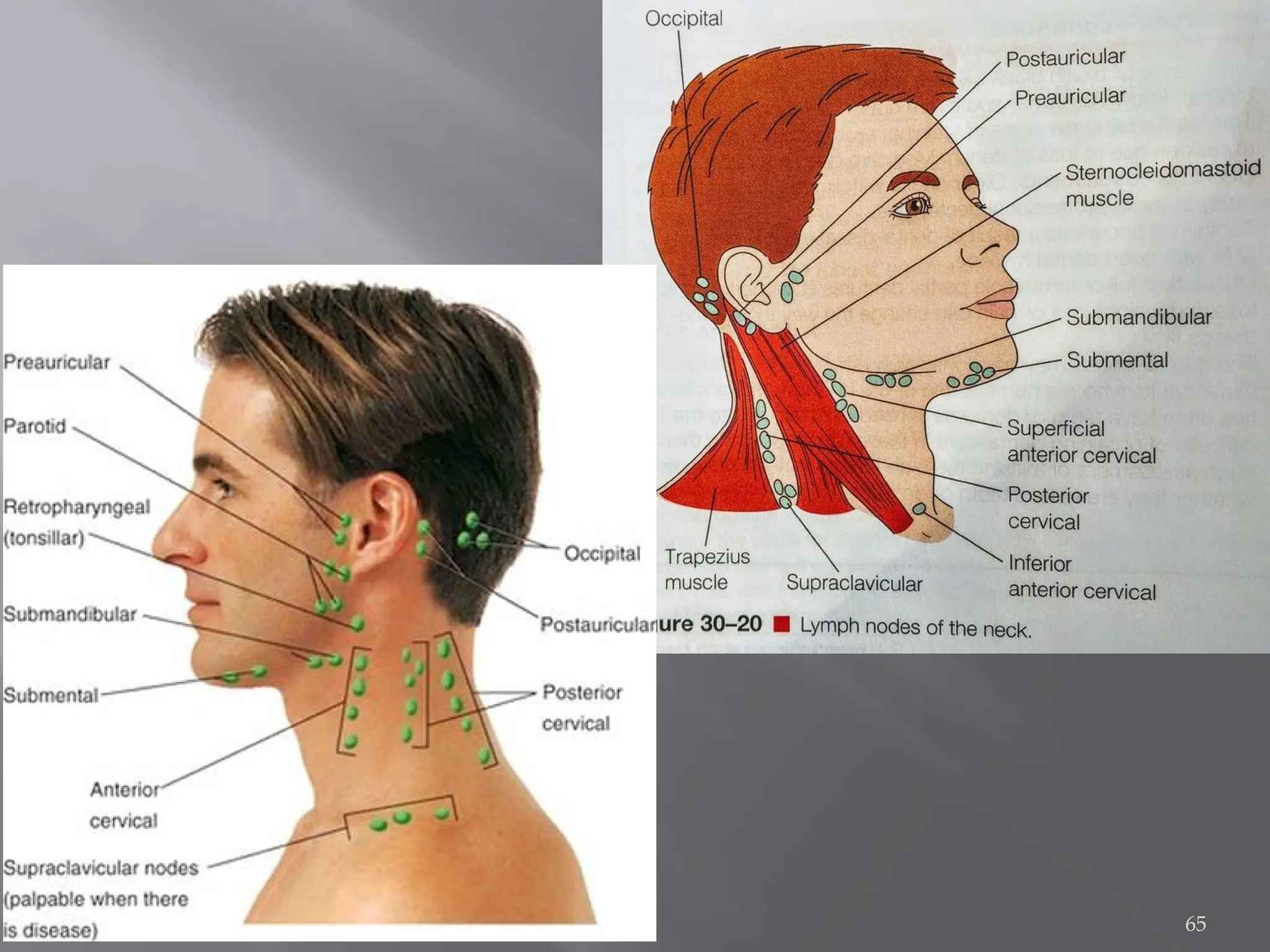
Name Location
1 Preauricular Anterior to the tragus of the ear.
2 Posterior auricular Along the mastoid process.
3 Occipital
Inferior to the occipital bone and on the lateral side of the
occipital bone.
4 Submental Under the chin behind the bony prominence.
5 Submandibular Halfway between the submental nodes and the angle of the jaw.
6 Tonsillar Inferior to the angle of the jaw.
7 Superficial cervical
chain
Along the sternomastoid muscle at the top, just below the
mastoid process.
8 Deep cervical chain Further down the sternomastoid muscle.
9 Posterior cervical
chain
Behind the sternomastoid muscle.
10 Supraclavicular Superior to the clavicles.
05/12/2025 63
05/12/2025 64
05/12/2025 65
05/12/2025 66
 Prothrombin Time Test. A prothrombin time
(PT/INR) test measures how fast a blood sample
forms a clot. Healthcare providers often do this
test to monitor how fast your blood clots if
you're taking the blood thinner warfarin. It's
also used to diagnose blood disorders.
 PT; 11 to 13.5 seconds. · INR of 0.8 to 1.1. · INR
of 2.0 to 3.0 if you're taking warfarin.
 The normal bleeding time is between 2-7
minutes. The normal clotting time in a person is
between 8-15 minutes.
05/12/2025 67
05/12/2025 68
05/12/2025 69
05/12/2025 70

subjective assessment-1.pptx clinical practice

  • 1.
  • 2.
    Objectives at the endof this lecture the students should be able to record:  Chief complain  Present illness  Past medical history  Systemic enquiry  Family history  Drug history  Social history 05/12/2025 2
  • 3.
  • 4.
    What is subjectiveassessment ??? 05/12/2025 4
  • 5.
    Components of history The present complaint  The history of the present complaint  Remaining questions of abnormal system  Review of systems  Past medical history  Past surgical history  Drug history  Immunizations  Family history  Social history & habits 05/12/2025 5
  • 6.
    Importance of historytaking  Obtaining an accurate history is the critical first step in determing the etiology of a patient problem  it direct the therapist assess a particular area  It also direct that what type of assessment should be carried out 05/12/2025 6
  • 7.
    General Approach  Introduceyourself.  Note – never forget patient names  Create patient appropriately in a friendly relaxed way.  Confidentiality and respect patient privacy.  Try to see things from patient point of view. Understand patient underneath mental status, anxiety, irritation or depression. Always exhibit neutral position.  Listening  Questioning: simple/clear/avoid medical terms/open, leading, interrupting, direct questions and summarizing 05/12/2025 7
  • 8.
    Taking the history& Recording  Always record personal details: NASEOMADR.  Name,  Age,  Address,  Sex,  Ethnicity  Occupation,  Religion,  Marital status.  Date of examination 05/12/2025 8
  • 9.
    Complete History Taking Chief complaint  History of present illness  Past medical /surgical history  Systemic review  Family history  Drug /blood transfusion history  Social history  Gyn/obs history. 05/12/2025 9
  • 10.
    Chief Complaint  Themain reason push the pt. to seek for visiting a physician or for help  Usually a single symptoms, occasionally more than one complaints eg: chest pain, palpitation, shortness of breath, ankle swelling etc  The patient describe the problem in their own words.  It should be recorded in pt’s own words.  What brings your here? How can I help you? What seems to be the problem? 05/12/2025 10
  • 11.
    Chief Complaint Cheif Complaint(CC):  Short/specific in one clear sentence communicating present/major problem/issue. As:  Timing – fever for last two weeks or since Monday  Recurrent –recurring episode of abdominal pain/cough  Any major disease important e.g. DM, asthma, HT, pregnancy, IHD:  Note: CC should be put in patient language. 05/12/2025 11
  • 12.
    History of PresentIllness - Tips  Elaborate on the chief complaint in detail  Ask relevant associated symptoms  Have differential diagnosis in mind  Lead the conversation & thoughts  Decide & weight the importance of minor complaints 05/12/2025 12
  • 13.
    History of PresentIllness - Tips  Avoid medical terminology & make use of a descriptive language that is familiar to them 05/12/2025 13
  • 14.
    Pain (OPQRST) Position/site Severity –how it affects daily work/physical activities. Wakes him up at night, cannot sleep/do any work. Relationship to anything or other bodily function/position. Radiation: where moved to Relieving or aggravating factors – any activities or position Quality, nature, character – burning sharp, stabbing, crushing; also explain depth of pain – superficial or deep. Timing – mode of onset (abrupt or gradual), progression (continuous or intermittent – if intermittent ask frequency/ nature.) Treatment received or/and outcome. Onset of disease Are there any associated symptoms? . 05/12/2025 14
  • 15.
    Past Medical /SurgicalHistory  Start by asking the patient if they have any medical problems  IHD/Heart Attack/DM/Asthma/HT/RHD, TB/Jaundice/Fits :E.g. if diabetic- mention time of diagnosis/current medication/clinic check up  Past surgical/operation history  E.g. time/place/ what type of operation.  Note any blood transfusion / blood grouping.  H/O dental extractions/circumcision & any exessive bleeding during these procedures.  History of trauma/accidents  E.g. time/place/ and what type of accident  Any minor operations or procedures including endoscopies, dental interventions, biopsies. 05/12/2025 15
  • 16.
    Drug History  DrugHistory (DH)  Always use generic name or put trade name in brackets with dosage, timing &how long.  Example: Ranitidine 150 mg BD PO  Note: do not forget to mention: OTC/Vitamins/Traditional /Herbal medicine & alternative medicine as cupping or acupuncture.  Blood transfusion. 05/12/2025 16
  • 17.
    Drug History  bd(Bis die) - Twice daily (usually morning and night)  tds (ter die sumendus)/tid (ter in die) = Three times a day mainly 8 hourly  qds (quarter die sumendus)/qid (quarter in die) = four times daily mainly 6 hourly  Mane/(om – omni mane) = morning  Nocte/(on – omni nocte) = night  ac (ante cibum) = before food  pc (post cibum) = after food  po (per orum/os) = by mouth  stat – statim = immediately as initial dose  Rx (recipe) = treat with 05/12/2025 17
  • 18.
    Family History  Anyfamilial disease/running in families e.g. breast cancer, IHD, DM, schizophrenia, Developmental delay, asthma, albinism.  Infections running in families as TB, Leprosy.  Cholera, typhoid in case of epidemics. 05/12/2025 18
  • 19.
    Social History  Smokinghistory - amount, duration & type.  A strong risk factor for IHD  Alcohol history - amount, duration & type.  Occupation, social & education background, ADL, family social support& financial situation.  Social class.  Home conditions as:  Water supply.  Sanitation status in his home & surrounding.  Animals / birds in his/her house. 05/12/2025 19
  • 20.
    Social History: smoking The most important cause of preventable diseases.  Smoking history - amount, duration & type.  Amount: pack”year calculations.  Duration: continuous or interrupted.  Any trials of quitting & how many.  Deep inhalation or superficial.  Active or passive smoker.  Type: packs, self-made, Cigars, Shesha , chewing etc. 05/12/2025 20
  • 21.
    Social History: smoking Ask the smoker whether he is willing to quit or not.  Do not forget to encourage the smoker to quit whenever contacting a smoker as it is proved to increase quitting rate.  If he is willing to quit, but can not, help him by NRT 05/12/2025 21
  • 22.
    Social History: alcohol. Note: Do not advice patients or individuals , to drink for health, because of:  Religious & cultural reasons.  Possibility of addiction with its known health problems. 05/12/2025 22
  • 23.
    Other Relevant History Gyane/Obstetric history if female  Gravida, para, abortions, SZ sections, antenatal care & screens as for Hep B & C. 05/12/2025 23
  • 24.
    Other Relevant History Immunization if small child  Note: Look for the child health card.  Note:  If small child, obtain the history from the care giver. Make sure; talk to right care giver.  If some one does not talk to your language, get an interpreter(neutral not family friend or member also familiar with both language). Ask simple & straight question but do not go for yes or no answer. 05/12/2025 24
  • 25.
    System Review (SR) Thisis a guide not to miss anything Any significant finding should be moved to HPC or PMH depending upon where you think it belongs. Do not forget to ask associated symptoms of PC with the System involved When giving verbal reports, say no significant finding on systems review to show you did it. However when writing up patient notes, you should record the systems review so that the relieving doctors know what system you covered. 05/12/2025 25
  • 26.
    System Review General •Weakness •Fatigue •Anorexia •Change ofweight •Fever/chills •Lumps •Night sweats 05/12/2025 26
  • 27.
    System Review Cardiovascular •Chest pain •ParoxysmalNocturnal Dyspnoea •Orthopnoea •Short Of Breath(SOB) •Cough/sputum (pinkish/frank blood) •Swelling of ankle(SOA) •Palpitations •Cyanosis 05/12/2025 27
  • 28.
    System Review Gastrointestinal/Alimentary •Appetite (anorexia/weightchange) •Diet •Nausea/vomiting •Regurgitation/heart burn •Difficulty in swallowing •Abdominal pain/distension •Change of bowel habit • melaena, •Jaundice 05/12/2025 28
  • 29.
    System Review Respiratory System •Cough(productive/dry) •Sputum(colour, amount, smell) •Haemoptysis •Chest pain •SOB/Dyspnoea •Tachypnoea •Hoarseness •Wheezing 05/12/2025 29
  • 30.
    System Review Urinary System •Frequency •Dysuria •Urgency •Hesitancy •Terminaldribbling •Nocturia •Incontinence •Character of urine:color/ amount (polyuria) & timing •Fever 05/12/2025 30
  • 31.
    System Review Nervous System •Visual/Smell/Taste/Hearing/Speechproblem •Head ache •Fits/Faints/Black outs/loss of consciousness(LOC) •Muscle weakness/numbness/paralysis •Abnormal sensation •Tremor •Change of behaviour or psyche. •Pariesis. 05/12/2025 31
  • 32.
    System Review Musculoskeletal System •Pain– muscle, bone, joint •Swelling •Weakness/movement •Deformities •Gait 05/12/2025 32
  • 33.
    Subjective Assessment  MainProblem  Pain  Stiffness  Giving way  Instability  Weakness  Loss of function  Post Trauma 05/12/2025 33
  • 34.
    Subjective Assessment  Pain Use Body Chart 05/12/2025 34
  • 35.
    Subjective Assessment  Areaof current symptom:  Where exactly your pain is?  P1 vs P2 – relate them  Relationship of symptoms  Check relevant areas  Intensity of pain  Quality of pain i.e. sharp, dull, burning, tingling, excruciating  Radiating or Non radiating  Deep or Superficial  Abnormal sensation:  paraesthesia, analgesia, neurogenic (central,peripheral)  Constant or Intermittent 05/12/2025 35
  • 36.
  • 37.
    Subjective Assessment  Specialquestion  Spine  P&N  Numbness  Headaches – rule out Migraine  VBI signs  Cord signs  CE signs 05/12/2025 37
  • 38.
    Subjective Assessment  Shoulder Dislocate, Clicking,  Knee  Grinding, Buckling, Locking  Ankle  Give way 05/12/2025 38
  • 39.
    Subjective Assessment  Isthe Disorder Irritable?  Provoking activity and Severity  Degree and quality of increased symptoms  How long it takes to increase and ease  Aggravating and Relieving factors 05/12/2025 39
  • 40.
    Subjective Assessment  24/24 Am : inflamation vs degeneration  Pm : mechanical stress vs degenerative process  Night :  difficulty going to sleep  Comfortable and uncomfortable position of sleep  Does movement or position wake him up  How many times does he wake up in night  What type of pillow and mattress is used 05/12/2025 40
  • 41.
    Subjective Assessment  onset How long have you had it?  Sudden  Incident – Stuck (mechanism/ swelling), Not stuck  No incident- wakened with, During am/ pm  Gradual  What did you notice first? – from predisposing activities  Unusual, heavy, sustained posture, over tired, cold/ damp  PMH-  first bout in detail- cause, duration, treatment  Successive bouts- frequency, ease of cause 05/12/2025 41
  • 42.
    Current History/ PastMedical History 05/12/2025 42
  • 43.
  • 44.
    SOAP Subjective: how patientfeels/thinks about him. How does he look. Includes PC and general appearance/condition of patient Objective – relevant points of patient complaints/vital sings, physical examination/daily weight,fluid balance,diet/laboratory investigation and interpretation Plan – about management, treatment, further investigation, follow up and rehabilitation Assessment – address each active problem after making a problem list. Make differential diagnosis. 05/12/2025 44
  • 45.
  • 46.
    Social History: alcohol. Whether drinking alcohol or not.  If drinking know whether it is healthy or not.  Healthy alcohol use:  Men: 14 units/week, not > 4 units/session.  Women: 7 units/week, not > 2 units/session.  Don’t forget that healthy alcohol use is associated with less IHD & Ischemic CVA.  Unhealthy alcohol use is associated with cardiomyopathy, CVA, Myopathies, liver cirrhosis & CPNS dysfunction. 05/12/2025 46
  • 47.
  • 48.
  • 49.
  • 50.
     ADLs (Activitiesof Daily Living) and IADLs (Instrumental Activities of Daily Living) are two types of daily activities that are essential for independent living.  # ADLs (Activities of Daily Living)  - Basic self-care activities that are necessary for daily living  - Examples:  - Bathing/Showering  - Dressing  - Grooming  - Toileting  - Feeding/Eating  - Transferring (e.g., from bed to chair)  # IADLs (Instrumental Activities of Daily Living)  - More complex activities that require cognitive and physical abilities  - Examples:  - Managing finances  - Shopping for groceries or personal items  - Preparing meals  - Doing laundry  - Managing medications  - Using the telephone 05/12/2025 50
  • 51.
     Key differences: - ADLs focus on basic self-care, while IADLs focus on more complex tasks that require cognitive and physical abilities.  - ADLs are typically more essential for daily survival, while IADLs are important for maintaining independence and quality of life.  Healthcare professionals often assess ADLs and IADLs to evaluate an individual's ability to live independently and to identify areas where assistance may be needed. 05/12/2025 51
  • 52.
  • 53.
     # InappropriateWords  - Words that are offensive, insensitive, or unacceptable in a particular context or culture  - Examples:  - Profanity or swear words  - Racist or sexist slurs  - Insults or derogatory terms  - These words can be understood, but their use is considered impolite, hurtful, or unprofessional.  # Incomprehensible Words  - Words that are difficult or impossible to understand due to their complexity, ambiguity, or lack of clarity  - Examples:  - Technical jargon or specialized terminology  - Words with multiple meanings or connotations  - Words that are misspelled, mispronounced, or used incorrectly  - These words can be confusing, even for people with strong language skills.  Key differences:- Inappropriate words are clear in meaning but unacceptable in context.  - Incomprehensible words are unclear or confusing, making it hard to understand their intended meaning. 05/12/2025 53
  • 54.
     In thecontext of the Glasgow Coma Scale (GCS), abnormal flexion and abnormal extension refer to two types of abnormal posturing:  # Abnormal Flexion (Decorticate Posturing)  - A patient exhibits flexion of the upper limbs (bending of the arms) and extension of the lower limbs (straightening of the legs)  - Indicates a severe brain injury, but with some preservation of brainstem function  - Score: 3 (out of 6) in the Motor component of the GCS  # Abnormal Extension (Decerebrate Posturing)  - A patient exhibits extension of both upper and lower limbs (straightening of the arms and legs)  - Indicates a more severe brain injury, with loss of brainstem function  - Score: 2 (out of 6) in the Motor component of the GCS 05/12/2025 54
  • 55.
     In summary: - Abnormal flexion (decorticate posturing) indicates a severe brain injury, but with some preservation of brainstem function.  - Abnormal extension (decerebrate posturing) indicates a more severe brain injury, with loss of brainstem function.  The GCS is a widely used system to assess the level of consciousness in patients with brain injuries 05/12/2025 55
  • 56.
    Feature Decorticate PosturingDecerebrate Posturing Arm Position Flexed at elbows, towards the body Extended straight out Leg Position Extended Extended Significance Damage to corticospinal tract More severe brainstem damage (midbrain/upper pons) 05/12/2025 56
  • 57.
  • 58.
     These termsrefer to the three main body types or somatotypes, as introduced by American psychologist William H. Sheldon:  *Ectomorph*  - Characterized by a slender, lean, and delicate body build  - Typically have:  - Narrow bone structure  - Small muscles  - Fast metabolism  - Difficulty gaining weight  - Often described as "thin" or "lean"  *Mesomorph*  - Characterized by a muscular, athletic, and well-proportioned body build  - Typically have:  - Wide bone structure  - Large muscles  - Medium metabolism  - Easy to gain muscle mass  - Often described as "muscular" or "athletic" 05/12/2025 58
  • 59.
     *Endomorph*  -Characterized by a rounded, curvy, and soft body build  - Typically have:  - Wide bone structure  - Large fat storage  - Slow metabolism  - Difficulty losing weight  - Often described as "curvy" or "voluptuous"  Keep in mind that:  - These body types are not absolute and can vary across individuals.  - Many people have a combination of characteristics from multiple body types.  - Body type is influenced by genetics, lifestyle, and environmental factors.  Sheldon's somatotype theory aimed to categorize individuals into these three main body types, but it's essential to remember that human bodies are diverse and complex. 05/12/2025 59
  • 60.
  • 61.
  • 62.
  • 63.
    Name Location 1 PreauricularAnterior to the tragus of the ear. 2 Posterior auricular Along the mastoid process. 3 Occipital Inferior to the occipital bone and on the lateral side of the occipital bone. 4 Submental Under the chin behind the bony prominence. 5 Submandibular Halfway between the submental nodes and the angle of the jaw. 6 Tonsillar Inferior to the angle of the jaw. 7 Superficial cervical chain Along the sternomastoid muscle at the top, just below the mastoid process. 8 Deep cervical chain Further down the sternomastoid muscle. 9 Posterior cervical chain Behind the sternomastoid muscle. 10 Supraclavicular Superior to the clavicles. 05/12/2025 63
  • 64.
  • 65.
  • 66.
  • 67.
     Prothrombin TimeTest. A prothrombin time (PT/INR) test measures how fast a blood sample forms a clot. Healthcare providers often do this test to monitor how fast your blood clots if you're taking the blood thinner warfarin. It's also used to diagnose blood disorders.  PT; 11 to 13.5 seconds. · INR of 0.8 to 1.1. · INR of 2.0 to 3.0 if you're taking warfarin.  The normal bleeding time is between 2-7 minutes. The normal clotting time in a person is between 8-15 minutes. 05/12/2025 67
  • 68.
  • 69.
  • 70.

Editor's Notes

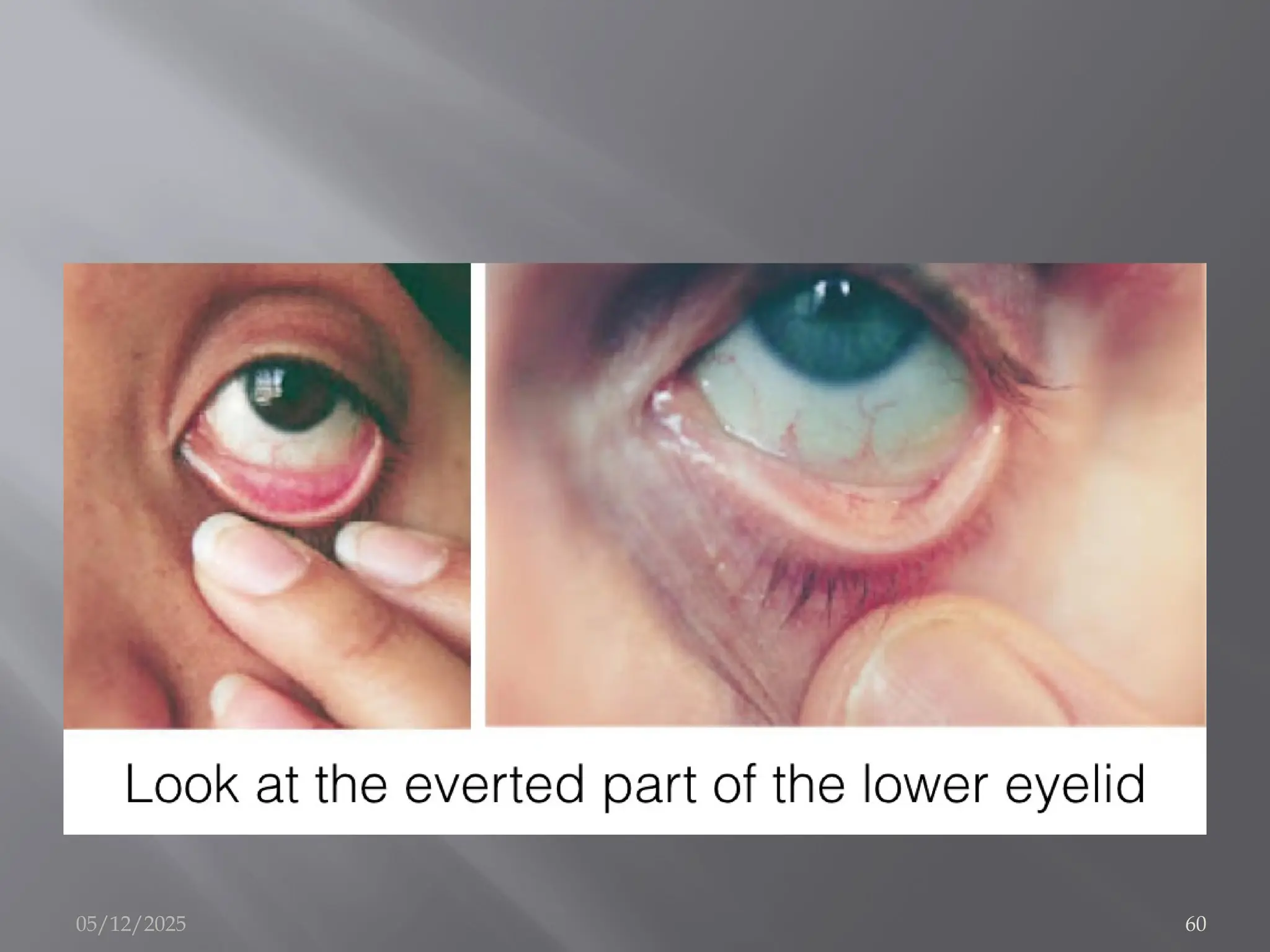
  • #60 Lower conjectiva
  • #62 Upper sclera
  • #67 A prothrombin time (PT) is a test used to help detect and diagnose a bleeding disorder or excessive clotting disorder; the international normalized ratio (INR) is calculated from a PT result and is used to monitor how well the blood-thinning medication (anticoagulant) warfarin (Coumadin®)