1
Mental Health Consultation
Patient Name: Subcortical Thalamic Aphasia Facility: XXXX
Date: 7-9-xx
Additional history can be found elsewhere in this chart and will not be repeated here.
Reasonfor Referral: xx-year-old, white, married, male and xxxx national… I was asked to
evaluate him because of a sudden change in mental status and behavior “during the past few
days”; “He is at times verbally abusive towards staff swearing and name calling; he is
combative …hitting and kicking at people...agitated…wandering…attempting to
elope…searching for his wife…much more confused”. He was admitted from XXXX on 5-28-xx
where he was treated for acute stroke.
Background Information: Previous notes from XXXX including those by a speech pathologist
and nursing notes from XXXX show that his aphasia was improving dramatically until recent
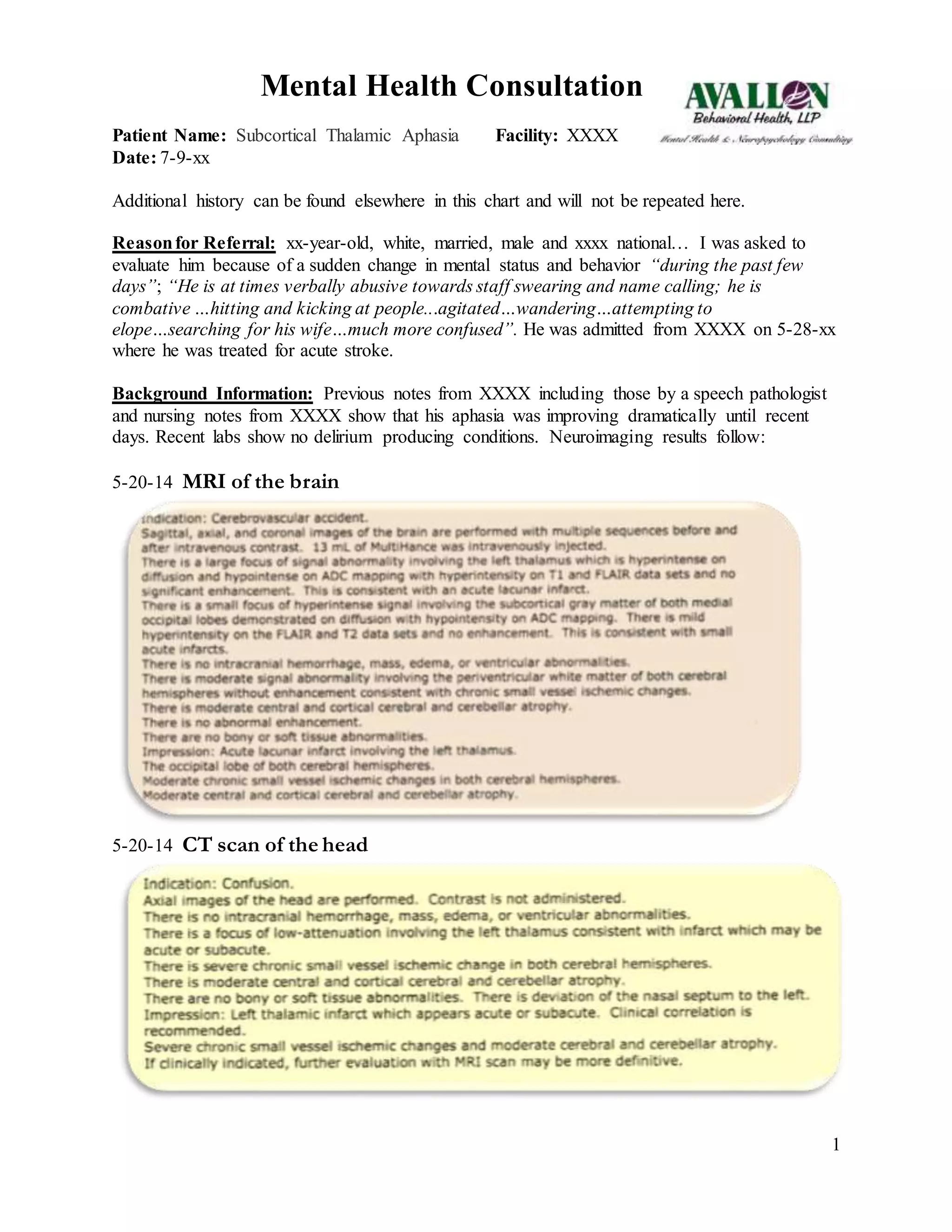
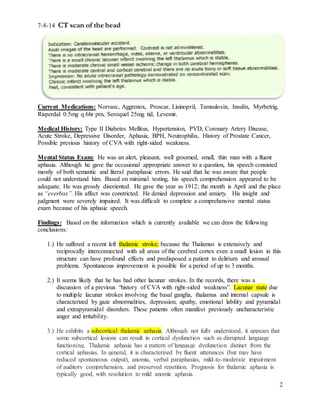
days. Recent labs show no delirium producing conditions. Neuroimaging results follow:
5-20-14 MRI of the brain
5-20-14 CT scan of the head
2
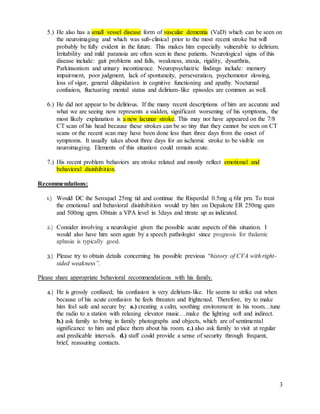
7-8-14 CT scan of the head
Current Medications: Norvasc, Aggrenox, Proscar, Lisinopril, Tamsulosin, Insulin, Myrbetrig,
Risperdal 0.5mg q 6hr prn, Seroquel 25mg tid, Levemir.
Medical History: Type II Diabetes Mellitus, Hypertension, PVD, Coronary Artery Disease,
Acute Stroke, Depressive Disorder, Aphasia, BPH, Neutrophilia, History of Prostate Cancer,
Possible previous history of CVA with right-sided weakness.
Mental Status Exam: He was an alert, pleasant, well groomed, small, thin man with a fluent
aphasia. Although he gave the occasional appropriate answer to a question, his speech consisted
mostly of both semantic and literal paraphasic errors. He said that he was aware that people
could not understand him. Based on minimal testing, his speech comprehension appeared to be
adequate. He was grossly disoriented. He gave the year as 1912; the month is April and the place
as “everbox”. His affect was constricted. He denied depression and anxiety. His insight and
judgment were severely impaired. It was difficult to complete a comprehensive mental status
exam because of his aphasic speech.
Findings: Based on the information which is currently available we can draw the following
conclusions:
1.) He suffered a recent left thalamic stroke; because the Thalamus is extensively and
reciprocally interconnected with all areas of the cerebral cortex even a small lesion in this
structure can have profound effects and predisposed a patient to delirium and arousal
problems. Spontaneous improvement is possible for a period of up to 3 months.
2.) It seems likely that he has had other lacunar strokes. In the records, there was a
discussion of a previous “history of CVA with right-sided weakness”. Lacunar state due
to multiple lacunar strokes involving the basal ganglia, thalamus and internal capsule is
characterized by gaze abnormalities, depression, apathy, emotional lability and pyramidal
and extrapyramidal disorders. These patients often manifest previously uncharacteristic
anger and irritability.
3.) He exhibits a subcortical thalamic aphasia. Although not fully understood, it appears that
some subcortical lesions can result in cortical dysfunction such as disrupted language
functioning. Thalamic aphasia has a pattern of language dysfunction distinct from the
cortical aphasias. In general, it is characterized by fluent utterances (but may have
reduced spontaneous output), anomia, verbal paraphasias, mild-to-moderate impairment
of auditory comprehension, and preserved repetition. Prognosis for thalamic aphasia is
typically good, with resolution to mild anomic aphasia.
3
5.) He also has a small vessel disease form of vascular dementia (VaD) which can be seen on
the neuroimaging and which was sub-clinical prior to the most recent stroke but will
probably be fully evident in the future. This makes him especially vulnerable to delirium.
Irritability and mild paranoia are often seen in these patients. Neurological signs of this
disease include: gait problems and falls, weakness, ataxia, rigidity, dysarthria,
Parkinsonism and urinary incontinence. Neuropsychiatric findings include: memory
impairment, poor judgment, lack of spontaneity, perseveration, psychomotor slowing,
loss of vigor, general dilapidation in cognitive functioning and apathy. Nocturnal
confusion, fluctuating mental status and delirium-like episodes are common as well.
6.) He did not appear to be delirious. If the many recent descriptions of him are accurate and
what we are seeing now represents a sudden, significant worsening of his symptoms, the
most likely explanation is a new lacunar stroke. This may not have appeared on the 7/8
CT scan of his head because these strokes can be so tiny that they cannot be seen on CT
scans or the recent scan may have been done less than three days from the onset of
symptoms. It usually takes about three days for an ischemic stroke to be visible on
neuroimaging. Elements of this situation could remain acute.
7.) His recent problem behaviors are stroke related and mostly reflect emotional and
behavioral disinhibition.
Recommendations:
1.) Would DC the Seroquel 25mg tid and continue the Risperdal 0.5mg q 6hr prn. To treat
the emotional and behavioral disinhibition would try him on Depakote ER 250mg qam
and 500mg qpm. Obtain a VPA level in 3days and titrate up as indicated.
2.) Consider involving a neurologist given the possible acute aspects of this situation. I
would also have him seen again by a speech pathologist since prognosis for thalamic
aphasia is typically good.
3.) Please try to obtain details concerning his possible previous “history of CVA with right-
sided weakness”.
Please share appropriate behavioral recommendations with his family.
4.) He is grossly confused; his confusion is very delirium-like. He seems to strike out when
because of his acute confusion he feels threaten and frightened. Therefore, try to make
him feel safe and secure by: a.) creating a calm, soothing environment in his room…tune
the radio to a station with relaxing elevator music…make the lighting soft and indirect.
b.) ask family to bring in family photographs and objects, which are of sentimental
significance to him and place them about his room. c.) also ask family to visit at regular
and predicable intervals. d.) staff could provide a sense of security through frequent,
brief, reassuring contacts.
4
5.) When providing care use the following techniques:
a. Use touch and eye contact to calm him.
b. Announce any physical contact before touching him.
c. Approach from the front, arms at your sides.
d. Maintain direct eye contact and speak in a firm but non-threatening, soft voice.
e. Reinforce positive behavior with immediate praise.
f. Offer him an object with texture and color to handle to distract him.
g. Talk to him. Tell him a story
6.) Try not to ask questions which draw attention to his memory loss and general cognitive
impairment.
7.) Keep him busy with simple, repetitive, failure-free activities which will allow him to
discharge excess restless energy.
8.) Provide him with memory and orientation aides such as: signs, large clocks and
calendars. Help him label his possessions and make lists of important names,
appointments, etc. Repeat important information/instructions to him many times each
day using the same words each time.
9.) Limit the use of questions but when you must ask a question keep to the here and now
and word your questions so they can be answered yes or no. Give one direction or ask
one question at a time.
10.) Start each conversation by identifying yourself and use short, simple sentences with
familiar words. Smile and use gentile touch.
___________________________
Drew Chenelly, Psy.D.
Clinical Neuropsychologist

Subcortical Thalamic Aphasia

  • 1.
    1 Mental Health Consultation PatientName: Subcortical Thalamic Aphasia Facility: XXXX Date: 7-9-xx Additional history can be found elsewhere in this chart and will not be repeated here. Reasonfor Referral: xx-year-old, white, married, male and xxxx national… I was asked to evaluate him because of a sudden change in mental status and behavior “during the past few days”; “He is at times verbally abusive towards staff swearing and name calling; he is combative …hitting and kicking at people...agitated…wandering…attempting to elope…searching for his wife…much more confused”. He was admitted from XXXX on 5-28-xx where he was treated for acute stroke. Background Information: Previous notes from XXXX including those by a speech pathologist and nursing notes from XXXX show that his aphasia was improving dramatically until recent days. Recent labs show no delirium producing conditions. Neuroimaging results follow: 5-20-14 MRI of the brain 5-20-14 CT scan of the head
  • 2.
    2 7-8-14 CT scanof the head Current Medications: Norvasc, Aggrenox, Proscar, Lisinopril, Tamsulosin, Insulin, Myrbetrig, Risperdal 0.5mg q 6hr prn, Seroquel 25mg tid, Levemir. Medical History: Type II Diabetes Mellitus, Hypertension, PVD, Coronary Artery Disease, Acute Stroke, Depressive Disorder, Aphasia, BPH, Neutrophilia, History of Prostate Cancer, Possible previous history of CVA with right-sided weakness. Mental Status Exam: He was an alert, pleasant, well groomed, small, thin man with a fluent aphasia. Although he gave the occasional appropriate answer to a question, his speech consisted mostly of both semantic and literal paraphasic errors. He said that he was aware that people could not understand him. Based on minimal testing, his speech comprehension appeared to be adequate. He was grossly disoriented. He gave the year as 1912; the month is April and the place as “everbox”. His affect was constricted. He denied depression and anxiety. His insight and judgment were severely impaired. It was difficult to complete a comprehensive mental status exam because of his aphasic speech. Findings: Based on the information which is currently available we can draw the following conclusions: 1.) He suffered a recent left thalamic stroke; because the Thalamus is extensively and reciprocally interconnected with all areas of the cerebral cortex even a small lesion in this structure can have profound effects and predisposed a patient to delirium and arousal problems. Spontaneous improvement is possible for a period of up to 3 months. 2.) It seems likely that he has had other lacunar strokes. In the records, there was a discussion of a previous “history of CVA with right-sided weakness”. Lacunar state due to multiple lacunar strokes involving the basal ganglia, thalamus and internal capsule is characterized by gaze abnormalities, depression, apathy, emotional lability and pyramidal and extrapyramidal disorders. These patients often manifest previously uncharacteristic anger and irritability. 3.) He exhibits a subcortical thalamic aphasia. Although not fully understood, it appears that some subcortical lesions can result in cortical dysfunction such as disrupted language functioning. Thalamic aphasia has a pattern of language dysfunction distinct from the cortical aphasias. In general, it is characterized by fluent utterances (but may have reduced spontaneous output), anomia, verbal paraphasias, mild-to-moderate impairment of auditory comprehension, and preserved repetition. Prognosis for thalamic aphasia is typically good, with resolution to mild anomic aphasia.
  • 3.
    3 5.) He alsohas a small vessel disease form of vascular dementia (VaD) which can be seen on the neuroimaging and which was sub-clinical prior to the most recent stroke but will probably be fully evident in the future. This makes him especially vulnerable to delirium. Irritability and mild paranoia are often seen in these patients. Neurological signs of this disease include: gait problems and falls, weakness, ataxia, rigidity, dysarthria, Parkinsonism and urinary incontinence. Neuropsychiatric findings include: memory impairment, poor judgment, lack of spontaneity, perseveration, psychomotor slowing, loss of vigor, general dilapidation in cognitive functioning and apathy. Nocturnal confusion, fluctuating mental status and delirium-like episodes are common as well. 6.) He did not appear to be delirious. If the many recent descriptions of him are accurate and what we are seeing now represents a sudden, significant worsening of his symptoms, the most likely explanation is a new lacunar stroke. This may not have appeared on the 7/8 CT scan of his head because these strokes can be so tiny that they cannot be seen on CT scans or the recent scan may have been done less than three days from the onset of symptoms. It usually takes about three days for an ischemic stroke to be visible on neuroimaging. Elements of this situation could remain acute. 7.) His recent problem behaviors are stroke related and mostly reflect emotional and behavioral disinhibition. Recommendations: 1.) Would DC the Seroquel 25mg tid and continue the Risperdal 0.5mg q 6hr prn. To treat the emotional and behavioral disinhibition would try him on Depakote ER 250mg qam and 500mg qpm. Obtain a VPA level in 3days and titrate up as indicated. 2.) Consider involving a neurologist given the possible acute aspects of this situation. I would also have him seen again by a speech pathologist since prognosis for thalamic aphasia is typically good. 3.) Please try to obtain details concerning his possible previous “history of CVA with right- sided weakness”. Please share appropriate behavioral recommendations with his family. 4.) He is grossly confused; his confusion is very delirium-like. He seems to strike out when because of his acute confusion he feels threaten and frightened. Therefore, try to make him feel safe and secure by: a.) creating a calm, soothing environment in his room…tune the radio to a station with relaxing elevator music…make the lighting soft and indirect. b.) ask family to bring in family photographs and objects, which are of sentimental significance to him and place them about his room. c.) also ask family to visit at regular and predicable intervals. d.) staff could provide a sense of security through frequent, brief, reassuring contacts.
  • 4.
    4 5.) When providingcare use the following techniques: a. Use touch and eye contact to calm him. b. Announce any physical contact before touching him. c. Approach from the front, arms at your sides. d. Maintain direct eye contact and speak in a firm but non-threatening, soft voice. e. Reinforce positive behavior with immediate praise. f. Offer him an object with texture and color to handle to distract him. g. Talk to him. Tell him a story 6.) Try not to ask questions which draw attention to his memory loss and general cognitive impairment. 7.) Keep him busy with simple, repetitive, failure-free activities which will allow him to discharge excess restless energy. 8.) Provide him with memory and orientation aides such as: signs, large clocks and calendars. Help him label his possessions and make lists of important names, appointments, etc. Repeat important information/instructions to him many times each day using the same words each time. 9.) Limit the use of questions but when you must ask a question keep to the here and now and word your questions so they can be answered yes or no. Give one direction or ask one question at a time. 10.) Start each conversation by identifying yourself and use short, simple sentences with familiar words. Smile and use gentile touch. ___________________________ Drew Chenelly, Psy.D. Clinical Neuropsychologist