1
Mental Health Consultation
Patient Name: Occam’s razor Facility: XXXX
Date: 11-4-13
Additional history can be found elsewhere in this chart and will not be repeated here.
Reason for Referral: xx-year-old, white, xxxx, female… I was asked to evaluate her because of
a recent increase in aggressive behavior “combative with care…swearing…struck another
resident”. She was admitted from XXXX on 12-31-13 where she had been treated for a delirium
secondary to dehydration, hypernatremia and UTI.
Background Information: 10-10-13 labs: CBC = anemia, BUN& Creatinine were high.
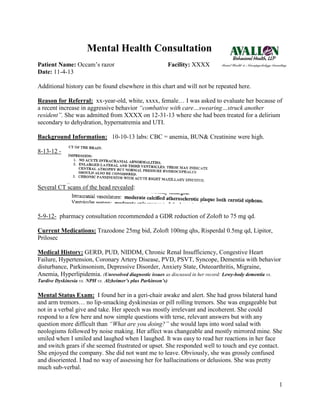
8-13-12 -
Several CT scans of the head revealed:
5-9-12- pharmacy consultation recommended a GDR reduction of Zoloft to 75 mg qd.
Current Medications: Trazodone 25mg bid, Zoloft 100mg qhs, Risperdal 0.5mg qd, Lipitor,
Prilosec
Medical History: GERD, PUD, NIDDM, Chronic Renal Insufficiency, Congestive Heart
Failure, Hypertension, Coronary Artery Disease, PVD, PSVT, Syncope, Dementia with behavior
disturbance, Parkinsonism, Depressive Disorder, Anxiety State, Osteoarthritis, Migraine,
Anemia, Hyperlipidemia. (Unresolved diagnostic issues as discussed in her record: Lewy-body dementia vs.
Tardive Dyskinesia vs. NPH vs. Alzheimer’s plus Parkinson’s)
Mental Status Exam: I found her in a geri-chair awake and alert. She had gross bilateral hand
and arm tremors… no lip-smacking dyskinesias or pill rolling tremors. She was engageable but
not in a verbal give and take. Her speech was mostly irrelevant and incoherent. She could
respond to a few here and now simple questions with terse, relevant answers but with any
question more difficult than “What are you doing?” she would laps into word salad with
neologisms followed by noise making. Her affect was changeable and mostly mirrored mine. She
smiled when I smiled and laughed when I laughed. It was easy to read her reactions in her face
and switch gears if she seemed frustrated or upset. She responded well to touch and eye contact.
She enjoyed the company. She did not want me to leave. Obviously, she was grossly confused
and disoriented. I had no way of assessing her for hallucinations or delusions. She was pretty
much sub-verbal.
2
Findings and Recommendations: Reviewing each of the possible diagnoses:
Pure Lewy-body dementia is chronic progressive dementia with late onset parkinsonian signs
that may include a mild or prominent movement disorder, supranuclear gaze palsy, limb and
axial rigidity and tremor. There are impressive fluctuations in cognitive dysfunction as well as
intermittent episodes of confusion, hallucinations and paranoid delusions. Wide swings in
behavior are common. The occurrence of episodic gross confusion alternating with more lucid
intervals suggests delirium but is not delirium because the fluctuations are not due to an
underlying reversible cause. Intellectual functioning overall is generally better preserved than it
is in Alzheimer’s patients at a comparable stage of that disease. This diagnosis seems unlikely
for a number of reasons: 1) the symptoms do not seem severe enough 2) she does not have lucid
intervals that I know of 3) I did not see gaze restrictions 4) there is no wide fluctuation in mental
status.
I believe we can rule out Tardive Dyskinesia because she did not exhibit any of the typical lip-
smacking dyskinesias or pill rolling tremors usually seen in that disorder.
The syndrome of Normal Pressure Hydrocephalus includes a triad of symptoms: dementia,
gait disturbance (a broad-based stance, short shuffling steps, "magnetic gate” or hesitancy in the
initiation of a step) and urinary incontinence. These features are associated with evidence of
uneven ventricular dilation in the absence of significantly elevated intracranial pressure. Chronic
hydrocephalus is marked by apathy and a general slowing of thought and activity.It progressively
worsens. I have not seen her gait but I know she has at least two of the above three signs. This
diagnosis a definite possibility. However, the issue is academic because it is too late for a VP
shunt placement.
Following the principle of Occam’s razor, the simplest solution is usually the correct solution, I
believe she probably suffers from a Vascular Dementia (VaD) with an overlay of chronic
delirium secondary to Chronic Renal Insufficiency with high BUNs.
1. I don’t know why she is taking two antidepressants (Trazadone bid not just @ hs). To
reduce the risk of serotonin syndrome, however small, and because her dementia has
advanced beyond a point where depression is likely (generally as a dementia progresses,
patients loose the psychological and neurophysiologic complexity required to experience
ongoing clinical depression) would DC the Trazodone and reduce the Zoloft to 75mg
qd… an SSRI should be given in the AM not at hs.
2. Would increase her Risperidone to 0.5mg bid and Risperidone to 0.5mg bid prn to treat
the delirium like symptoms. If she gets worse, this will add weight to Lewy-body as a
possible diagnosis and we will have to rethink her meds.
3
3. When providing her care use the following techniques:
a) Use touch and eye contact to calm her. She responds well to this.
b) Announce any physical contact before touching her.
c) Approach from the front, arms at your sides.
d) Maintain direct eye contact and speak in a firm but non-threatening, soft voice.
e) Reinforce positive behavior with immediate praise.
f) Offer her an object with texture and color to handle to distract her.
g) Talk to her. Tell her a story
4. In general, smile at her and laugh. She mirrors the moods and actions of others. Keep it
positive and she will be positive.
5. It is easy to read her reactions by watching her face. Switch gears if she seems frustrated
or upset.
6. Tune the radio in her room to an NPR talk program. She seeks contact with others.
7. Stability and predictability will limit frustration. Establish a predictable and consistent
daily routine for her.
8. When interacting with her:
 Limit the use of questions but when you must ask a question keep to the here and now
and word your questions so they can be answered yes or no.
 Give one direction or ask one question at a time.
 Start each conversation by identifying yourself and use short, simple sentences with
familiar words. Smile and use gentile touch.
 Provide a sense of security through frequent, brief, reassuring contacts.
 Avoid presenting her with decisions by using no choice instructions.
 Avoid “why” questions.
 Use gesture whenever you can.
___________________________
Drew Chenelly, Psy.D.
Clinical Neuropsychologist

Occam's Razor

  • 1.
    1 Mental Health Consultation PatientName: Occam’s razor Facility: XXXX Date: 11-4-13 Additional history can be found elsewhere in this chart and will not be repeated here. Reason for Referral: xx-year-old, white, xxxx, female… I was asked to evaluate her because of a recent increase in aggressive behavior “combative with care…swearing…struck another resident”. She was admitted from XXXX on 12-31-13 where she had been treated for a delirium secondary to dehydration, hypernatremia and UTI. Background Information: 10-10-13 labs: CBC = anemia, BUN& Creatinine were high. 8-13-12 - Several CT scans of the head revealed: 5-9-12- pharmacy consultation recommended a GDR reduction of Zoloft to 75 mg qd. Current Medications: Trazodone 25mg bid, Zoloft 100mg qhs, Risperdal 0.5mg qd, Lipitor, Prilosec Medical History: GERD, PUD, NIDDM, Chronic Renal Insufficiency, Congestive Heart Failure, Hypertension, Coronary Artery Disease, PVD, PSVT, Syncope, Dementia with behavior disturbance, Parkinsonism, Depressive Disorder, Anxiety State, Osteoarthritis, Migraine, Anemia, Hyperlipidemia. (Unresolved diagnostic issues as discussed in her record: Lewy-body dementia vs. Tardive Dyskinesia vs. NPH vs. Alzheimer’s plus Parkinson’s) Mental Status Exam: I found her in a geri-chair awake and alert. She had gross bilateral hand and arm tremors… no lip-smacking dyskinesias or pill rolling tremors. She was engageable but not in a verbal give and take. Her speech was mostly irrelevant and incoherent. She could respond to a few here and now simple questions with terse, relevant answers but with any question more difficult than “What are you doing?” she would laps into word salad with neologisms followed by noise making. Her affect was changeable and mostly mirrored mine. She smiled when I smiled and laughed when I laughed. It was easy to read her reactions in her face and switch gears if she seemed frustrated or upset. She responded well to touch and eye contact. She enjoyed the company. She did not want me to leave. Obviously, she was grossly confused and disoriented. I had no way of assessing her for hallucinations or delusions. She was pretty much sub-verbal.
  • 2.
    2 Findings and Recommendations:Reviewing each of the possible diagnoses: Pure Lewy-body dementia is chronic progressive dementia with late onset parkinsonian signs that may include a mild or prominent movement disorder, supranuclear gaze palsy, limb and axial rigidity and tremor. There are impressive fluctuations in cognitive dysfunction as well as intermittent episodes of confusion, hallucinations and paranoid delusions. Wide swings in behavior are common. The occurrence of episodic gross confusion alternating with more lucid intervals suggests delirium but is not delirium because the fluctuations are not due to an underlying reversible cause. Intellectual functioning overall is generally better preserved than it is in Alzheimer’s patients at a comparable stage of that disease. This diagnosis seems unlikely for a number of reasons: 1) the symptoms do not seem severe enough 2) she does not have lucid intervals that I know of 3) I did not see gaze restrictions 4) there is no wide fluctuation in mental status. I believe we can rule out Tardive Dyskinesia because she did not exhibit any of the typical lip- smacking dyskinesias or pill rolling tremors usually seen in that disorder. The syndrome of Normal Pressure Hydrocephalus includes a triad of symptoms: dementia, gait disturbance (a broad-based stance, short shuffling steps, "magnetic gate” or hesitancy in the initiation of a step) and urinary incontinence. These features are associated with evidence of uneven ventricular dilation in the absence of significantly elevated intracranial pressure. Chronic hydrocephalus is marked by apathy and a general slowing of thought and activity.It progressively worsens. I have not seen her gait but I know she has at least two of the above three signs. This diagnosis a definite possibility. However, the issue is academic because it is too late for a VP shunt placement. Following the principle of Occam’s razor, the simplest solution is usually the correct solution, I believe she probably suffers from a Vascular Dementia (VaD) with an overlay of chronic delirium secondary to Chronic Renal Insufficiency with high BUNs. 1. I don’t know why she is taking two antidepressants (Trazadone bid not just @ hs). To reduce the risk of serotonin syndrome, however small, and because her dementia has advanced beyond a point where depression is likely (generally as a dementia progresses, patients loose the psychological and neurophysiologic complexity required to experience ongoing clinical depression) would DC the Trazodone and reduce the Zoloft to 75mg qd… an SSRI should be given in the AM not at hs. 2. Would increase her Risperidone to 0.5mg bid and Risperidone to 0.5mg bid prn to treat the delirium like symptoms. If she gets worse, this will add weight to Lewy-body as a possible diagnosis and we will have to rethink her meds.
  • 3.
    3 3. When providingher care use the following techniques: a) Use touch and eye contact to calm her. She responds well to this. b) Announce any physical contact before touching her. c) Approach from the front, arms at your sides. d) Maintain direct eye contact and speak in a firm but non-threatening, soft voice. e) Reinforce positive behavior with immediate praise. f) Offer her an object with texture and color to handle to distract her. g) Talk to her. Tell her a story 4. In general, smile at her and laugh. She mirrors the moods and actions of others. Keep it positive and she will be positive. 5. It is easy to read her reactions by watching her face. Switch gears if she seems frustrated or upset. 6. Tune the radio in her room to an NPR talk program. She seeks contact with others. 7. Stability and predictability will limit frustration. Establish a predictable and consistent daily routine for her. 8. When interacting with her:  Limit the use of questions but when you must ask a question keep to the here and now and word your questions so they can be answered yes or no.  Give one direction or ask one question at a time.  Start each conversation by identifying yourself and use short, simple sentences with familiar words. Smile and use gentile touch.  Provide a sense of security through frequent, brief, reassuring contacts.  Avoid presenting her with decisions by using no choice instructions.  Avoid “why” questions.  Use gesture whenever you can. ___________________________ Drew Chenelly, Psy.D. Clinical Neuropsychologist