By: Nelson D. Calisa Jr.
AB-English IV

 A problem solving exists when a goal-oriented task
is blocked, or when a need is not satisfied.
 A problem solving is adjusting to the situations by
acquiring new modes of response.
 A problem solving requires adequate knowledge
and information that are valid and verifiable for the
effective solutions of the problems.
Problem Solving

 Perception by or based on stimulation of the senses.
 This is an inherent capacity of any of the faculties, as
sight, hearing, smell, taste or touch by which man
perceive stimuli originating from outside and inside
the body.
Sense Perception

 Is the ability to acquire knowledge
without inference and/or the use of reason.
Intuition

 Is essentially an arousal of images and ideas by
which an individual manipulates and rearranges
aspects of the world which have fallen within his
experience.
 CREATIVE THINKING-is production thinking,
with novel ideas created through imaginations rather
that routine outcomes.
Thinking

1. Preparation- In writing a term paper, a student
writes something, revises what he has written, or
changes the entire topic and starts all over again.
2. Incubation- some creative thinkers deliberately put
aside all there thoughts about the problem but the
concept in the back of his mind for sometime is
gradually shaping up.
Aspects that are important
during creative process

 Awareness to what we think is important.
 The first is our experience of thinking as a flowing,
often chaotic, stream of impressions, ideas and
fragments of phrases, this places our mind in auto-
pilot and let our thoughts wander: DREAMING
 Thinking is an ongoing back and forth between flow
and stability, between automatic pilot and
concentration.
Thinking as a Process

1. We think pattern and sequences
2. We think on planes of abstractions and levels of
attention
Characteristic patterns of
thinking process

1. Recall
2. Recognition
3. Relearning
4. Reintegration
Remembering

 Passive decay through disuse
 Motivated forgetting
 Systematic distortion of memory trances
Theories of Forgetting
(forgetting is the loss of retention, extinction of what has been
learned)

 Types:
1. Episodic memory
2. Semantic memory
3. Procedural memory
Memory (ability to store facts and information so
that can be utilized in the future)

1. The pupils/students must have a clear idea of the
goal.
2. The pupils/students must be physiologically and
psychologically ready and prepare to respond their
new experience.
3. The pupils/students must be motivated to learn.
Principles of Learning

4. The pupils/students must be active in any
teaching-learning process.
5. The pupils/students must always repeat or practice
what they have learned.
6. The pupils/students must see and feel the
significance, meanings, implications and
application to real-life situation of a given
experience.

7. The pupils/students have to be taught in different
ways because of individual differences.
8. The pupils/students have to learn democracy in a
democratic environment by practicing and living
with it.
9. The pupils/students must put together the parts of
a given task and become aware of it as a
meaningful whole.

10. The pupils/students increasing independence from
adults and ever increasing sense of responsibility
are clear signposts of a good teaching.
11. The pupils/students learn faster when the teacher
utilizes their past experience.
12. The pupils/students can be stimulated to think and
to reason through the teacher’s expression of
confidence in their own aptitudes and skills by
way of provoking curiosity and through
encouraging creative endeavor.

13. The pupils/students educational growth depends
on the selection of subject
matter, activities, experiences that will be included
in the preparation of lesson plan
14. The pupils/students should have curriculum of all
experiences, curriculum and co-curriculum, inside
or outside the classroom which are under the
jurisdiction of schools and are planned and directed
for the purpose of promoting the intellectual
social, and emotional growth and development of
the learners.

1. Learning by doing is a good advice
2. One learns to do what one does
3. The amount of reinforcement necessary to the
learners’ stage of development and their previous
learning
4. The principle of readiness is related to the learners’
stage of development and their previous learning
Cognitive Learning

5. The pupils/students’ self-concept and beliefs about
their abilities are extremely important.
6. Teachers should provide opportunities for
meaningful and appropriate practices.
7. Transfer of learning to new situations can be
horizontal.

8. Learning should be goal-directed and focused.
9. Positive feedbacks, realistic praise, and
encouragement are motivating in the teaching-
learning process.
10. Metacognition is an advanced cognitive process
whereby learners acquire specific learning
strategies and also sense when they are not
learning.

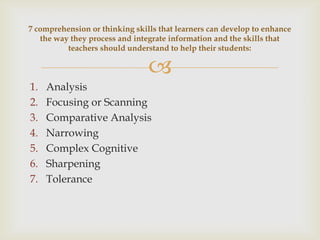
1. Analysis
2. Focusing or Scanning
3. Comparative Analysis
4. Narrowing
5. Complex Cognitive
6. Sharpening
7. Tolerance
7 comprehension or thinking skills that learners can develop to enhance
the way they process and integrate information and the skills that
teachers should understand to help their students:

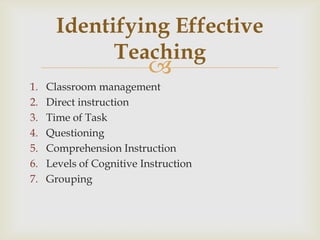
1. Classroom management
2. Direct instruction
3. Time of Task
4. Questioning
5. Comprehension Instruction
6. Levels of Cognitive Instruction
7. Grouping
Identifying Effective
Teaching

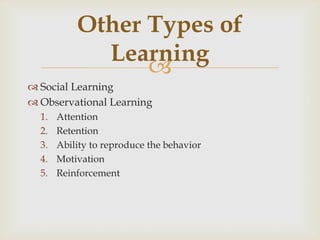
 Social Learning
 Observational Learning
1. Attention
2. Retention
3. Ability to reproduce the behavior
4. Motivation
5. Reinforcement
Other Types of
Learning

 The Law of Readiness
 The Law of Exercise
 The Law of Effect
Laws of Learning

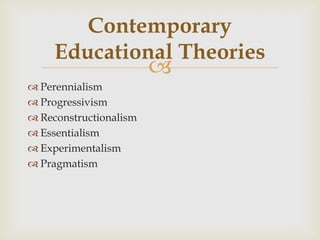
 Perennialism
 Progressivism
 Reconstructionalism
 Essentialism
 Experimentalism
 Pragmatism
Contemporary
Educational Theories

Studying Techniques to Improve Performance

  • 1.
    By: Nelson D.Calisa Jr. AB-English IV
  • 2.
      A problemsolving exists when a goal-oriented task is blocked, or when a need is not satisfied.  A problem solving is adjusting to the situations by acquiring new modes of response.  A problem solving requires adequate knowledge and information that are valid and verifiable for the effective solutions of the problems. Problem Solving
  • 3.
      Perception byor based on stimulation of the senses.  This is an inherent capacity of any of the faculties, as sight, hearing, smell, taste or touch by which man perceive stimuli originating from outside and inside the body. Sense Perception
  • 4.
      Is theability to acquire knowledge without inference and/or the use of reason. Intuition
  • 5.
      Is essentiallyan arousal of images and ideas by which an individual manipulates and rearranges aspects of the world which have fallen within his experience.  CREATIVE THINKING-is production thinking, with novel ideas created through imaginations rather that routine outcomes. Thinking
  • 6.
     1. Preparation- Inwriting a term paper, a student writes something, revises what he has written, or changes the entire topic and starts all over again. 2. Incubation- some creative thinkers deliberately put aside all there thoughts about the problem but the concept in the back of his mind for sometime is gradually shaping up. Aspects that are important during creative process
  • 7.
      Awareness towhat we think is important.  The first is our experience of thinking as a flowing, often chaotic, stream of impressions, ideas and fragments of phrases, this places our mind in auto- pilot and let our thoughts wander: DREAMING  Thinking is an ongoing back and forth between flow and stability, between automatic pilot and concentration. Thinking as a Process
  • 8.
     1. We thinkpattern and sequences 2. We think on planes of abstractions and levels of attention Characteristic patterns of thinking process
  • 9.
     1. Recall 2. Recognition 3.Relearning 4. Reintegration Remembering
  • 10.
      Passive decaythrough disuse  Motivated forgetting  Systematic distortion of memory trances Theories of Forgetting (forgetting is the loss of retention, extinction of what has been learned)
  • 11.
      Types: 1. Episodicmemory 2. Semantic memory 3. Procedural memory Memory (ability to store facts and information so that can be utilized in the future)
  • 12.
     1. The pupils/studentsmust have a clear idea of the goal. 2. The pupils/students must be physiologically and psychologically ready and prepare to respond their new experience. 3. The pupils/students must be motivated to learn. Principles of Learning
  • 13.
     4. The pupils/studentsmust be active in any teaching-learning process. 5. The pupils/students must always repeat or practice what they have learned. 6. The pupils/students must see and feel the significance, meanings, implications and application to real-life situation of a given experience.
  • 14.
     7. The pupils/studentshave to be taught in different ways because of individual differences. 8. The pupils/students have to learn democracy in a democratic environment by practicing and living with it. 9. The pupils/students must put together the parts of a given task and become aware of it as a meaningful whole.
  • 15.
     10. The pupils/studentsincreasing independence from adults and ever increasing sense of responsibility are clear signposts of a good teaching. 11. The pupils/students learn faster when the teacher utilizes their past experience. 12. The pupils/students can be stimulated to think and to reason through the teacher’s expression of confidence in their own aptitudes and skills by way of provoking curiosity and through encouraging creative endeavor.
  • 16.
     13. The pupils/studentseducational growth depends on the selection of subject matter, activities, experiences that will be included in the preparation of lesson plan 14. The pupils/students should have curriculum of all experiences, curriculum and co-curriculum, inside or outside the classroom which are under the jurisdiction of schools and are planned and directed for the purpose of promoting the intellectual social, and emotional growth and development of the learners.
  • 17.
     1. Learning bydoing is a good advice 2. One learns to do what one does 3. The amount of reinforcement necessary to the learners’ stage of development and their previous learning 4. The principle of readiness is related to the learners’ stage of development and their previous learning Cognitive Learning
  • 18.
     5. The pupils/students’self-concept and beliefs about their abilities are extremely important. 6. Teachers should provide opportunities for meaningful and appropriate practices. 7. Transfer of learning to new situations can be horizontal.
  • 19.
     8. Learning shouldbe goal-directed and focused. 9. Positive feedbacks, realistic praise, and encouragement are motivating in the teaching- learning process. 10. Metacognition is an advanced cognitive process whereby learners acquire specific learning strategies and also sense when they are not learning.
  • 20.
     1. Analysis 2. Focusingor Scanning 3. Comparative Analysis 4. Narrowing 5. Complex Cognitive 6. Sharpening 7. Tolerance 7 comprehension or thinking skills that learners can develop to enhance the way they process and integrate information and the skills that teachers should understand to help their students:
  • 21.
     1. Classroom management 2.Direct instruction 3. Time of Task 4. Questioning 5. Comprehension Instruction 6. Levels of Cognitive Instruction 7. Grouping Identifying Effective Teaching
  • 22.
      Social Learning Observational Learning 1. Attention 2. Retention 3. Ability to reproduce the behavior 4. Motivation 5. Reinforcement Other Types of Learning
  • 23.
      The Lawof Readiness  The Law of Exercise  The Law of Effect Laws of Learning
  • 24.
      Perennialism  Progressivism Reconstructionalism  Essentialism  Experimentalism  Pragmatism Contemporary Educational Theories