By:
Anand Kadali,
Hari Prasad Gollapalli,
Kalyanam Sudheer Kumar.
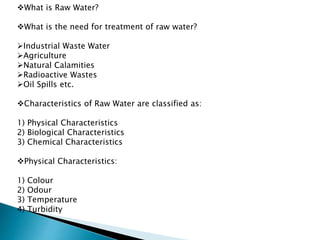
What is Raw Water?
What is the need for treatment of raw water?
Industrial Waste Water
Agriculture
Natural Calamities
Radioactive Wastes
Oil Spills etc.
Characteristics of Raw Water are classified as:
1) Physical Characteristics
2) Biological Characteristics
3) Chemical Characteristics
Physical Characteristics:
1) Colour
2) Odour
3) Temperature
4) Turbidity
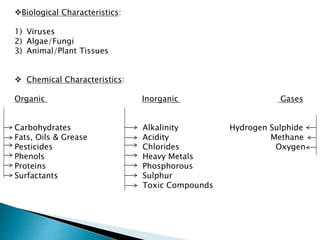
Biological Characteristics:
1) Viruses
2) Algae/Fungi
3) Animal/Plant Tissues
 Chemical Characteristics:
Organic Inorganic Gases
Carbohydrates Alkalinity Hydrogen Sulphide
Fats, Oils & Grease Acidity Methane
Pesticides Chlorides Oxygen
Phenols Heavy Metals
Proteins Phosphorous
Surfactants Sulphur
Toxic Compounds
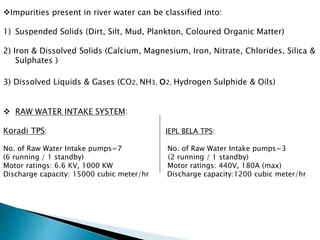
Impurities present in river water can be classified into:
1) Suspended Solids (Dirt, Silt, Mud, Plankton, Coloured Organic Matter)
2) Iron & Dissolved Solids (Calcium, Magnesium, Iron, Nitrate, Chlorides, Silica &
Sulphates )
3) Dissolved Liquids & Gases (CO2, NH3, o2, Hydrogen Sulphide & Oils)
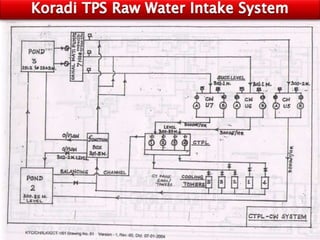
 RAW WATER INTAKE SYSTEM:
Koradi TPS: IEPL BELA TPS:
No. of Raw Water Intake pumps=7 No. of Raw Water Intake pumps=3
(6 running / 1 standby) (2 running / 1 standby)
Motor ratings: 6.6 KV, 1000 KW Motor ratings: 440V, 180A (max)
Discharge capacity: 15000 cubic meter/hr Discharge capacity:1200 cubic meter/hr
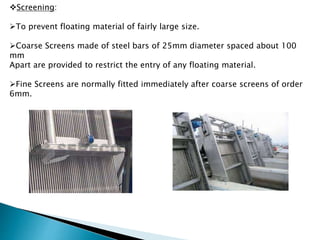
Screening:
To prevent floating material of fairly large size.
Coarse Screens made of steel bars of 25mm diameter spaced about 100
mm
Apart are provided to restrict the entry of any floating material.
Fine Screens are normally fitted immediately after coarse screens of order
6mm.
Pre Chlorination:
Chlorine is injected into raw water at a dosing rate of 2-5 mg/liter.
Pre chlorination destroys bacteria & kills algae.
 Oxidizes and precipitates iron and manganese.
 Reduces color and slime formation.
Raw Water Storage:
Raw Water stored as a backup of 7 to 8 days in plant’s reservoir.
This is sufficient to reduce pathogenic bacteria, suspended solids
& river algae.
Raw water quality is noticeable purely as a result of retention of
water provided.
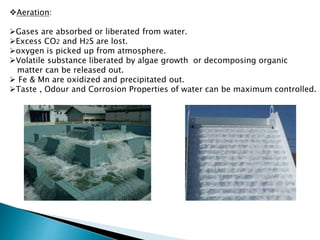
Aeration:
Gases are absorbed or liberated from water.
Excess CO2 and H2S are lost.
oxygen is picked up from atmosphere.
Volatile substance liberated by algae growth or decomposing organic
matter can be released out.
 Fe & Mn are oxidized and precipitated out.
Taste , Odour and Corrosion Properties of water can be maximum controlled.
Coagulation:
A process by which small particles in suspension join together to form
larger agglomerate. Fine suspended particles and colloids carry positive
& negative charges.
For agglomeration fine particles should come in contact with each
other. Mixing promotes the effect but violent mixing breaks down the
attraction between the particles.
Coagulation Aids Poly Acryl amide
Activated Silica
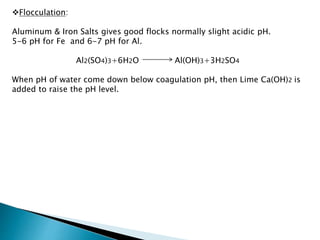
Flocculation:
Aluminum & Iron Salts gives good flocks normally slight acidic pH.
5-6 pH for Fe and 6-7 pH for Al.
Al2(SO4)3+6H2O Al(OH)3+3H2SO4
When pH of water come down below coagulation pH, then Lime Ca(OH)2 is
added to raise the pH level.
Clarifiers:
Water is cleared from most of the suspended particles. It consists of a
flash mixer & settler in separate compartments.
Flash Mixer Chemicals dozed + high speed agitation + retention
Flocculation Chamber Gentle agitation + 20-60 minutes
retention.
Settling Chamber Collection of suspended particles.
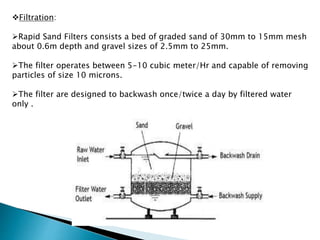
Filtration:
Rapid Sand Filters consists a bed of graded sand of 30mm to 15mm mesh
about 0.6m depth and gravel sizes of 2.5mm to 25mm.
The filter operates between 5-10 cubic meter/Hr and capable of removing
particles of size 10 microns.
The filter are designed to backwash once/twice a day by filtered water
only .
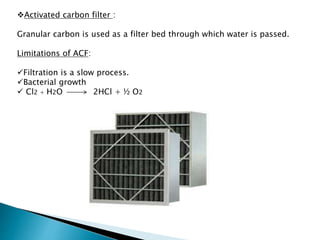
Activated carbon filter :
Granular carbon is used as a filter bed through which water is passed.
Limitations of ACF:
Filtration is a slow process.
Bacterial growth
 Cl2 + H2O 2HCl + ½ O2
Conclusion:
Thus after the filtration process the water is stored in a filtered water
storage tank and this water is called portable water/general service water and
suitable for drinking and cooling of some auxiliaries and other purposes. This
water is further sent to post treatment in DM Plant.

Raw Water Intake & Pre Treatment of Raw Water in a Thermal Power Plant

  • 1.
    By: Anand Kadali, Hari PrasadGollapalli, Kalyanam Sudheer Kumar.
  • 2.
    What is RawWater? What is the need for treatment of raw water? Industrial Waste Water Agriculture Natural Calamities Radioactive Wastes Oil Spills etc. Characteristics of Raw Water are classified as: 1) Physical Characteristics 2) Biological Characteristics 3) Chemical Characteristics Physical Characteristics: 1) Colour 2) Odour 3) Temperature 4) Turbidity
  • 3.
    Biological Characteristics: 1) Viruses 2)Algae/Fungi 3) Animal/Plant Tissues  Chemical Characteristics: Organic Inorganic Gases Carbohydrates Alkalinity Hydrogen Sulphide Fats, Oils & Grease Acidity Methane Pesticides Chlorides Oxygen Phenols Heavy Metals Proteins Phosphorous Surfactants Sulphur Toxic Compounds
  • 4.
    Impurities present inriver water can be classified into: 1) Suspended Solids (Dirt, Silt, Mud, Plankton, Coloured Organic Matter) 2) Iron & Dissolved Solids (Calcium, Magnesium, Iron, Nitrate, Chlorides, Silica & Sulphates ) 3) Dissolved Liquids & Gases (CO2, NH3, o2, Hydrogen Sulphide & Oils)  RAW WATER INTAKE SYSTEM: Koradi TPS: IEPL BELA TPS: No. of Raw Water Intake pumps=7 No. of Raw Water Intake pumps=3 (6 running / 1 standby) (2 running / 1 standby) Motor ratings: 6.6 KV, 1000 KW Motor ratings: 440V, 180A (max) Discharge capacity: 15000 cubic meter/hr Discharge capacity:1200 cubic meter/hr
  • 6.
    Screening: To prevent floatingmaterial of fairly large size. Coarse Screens made of steel bars of 25mm diameter spaced about 100 mm Apart are provided to restrict the entry of any floating material. Fine Screens are normally fitted immediately after coarse screens of order 6mm.
  • 7.
    Pre Chlorination: Chlorine isinjected into raw water at a dosing rate of 2-5 mg/liter. Pre chlorination destroys bacteria & kills algae.  Oxidizes and precipitates iron and manganese.  Reduces color and slime formation. Raw Water Storage: Raw Water stored as a backup of 7 to 8 days in plant’s reservoir. This is sufficient to reduce pathogenic bacteria, suspended solids & river algae. Raw water quality is noticeable purely as a result of retention of water provided.
  • 8.
    Aeration: Gases are absorbedor liberated from water. Excess CO2 and H2S are lost. oxygen is picked up from atmosphere. Volatile substance liberated by algae growth or decomposing organic matter can be released out.  Fe & Mn are oxidized and precipitated out. Taste , Odour and Corrosion Properties of water can be maximum controlled.
  • 9.
    Coagulation: A process bywhich small particles in suspension join together to form larger agglomerate. Fine suspended particles and colloids carry positive & negative charges. For agglomeration fine particles should come in contact with each other. Mixing promotes the effect but violent mixing breaks down the attraction between the particles. Coagulation Aids Poly Acryl amide Activated Silica
  • 10.
    Flocculation: Aluminum & IronSalts gives good flocks normally slight acidic pH. 5-6 pH for Fe and 6-7 pH for Al. Al2(SO4)3+6H2O Al(OH)3+3H2SO4 When pH of water come down below coagulation pH, then Lime Ca(OH)2 is added to raise the pH level.
  • 11.
    Clarifiers: Water is clearedfrom most of the suspended particles. It consists of a flash mixer & settler in separate compartments. Flash Mixer Chemicals dozed + high speed agitation + retention Flocculation Chamber Gentle agitation + 20-60 minutes retention. Settling Chamber Collection of suspended particles.
  • 12.
    Filtration: Rapid Sand Filtersconsists a bed of graded sand of 30mm to 15mm mesh about 0.6m depth and gravel sizes of 2.5mm to 25mm. The filter operates between 5-10 cubic meter/Hr and capable of removing particles of size 10 microns. The filter are designed to backwash once/twice a day by filtered water only .
  • 13.
    Activated carbon filter: Granular carbon is used as a filter bed through which water is passed. Limitations of ACF: Filtration is a slow process. Bacterial growth  Cl2 + H2O 2HCl + ½ O2
  • 14.
    Conclusion: Thus after thefiltration process the water is stored in a filtered water storage tank and this water is called portable water/general service water and suitable for drinking and cooling of some auxiliaries and other purposes. This water is further sent to post treatment in DM Plant.