Fatima kh. salah
1st year orthodontic resident
Al-Quds university
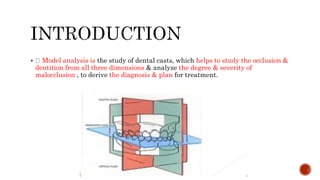
 Model analysis is the study of dental casts, which helps to study the occlusion &
dentition from all three dimensions & analyze the degree & severity of
malocclusion , to derive the diagnosis & plan for treatment.
 . They are three dimensional records of the patient’s dentition.
 Occlusion can be visualized from the lingual aspect.
 They provide a permanent record of the intermaxillary relationship.
 Helps to motivate the patients,as they can visualized the treatment progress.
 They are needed for comparison purposes at the end of treatment & act as a
reference for post treatment changes.
 They serve as reminder for the parent & the patient of the condition present at
the start of treatment.
 In case the patient has to be transferred to another clinician, study model are
an important record
 Vertical skeletal jaw discrepancy can’t be ascertained from cast.
 Dental cast simply provide an idea of the relative anteroposterior relationship of
the jaws to each other.
 Wheather the maxilla is retrusive or protrusive can’t be ascertained from casts
i.e.anteroposterior status of jaw to skeletal craniofacial complex can’t be determined
from study cast.
 Degree of labial/lingual inclination of incisors observed on cast can be misleading
because one tends to judge in relation to the artistic portion of the dental cast base
 . Ref:-Jacobson A.,Jacobson R.L;Radiographic cephaometry from basics to 3-D
imaging.2nd ed;2-4
 NON –RADIOGRAPHIC SPACE ANALYSES
 Moyer’s
 Tanaka Johnston
 Ballard and Wylie
 RADIOGRAPHIC ANALYSES
 Nance’s
 Huckaba’s
 COMBINATION OF RADIOGRAPHS AND PREDICTION CHARTS
 Hixon and Old father
 Staley kerber
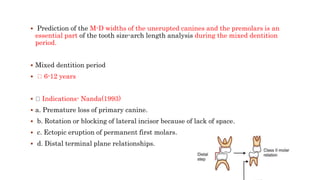
 Prediction of the M-D widths of the unerupted canines and the premolars is an
essential part of the tooth size-arch length analysis during the mixed dentition
period.
 Mixed dentition period
 6-12 years
 Indications- Nanda(1993)
 a. Premature loss of primary canine.
 b. Rotation or blocking of lateral incisor because of lack of space.
 c. Ectopic eruption of permanent first molars.
 d. Distal terminal plane relationships.
 Basis- high co relation among groups of teeth , thus measuring one group of teeth,
prediction of size of other group of teeth can be done1.
 Armamentarium-
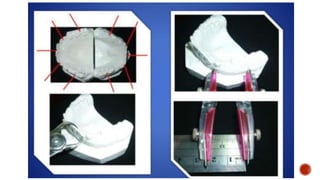
 1. Dental cast
 2. Boley’s guage
 3. Probability chart
 Procedure:
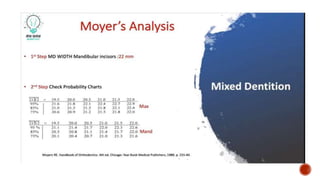
 1. Measure the widths of each of four permanent mandibular incisors .
 2. Total the M-D widths of mandibular incisors
 3. Using prediction chart for space available in mandibular arch,locate the value
closest to the sum of four mandibular incisor
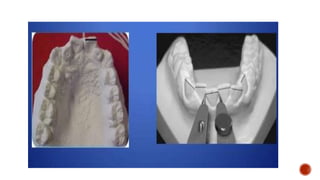
 3)On the study cast, determine and mark the midline of mandibular arch.
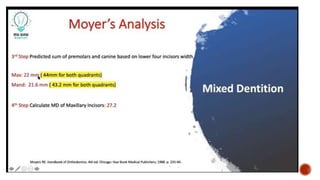
 4)Total the M-D widths of right mand’ incisors & set the boley’s gauge to this
value. Measure from midline to right side. Place one point of the gauge at the
midline bet’n the central incisor and let the other end lie along the line of the
dental arch on the right side. Mark on the point where the precise point where
the distal tip of boley’s gauge touched. Repeat for the left side.
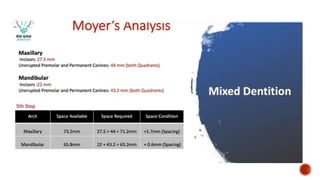
 5) Measure the dist betw the point marked on the cast to the mesial surface of
perm’ 1st molar.Record that value and calculate the difference

 6) Repeat the process on the maxillary arch.
 6)Compute the amt of space available. Measure the dist’ from the point marked
on the cast to mesial surface of the 1st molar, and calculate space difference
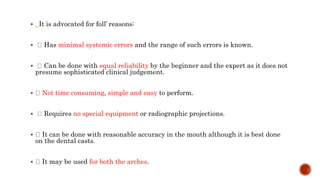
 . It is advocated for foll’ reasons:
 Has minimal systemic errors and the range of such errors is known.
 Can be done with equal reliability by the beginner and the expert as it does not
presume sophisticated clinical judgement.
 Not time consuming, simple and easy to perform.
 Requires no special equipment or radiographic projections.
 It can be done with reasonable accuracy in the mouth although it is best done
on the dental casts.
 It may be used for both the arches.
 Advantages-
 It has minimal error.
 Can be done with equal reliability
 Not time consuming
 No special equipment required
 Can be done in mouth as well as on cast
 Can be used for both arches
 Limitations
 1. Moyer’s analysis is probability analysis
 2. It does not account for tipping of mandibular incisor either lingually or facially
 3. Maxillary tooth size is predicted by mandibular teeth
 4. Moyers advised caution in using any analysis, as none was able to compensate
for the biological variation in individuals during the transition from primary to
permanent dentition3.
 5. Moyers equation does not mention the population group from which they were
calculated 13
 6. Moyer’s method of prediction may have population variations. For one to be
sure of the accuracy while using Moyer’s method it may be safer to develop
prediction tables for specific populations. Thus Moyer’s method cannot universally
be applied12
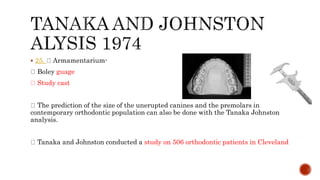
 25. Armamentarium-
Boley guage
Study cast
The prediction of the size of the unerupted canines and the premolars in
contemporary orthodontic population can also be done with the Tanaka Johnston
analysis.
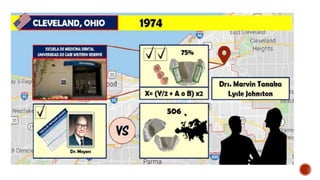
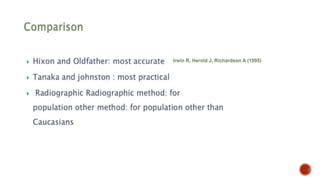
Tanaka and Johnston conducted a study on 506 orthodontic patients in Cleveland
 They believed that the Moyer’s equations and the size of his confidence
intervals have never been validated on any other samples
 They simplified the Moyer’s results and gave regressive equations of the form
 Y = A+B(X)
 Where Y = sum of the mesio distal widths of the unerupted canines and
premolars
 X = sum of the mesio distal widths of the lower incisors
 A & B are constants.
 For the maxillary arch , Y = 11 + 0.5 ( X )
 For the mandibular arch, Y = 10.5 + 0.5 ( X )
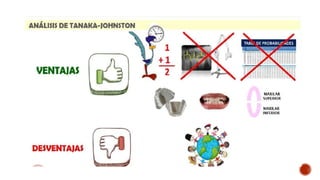
 Advantages-
 • Technique involves simple, easily repeated procedure with minimum material
requirement.
 • Prediction chart and radiograph is not required
 Limitations-
 • Error in predicted size if patients are not from North western European descent
 . • *John Y. K. Linga; Ricky W. K. Wong concluded constants for males (upper-
11.5; lower-10.5) or females (upper-11.0; lower-10.0) for southern Chinese
populatio
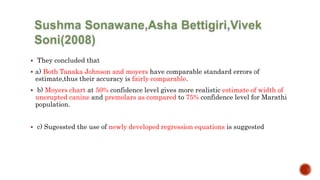
 They concluded that
 a) Both Tanaka Johnson and moyers have comparable standard errors of
estimate,thus their accuracy is fairly comparable.
 b) Moyers chart at 50% confidence level gives more realistic estimate of width of
unerupted canine and premolars as compared to 75% confidence level for Marathi
population.
 c) Sugessted the use of newly developed regression equations is suggested
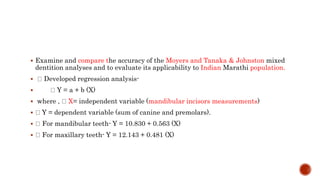
 Examine and compare the accuracy of the Moyers and Tanaka & Johnston mixed
dentition analyses and to evaluate its applicability to Indian Marathi population.
 Developed regression analysis-
 Y = a + b (X)
 where , X= independent variable (mandibular incisors measurements)
 Y = dependent variable (sum of canine and premolars).
 For mandibular teeth- Y = 10.830 + 0.563 (X)
 For maxillary teeth- Y = 12.143 + 0.481 (X)
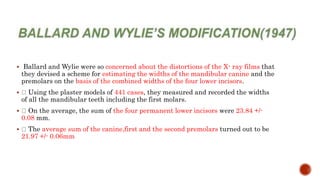
 Ballard and Wylie were so concerned about the distortions of the X- ray films that
they devised a scheme for estimating the widths of the mandibular canine and the
premolars on the basis of the combined widths of the four lower incisors.
 Using the plaster models of 441 cases, they measured and recorded the widths
of all the mandibular teeth including the first molars.
 On the average, the sum of the four permanent lower incisors were 23.84 +/-
0.08 mm.
 The average sum of the canine,first and the second premolars turned out to be
21.97 +/- 0.06mm
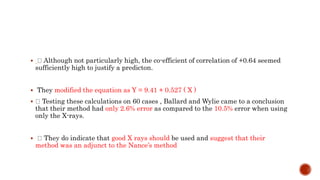
 Although not particularly high, the co-efficient of correlation of +0.64 seemed
sufficiently high to justify a predicton.
 They modified the equation as Y = 9.41 + 0.527 ( X )
 Testing these calculations on 60 cases , Ballard and Wylie came to a conclusion
that their method had only 2.6% error as compared to the 10.5% error when using
only the X-rays.
 They do indicate that good X rays should be used and suggest that their
method was an adjunct to the Nance’s method
 COMBINATION OF RADIOGRAPHS AND PREDICTION CHARTS
 Hixon and Old father
 Staley kerber
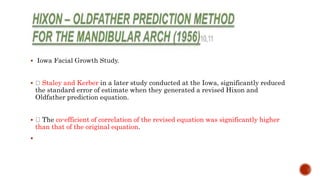
 Iowa Facial Growth Study.
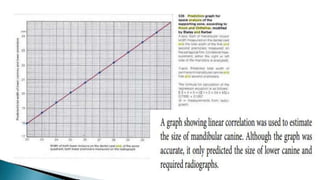
 Staley and Kerber in a later study conducted at the Iowa, significantly reduced
the standard error of estimate when they generated a revised Hixon and
Oldfather prediction equation.
 The co-efficient of correlation of the revised equation was significantly higher
than that of the original equation.

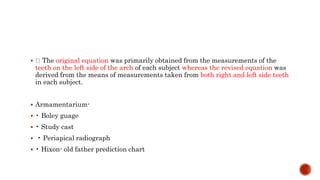
 The original equation was primarily obtained from the measurements of the
teeth on the left side of the arch of each subject whereas the revised equation was
derived from the means of measurements taken from both right and left side teeth
in each subject.
 Armamentarium-
 • Boley guage
 • Study cast
 • Periapical radiograph
 • Hixon- old father prediction chart
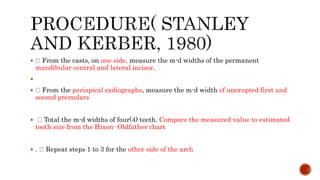
 From the casts, on one side, measure the m-d widths of the permanent
mandibular central and lateral incisor.

 From the periapical radiographs, measure the m-d width of unerupted first and
second premolars
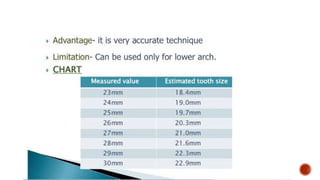
 Total the m-d widths of four(4) teeth. Compare the measured value to estimated
tooth size from the Hixon- Oldfather chart
 . Repeat steps 1 to 3 for the other side of the arch
RADIOGRAPHIC ANALYSES
 Nance’s
 Huckaba’s
 This analysis is similar to arch perimeter analysis of the permanent dentition
 Armamentarium
 Dental cast
 Boley gauge, millimeter ruler
 Peri-apical radiograph
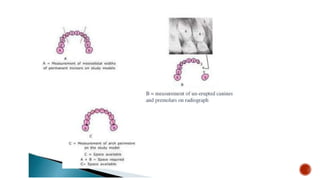
 SPACE REQUIRED:
 ◦ measure the mesio distal width of the erupted permanent teeth.
 ◦ Measure the width of each unerupted tooth, cuspids and bicuspids from the
IOPA.

 ◦ The total mesiodistal width of all the teeth in each quadrant will indicate space
required to accommodate the permanent teeth
 SPACE AVAILABLE: ◦ using brass wire, measure the arch perimeter from the
mesial surface of permanent first molar to the mesial surface of the permanent
first molar on the other side.
 ◦ Compare the space required and space available to arrive at the arch length
discrepancy
 ADVANTAGES
 It results in minimal errors
 It can be performed with reliability
 It allows analysis of both arches
 LIMITATION
 It is time consuming
 Complete mouth radiograph is needed
 Magnification power technique
 This analysis makes use of a radiograph and study cast to determine the width of
unerupted teeth
 Armamentarium
 Dental cast
 Boley gauge, millimeter ruler
 Periapical radiograph
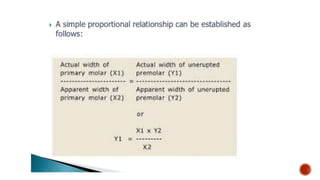
 With any type of radiograph, it is necessary to compensate for enlargement of
radiographic image.
 This can be done by measuring an object that can be seen both in the
radiograph and on the cast, such as primary molar tooth.
 It is possible to determine the measurements of un- erupted teeth by studying
the teeth that have already erupted in a radiograph and on a cast
 * Mixed dentition analysis forms an integral aspect of orthodontic diagnosis to
determine whether the treatment plan is going to involve serial extraction, space
maintenance, space gaining or simply periodic observation of the patient.
 https://www.slideshare.net/MohanadSharif/part-two-the-royal-london-space-
planning

Mixed dentition space analysis.pptx

  • 1.
    Fatima kh. salah 1styear orthodontic resident Al-Quds university
  • 2.
     Model analysisis the study of dental casts, which helps to study the occlusion & dentition from all three dimensions & analyze the degree & severity of malocclusion , to derive the diagnosis & plan for treatment.
  • 3.
     . Theyare three dimensional records of the patient’s dentition.  Occlusion can be visualized from the lingual aspect.  They provide a permanent record of the intermaxillary relationship.  Helps to motivate the patients,as they can visualized the treatment progress.  They are needed for comparison purposes at the end of treatment & act as a reference for post treatment changes.  They serve as reminder for the parent & the patient of the condition present at the start of treatment.  In case the patient has to be transferred to another clinician, study model are an important record
  • 4.
     Vertical skeletaljaw discrepancy can’t be ascertained from cast.  Dental cast simply provide an idea of the relative anteroposterior relationship of the jaws to each other.  Wheather the maxilla is retrusive or protrusive can’t be ascertained from casts i.e.anteroposterior status of jaw to skeletal craniofacial complex can’t be determined from study cast.  Degree of labial/lingual inclination of incisors observed on cast can be misleading because one tends to judge in relation to the artistic portion of the dental cast base  . Ref:-Jacobson A.,Jacobson R.L;Radiographic cephaometry from basics to 3-D imaging.2nd ed;2-4
  • 5.
     NON –RADIOGRAPHICSPACE ANALYSES  Moyer’s  Tanaka Johnston  Ballard and Wylie  RADIOGRAPHIC ANALYSES  Nance’s  Huckaba’s  COMBINATION OF RADIOGRAPHS AND PREDICTION CHARTS  Hixon and Old father  Staley kerber
  • 6.
     Prediction ofthe M-D widths of the unerupted canines and the premolars is an essential part of the tooth size-arch length analysis during the mixed dentition period.  Mixed dentition period  6-12 years  Indications- Nanda(1993)  a. Premature loss of primary canine.  b. Rotation or blocking of lateral incisor because of lack of space.  c. Ectopic eruption of permanent first molars.  d. Distal terminal plane relationships.
  • 7.
     Basis- highco relation among groups of teeth , thus measuring one group of teeth, prediction of size of other group of teeth can be done1.  Armamentarium-  1. Dental cast  2. Boley’s guage  3. Probability chart
  • 8.
     Procedure:  1.Measure the widths of each of four permanent mandibular incisors .  2. Total the M-D widths of mandibular incisors  3. Using prediction chart for space available in mandibular arch,locate the value closest to the sum of four mandibular incisor  3)On the study cast, determine and mark the midline of mandibular arch.  4)Total the M-D widths of right mand’ incisors & set the boley’s gauge to this value. Measure from midline to right side. Place one point of the gauge at the midline bet’n the central incisor and let the other end lie along the line of the dental arch on the right side. Mark on the point where the precise point where the distal tip of boley’s gauge touched. Repeat for the left side.
  • 9.
     5) Measurethe dist betw the point marked on the cast to the mesial surface of perm’ 1st molar.Record that value and calculate the difference   6) Repeat the process on the maxillary arch.  6)Compute the amt of space available. Measure the dist’ from the point marked on the cast to mesial surface of the 1st molar, and calculate space difference
  • 13.
     . Itis advocated for foll’ reasons:  Has minimal systemic errors and the range of such errors is known.  Can be done with equal reliability by the beginner and the expert as it does not presume sophisticated clinical judgement.  Not time consuming, simple and easy to perform.  Requires no special equipment or radiographic projections.  It can be done with reasonable accuracy in the mouth although it is best done on the dental casts.  It may be used for both the arches.
  • 14.
     Advantages-  Ithas minimal error.  Can be done with equal reliability  Not time consuming  No special equipment required  Can be done in mouth as well as on cast  Can be used for both arches  Limitations  1. Moyer’s analysis is probability analysis  2. It does not account for tipping of mandibular incisor either lingually or facially  3. Maxillary tooth size is predicted by mandibular teeth
  • 15.
     4. Moyersadvised caution in using any analysis, as none was able to compensate for the biological variation in individuals during the transition from primary to permanent dentition3.  5. Moyers equation does not mention the population group from which they were calculated 13  6. Moyer’s method of prediction may have population variations. For one to be sure of the accuracy while using Moyer’s method it may be safer to develop prediction tables for specific populations. Thus Moyer’s method cannot universally be applied12
  • 16.
     25. Armamentarium- Boleyguage Study cast The prediction of the size of the unerupted canines and the premolars in contemporary orthodontic population can also be done with the Tanaka Johnston analysis. Tanaka and Johnston conducted a study on 506 orthodontic patients in Cleveland
  • 18.
     They believedthat the Moyer’s equations and the size of his confidence intervals have never been validated on any other samples  They simplified the Moyer’s results and gave regressive equations of the form  Y = A+B(X)  Where Y = sum of the mesio distal widths of the unerupted canines and premolars  X = sum of the mesio distal widths of the lower incisors  A & B are constants.  For the maxillary arch , Y = 11 + 0.5 ( X )  For the mandibular arch, Y = 10.5 + 0.5 ( X )
  • 19.
     Advantages-  •Technique involves simple, easily repeated procedure with minimum material requirement.  • Prediction chart and radiograph is not required  Limitations-  • Error in predicted size if patients are not from North western European descent  . • *John Y. K. Linga; Ricky W. K. Wong concluded constants for males (upper- 11.5; lower-10.5) or females (upper-11.0; lower-10.0) for southern Chinese populatio
  • 23.
     They concludedthat  a) Both Tanaka Johnson and moyers have comparable standard errors of estimate,thus their accuracy is fairly comparable.  b) Moyers chart at 50% confidence level gives more realistic estimate of width of unerupted canine and premolars as compared to 75% confidence level for Marathi population.  c) Sugessted the use of newly developed regression equations is suggested
  • 24.
     Examine andcompare the accuracy of the Moyers and Tanaka & Johnston mixed dentition analyses and to evaluate its applicability to Indian Marathi population.  Developed regression analysis-  Y = a + b (X)  where , X= independent variable (mandibular incisors measurements)  Y = dependent variable (sum of canine and premolars).  For mandibular teeth- Y = 10.830 + 0.563 (X)  For maxillary teeth- Y = 12.143 + 0.481 (X)
  • 25.
     Ballard andWylie were so concerned about the distortions of the X- ray films that they devised a scheme for estimating the widths of the mandibular canine and the premolars on the basis of the combined widths of the four lower incisors.  Using the plaster models of 441 cases, they measured and recorded the widths of all the mandibular teeth including the first molars.  On the average, the sum of the four permanent lower incisors were 23.84 +/- 0.08 mm.  The average sum of the canine,first and the second premolars turned out to be 21.97 +/- 0.06mm
  • 26.
     Although notparticularly high, the co-efficient of correlation of +0.64 seemed sufficiently high to justify a predicton.  They modified the equation as Y = 9.41 + 0.527 ( X )  Testing these calculations on 60 cases , Ballard and Wylie came to a conclusion that their method had only 2.6% error as compared to the 10.5% error when using only the X-rays.  They do indicate that good X rays should be used and suggest that their method was an adjunct to the Nance’s method
  • 27.
     COMBINATION OFRADIOGRAPHS AND PREDICTION CHARTS  Hixon and Old father  Staley kerber
  • 28.
     Iowa FacialGrowth Study.  Staley and Kerber in a later study conducted at the Iowa, significantly reduced the standard error of estimate when they generated a revised Hixon and Oldfather prediction equation.  The co-efficient of correlation of the revised equation was significantly higher than that of the original equation. 
  • 29.
     The originalequation was primarily obtained from the measurements of the teeth on the left side of the arch of each subject whereas the revised equation was derived from the means of measurements taken from both right and left side teeth in each subject.  Armamentarium-  • Boley guage  • Study cast  • Periapical radiograph  • Hixon- old father prediction chart
  • 30.
     From thecasts, on one side, measure the m-d widths of the permanent mandibular central and lateral incisor.   From the periapical radiographs, measure the m-d width of unerupted first and second premolars  Total the m-d widths of four(4) teeth. Compare the measured value to estimated tooth size from the Hixon- Oldfather chart  . Repeat steps 1 to 3 for the other side of the arch
  • 33.
  • 34.
     This analysisis similar to arch perimeter analysis of the permanent dentition  Armamentarium  Dental cast  Boley gauge, millimeter ruler  Peri-apical radiograph
  • 35.
     SPACE REQUIRED: ◦ measure the mesio distal width of the erupted permanent teeth.  ◦ Measure the width of each unerupted tooth, cuspids and bicuspids from the IOPA.   ◦ The total mesiodistal width of all the teeth in each quadrant will indicate space required to accommodate the permanent teeth
  • 36.
     SPACE AVAILABLE:◦ using brass wire, measure the arch perimeter from the mesial surface of permanent first molar to the mesial surface of the permanent first molar on the other side.  ◦ Compare the space required and space available to arrive at the arch length discrepancy
  • 38.
     ADVANTAGES  Itresults in minimal errors  It can be performed with reliability  It allows analysis of both arches  LIMITATION  It is time consuming  Complete mouth radiograph is needed
  • 39.
     Magnification powertechnique  This analysis makes use of a radiograph and study cast to determine the width of unerupted teeth  Armamentarium  Dental cast  Boley gauge, millimeter ruler  Periapical radiograph
  • 40.
     With anytype of radiograph, it is necessary to compensate for enlargement of radiographic image.  This can be done by measuring an object that can be seen both in the radiograph and on the cast, such as primary molar tooth.  It is possible to determine the measurements of un- erupted teeth by studying the teeth that have already erupted in a radiograph and on a cast
  • 43.
     * Mixeddentition analysis forms an integral aspect of orthodontic diagnosis to determine whether the treatment plan is going to involve serial extraction, space maintenance, space gaining or simply periodic observation of the patient.
  • 44.