STUDIO ROLES
DIRECTOR
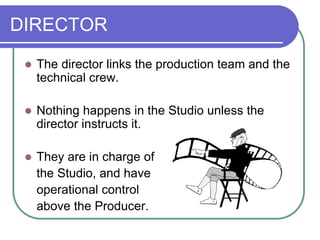
 The director links the production team and the
technical crew.
 Nothing happens in the Studio unless the
director instructs it.
 They are in charge of
the Studio, and have
operational control
above the Producer.
DIRECTOR (cont)
 The director works out how he/she can follow
the running order and script in the smoothest
way.
 The job of a director may also include
adjusting cameras, loading videotapes,
moving presenters, guests or reporters and
changing graphics.
COMMANDS
 The director issues commands to the
camera operators to:
 Set up shots
 Refine the framing and composition of a
shot
 Direct the movement of a camera while
the shot is on the air
COMMANDS
 The director also issues commands to the
vision mixer and sound supervisor.
 Commands to the team should be clear and
brief: e.g instead of saying, “Ready to cut to
Camera 2. . . Cut to Camera 2,” say “Ready
to take 2 ... take 2.”
PRODUCTION ASSISTANT
 The PA is responsible for keeping the running
order and scripts in shape.
 The PA prints scripts. Floor manager
distributes them to the studio and gallery.
 Responsible for timing. They time the length of
each insert and the whole programme. They
warn the editorial team if the programme is
likely to run over or under the allotted time.
PRODUCTION ASSISTANT (cont.)
 The production assistant uses the stopwatch
to time the length of each VT clip played out
by the vision mixer.
 When the programme is on air, they count
down in seconds (usually 5, 4, 3, 2, 1) to warn
the gallery and studio team the next section of
the programme is due to start.
 In studio music productions it is the PA who
bar counts the music.
FLOOR MANAGER
 The floor manager stays in the television
studio during a production.
 The floor manager is responsible for the safety
of everyone in the studio.
 Through a headset, they are in direct, two-way
communication with the director in the gallery.
 The floor manager is effectively the "eyes and
ears" and "hands and feet" of the director in
the studio.
FLOOR MANAGER (cont)
 Distribute running orders and scripts to the
studio and gallery team.
 They listen for changes and pass them onto
the director.
 In rehearsals, the floor manager will "sit in" for
the presenter, so the director can block the
programme.
 Count down and cue presenters and
interviewees.
 Brief and warm up studio audiences.
CAMERA OPERATORS
 The director asks the camera operator to
frame the shots needed.
 The camera operator can zoom in or out, track
in or out, crab right or left, pan left and right,
crane up and down, or tilt up and down.
 Together with the floor manager, they are
responsible for the safety in the studio.
 They have to think carefully about how to
move the cameras around to get the best
shots, without causing an accident.
CAMERA OPERATORS
 During rehearsals, the camera operators
suggest a variety of different shots, angles and
ways of framing.
 The director selects the best ideas to use in
the live programme.
 The camera operator follows the running order
timings and countdowns from the production
assistant.
VISION MIXER
 Vision mixers work in the gallery. They are
responsible for controlling the vision mixing
desk: the pictures that the viewer sees on
their television.
 Typical work activities include:
1. viewing images from a variety of sources, e.g.
pictures from several cameras, digital video
effects, graphics and outside broadcast
materials;
2. selecting the images and putting them
together - 'cutting', 'mixing' and 'wiping';
controlling which camera goes on air.
VISION MIXER COMMANDS
 Give a “ready” or “standby” cue whenever
possible. This tells the cameraman to hold a
particular shot that it is about to air. Give a “ready”
command just before a camera movement e.g. if the
talent is seated and is scheduled to getup and move to
the left, say, “Camera 3, ready to pan right with the
talent.”
 Identify each camera by number, not name. Begin
a command with the camera number. Do not say,
“Ready to pan right with the talent, Camera 3.
 Be specific when issuing commands. For example,
the command “Camera 1, zoom out” is too vague.
Instead, you should say: “Camera 1, zoom out to
two shot.”
SOUND SUPERVISOR
 Sound Supervisors are in charge of sound crews,
including Grams (Gramophone) Operators, Sound
Technicians, Boom Operators, and Technical
Assistants.
 Just before the production they check all the sound
levels.
 They are responsible for the television audio mixing
console.
 The console has all the sound inputs fed into it,
including mic’s from the studio, CD players, sound
fx and so forth.
SOUND SUPERVISOR (cont)
 The sound supervisor has absolute control over the
inputs and must balance them so that they
are at a compatible level.
 The output must be at an acceptable
level to the receiver (videotape recorder,
television set or monitor) and must fade-in or fade-out
at the command of the director.
 The sound supervisor looks at the running order and
listens to the director to know when to put the
different sound sources live on air.
SOUND SUPERVISOR
 They use the "faders" on the desk to make sounds
louder (fade up) or quieter (fade down).
 A "mix" is a move from one sound source another by
fading one up and the other down.
 A "balance" is move between sound sources so that
the overall sound level stays the same.
 A "cross fade" is a move from one source to the other
where the sound overlaps
AUTOCUE OPERATOR
 The autocue operator controls the equipment
which allows presenters to read their script
without having to remember it or look down at
a piece of paper.
 The scripts are loaded into a computer in the
same order as they appear in the running
order. As the presenter read the scripts from a
screen in front of them, the operator controls
the speed of the words, matching it to the
presenter's natural pace.
AUTOCUE
 It is the job of the autocue operator to update
the scripts, under direction from the producer,
director or presenter. Sometimes they have
to do this while the programme is live on air!
 There are portable versions of autocue which
can be taken on location when necessary.
VT PLAY IN
 The video tape operator is responsible for playing all
the pre-recorded visual material at the right time.
 Under instruction from the director, they load the video
tapes (including any inserts) in the sequence written
on the running order.
 After the programme rehearsal, the VT operator
makes sure the tapes are rewound to the start position
for transmission.
 The VT operator should know the length of each report
and the whole programme.
PRODUCER
 Sits in the gallery.
 Controls the content, rather than the visuals.
 Liaises with the PA over durations of items,
and reallocates time accordingly.
 Often feeds questions to the presenters over
talkback.

Studio Roles

  • 1.
  • 2.
    DIRECTOR  The directorlinks the production team and the technical crew.  Nothing happens in the Studio unless the director instructs it.  They are in charge of the Studio, and have operational control above the Producer.
  • 3.
    DIRECTOR (cont)  Thedirector works out how he/she can follow the running order and script in the smoothest way.  The job of a director may also include adjusting cameras, loading videotapes, moving presenters, guests or reporters and changing graphics.
  • 4.
    COMMANDS  The directorissues commands to the camera operators to:  Set up shots  Refine the framing and composition of a shot  Direct the movement of a camera while the shot is on the air
  • 5.
    COMMANDS  The directoralso issues commands to the vision mixer and sound supervisor.  Commands to the team should be clear and brief: e.g instead of saying, “Ready to cut to Camera 2. . . Cut to Camera 2,” say “Ready to take 2 ... take 2.”
  • 6.
    PRODUCTION ASSISTANT  ThePA is responsible for keeping the running order and scripts in shape.  The PA prints scripts. Floor manager distributes them to the studio and gallery.  Responsible for timing. They time the length of each insert and the whole programme. They warn the editorial team if the programme is likely to run over or under the allotted time.
  • 7.
    PRODUCTION ASSISTANT (cont.) The production assistant uses the stopwatch to time the length of each VT clip played out by the vision mixer.  When the programme is on air, they count down in seconds (usually 5, 4, 3, 2, 1) to warn the gallery and studio team the next section of the programme is due to start.  In studio music productions it is the PA who bar counts the music.
  • 8.
    FLOOR MANAGER  Thefloor manager stays in the television studio during a production.  The floor manager is responsible for the safety of everyone in the studio.  Through a headset, they are in direct, two-way communication with the director in the gallery.  The floor manager is effectively the "eyes and ears" and "hands and feet" of the director in the studio.
  • 9.
    FLOOR MANAGER (cont) Distribute running orders and scripts to the studio and gallery team.  They listen for changes and pass them onto the director.  In rehearsals, the floor manager will "sit in" for the presenter, so the director can block the programme.  Count down and cue presenters and interviewees.  Brief and warm up studio audiences.
  • 10.
    CAMERA OPERATORS  Thedirector asks the camera operator to frame the shots needed.  The camera operator can zoom in or out, track in or out, crab right or left, pan left and right, crane up and down, or tilt up and down.  Together with the floor manager, they are responsible for the safety in the studio.  They have to think carefully about how to move the cameras around to get the best shots, without causing an accident.
  • 11.
    CAMERA OPERATORS  Duringrehearsals, the camera operators suggest a variety of different shots, angles and ways of framing.  The director selects the best ideas to use in the live programme.  The camera operator follows the running order timings and countdowns from the production assistant.
  • 12.
    VISION MIXER  Visionmixers work in the gallery. They are responsible for controlling the vision mixing desk: the pictures that the viewer sees on their television.  Typical work activities include: 1. viewing images from a variety of sources, e.g. pictures from several cameras, digital video effects, graphics and outside broadcast materials; 2. selecting the images and putting them together - 'cutting', 'mixing' and 'wiping'; controlling which camera goes on air.
  • 13.
    VISION MIXER COMMANDS Give a “ready” or “standby” cue whenever possible. This tells the cameraman to hold a particular shot that it is about to air. Give a “ready” command just before a camera movement e.g. if the talent is seated and is scheduled to getup and move to the left, say, “Camera 3, ready to pan right with the talent.”  Identify each camera by number, not name. Begin a command with the camera number. Do not say, “Ready to pan right with the talent, Camera 3.  Be specific when issuing commands. For example, the command “Camera 1, zoom out” is too vague. Instead, you should say: “Camera 1, zoom out to two shot.”
  • 14.
    SOUND SUPERVISOR  SoundSupervisors are in charge of sound crews, including Grams (Gramophone) Operators, Sound Technicians, Boom Operators, and Technical Assistants.  Just before the production they check all the sound levels.  They are responsible for the television audio mixing console.  The console has all the sound inputs fed into it, including mic’s from the studio, CD players, sound fx and so forth.
  • 15.
    SOUND SUPERVISOR (cont) The sound supervisor has absolute control over the inputs and must balance them so that they are at a compatible level.  The output must be at an acceptable level to the receiver (videotape recorder, television set or monitor) and must fade-in or fade-out at the command of the director.  The sound supervisor looks at the running order and listens to the director to know when to put the different sound sources live on air.
  • 16.
    SOUND SUPERVISOR  Theyuse the "faders" on the desk to make sounds louder (fade up) or quieter (fade down).  A "mix" is a move from one sound source another by fading one up and the other down.  A "balance" is move between sound sources so that the overall sound level stays the same.  A "cross fade" is a move from one source to the other where the sound overlaps
  • 17.
    AUTOCUE OPERATOR  Theautocue operator controls the equipment which allows presenters to read their script without having to remember it or look down at a piece of paper.  The scripts are loaded into a computer in the same order as they appear in the running order. As the presenter read the scripts from a screen in front of them, the operator controls the speed of the words, matching it to the presenter's natural pace.
  • 18.
    AUTOCUE  It isthe job of the autocue operator to update the scripts, under direction from the producer, director or presenter. Sometimes they have to do this while the programme is live on air!  There are portable versions of autocue which can be taken on location when necessary.
  • 19.
    VT PLAY IN The video tape operator is responsible for playing all the pre-recorded visual material at the right time.  Under instruction from the director, they load the video tapes (including any inserts) in the sequence written on the running order.  After the programme rehearsal, the VT operator makes sure the tapes are rewound to the start position for transmission.  The VT operator should know the length of each report and the whole programme.
  • 20.
    PRODUCER  Sits inthe gallery.  Controls the content, rather than the visuals.  Liaises with the PA over durations of items, and reallocates time accordingly.  Often feeds questions to the presenters over talkback.