Student-generated videos: A model for developing written
standard operating procedures in academic labs
North Carolina State University
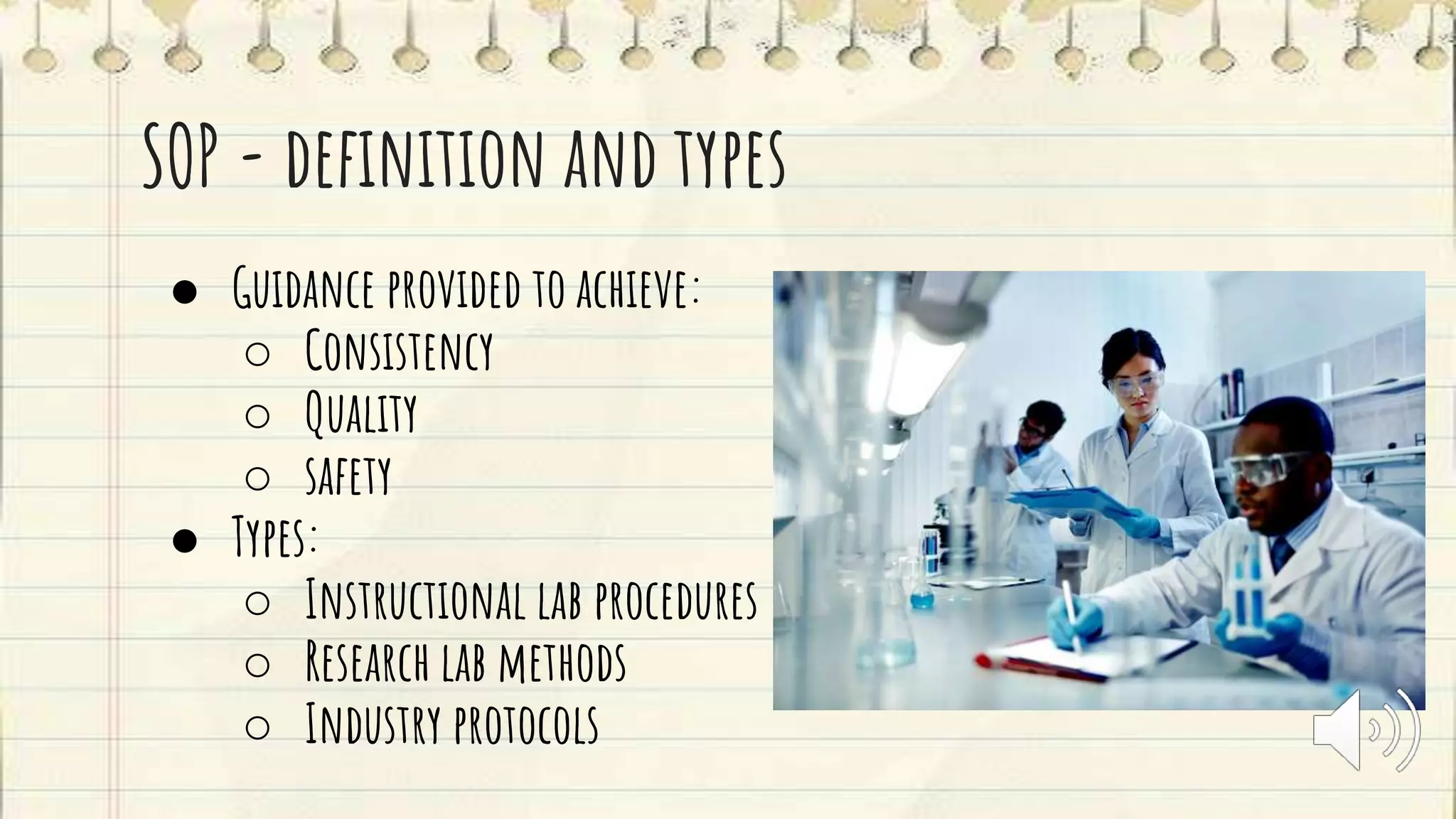
Melinda Box, Chem Dept Safety Officer
Ciana Paye, Undergraduate Student
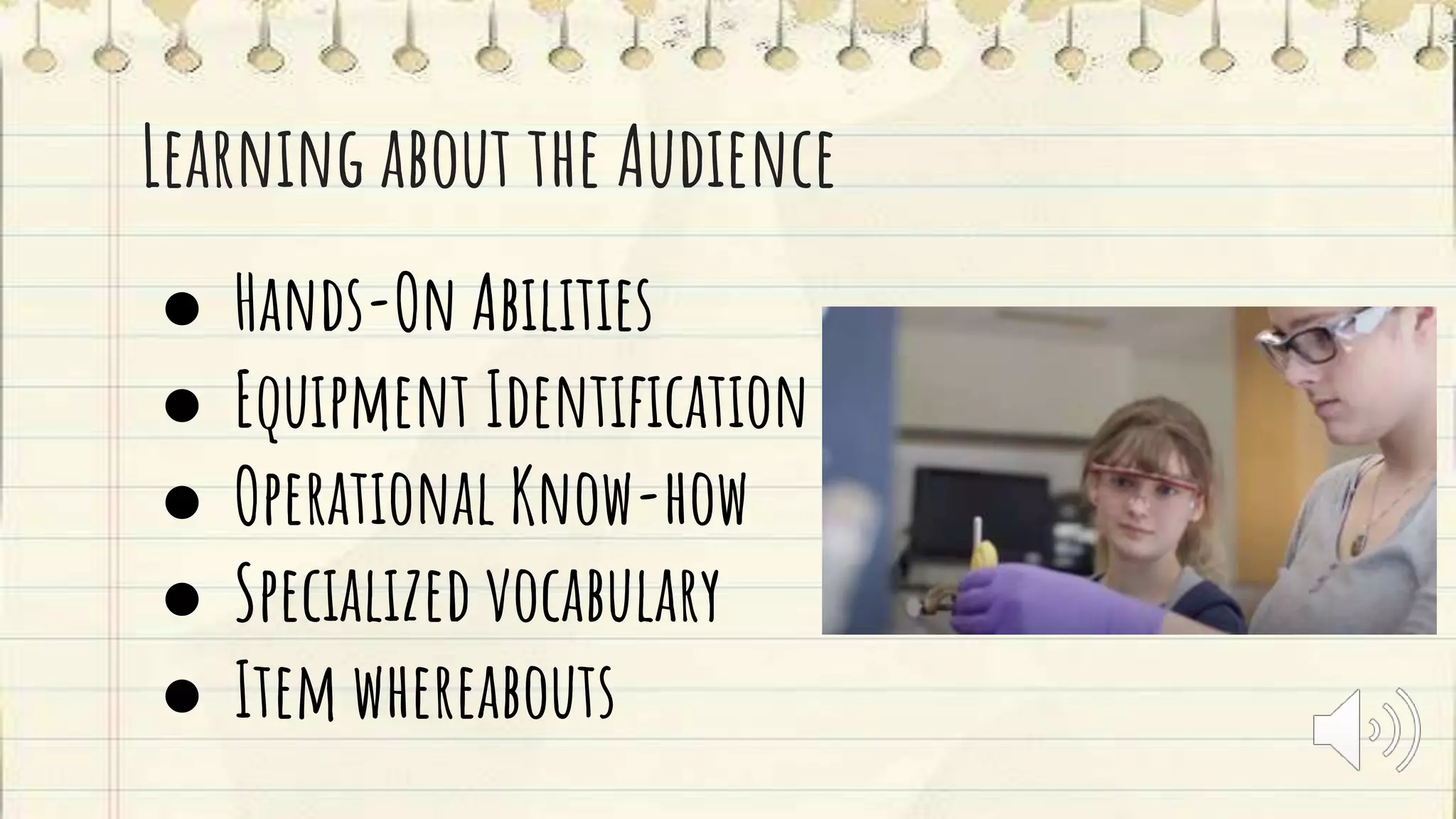
Maria Gallardo-Williams, Director of Organic Chemistry Labs
SOP - definition and types
● Guidance provided to achieve:
○ Consistency
○ Quality
○ safety
● Types:
○ Instructional lab procedures
○ Research lab methods
○ Industry protocols
Common Issues in SOP Content
● EXCESS INFORMATION
● Unuseful detail
● OVER Use OF TEMPLATE
● LACK OF Procedure
Learning about the Audience
● Hands-On Abilities
● Equipment Identification
● Operational Know-how
● Specialized vocabulary
● Item whereabouts
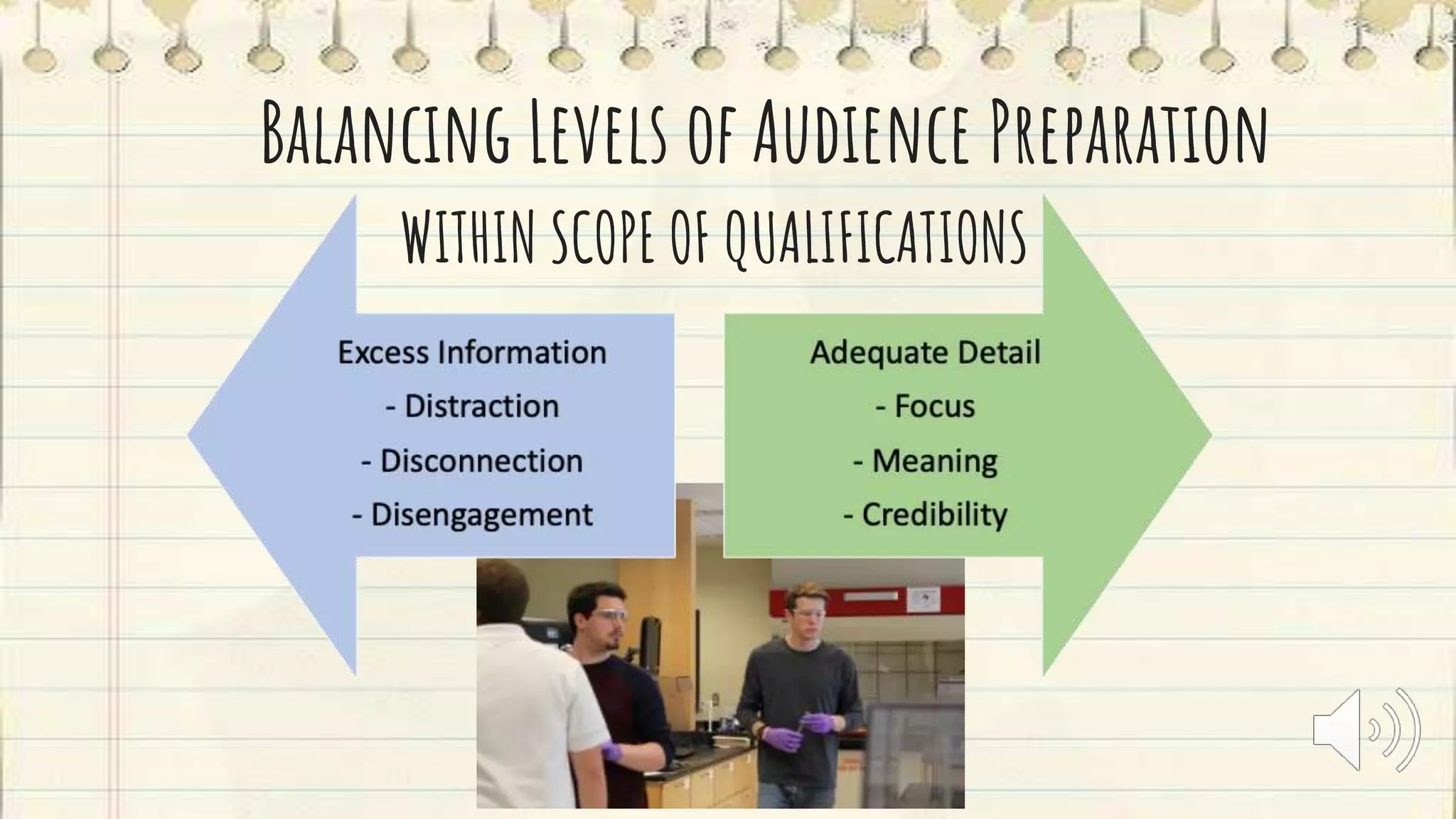
Balancing Levels of Audience Preparation
WITHIN SCOPE OF QUALIFICATIONS
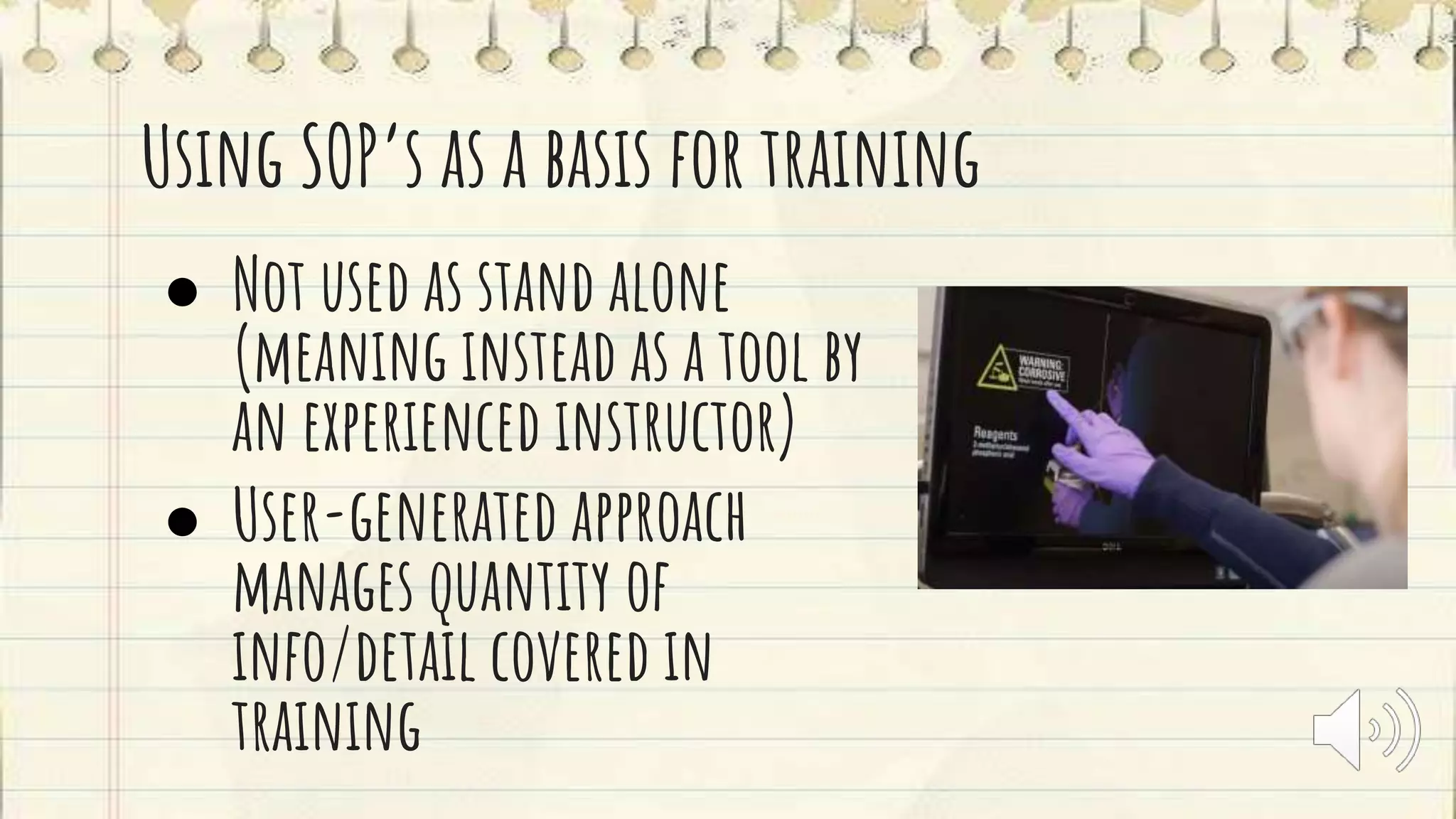
Using SOP’s as a basis for training
● Not used as stand alone
(meaning instead as a tool by
an experienced instructor)
● User-generated approach
manages quantity of
info/detail covered in
training
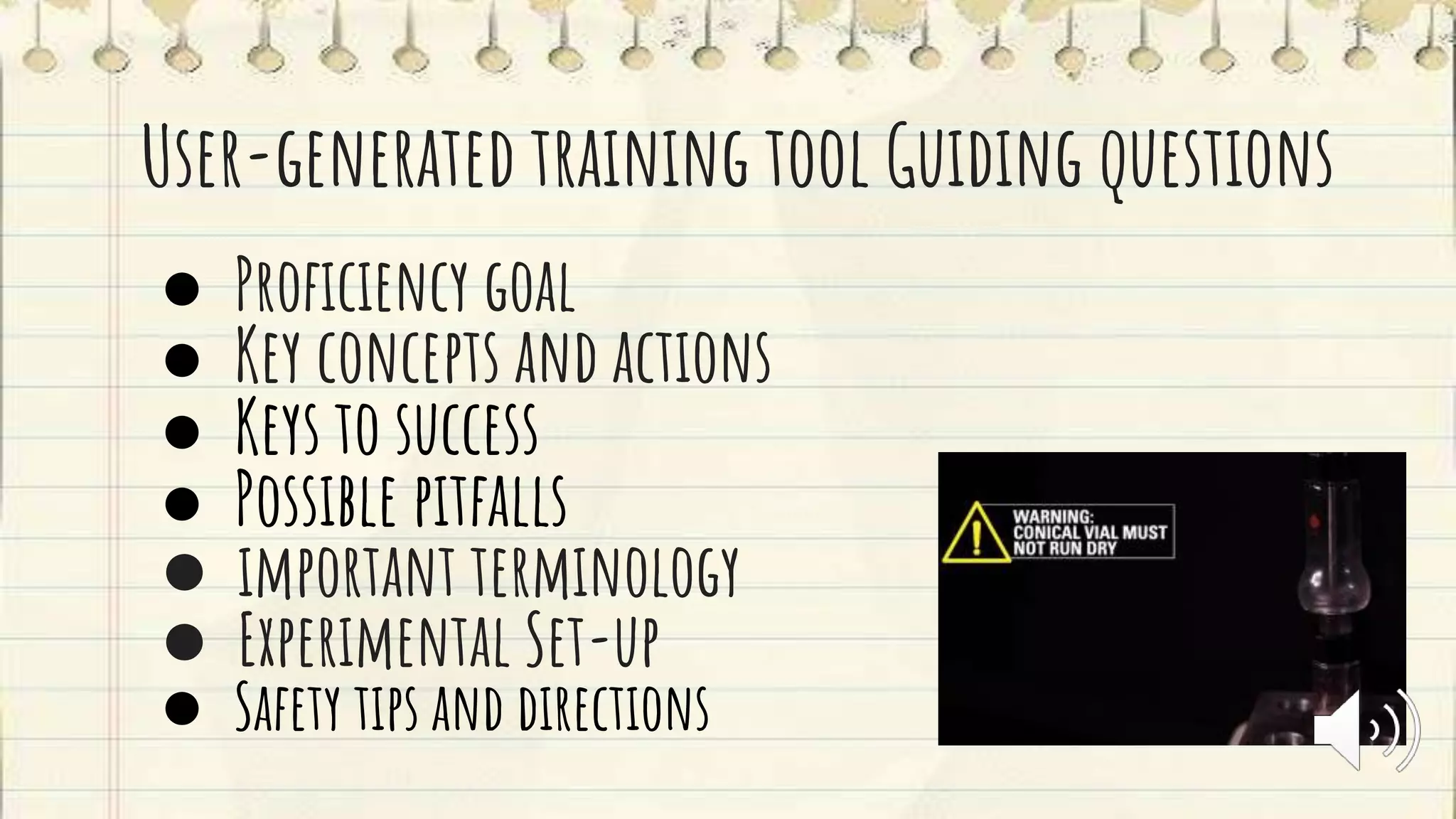
User-generated training tool Guiding questions
● Proficiency goal
● Key concepts and actions
● Keys to success
● Possible pitfalls
● important terminology
● Experimental Set-up
● Safety tips and directions
Newly Trained Users Making Instructional Videos
● efficiently identify needed info
● Invite engagement through immediacy
● Bring enthusiasm and commitment
● Reap personal benefits by deepening
understanding and showcasing new expertise
● Strengthen connection to content recipients
Why Story Structure Is Essential
● Comprehendable and user-friendly
● Universal approach → Resonance
● Organization, consistency,
structure
● Beginning, middle, end
How Story Structure Fits
● Plot
○ Utilizes Beginning, Middle, and End
○ provides familiar sense of purpose and direction
● evokes identification with the Protagonist
● Provides a clear challenge
Authentication of content
● By one person recording the
steps while another performs
them to make the draft
● by another user running
through the draft
● By an expert
Lessons Learned from user-generated video production
● Form a team
● Facilitate sharing between past and current
writing teams with an on-line repository
● Recruit Users with varied aptitudes
● Start with an assignment to review
Best Practices for Instructional Videos and SOPs
● Get New Users involved in development of SOPs
● Authenticate written content
● Follow story structure
● Format SOPs as Training Tools rather than
standalone documents
Acknowledgements
● Students contributing to the NCSU Organic Chemistry
Lecture and Lab Instructional video Collection
● office of Distance Education and Learning Technology
Applications (aka DELTA) @ NCSU
● NCSU Chemistry Department

Student-generated videos: a model for developing written standard operating procedures in academic labs

  • 1.
    Student-generated videos: Amodel for developing written standard operating procedures in academic labs North Carolina State University Melinda Box, Chem Dept Safety Officer Ciana Paye, Undergraduate Student Maria Gallardo-Williams, Director of Organic Chemistry Labs
  • 2.
    SOP - definitionand types ● Guidance provided to achieve: ○ Consistency ○ Quality ○ safety ● Types: ○ Instructional lab procedures ○ Research lab methods ○ Industry protocols
  • 3.
    Common Issues inSOP Content ● EXCESS INFORMATION ● Unuseful detail ● OVER Use OF TEMPLATE ● LACK OF Procedure
  • 4.
    Learning about theAudience ● Hands-On Abilities ● Equipment Identification ● Operational Know-how ● Specialized vocabulary ● Item whereabouts
  • 5.
    Balancing Levels ofAudience Preparation WITHIN SCOPE OF QUALIFICATIONS
  • 6.
    Using SOP’s asa basis for training ● Not used as stand alone (meaning instead as a tool by an experienced instructor) ● User-generated approach manages quantity of info/detail covered in training
  • 7.
    User-generated training toolGuiding questions ● Proficiency goal ● Key concepts and actions ● Keys to success ● Possible pitfalls ● important terminology ● Experimental Set-up ● Safety tips and directions
  • 8.
    Newly Trained UsersMaking Instructional Videos ● efficiently identify needed info ● Invite engagement through immediacy ● Bring enthusiasm and commitment ● Reap personal benefits by deepening understanding and showcasing new expertise ● Strengthen connection to content recipients
  • 9.
    Why Story StructureIs Essential ● Comprehendable and user-friendly ● Universal approach → Resonance ● Organization, consistency, structure ● Beginning, middle, end
  • 10.
    How Story StructureFits ● Plot ○ Utilizes Beginning, Middle, and End ○ provides familiar sense of purpose and direction ● evokes identification with the Protagonist ● Provides a clear challenge
  • 11.
    Authentication of content ●By one person recording the steps while another performs them to make the draft ● by another user running through the draft ● By an expert
  • 12.
    Lessons Learned fromuser-generated video production ● Form a team ● Facilitate sharing between past and current writing teams with an on-line repository ● Recruit Users with varied aptitudes ● Start with an assignment to review
  • 13.
    Best Practices forInstructional Videos and SOPs ● Get New Users involved in development of SOPs ● Authenticate written content ● Follow story structure ● Format SOPs as Training Tools rather than standalone documents
  • 14.
    Acknowledgements ● Students contributingto the NCSU Organic Chemistry Lecture and Lab Instructional video Collection ● office of Distance Education and Learning Technology Applications (aka DELTA) @ NCSU ● NCSU Chemistry Department

Editor's Notes

  • #2 Good evening and welcome to our presentation on using student-generated videos as a model for developing written standard operating procedures, in academic laboratories, in particular.  I’m Melinda Box, and I’m the Chemistry Dept Safety Officer at North Carolina State University, and my co-authors are Ciana Paye, who is an Undergraduate Assistant in our Organic Chemistry lab program, and Maria Gallardo-Williams, who is the Director of that Organic Chemistry Lab program, where these student-generated videos were made.
  • #3 First I want to start off by establishing a baseline of what we mean by Standard Operating Procedures (or SOP’s) since they can take a variety of forms.  Our focus is in the laboratory, and there they constitute sets of instructions, which are intended to insure consistency, quality, and safety for things like procedures and protocols in settings that include research, instruction, processing, and manufacturing.  What we want to outline here is how our experiences in an instructional setting can be extrapolated to those of other lab settings, and how the lessons we learned through involving undergraduate students can be utilized with equal success among graduate students, researcher staff, and other lab technicians to provide clear, useful, and dependable direction.
  • #4 Unfortunately, all too often the SOP’s that do exist lack the qualities that would make them essential for the tasks or realms they cover and so they get neglected.  The reason may be one of a number of things that make them insufficiently engaging or useful in applying them to practice or using them as guidance for training.  Qualities that make them relegated to this status of just a bureaucratic exercise include providing excess information in the SOP, incorporating unuseful detail, repetitively using the same content as can happen with an unvarying use of templates, in which case the same information might show up again and again and so people stop noticing it, and lacking a clear procedure so that there is not a sufficient link between what the content is and practice.
  • #5 So how do we address this issue?  First we have to get to know the audience when we’re approaching writing an SOP.  Aspects of the audience’s background to check might include hands-on abilities, equipment identifications, operational knowledge,  lexigraphic comprehension (or their vocabulary familiarity), and item locations.  Note that this last area of knowledge can be easily overlooked in writing an SOP because we are often focused on aptitude and conceptual familiarity and forget to take into consideration the practicalities of where this procedure will be done.
  • #6 So next how do we frame this knowledge of the audience preparation? First we must identify how much variation there is in their levels of skill and knowledge, and then, narrowing from there, we can establish a center, so to speak, for that variation in terms of the qualifications necessary for the setting or position.  Starting from this midpoint will help a lot when it comes to reducing the amount of potentially unuseful and ineffective information.  Nonetheless trying to cover the extreme of the least possible preparation can still result in an amount of detail that is distracting for many, if not most users, and thus communicates disconnection with the audience and causes user disengagement.  As a result a balance must be sought between the amount of detail needed to address the lowest possible preparation and to maintain the average user’s attention because a document that is sufficiently focused in this fashion will convey greater meaning and thus establish or maintain credibility for the SOP source as a whole.
  • #7 So how do we achieve that balance?  One way is to view SOP’s as training tools rather than stand alone directions and let me explain why.  If an SOP is written to include enough information so that all first-time users would have everything they needed without the assistance of an experienced guide, then the document becomes only good for that first use. Meaning it’s only beneficial to a reader when they need the most information they will ever need, and after that the introductory information becomes a distraction and a hindrance to successful implementation.  There is so much editing that has to go on in the brain to skip over the parts that are no longer needed that users are unlikely to turn to it for support. By contrast, if the SOP is introduced and initially interpreted under the tutelage of a trainer that additional content is never needed. Instead as a training tool the SOP focuses on the unique and high priority aspects of a procedure, leaning on the trainer’s validation of user understanding to fill in variations in preparation and background knowledge. And, in our experience, we found that the user-generated approach became a direct route to creating SOP’s that fill this training tool role. When people learn something new, they often want to share it with someone else, and that inherent immediacy readily translates to managing the amount of information and detail that must be included.
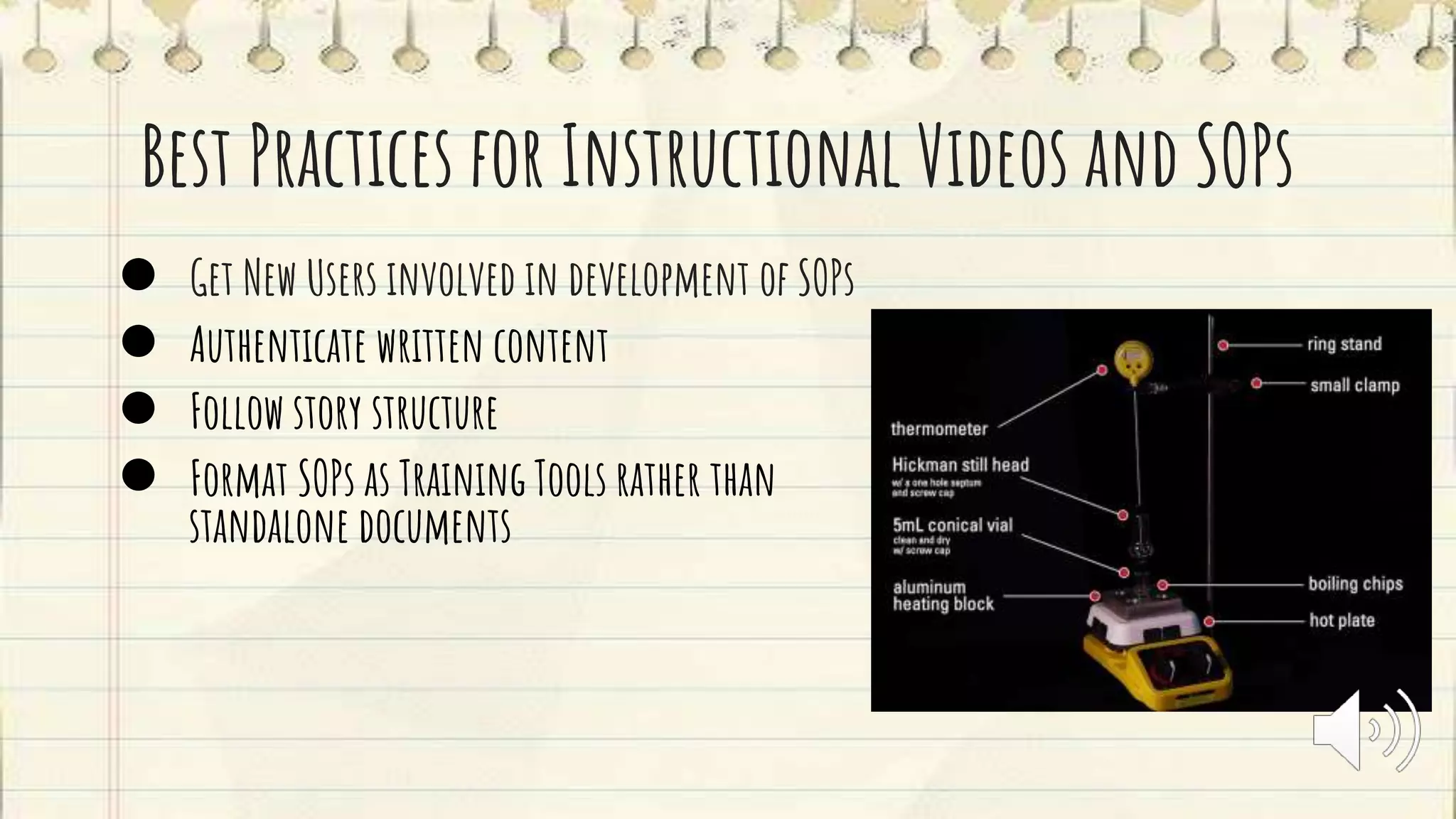
  • #8 So how did we guide users as they generated the instructional videos? We encourage them to consider questions such as: What proficiency were you working toward in doing this procedure? What are the key concepts you needed to learn? What novel sequence of actions were you introduced to? What were the keys to success?  What possible pitfalls were there? What new terminology did you learn? What were the important details of the set-up?  What did you need to know to work safely?
  • #9 In our experience with producing user-generated content, such as video and educational materials, we have learned some lessons that we believe can be applied to the creation and use of written SOPs. When users (as opposed to experts) generate content, their immediate past experience can be the blueprint for the new content creation. They are generally able to focus on the essential information required, and not likely to share extraneous details. This near-peer, recent learner perspective model of information transfer produces very different content from that which would be delivered by an expert. It is more immediate and therefore appeals more readily to new users, inviting greater engagement.  From the creators’ perspective, the users that produce the content benefit from the opportunity to showcase their newly acquired expertise and share it with others, which can lead to a deeper understanding of the principles involved, and insure that they keep a vested interest in the outcome. In that regard, this exercise is a learning experience, and a chance to extend the learning past the occasional use of a procedure or technique.  From the viewpoint of the SOP target recipients, the material is being delivered by a peer (or peers) that just mastered the content, understands the importance of the limited information being shared, and is still enthusiastic about their achievement. The ability to connect among peers is maximized in this exchange, and users appreciate the information transfer. This creates a link between new and existing users, and in turn can inspire the new users to become creators of other learning materials.
  • #10 What we also found was that story structure was essential to user-generated video success. It provided a format that was comprehendable and user-friendly, which, of course, when it comes to SOPs, whether in education, research, or industry, would also be essential.  A standard expectation of written instructions or procedures is that they will have a clear beginning, middle, and end. (Campanizzi 2004) In addition, for content to be understandable and easy to follow, it must have structure, organization, and consistency. (Fuentes 2018 and others?). And what better way is there to meet those operational needs than through the timeless and universal resonance of story.
  • #11 The familiarity of having an introduction, some action in the middle, and then verification of success as resolution, follows the same structure as plot and thus creates the same anticipation of direction and sense of purpose that focuses attention and prepares recipients to learn.  Aspects like a main character who experiences a challenge in a particular setting seamlessly fall into similar aspects of a standard operating procedure.  In that case, SOPs instead have a lab worker challenged with running a procedure using certain materials in their laboratory. Therefore, following story structure for this application is intuitive for both the writers and the users. In addition, the impact it has is strengthened because it taps into shared understanding and capitalizes on universal expectations.
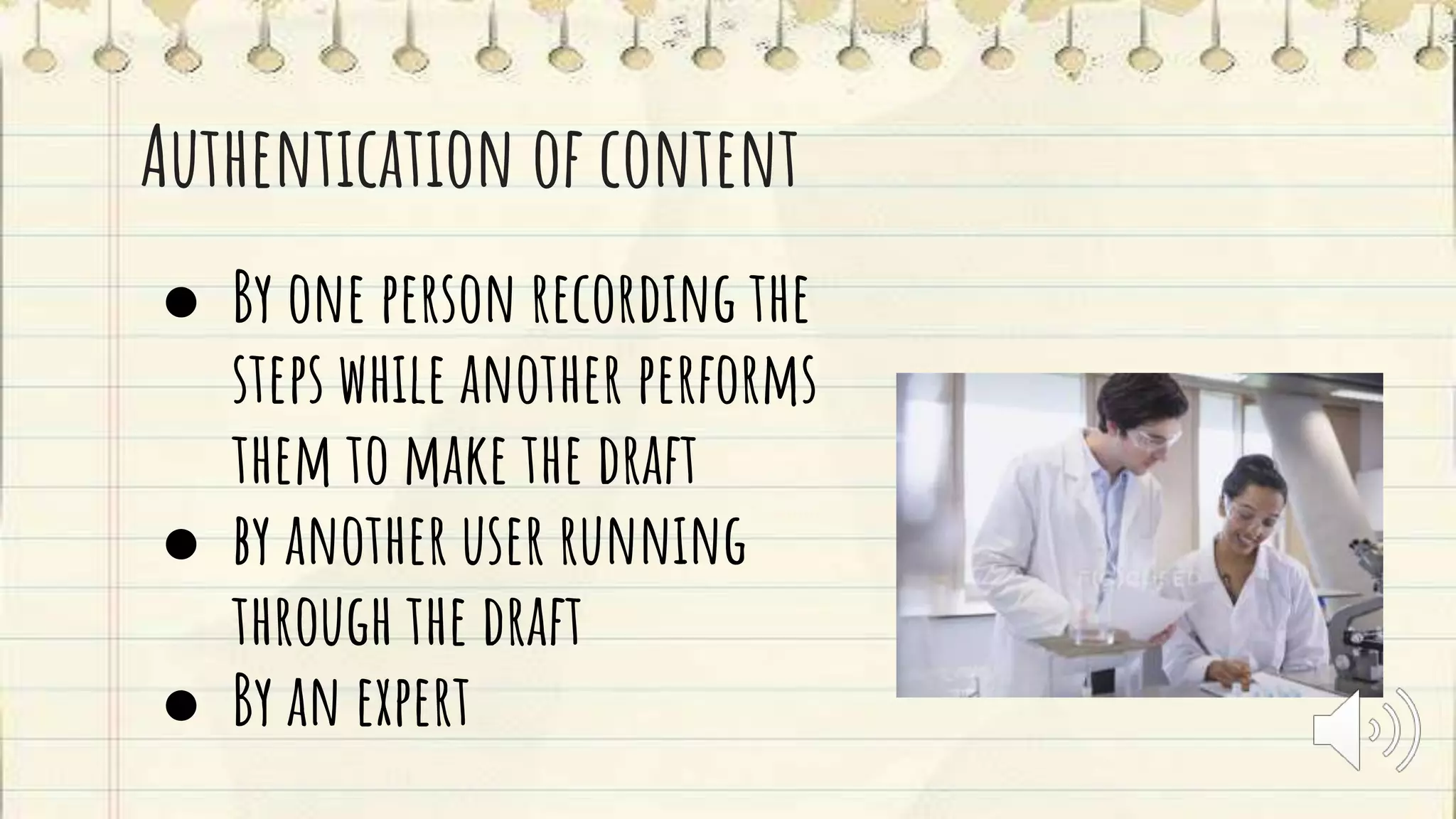
  • #12 We also found that when creating content it was necessary to authenticate it. This analysis and verification ensured that the instructions provided were accurate, safe, and useful. Authentication progressed thorugh multiple stages. The first stage involved making an initial record of the instructions, which was achieved by one user observing the performance of the procedure by another user.  This arrangement supported mental focus and preserved continuity of task for both the writer and the operator thereby improving the utility of their initial draft of procedure. The second stage involved a run-through and initial review, which were done by other users. Since they were most recently in contact with the information, they were readily able to recognize excess material and incorrect ordering of a procedure’s steps. We found that while existing members of the team make good reviewers, new members brought a fresh perspective that was also important to consider.  Finally, the material was reviewed by an expert, such as the course instructor, who looked for conceptual and factual errors and verified sufficient communication of safety. We found that if a procedure had been carefully drafted and reviewed by users, this last review, for the expert, was not time consuming.
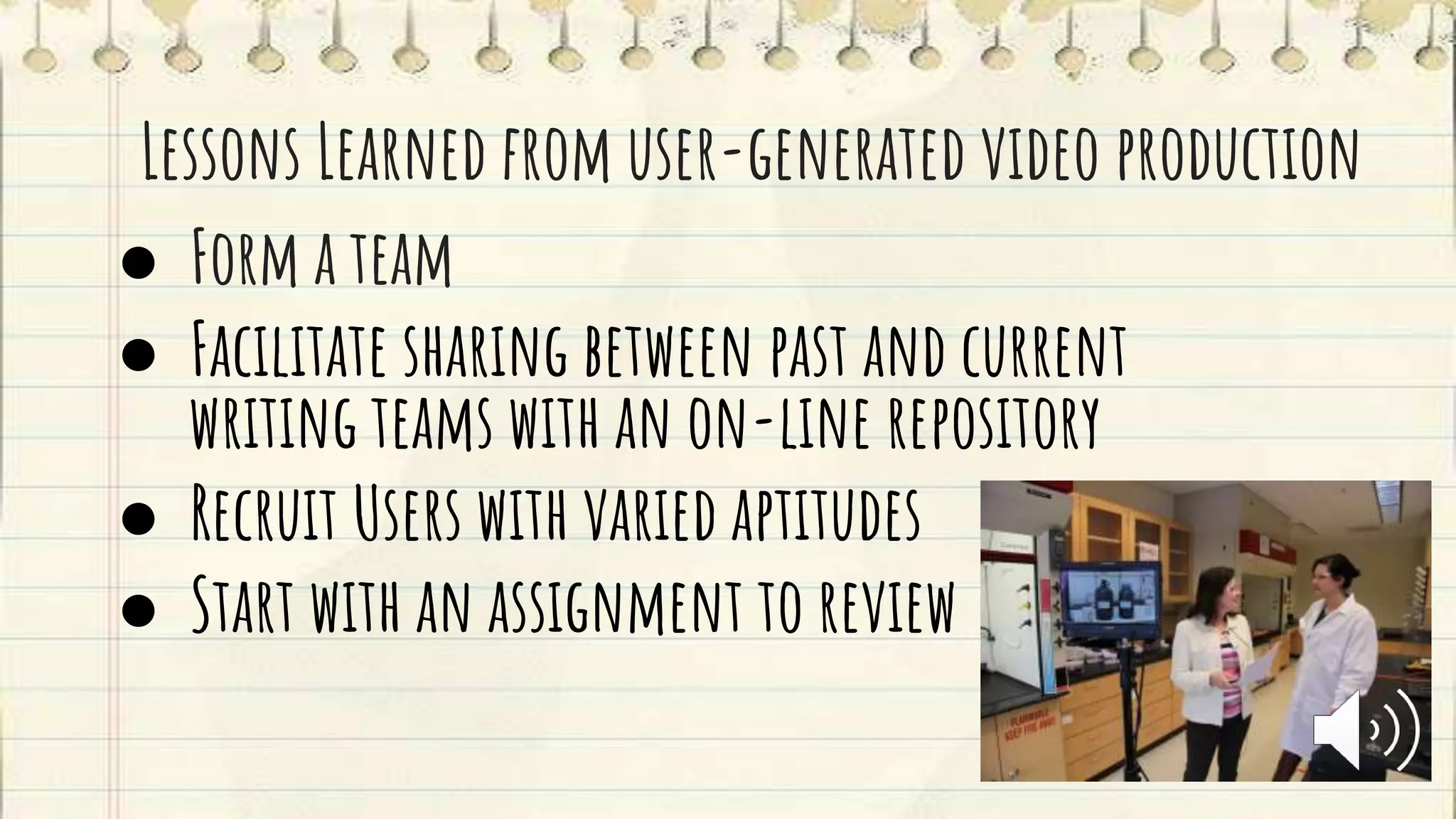
  • #13 So what we’ve learned from doing that kind of thinking and approach when it comes to students generating instructional videos for other students is that, it is important to include more than one user per protocol. Having to be accountable to a team or a partner will keep the users on track and contribute to timely delivery. In some cases, some users will find that they have a natural ability for this kind of work, and they might enjoy being involved in the project long-term, meaning generating more than one instructional video. Others might not find the work to be as rewarding, in which case they can safely leave the project in the care of other team members. So in that way, a team can compensate for varying degrees of connecting with this experience. Having an online repository of best practices and procedures can save a lot of time for all parties involved. Experienced users can upload planning documents, scripts, or other materials, and newer users can use those as blueprints for future projects. Using a google drive folder for this purpose made it is easy to maintain and update as needed. This served as a flexible alternative to strict templates. So instead of providing guard rails, it offered inspiration. Also, keep an open mind when recruiting new users for the program. Sometimes a student that has struggled with the material can generate a better training resource than a very accomplished student, because they have had time and opportunity to grasp the difficulties that an inexperienced student would likely encounter. By contrast, users who learned with greater ease may tend to omit or reduce some aspects of description because they were less conscious of those details while becoming proficient. Lastly, we found that an easy way to introduce new users to the idea of creating content is to ask them to participate as reviewers first. In this way, they get to see what the scope of the project is and get an idea of the work that is required prior to making the commitment to work on a project.
  • #14 We believe the best practices that we observed in making student-generated instructional videos can also be applied to writing SOPs.  Those practices included: Having new users contribute their fresh perspective.  This was invaluable for developing targeted, streamlined, and engaging content. Authenticating written content both in the initial drafting and in the follow-up verification. This was necessary not only to ensure accuracy and safety, but also to ensure readability and utility. Following story structure for universal resonance. This provided an inviting, familiar, and effective means of communication for both writers and users. Formatting SOPs for introduction by a trainer as opposed to used as standalone documents.  This resulted in content that supported regular practice rather than only in first-time use.
  • #15 So in conclusion, I want to acknowledge all of those who contributed to the NCSU Organic Chemistry lecture and lab instructional videos including: all of the students who served as the users who generated the content the office of Distance Education and Learning Technology Applications who provided all of our video and technical support  And I also want to acknowledge the NC State Chemistry Department who have supported us through all of our efforts and innovations in the use of student-generated videos for instruction  Thank you for your time and attention and I look forward to your questions.