Student Stress
A Question of Balance
Delete Box or
Insert Text or
Image Here.
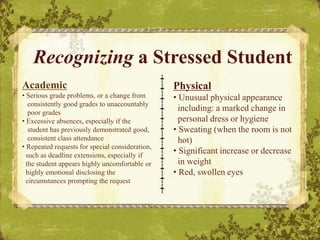
Academic
• Serious grade problems, or a change from
consistently good grades to unaccountably
poor grades
• Excessive absences, especially if the
student has previously demonstrated good,
consistent class attendance
• Repeated requests for special consideration,
such as deadline extensions, especially if
the student appears highly uncomfortable or
highly emotional disclosing the
circumstances prompting the request
Recognizing a Stressed Student
Physical
• Unusual physical appearance
including: a marked change in
personal dress or hygiene
• Sweating (when the room is not
hot)
• Significant increase or decrease
in weight
• Red, swollen eyes
Delete Box or
Insert Text or
Image Here.
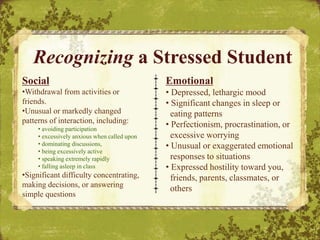
Social
•Withdrawal from activities or
friends.
•Unusual or markedly changed
patterns of interaction, including:
• avoiding participation
• excessively anxious when called upon
• dominating discussions,
• being excessively active
• speaking extremely rapidly
• falling asleep in class
•Significant difficulty concentrating,
making decisions, or answering
simple questions
Recognizing a Stressed Student
Emotional
• Depressed, lethargic mood
• Significant changes in sleep or
eating patterns
• Perfectionism, procrastination, or
excessive worrying
• Unusual or exaggerated emotional
responses to situations
• Expressed hostility toward you,
friends, parents, classmates, or
others
Helping a Stressed Student
• Reach out
• Listen
• Understand
• Normalize
• De-stigmatize Counselling
It is time to refer the student to counselling when …
• You don’t know how to help the student.
• You feel that the student’s circumstances are overwhelming.
• You feel unable to provide all the support the student needs.
•The student’s struggles leave you feeling helpless and anxious.
• You are spending large amounts of time on the student’s problems.
•There is immediate danger to the student or someone else (i.e. suicide,
homicide, abuse, assault, harassment, etc.). In these situations, it is
important to refer directly to the Head of Pastoral or Counsellor.
When should I refer a student to the counsellor?
Taking Care of Yourself!
The time to relax is when you don't have time for it.
~ Sydney J. Harris
• Reach out to a friend, family member, mentor or spiritual advisor.
• Exercise and engage in physical activity. This can help you work off stress, clear
your head, and improve mood. Start with a few minutes a day and work up to 20-30
minutes every day.
• Eat a healthy diet. Your body needs food in order for your mind to function well.
• Sleep, go to bed and get up at regular times. This routine can help you to regulate
your sleep/wake cycle.
•Limit your caffeine and/or alcohol consumption
•Talk to a professional therapist. Effective help is available.

Student stress

  • 1.
  • 2.
    Delete Box or InsertText or Image Here. Academic • Serious grade problems, or a change from consistently good grades to unaccountably poor grades • Excessive absences, especially if the student has previously demonstrated good, consistent class attendance • Repeated requests for special consideration, such as deadline extensions, especially if the student appears highly uncomfortable or highly emotional disclosing the circumstances prompting the request Recognizing a Stressed Student Physical • Unusual physical appearance including: a marked change in personal dress or hygiene • Sweating (when the room is not hot) • Significant increase or decrease in weight • Red, swollen eyes
  • 3.
    Delete Box or InsertText or Image Here. Social •Withdrawal from activities or friends. •Unusual or markedly changed patterns of interaction, including: • avoiding participation • excessively anxious when called upon • dominating discussions, • being excessively active • speaking extremely rapidly • falling asleep in class •Significant difficulty concentrating, making decisions, or answering simple questions Recognizing a Stressed Student Emotional • Depressed, lethargic mood • Significant changes in sleep or eating patterns • Perfectionism, procrastination, or excessive worrying • Unusual or exaggerated emotional responses to situations • Expressed hostility toward you, friends, parents, classmates, or others
  • 4.
    Helping a StressedStudent • Reach out • Listen • Understand • Normalize • De-stigmatize Counselling
  • 5.
    It is timeto refer the student to counselling when … • You don’t know how to help the student. • You feel that the student’s circumstances are overwhelming. • You feel unable to provide all the support the student needs. •The student’s struggles leave you feeling helpless and anxious. • You are spending large amounts of time on the student’s problems. •There is immediate danger to the student or someone else (i.e. suicide, homicide, abuse, assault, harassment, etc.). In these situations, it is important to refer directly to the Head of Pastoral or Counsellor. When should I refer a student to the counsellor?
  • 6.
    Taking Care ofYourself! The time to relax is when you don't have time for it. ~ Sydney J. Harris • Reach out to a friend, family member, mentor or spiritual advisor. • Exercise and engage in physical activity. This can help you work off stress, clear your head, and improve mood. Start with a few minutes a day and work up to 20-30 minutes every day. • Eat a healthy diet. Your body needs food in order for your mind to function well. • Sleep, go to bed and get up at regular times. This routine can help you to regulate your sleep/wake cycle. •Limit your caffeine and/or alcohol consumption •Talk to a professional therapist. Effective help is available.