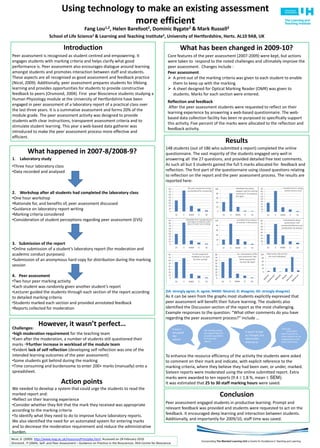
Using technology to make an existing assessment more efficientFang Lou1,2, Helen Barefoot2, Dominic Bygate2 & Mark Russell2School of Life Science1 & Learning and Teaching Institute2, University of Hertfordshire, Herts. AL10 9AB, UKIntroductionPeer assessment is recognised as student centred and empowering. It engages students with marking criteria and helps clarify what good performance is. Peer assessment also encourages dialogue around learning amongst students and promotes interaction between staff and students. These aspects are all recognised as good assessment and feedback practice (Nicol, 2009). Additionally, peer assessment prepares students for lifelong learning and provides opportunities for students to provide constructive feedback to peers (Orsmond, 2004). First  year Bioscience students studying a Human Physiology module at the University of Hertfordshire have been engaged in peer assessment of a laboratory report of a practical class over the last three years. It is a summative assessment and forms 20% of the module grade. The peer assessment activity was designed to provide students with clear instructions, transparent assessment criteria and to stimulate student learning. This year a web-based data gatherer was introduced to make the peer assessment process more effective and efficient. What has been changed in 2009-10?Core features of the peer assessment (2007-2009) were kept, but actions were taken to  respond to the noted challenges and ultimately improve the peer assessment.  Changes include :Peer assessmentA print-out of the marking criteria was given to each student to enable them to keep up with the marking

Iblc10 making an existing assessment more efficient

  • 1.
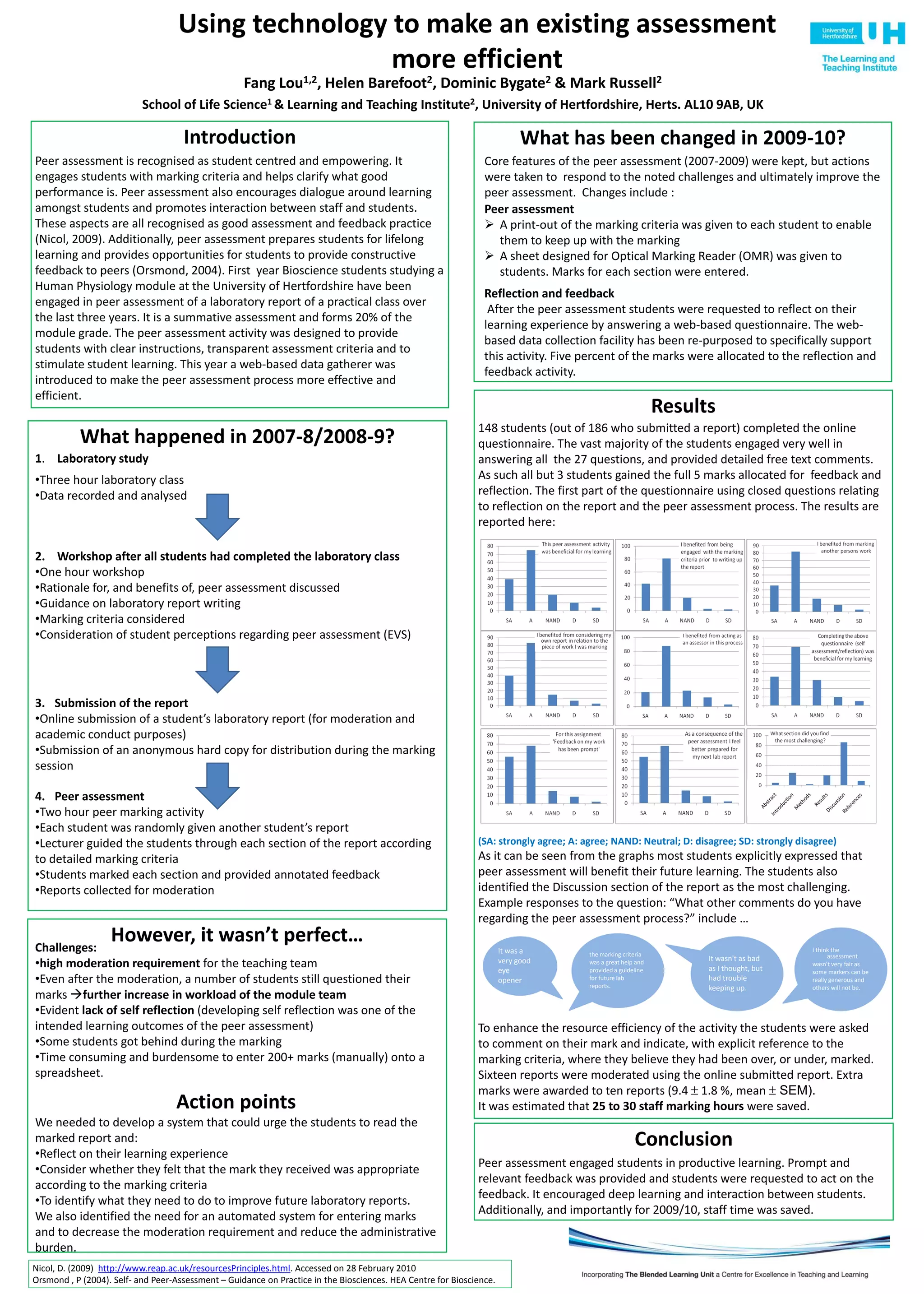
    Using technology tomake an existing assessment more efficientFang Lou1,2, Helen Barefoot2, Dominic Bygate2 & Mark Russell2School of Life Science1 & Learning and Teaching Institute2, University of Hertfordshire, Herts. AL10 9AB, UKIntroductionPeer assessment is recognised as student centred and empowering. It engages students with marking criteria and helps clarify what good performance is. Peer assessment also encourages dialogue around learning amongst students and promotes interaction between staff and students. These aspects are all recognised as good assessment and feedback practice (Nicol, 2009). Additionally, peer assessment prepares students for lifelong learning and provides opportunities for students to provide constructive feedback to peers (Orsmond, 2004). First year Bioscience students studying a Human Physiology module at the University of Hertfordshire have been engaged in peer assessment of a laboratory report of a practical class over the last three years. It is a summative assessment and forms 20% of the module grade. The peer assessment activity was designed to provide students with clear instructions, transparent assessment criteria and to stimulate student learning. This year a web-based data gatherer was introduced to make the peer assessment process more effective and efficient. What has been changed in 2009-10?Core features of the peer assessment (2007-2009) were kept, but actions were taken to respond to the noted challenges and ultimately improve the peer assessment. Changes include :Peer assessmentA print-out of the marking criteria was given to each student to enable them to keep up with the marking