Dr.J.Kalavathi.,M.Sc.,Ph.D.,
Assistant Professor
Department of Information Technology
V.V.Vanniaperumal College for Women,
Virudhunagar.
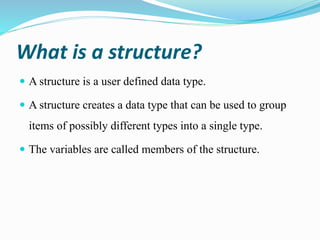
What is a structure?
 A structure is a user defined data type.
 A structure creates a data type that can be used to group
items of possibly different types into a single type.
 The variables are called members of the structure.
How to create a structure?
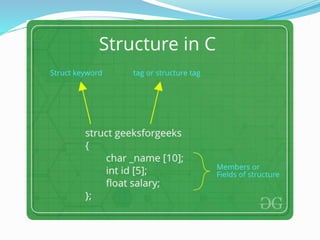
 ‘struct’ keyword is used to create a structure.
Following is an example.
struct address
{
char name[50];
char street[100];
char city[50];
char state[20];
int pin;
};
How to declare structure
variables?
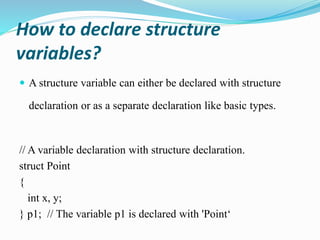
 A structure variable can either be declared with structure
declaration or as a separate declaration like basic types.
// A variable declaration with structure declaration.
struct Point
{
int x, y;
} p1; // The variable p1 is declared with 'Point‘
How to declare structure
variables?
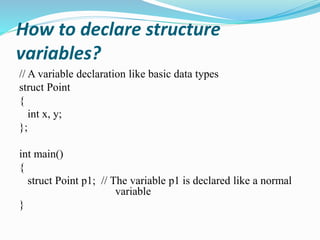
// A variable declaration like basic data types
struct Point
{
int x, y;
};
int main()
{
struct Point p1; // The variable p1 is declared like a normal
variable
}
How to initialize structure
members?
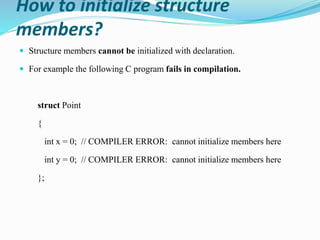
 Structure members cannot be initialized with declaration.
 For example the following C program fails in compilation.
struct Point
{
int x = 0; // COMPILER ERROR: cannot initialize members here
int y = 0; // COMPILER ERROR: cannot initialize members here
};
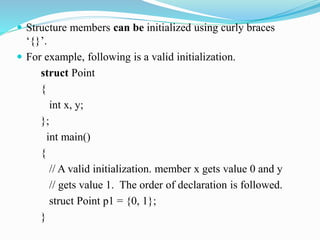
 Structure members can be initialized using curly braces
‘{}’.
 For example, following is a valid initialization.
struct Point
{
int x, y;
};
int main()
{
// A valid initialization. member x gets value 0 and y
// gets value 1. The order of declaration is followed.
struct Point p1 = {0, 1};
}
How to access structure elements?
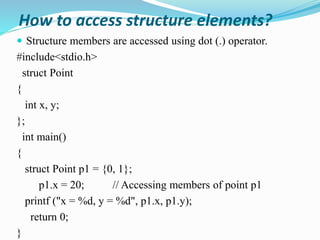
 Structure members are accessed using dot (.) operator.
#include<stdio.h>
struct Point
{
int x, y;
};
int main()
{
struct Point p1 = {0, 1};
p1.x = 20; // Accessing members of point p1
printf ("x = %d, y = %d", p1.x, p1.y);
return 0;
}
Copying and Comparing Structure
Variables
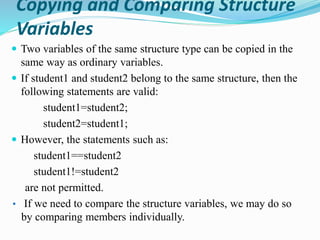
 Two variables of the same structure type can be copied in the
same way as ordinary variables.
 If student1 and student2 belong to the same structure, then the
following statements are valid:
student1=student2;
student2=student1;
 However, the statements such as:
student1==student2
student1!=student2
are not permitted.
• If we need to compare the structure variables, we may do so
by comparing members individually.
What is an array of structures?
#include<stdio.h>
struct Point
{
int x, y;
};
int main()
{
struct Point arr[10]; // Create an Array of Structures
arr[0].x = 10; // Access Array Members
arr[0].y = 20;
printf("%d %d", arr[0].x, arr[0].y);
return 0;
}
Structures in c

Structures in c

  • 1.
    Dr.J.Kalavathi.,M.Sc.,Ph.D., Assistant Professor Department ofInformation Technology V.V.Vanniaperumal College for Women, Virudhunagar.
  • 2.
    What is astructure?  A structure is a user defined data type.  A structure creates a data type that can be used to group items of possibly different types into a single type.  The variables are called members of the structure.
  • 4.
    How to createa structure?  ‘struct’ keyword is used to create a structure. Following is an example. struct address { char name[50]; char street[100]; char city[50]; char state[20]; int pin; };
  • 5.
    How to declarestructure variables?  A structure variable can either be declared with structure declaration or as a separate declaration like basic types. // A variable declaration with structure declaration. struct Point { int x, y; } p1; // The variable p1 is declared with 'Point‘
  • 6.
    How to declarestructure variables? // A variable declaration like basic data types struct Point { int x, y; }; int main() { struct Point p1; // The variable p1 is declared like a normal variable }
  • 7.
    How to initializestructure members?  Structure members cannot be initialized with declaration.  For example the following C program fails in compilation. struct Point { int x = 0; // COMPILER ERROR: cannot initialize members here int y = 0; // COMPILER ERROR: cannot initialize members here };
  • 8.
     Structure memberscan be initialized using curly braces ‘{}’.  For example, following is a valid initialization. struct Point { int x, y; }; int main() { // A valid initialization. member x gets value 0 and y // gets value 1. The order of declaration is followed. struct Point p1 = {0, 1}; }
  • 9.
    How to accessstructure elements?  Structure members are accessed using dot (.) operator. #include<stdio.h> struct Point { int x, y; }; int main() { struct Point p1 = {0, 1}; p1.x = 20; // Accessing members of point p1 printf ("x = %d, y = %d", p1.x, p1.y); return 0; }
  • 10.
    Copying and ComparingStructure Variables  Two variables of the same structure type can be copied in the same way as ordinary variables.  If student1 and student2 belong to the same structure, then the following statements are valid: student1=student2; student2=student1;  However, the statements such as: student1==student2 student1!=student2 are not permitted. • If we need to compare the structure variables, we may do so by comparing members individually.
  • 11.
    What is anarray of structures? #include<stdio.h> struct Point { int x, y; }; int main() { struct Point arr[10]; // Create an Array of Structures arr[0].x = 10; // Access Array Members arr[0].y = 20; printf("%d %d", arr[0].x, arr[0].y); return 0; }