Dr. (Mrs.) J.Kalavathi, M.Sc.,Ph.D.,
Assistant Professor of Information Technology,
V.V.Vanniaperumal College for Women,
Virudhunagar.
1
• Game Playing is an important domain of artificial
intelligence.
• Games don’t require much knowledge; the only
knowledge we need to provide is the rules, legal moves
and the conditions of winning or losing the game.
• Both players try to win the game. So, both of them try to
make the best move possible at each turn.
2
• Searching techniques like BFS(Breadth First Search) are
not accurate for this as the branching factor is very high,
so searching will take a lot of time. So, we need another
search procedures that improve –
• Generate procedure so that only good moves are
generated.
• Test procedure so that the best move can be explored
first.
3
4
Why do AI researchers study game playing?
1. It’s a good reasoning problem, formal and nontrivial.
2. Direct comparison with humans and other computer
programs is easy.
Mainly games of strategy with the following characteristics:
1. Sequence of moves to play
2. Rules that specify possible moves
3. Rules that specify a payment for each move
4. Objective is to maximize your payment
5
• Unpredictable opponent  specifying a move for every
possible opponent reply
• Time limits  unlikely to find goal, must approximate
6
7
Opponent’s Move
Generate New Position
Generate Successors
Game
Over?
Evaluate Successors
Move to Highest-Valued Successor
Game
Over?
no
no yes
yes
Two-Player Game
8
The computer is Max.
The opponent is Min.
At the leaf nodes, the
utility function
is employed. Big value
means good, small is bad.
computer’s
turn
opponent’s
turn
computer’s
turn
opponent’s
turn
leaf nodes
are evaluated
• utility function: the function applied to leaf nodes
• backed-up value
• of a max-position: the value of its largest successor
• of a min-position: the value of its smallest successor
• minimax procedure: search down several levels;
at the bottom level apply the utility function,
back-up values all the way up to the root node,
and that node selects the move.
9
• Perfect play for deterministic games
• Idea: choose move to position with highest minimax
value
= best achievable payoff against best play
• E.g., 2-ply game:
10
• Why do we take the min value every other level of the
tree?
• These nodes represent the opponent’s choice of move.
• The computer assumes that the human will choose that
move that is of least value to the computer.
11
12
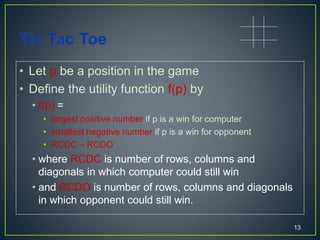
• Let p be a position in the game
• Define the utility function f(p) by
• f(p) =
• largest positive number if p is a win for computer
• smallest negative number if p is a win for opponent
• RCDC – RCDO
• where RCDC is number of rows, columns and
diagonals in which computer could still win
• and RCDO is number of rows, columns and diagonals
in which opponent could still win.
13
• X = Computer; O = Opponent
14
O
X
X O
rows
cols
diags
O O X
X X
X O
rows
cols
diags
15
max
min
max
leaf
2 5 1
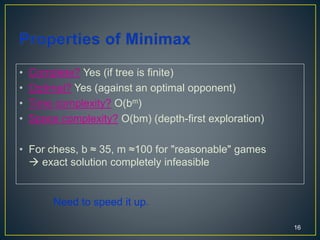
• Complete? Yes (if tree is finite)
• Optimal? Yes (against an optimal opponent)
• Time complexity? O(bm)
• Space complexity? O(bm) (depth-first exploration)
• For chess, b ≈ 35, m ≈100 for "reasonable" games
 exact solution completely infeasible
16
Need to speed it up.
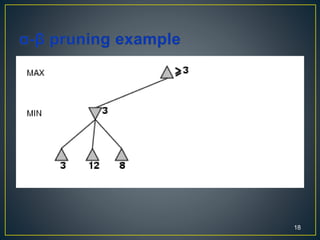
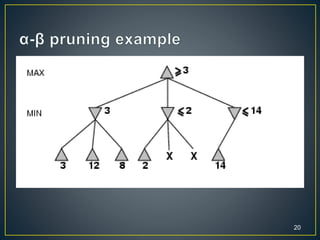
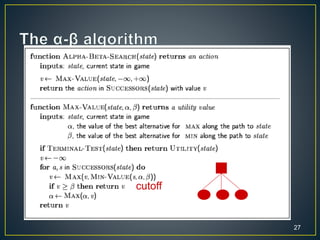
• The alpha-beta procedure can speed up a depth-first
minimax search.
• Alpha: a lower bound on the value that a max node may
ultimately be assigned
• Beta: an upper bound on the value that a minimizing
node may ultimately be assigned
17
v > 
v < 
18
19
alpha cutoff
 = 3
20
21
22
23
> 3
3
8 10
 = 3
What happens here? Is there an alpha cutoff?
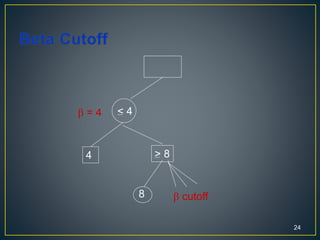
24
< 4
4
 = 4
> 8
8  cutoff
25
5 2 10 11 1 2 2 8 6 5 12 4 3 25 2
max
min
max
eval
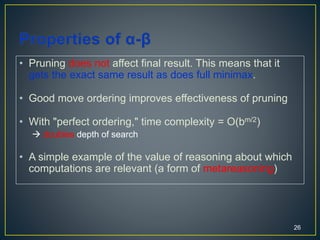
• Pruning does not affect final result. This means that it
gets the exact same result as does full minimax.
• Good move ordering improves effectiveness of pruning
• With "perfect ordering," time complexity = O(bm/2)
 doubles depth of search
• A simple example of the value of reasoning about which
computations are relevant (a form of metareasoning)
26
27
cutoff
28
cutoff
29
...100
< 100 < 100
1. limited search for a few levels
2. reorder the level-1 sucessors
3. proceed with - minimax search
30
• Waiting for Quiescence: continue the search until
no drastic change occurs from one level to the
next.
• Secondary Search: after choosing a move,
search a few more levels beneath it to be sure it
still looks good.
• Book Moves: for some parts of the game
(especially initial and end moves), keep a catalog
of best moves to make.
31
• For chess/checkers, typically linear weighted sum of
features
Eval(s) = w1 f1(s) + w2 f2(s) + … + wn fn(s)
e.g., w1 = 9 with
f1(s) = (number of white queens) – (number of black
queens), etc.
32
• It uses a linear evaluation function
f(n) = a1x1(n) + a2x2(n) + ... + amxm(n)
For example: f = 6K + 4M + U
• K = King Advantage
• M = Man Advantage
• U = Undenied Mobility Advantage (number of moves that Max has
that Min can’t jump after)
33
• In learning mode
• Computer acts as 2 players: A and B
• A adjusts its coefficients after every move
• B uses the static utility function
• If A wins, its function is given to B
34
• How does A change its function?
1. Coefficent replacement
(node ) = backed-up value(node) – initial value(node)
if > 0 then terms that contributed positively are
given more weight and terms that contributed
negatively get less weight
if < 0 then terms that contributed negatively are
given more weight and terms that contributed
positively get less weight
35
• How does A change its function?
2. Term Replacement
38 terms altogether
16 used in the utility function at any one time
Terms that consistently correlate low with the
function value are removed and added to the end of
the term queue.
They are replaced by terms from the front of the
term queue.
36
37
P’s holes
p’s holes
KP Kp
6 6 6 6 6 6
6 6 6 6 6 6
0 0
To move, pick up all the stones in one of your holes, and
put one stone in each hole, starting at the next one,
including your Kalah and skipping the opponent’s Kalah.
counterclockwise
• If the last stone lands in your Kalah, you get
another turn.
• If the last stone lands in your empty hole, take all
the stones from your opponent’s hole directly
across from it and put them in your Kalah.
• If all of your holes become empty, the opponent
keeps the rest of the stones.
• The winner is the player who has the most
stones in his Kalah at the end of the game.
38
MinimaxCutoff is identical to MinimaxValue except
1. Terminal? is replaced by Cutoff?
2. Utility is replaced by Eval
Does it work in practice?
bm = 106, b=35  m=4
4-ply lookahead is a hopeless chess player!
• 4-ply ≈ human novice
• 8-ply ≈ typical PC, human master
• 12-ply ≈ Deep Blue, Kasparov
39
• Checkers: Chinook ended 40-year-reign of human world champion
Marion Tinsley in 1994. Used a precomputed endgame database
defining perfect play for all positions involving 8 or fewer pieces on
the board, a total of 444 billion positions.
• Chess: Deep Blue defeated human world champion Garry Kasparov
in a six-game match in 1997. Deep Blue searches 200 million
positions per second, uses very sophisticated evaluation, and
undisclosed methods for extending some lines of search up to 40 ply.
• Othello: human champions refuse to compete against computers,
who are too good.
• Go: human champions refuse to compete against computers, who
are too bad. In Go, b > 300, so most programs use pattern
knowledge bases to suggest plausible moves.
40
• What about games that involve chance, such as
• rolling dice
• picking a card
• Use three kinds of nodes:
• max nodes
• min nodes
• chance nodes
41
   min
chance
max
42
c
d1
di dk
S(c,di)
chance node with
max children
expectimax(c) = ∑P(di) max(backed-up-value(s))
i s in S(c,di)
expectimin(c’) = ∑P(di) min(backed-up-value(s))
i s in S(c,di)
43
 
3 5 1 4 1 2 4 5
.4 .6 .4 .6
.4 .6
max
chance
min
chance
max
leaf
1.2
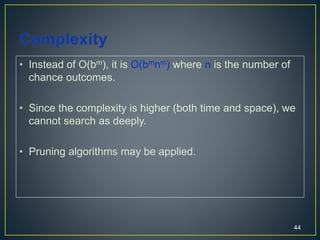
• Instead of O(bm), it is O(bmnm) where n is the number of
chance outcomes.
• Since the complexity is higher (both time and space), we
cannot search as deeply.
• Pruning algorithms may be applied.
44
• Games are fun to work on!
• They illustrate several important points about AI.
• Perfection is unattainable  must approximate.
• Game playing programs have shown the world
what AI can do.
45

Games

  • 1.
    Dr. (Mrs.) J.Kalavathi,M.Sc.,Ph.D., Assistant Professor of Information Technology, V.V.Vanniaperumal College for Women, Virudhunagar. 1
  • 2.
    • Game Playingis an important domain of artificial intelligence. • Games don’t require much knowledge; the only knowledge we need to provide is the rules, legal moves and the conditions of winning or losing the game. • Both players try to win the game. So, both of them try to make the best move possible at each turn. 2
  • 3.
    • Searching techniqueslike BFS(Breadth First Search) are not accurate for this as the branching factor is very high, so searching will take a lot of time. So, we need another search procedures that improve – • Generate procedure so that only good moves are generated. • Test procedure so that the best move can be explored first. 3
  • 4.
    4 Why do AIresearchers study game playing? 1. It’s a good reasoning problem, formal and nontrivial. 2. Direct comparison with humans and other computer programs is easy.
  • 5.
    Mainly games ofstrategy with the following characteristics: 1. Sequence of moves to play 2. Rules that specify possible moves 3. Rules that specify a payment for each move 4. Objective is to maximize your payment 5
  • 6.
    • Unpredictable opponent specifying a move for every possible opponent reply • Time limits  unlikely to find goal, must approximate 6
  • 7.
    7 Opponent’s Move Generate NewPosition Generate Successors Game Over? Evaluate Successors Move to Highest-Valued Successor Game Over? no no yes yes Two-Player Game
  • 8.
    8 The computer isMax. The opponent is Min. At the leaf nodes, the utility function is employed. Big value means good, small is bad. computer’s turn opponent’s turn computer’s turn opponent’s turn leaf nodes are evaluated
  • 9.
    • utility function:the function applied to leaf nodes • backed-up value • of a max-position: the value of its largest successor • of a min-position: the value of its smallest successor • minimax procedure: search down several levels; at the bottom level apply the utility function, back-up values all the way up to the root node, and that node selects the move. 9
  • 10.
    • Perfect playfor deterministic games • Idea: choose move to position with highest minimax value = best achievable payoff against best play • E.g., 2-ply game: 10
  • 11.
    • Why dowe take the min value every other level of the tree? • These nodes represent the opponent’s choice of move. • The computer assumes that the human will choose that move that is of least value to the computer. 11
  • 12.
  • 13.
    • Let pbe a position in the game • Define the utility function f(p) by • f(p) = • largest positive number if p is a win for computer • smallest negative number if p is a win for opponent • RCDC – RCDO • where RCDC is number of rows, columns and diagonals in which computer could still win • and RCDO is number of rows, columns and diagonals in which opponent could still win. 13
  • 14.
    • X =Computer; O = Opponent 14 O X X O rows cols diags O O X X X X O rows cols diags
  • 15.
  • 16.
    • Complete? Yes(if tree is finite) • Optimal? Yes (against an optimal opponent) • Time complexity? O(bm) • Space complexity? O(bm) (depth-first exploration) • For chess, b ≈ 35, m ≈100 for "reasonable" games  exact solution completely infeasible 16 Need to speed it up.
  • 17.
    • The alpha-betaprocedure can speed up a depth-first minimax search. • Alpha: a lower bound on the value that a max node may ultimately be assigned • Beta: an upper bound on the value that a minimizing node may ultimately be assigned 17 v >  v < 
  • 18.
  • 19.
  • 20.
  • 21.
  • 22.
  • 23.
    23 > 3 3 8 10 = 3 What happens here? Is there an alpha cutoff?
  • 24.
    24 < 4 4  =4 > 8 8  cutoff
  • 25.
    25 5 2 1011 1 2 2 8 6 5 12 4 3 25 2 max min max eval
  • 26.
    • Pruning doesnot affect final result. This means that it gets the exact same result as does full minimax. • Good move ordering improves effectiveness of pruning • With "perfect ordering," time complexity = O(bm/2)  doubles depth of search • A simple example of the value of reasoning about which computations are relevant (a form of metareasoning) 26
  • 27.
  • 28.
  • 29.
  • 30.
    1. limited searchfor a few levels 2. reorder the level-1 sucessors 3. proceed with - minimax search 30
  • 31.
    • Waiting forQuiescence: continue the search until no drastic change occurs from one level to the next. • Secondary Search: after choosing a move, search a few more levels beneath it to be sure it still looks good. • Book Moves: for some parts of the game (especially initial and end moves), keep a catalog of best moves to make. 31
  • 32.
    • For chess/checkers,typically linear weighted sum of features Eval(s) = w1 f1(s) + w2 f2(s) + … + wn fn(s) e.g., w1 = 9 with f1(s) = (number of white queens) – (number of black queens), etc. 32
  • 33.
    • It usesa linear evaluation function f(n) = a1x1(n) + a2x2(n) + ... + amxm(n) For example: f = 6K + 4M + U • K = King Advantage • M = Man Advantage • U = Undenied Mobility Advantage (number of moves that Max has that Min can’t jump after) 33
  • 34.
    • In learningmode • Computer acts as 2 players: A and B • A adjusts its coefficients after every move • B uses the static utility function • If A wins, its function is given to B 34
  • 35.
    • How doesA change its function? 1. Coefficent replacement (node ) = backed-up value(node) – initial value(node) if > 0 then terms that contributed positively are given more weight and terms that contributed negatively get less weight if < 0 then terms that contributed negatively are given more weight and terms that contributed positively get less weight 35
  • 36.
    • How doesA change its function? 2. Term Replacement 38 terms altogether 16 used in the utility function at any one time Terms that consistently correlate low with the function value are removed and added to the end of the term queue. They are replaced by terms from the front of the term queue. 36
  • 37.
    37 P’s holes p’s holes KPKp 6 6 6 6 6 6 6 6 6 6 6 6 0 0 To move, pick up all the stones in one of your holes, and put one stone in each hole, starting at the next one, including your Kalah and skipping the opponent’s Kalah. counterclockwise
  • 38.
    • If thelast stone lands in your Kalah, you get another turn. • If the last stone lands in your empty hole, take all the stones from your opponent’s hole directly across from it and put them in your Kalah. • If all of your holes become empty, the opponent keeps the rest of the stones. • The winner is the player who has the most stones in his Kalah at the end of the game. 38
  • 39.
    MinimaxCutoff is identicalto MinimaxValue except 1. Terminal? is replaced by Cutoff? 2. Utility is replaced by Eval Does it work in practice? bm = 106, b=35  m=4 4-ply lookahead is a hopeless chess player! • 4-ply ≈ human novice • 8-ply ≈ typical PC, human master • 12-ply ≈ Deep Blue, Kasparov 39
  • 40.
    • Checkers: Chinookended 40-year-reign of human world champion Marion Tinsley in 1994. Used a precomputed endgame database defining perfect play for all positions involving 8 or fewer pieces on the board, a total of 444 billion positions. • Chess: Deep Blue defeated human world champion Garry Kasparov in a six-game match in 1997. Deep Blue searches 200 million positions per second, uses very sophisticated evaluation, and undisclosed methods for extending some lines of search up to 40 ply. • Othello: human champions refuse to compete against computers, who are too good. • Go: human champions refuse to compete against computers, who are too bad. In Go, b > 300, so most programs use pattern knowledge bases to suggest plausible moves. 40
  • 41.
    • What aboutgames that involve chance, such as • rolling dice • picking a card • Use three kinds of nodes: • max nodes • min nodes • chance nodes 41    min chance max
  • 42.
    42 c d1 di dk S(c,di) chance nodewith max children expectimax(c) = ∑P(di) max(backed-up-value(s)) i s in S(c,di) expectimin(c’) = ∑P(di) min(backed-up-value(s)) i s in S(c,di)
  • 43.
    43   3 51 4 1 2 4 5 .4 .6 .4 .6 .4 .6 max chance min chance max leaf 1.2
  • 44.
    • Instead ofO(bm), it is O(bmnm) where n is the number of chance outcomes. • Since the complexity is higher (both time and space), we cannot search as deeply. • Pruning algorithms may be applied. 44
  • 45.
    • Games arefun to work on! • They illustrate several important points about AI. • Perfection is unattainable  must approximate. • Game playing programs have shown the world what AI can do. 45