

LET'S TALK ABOUT STRING
OPERATIONS IN C++17
string_view, searchers and conversion routines
Bartłomiej Filipek, bfilipek.com18th September 2018
About me
 See my coding blog at:
www.bfilipek.com
 11y+ experience
 Currently @Xara.com
 Text related features for advanced
document editors
 Somehow addicted to C++ 
Xara Cloud Demo
C++17 In Detail
The plan
 string_view
 Elementary conversion routines
 Searchers
 Summary
string_view
H E L L O W O R L D
Owning String
Non-Owning String-View
[start_ptr, length]
0
string_view
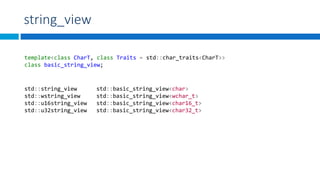
template<class CharT, class Traits = std::char_traits<CharT>>
class basic_string_view;
std::string_view std::basic_string_view<char>
std::wstring_view std::basic_string_view<wchar_t>
std::u16string_view std::basic_string_view<char16_t>
std::u32string_view std::basic_string_view<char32_t>
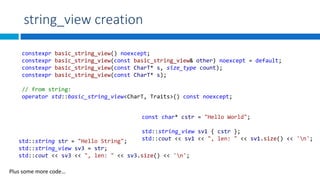
string_view creation
const char* cstr = "Hello World";
std::string_view sv1 { cstr };
std::cout << sv1 << ", len: " << sv1.size() << 'n';std::string str = "Hello String";
std::string_view sv3 = str;
std::cout << sv3 << ", len: " << sv3.size() << 'n';
Plus some more code…
constexpr basic_string_view() noexcept;
constexpr basic_string_view(const basic_string_view& other) noexcept = default;
constexpr basic_string_view(const CharT* s, size_type count);
constexpr basic_string_view(const CharT* s);
// from string:
operator std::basic_string_view<CharT, Traits>() const noexcept;
string_view operations
operator[]
at
front
back
data
size/length
max_size
empty
remove_prefix
remove_suffix
swap
copy (not constexpr)
substr - complexity O(1) and not O(n) as in std::string
compare
find
rfind
find_first_of
find_last_of
find_first_not_of
find_last_not_of
operators for lexicography compare: ==, !=, <=, >=, <, >
operator <<
Bonus, C++20:
starts_with
ends_with
How many string copies?
std::string StartFromWordStr(const std::string& strArg, const std::string& word)
{
return strArg.substr(strArg.find(word));
}
// call:
std::string str {"Hello Amazing Programming Environment" };
auto subStr = StartFromWordStr(str, "Programming Environment");
std::cout << subStr << "n";
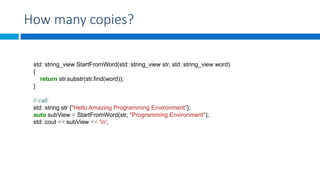
How many copies?
std::string_view StartFromWord(std::string_view str, std::string_view word)
{
return str.substr(str.find(word));
}
// call:
std::string str {"Hello Amazing Programming Environment"};
auto subView = StartFromWord(str, "Programming Environment");
std::cout << subView << 'n';
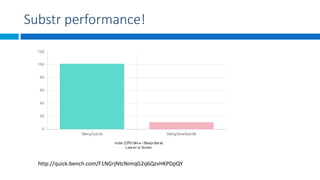
Substr performance!
http://quick-bench.com/F1NGrjNtcNimqG2q6QzvHKPDpQY
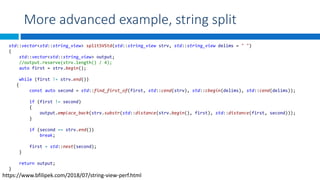
More advanced example, string split
std::vector<std::string_view> splitSVStd(std::string_view strv, std::string_view delims = " ")
{
std::vector<std::string_view> output;
//output.reserve(strv.length() / 4);
auto first = strv.begin();
while (first != strv.end())
{
const auto second = std::find_first_of(first, std::cend(strv), std::cbegin(delims), std::cend(delims));
if (first != second)
{
output.emplace_back(strv.substr(std::distance(strv.begin(), first), std::distance(first, second)));
}
if (second == strv.end())
break;
first = std::next(second);
}
return output;
}
https://www.bfilipek.com/2018/07/string-view-perf.html
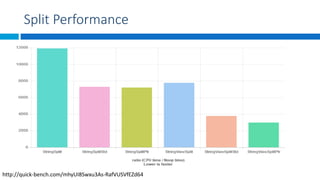
Split Performance
http://quick-bench.com/mhyUI8Swxu3As-RafVUSVfEZd64
SSO
 Currently, it’s 15 characters in MSVC (VS 2017)/GCC (8.1) or 22
characters in Clang (6.0).
Risks!
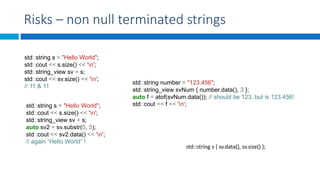
 Non null terminated strings
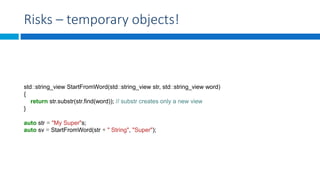
 Temporary objects
Risks – non null terminated strings
std::string s = "Hello World";
std::cout << s.size() << 'n';
std::string_view sv = s;
std::cout << sv.size() << 'n';
// 11 & 11
std::string s = "Hello World";
std::cout << s.size() << 'n';
std::string_view sv = s;
auto sv2 = sv.substr(0, 5);
std::cout << sv2.data() << 'n';
// again “Hello World” !
std::string number = "123.456";
std::string_view svNum { number.data(), 3 };
auto f = atof(svNum.data()); // should be 123, but is 123.456!
std::cout << f << 'n';
std::string s { sv.data(), sv.size() };
Risks – temporary objects!
std::string_view StartFromWord(std::string_view str, std::string_view word)
{
return str.substr(str.find(word)); // substr creates only a new view
}
auto str = "My Super"s;
auto sv = StartFromWord(str + " String", "Super");
Risks – temporary objects!
std::vector<int> GenerateVec()
{
return std::vector<int>(5, 1);
}
const std::vector<int>& refv = GenerateVec();
for (auto &elem : GenerateVec())
{
// ...
}
std::string func()
{
std::string s;
// build s...
return s;
}
std::string_view sv = func();
// no temp lifetime extension!
std::vector<int> CreateVector() { ... }
std::string GetString() { return "Hello"; }
auto &x = CreateVector()[10]; // arbitrary element!
auto pStr = GetString().c_str();
https://wg21.link/p0936
string_view - summary
 What do you think?
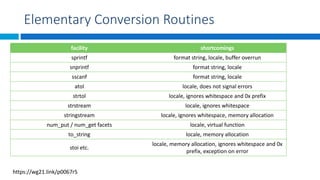
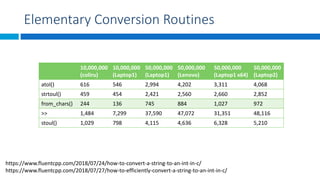
Elementary Conversion Routines
facility shortcomings
sprintf format string, locale, buffer overrun
snprintf format string, locale
sscanf format string, locale
atol locale, does not signal errors
strtol locale, ignores whitespace and 0x prefix
strstream locale, ignores whitespace
stringstream locale, ignores whitespace, memory allocation
num_put / num_get facets locale, virtual function
to_string locale, memory allocation
stoi etc.
locale, memory allocation, ignores whitespace and 0x
prefix, exception on error
https://wg21.link/p0067r5
Elementary Conversion Routines
10,000,000
(coliru)
10,000,000
(Laptop1)
50,000,000
(Laptop1)
50,000,000
(Lenovo)
50,000,000
(Laptop1 x64)
50,000,000
(Laptop2)
atol() 616 546 2,994 4,202 3,311 4,068
strtoul() 459 454 2,421 2,560 2,660 2,852
from_chars() 244 136 745 884 1,027 972
>> 1,484 7,299 37,590 47,072 31,351 48,116
stoul() 1,029 798 4,115 4,636 6,328 5,210
https://www.fluentcpp.com/2018/07/24/how-to-convert-a-string-to-an-int-in-c/
https://www.fluentcpp.com/2018/07/27/how-to-efficiently-convert-a-string-to-an-int-in-c/
Elementary Conversion Routines
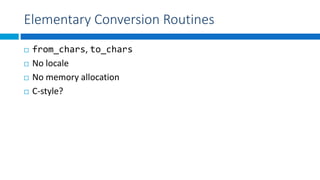
 from_chars, to_chars
 No locale
 No memory allocation
 C-style?
Elementary Conversion Routines
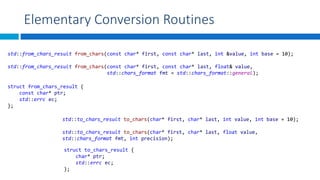
std::from_chars_result from_chars(const char* first, const char* last, int &value, int base = 10);
std::from_chars_result from_chars(const char* first, const char* last, float& value,
std::chars_format fmt = std::chars_format::general);
struct from_chars_result {
const char* ptr;
std::errc ec;
};
struct to_chars_result {
char* ptr;
std::errc ec;
};
std::to_chars_result to_chars(char* first, char* last, int value, int base = 10);
std::to_chars_result to_chars(char* first, char* last, float value,
std::chars_format fmt, int precision);
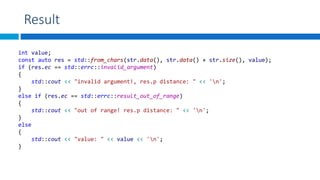
Result
int value;
const auto res = std::from_chars(str.data(), str.data() + str.size(), value);
if (res.ec == std::errc::invalid_argument)
{
std::cout << "invalid argument!, res.p distance: " << 'n';
}
else if (res.ec == std::errc::result_out_of_range)
{
std::cout << "out of range! res.p distance: " << 'n';
}
else
{
std::cout << "value: " << value << 'n';
}
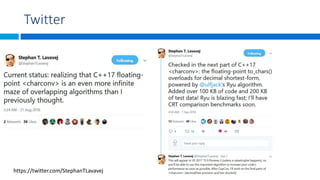
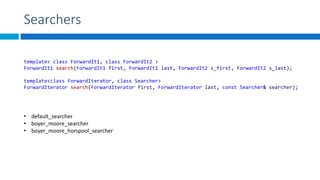
Twitter
https://twitter.com/StephanTLavavej
Searchers
• default_searcher
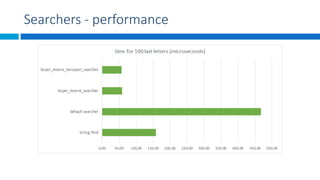
• boyer_moore_searcher
• boyer_moore_horspool_searcher
template< class ForwardIt1, class ForwardIt2 >
ForwardIt1 search(ForwardIt1 first, ForwardIt1 last, ForwardIt2 s_first, ForwardIt2 s_last);
template<class ForwardIterator, class Searcher>
ForwardIterator search(ForwardIterator first, ForwardIterator last, const Searcher& searcher);
Searchers
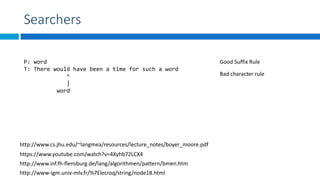
P: word
T: There would have been a time for such a word
^
|
word
https://www.youtube.com/watch?v=4Xyhb72LCX4
Bad character rule
Good Suffix Rule
http://www.inf.fh-flensburg.de/lang/algorithmen/pattern/bmen.htm
http://www.cs.jhu.edu/~langmea/resources/lecture_notes/boyer_moore.pdf
http://www-igm.univ-mlv.fr/%7Elecroq/string/node18.html
Searchers – some code
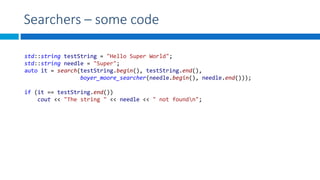
std::string testString = "Hello Super World";
std::string needle = "Super";
auto it = search(testString.begin(), testString.end(),
boyer_moore_searcher(needle.begin(), needle.end()));
if (it == testString.end())
cout << "The string " << needle << " not foundn";
Searchers - performance
Summary
 string_view – good potential, with some risks!
 Conversion routines – finally!
 Searchers – nice addition!

Let's talks about string operations in C++17

  • 1.
    LET'S TALK ABOUTSTRING OPERATIONS IN C++17 string_view, searchers and conversion routines Bartłomiej Filipek, bfilipek.com18th September 2018
  • 2.
    About me  Seemy coding blog at: www.bfilipek.com  11y+ experience  Currently @Xara.com  Text related features for advanced document editors  Somehow addicted to C++  Xara Cloud Demo C++17 In Detail
  • 3.
    The plan  string_view Elementary conversion routines  Searchers  Summary
  • 4.
    string_view H E LL O W O R L D Owning String Non-Owning String-View [start_ptr, length] 0
  • 5.
    string_view template<class CharT, classTraits = std::char_traits<CharT>> class basic_string_view; std::string_view std::basic_string_view<char> std::wstring_view std::basic_string_view<wchar_t> std::u16string_view std::basic_string_view<char16_t> std::u32string_view std::basic_string_view<char32_t>
  • 6.
    string_view creation const char*cstr = "Hello World"; std::string_view sv1 { cstr }; std::cout << sv1 << ", len: " << sv1.size() << 'n';std::string str = "Hello String"; std::string_view sv3 = str; std::cout << sv3 << ", len: " << sv3.size() << 'n'; Plus some more code… constexpr basic_string_view() noexcept; constexpr basic_string_view(const basic_string_view& other) noexcept = default; constexpr basic_string_view(const CharT* s, size_type count); constexpr basic_string_view(const CharT* s); // from string: operator std::basic_string_view<CharT, Traits>() const noexcept;
  • 7.
    string_view operations operator[] at front back data size/length max_size empty remove_prefix remove_suffix swap copy (notconstexpr) substr - complexity O(1) and not O(n) as in std::string compare find rfind find_first_of find_last_of find_first_not_of find_last_not_of operators for lexicography compare: ==, !=, <=, >=, <, > operator << Bonus, C++20: starts_with ends_with
  • 8.
    How many stringcopies? std::string StartFromWordStr(const std::string& strArg, const std::string& word) { return strArg.substr(strArg.find(word)); } // call: std::string str {"Hello Amazing Programming Environment" }; auto subStr = StartFromWordStr(str, "Programming Environment"); std::cout << subStr << "n";
  • 9.
    How many copies? std::string_viewStartFromWord(std::string_view str, std::string_view word) { return str.substr(str.find(word)); } // call: std::string str {"Hello Amazing Programming Environment"}; auto subView = StartFromWord(str, "Programming Environment"); std::cout << subView << 'n';
  • 10.
  • 11.
    More advanced example,string split std::vector<std::string_view> splitSVStd(std::string_view strv, std::string_view delims = " ") { std::vector<std::string_view> output; //output.reserve(strv.length() / 4); auto first = strv.begin(); while (first != strv.end()) { const auto second = std::find_first_of(first, std::cend(strv), std::cbegin(delims), std::cend(delims)); if (first != second) { output.emplace_back(strv.substr(std::distance(strv.begin(), first), std::distance(first, second))); } if (second == strv.end()) break; first = std::next(second); } return output; } https://www.bfilipek.com/2018/07/string-view-perf.html
  • 12.
  • 13.
    SSO  Currently, it’s15 characters in MSVC (VS 2017)/GCC (8.1) or 22 characters in Clang (6.0).
  • 14.
    Risks!  Non nullterminated strings  Temporary objects
  • 15.
    Risks – nonnull terminated strings std::string s = "Hello World"; std::cout << s.size() << 'n'; std::string_view sv = s; std::cout << sv.size() << 'n'; // 11 & 11 std::string s = "Hello World"; std::cout << s.size() << 'n'; std::string_view sv = s; auto sv2 = sv.substr(0, 5); std::cout << sv2.data() << 'n'; // again “Hello World” ! std::string number = "123.456"; std::string_view svNum { number.data(), 3 }; auto f = atof(svNum.data()); // should be 123, but is 123.456! std::cout << f << 'n'; std::string s { sv.data(), sv.size() };
  • 16.
    Risks – temporaryobjects! std::string_view StartFromWord(std::string_view str, std::string_view word) { return str.substr(str.find(word)); // substr creates only a new view } auto str = "My Super"s; auto sv = StartFromWord(str + " String", "Super");
  • 17.
    Risks – temporaryobjects! std::vector<int> GenerateVec() { return std::vector<int>(5, 1); } const std::vector<int>& refv = GenerateVec(); for (auto &elem : GenerateVec()) { // ... } std::string func() { std::string s; // build s... return s; } std::string_view sv = func(); // no temp lifetime extension! std::vector<int> CreateVector() { ... } std::string GetString() { return "Hello"; } auto &x = CreateVector()[10]; // arbitrary element! auto pStr = GetString().c_str(); https://wg21.link/p0936
  • 18.
    string_view - summary What do you think?
  • 19.
    Elementary Conversion Routines facilityshortcomings sprintf format string, locale, buffer overrun snprintf format string, locale sscanf format string, locale atol locale, does not signal errors strtol locale, ignores whitespace and 0x prefix strstream locale, ignores whitespace stringstream locale, ignores whitespace, memory allocation num_put / num_get facets locale, virtual function to_string locale, memory allocation stoi etc. locale, memory allocation, ignores whitespace and 0x prefix, exception on error https://wg21.link/p0067r5
  • 20.
    Elementary Conversion Routines 10,000,000 (coliru) 10,000,000 (Laptop1) 50,000,000 (Laptop1) 50,000,000 (Lenovo) 50,000,000 (Laptop1x64) 50,000,000 (Laptop2) atol() 616 546 2,994 4,202 3,311 4,068 strtoul() 459 454 2,421 2,560 2,660 2,852 from_chars() 244 136 745 884 1,027 972 >> 1,484 7,299 37,590 47,072 31,351 48,116 stoul() 1,029 798 4,115 4,636 6,328 5,210 https://www.fluentcpp.com/2018/07/24/how-to-convert-a-string-to-an-int-in-c/ https://www.fluentcpp.com/2018/07/27/how-to-efficiently-convert-a-string-to-an-int-in-c/
  • 21.
    Elementary Conversion Routines from_chars, to_chars  No locale  No memory allocation  C-style?
  • 22.
    Elementary Conversion Routines std::from_chars_resultfrom_chars(const char* first, const char* last, int &value, int base = 10); std::from_chars_result from_chars(const char* first, const char* last, float& value, std::chars_format fmt = std::chars_format::general); struct from_chars_result { const char* ptr; std::errc ec; }; struct to_chars_result { char* ptr; std::errc ec; }; std::to_chars_result to_chars(char* first, char* last, int value, int base = 10); std::to_chars_result to_chars(char* first, char* last, float value, std::chars_format fmt, int precision);
  • 23.
    Result int value; const autores = std::from_chars(str.data(), str.data() + str.size(), value); if (res.ec == std::errc::invalid_argument) { std::cout << "invalid argument!, res.p distance: " << 'n'; } else if (res.ec == std::errc::result_out_of_range) { std::cout << "out of range! res.p distance: " << 'n'; } else { std::cout << "value: " << value << 'n'; }
  • 24.
  • 25.
    Searchers • default_searcher • boyer_moore_searcher •boyer_moore_horspool_searcher template< class ForwardIt1, class ForwardIt2 > ForwardIt1 search(ForwardIt1 first, ForwardIt1 last, ForwardIt2 s_first, ForwardIt2 s_last); template<class ForwardIterator, class Searcher> ForwardIterator search(ForwardIterator first, ForwardIterator last, const Searcher& searcher);
  • 26.
    Searchers P: word T: Therewould have been a time for such a word ^ | word https://www.youtube.com/watch?v=4Xyhb72LCX4 Bad character rule Good Suffix Rule http://www.inf.fh-flensburg.de/lang/algorithmen/pattern/bmen.htm http://www.cs.jhu.edu/~langmea/resources/lecture_notes/boyer_moore.pdf http://www-igm.univ-mlv.fr/%7Elecroq/string/node18.html
  • 27.
    Searchers – somecode std::string testString = "Hello Super World"; std::string needle = "Super"; auto it = search(testString.begin(), testString.end(), boyer_moore_searcher(needle.begin(), needle.end())); if (it == testString.end()) cout << "The string " << needle << " not foundn";
  • 28.
  • 29.
    Summary  string_view –good potential, with some risks!  Conversion routines – finally!  Searchers – nice addition!

Editor's Notes

  • #9 How many copies? The first one is for str. • The second one is for the second argument in StartFromWordStr - the argument is const string& so since we pass const char* it will create a new string. • The third one comes from substr which returns a new string. • Then we might also have another copy or two - as the object is returned from the function. But usually, the compiler can optimise and elide the copies (especially since C++17 when Copy Elision became mandatory in that case). • If the string is short, then there might be no heap allocation as Small String Optimisation¹.
  • #11 What else?
  • #26 When matching and finding a mismatch we know that “u” doesn’t occur in “word” so we can skip the next two positions.
  • #27 When matching and finding a mismatch we know that “u” doesn’t occur in “word” so we can skip the next two positions.