Download as PDF, PPTX
![EMPTY BASE CLASS OPTIMISATION,
[[NO_UNIQUE_ADDRESS]]
And Other C++20 Attributes…
Bartłomiej Filipek, bfilipek.com21st July 2020](https://image.slidesharecdn.com/emptybaseattributespublic-200727061030/75/Empty-Base-Class-Optimisation-no_unique_address-and-other-C-20-Attributes-1-2048.jpg)

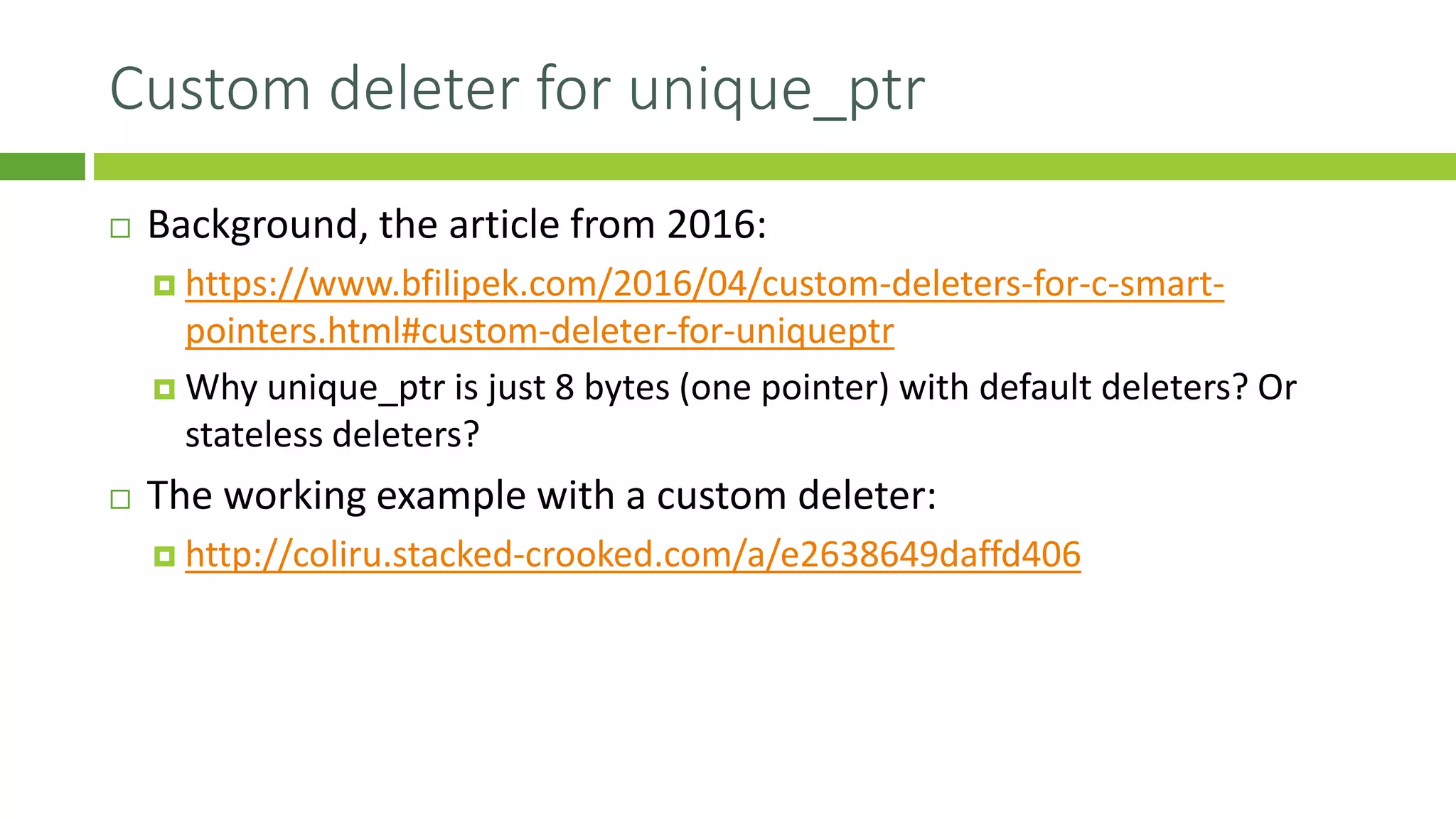
![The plan
Unique_ptr and a custom deleter
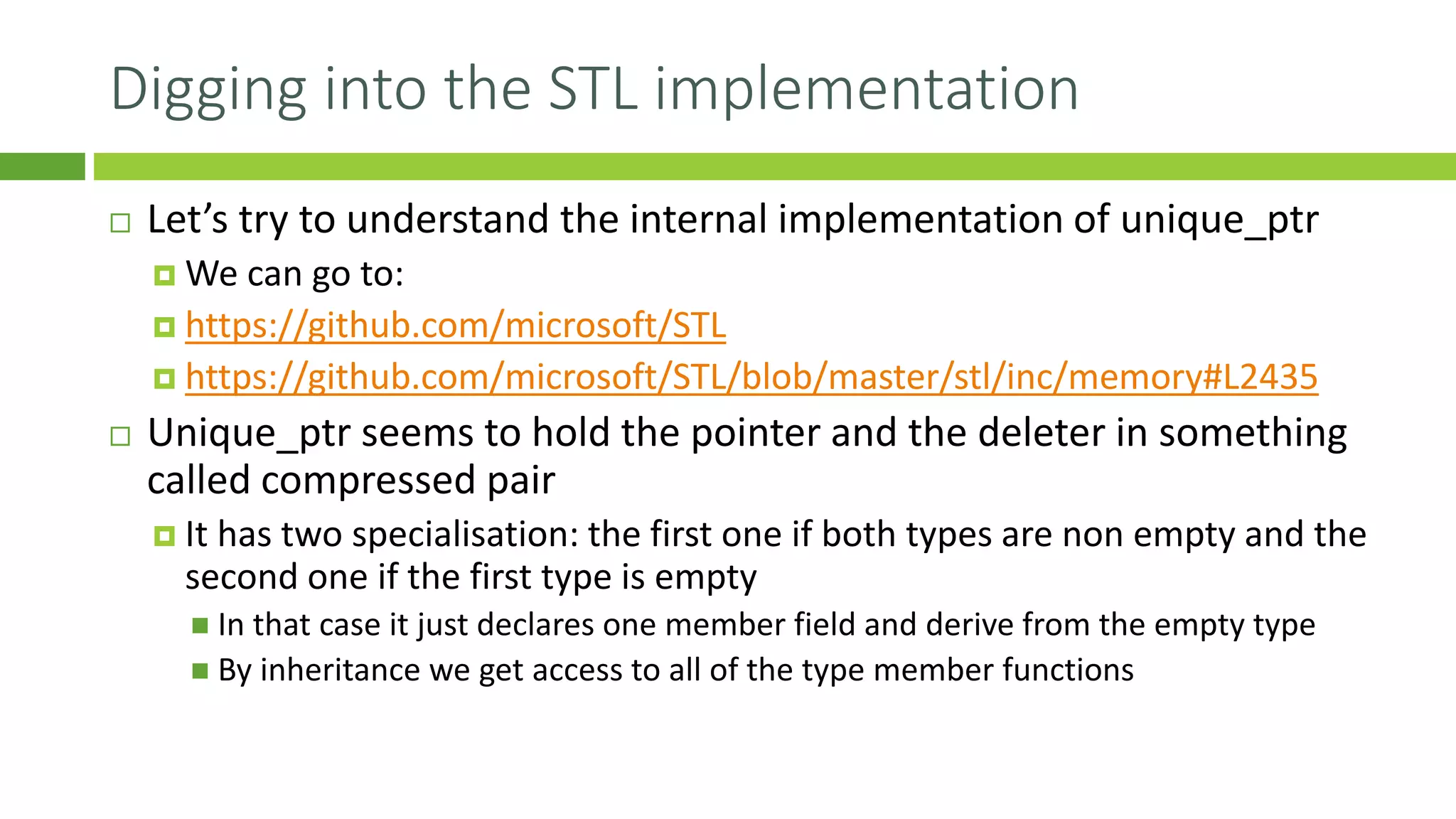
Digging into the STL implementation
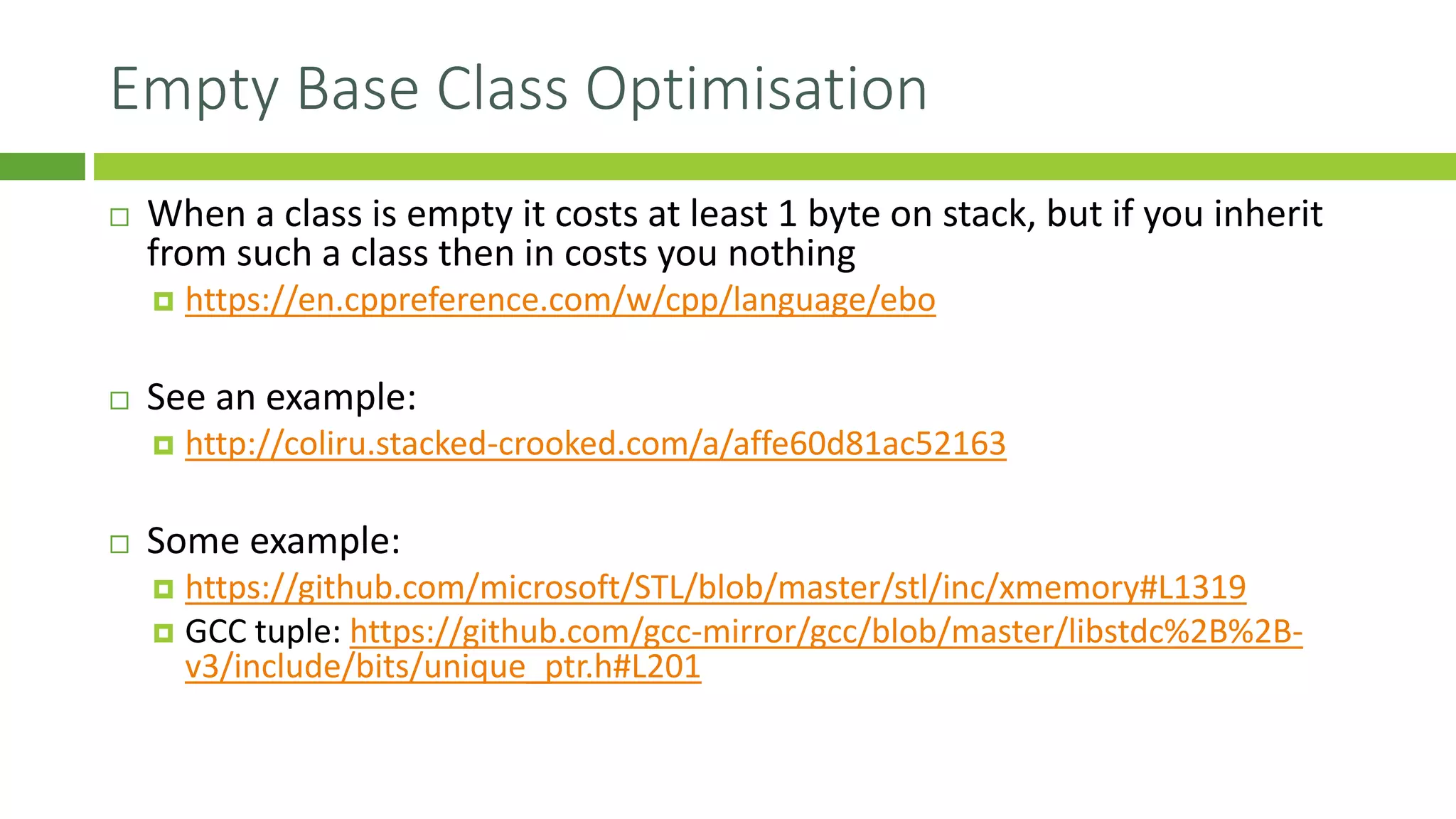
Empty Base Class Optimisation
[[no_unique_address]]
Other C++20 Attributes and Features](https://image.slidesharecdn.com/emptybaseattributespublic-200727061030/75/Empty-Base-Class-Optimisation-no_unique_address-and-other-C-20-Attributes-3-2048.jpg)
![[[no_unique_address]]
Let’s rewrite the compressed pair into something really simple thanks
to the new attribute from C++20
http://coliru.stacked-crooked.com/a/7ccae3a3168e73b9](https://image.slidesharecdn.com/emptybaseattributespublic-200727061030/75/Empty-Base-Class-Optimisation-no_unique_address-and-other-C-20-Attributes-7-2048.jpg)
![Attributes in C++17
[[noreturn]] indicates that the function does not return
[[carries_dependency]]
indicates that dependency chain in release-consume
std::memory_order propagates in and out of the function
[[deprecated]]
[[deprecated("reason")]]
indicates that the use of the name or entity declared with this
attribute is allowed, but discouraged for some reason
[[fallthrough]]
indicates that the fall through from the previous case label is
intentional and should not be diagnosed by a compiler that warns
on fall-through
[[nodiscard]]
encourages the compiler to issue a warning if the return value is
discarded
[[maybe_unused]] suppresses compiler warnings on unused entities, if any
https://www.bfilipek.com/2017/07/cpp17-in-details-attributes.html
https://www.bfilipek.com/2017/11/nodiscard.html](https://image.slidesharecdn.com/emptybaseattributespublic-200727061030/75/Empty-Base-Class-Optimisation-no_unique_address-and-other-C-20-Attributes-8-2048.jpg)
![Attributes in C++20
[[nodiscard("reason")]]
encourages the compiler to issue a warning if the
return value is discarded
[[likely]]
[[unlikely]]
indicates that the compiler should optimize for the
case where a path of execution through a statement
is more or less likely than any other path of execution
[[no_unique_address]]
indicates that a non-static data member need not
have an address distinct from all other non-static
data members of its class
• Apply [[nodiscard]] to the standard library - P0600
• [[nodiscard]] for constructors - P1771](https://image.slidesharecdn.com/emptybaseattributespublic-200727061030/75/Empty-Base-Class-Optimisation-no_unique_address-and-other-C-20-Attributes-9-2048.jpg)
![Summary
Empty Base Class Optimisation relies on the fact that if you inherit
from a empty class then you don’t need more memory, but you get
access to member functions.
The technique is however a bit complicated
Thanks to the new C++20 attribute – [[no_unique_address]] the code can
be much simpler
Since C++11 the Standard has been taking vendor specific annotation
syntax into a common form of [[attrib_name]].
C++20 adds new attributes: [[no_unique_address]], [[likely]] and
[[unlikely]]](https://image.slidesharecdn.com/emptybaseattributespublic-200727061030/75/Empty-Base-Class-Optimisation-no_unique_address-and-other-C-20-Attributes-10-2048.jpg)

The document discusses optimization techniques in C++20, including empty base class optimization and the new [[no_unique_address]] attribute. It explains how these features contribute to improving memory efficiency and simplifies code. The author also highlights the evolution of attribute syntax since C++11 and introduces additional attributes in C++20.


![CSC2161Programming_in_Cpp_Lecture4-OOP Classes and Objects[1].pptx](https://cdn.slidesharecdn.com/ss_thumbnails/csc2161programmingincpplecture4-oopclassesandobjects1-241029163609-be58d7d3-thumbnail.jpg?width=640&height=640&fit=bounds)


![Vibe Coding vs. Spec-Driven Development [Free Meetup]](https://cdn.slidesharecdn.com/ss_thumbnails/vibecodingvsspecdrivendevelopment-251209105622-43f455e7-thumbnail.jpg?width=640&height=640&fit=bounds)


