Compilers and Libraries
Staffan Tjernström
Lead Software Engineer
Eagle Seven Technologies, LLC
stjernstrom@eagleseven.com
https://www.linkedin.com/pub/staffan-tjernstr%C3%B6m/6/595/137
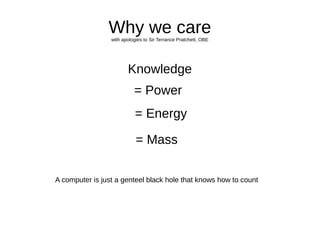
Why we carewith apologies to Sir Terrance Pratchett, OBE
Knowledge
Why we carewith apologies to Sir Terrance Pratchett, OBE
Knowledge
= Power
= Energy
= Mass
A computer is just a genteel black hole that knows how to count
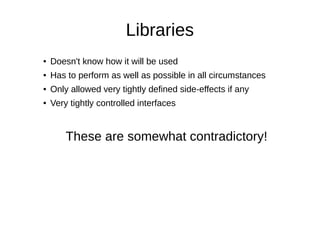
Libraries
● Doesn't know how it will be used
● Has to perform as well as possible in all circumstances
● Only allowed very tightly defined side-effects if any
● Very tightly controlled interfaces
These are somewhat contradictory!
The classic example
Thread 1
while( running )
{
int item_count(0);
for( auto i : *p_map )
{
item_count++;
}
p_map->erase( item_count - 1 );
}
Occasional SegVio!
Thread 2
for( int i = 0; i < 1024 * 1024 ; i++ )
{
my_map[ i ] = i * 16;
}
running = false;
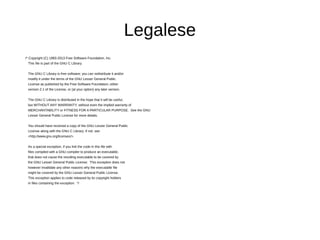
Legalese
/* Copyright (C) 1993-2013 Free Software Foundation, Inc.
This file is part of the GNU C Library.
The GNU C Library is free software; you can redistribute it and/or
modify it under the terms of the GNU Lesser General Public
License as published by the Free Software Foundation; either
version 2.1 of the License, or (at your option) any later version.
The GNU C Library is distributed in the hope that it will be useful,
but WITHOUT ANY WARRANTY; without even the implied warranty of
MERCHANTABILITY or FITNESS FOR A PARTICULAR PURPOSE. See the GNU
Lesser General Public License for more details.
You should have received a copy of the GNU Lesser General Public
License along with the GNU C Library; if not, see
<http://www.gnu.org/licenses/>.
As a special exception, if you link the code in this file with
files compiled with a GNU compiler to produce an executable,
that does not cause the resulting executable to be covered by
the GNU Lesser General Public License. This exception does not
however invalidate any other reasons why the executable file
might be covered by the GNU Lesser General Public License.
This exception applies to code released by its copyright holders
in files containing the exception. */
Example Code
#include <stdio.h>
int main( )
{
char const text[] = “Hello Universe”;
FILE *fp = fopen(“invalid/path/to/file”, “w+”);
fwrite( text, sizeof( char ), sizeof( text ), fp );
fclose( fp );
}
Segmentation Fault!
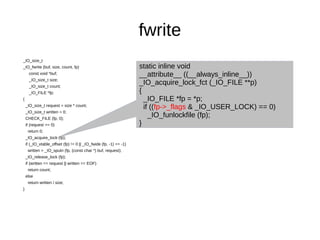
fwrite
_IO_size_t
_IO_fwrite (buf, size, count, fp)
const void *buf;
_IO_size_t size;
_IO_size_t count;
_IO_FILE *fp;
{
_IO_size_t request = size * count;
_IO_size_t written = 0;
CHECK_FILE (fp, 0);
if (request == 0)
return 0;
_IO_acquire_lock (fp);
if (_IO_vtable_offset (fp) != 0 || _IO_fwide (fp, -1) == -1)
written = _IO_sputn (fp, (const char *) buf, request);
_IO_release_lock (fp);
if (written == request || written == EOF)
return count;
else
return written / size;
}
static inline void
__attribute__ ((__always_inline__))
_IO_acquire_lock_fct (_IO_FILE **p)
{
_IO_FILE *fp = *p;
if ((fp->_flags & _IO_USER_LOCK) == 0)
_IO_funlockfile (fp);
}
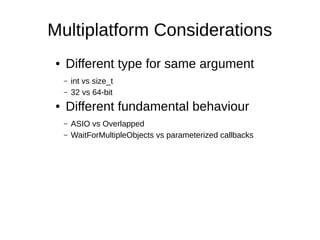
Multiplatform Considerations
● Different type for same argument
– int vs size_t
– 32 vs 64-bit
● Different fundamental behaviour
– ASIO vs Overlapped
– WaitForMultipleObjects vs parameterized callbacks
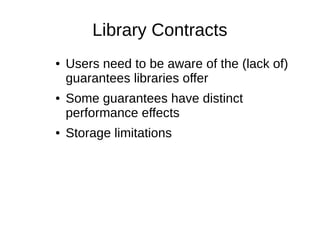
Library Contracts
● Users need to be aware of the (lack of)
guarantees libraries offer
● Some guarantees have distinct
performance effects
● Storage limitations
Successful implementations
● CP/M 3 BIOS jump vectors
● glibc
● Boost
● C++ standard library
● Linux syscall()
● Many more
Compilers
● Processors have complex behaviours
● System components no longer equal in
latency
● Target systems not the same as build
systems
● Virtual Targets
Loopy code
extern int elem[64];
int i, sum;
for( i = 63; i; i-- )
{
sum = sum + elem[ i ];
}
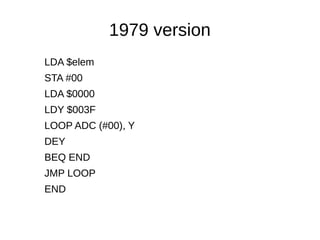
1979 version
LDA $elem
STA #00
LDA $0000
LDY $003F
LOOP ADC (#00), Y
DEY
BEQ END
JMP LOOP
END
1979 Behaviour
● Linear complexity up to 255 bytes
● Easy to deduce C from assembler
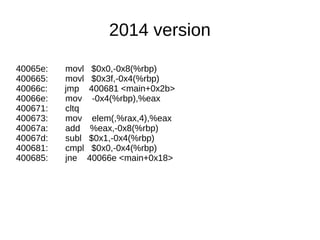
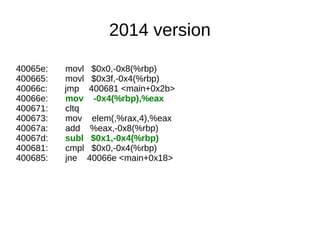
2014 version
40065e: movl $0x0,-0x8(%rbp)
400665: movl $0x3f,-0x4(%rbp)
40066c: jmp 400681 <main+0x2b>
40066e: mov -0x4(%rbp),%eax
400671: cltq
400673: mov elem(,%rax,4),%eax
40067a: add %eax,-0x8(%rbp)
40067d: subl $0x1,-0x4(%rbp)
400681: cmpl $0x0,-0x4(%rbp)
400685: jne 40066e <main+0x18>
2014 behaviour
● Still possible to deduce C from code
● Not linear behaviour
– Each run takes different amount of time !
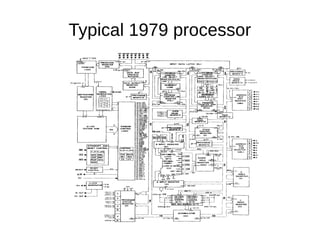
Typical 1979 processor
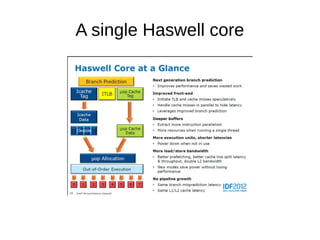
A single Haswell core
2014 version
40065e: movl $0x0,-0x8(%rbp)
400665: movl $0x3f,-0x4(%rbp)
40066c: jmp 400681 <main+0x2b>
40066e: mov -0x4(%rbp),%eax
400671: cltq
400673: mov elem(,%rax,4),%eax
40067a: add %eax,-0x8(%rbp)
40067d: subl $0x1,-0x4(%rbp)
400681: cmpl $0x0,-0x4(%rbp)
400685: jne 40066e <main+0x18>
Loop Carry Dependency
● Address update is done using the result
of a previous loop iteration
● Deprives the out-of-order engine of the
capability to have multiple iterations in-
flight
● Memory loads, instruction latency,
bypass delays cannot be amortized
efficiently.
Everyone is writing parallel programs
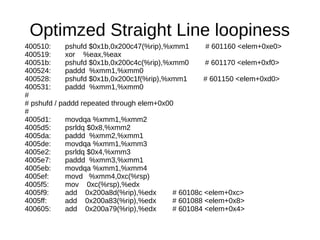
Optimzed Straight Line loopiness
400510: pshufd $0x1b,0x200c47(%rip),%xmm1 # 601160 <elem+0xe0>
400519: xor %eax,%eax
40051b: pshufd $0x1b,0x200c4c(%rip),%xmm0 # 601170 <elem+0xf0>
400524: paddd %xmm1,%xmm0
400528: pshufd $0x1b,0x200c1f(%rip),%xmm1 # 601150 <elem+0xd0>
400531: paddd %xmm1,%xmm0
#
# pshufd / paddd repeated through elem+0x00
#
4005d1: movdqa %xmm1,%xmm2
4005d5: psrldq $0x8,%xmm2
4005da: paddd %xmm2,%xmm1
4005de: movdqa %xmm1,%xmm3
4005e2: psrldq $0x4,%xmm3
4005e7: paddd %xmm3,%xmm1
4005eb: movdqa %xmm1,%xmm4
4005ef: movd %xmm4,0xc(%rsp)
4005f5: mov 0xc(%rsp),%edx
4005f9: add 0x200a8d(%rip),%edx # 60108c <elem+0xc>
4005ff: add 0x200a83(%rip),%edx # 601088 <elem+0x8>
400605: add 0x200a79(%rip),%edx # 601084 <elem+0x4>
Store Forwarding
● Use data written earlier without going
through memory or cache
● Data size and alignment in the store and
load must follow restrictive rules
● A store forwarded load must have the same start point as the
forwarded store.
● The length of the load must be less than or equal to the
length of the store.
● Data from the store must be available by
the time the load starts
Store Forward example
mov [EBP],'helloworld'
mov AL, [EBP] ;not blocked
mov BL, [EBP+1] ;blocked
mov CL, [EBP+2] ;blocked
mov DL, [EBP+3] ;blocked
mov AL, [EBP] ;not blocked, issued
before blocked loads
Suggested Reading
● Intel® 64 and IA-32 Architectures
Optimization Reference Manual
● The Software Optimization Cookbook
We're Hiring!We're Hiring!
http://www.eagleseven.com/candidates.php

CompilersAndLibraries

  • 1.
    Compilers and Libraries StaffanTjernström Lead Software Engineer Eagle Seven Technologies, LLC stjernstrom@eagleseven.com https://www.linkedin.com/pub/staffan-tjernstr%C3%B6m/6/595/137
  • 2.
    Why we carewithapologies to Sir Terrance Pratchett, OBE Knowledge
  • 3.
    Why we carewithapologies to Sir Terrance Pratchett, OBE Knowledge = Power = Energy = Mass A computer is just a genteel black hole that knows how to count
  • 4.
    Libraries ● Doesn't knowhow it will be used ● Has to perform as well as possible in all circumstances ● Only allowed very tightly defined side-effects if any ● Very tightly controlled interfaces These are somewhat contradictory!
  • 5.
    The classic example Thread1 while( running ) { int item_count(0); for( auto i : *p_map ) { item_count++; } p_map->erase( item_count - 1 ); } Occasional SegVio! Thread 2 for( int i = 0; i < 1024 * 1024 ; i++ ) { my_map[ i ] = i * 16; } running = false;
  • 6.
    Legalese /* Copyright (C)1993-2013 Free Software Foundation, Inc. This file is part of the GNU C Library. The GNU C Library is free software; you can redistribute it and/or modify it under the terms of the GNU Lesser General Public License as published by the Free Software Foundation; either version 2.1 of the License, or (at your option) any later version. The GNU C Library is distributed in the hope that it will be useful, but WITHOUT ANY WARRANTY; without even the implied warranty of MERCHANTABILITY or FITNESS FOR A PARTICULAR PURPOSE. See the GNU Lesser General Public License for more details. You should have received a copy of the GNU Lesser General Public License along with the GNU C Library; if not, see <http://www.gnu.org/licenses/>. As a special exception, if you link the code in this file with files compiled with a GNU compiler to produce an executable, that does not cause the resulting executable to be covered by the GNU Lesser General Public License. This exception does not however invalidate any other reasons why the executable file might be covered by the GNU Lesser General Public License. This exception applies to code released by its copyright holders in files containing the exception. */
  • 7.
    Example Code #include <stdio.h> intmain( ) { char const text[] = “Hello Universe”; FILE *fp = fopen(“invalid/path/to/file”, “w+”); fwrite( text, sizeof( char ), sizeof( text ), fp ); fclose( fp ); } Segmentation Fault!
  • 8.
    fwrite _IO_size_t _IO_fwrite (buf, size,count, fp) const void *buf; _IO_size_t size; _IO_size_t count; _IO_FILE *fp; { _IO_size_t request = size * count; _IO_size_t written = 0; CHECK_FILE (fp, 0); if (request == 0) return 0; _IO_acquire_lock (fp); if (_IO_vtable_offset (fp) != 0 || _IO_fwide (fp, -1) == -1) written = _IO_sputn (fp, (const char *) buf, request); _IO_release_lock (fp); if (written == request || written == EOF) return count; else return written / size; } static inline void __attribute__ ((__always_inline__)) _IO_acquire_lock_fct (_IO_FILE **p) { _IO_FILE *fp = *p; if ((fp->_flags & _IO_USER_LOCK) == 0) _IO_funlockfile (fp); }
  • 9.
    Multiplatform Considerations ● Differenttype for same argument – int vs size_t – 32 vs 64-bit ● Different fundamental behaviour – ASIO vs Overlapped – WaitForMultipleObjects vs parameterized callbacks
  • 10.
    Library Contracts ● Usersneed to be aware of the (lack of) guarantees libraries offer ● Some guarantees have distinct performance effects ● Storage limitations
  • 11.
    Successful implementations ● CP/M3 BIOS jump vectors ● glibc ● Boost ● C++ standard library ● Linux syscall() ● Many more
  • 12.
    Compilers ● Processors havecomplex behaviours ● System components no longer equal in latency ● Target systems not the same as build systems ● Virtual Targets
  • 13.
    Loopy code extern intelem[64]; int i, sum; for( i = 63; i; i-- ) { sum = sum + elem[ i ]; }
  • 14.
    1979 version LDA $elem STA#00 LDA $0000 LDY $003F LOOP ADC (#00), Y DEY BEQ END JMP LOOP END
  • 15.
    1979 Behaviour ● Linearcomplexity up to 255 bytes ● Easy to deduce C from assembler
  • 16.
    2014 version 40065e: movl$0x0,-0x8(%rbp) 400665: movl $0x3f,-0x4(%rbp) 40066c: jmp 400681 <main+0x2b> 40066e: mov -0x4(%rbp),%eax 400671: cltq 400673: mov elem(,%rax,4),%eax 40067a: add %eax,-0x8(%rbp) 40067d: subl $0x1,-0x4(%rbp) 400681: cmpl $0x0,-0x4(%rbp) 400685: jne 40066e <main+0x18>
  • 17.
    2014 behaviour ● Stillpossible to deduce C from code ● Not linear behaviour – Each run takes different amount of time !
  • 18.
  • 19.
  • 20.
    2014 version 40065e: movl$0x0,-0x8(%rbp) 400665: movl $0x3f,-0x4(%rbp) 40066c: jmp 400681 <main+0x2b> 40066e: mov -0x4(%rbp),%eax 400671: cltq 400673: mov elem(,%rax,4),%eax 40067a: add %eax,-0x8(%rbp) 40067d: subl $0x1,-0x4(%rbp) 400681: cmpl $0x0,-0x4(%rbp) 400685: jne 40066e <main+0x18>
  • 21.
    Loop Carry Dependency ●Address update is done using the result of a previous loop iteration ● Deprives the out-of-order engine of the capability to have multiple iterations in- flight ● Memory loads, instruction latency, bypass delays cannot be amortized efficiently.
  • 22.
    Everyone is writingparallel programs
  • 23.
    Optimzed Straight Lineloopiness 400510: pshufd $0x1b,0x200c47(%rip),%xmm1 # 601160 <elem+0xe0> 400519: xor %eax,%eax 40051b: pshufd $0x1b,0x200c4c(%rip),%xmm0 # 601170 <elem+0xf0> 400524: paddd %xmm1,%xmm0 400528: pshufd $0x1b,0x200c1f(%rip),%xmm1 # 601150 <elem+0xd0> 400531: paddd %xmm1,%xmm0 # # pshufd / paddd repeated through elem+0x00 # 4005d1: movdqa %xmm1,%xmm2 4005d5: psrldq $0x8,%xmm2 4005da: paddd %xmm2,%xmm1 4005de: movdqa %xmm1,%xmm3 4005e2: psrldq $0x4,%xmm3 4005e7: paddd %xmm3,%xmm1 4005eb: movdqa %xmm1,%xmm4 4005ef: movd %xmm4,0xc(%rsp) 4005f5: mov 0xc(%rsp),%edx 4005f9: add 0x200a8d(%rip),%edx # 60108c <elem+0xc> 4005ff: add 0x200a83(%rip),%edx # 601088 <elem+0x8> 400605: add 0x200a79(%rip),%edx # 601084 <elem+0x4>
  • 24.
    Store Forwarding ● Usedata written earlier without going through memory or cache ● Data size and alignment in the store and load must follow restrictive rules ● A store forwarded load must have the same start point as the forwarded store. ● The length of the load must be less than or equal to the length of the store. ● Data from the store must be available by the time the load starts
  • 25.
    Store Forward example mov[EBP],'helloworld' mov AL, [EBP] ;not blocked mov BL, [EBP+1] ;blocked mov CL, [EBP+2] ;blocked mov DL, [EBP+3] ;blocked mov AL, [EBP] ;not blocked, issued before blocked loads
  • 26.
    Suggested Reading ● Intel®64 and IA-32 Architectures Optimization Reference Manual ● The Software Optimization Cookbook
  • 27.