
HOW TO USE VOCABULARY
TYPES FROM C++17?
std::optional, std::variant, std::any
Bartłomiej Filipek, bfilipek.com17th September 2019
About me
 See my coding blog at: www.bfilipek.com
 ~12y coding experience
 Microsoft MVP
 C++ ISO Member
 @Xara.com
 Text related features for advanced document
editors
 Somehow addicted to C++ 
Xara Cloud DemoC++17 In Detail
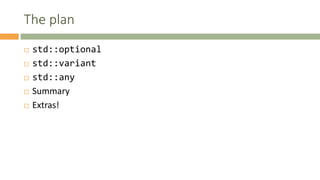
The plan
 std::optional
 std::variant
 std::any
 Summary
 Extras!
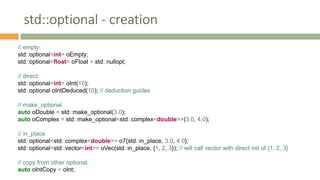
std::optional - creation
// empty:
std::optional<int> oEmpty;
std::optional<float> oFloat = std::nullopt;
// direct:
std::optional<int> oInt(10);
std::optional oIntDeduced(10); // deduction guides
// make_optional
auto oDouble = std::make_optional(3.0);
auto oComplex = std::make_optional<std::complex<double>>(3.0, 4.0);
// in_place
std::optional<std::complex<double>> o7{std::in_place, 3.0, 4.0};
std::optional<std::vector<int>> oVec(std::in_place, {1, 2, 3}); // will call vector with direct init of {1, 2, 3}
// copy from other optional:
auto oIntCopy = oInt;
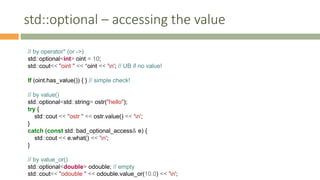
std::optional – accessing the value
// by operator* (or ->)
std::optional<int> oint = 10;
std::cout<< "oint " << *oint << 'n'; // UB if no value!
If (oint.has_value()) { } // simple check!
// by value()
std::optional<std::string> ostr("hello");
try {
std::cout << "ostr " << ostr.value() << 'n';
}
catch (const std::bad_optional_access& e) {
std::cout << e.what() << 'n';
}
// by value_or()
std::optional<double> odouble; // empty
std::cout<< "odouble " << odouble.value_or(10.0) << 'n';
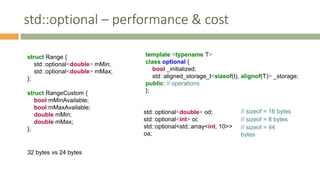
std::optional – performance & cost
struct Range {
std::optional<double> mMin;
std::optional<double> mMax;
};
struct RangeCustom {
bool mMinAvailable;
bool mMaxAvailable;
double mMin;
double mMax;
};
template <typename T>
class optional {
bool _initialized;
std::aligned_storage_t<sizeof(t), alignof(T)> _storage;
public: // operations
};
std::optional<double> od;
std::optional<int> oi;
std::optional<std::array<int, 10>>
oa;
32 bytes vs 24 bytes
// sizeof = 44
bytes
// sizeof = 16 bytes
// sizeof = 8 bytes
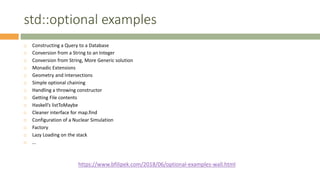
std::optional examples
 Constructing a Query to a Database
 Conversion from a String to an Integer
 Conversion from String, More Generic solution
 Monadic Extensions
 Geometry and Intersections
 Simple optional chaining
 Handling a throwing constructor
 Getting File contents
 Haskell’s listToMaybe
 Cleaner interface for map.find
 Configuration of a Nuclear Simulation
 Factory
 Lazy Loading on the stack
 …
https://www.bfilipek.com/2018/06/optional-examples-wall.html
std::variant
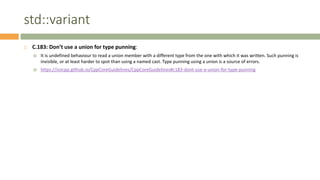
 C.183: Don’t use a union for type punning:
 It is undefined behaviour to read a union member with a different type from the one with which it was written. Such punning is
invisible, or at least harder to spot than using a named cast. Type punning using a union is a source of errors.
 https://isocpp.github.io/CppCoreGuidelines/CppCoreGuidelines#c183-dont-use-a-union-for-type-punning
std::variant - creation
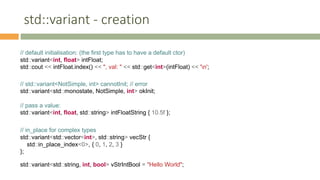
// default initialisation: (the first type has to have a default ctor)
std::variant<int, float> intFloat;
std::cout << intFloat.index() << ", val: " << std::get<int>(intFloat) << 'n';
// std::variant<NotSimple, int> cannotInit; // error
std::variant<std::monostate, NotSimple, int> okInit;
// pass a value:
std::variant<int, float, std::string> intFloatString { 10.5f };
// in_place for complex types
std::variant<std::vector<int>, std::string> vecStr {
std::in_place_index<0>, { 0, 1, 2, 3 }
};
std::variant<std::string, int, bool> vStrIntBool = "Hello World";
std::variant – changing the value
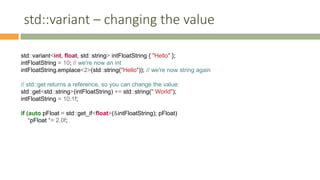
std::variant<int, float, std::string> intFloatString { "Hello" };
intFloatString = 10; // we're now an int
intFloatString.emplace<2>(std::string("Hello")); // we're now string again
// std::get returns a reference, so you can change the value:
std::get<std::string>(intFloatString) += std::string(" World");
intFloatString = 10.1f;
if (auto pFloat = std::get_if<float>(&intFloatString); pFloat)
*pFloat *= 2.0f;
std::variant – accessing the value
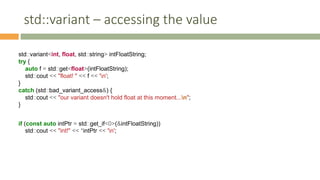
std::variant<int, float, std::string> intFloatString;
try {
auto f = std::get<float>(intFloatString);
std::cout << "float! " << f << 'n';
}
catch (std::bad_variant_access&) {
std::cout << "our variant doesn't hold float at this moment...n";
}
if (const auto intPtr = std::get_if<0>(&intFloatString))
std::cout << "int!" << *intPtr << 'n';
std::variant - visitors
// a generic lambda:
auto PrintVisitor = [](const auto& t) { std::cout << t << 'n'; };
std::variant<int, float, std::string> intFloatString { "Hello" };
std::visit(PrintVisitor, intFloatString);
struct MultiplyVisitor {
float mFactor;
MultiplyVisitor(float factor) : mFactor(factor) { }
void operator()(int& i) const { i *= static_cast<int>(mFactor); }
void operator()(float& f) const { f *= mFactor; }
void operator()(std::string& ) const { // nothing to do here...}
};
std::visit(MultiplyVisitor(2.5f), intFloatString );
std::visit(PrintVisitor, intFloatString );
std::variant - visitors
std::variant<int, float, std::string> myVariant;
std::visit(
overload {
[](const int& i) { std::cout << "int: " << i; },
[](const std::string& s) { std::cout << "string: " << s; },
[](const float& f) { std::cout << "float: " << f; }
},
myVariant
);
Overload
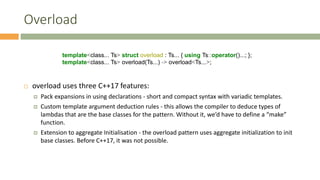
 overload uses three C++17 features:
 Pack expansions in using declarations - short and compact syntax with variadic templates.
 Custom template argument deduction rules - this allows the compiler to deduce types of
lambdas that are the base classes for the pattern. Without it, we’d have to define a “make”
function.
 Extension to aggregate Initialisation - the overload pattern uses aggregate initialization to init
base classes. Before C++17, it was not possible.
template<class... Ts> struct overload : Ts... { using Ts::operator()...; };
template<class... Ts> overload(Ts...) -> overload<Ts...>;
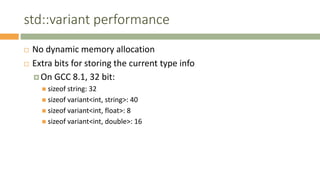
std::variant performance
 No dynamic memory allocation
 Extra bits for storing the current type info
 On GCC 8.1, 32 bit:
 sizeof string: 32
 sizeof variant<int, string>: 40
 sizeof variant<int, float>: 8
 sizeof variant<int, double>: 16
std::variant examples
 Parsing files
 Config files
 Finite state machines -> Space Game: A std::variant-Based State
Machine by Example
 Polymorphism
 Error handling
 … ?
 https://www.bfilipek.com/2018/06/variant.html
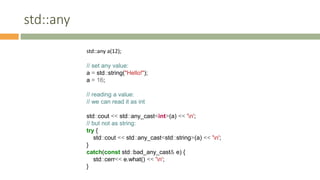
std::any
std::any a(12);
// set any value:
a = std::string("Hello!");
a = 16;
// reading a value:
// we can read it as int
std::cout << std::any_cast<int>(a) << 'n';
// but not as string:
try {
std::cout << std::any_cast<std::string>(a) << 'n';
}
catch(const std::bad_any_cast& e) {
std::cerr<< e.what() << 'n';
}
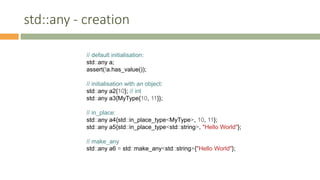
std::any - creation
// default initialisation:
std::any a;
assert(!a.has_value());
// initialisation with an object:
std::any a2{10}; // int
std::any a3{MyType{10, 11}};
// in_place:
std::any a4{std::in_place_type<MyType>, 10, 11};
std::any a5{std::in_place_type<std::string>, "Hello World"};
// make_any
std::any a6 = std::make_any<std::string>{"Hello World"};
std::any
// you can use it in a container:
std::map<std::string, std::any> m;
m["integer"] = 10;
m["string"] = std::string("Hello World");
m["float"] = 1.0f;
for (auto &[key, val] : m) {
if (val.type() == typeid(int))
std::cout << "int: " << std::any_cast<int>(val) << 'n’;
else if (val.type() == typeid(std::string))
std::cout << "string: " << std::any_cast<std::string>(val) << 'n’;
else if (val.type() == typeid(float))
std::cout << "float: " << std::any_cast<float>(val) << 'n’;
}
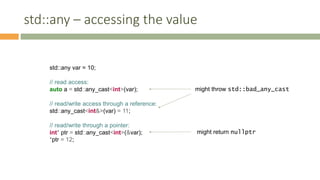
std::any – accessing the value
std::any var = 10;
// read access:
auto a = std::any_cast<int>(var);
// read/write access through a reference:
std::any_cast<int&>(var) = 11;
// read/write through a pointer:
int* ptr = std::any_cast<int>(&var);
*ptr = 12;
might throw std::bad_any_cast
might return nullptr
std::any – size and performance
Compiler Sizeof(std::any)
GCC 8.1 (Coliru) 16 16
Clang 7.0.0 (Wandbox) 32
MSVC 2017 15.7.0 32-bit 40
MSVC 2017 15.7.0 64-bit 64
23.8.3 [any.class]:
Implementations should avoid the use of dynamically allocated memory for a small contained value.
Example: where the object constructed is holding only an int. Such small object optimisation shall only
be applied to types T for which is_nothrow_move_constructible_v<T> is true.
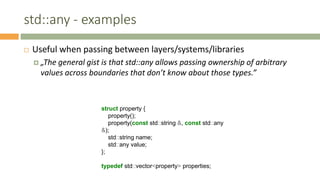
std::any - examples
 Useful when passing between layers/systems/libraries
 „The general gist is that std::any allows passing ownership of arbitrary
values across boundaries that don’t know about those types.”
struct property {
property();
property(const std::string &, const std::any
&);
std::string name;
std::any value;
};
typedef std::vector<property> properties;
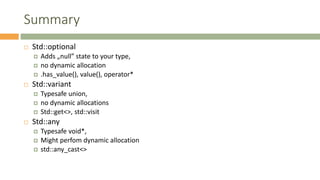
Summary
 Std::optional
 Adds „null” state to your type,
 no dynamic allocation
 .has_value(), value(), operator*
 Std::variant
 Typesafe union,
 no dynamic allocations
 Std::get<>, std::visit
 Std::any
 Typesafe void*,
 Might perfom dynamic allocation
 std::any_cast<>
Quiz Time
 Why is std::optional better than unique_ptr? (for storing nullable
types?)
 Unique_ptr also nullable, but requires dynamic memory allocation, cannot
copy easily
Quiz Time
 What’s the sizeof of std::variant?
 Depends 
 In general, it’s the max size of all variant types + place for the discriminator
value
Quiz Time
 What’s std::monostate?
 Default constructible, empty object
 Helpful when your types in variant cannot be default constructible
 Variant<monostate, TypeA, TypeB> var;
Quiz Time
 Can std::variant get into an invalid state?
 When old value is destroyed and then during the initialisation of the new
value we throw exception
 See example: http://coliru.stacked-crooked.com/a/413ce70317dbd2e5
Quiz Time
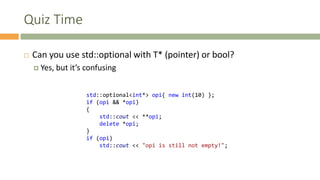
 Can you use std::optional with T* (pointer) or bool?
 Yes, but it’s confusing
std::optional<int*> opi{ new int(10) };
if (opi && *opi)
{
std::cout << **opi;
delete *opi;
}
if (opi)
std::cout << "opi is still not empty!";
https://devblogs.microsoft.com/cppblog/open-sourcing-msvcs-stl/
https://devblogs.microsoft.com/cppblog/c20-concepts-are-here-in-visual-studio-2019-version-16-3/

Vocabulary Types in C++17

  • 1.
    HOW TO USEVOCABULARY TYPES FROM C++17? std::optional, std::variant, std::any Bartłomiej Filipek, bfilipek.com17th September 2019
  • 2.
    About me  Seemy coding blog at: www.bfilipek.com  ~12y coding experience  Microsoft MVP  C++ ISO Member  @Xara.com  Text related features for advanced document editors  Somehow addicted to C++  Xara Cloud DemoC++17 In Detail
  • 3.
    The plan  std::optional std::variant  std::any  Summary  Extras!
  • 4.
    std::optional - creation //empty: std::optional<int> oEmpty; std::optional<float> oFloat = std::nullopt; // direct: std::optional<int> oInt(10); std::optional oIntDeduced(10); // deduction guides // make_optional auto oDouble = std::make_optional(3.0); auto oComplex = std::make_optional<std::complex<double>>(3.0, 4.0); // in_place std::optional<std::complex<double>> o7{std::in_place, 3.0, 4.0}; std::optional<std::vector<int>> oVec(std::in_place, {1, 2, 3}); // will call vector with direct init of {1, 2, 3} // copy from other optional: auto oIntCopy = oInt;
  • 5.
    std::optional – accessingthe value // by operator* (or ->) std::optional<int> oint = 10; std::cout<< "oint " << *oint << 'n'; // UB if no value! If (oint.has_value()) { } // simple check! // by value() std::optional<std::string> ostr("hello"); try { std::cout << "ostr " << ostr.value() << 'n'; } catch (const std::bad_optional_access& e) { std::cout << e.what() << 'n'; } // by value_or() std::optional<double> odouble; // empty std::cout<< "odouble " << odouble.value_or(10.0) << 'n';
  • 6.
    std::optional – performance& cost struct Range { std::optional<double> mMin; std::optional<double> mMax; }; struct RangeCustom { bool mMinAvailable; bool mMaxAvailable; double mMin; double mMax; }; template <typename T> class optional { bool _initialized; std::aligned_storage_t<sizeof(t), alignof(T)> _storage; public: // operations }; std::optional<double> od; std::optional<int> oi; std::optional<std::array<int, 10>> oa; 32 bytes vs 24 bytes // sizeof = 44 bytes // sizeof = 16 bytes // sizeof = 8 bytes
  • 7.
    std::optional examples  Constructinga Query to a Database  Conversion from a String to an Integer  Conversion from String, More Generic solution  Monadic Extensions  Geometry and Intersections  Simple optional chaining  Handling a throwing constructor  Getting File contents  Haskell’s listToMaybe  Cleaner interface for map.find  Configuration of a Nuclear Simulation  Factory  Lazy Loading on the stack  … https://www.bfilipek.com/2018/06/optional-examples-wall.html
  • 8.
    std::variant  C.183: Don’tuse a union for type punning:  It is undefined behaviour to read a union member with a different type from the one with which it was written. Such punning is invisible, or at least harder to spot than using a named cast. Type punning using a union is a source of errors.  https://isocpp.github.io/CppCoreGuidelines/CppCoreGuidelines#c183-dont-use-a-union-for-type-punning
  • 9.
    std::variant - creation //default initialisation: (the first type has to have a default ctor) std::variant<int, float> intFloat; std::cout << intFloat.index() << ", val: " << std::get<int>(intFloat) << 'n'; // std::variant<NotSimple, int> cannotInit; // error std::variant<std::monostate, NotSimple, int> okInit; // pass a value: std::variant<int, float, std::string> intFloatString { 10.5f }; // in_place for complex types std::variant<std::vector<int>, std::string> vecStr { std::in_place_index<0>, { 0, 1, 2, 3 } }; std::variant<std::string, int, bool> vStrIntBool = "Hello World";
  • 10.
    std::variant – changingthe value std::variant<int, float, std::string> intFloatString { "Hello" }; intFloatString = 10; // we're now an int intFloatString.emplace<2>(std::string("Hello")); // we're now string again // std::get returns a reference, so you can change the value: std::get<std::string>(intFloatString) += std::string(" World"); intFloatString = 10.1f; if (auto pFloat = std::get_if<float>(&intFloatString); pFloat) *pFloat *= 2.0f;
  • 11.
    std::variant – accessingthe value std::variant<int, float, std::string> intFloatString; try { auto f = std::get<float>(intFloatString); std::cout << "float! " << f << 'n'; } catch (std::bad_variant_access&) { std::cout << "our variant doesn't hold float at this moment...n"; } if (const auto intPtr = std::get_if<0>(&intFloatString)) std::cout << "int!" << *intPtr << 'n';
  • 12.
    std::variant - visitors //a generic lambda: auto PrintVisitor = [](const auto& t) { std::cout << t << 'n'; }; std::variant<int, float, std::string> intFloatString { "Hello" }; std::visit(PrintVisitor, intFloatString); struct MultiplyVisitor { float mFactor; MultiplyVisitor(float factor) : mFactor(factor) { } void operator()(int& i) const { i *= static_cast<int>(mFactor); } void operator()(float& f) const { f *= mFactor; } void operator()(std::string& ) const { // nothing to do here...} }; std::visit(MultiplyVisitor(2.5f), intFloatString ); std::visit(PrintVisitor, intFloatString );
  • 13.
    std::variant - visitors std::variant<int,float, std::string> myVariant; std::visit( overload { [](const int& i) { std::cout << "int: " << i; }, [](const std::string& s) { std::cout << "string: " << s; }, [](const float& f) { std::cout << "float: " << f; } }, myVariant );
  • 14.
    Overload  overload usesthree C++17 features:  Pack expansions in using declarations - short and compact syntax with variadic templates.  Custom template argument deduction rules - this allows the compiler to deduce types of lambdas that are the base classes for the pattern. Without it, we’d have to define a “make” function.  Extension to aggregate Initialisation - the overload pattern uses aggregate initialization to init base classes. Before C++17, it was not possible. template<class... Ts> struct overload : Ts... { using Ts::operator()...; }; template<class... Ts> overload(Ts...) -> overload<Ts...>;
  • 15.
    std::variant performance  Nodynamic memory allocation  Extra bits for storing the current type info  On GCC 8.1, 32 bit:  sizeof string: 32  sizeof variant<int, string>: 40  sizeof variant<int, float>: 8  sizeof variant<int, double>: 16
  • 16.
    std::variant examples  Parsingfiles  Config files  Finite state machines -> Space Game: A std::variant-Based State Machine by Example  Polymorphism  Error handling  … ?  https://www.bfilipek.com/2018/06/variant.html
  • 17.
    std::any std::any a(12); // setany value: a = std::string("Hello!"); a = 16; // reading a value: // we can read it as int std::cout << std::any_cast<int>(a) << 'n'; // but not as string: try { std::cout << std::any_cast<std::string>(a) << 'n'; } catch(const std::bad_any_cast& e) { std::cerr<< e.what() << 'n'; }
  • 18.
    std::any - creation //default initialisation: std::any a; assert(!a.has_value()); // initialisation with an object: std::any a2{10}; // int std::any a3{MyType{10, 11}}; // in_place: std::any a4{std::in_place_type<MyType>, 10, 11}; std::any a5{std::in_place_type<std::string>, "Hello World"}; // make_any std::any a6 = std::make_any<std::string>{"Hello World"};
  • 19.
    std::any // you canuse it in a container: std::map<std::string, std::any> m; m["integer"] = 10; m["string"] = std::string("Hello World"); m["float"] = 1.0f; for (auto &[key, val] : m) { if (val.type() == typeid(int)) std::cout << "int: " << std::any_cast<int>(val) << 'n’; else if (val.type() == typeid(std::string)) std::cout << "string: " << std::any_cast<std::string>(val) << 'n’; else if (val.type() == typeid(float)) std::cout << "float: " << std::any_cast<float>(val) << 'n’; }
  • 20.
    std::any – accessingthe value std::any var = 10; // read access: auto a = std::any_cast<int>(var); // read/write access through a reference: std::any_cast<int&>(var) = 11; // read/write through a pointer: int* ptr = std::any_cast<int>(&var); *ptr = 12; might throw std::bad_any_cast might return nullptr
  • 21.
    std::any – sizeand performance Compiler Sizeof(std::any) GCC 8.1 (Coliru) 16 16 Clang 7.0.0 (Wandbox) 32 MSVC 2017 15.7.0 32-bit 40 MSVC 2017 15.7.0 64-bit 64 23.8.3 [any.class]: Implementations should avoid the use of dynamically allocated memory for a small contained value. Example: where the object constructed is holding only an int. Such small object optimisation shall only be applied to types T for which is_nothrow_move_constructible_v<T> is true.
  • 22.
    std::any - examples Useful when passing between layers/systems/libraries  „The general gist is that std::any allows passing ownership of arbitrary values across boundaries that don’t know about those types.” struct property { property(); property(const std::string &, const std::any &); std::string name; std::any value; }; typedef std::vector<property> properties;
  • 23.
    Summary  Std::optional  Adds„null” state to your type,  no dynamic allocation  .has_value(), value(), operator*  Std::variant  Typesafe union,  no dynamic allocations  Std::get<>, std::visit  Std::any  Typesafe void*,  Might perfom dynamic allocation  std::any_cast<>
  • 24.
    Quiz Time  Whyis std::optional better than unique_ptr? (for storing nullable types?)  Unique_ptr also nullable, but requires dynamic memory allocation, cannot copy easily
  • 25.
    Quiz Time  What’sthe sizeof of std::variant?  Depends   In general, it’s the max size of all variant types + place for the discriminator value
  • 26.
    Quiz Time  What’sstd::monostate?  Default constructible, empty object  Helpful when your types in variant cannot be default constructible  Variant<monostate, TypeA, TypeB> var;
  • 27.
    Quiz Time  Canstd::variant get into an invalid state?  When old value is destroyed and then during the initialisation of the new value we throw exception  See example: http://coliru.stacked-crooked.com/a/413ce70317dbd2e5
  • 28.
    Quiz Time  Canyou use std::optional with T* (pointer) or bool?  Yes, but it’s confusing std::optional<int*> opi{ new int(10) }; if (opi && *opi) { std::cout << **opi; delete *opi; } if (opi) std::cout << "opi is still not empty!";
  • 29.