C++11

                      Alex Sinyakov,
   Software Engineer at AMC Bridge
               Twitter: @innochenti
     E-mail: innochenti@gmail.com
   PDF Slides: http://j.mp/cpp11ref
null pointer constant
C++03
void foo(char*);
void foo(int);

foo(NULL);
null pointer constant
C++03                           C++11
void foo(char*);                void foo(char*);
void foo(int);                  void foo(int);

foo(NULL); //calls second foo   foo(nullptr); //calls first foo
standard types
C++03
sizeof(int) == ?
sizeof(char) == 1 byte(== ? bits)

sizeof(char) <= sizeof(short) <=
sizeof(int) <= sizeof(long)
standard types
C++03                             C++11
sizeof(int) == ?                  int8_t
sizeof(char) == 1 byte(== ? bits) uint8_t
                                  int16_t
sizeof(char) <= sizeof(short) <= uint16_t
sizeof(int) <= sizeof(long)       int32_t
                                  uint32_t
                                  int64_t
                                  uint64_t
raw string literals
C++03                                                C++11
string test="C:ABCDfile1.txt";             string test=R"(C:ABCDfile1.txt)";
cout << test << endl;                                cout << test << endl;

C:ABCDfile1.txt                                 C:ABCDfile1.txt

string test;                                         string test;
test = "First Line.nSecond line.nThird Line.n";   test = R"(First Line.nSecond line.nThird Line.n)";
cout << test << endl;                                cout << test << endl;

First Line.                                          First Line.nSecond line.nThird Line.n
Second line.
Third Line.
                                                     string test =
                                                     R"(First Line.
                                                     Second line.
                                                     Third Line.)";
                                                     cout << test << endl;
                                                     First Line.
                                                     Second line.
                                                     Third Line.
in-class member initializers
C++03                            C++11
class A                          class A
{                                {
public:                          public:
  A(): a(4), b(2),                 A() {}
   h("text1"), s("text2") {}       A(int in_a) : a(in_a) {}
  A(int in_a) : a(in_a), b(2),     A(C c) {}
   h("text1"), s("text2") {}     private:
  A(C c) : a(4), b(2),             int a = 4;
   h("text1"), s("text2") {}       int b = 2;
private:                           string h = "text1";
  int a;                           string s = "text2";
  int b;                         };
  string h;
  string s;
};
delegating constructors
C++03                                             C++11
class A                                           class A
{                                                 {
  int a;                                            int a;
                                                  public:
  void validate(int x)
                                                    A(int x)
  {                                                 {
    if (0<x && x<=42) a=x; else throw bad_A(x);       if (0<x && x<=42) a=x; else throw bad_A(x);
  }                                                 }
public:                                             A() : A(42){ }
  A(int x) { validate(x); }                         A(string s) : A(stoi(s)){ }
  A() { validate(42); }                           };
  A(string s)
  {
    int x = stoi(s);
    validate(x);
  }
};
override
C++03                              C++11
struct Base                        struct Base
{                                  {
  virtual void some_func(float);     virtual void some_func(float);
};                                 };

struct Derived : Base              struct Derived : Base
{                                  {
  virtual void some_func(int);       void some_func(int) override;
  //warning                          //error
};                                 };
final
C++11                         Java
struct Base1 final {};        final class Base1 {}
struct Derived1 : Base1{      class Derived1 extends Base1 {
//error                       //error
};                            }

struct Base2{                 class Base2 {
 virtual void f() final;        public final void f(){};
};                            }

struct Derived2 : Base2 {     class Derived2 extends Base2 {
 void f(); //error              public void f(){}; //error
};                            }
static_assert
C++11
template<class T>
void f(T v){
  static_assert(sizeof(v) == 4, “v must have size of 4 bytes");
  //do something with v
}
void g(){
  int64_t v; // 8 bytes
  f(v);
}
vs2010/2012 output:
1>d:main.cpp(5): error C2338: v must have size of 4 bytes
type traits
C++11                                                             Output
#include <type_traits>
#include <iostream>
using namespace std;

struct A { };
struct B { virtual void f(){} };
struct C : B {};

int main()
{
  cout << "int:" << has_virtual_destructor<int>::value << endl;   int:0
  cout << "int:"<< is_polymorphic<int>::value << endl;            int:0
  cout << "A: " << is_polymorphic<A>::value << endl;              A: 0
  cout << "B: " << is_polymorphic<B>::value << endl;              B: 1
  cout << "C: " << is_polymorphic<C>::value << endl;              C: 1
  typedef int mytype[][24][60];
  cout << "(0 dim.): " << extent<mytype,0>::value << endl;        (0st dim.): 0
  cout << "(1 dim.): " << extent<mytype,1>::value << endl;        (1st dim.): 24
  cout << "(2 dim.): " << extent<mytype,2>::value << endl;        (2st dim.): 60
  return 0;
}
auto
C++03                                               C++11
map<string,string>::iterator it = m.begin(); auto it = m.begin();
double const param = config["param"];        auto const param = config["param"];
singleton& s = singleton::instance();        auto& s = singleton::instance();
                           Prefer using auto in the following cases:
auto p = new T();
Here is T in the expression. No need to repeat it again.

auto p = make_shared<T>(arg1);
The same as above.

auto my_lambda = [](){};
If you need to store lambda you may use auto or std::function

auto it = m.begin();
Instead of: map<string,list<int>::iterator>::const_iterator it = m.cbegin();

http://programmers.stackexchange.com/questions/180216/does-auto-make-c-code-harder-to-
understand
decltype
C++11                      C++11
int main(){                int main(){
 int i = 4;                 int i = 4;
 const int j = 6;           const int j = 6;
 const int& k = i;          const int& k = i;
 int a[5];                  int a[5];
 int *p;                    int *p;
                            //decltype is an operator for querying the type of an expression.
                            //similarly to the sizeof operator, the operand of decltype is unevaluated.
    int var1;               decltype(i) var1;
    int var2;               decltype(1) var2;
    int var3;               decltype(2+3) var3;
    int& var4 = i;          decltype(i=1) var4 = i; //there is no assignment i to 1
    //                      // i == 4 as before
    const int var5 = 1;     decltype(j) var5 = 1;
    const int& var6 = j;    decltype(k) var6 = j;
    int var7[5];            decltype(a) var7;
    int& var8 = i;          decltype(a[3]) var8 = i;
    int& var9 = i;          decltype(*p) var9 = i;

    return 0;                  return 0;
}                          }
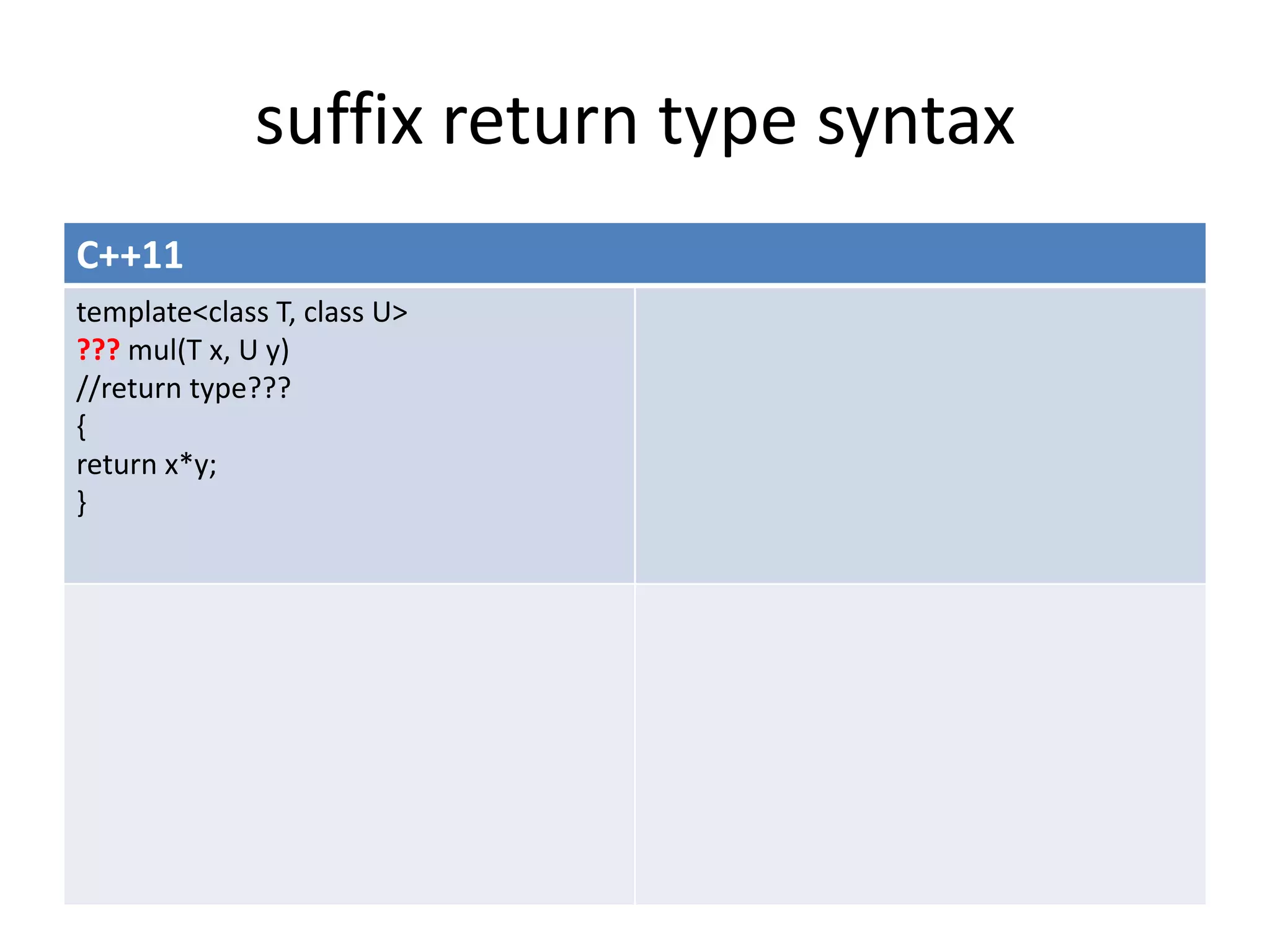
suffix return type syntax
C++11
template<class T, class U>
??? add(T x, U y)
//return type???
{
  return x+y;
}
suffix return type syntax
C++11
template<class T, class U>   template<class T, class U>
??? add(T x, U y)            decltype(x+y) add(T x, U y)
//return type???             //scope problem
{                            {
  return x+y;                  return x+y;
}                            }
suffix return type syntax
C++11
template<class T, class U>                  template<class T, class U>
??? add(T x, U y)                           decltype(x+y) add(T x, U y)
//return type???                            //scope problem
{                                           {
  return x+y;                                 return x+y;
}                                           }


template<class T, class U>
decltype(*(T*)(0)+*(U*)(0)) add(T x, U y)
// ugly!
{
  return x+y;
}
suffix return type syntax
C++11
template<class T, class U>                  template<class T, class U>
??? add(T x, U y)                           decltype(x+y) add(T x, U y)
//return type???                            //scope problem
{                                           {
  return x+y;                                 return x+y;
}                                           }


template<class T, class U>                  template<class T, class U>
decltype(*(T*)(0)+*(U*)(0)) add(T x, U y)   auto add(T x, U y) -> decltype(x+y)
// ugly!                                    {
{                                             return x+y;
  return x+y;                               }
}
suffix return type syntax
C++03                                        C++11
struct LinkedList                            struct LinkedList
{                                            {
  struct Link { /* ... */ };                   struct Link { /* ... */ };
  Link* erase(Link* p);                        Link* erase(Link* p);
  // ...                                       // ...
};                                           };

LinkedList::Link* LinkedList::erase(Link* p) auto LinkedList::erase(Link* p) -> Link*
{ /* ... */ }                                { /* ... */ }
std::function
C++11
int sum(int a, int b) { return a + b; }

function<int (int, int)> fsum = &sum;

fsum(4,2);
std::function
C++11
struct Foo
{
  void f(int i){}
};

function<void(Foo&, int)> fmember = mem_fn(&Foo::f);

Foo foo;
fmember(foo, 42);
std::function
C++11
struct Foo
{
  void f(int i){}
};

Foo foo;
function<void(int)> fmember = bind(&Foo::f, foo, _1);

fmember(42);
std::bind
C++11                                                     output
float div(float a, float b){ return a/b; }
cout << “6/1” << div(6,1);                                6/1 = 6
cout << “6/2” << div(6,2);                                6/2 = 3
cout << “6/3” << div(6,3);                                6/3 = 2

function<float(float, float)> inv_div = bind(div, _2, _1);
cout << “1/6” << inv_div(6,1);                             1/6 = 0.166
cout << “2/6” << inv_div(6,2);                             2/6 = 0.333
cout << “3/6” << inv_div(6,3);                             3/6 = 0.5

function<float(float)> div_by_6 = bind(div, _1, 6);       1/6 = 0.166
cout << “1/6” << div_by_6 (1);                            2/6 = 0.333
cout << “2/6” << div_by_6 (2);                            3/6 = 0.5
cout << “3/6” << div_by_6 (3);
std::bind
C++11
//Practical usage
linear_congruential_engine<uint64_t, 1103545, 123, 21478> generator(1127590);
uniform_int_distribution<int> distribution(1,6);
int rnd = distribution(generator);

//Let’s make things a little bit easier:
auto dice = bind( distribution, generator );
int rnd = dice()+dice()+dice();
function objects
C++11(deprecated binders             C++11
and adaptors)
unary_function,                      Function wrappers
binary_function,                     function
ptr_fun,                             mem_fn
pointer_to_unary_function,           bad_function_call
pointer_to_binary_function,
mem_fun,                             Bind
mem_fun_t,                           bind
mem_fun1_t                           is_bind_expression
const_mem_fun_t                      is_placeholder
const_mem_fun1_t                     _1, _2, _3, ...
mem_fun_ref
mem_fun_ref_t                        Reference wrappers
mem_fun1_ref_t                       reference_wrapper
const_mem_fun_ref_t                  ref
const_mem_fun1_ref_t                 cref
binder1st
binder2nd
bind1st
bind2nd
lambdas
C++03
struct functor
{
  int &a;
  functor(int& _a)
  : a(_a)
  {
  }
  bool operator()(int x) const
  {
    return a == x;
  }
};
int a = 42;
count_if(v.begin(), v.end(), functor(a));
lambdas
C++03                                       C++11
struct functor                              int a = 42;
{                                           count_if(v.begin(), v.end(), [&a](int x){ return
  int &a;                                   x == a;});
  functor(int& _a)
  : a(_a)
  {                                         C++14
  }                                         //possible C++14 lambdas
  bool operator()(int x) const              count_if(v.begin(),v.end(),[&a](auto x)x == a);
  {
    return a == x;                          http://isocpp.org/blog/2012/12/an-
  }                                         implementation-of-generic-lambdas-request-
};                                          for-feedback-faisal-vali
int a = 42;
count_if(v.begin(), v.end(), functor(a));
lambdas/closures
C++11                                                             test scope lambda scope
void test()
{
  int x = 4;                                                      x=4
  int y = 5;                                                      y=5
  [&](){x = 2;y = 2;}();                                          x=2 y=2   x=2 y=2
  [=]() mutable{x = 3;y = 5;}();                                  x=2 y=2   x=3 y=5
  [=,&x]() mutable{x = 7;y = 9;}();                               x=7 y=2   x=7 y=9
}
void test()
{
  int x = 4;                                                      x=4
  int y = 5;                                                      y=5
  auto z = [=]() mutable{x = 3;++y; int w = x + y; return w; };             //closure
                                                                            //x,y lives inside z
    z();                                                          x=4 y=5   x=3 y=6 w=9
    z();                                                          x=4 y=5   x=3 y=7 w=10
    z();                                                          x=4 y=5   x=3 y=8 w=11
}
recursive lambdas
function<int(int)> f = [&f](int n)
{
  return n <= 1 ? 1 : n * f(n - 1);
};

int x = f(4); //x = 24
std::tuple
C++11                                      python
tuple<int,float,string> t(1,2.f,”text”);   t = (1,2.0,’text’)
int x = get<0>(t);                         x = t[0]
float y = get<1>(t);                       y = t[1]
string z = get<2>(t);                      z = t[2]
int myint;
char mychar;
tuple<int,float,char> mytuple;
// packing values into tuple               // packing values into tuple
mytuple = make_tuple (10, 2.6, 'a');       mytuple = (10, 2.6, 'a')
// unpacking tuple into variables          // unpacking tuple into variables
tie(myint, ignore, mychar) = mytuple;      myint, _, mychar = mytuple
int a = 5;                                 a=5
int b = 6;                                 b=6
tie(b, a) = make_tuple(a, b);              b,a = a,b
std::tuple/std::tie(for lexicographical
                        comparison)
C++03                                                     C++11
struct Student                                            struct Student
{
  string name;                                            {
  int classId;                                              string name;
  int numPassedExams;                                       int classId;
 bool operator<(const Student& rhs) const                   int numPassedExams;
 {
   if(name < rhs.name)                                     bool operator<(const Student& rhs) const
     return true;
                                                           {
      if(name == rhs.name)                                   return tie(name, classId, numPassedExams) <
      {                                                       tie(rhs.name, rhs.classId, rhs.numPassedExams);
        if(classId < rhs.classId)
          return true;                                     }
                                                          };
          if(classId == rhs.classId)
            return numPassedExams < rhs.numPassedExams;
      }                                                   set<Student> students;

      return false;
  }
};

set<Student> students;
Uniform Initialization and
                            std::initializer_list
C++03                                                      C++11
int                          a[] = { 1, 2, 3, 4, 5 };      int         a[] = { 1, 2, 3, 4, 5 };
vector<int>                  v;                            vector<int> v = { 1, 2, 3, 4, 5 };
for( int i = 1; i <= 5; ++i ) v.push_back(i);

map<int, string> labels;                                   map<int, string> labels {
labels.insert(make_pair(1, “Open”));                       { 1 , "Open" },
labels.insert(make_pair(2, “Close”));                      { 2 , "Close" },
labels.insert(make_pair(3, “Reboot”));                     { 3 , "Reboot" } };


Vector3 normalize(const Vector3& v)                        Vector3 normalize(const Vector3& v)
{                                                          {
  float inv_len = 1.f/ length(v);                            float inv_len = 1.f/ length(v);
  return Vector3(v.x*inv_len, v.y*inv_len, v.z*inv_len);     return {v.x*inv_len, v.y*inv_len, v.z*inv_len};
}                                                          }


Vector3 x = normalize(Vector3(2,5,9));                     Vector3 x = normalize({2,5,9});
Vector3 y(4,2,1);                                          Vector3 y{4,2,1};
std::initializer_list
C++11
vector<int>    v = { 1, 2, 3, 4, 5 }; //How to make this works?
vector<int> v = { 1, 2, 3, 4, 5 };                         template<class T>
//vector(initializer_list<T> args) is called               class vector{
                                                            vector(initializer_list<T> args)
                                                            { /*rude, naive implementation to show how ctor
                                                           with initiailizer_list works*/
                                                              for(auto it = begin(args); it != end(args); ++it)
                                                               push_back(*it);
                                                            }
                                                           //…
                                                           };

//what is initializer_list<T> ?                            initializer_list<T> is a lightweight proxy object that
                                                           provides access to an array of objects of type T.
                                                           A std::initializer_list object is automatically
                                                           constructed when:
                                                           vector<int> v{1,2,3,4,5};//list-initialization
                                                           v = {1,2,3,4,5};//assignment expression
                                                           f({1,2,3,4,5});//function call
                                                           for (int x : {1, 2, 3})//ranged for loop
                                                            cout << x << endl;
Uniform Initialization
C++11
//but wait!!! How then does this work??             The answer is:
struct Vector3{                                     now you can use {} instead of ()
float x,y,z;                                        But what about following case:
Vector3(float _x, float _y, float _z)               struct T {
 : x(_x), y(_y), z(_z){}                             T(int,int);
//I don’t see ctor with std::initializer_list!       T(initializer_list<int>);
                                                    };
};
                                                    T foo {10,20}; // calls initializer_list ctor
Vector3 normalize(const Vector3& v){                T bar (10,20); // calls first constructor
  float inv_len = 1.f/ length(v);
  return {v.x*inv_len, v.y*inv_len, v.z*inv_len};   Initializer-list constructors take precedence over other
}                                                   constructors when the initializer-list constructor syntax is
                                                    used!

Vector3 x = normalize({2,5,9});                     So, be careful! Consider following example:
Vector3 y{4,2,1};
                                                    vector<int> v(5); // v contains five elements {0,0,0,0,0}
                                                    vector<int> v{5}; // v contains one element {5}
Uniform Initialization
C++11
Uniform initialization solves many problems:
Narrowing
int x = 6.3; //warning!
int y {6.3}; //error: narrowing
int z = {6.3}; //error: narrowing
vector<int> v = { 1, 4.3, 4, 0.6 }; //error: double to int narrowing

“The most vexing parse” problem
struct B{                                                   struct B{
B(){}                                                       B(){}
};                                                          };

struct A{                                                   struct A{
A(B){}                                                      A(B){}
void f(){}                                                  void f(){}
};                                                          };

int main(){                                                 int main(){
A a(B()); //this is function declaration!                   A a{B()}; //calls B ctor, then A ctor. Everything is ok.
a.f(); //compile error!                                     a.f(); //calls A::f
return 0;                                                   return 0;
}                                                           }
Uniform Initialization and
              std::initializer_list
// Don’t mix std::initializer_list with auto
int n;
auto w(n); // int
auto x = n; // int
auto y {n}; // std::initializer_list<int>
auto z = {n}; // std::initializer_list<int>
using
C++03
typedef int int32_t; // on windows
typedef void (*Fn)(double);
template <int U, int V> class Type;

typedef Type<42,36> ConcreteType;
template<int V>                         template<int V>
typedef Type<42,V> MyType;              struct meta_type{
//error: not legal C++ code               typedef Type<42, V> type;
                                        };
MyType<36> object;                      typedef meta_type<36>::type MyType;
                                        MyType object;
using
C++03                                   C++11
typedef int int32_t; // on windows      using int32_t = int; // on windows
typedef void (*Fn)(double);             using Fn = void (*)(double);
template <int U, int V> class Type;     template <int U, int V> class Type;

typedef Type<42,36> ConcreteType;       using ConcreteType = Type<42,36>;
template<int V>                         template <int V>
struct meta_type{                       using MyType = Type<42, V>;
  typedef Type<42, V> type;
};
typedef meta_type<36>::type MyType;
MyType object;                          MyType<36> object;
explicit conversion operators
C++03
struct A { A(int){}; };
void f(A){};

int main(){
A a(1);
f(1); //silent implicit cast!
return 0;
}
explicit conversion operators
C++03
struct A {explicit A(int){}; };
void f(A){};

int main(){
A a(1);
f(1); //error: implicit cast!
return 0;
}
explicit conversion operators
C++03                                C++11
struct A {                           struct A {
 A(int) {}                            A(int) {}
};                                   };

struct B {                           struct B {
 int m;                               int m;
 B(int x) : m(x) {}                   B(int x) : m(x) {}
 operator A() { return A(m); }        explicit operator A() { return A(m); }
};                                   };

void f(A){}                          void f(A){}

int main(){                          int main(){
  B b(1);                              B b(1);
  A a = b; //silent implicit cast!     A a = b; //error: implicit cast!
  f(b); //silent implicit cast!        f(b); //error: implicit cast!
  return 0;                            return 0;
}                                    }
explicit conversion operators
C++03                                C++11
struct A {                           struct A {
 A(int) {}                            A(int) {}
};                                   };

struct B {                           struct B {
 int m;                               int m;
 B(int x) : m(x) {}                   B(int x) : m(x) {}
 operator A() { return A(m); }        explicit operator A() { return A(m); }
};                                   };

void f(A){}                          void f(A){}

int main(){                          int main(){
  B b(1);                              B b(1);
  A a = b; //silent implicit cast!     A a = static_cast<A>(b);
  f(b); //silent implicit cast!        f(static_cast<A>(b));
  return 0;                            return 0;
}                                    }
control of defaults: default and delete
C++11
class A
{
  A& operator=(A) = delete; // disallow copying
  A(const A&) = delete;
};

struct B
{
  B(float); // can initialize with a float
  B(long) = delete; // but not with long
};

struct C
{
  virtual ~C() = default;
};
enum class - scoped and strongly
                 typed enums
C++03                                        C++11
enum Alert { green, yellow, red };           enum class Alert { green, yellow, red };
//enum Color{ red, blue };                   enum class Color : int{ red, blue };
//error C2365: 'red' : redefinition
                                             Alert a = 7; // error (as ever in C++)
Alert a = 7; // error (as ever in C++)       Color c = 7; // error: no int->Color conversion
int a2 = red; // ok: Alert->int conversion   int a2 = red; // error
int a3 = Alert::red; // error                int a3 = Alert::red; //error
                                             int a4 = blue; // error: blue not in scope
                                             int a5 = Color::blue; //error: not Color->int
                                             conversion
                                             Color a6 = Color::blue; //ok
user-defined literals
C++03                        C++11
123 // int                   1.2_i // imaginary
1.2 // double                123.4567891234_df // decimal floating point (IBM)
1.2F // float                101010111000101_b // binary
'a' // char                  123_s // seconds
1ULL // unsigned long long   123.56_km // not miles! (units)

                             Speed v = 100_km/1_h;

                             int operator "" _km(int val){
                               return val;
                             }

                             Practical usage:
                             http://www.codeproject.com/Articles/447922/Applic
                             ation-of-Cplusplus11-User-Defined-Literals-t
Move Semantics
C++03
typedef vector<float> Matrix;

//requires already created C
void Mul(const Matrix& A, const Matrix& B, Matrix& C);

//need to manage lifetime manually using new/delete
void Mul(const Matrix& A, const Matrix& B, Matrix* C);

//please, don’t forget to call delete
Matrix* operator*(const Matrix& A, const Matrix& B);

//no need to manage lifetime manually, but adds some
//performance and abstraction penalty
shared_ptr<Matrix> operator* (const Matrix& A, const
Matrix& B);
Move Semantics
C++03                                                    C++11
typedef vector<float> Matrix;                            typedef vector<float> Matrix;

//requires already created C
void Mul(const Matrix& A, const Matrix& B, Matrix& C);

//need to manage lifetime manually using new/delete
void Mul(const Matrix& A, const Matrix& B, Matrix* C);
                                                         //Cool syntax, no abstraction or performance
//please, don’t forget to call delete                    //penalty! Thanks to move semantics!
Matrix* operator*(const Matrix& A, const Matrix& B);     Matrix operator*(const Matrix& A, const Matrix& B);

//no need to manage lifetime manually, but adds some
//performance and abstraction penalty
shared_ptr<Matrix> operator* (const Matrix& A, const
Matrix& B);
                                                         Matrix A(10000);
                                                         Matrix B(10000);
                                                         Matrix C = A * B;
Move Semantics
C++11
typedef vector<float> Matrix;                         template<class T>
                                                      class vector
Matrix operator*(const Matrix& A, const Matrix& B);   {
{                                                       T* data;
  Matrix ret(A.size()); //ret.data = 0x0028fabc         size_t size;
  //ret.size = 100000
  //matrix multiplication algorithm                   public:
  //                                                   vector(vector<T>&& rhs)
  return ret; //vector<float>(vector<float>&&)         : data(rhs.data)
  //C.data = ret.data, C.size = ret.size               , size(rhs.size)
  //ret.data = nullptr, ret.size = 0                   {
}//~vector<float>()                                      rhs.data = nullptr;
  //delete ret.data; //”delete nullptr;” is ok.          rhs.size = 0;
                                                       }
Matrix A(10000);                                       ~vector()
Matrix B(10000);                                       {
Matrix C = A * B;                                        delete[] data;
                                                       }
//C.data = 0x0028fabc                                 //…
//C.size = 100000                                     };
Move Semantics
C++03                                                   C++11
typedef vector<float> BigObj;                           typedef vector<float> BigObj;
void f(BigObj&); //reference to lvalue                  void f(BigObj&&); //reference to rvalue
                                                        void f(BigObj&); //reference to lvalue

//test1                                                 //test1
BigObj x = createBigObject(); //BigObj(const BigObj&)   BigObj x = createBigObject();

f(x); //BigObj(const BigObj&)                           f(x); //BigObj(const BigObj&)
f(createBigObject()); //BigObj(const BigObj&)           f(createBigObject()); //BigObj(BigObj&&)

                                                        //test2
                                                        BigObj x = createBigObject();
                                                        f(move(x)); // move makes from input value – rvalue.

//test3                                                 //test3
BigObj createBigObject()                                BigObj createBigObject()
{                                                       {
BigObj object(100000); //value                          BigObj object(100000); //prvalue
return object; //BigObj(const BigObj&)                  return object; //BigObj(BigObj&&)
}//~BigObj                                              }//~BigObj

BigObj x = createBigObject();                           BigObj x = createBigObject();
constexpr
C++03                                          C++11
template<int N>                                constexpr int Fib(int n)
struct Fib{                                    {
 enum {                                         return n<=2 ? 1 : Fib(n-1)+Fib(n-2);
   value = Fib<N-1>::value + Fib<N-2>::value   }
 };
};                                             cout << Fib(15); //compile time

template<> struct Fib<1>{                      int a = 15;
 enum { value = 1 };                           cout << Fib(a); //runtime
};

template<> struct Fib<0> {
 enum { value = 0 };
};

cout << Fib<15>::value;
range-for, begin, end
C++03                                            C++11
vector<int> v;                                   vector<int> v;
for( vector<int>::iterator i = v.begin(); i !=   for( auto d : v )
v.end(); ++i )                                     total += d;
   total += *i;

sort( v.begin(), v.end() );                      sort( begin(v), end(v) );

int a[] = {1,2,3,4,5};                           int a[] = {1,2,3,4,5};
sort( &a[0], &a[0] + sizeof(a)/sizeof(a[0]));    sort( begin(a), end(a) );
Memory management
  (unique_ptr is safe replacement for
     unsafe deprecated auto_ptr)
C++11
unique_ptr<int> p1(new int(42));
unique_ptr<int> p2 = p1; //Compile error. Only “move” operation is possible.
unique_ptr<int> p3 = move(p1); //Transfers ownership. p3 now owns the memory and p1 is nullptr.
p3.reset(); //Deletes the memory.
p1.reset(); //Does nothing.

unique_ptr<int> createUniqueResource()
{
  unique_ptr<int> ret( new int(42) );
  return ret; //no need to move(ret);
}
F* OpenFile(char* name);
void CloseFile(F*);
/* custom deleter */

unique_ptr<F, function<decltype(CloseFile)>> file(OpenFile("text"), CloseFile);
file->read(1024);
Memory management
   (shared_ptr = ref(+weak) thread safe
void test()
                 counter)
{
     shared_ptr<int> p( new int(42) );         ref count = 1, weak count = 0
     {
            shared_ptr<int> x = p;             ref count = 2, weak count = 0
            {
              shared_ptr<int> y = p;           ref count = 3, weak count = 0
            }                                  ref count = 2, weak count = 0
     }                                         ref count = 1, weak count = 0
     // use weak_ptr to break reference-count cycles
     weak_ptr<int> wp = p;                     ref count = 1, weak count = 1 – note ref count is still 1
     shared_ptr<int> ap = wp.lock();           ref count = 2, weak count = 1
     {
              shared_ptr<int> y = ap;          ref count = 3, weak count = 1
     }                                         ref count = 2, weak count = 1
}                                     ap dtor: ref count = 1, weak count = 1
                                      wp dtor: ref count = 1, weak count = 0
                                      p dtor:  ref count = 0, weak count = 0 - destroy p!
Variadic templates
C++03                                          C++11
void f();                                      template <class ...T>
template<class T>                              void f(T... args);
void f(T arg1);
template<class T, class U>
void f(T arg1, U arg2);
template<class T, class U, class Y>
void f(T arg1, U arg2, Y arg3);
template<class T, class U, class Y, class Z>
void f(T arg1, U arg2, Y arg3, Z arg4);

f(“test”,42,’s’,12.f);                         f(“test”,42,’s’,12.f);
//… till some max N.
Variadic templates
C++11                                        C++11(call sequence)
template<class T>                            print_list(first = 42, ...rest = "hello",2.3,'a')
void print_list(T value)                      42
{                                             print_list(first = "hello", ...rest = 2.3,'a')
  cout<<value<<endl;                           hello
}                                              print_list(first = 2.3, ...rest = 'a')
                                                 2.3
template<class First, class ...Rest>             print_list(value ='a') //trivial case
void print_list(First first, Rest ...rest)       a
{
  cout<<first<<","; print_list(rest...);
}
                                             Output
print_list(42,"hello",2.3,'a');              42,hello,2.3,a
Tuple definition using
                      variadic templates
C++11
template<class... Elements>                           “LISP-style” definition:
class tuple;                                          A tuple is either:

template<>                                            - An empty tuple, or
class tuple<> {};

template<class Head, class... Tail>                   - A pair (head, tail) where head is
class tuple<Head, Tail...> : private tuple<Tail...>   the first element of the tuple and
{                                                     tail is a tuple containing the rest(…)
  Head head;                                          of the elements.
  //
};
Variadic templates
C++11                                     Haskell
template<int... Elements> struct count;   count [] = 0
                                          count (T:Args) = 1 + count Args
template<> struct count<>
{
  static const int value = 0;             //call
};                                        count [0,1,2,3,4]

template<int T, int... Args>
struct count<T, Args...>
{
  static const int value = 1 +
    count<Args...>::value;
};

//call
int x = count<0,1,2,3,4>::value;
Variadic templates(sizeof... operator)
C++11
template<int... Elements> struct count;   template<int... Elements>
                                          struct count
template<> struct count<>                 {
{                                           static const int value = sizeof...(Elements);
  static const int value = 0;             };
};
                                          /*
template<int T, int... Args>              sizeof...() – return the number elements in
struct count<T, Args...>                  a parameter pack
{                                         */
  static const int value = 1 +
    count<Args...>::value;                //call
};                                        int x = count<0,1,2,3,4>::value;

//call
int x = count<0,1,2,3,4>::value;
std::string
Interprets a signed integer value in the string:
int    stoi( const std::string& str, size_t *pos = 0, int base = 10 );
long stol( const std::string& str, size_t *pos = 0, int base = 10 );
long long stoll( const std::string& str, size_t *pos = 0, int base = 10 );

Interprets an unsigned integer value in the string:
unsigned long stoul( const std::string& str, size_t *pos = 0, int base = 10 );
unsigned long long stoull( const std::string& str, size_t *pos = 0, int base = 10 );

Interprets a floating point value in a string:
float    stof( const std::string& str, size_t *pos = 0 );
double stod( const std::string& str, size_t *pos = 0 );
long double stold( const std::string& str, size_t *pos = 0 );

Converts a (un)signed/decimal integer to a string/wstring:
to_string
to_wstring
std::array
C++03                                             C++11
char arr1[] = "xyz"; //'0' is added to the end   array<char, 3> arr1 = {'x', 'y', 'z'};
int arr2[] = {2112, 90125, 1928};                 array<int, 3> arr2 = {2112, 90125, 1928};


int* x = arr2; //ok                               int* x = arr2; //error
                                                  x = arr2.data(); //ok


cout << sizeof(arr1) - 1 << endl;                 cout << arr1.size() << endl;
cout << sizeof(arr2) / sizeof(int) << endl;       cout << arr2.size() << endl;


arr2[-42] = 36; //oops                            arr2.at(-42) = 36;
                                                  //throws std::out_of_range exception

http://stackoverflow.com/questions/6111565/now-that-we-have-stdarray-what-uses-are-left-for-c-
style-arrays
std::vector
C++03                                                         C++11
void c_style_f(int* x){}                                      void c_style_f(int* x){}

void test(){                                                  void test(){
 vector<int> v;                                                vector<int> v;

    if(!v.empty())                                                c_style_f(v.data());
      c_style_f(&v[0]);                                       }

    if(!v.empty())
      c_style_f(&v.front());

    if(!v.empty())
      c_style_f(&*v.begin());
}
vector<int> v;                                                vector<int> v;
v.push_back( 1 ); //capacity = 1                              v.push_back( 1 ); //capacity = 1
v.reserve( 20 ); //capacity = 20                              v.reserve( 20 ); //capacity = 20
vector<int>(v).swap(v); //capacity = 1                        v.shrink_to_fit(); //capacity = 1
//very intuitive!

struct Some_type{                                             struct Some_type{
  Some_type(int _x, int _y, int _z) : x(_x), y(_y), z(_z){}     Some_type(int _x, int _y, int _z) : x(_x), y(_y), z(_z){}
  int x,y,z;                                                    int x,y,z;
};                                                            };

vector<Some_type> v;                                          vector<Some_type> v;
v.push_back(Some_type(1,2,3));                                v.emplace_back(1,2,3);
STL
std::regex
bool equals = regex_match("subject", regex("(sub)(.*)") );

std::chrono
auto start = high_resolution_clock::now();
some_long_computations();
auto end = high_resolution_clock::now();
cout<<duration_cast<milliseconds>(end-start).count();

std::ratio
using sum = ratio_add<ratio<1,2>, ratio<2,3>>;

cout << "sum = " << sum::num << "/" << sum::den;
cout << " (which is: " << ( double(sum::num) / sum::den ) << ")" << endl;

Output: sum = 7/6 (which is: 1.166667)
STL
New algorithms:
std::all_of, std::none_of, std::any_of,
std::find_if_not, std::copy_if, std::copy_n,
std::move, std::move_n, std::move_backward,
std::shuffle, std::random_shuffle,
std::is_partitioned, std::partition_copy,
std::partition_point, std::is_sorted,
std::is_sorted_until, std::is_heap_until,
std::min_max, std::minmax_element,
std::is_permutation, std::iota
Threads and memory model
Threading support:
thread, mutex, condition variable,
future/promise, package task

Memory model:
atomic, fence

Difference between std::thread and boost::thread:
http://stackoverflow.com/questions/7241993/is-it-smart-to-replace-boostthread-and-boostmutex-with-
c11-equivalents
std::thread
C++11                       Java
#include <thread>           public class TestThread {
#include <iostream>

                              public static void main(String[] args) throws
int main()
                            InterruptedException {
{
                                Thread t1 = new Thread(new Runnable() {
  using namespace std;            public void run() {
  thread t1([](){                   System.out.println(“Hi from thread");
     cout << “Hi from             }
      thread” << endl;});       });
                                t1.start();
    t1.join();
                                    t1.join();
    return 0;
                                }
}                           }
std::mutex
C++11                                       Output(may vary)
#include <iostream>                         1: 0
#include <thread>
//version without mutex!!!                  1: 1
using namespace std;                        1: 2
void run(size_t n){                         1: 3
  for (size_t i = 0; i < 5; ++i){           1: 4
    cout << n << ": " << i << endl;
  }                                         23: 0
}                                           3: 1
int main(){                                 3: 2
  thread t1(run, 1);                        3: 3
  thread t2(run, 2);
  thread t3(run, 3);                        3: 4
    t1.join();
                                            :0
    t2.join();                              2: 1
    t3.join();                              2: 2
    return 0;                               2: 3
}                                           2: 4
std::mutex
C++11                                     Output(is defined within run)
#include <iostream>
#include <thread>
                                          1: 0
#include <mutex>                          1: 1
using namespace std;                      1: 2
mutex m;
                                          1: 3
                                          1: 4
void run(size_t n){
 m.lock();                                2: 0
 for (size_t i = 0; i < 5; ++i){          2: 1
   cout << n << ": " << i << endl;
 }                                        2: 2
    m.unlock();
                                          2: 3
}                                         2: 4
int main(){                               3: 0
 thread t1(run, 1);
 thread t2(run, 2);
                                          3: 1
 thread t3(run, 3);                       3: 2
    t1.join();                            3: 3
    t2.join();                            3: 4
    t3.join();

    return 0;
}
std::lock_guard+std::mutex
C++11
#include <iostream>                  #include <iostream>
#include <thread>                    #include <thread>
#include <mutex>                     #include <mutex>

using namespace std;                 using namespace std;

mutex m;                             mutex m;

void run(size_t n){                  void run(size_t n){
 m.lock();                             lock_guard<mutex> lm(m); //ctor – m.lock(), dtor – m.unlock()
 for (size_t i = 0; i < 5; ++i){       for (size_t i = 0; i < 5; ++i){
   cout << n << ": " << i << endl;       cout << n << ": " << i << endl;
 }                                     }
                                     }
    m.unlock();
}                                    int main(){
                                      thread t1(run, 1);
int main(){                           thread t2(run, 2);
 thread t1(run, 1);                   thread t3(run, 3);
 thread t2(run, 2);
 thread t3(run, 3);                      t1.join();
                                         t2.join();
    t1.join();                           t3.join();
    t2.join();
    t3.join();                           return 0;
                                     }
    return 0;
}
std::async
C++11
#include <iostream>
#include <future>

using namespace std;

int Fib(int n){
  return n<=2 ? 1 : Fib(n-1)+Fib(n-2);
}

int calc1(){ return Fib(30); }

int calc2(){ return Fib(40); }

int main()
{
  // start calc1() asynchronously
  future<int> result1 = async(calc1);
  // call calc2() synchronously
  int result2 = calc2();
  // wait for calc1() and add its result to result2
  int result = result1.get() + result2;
  cout << "calc1()+calc2(): " << result << endl;
  return 0;
}
Deprecated idioms
C++11
Now that we have C++11, we can use new features instead of following idioms:
nullptr
Move_Constructor
Safe_bool
Shrink-to-fit
Type_Safe_Enum
Requiring_or_Prohibiting_Heap-based_Objects
Type_Generator
Final_Class
address_of

http://stackoverflow.com/questions/9299101/what-c-idioms-are-deprecated-in-c11
C++11 compiler support
gcc                icc      msvc(with NOV CTP) Ibm xlc              clang

38/39              27/39    24/39                  17/39            37/39
Not implemented:   Full STL Full STL               Not              Full STL
threads, regex     support support(without init.   implemented:     support
                            list)                  threads, regex
links

http://www.isocpp.org

http://www.cplusplus.com

http://www.stroustrup.com/C++11FAQ.html

http://channel9.msdn.com/Events/GoingNative/GoingNative-2012/Keynote-Bjarne-Stroustrup-Cpp11-Style

http://channel9.msdn.com/Events/Build/BUILD2011/TOOL-835T

http://channel9.msdn.com/posts/C-and-Beyond-2011-Herb-Sutter-Why-C

http://channel9.msdn.com/Events/Lang-NEXT/Lang-NEXT-2012/-Not-Your-Father-s-C-

http://cpprocks.com/cpp11-stl-additions/

http://cpprocks.com/c11-a-visual-summary-of-changes/#!prettyPhoto

http://wiki.apache.org/stdcxx/C++0xCompilerSupport

C++11

  • 1.
    C++11 Alex Sinyakov, Software Engineer at AMC Bridge Twitter: @innochenti E-mail: innochenti@gmail.com PDF Slides: http://j.mp/cpp11ref
  • 2.
    null pointer constant C++03 voidfoo(char*); void foo(int); foo(NULL);
  • 3.
    null pointer constant C++03 C++11 void foo(char*); void foo(char*); void foo(int); void foo(int); foo(NULL); //calls second foo foo(nullptr); //calls first foo
  • 4.
    standard types C++03 sizeof(int) ==? sizeof(char) == 1 byte(== ? bits) sizeof(char) <= sizeof(short) <= sizeof(int) <= sizeof(long)
  • 5.
    standard types C++03 C++11 sizeof(int) == ? int8_t sizeof(char) == 1 byte(== ? bits) uint8_t int16_t sizeof(char) <= sizeof(short) <= uint16_t sizeof(int) <= sizeof(long) int32_t uint32_t int64_t uint64_t
  • 6.
    raw string literals C++03 C++11 string test="C:ABCDfile1.txt"; string test=R"(C:ABCDfile1.txt)"; cout << test << endl; cout << test << endl; C:ABCDfile1.txt C:ABCDfile1.txt string test; string test; test = "First Line.nSecond line.nThird Line.n"; test = R"(First Line.nSecond line.nThird Line.n)"; cout << test << endl; cout << test << endl; First Line. First Line.nSecond line.nThird Line.n Second line. Third Line. string test = R"(First Line. Second line. Third Line.)"; cout << test << endl; First Line. Second line. Third Line.
  • 7.
    in-class member initializers C++03 C++11 class A class A { { public: public: A(): a(4), b(2), A() {} h("text1"), s("text2") {} A(int in_a) : a(in_a) {} A(int in_a) : a(in_a), b(2), A(C c) {} h("text1"), s("text2") {} private: A(C c) : a(4), b(2), int a = 4; h("text1"), s("text2") {} int b = 2; private: string h = "text1"; int a; string s = "text2"; int b; }; string h; string s; };
  • 8.
    delegating constructors C++03 C++11 class A class A { { int a; int a; public: void validate(int x) A(int x) { { if (0<x && x<=42) a=x; else throw bad_A(x); if (0<x && x<=42) a=x; else throw bad_A(x); } } public: A() : A(42){ } A(int x) { validate(x); } A(string s) : A(stoi(s)){ } A() { validate(42); } }; A(string s) { int x = stoi(s); validate(x); } };
  • 9.
    override C++03 C++11 struct Base struct Base { { virtual void some_func(float); virtual void some_func(float); }; }; struct Derived : Base struct Derived : Base { { virtual void some_func(int); void some_func(int) override; //warning //error }; };
  • 10.
    final C++11 Java struct Base1 final {}; final class Base1 {} struct Derived1 : Base1{ class Derived1 extends Base1 { //error //error }; } struct Base2{ class Base2 { virtual void f() final; public final void f(){}; }; } struct Derived2 : Base2 { class Derived2 extends Base2 { void f(); //error public void f(){}; //error }; }
  • 11.
    static_assert C++11 template<class T> void f(Tv){ static_assert(sizeof(v) == 4, “v must have size of 4 bytes"); //do something with v } void g(){ int64_t v; // 8 bytes f(v); } vs2010/2012 output: 1>d:main.cpp(5): error C2338: v must have size of 4 bytes
  • 12.
    type traits C++11 Output #include <type_traits> #include <iostream> using namespace std; struct A { }; struct B { virtual void f(){} }; struct C : B {}; int main() { cout << "int:" << has_virtual_destructor<int>::value << endl; int:0 cout << "int:"<< is_polymorphic<int>::value << endl; int:0 cout << "A: " << is_polymorphic<A>::value << endl; A: 0 cout << "B: " << is_polymorphic<B>::value << endl; B: 1 cout << "C: " << is_polymorphic<C>::value << endl; C: 1 typedef int mytype[][24][60]; cout << "(0 dim.): " << extent<mytype,0>::value << endl; (0st dim.): 0 cout << "(1 dim.): " << extent<mytype,1>::value << endl; (1st dim.): 24 cout << "(2 dim.): " << extent<mytype,2>::value << endl; (2st dim.): 60 return 0; }
  • 13.
    auto C++03 C++11 map<string,string>::iterator it = m.begin(); auto it = m.begin(); double const param = config["param"]; auto const param = config["param"]; singleton& s = singleton::instance(); auto& s = singleton::instance(); Prefer using auto in the following cases: auto p = new T(); Here is T in the expression. No need to repeat it again. auto p = make_shared<T>(arg1); The same as above. auto my_lambda = [](){}; If you need to store lambda you may use auto or std::function auto it = m.begin(); Instead of: map<string,list<int>::iterator>::const_iterator it = m.cbegin(); http://programmers.stackexchange.com/questions/180216/does-auto-make-c-code-harder-to- understand
  • 14.
    decltype C++11 C++11 int main(){ int main(){ int i = 4; int i = 4; const int j = 6; const int j = 6; const int& k = i; const int& k = i; int a[5]; int a[5]; int *p; int *p; //decltype is an operator for querying the type of an expression. //similarly to the sizeof operator, the operand of decltype is unevaluated. int var1; decltype(i) var1; int var2; decltype(1) var2; int var3; decltype(2+3) var3; int& var4 = i; decltype(i=1) var4 = i; //there is no assignment i to 1 // // i == 4 as before const int var5 = 1; decltype(j) var5 = 1; const int& var6 = j; decltype(k) var6 = j; int var7[5]; decltype(a) var7; int& var8 = i; decltype(a[3]) var8 = i; int& var9 = i; decltype(*p) var9 = i; return 0; return 0; } }
  • 15.
    suffix return typesyntax C++11 template<class T, class U> ??? add(T x, U y) //return type??? { return x+y; }
  • 16.
    suffix return typesyntax C++11 template<class T, class U> template<class T, class U> ??? add(T x, U y) decltype(x+y) add(T x, U y) //return type??? //scope problem { { return x+y; return x+y; } }
  • 17.
    suffix return typesyntax C++11 template<class T, class U> template<class T, class U> ??? add(T x, U y) decltype(x+y) add(T x, U y) //return type??? //scope problem { { return x+y; return x+y; } } template<class T, class U> decltype(*(T*)(0)+*(U*)(0)) add(T x, U y) // ugly! { return x+y; }
  • 18.
    suffix return typesyntax C++11 template<class T, class U> template<class T, class U> ??? add(T x, U y) decltype(x+y) add(T x, U y) //return type??? //scope problem { { return x+y; return x+y; } } template<class T, class U> template<class T, class U> decltype(*(T*)(0)+*(U*)(0)) add(T x, U y) auto add(T x, U y) -> decltype(x+y) // ugly! { { return x+y; return x+y; } }
  • 19.
    suffix return typesyntax C++03 C++11 struct LinkedList struct LinkedList { { struct Link { /* ... */ }; struct Link { /* ... */ }; Link* erase(Link* p); Link* erase(Link* p); // ... // ... }; }; LinkedList::Link* LinkedList::erase(Link* p) auto LinkedList::erase(Link* p) -> Link* { /* ... */ } { /* ... */ }
  • 20.
    std::function C++11 int sum(int a,int b) { return a + b; } function<int (int, int)> fsum = &sum; fsum(4,2);
  • 21.
    std::function C++11 struct Foo { void f(int i){} }; function<void(Foo&, int)> fmember = mem_fn(&Foo::f); Foo foo; fmember(foo, 42);
  • 22.
    std::function C++11 struct Foo { void f(int i){} }; Foo foo; function<void(int)> fmember = bind(&Foo::f, foo, _1); fmember(42);
  • 23.
    std::bind C++11 output float div(float a, float b){ return a/b; } cout << “6/1” << div(6,1); 6/1 = 6 cout << “6/2” << div(6,2); 6/2 = 3 cout << “6/3” << div(6,3); 6/3 = 2 function<float(float, float)> inv_div = bind(div, _2, _1); cout << “1/6” << inv_div(6,1); 1/6 = 0.166 cout << “2/6” << inv_div(6,2); 2/6 = 0.333 cout << “3/6” << inv_div(6,3); 3/6 = 0.5 function<float(float)> div_by_6 = bind(div, _1, 6); 1/6 = 0.166 cout << “1/6” << div_by_6 (1); 2/6 = 0.333 cout << “2/6” << div_by_6 (2); 3/6 = 0.5 cout << “3/6” << div_by_6 (3);
  • 24.
    std::bind C++11 //Practical usage linear_congruential_engine<uint64_t, 1103545,123, 21478> generator(1127590); uniform_int_distribution<int> distribution(1,6); int rnd = distribution(generator); //Let’s make things a little bit easier: auto dice = bind( distribution, generator ); int rnd = dice()+dice()+dice();
  • 25.
    function objects C++11(deprecated binders C++11 and adaptors) unary_function, Function wrappers binary_function, function ptr_fun, mem_fn pointer_to_unary_function, bad_function_call pointer_to_binary_function, mem_fun, Bind mem_fun_t, bind mem_fun1_t is_bind_expression const_mem_fun_t is_placeholder const_mem_fun1_t _1, _2, _3, ... mem_fun_ref mem_fun_ref_t Reference wrappers mem_fun1_ref_t reference_wrapper const_mem_fun_ref_t ref const_mem_fun1_ref_t cref binder1st binder2nd bind1st bind2nd
  • 26.
    lambdas C++03 struct functor { int &a; functor(int& _a) : a(_a) { } bool operator()(int x) const { return a == x; } }; int a = 42; count_if(v.begin(), v.end(), functor(a));
  • 27.
    lambdas C++03 C++11 struct functor int a = 42; { count_if(v.begin(), v.end(), [&a](int x){ return int &a; x == a;}); functor(int& _a) : a(_a) { C++14 } //possible C++14 lambdas bool operator()(int x) const count_if(v.begin(),v.end(),[&a](auto x)x == a); { return a == x; http://isocpp.org/blog/2012/12/an- } implementation-of-generic-lambdas-request- }; for-feedback-faisal-vali int a = 42; count_if(v.begin(), v.end(), functor(a));
  • 28.
    lambdas/closures C++11 test scope lambda scope void test() { int x = 4; x=4 int y = 5; y=5 [&](){x = 2;y = 2;}(); x=2 y=2 x=2 y=2 [=]() mutable{x = 3;y = 5;}(); x=2 y=2 x=3 y=5 [=,&x]() mutable{x = 7;y = 9;}(); x=7 y=2 x=7 y=9 } void test() { int x = 4; x=4 int y = 5; y=5 auto z = [=]() mutable{x = 3;++y; int w = x + y; return w; }; //closure //x,y lives inside z z(); x=4 y=5 x=3 y=6 w=9 z(); x=4 y=5 x=3 y=7 w=10 z(); x=4 y=5 x=3 y=8 w=11 }
  • 29.
    recursive lambdas function<int(int)> f= [&f](int n) { return n <= 1 ? 1 : n * f(n - 1); }; int x = f(4); //x = 24
  • 30.
    std::tuple C++11 python tuple<int,float,string> t(1,2.f,”text”); t = (1,2.0,’text’) int x = get<0>(t); x = t[0] float y = get<1>(t); y = t[1] string z = get<2>(t); z = t[2] int myint; char mychar; tuple<int,float,char> mytuple; // packing values into tuple // packing values into tuple mytuple = make_tuple (10, 2.6, 'a'); mytuple = (10, 2.6, 'a') // unpacking tuple into variables // unpacking tuple into variables tie(myint, ignore, mychar) = mytuple; myint, _, mychar = mytuple int a = 5; a=5 int b = 6; b=6 tie(b, a) = make_tuple(a, b); b,a = a,b
  • 31.
    std::tuple/std::tie(for lexicographical comparison) C++03 C++11 struct Student struct Student { string name; { int classId; string name; int numPassedExams; int classId; bool operator<(const Student& rhs) const int numPassedExams; { if(name < rhs.name) bool operator<(const Student& rhs) const return true; { if(name == rhs.name) return tie(name, classId, numPassedExams) < { tie(rhs.name, rhs.classId, rhs.numPassedExams); if(classId < rhs.classId) return true; } }; if(classId == rhs.classId) return numPassedExams < rhs.numPassedExams; } set<Student> students; return false; } }; set<Student> students;
  • 32.
    Uniform Initialization and std::initializer_list C++03 C++11 int a[] = { 1, 2, 3, 4, 5 }; int a[] = { 1, 2, 3, 4, 5 }; vector<int> v; vector<int> v = { 1, 2, 3, 4, 5 }; for( int i = 1; i <= 5; ++i ) v.push_back(i); map<int, string> labels; map<int, string> labels { labels.insert(make_pair(1, “Open”)); { 1 , "Open" }, labels.insert(make_pair(2, “Close”)); { 2 , "Close" }, labels.insert(make_pair(3, “Reboot”)); { 3 , "Reboot" } }; Vector3 normalize(const Vector3& v) Vector3 normalize(const Vector3& v) { { float inv_len = 1.f/ length(v); float inv_len = 1.f/ length(v); return Vector3(v.x*inv_len, v.y*inv_len, v.z*inv_len); return {v.x*inv_len, v.y*inv_len, v.z*inv_len}; } } Vector3 x = normalize(Vector3(2,5,9)); Vector3 x = normalize({2,5,9}); Vector3 y(4,2,1); Vector3 y{4,2,1};
  • 33.
    std::initializer_list C++11 vector<int> v = { 1, 2, 3, 4, 5 }; //How to make this works? vector<int> v = { 1, 2, 3, 4, 5 }; template<class T> //vector(initializer_list<T> args) is called class vector{ vector(initializer_list<T> args) { /*rude, naive implementation to show how ctor with initiailizer_list works*/ for(auto it = begin(args); it != end(args); ++it) push_back(*it); } //… }; //what is initializer_list<T> ? initializer_list<T> is a lightweight proxy object that provides access to an array of objects of type T. A std::initializer_list object is automatically constructed when: vector<int> v{1,2,3,4,5};//list-initialization v = {1,2,3,4,5};//assignment expression f({1,2,3,4,5});//function call for (int x : {1, 2, 3})//ranged for loop cout << x << endl;
  • 34.
    Uniform Initialization C++11 //but wait!!!How then does this work?? The answer is: struct Vector3{ now you can use {} instead of () float x,y,z; But what about following case: Vector3(float _x, float _y, float _z) struct T { : x(_x), y(_y), z(_z){} T(int,int); //I don’t see ctor with std::initializer_list! T(initializer_list<int>); }; }; T foo {10,20}; // calls initializer_list ctor Vector3 normalize(const Vector3& v){ T bar (10,20); // calls first constructor float inv_len = 1.f/ length(v); return {v.x*inv_len, v.y*inv_len, v.z*inv_len}; Initializer-list constructors take precedence over other } constructors when the initializer-list constructor syntax is used! Vector3 x = normalize({2,5,9}); So, be careful! Consider following example: Vector3 y{4,2,1}; vector<int> v(5); // v contains five elements {0,0,0,0,0} vector<int> v{5}; // v contains one element {5}
  • 35.
    Uniform Initialization C++11 Uniform initializationsolves many problems: Narrowing int x = 6.3; //warning! int y {6.3}; //error: narrowing int z = {6.3}; //error: narrowing vector<int> v = { 1, 4.3, 4, 0.6 }; //error: double to int narrowing “The most vexing parse” problem struct B{ struct B{ B(){} B(){} }; }; struct A{ struct A{ A(B){} A(B){} void f(){} void f(){} }; }; int main(){ int main(){ A a(B()); //this is function declaration! A a{B()}; //calls B ctor, then A ctor. Everything is ok. a.f(); //compile error! a.f(); //calls A::f return 0; return 0; } }
  • 36.
    Uniform Initialization and std::initializer_list // Don’t mix std::initializer_list with auto int n; auto w(n); // int auto x = n; // int auto y {n}; // std::initializer_list<int> auto z = {n}; // std::initializer_list<int>
  • 37.
    using C++03 typedef int int32_t;// on windows typedef void (*Fn)(double); template <int U, int V> class Type; typedef Type<42,36> ConcreteType; template<int V> template<int V> typedef Type<42,V> MyType; struct meta_type{ //error: not legal C++ code typedef Type<42, V> type; }; MyType<36> object; typedef meta_type<36>::type MyType; MyType object;
  • 38.
    using C++03 C++11 typedef int int32_t; // on windows using int32_t = int; // on windows typedef void (*Fn)(double); using Fn = void (*)(double); template <int U, int V> class Type; template <int U, int V> class Type; typedef Type<42,36> ConcreteType; using ConcreteType = Type<42,36>; template<int V> template <int V> struct meta_type{ using MyType = Type<42, V>; typedef Type<42, V> type; }; typedef meta_type<36>::type MyType; MyType object; MyType<36> object;
  • 39.
    explicit conversion operators C++03 structA { A(int){}; }; void f(A){}; int main(){ A a(1); f(1); //silent implicit cast! return 0; }
  • 40.
    explicit conversion operators C++03 structA {explicit A(int){}; }; void f(A){}; int main(){ A a(1); f(1); //error: implicit cast! return 0; }
  • 41.
    explicit conversion operators C++03 C++11 struct A { struct A { A(int) {} A(int) {} }; }; struct B { struct B { int m; int m; B(int x) : m(x) {} B(int x) : m(x) {} operator A() { return A(m); } explicit operator A() { return A(m); } }; }; void f(A){} void f(A){} int main(){ int main(){ B b(1); B b(1); A a = b; //silent implicit cast! A a = b; //error: implicit cast! f(b); //silent implicit cast! f(b); //error: implicit cast! return 0; return 0; } }
  • 42.
    explicit conversion operators C++03 C++11 struct A { struct A { A(int) {} A(int) {} }; }; struct B { struct B { int m; int m; B(int x) : m(x) {} B(int x) : m(x) {} operator A() { return A(m); } explicit operator A() { return A(m); } }; }; void f(A){} void f(A){} int main(){ int main(){ B b(1); B b(1); A a = b; //silent implicit cast! A a = static_cast<A>(b); f(b); //silent implicit cast! f(static_cast<A>(b)); return 0; return 0; } }
  • 43.
    control of defaults:default and delete C++11 class A { A& operator=(A) = delete; // disallow copying A(const A&) = delete; }; struct B { B(float); // can initialize with a float B(long) = delete; // but not with long }; struct C { virtual ~C() = default; };
  • 44.
    enum class -scoped and strongly typed enums C++03 C++11 enum Alert { green, yellow, red }; enum class Alert { green, yellow, red }; //enum Color{ red, blue }; enum class Color : int{ red, blue }; //error C2365: 'red' : redefinition Alert a = 7; // error (as ever in C++) Alert a = 7; // error (as ever in C++) Color c = 7; // error: no int->Color conversion int a2 = red; // ok: Alert->int conversion int a2 = red; // error int a3 = Alert::red; // error int a3 = Alert::red; //error int a4 = blue; // error: blue not in scope int a5 = Color::blue; //error: not Color->int conversion Color a6 = Color::blue; //ok
  • 45.
    user-defined literals C++03 C++11 123 // int 1.2_i // imaginary 1.2 // double 123.4567891234_df // decimal floating point (IBM) 1.2F // float 101010111000101_b // binary 'a' // char 123_s // seconds 1ULL // unsigned long long 123.56_km // not miles! (units) Speed v = 100_km/1_h; int operator "" _km(int val){ return val; } Practical usage: http://www.codeproject.com/Articles/447922/Applic ation-of-Cplusplus11-User-Defined-Literals-t
  • 46.
    Move Semantics C++03 typedef vector<float>Matrix; //requires already created C void Mul(const Matrix& A, const Matrix& B, Matrix& C); //need to manage lifetime manually using new/delete void Mul(const Matrix& A, const Matrix& B, Matrix* C); //please, don’t forget to call delete Matrix* operator*(const Matrix& A, const Matrix& B); //no need to manage lifetime manually, but adds some //performance and abstraction penalty shared_ptr<Matrix> operator* (const Matrix& A, const Matrix& B);
  • 47.
    Move Semantics C++03 C++11 typedef vector<float> Matrix; typedef vector<float> Matrix; //requires already created C void Mul(const Matrix& A, const Matrix& B, Matrix& C); //need to manage lifetime manually using new/delete void Mul(const Matrix& A, const Matrix& B, Matrix* C); //Cool syntax, no abstraction or performance //please, don’t forget to call delete //penalty! Thanks to move semantics! Matrix* operator*(const Matrix& A, const Matrix& B); Matrix operator*(const Matrix& A, const Matrix& B); //no need to manage lifetime manually, but adds some //performance and abstraction penalty shared_ptr<Matrix> operator* (const Matrix& A, const Matrix& B); Matrix A(10000); Matrix B(10000); Matrix C = A * B;
  • 48.
    Move Semantics C++11 typedef vector<float>Matrix; template<class T> class vector Matrix operator*(const Matrix& A, const Matrix& B); { { T* data; Matrix ret(A.size()); //ret.data = 0x0028fabc size_t size; //ret.size = 100000 //matrix multiplication algorithm public: // vector(vector<T>&& rhs) return ret; //vector<float>(vector<float>&&) : data(rhs.data) //C.data = ret.data, C.size = ret.size , size(rhs.size) //ret.data = nullptr, ret.size = 0 { }//~vector<float>() rhs.data = nullptr; //delete ret.data; //”delete nullptr;” is ok. rhs.size = 0; } Matrix A(10000); ~vector() Matrix B(10000); { Matrix C = A * B; delete[] data; } //C.data = 0x0028fabc //… //C.size = 100000 };
  • 49.
    Move Semantics C++03 C++11 typedef vector<float> BigObj; typedef vector<float> BigObj; void f(BigObj&); //reference to lvalue void f(BigObj&&); //reference to rvalue void f(BigObj&); //reference to lvalue //test1 //test1 BigObj x = createBigObject(); //BigObj(const BigObj&) BigObj x = createBigObject(); f(x); //BigObj(const BigObj&) f(x); //BigObj(const BigObj&) f(createBigObject()); //BigObj(const BigObj&) f(createBigObject()); //BigObj(BigObj&&) //test2 BigObj x = createBigObject(); f(move(x)); // move makes from input value – rvalue. //test3 //test3 BigObj createBigObject() BigObj createBigObject() { { BigObj object(100000); //value BigObj object(100000); //prvalue return object; //BigObj(const BigObj&) return object; //BigObj(BigObj&&) }//~BigObj }//~BigObj BigObj x = createBigObject(); BigObj x = createBigObject();
  • 50.
    constexpr C++03 C++11 template<int N> constexpr int Fib(int n) struct Fib{ { enum { return n<=2 ? 1 : Fib(n-1)+Fib(n-2); value = Fib<N-1>::value + Fib<N-2>::value } }; }; cout << Fib(15); //compile time template<> struct Fib<1>{ int a = 15; enum { value = 1 }; cout << Fib(a); //runtime }; template<> struct Fib<0> { enum { value = 0 }; }; cout << Fib<15>::value;
  • 51.
    range-for, begin, end C++03 C++11 vector<int> v; vector<int> v; for( vector<int>::iterator i = v.begin(); i != for( auto d : v ) v.end(); ++i ) total += d; total += *i; sort( v.begin(), v.end() ); sort( begin(v), end(v) ); int a[] = {1,2,3,4,5}; int a[] = {1,2,3,4,5}; sort( &a[0], &a[0] + sizeof(a)/sizeof(a[0])); sort( begin(a), end(a) );
  • 52.
    Memory management (unique_ptr is safe replacement for unsafe deprecated auto_ptr) C++11 unique_ptr<int> p1(new int(42)); unique_ptr<int> p2 = p1; //Compile error. Only “move” operation is possible. unique_ptr<int> p3 = move(p1); //Transfers ownership. p3 now owns the memory and p1 is nullptr. p3.reset(); //Deletes the memory. p1.reset(); //Does nothing. unique_ptr<int> createUniqueResource() { unique_ptr<int> ret( new int(42) ); return ret; //no need to move(ret); } F* OpenFile(char* name); void CloseFile(F*); /* custom deleter */ unique_ptr<F, function<decltype(CloseFile)>> file(OpenFile("text"), CloseFile); file->read(1024);
  • 53.
    Memory management (shared_ptr = ref(+weak) thread safe void test() counter) { shared_ptr<int> p( new int(42) ); ref count = 1, weak count = 0 { shared_ptr<int> x = p; ref count = 2, weak count = 0 { shared_ptr<int> y = p; ref count = 3, weak count = 0 } ref count = 2, weak count = 0 } ref count = 1, weak count = 0 // use weak_ptr to break reference-count cycles weak_ptr<int> wp = p; ref count = 1, weak count = 1 – note ref count is still 1 shared_ptr<int> ap = wp.lock(); ref count = 2, weak count = 1 { shared_ptr<int> y = ap; ref count = 3, weak count = 1 } ref count = 2, weak count = 1 } ap dtor: ref count = 1, weak count = 1 wp dtor: ref count = 1, weak count = 0 p dtor: ref count = 0, weak count = 0 - destroy p!
  • 54.
    Variadic templates C++03 C++11 void f(); template <class ...T> template<class T> void f(T... args); void f(T arg1); template<class T, class U> void f(T arg1, U arg2); template<class T, class U, class Y> void f(T arg1, U arg2, Y arg3); template<class T, class U, class Y, class Z> void f(T arg1, U arg2, Y arg3, Z arg4); f(“test”,42,’s’,12.f); f(“test”,42,’s’,12.f); //… till some max N.
  • 55.
    Variadic templates C++11 C++11(call sequence) template<class T> print_list(first = 42, ...rest = "hello",2.3,'a') void print_list(T value) 42 { print_list(first = "hello", ...rest = 2.3,'a') cout<<value<<endl; hello } print_list(first = 2.3, ...rest = 'a') 2.3 template<class First, class ...Rest> print_list(value ='a') //trivial case void print_list(First first, Rest ...rest) a { cout<<first<<","; print_list(rest...); } Output print_list(42,"hello",2.3,'a'); 42,hello,2.3,a
  • 56.
    Tuple definition using variadic templates C++11 template<class... Elements> “LISP-style” definition: class tuple; A tuple is either: template<> - An empty tuple, or class tuple<> {}; template<class Head, class... Tail> - A pair (head, tail) where head is class tuple<Head, Tail...> : private tuple<Tail...> the first element of the tuple and { tail is a tuple containing the rest(…) Head head; of the elements. // };
  • 57.
    Variadic templates C++11 Haskell template<int... Elements> struct count; count [] = 0 count (T:Args) = 1 + count Args template<> struct count<> { static const int value = 0; //call }; count [0,1,2,3,4] template<int T, int... Args> struct count<T, Args...> { static const int value = 1 + count<Args...>::value; }; //call int x = count<0,1,2,3,4>::value;
  • 58.
    Variadic templates(sizeof... operator) C++11 template<int...Elements> struct count; template<int... Elements> struct count template<> struct count<> { { static const int value = sizeof...(Elements); static const int value = 0; }; }; /* template<int T, int... Args> sizeof...() – return the number elements in struct count<T, Args...> a parameter pack { */ static const int value = 1 + count<Args...>::value; //call }; int x = count<0,1,2,3,4>::value; //call int x = count<0,1,2,3,4>::value;
  • 59.
    std::string Interprets a signedinteger value in the string: int stoi( const std::string& str, size_t *pos = 0, int base = 10 ); long stol( const std::string& str, size_t *pos = 0, int base = 10 ); long long stoll( const std::string& str, size_t *pos = 0, int base = 10 ); Interprets an unsigned integer value in the string: unsigned long stoul( const std::string& str, size_t *pos = 0, int base = 10 ); unsigned long long stoull( const std::string& str, size_t *pos = 0, int base = 10 ); Interprets a floating point value in a string: float stof( const std::string& str, size_t *pos = 0 ); double stod( const std::string& str, size_t *pos = 0 ); long double stold( const std::string& str, size_t *pos = 0 ); Converts a (un)signed/decimal integer to a string/wstring: to_string to_wstring
  • 60.
    std::array C++03 C++11 char arr1[] = "xyz"; //'0' is added to the end array<char, 3> arr1 = {'x', 'y', 'z'}; int arr2[] = {2112, 90125, 1928}; array<int, 3> arr2 = {2112, 90125, 1928}; int* x = arr2; //ok int* x = arr2; //error x = arr2.data(); //ok cout << sizeof(arr1) - 1 << endl; cout << arr1.size() << endl; cout << sizeof(arr2) / sizeof(int) << endl; cout << arr2.size() << endl; arr2[-42] = 36; //oops arr2.at(-42) = 36; //throws std::out_of_range exception http://stackoverflow.com/questions/6111565/now-that-we-have-stdarray-what-uses-are-left-for-c- style-arrays
  • 61.
    std::vector C++03 C++11 void c_style_f(int* x){} void c_style_f(int* x){} void test(){ void test(){ vector<int> v; vector<int> v; if(!v.empty()) c_style_f(v.data()); c_style_f(&v[0]); } if(!v.empty()) c_style_f(&v.front()); if(!v.empty()) c_style_f(&*v.begin()); } vector<int> v; vector<int> v; v.push_back( 1 ); //capacity = 1 v.push_back( 1 ); //capacity = 1 v.reserve( 20 ); //capacity = 20 v.reserve( 20 ); //capacity = 20 vector<int>(v).swap(v); //capacity = 1 v.shrink_to_fit(); //capacity = 1 //very intuitive! struct Some_type{ struct Some_type{ Some_type(int _x, int _y, int _z) : x(_x), y(_y), z(_z){} Some_type(int _x, int _y, int _z) : x(_x), y(_y), z(_z){} int x,y,z; int x,y,z; }; }; vector<Some_type> v; vector<Some_type> v; v.push_back(Some_type(1,2,3)); v.emplace_back(1,2,3);
  • 62.
    STL std::regex bool equals =regex_match("subject", regex("(sub)(.*)") ); std::chrono auto start = high_resolution_clock::now(); some_long_computations(); auto end = high_resolution_clock::now(); cout<<duration_cast<milliseconds>(end-start).count(); std::ratio using sum = ratio_add<ratio<1,2>, ratio<2,3>>; cout << "sum = " << sum::num << "/" << sum::den; cout << " (which is: " << ( double(sum::num) / sum::den ) << ")" << endl; Output: sum = 7/6 (which is: 1.166667)
  • 63.
    STL New algorithms: std::all_of, std::none_of,std::any_of, std::find_if_not, std::copy_if, std::copy_n, std::move, std::move_n, std::move_backward, std::shuffle, std::random_shuffle, std::is_partitioned, std::partition_copy, std::partition_point, std::is_sorted, std::is_sorted_until, std::is_heap_until, std::min_max, std::minmax_element, std::is_permutation, std::iota
  • 64.
    Threads and memorymodel Threading support: thread, mutex, condition variable, future/promise, package task Memory model: atomic, fence Difference between std::thread and boost::thread: http://stackoverflow.com/questions/7241993/is-it-smart-to-replace-boostthread-and-boostmutex-with- c11-equivalents
  • 65.
    std::thread C++11 Java #include <thread> public class TestThread { #include <iostream> public static void main(String[] args) throws int main() InterruptedException { { Thread t1 = new Thread(new Runnable() { using namespace std; public void run() { thread t1([](){ System.out.println(“Hi from thread"); cout << “Hi from } thread” << endl;}); }); t1.start(); t1.join(); t1.join(); return 0; } } }
  • 66.
    std::mutex C++11 Output(may vary) #include <iostream> 1: 0 #include <thread> //version without mutex!!! 1: 1 using namespace std; 1: 2 void run(size_t n){ 1: 3 for (size_t i = 0; i < 5; ++i){ 1: 4 cout << n << ": " << i << endl; } 23: 0 } 3: 1 int main(){ 3: 2 thread t1(run, 1); 3: 3 thread t2(run, 2); thread t3(run, 3); 3: 4 t1.join(); :0 t2.join(); 2: 1 t3.join(); 2: 2 return 0; 2: 3 } 2: 4
  • 67.
    std::mutex C++11 Output(is defined within run) #include <iostream> #include <thread> 1: 0 #include <mutex> 1: 1 using namespace std; 1: 2 mutex m; 1: 3 1: 4 void run(size_t n){ m.lock(); 2: 0 for (size_t i = 0; i < 5; ++i){ 2: 1 cout << n << ": " << i << endl; } 2: 2 m.unlock(); 2: 3 } 2: 4 int main(){ 3: 0 thread t1(run, 1); thread t2(run, 2); 3: 1 thread t3(run, 3); 3: 2 t1.join(); 3: 3 t2.join(); 3: 4 t3.join(); return 0; }
  • 68.
    std::lock_guard+std::mutex C++11 #include <iostream> #include <iostream> #include <thread> #include <thread> #include <mutex> #include <mutex> using namespace std; using namespace std; mutex m; mutex m; void run(size_t n){ void run(size_t n){ m.lock(); lock_guard<mutex> lm(m); //ctor – m.lock(), dtor – m.unlock() for (size_t i = 0; i < 5; ++i){ for (size_t i = 0; i < 5; ++i){ cout << n << ": " << i << endl; cout << n << ": " << i << endl; } } } m.unlock(); } int main(){ thread t1(run, 1); int main(){ thread t2(run, 2); thread t1(run, 1); thread t3(run, 3); thread t2(run, 2); thread t3(run, 3); t1.join(); t2.join(); t1.join(); t3.join(); t2.join(); t3.join(); return 0; } return 0; }
  • 69.
    std::async C++11 #include <iostream> #include <future> usingnamespace std; int Fib(int n){ return n<=2 ? 1 : Fib(n-1)+Fib(n-2); } int calc1(){ return Fib(30); } int calc2(){ return Fib(40); } int main() { // start calc1() asynchronously future<int> result1 = async(calc1); // call calc2() synchronously int result2 = calc2(); // wait for calc1() and add its result to result2 int result = result1.get() + result2; cout << "calc1()+calc2(): " << result << endl; return 0; }
  • 70.
    Deprecated idioms C++11 Now thatwe have C++11, we can use new features instead of following idioms: nullptr Move_Constructor Safe_bool Shrink-to-fit Type_Safe_Enum Requiring_or_Prohibiting_Heap-based_Objects Type_Generator Final_Class address_of http://stackoverflow.com/questions/9299101/what-c-idioms-are-deprecated-in-c11
  • 71.
    C++11 compiler support gcc icc msvc(with NOV CTP) Ibm xlc clang 38/39 27/39 24/39 17/39 37/39 Not implemented: Full STL Full STL Not Full STL threads, regex support support(without init. implemented: support list) threads, regex
  • 72.