STRIKE, LAYOFF & VOLUNTARY
    RETIREMENT SCHEME

                  Presented By
                  Praveen Kumar Pai.P
                  S3 MBA Roll no: 28
                  I.M.T Punnapra
ST R IKE
• Strike is concerted refusal to work on the part of
  workmen who are in a particular vocational area.
• Strike is a work stoppage caused by mass refusal of
  employees to perform work. A strike usually takes place
  in response to employees grievances.
• Acc. To sec2(q) of the Act “Cessation of work by a body of
  persons employed in an industry acting in combination or
  a concerted refusal or a refusal under a common
  understanding of any number of persons who are or have
  been so employed to continue to work or to accept
  employment.”
FORMS OF STRIKE
• Go slow –In this form of strike ,workers enter the work place
  and do not do their work. Therefore, it is more prudent and
  safe to disallow workers to remain at their workplace ,when
  not doing their work.
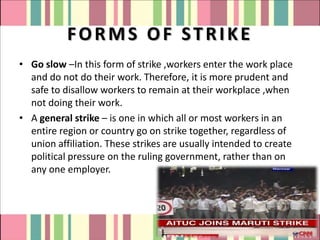
• A general strike – is one in which all or most workers in an
  entire region or country go on strike together, regardless of
  union affiliation. These strikes are usually intended to create
  political pressure on the ruling government, rather than on
  any one employer.
Contd…
• Down strike - Employees show up to their place of
  employment, but they refuse to work. They also refuse to
  leave, which makes it very difficult for anyone to defy the
  union and take the workers' places.
• Sick-out (or sick-in) - All, or a significant number of union
  members call in sick on the same day. They haven't broken
  any rules, because they just use sick leave that was allotted to
  them. However, the sudden loss of so many employees all on
  one day can show the employer just what it would be like if
  they really went on strike
L AYO F F
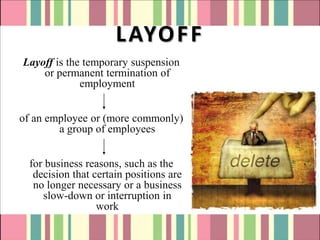
Layoff is the temporary suspension
    or permanent termination of
             employment


of an employee or (more commonly)
        a group of employees


  for business reasons, such as the
   decision that certain positions are
   no longer necessary or a business
     slow-down or interruption in
                  work
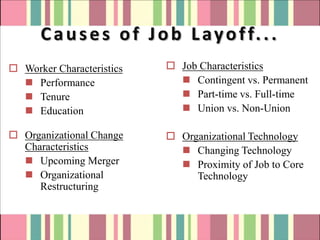
C a u s e s o f J o b L a y o f f. . .
 Worker Characteristics    Job Characteristics
   Performance               Contingent vs. Permanent
   Tenure                    Part-time vs. Full-time
   Education                 Union vs. Non-Union

 Organizational Change     Organizational Technology
  Characteristics             Changing Technology
   Upcoming Merger           Proximity of Job to Core
   Organizational              Technology
     Restructuring
Side-effects of Layoff for the
              Company
• Sometimes things don't work out as forecast for a company.
  Clients delay purchases. Suppliers raise prices. Competitors steal
  market share.
• Unfortunately, the very pressure to take action quickly ultimately
  works against their own best interest. Foolishly therefore,
  reducing the workforce becomes an automatic response for
  companies who need to cut costs. But it has its side-effects :
•   Job cuts reduce performance
•   Job cuts don't save money
•   Threat to investments
Side-effects of Layoff to the
           employee
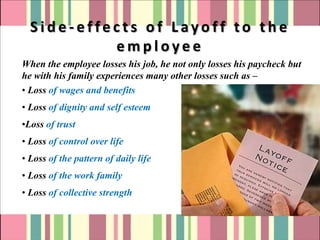
When the employee losses his job, he not only losses his paycheck but
he with his family experiences many other losses such as –
• Loss of wages and benefits
• Loss of dignity and self esteem
•Loss of trust
• Loss of control over life
• Loss of the pattern of daily life
• Loss of the work family
• Loss of collective strength
V O L U N TA R Y R E T I R E M E N T
               SCHEME.
• The Voluntary Retirement Scheme
  (VRS) is the latest mantra of many a
  corporate and Public sector units.

• VRS is a scheme whereby the
  employee is offered to voluntarily
  retire from his services before his
  retirement date.

• Subject to certain conditions the
  company offers VRS to its employees
  It is the golden route to cut the excess
  flab.
THE GOLDEN HANDSHAKE
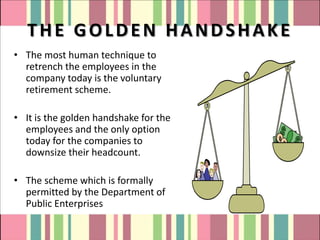
• The most human technique to
  retrench the employees in the
  company today is the voluntary
  retirement scheme.

• It is the golden handshake for the
  employees and the only option
  today for the companies to
  downsize their headcount.

• The scheme which is formally
  permitted by the Department of
  Public Enterprises
Contd…
• As the name suggests the VRS is strictly
  voluntary i.e. one can neither compel the
  workers to accept it nor apply it selectively to
  certain individuals.

• One can however choose the levels, units and
  age groups among whom one wants to offer
  VRS.

• The company can always accept or reject the
  application for the VRS.

• But usually this is not done in practical
  circumstances as it sends wrong signals to the
  employees
BENEFITS
•    The normal benefits that an
     employee gets:

1.   Provident fund
2.   Gratuity
3.   Salary for the notice period
4.   Cost of transfer to the
     hometown
OTHER BENEFITS
•  Also to make the scheme very
   attractive for the employees
   the severance package as it is
   called can include other
   benefits like
1. Medical insurance
2. Housing loans
3. Subsidies on children's
   education loans, etc.
Strike, layoff & voluntary retirement scheme

Strike, layoff & voluntary retirement scheme

  • 1.
    STRIKE, LAYOFF &VOLUNTARY RETIREMENT SCHEME Presented By Praveen Kumar Pai.P S3 MBA Roll no: 28 I.M.T Punnapra
  • 2.
    ST R IKE •Strike is concerted refusal to work on the part of workmen who are in a particular vocational area. • Strike is a work stoppage caused by mass refusal of employees to perform work. A strike usually takes place in response to employees grievances. • Acc. To sec2(q) of the Act “Cessation of work by a body of persons employed in an industry acting in combination or a concerted refusal or a refusal under a common understanding of any number of persons who are or have been so employed to continue to work or to accept employment.”
  • 3.
    FORMS OF STRIKE •Go slow –In this form of strike ,workers enter the work place and do not do their work. Therefore, it is more prudent and safe to disallow workers to remain at their workplace ,when not doing their work. • A general strike – is one in which all or most workers in an entire region or country go on strike together, regardless of union affiliation. These strikes are usually intended to create political pressure on the ruling government, rather than on any one employer.
  • 4.
    Contd… • Down strike- Employees show up to their place of employment, but they refuse to work. They also refuse to leave, which makes it very difficult for anyone to defy the union and take the workers' places. • Sick-out (or sick-in) - All, or a significant number of union members call in sick on the same day. They haven't broken any rules, because they just use sick leave that was allotted to them. However, the sudden loss of so many employees all on one day can show the employer just what it would be like if they really went on strike
  • 5.
    L AYO FF Layoff is the temporary suspension or permanent termination of employment of an employee or (more commonly) a group of employees for business reasons, such as the decision that certain positions are no longer necessary or a business slow-down or interruption in work
  • 6.
    C a us e s o f J o b L a y o f f. . .  Worker Characteristics  Job Characteristics  Performance  Contingent vs. Permanent  Tenure  Part-time vs. Full-time  Education  Union vs. Non-Union  Organizational Change  Organizational Technology Characteristics  Changing Technology  Upcoming Merger  Proximity of Job to Core  Organizational Technology Restructuring
  • 7.
    Side-effects of Layofffor the Company • Sometimes things don't work out as forecast for a company. Clients delay purchases. Suppliers raise prices. Competitors steal market share. • Unfortunately, the very pressure to take action quickly ultimately works against their own best interest. Foolishly therefore, reducing the workforce becomes an automatic response for companies who need to cut costs. But it has its side-effects : • Job cuts reduce performance • Job cuts don't save money • Threat to investments
  • 8.
    Side-effects of Layoffto the employee When the employee losses his job, he not only losses his paycheck but he with his family experiences many other losses such as – • Loss of wages and benefits • Loss of dignity and self esteem •Loss of trust • Loss of control over life • Loss of the pattern of daily life • Loss of the work family • Loss of collective strength
  • 9.
    V O LU N TA R Y R E T I R E M E N T SCHEME. • The Voluntary Retirement Scheme (VRS) is the latest mantra of many a corporate and Public sector units. • VRS is a scheme whereby the employee is offered to voluntarily retire from his services before his retirement date. • Subject to certain conditions the company offers VRS to its employees It is the golden route to cut the excess flab.
  • 10.
    THE GOLDEN HANDSHAKE •The most human technique to retrench the employees in the company today is the voluntary retirement scheme. • It is the golden handshake for the employees and the only option today for the companies to downsize their headcount. • The scheme which is formally permitted by the Department of Public Enterprises
  • 11.
    Contd… • As thename suggests the VRS is strictly voluntary i.e. one can neither compel the workers to accept it nor apply it selectively to certain individuals. • One can however choose the levels, units and age groups among whom one wants to offer VRS. • The company can always accept or reject the application for the VRS. • But usually this is not done in practical circumstances as it sends wrong signals to the employees
  • 12.
    BENEFITS • The normal benefits that an employee gets: 1. Provident fund 2. Gratuity 3. Salary for the notice period 4. Cost of transfer to the hometown
  • 13.
    OTHER BENEFITS • Also to make the scheme very attractive for the employees the severance package as it is called can include other benefits like 1. Medical insurance 2. Housing loans 3. Subsidies on children's education loans, etc.