CS Meenakshi Jayaraman
Industrial Relations Code, 2020
Part IV
2
Credits and Acknowledgments
Iswariya BS
3
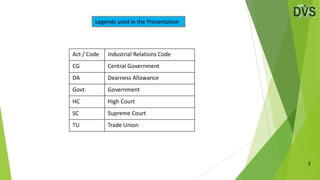
Legends used in the Presentation
Act / Code Industrial Relations Code
CG Central Government
DA Dearness Allowance
Govt. Government
HC High Court
SC Supreme Court
TU Trade Union
4
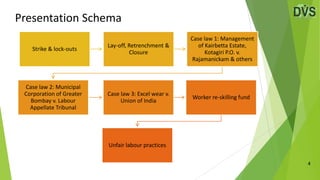
Presentation Schema
Strike & lock-outs
Lay-off, Retrenchment &
Closure
Case law 1: Management
of Kairbetta Estate,
Kotagiri P.O. v.
Rajamanickam & others
Case law 2: Municipal
Corporation of Greater
Bombay v. Labour
Appellate Tribunal
Case law 3: Excel wear v.
Union of India
Worker re-skilling fund
Unfair labour practices
Strikes & Lock-outs
5
6
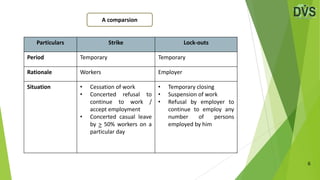
Particulars Strike Lock-outs
Period Temporary Temporary
Rationale Workers Employer
Situation • Cessation of work
• Concerted refusal to
continue to work /
accept employment
• Concerted casual leave
by > 50% workers on a
particular day
• Temporary closing
• Suspension of work
• Refusal by employer to
continue to employ any
number of persons
employed by him
A comparsion
7
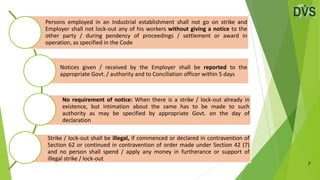
Persons employed in an Industrial establishment shall not go on strike and
Employer shall not lock-out any of his workers without giving a notice to the
other party / during pendency of proceedings / settlement or award in
operation, as specified in the Code
Notices given / received by the Employer shall be reported to the
appropriate Govt. / authority and to Conciliation officer within 5 days
No requirement of notice: When there is a strike / lock-out already in
existence, but intimation about the same has to be made to such
authority as may be specified by appropriate Govt. on the day of
declaration
Strike / lock-out shall be illegal, if commenced or declared in contravention of
Section 62 or continued in contravention of order made under Section 42 (7)
and no person shall spend / apply any money in furtherance or support of
illegal strike / lock-out
Lay-off, Retrenchment & Closure
8
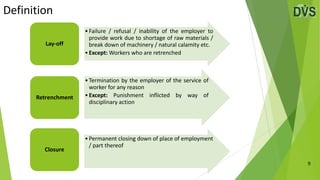
Definition
9
•Failure / refusal / inability of the employer to
provide work due to shortage of raw materials /
break down of machinery / natural calamity etc.
•Except: Workers who are retrenched
Lay-off
•Termination by the employer of the service of
worker for any reason
•Except: Punishment inflicted by way of
disciplinary action
Retrenchment
•Permanent closing down of place of employment
/ part thereof
Closure
Contd.
10
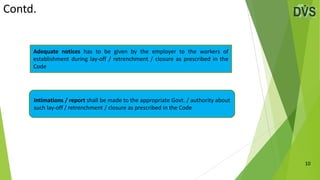
Adequate notices has to be given by the employer to the workers of
establishment during lay-off / retrenchment / closure as prescribed in the
Code
Intimations / report shall be made to the appropriate Govt. / authority about
such lay-off / retrenchment / closure as prescribed in the Code
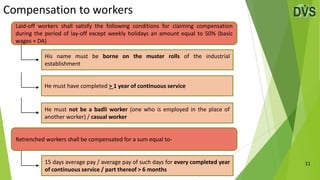
Compensation to workers
11
Laid-off workers shall satisfy the following conditions for claiming compensation
during the period of lay-off except weekly holidays an amount equal to 50% (basic
wages + DA)
His name must be borne on the muster rolls of the industrial
establishment
He must have completed > 1 year of continuous service
He must not be a badli worker (one who is employed in the place of
another worker) / casual worker
Retrenched workers shall be compensated for a sum equal to-
15 days average pay / average pay of such days for every completed year
of continuous service / part thereof > 6 months
Contd.
12
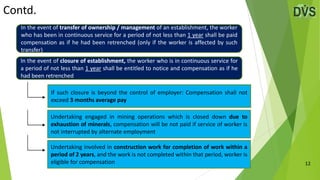
In the event of transfer of ownership / management of an establishment, the worker
who has been in continuous service for a period of not less than 1 year shall be paid
compensation as if he had been retrenched (only if the worker is affected by such
transfer)
In the event of closure of establishment, the worker who is in continuous service for
a period of not less than 1 year shall be entitled to notice and compensation as if he
had been retrenched
If such closure is beyond the control of employer: Compensation shall not
exceed 3 months average pay
Undertaking engaged in mining operations which is closed down due to
exhaustion of minerals, compensation will be not paid if service of worker is
not interrupted by alternate employment
Undertaking involved in construction work for completion of work within a
period of 2 years, and the work is not completed within that period, worker is
eligible for compensation
Case law
13
14
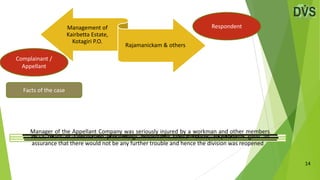
Management of
Kairbetta Estate,
Kotagiri P.O.
Rajamanickam & others
Facts of the case
Complainant /
Appellant
Respondent
Manager of the Appellant Company was seriously injured by a workman and other members
of the management were threatened for serious consequences if they work in that divisionHence, the management closed the division from 28th July to 2nd September, 1957As a result of Conciliation proceedings before the labour officer, respondents gave an
assurance that there would not be any further trouble and hence the division was reopened
Contd.
15
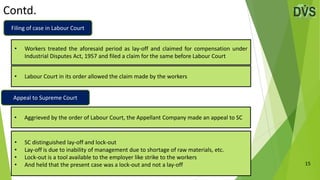
• Labour Court in its order allowed the claim made by the workers
• Workers treated the aforesaid period as lay-off and claimed for compensation under
Industrial Disputes Act, 1957 and filed a claim for the same before Labour Court
• Aggrieved by the order of Labour Court, the Appellant Company made an appeal to SC
• SC distinguished lay-off and lock-out
• Lay-off is due to inability of management due to shortage of raw materials, etc.
• Lock-out is a tool available to the employer like strike to the workers
• And held that the present case was a lock-out and not a lay-off
Filing of case in Labour Court
Appeal to Supreme Court
Contd.
16
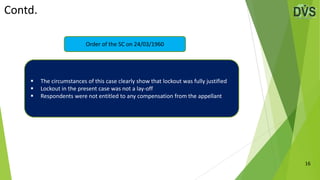
Order of the SC on 24/03/1960
 The circumstances of this case clearly show that lockout was fully justified
 Lockout in the present case was not a lay-off
 Respondents were not entitled to any compensation from the appellant
Case law
17
18
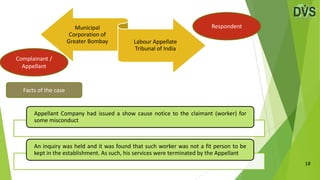
Municipal
Corporation of
Greater Bombay Labour Appellate
Tribunal of India
Facts of the case
Complainant /
Appellant
Respondent
Appellant Company had issued a show cause notice to the claimant (worker) for
some misconduct
An inquiry was held and it was found that such worker was not a fit person to be
kept in the establishment. As such, his services were terminated by the Appellant
Contd.
19
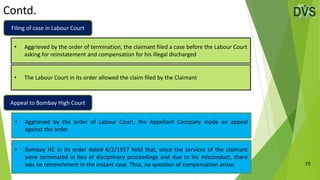
• The Labour Court in its order allowed the claim filed by the Claimant
• Aggrieved by the order of termination, the claimant filed a case before the Labour Court
asking for reinstatement and compensation for his illegal discharged
• Aggrieved by the order of Labour Court, the Appellant Company made an appeal
against the order
Filing of case in Labour Court
Appeal to Bombay High Court
• Bombay HC in its order dated 6/2/1957 held that, since the services of the claimant
were terminated in lieu of disciplinary proceedings and due to his misconduct, there
was no retrenchment in the instant case. Thus, no question of compensation arose.
Case law
20
21
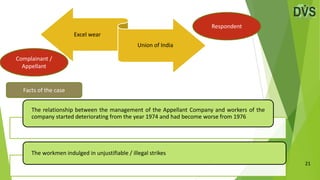
Excel wear
Union of India
Facts of the case
Complainant /
Appellant
Respondent
The relationship between the management of the Appellant Company and workers of the
company started deteriorating from the year 1974 and had become worse from 1976
The workmen indulged in unjustifiable / illegal strikes
Contd.
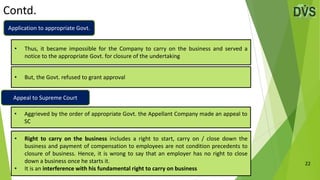
22
• But, the Govt. refused to grant approval
• Thus, it became impossible for the Company to carry on the business and served a
notice to the appropriate Govt. for closure of the undertaking
• Aggrieved by the order of appropriate Govt. the Appellant Company made an appeal to
SC
• Right to carry on the business includes a right to start, carry on / close down the
business and payment of compensation to employees are not condition precedents to
closure of business. Hence, it is wrong to say that an employer has no right to close
down a business once he starts it.
• It is an interference with his fundamental right to carry on business
Application to appropriate Govt.
Appeal to Supreme Court
Contd.
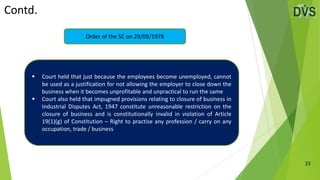
23
Order of the SC on 29/09/1978
 Court held that just because the employees become unemployed, cannot
be used as a justification for not allowing the employer to close down the
business when it becomes unprofitable and unpractical to run the same
 Court also held that impugned provisions relating to closure of business in
Industrial Disputes Act, 1947 constitute unreasonable restriction on the
closure of business and is constitutionally invalid in violation of Article
19(1)(g) of Constitution – Right to practise any profession / carry on any
occupation, trade / business
Worker re-skilling fund
24
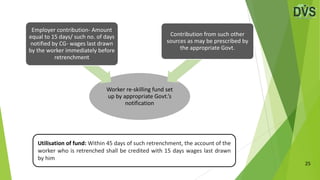
25
Worker re-skilling fund set
up by appropriate Govt.’s
notification
Employer contribution- Amount
equal to 15 days/ such no. of days
notified by CG- wages last drawn
by the worker immediately before
retrenchment
Contribution from such other
sources as may be prescribed by
the appropriate Govt.
Utilisation of fund: Within 45 days of such retrenchment, the account of the
worker who is retrenched shall be credited with 15 days wages last drawn
by him
Unfair labour practices
26
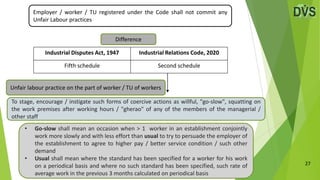
27
Employer / worker / TU registered under the Code shall not commit any
Unfair Labour practices
Industrial Disputes Act, 1947 Industrial Relations Code, 2020
Fifth schedule Second schedule
To stage, encourage / instigate such forms of coercive actions as willful, "go-slow", squatting on
the work premises after working hours / "gherao" of any of the members of the managerial /
other staff
• Go-slow shall mean an occasion when > 1 worker in an establishment conjointly
work more slowly and with less effort than usual to try to persuade the employer of
the establishment to agree to higher pay / better service condition / such other
demand
• Usual shall mean where the standard has been specified for a worker for his work
on a periodical basis and where no such standard has been specified, such rate of
average work in the previous 3 months calculated on periodical basis
Unfair labour practice on the part of worker / TU of workers
Difference
28
Thank You!
Scan the QR Code to Join our
Research Group on WhatsApp
Scan the QR Code to explore more
Research from our Website
DVS Advisors LLP
India-Singapore-London-Dubai-Malaysia-Africa
www.dvsca.com
Copyrights © 2020 DVS Advisors LLP

Industrial Relations Code, 2020- Part IV

  • 1.
    CS Meenakshi Jayaraman IndustrialRelations Code, 2020 Part IV
  • 2.
  • 3.
    3 Legends used inthe Presentation Act / Code Industrial Relations Code CG Central Government DA Dearness Allowance Govt. Government HC High Court SC Supreme Court TU Trade Union
  • 4.
    4 Presentation Schema Strike &lock-outs Lay-off, Retrenchment & Closure Case law 1: Management of Kairbetta Estate, Kotagiri P.O. v. Rajamanickam & others Case law 2: Municipal Corporation of Greater Bombay v. Labour Appellate Tribunal Case law 3: Excel wear v. Union of India Worker re-skilling fund Unfair labour practices
  • 5.
  • 6.
    6 Particulars Strike Lock-outs PeriodTemporary Temporary Rationale Workers Employer Situation • Cessation of work • Concerted refusal to continue to work / accept employment • Concerted casual leave by > 50% workers on a particular day • Temporary closing • Suspension of work • Refusal by employer to continue to employ any number of persons employed by him A comparsion
  • 7.
    7 Persons employed inan Industrial establishment shall not go on strike and Employer shall not lock-out any of his workers without giving a notice to the other party / during pendency of proceedings / settlement or award in operation, as specified in the Code Notices given / received by the Employer shall be reported to the appropriate Govt. / authority and to Conciliation officer within 5 days No requirement of notice: When there is a strike / lock-out already in existence, but intimation about the same has to be made to such authority as may be specified by appropriate Govt. on the day of declaration Strike / lock-out shall be illegal, if commenced or declared in contravention of Section 62 or continued in contravention of order made under Section 42 (7) and no person shall spend / apply any money in furtherance or support of illegal strike / lock-out
  • 8.
  • 9.
    Definition 9 •Failure / refusal/ inability of the employer to provide work due to shortage of raw materials / break down of machinery / natural calamity etc. •Except: Workers who are retrenched Lay-off •Termination by the employer of the service of worker for any reason •Except: Punishment inflicted by way of disciplinary action Retrenchment •Permanent closing down of place of employment / part thereof Closure
  • 10.
    Contd. 10 Adequate notices hasto be given by the employer to the workers of establishment during lay-off / retrenchment / closure as prescribed in the Code Intimations / report shall be made to the appropriate Govt. / authority about such lay-off / retrenchment / closure as prescribed in the Code
  • 11.
    Compensation to workers 11 Laid-offworkers shall satisfy the following conditions for claiming compensation during the period of lay-off except weekly holidays an amount equal to 50% (basic wages + DA) His name must be borne on the muster rolls of the industrial establishment He must have completed > 1 year of continuous service He must not be a badli worker (one who is employed in the place of another worker) / casual worker Retrenched workers shall be compensated for a sum equal to- 15 days average pay / average pay of such days for every completed year of continuous service / part thereof > 6 months
  • 12.
    Contd. 12 In the eventof transfer of ownership / management of an establishment, the worker who has been in continuous service for a period of not less than 1 year shall be paid compensation as if he had been retrenched (only if the worker is affected by such transfer) In the event of closure of establishment, the worker who is in continuous service for a period of not less than 1 year shall be entitled to notice and compensation as if he had been retrenched If such closure is beyond the control of employer: Compensation shall not exceed 3 months average pay Undertaking engaged in mining operations which is closed down due to exhaustion of minerals, compensation will be not paid if service of worker is not interrupted by alternate employment Undertaking involved in construction work for completion of work within a period of 2 years, and the work is not completed within that period, worker is eligible for compensation
  • 13.
  • 14.
    14 Management of Kairbetta Estate, KotagiriP.O. Rajamanickam & others Facts of the case Complainant / Appellant Respondent Manager of the Appellant Company was seriously injured by a workman and other members of the management were threatened for serious consequences if they work in that divisionHence, the management closed the division from 28th July to 2nd September, 1957As a result of Conciliation proceedings before the labour officer, respondents gave an assurance that there would not be any further trouble and hence the division was reopened
  • 15.
    Contd. 15 • Labour Courtin its order allowed the claim made by the workers • Workers treated the aforesaid period as lay-off and claimed for compensation under Industrial Disputes Act, 1957 and filed a claim for the same before Labour Court • Aggrieved by the order of Labour Court, the Appellant Company made an appeal to SC • SC distinguished lay-off and lock-out • Lay-off is due to inability of management due to shortage of raw materials, etc. • Lock-out is a tool available to the employer like strike to the workers • And held that the present case was a lock-out and not a lay-off Filing of case in Labour Court Appeal to Supreme Court
  • 16.
    Contd. 16 Order of theSC on 24/03/1960  The circumstances of this case clearly show that lockout was fully justified  Lockout in the present case was not a lay-off  Respondents were not entitled to any compensation from the appellant
  • 17.
  • 18.
    18 Municipal Corporation of Greater BombayLabour Appellate Tribunal of India Facts of the case Complainant / Appellant Respondent Appellant Company had issued a show cause notice to the claimant (worker) for some misconduct An inquiry was held and it was found that such worker was not a fit person to be kept in the establishment. As such, his services were terminated by the Appellant
  • 19.
    Contd. 19 • The LabourCourt in its order allowed the claim filed by the Claimant • Aggrieved by the order of termination, the claimant filed a case before the Labour Court asking for reinstatement and compensation for his illegal discharged • Aggrieved by the order of Labour Court, the Appellant Company made an appeal against the order Filing of case in Labour Court Appeal to Bombay High Court • Bombay HC in its order dated 6/2/1957 held that, since the services of the claimant were terminated in lieu of disciplinary proceedings and due to his misconduct, there was no retrenchment in the instant case. Thus, no question of compensation arose.
  • 20.
  • 21.
    21 Excel wear Union ofIndia Facts of the case Complainant / Appellant Respondent The relationship between the management of the Appellant Company and workers of the company started deteriorating from the year 1974 and had become worse from 1976 The workmen indulged in unjustifiable / illegal strikes
  • 22.
    Contd. 22 • But, theGovt. refused to grant approval • Thus, it became impossible for the Company to carry on the business and served a notice to the appropriate Govt. for closure of the undertaking • Aggrieved by the order of appropriate Govt. the Appellant Company made an appeal to SC • Right to carry on the business includes a right to start, carry on / close down the business and payment of compensation to employees are not condition precedents to closure of business. Hence, it is wrong to say that an employer has no right to close down a business once he starts it. • It is an interference with his fundamental right to carry on business Application to appropriate Govt. Appeal to Supreme Court
  • 23.
    Contd. 23 Order of theSC on 29/09/1978  Court held that just because the employees become unemployed, cannot be used as a justification for not allowing the employer to close down the business when it becomes unprofitable and unpractical to run the same  Court also held that impugned provisions relating to closure of business in Industrial Disputes Act, 1947 constitute unreasonable restriction on the closure of business and is constitutionally invalid in violation of Article 19(1)(g) of Constitution – Right to practise any profession / carry on any occupation, trade / business
  • 24.
  • 25.
    25 Worker re-skilling fundset up by appropriate Govt.’s notification Employer contribution- Amount equal to 15 days/ such no. of days notified by CG- wages last drawn by the worker immediately before retrenchment Contribution from such other sources as may be prescribed by the appropriate Govt. Utilisation of fund: Within 45 days of such retrenchment, the account of the worker who is retrenched shall be credited with 15 days wages last drawn by him
  • 26.
  • 27.
    27 Employer / worker/ TU registered under the Code shall not commit any Unfair Labour practices Industrial Disputes Act, 1947 Industrial Relations Code, 2020 Fifth schedule Second schedule To stage, encourage / instigate such forms of coercive actions as willful, "go-slow", squatting on the work premises after working hours / "gherao" of any of the members of the managerial / other staff • Go-slow shall mean an occasion when > 1 worker in an establishment conjointly work more slowly and with less effort than usual to try to persuade the employer of the establishment to agree to higher pay / better service condition / such other demand • Usual shall mean where the standard has been specified for a worker for his work on a periodical basis and where no such standard has been specified, such rate of average work in the previous 3 months calculated on periodical basis Unfair labour practice on the part of worker / TU of workers Difference
  • 28.
    28 Thank You! Scan theQR Code to Join our Research Group on WhatsApp Scan the QR Code to explore more Research from our Website DVS Advisors LLP India-Singapore-London-Dubai-Malaysia-Africa www.dvsca.com Copyrights © 2020 DVS Advisors LLP