Stress Ulcer Prophylaxis  in the ICU Suhail Sharif M.D. Illinois Masonic Medical Center UIC/MGH Department of Surgery
Introduction A “misnomer” Stress ulcers are superficial erosions in the gastric mucosa.
Pathogenesis Mucosal lining of the GI tract is replaced every 2-3 days. When there is lack of nutrient blood flow to support the replacement process, the surface of the bowel becomes denuded. Superficial erosion result. Gastric acid can aggravate the condition. Primary cause of stress ulceration is  impaired blood flow.


Clinical Features Gastric erosions are present in 10 – 25% of patients on admission to the ICU. 90% by day 3. Often clinically silent. 2 sequalae: Risk of translocation Hemorrhage Perforation is rare.
Bacterial Translocation Protective mechanisms: Indigenous bacteria are saprophytes. Bacteriocidal action of gastric acid. Intrinsic barrier of the mucosal lining. RES in the bowel. Disruption of mucosal barrier leads to subsequent translocation during stress ulceration. Incidence of bacterial translocation is not well documented.
 
 
Increase Incidence of Stress Ulcers Head injury Thermal injury (> 30% BSA) Emergent or major surgery Severe or multi-system trauma Shock or multi-organ failure Coagulopathy Mechanical ventilation for more than 48 hours. Ongoing therapy with ulcerogenic drugs. History of ulcer-related bleeding.
 
Preventive Strategies Preserve splanchnic blood flow Enteral nutrition Pharmacologic therapy
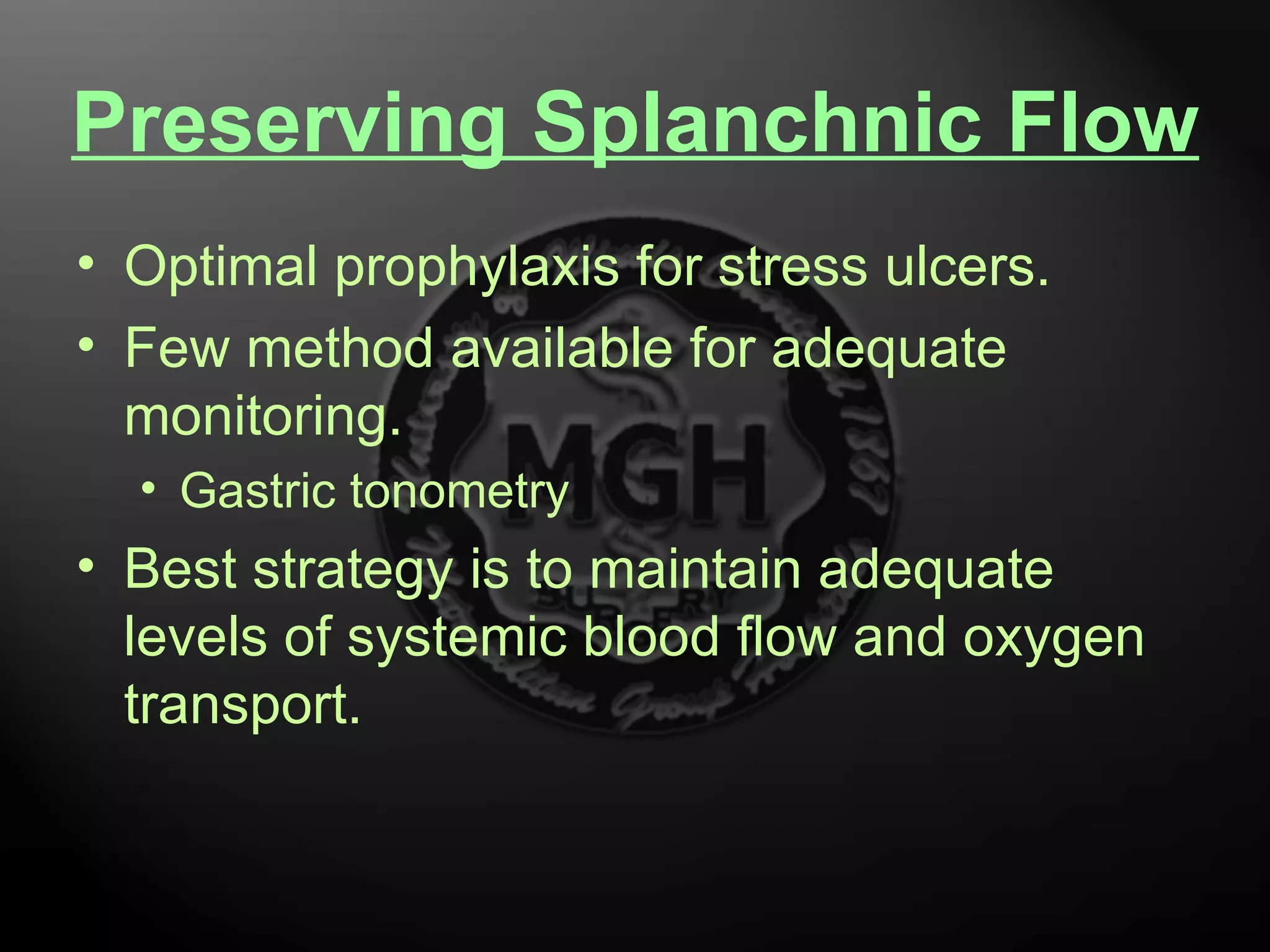
Preserving Splanchnic Flow Optimal prophylaxis for stress ulcers. Few method available for adequate monitoring. Gastric tonometry Best strategy is to maintain adequate levels of systemic blood flow and oxygen transport.


Stress Ulcer Prophylaxis In The Icu

  • 1.
    Stress Ulcer Prophylaxis in the ICU Suhail Sharif M.D. Illinois Masonic Medical Center UIC/MGH Department of Surgery
  • 2.
    Introduction A “misnomer”Stress ulcers are superficial erosions in the gastric mucosa.
  • 3.
    Pathogenesis Mucosal liningof the GI tract is replaced every 2-3 days. When there is lack of nutrient blood flow to support the replacement process, the surface of the bowel becomes denuded. Superficial erosion result. Gastric acid can aggravate the condition. Primary cause of stress ulceration is impaired blood flow.
  • 4.
  • 5.
  • 6.
  • 7.
  • 8.
  • 9.
    Clinical Features Gastricerosions are present in 10 – 25% of patients on admission to the ICU. 90% by day 3. Often clinically silent. 2 sequalae: Risk of translocation Hemorrhage Perforation is rare.
  • 10.
    Bacterial Translocation Protectivemechanisms: Indigenous bacteria are saprophytes. Bacteriocidal action of gastric acid. Intrinsic barrier of the mucosal lining. RES in the bowel. Disruption of mucosal barrier leads to subsequent translocation during stress ulceration. Incidence of bacterial translocation is not well documented.
  • 11.
  • 12.
  • 13.
    Increase Incidence ofStress Ulcers Head injury Thermal injury (> 30% BSA) Emergent or major surgery Severe or multi-system trauma Shock or multi-organ failure Coagulopathy Mechanical ventilation for more than 48 hours. Ongoing therapy with ulcerogenic drugs. History of ulcer-related bleeding.
  • 14.
  • 15.
    Preventive Strategies Preservesplanchnic blood flow Enteral nutrition Pharmacologic therapy
  • 16.
    Preserving Splanchnic FlowOptimal prophylaxis for stress ulcers. Few method available for adequate monitoring. Gastric tonometry Best strategy is to maintain adequate levels of systemic blood flow and oxygen transport.
  • 17.
  • 18.
  • 19.
  • 20.
  • 21.
  • 22.
  • 23.
  • 24.
  • 25.
  • 26.
  • 27.
  • 28.
  • 29.
  • 30.
  • 31.
  • 32.
  • 33.
  • 34.