STRATEGY FORMULATION: DATA
SYNTHESIS, ENVIRONMENTAL
SCANNING AND SWOT ANALYSIS
BY
TANKO AHMED fwc
Senior Fellow (Security & Strategic Studies)
Research Directorate, NIPSS, Kuru – Jos, NIGERIA
A Paper Presented to Participants of the
NIPSS Policy, Strategy and Leadership
Course No. 21 (4th – 29th April 2016)
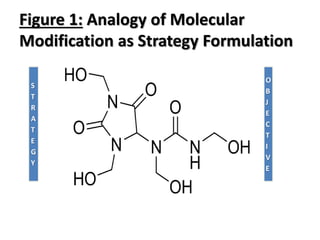
Figure 1: Analogy of Molecular
Modification as Strategy Formulation
S
T
R
A
T
E
G
Y
O
B
J
E
C
T
I
V
E
A Prologue
• The keen faculty of strategy extracts and
refine tidings by careful survey of situations
and assessment before initial or next moves.
• This paper discusses strategy formulation and
correlates its elements of data synthesis,
environmental scanning and SWOT analysis.
• These constituents of strategy formulation
pose challenges of solving a jigsaw puzzle for
organizational leadership.
Some Illustrations
• “Strategic formulation will help you fully
uncover your available options, set
priorities for them, and define the
methods to achieve them – Robert J. McKain
(n.d.)
• Strategy formulation is an initial or
ongoing process of perceiving new
position or opportunities which should be
embedded in organizations. – Harvard Business
Review Blog Network (n.d.)
INTRODUCTION
“Strategy formulation is not the consequences of
planning but its starting point”
– Henry Mintzberg
Background
• Strategic Formulation employs basic
information, general situation, and close
examination of organizations.
• These three courses of action are often
expressed in terms of data synthesis,
environmental scanning and SWOT analysis.
• All together, the trio represents the tool-kit
items of strategy formulation.
Literature Review
• Literature on strategy related issues has
experienced advancement and spread from classical
military operations to contemporary organizational
studies and practice (Mitchell, 2009; Acur & Englyst, 2006; Li,
Guohu & Eppler, 2008; Bordean, et al. 2010).
• Strategy formulation skills and philosophy tend to
uplift, embolden and expand the capacity and
frontier of organizational leadership (Acur & English, 2006;
Li, Guohu & Eppler, 2008; Bordean, et al. 2010).
• Presently, the venture of systematic planning and
execution are deemed as attributes of middle and
higher senior executives of organizations.
Literature Milestones
• Acur & Englyst (2006) expound on thinking phases and
generic approaches for organizational strategy formulation
including assessment and success criteria for organizations.
• Li, Guohu & Eppler (2008) demonstrate and review literature
on how to make strategy formulation works for
organizations.
• Mitchell (2009) emphasizes on organizational strategy
formulation as tool for corporate rather than military
operational instrument.
• Bordean (et al. 2010) investigates the application of strategy
formulation to companies as part of contemporary
challenges and opportunities to organizations and
leadership.
Gap to Fill
This paper works on correlation of data
synthesis, environmental scanning and
SWOT analysis as components of strategy
formulation.
Theorem
• Theories of strategy or theories of action associated
with strategy formulation flow along conceptual
transition overtime (Barney, 1986; Zan, 1990; Porter 1991;
Yarger, 2006; Chamberlin, 2010).
• There is a proposal for an integrative framework for
theory of strategy in managerial decisions and
actions (Barney, 1986; Zan, 1990).
• Also, there has been a long standing progress in the
field with emphasis on dynamic theory of strategy;
and cross-sectional and longitudinal problems in
organizational environment (Porter,1991).
A Theoretical Framework
• Yarger (2006) provides theories of action to the 21st
century organizational leadership in his work: ‘The Little
Book on Big Strategy’.
• Chamberlain (2010) reviews past trends and treat left-
over areas including concepts, forces, process and
mechanisms by with strategy can take effect.
• Theories on strategy formulation are inclined to
interactive nature of its components for rational
propositions.
• Theoretical framework for this paper presupposes the
correlation of strategic formulation components of data
synthesis, environmental scanning and SWOT analysis.
Problem Statement
• The use of strategy is avail to management process
of organizations in the systematic incorporation of
scientific observations and methods in formulating
plans derived from mission and vision statements.
• Strategy formulation poses prospects as much as
challenges to organizational leadership in the
strategic management process.
• There is the need for middle and higher executives
of organization to be acquainted with the rigours of
conducting the strategy formation process.
Points of Inquiry
• To conceptualize strategy formulation and its major
components;
• To itemize and correlate data synthesis,
environmental scanning, and SWOT analysis in
strategy formulation;
• To establish strategy formulation as starting point of
the strategic management process or planning;
• To explain the conduct of strategy formulation as tool
for organizational leadership; and
• To draw conclusion and suggest the way forward for
success and survival of organizations.
CONCEPTUAL
FRAMEWORK
Strategy
• Strategy focuses on possible courses of decisions
and action utilizing available resources and
determined by environmental influence.
• It is the practice of higher level plans or
leadership in achieving set goals of organizations
under ever changing situations or environments.
• It also involves patterns in streams of decisions
and actions that shape the future into desirable
ends by means of available resources (Mintzberg,
1978; Mintzberg & Quinn, 1996; Kvint, 2009; Freedman,
2013).
Strategy Formulation
• Strategy formulation is the task of analyzing the
organization’s internal and external environments,
and selecting or devising appropriate plans or
strategies in setting goals or objectives and ways of
achieving them.
• It involves the establishment or adjustment of
mission and vision statements, environmental
analysis or scanning, setting goals or objectives, and
the ways and means for attainment (Nabradi, n.d;
Mitchell, 2009).
• It is a living document that changes and grows time
or events.
Data Synthesis
• Data is a body of factual information assembled for
use in planning, decision making or drawing
conclusions.
• Synthesis refers to result of combination, of
different ideas, influences or data for the purpose
of producing structures or relationships, known as
formulation.
• Data Synthesis combines outcomes from different
assumptions on overall effects of particular
intervention to arrive at clear pattern for decision
and action (Ellerby, 2009; Berg, 2013; Ryan 2013).
Environmental Scanning
• Environment is the surrounding influence, settings,
situation, atmosphere, background, conditions or
circumstances which determining the activities or fate
of any given venture.
• Scanning refers to detailed or thorough examination
of the environment for the purpose of extracting
much needed data.
• Environmental Scanning is the systematic process of
close monitoring for environmental signals for use in
strategic decision making, action or formulation of
tasks (Zhang, Majid & Foo, 2010).
SWOT Analysis
• SWOT analysis is a veritable instrument or method of
strategic planning use in strategy formulation.
• It evaluates strengths or advantages over others;
weaknesses or disadvantages relative to others;
opportunities or chances for progress; and threats or
causes for concern.
• It is the work room of strategy formulation where
results of data synthesis and environmental scanning
are put together for evaluation.
• It is used to identify and align strategies to available
resources; and capabilities to realities of the
environment.
Organizational Leadership
• Organizational leadership is the management
staff that provides inspiration, objectives,
operational oversight and other
administrative services to the organization
often seen in Mission and Vision Statements
(BusinessDictionary.com).
Strategic Management Process
• The strategic management process (SMP) is
an objective, logical, systematic and
continuous approach for making major
decisions and taking actions in an
organization (Yousuf, 2016).
• It is defined as a dynamic process of strategy
formulation, implementation, evaluation and
control (Parnell, 2005; David, 2008; Vasile & Iancu,
2009; Vatchkova, 2010; Hill, Jones & Schilling, 2015;
Yousuf, 2016).
STRATEGIC FORMULATION
AND
DATA SYNTHESIS
The Sense in Data
• Data is most crucial in the process of
choosing appropriate courses of action
towards defined goals.
• Strategy formulation relies heavily on data
for planning, decision making and action for
overall effects (Ellerby, 2009).
• Strategic control can only be achieved by
data synthesis in which information is
gathered, refined, applied and reviewed
systematically over time (Ulwick, 1999).
Data Synthesis in Strategic Formulation
• Data Synthesis examines and infers relationships
among sources in a clear, obvious and definite
format for useful in strategic formulation.
• It combines information and ideas to create and
develop more ideas, better focus, wider perspective
in an impending strategic formulation cycle.
• Output of data synthesis is useful for core insight,
critical thinking and testing of ideas in making next
moves.
• These turn out good analysis as well as what to do
next in strategy formulation towards set objectives.
STRATEGIC FORMULATION
AND
ENVIRONMENTAL
SCANNING
The Keen Eyes of Strategy
• Strategy requires keen sense, balanced mind,
fast thinking, quick response and accurate
moves.
• Visual thinking improves mental attention
skills associated with environmental scanning
(Bohannon, 2009).
• A corresponding example of the keen eyes of
strategy is seen in the sharp sense and high
aptitude of expert computer gamers.
Environmental Scanning in Strategic
Formulation
• As organizational environment increasingly become
uncertain and complex, environmental scanning
enables organizations to detect change and formulate
adaptive strategies (Zhang, Majid & Foo, 2010).
• In strategic sense, environmental scanning is also
about mastering the immediate locality to national,
regional and global surroundings within which the
organization operates.
• It includes scanning strategies, internal factors and
perceived change leading to purposive strategy
formulation.
STRATEGIC FORMULATION
AND
SWOT ANALYSIS
SWOT Analysis in Strategic Formulation
• The process of taking stock of activities requires
thorough examination of internal status and
external context of organizations (Keeley, n.d.).
• SWOT analysis allows organizations to recognize
themselves and their surrounding environments in
order to plan, implement and monitor their
strategies (Hashemi, et al. 2012).
• Strategy formulation is concerned with areas of
strengths or advantages, contributions of external
factors or opportunities, as well as watching for
internal weaknesses and external threats.
STRATEGY FORMULATION AS
STRATEGIC TOOL OF
ORGANIZATIONAL LEADERSHIP
Strategy Formulation as Leadership
Instrument
• Strategy is “the match an organization makes
between its internal resources and skills and the
opportunities and risks created by its external
environment” (Grant, 2001 p. 114).
• The strategic formulation cycle consisting of
data synthesis, environmental scanning and
SWOT analysis submits to continuous review.
• It is an effective instrument of organizational
leadership for effective and efficient attainment
of mission and vision.
Strategy Formulation and
Organizational Performance
• Consensus on objectives or methods and
collaboration amongst management team
members positively relates to organizational
performance (Dess, 2006).
• Leadership has great influence on organizational
performance particular as it relates to strategy
formulation and day to day decision making
actions.
• All these are tied to the cycle of vision, mission
and strategy formulation leading to action plan.
CONCLUSION
Summary
• The paper conceptualizes strategy formulation
and its major components; and discusses and
correlates data synthesis, environmental
scanning, and SWOT analysis in strategy
formulation.
• It establishes strategy formulation as starting
point of the strategic management process or
planning; and explains the conduct of strategy
formulation as tool for organizational
leadership.
Conclusion
• The strategy formulation is proposed as a
crucial organizational leadership instrument
of the strategic management process with
illustrations.
• The paper draws conclusions on the
foundational value and contribution of
strategy formulation in the strategic
management process.
Recommendations
• It strongly recommends knowledge and skills
on strategy formulation and strategic
management process for middle and higher
executive who constitute organizational
leadership.
• A simulation exercise is designed to practice
on the application of strategy formulation in
real world situations.
SIMULATION EXERCISE
Groups of Course Participants are to prepare
Strategy Formulation Schedule for the National
Institute for Policy and Strategic Studies from
the amended Mission and Vision of previous
Exercise.
Reference
Acur, N. & Englyst, L. (2006). Assessment of strategy formulation: How to ensure quality in process and outcome. International Journal of Operations and
Production Management, 26(1), 69-91
Barney, J. B. (1086). Types of competition and the theory of strategy: Toward an integrative framework. Academy of Management Review, 11(4), 791-800
Retrieved from http://amr.aom.org/content/11/4/791.short
Berg, T., M. W. Heymanns, S. S. Leone, D. Vergouw, J. A Hayden, A. P. Verhagen, & H. Vet (2013). Overview of data-synthesis in systematic reviews of
studies on outcome prediction. BMC Medical Research Methodologies BMC Series. Retrieved from
http://bmcmmedresmethodol.biomedcentral.com/articles/10.1186/1471-2288-13-42
Bohannon, J. (2009). The keen eyes of a gamer. Science, March 30. [Online]. American Association for Advancement of Science (AAAS). Retrieved from
http://sciencemag.org/ 10 April 2016
Bordean, O., Borza, A., Rus, C & Mitra, C. (2010). An investigation on the strategy formulation process within the Roman companies. Managerial Challenges
of the Contemporary Society. Proceedings, 26-31
BusinessDictionary.com http://www.businessdictionary.com/definition/-organizational-leadership.html
Chamberlain, G. P. (2010). Understanding strategy. Charleston, NC: Create Space
Correia, Z. & Wilson, T. D. (1997). Scanning the business environment for information: A grounded theory approach. Information Research, 2(4), April.
Retrieved from http://www.informationr.net/ir/2-4/paper21.html
Costa, J. (1997). A study of strategic planning and environmental scanning in the multi-unit Portuguese hotel sector. A Thesis Submitted in Fulfillment of the
Requirements for the Award of PhD Degree, May. Department of Management studies, University of Surrey, UK>
David, F. R. (2008). Concepts of strategic management. (6th Edition). Upper Saddle River, NJ: Prince-Hall
Dess, G. G. (2006). Consensus on strategy formulation and organizational performance: Competitors in a fragmented industry. Strategic Management
Journal, November 8. DOI: 10.1002/smj.4250080305
Ellerby, L. (2009). Analysis, plus synthesis: Turning data into insights. UX Matters, April 27. Retrieved from
http://www.uxmatters.com/authors/archives/2007/03/lindsay_ellerby.php
Freedman, L. (2013). Strategy. Oxford, UK: Oxford University Press.
Grant, R. M. (2001). The resource-based theory of competitive advantage: Implications for strategy formulation. California Management Review, Spring
1991
___________ (2010). Analyzing the industry environment. In Mazzucato, M. (ed.). Strategy for business: A reader. London, SAGE Publications.
Hashemi, N. F., Masdeh, M. M., Razeghi, A. & Rahimian, A. (2012). Formulating and choosing strategies using SWOT analysis and QSPM matrix: A case study
of Hamadan Glass Company.
Harvard Business School Review (HBR) Blog Network. http://blogs.hbr.org/
Hill, C. W., Jones, G. R. & Schilling, M. A. (2015). Strategic management theory. (11th Edition). London, UK: Cengage Learning
Keeley, E. T. (n. d.). How to conduct a SWOT analysis. [Online]. Retrieved from http://oie.eku.edu/sites/oie.eku.edu/files/files/SWOT%20Analysis.pdf. 10
April 2016
• Kvint, V. (2009). The global emerging market: Strategic management and economics. New York, NY: Routledge Publishing
Li, Y., Guohu, S. & Eppler, M. J. (2008). Making strategy work: A literature review on factors influencing strategy implementation. ICA Working Papers
2/2008, Institute for Corporate Communication, Lugano, Switzerland
Michael Porter. (n.d.). BrainyQuote.com. Retrieved April 7, 2016, from BrainyQuote.com Web site:
http://www.brainyquote.com/quotes/quotes/m/michaelpor378202.html
Mitchell, R. C. (2009). Strategy formulation. [Online]. Retrieved from http://www.saylor.org/site/wp-content/uploads/2013/04/BUS300-2.3_Strategy-
Formulation.pdf. 10 April 2016
Mintzberg, H. & Quinn, J. B. (1996). The strategy process: Concepts, contexts, cases. Upper Saddle River, NJ: Prentice Hall
Mintzberg, H. (1978). Patterns in strategy formation. Management Science, 24(9), 934-948
Nabradi, A. (n.d.). Strategic management process: strategy formulation. [Online]. Retrieved from
http://www.agr.unizg.hr/multimedia/pdf/strategic_mgmt_2.pdf.
Parnell, J. A. (2005). Strategic philosophy and management level. Management Decision, 3(2), 157-170. Retrieved from
http://www.emeraldinsight.com/0025.1747.htm
Porter, M. E. (1991). Towards a dynamic theory of strategy. Strategic Management Journal, 12(S2), 95-117, Winter. DOI.10.1002/smj.4250121008
Porter, M. E. (2010). What is strategy. In Mazzucato, M. (ed.). Strategy for business: A reader. London, SAGE Publications.
Ryan, R. (2013). Cochrane consumers and communication review group: Data synthesis and analysis. Cochrane Consumers and Communication Review
Group, June. Retrieved from http://ccorg.cochrane.org
Scouller, J. (2011). Three levels of leadership: How to develop your leadership presence, knowhow and skills. Cirencester, UK: Management Books 2000
Theocharopoulos, M. (2012). Strategy formulation using SWOT. Retrieved from http://www.slideshare.net/manostheocharopoulos/strategy-
formulation-using-swot-15650383
Ulwick, A. W. (1999). Business strategy formulation: Theory, process, and the intellectual revolution. London, UK: Quorum Books
Vasile, T. & Iancu, A. (2009). A model of the strategic management process.
Vatchkova, E. (2012). Contents historical development of strategy: Strategic management. Retrieved from
http://www.iuc.edu.eu./group/mba_learning/2012STRATMAN/EV-L1-introduction.pdf
William E. Rothschild, W. E. (n.d.). http://www.azquotes.com/picture-quotes/
Yarger, H. R. (2006). Strategic theory for the 21st century: The little book for big strategy. Strategic Studies Institute. Retrieved from
http://www..StrategicStudiesInstitute.army.mil/
Yousuf, M. (2016). The nature of strategic management Chapter I, What is strategic management. Academia.
https://www.academia.edu/6349510/THE_NATURE_OF_STRATEGIC_MANAGEMENT_I_WHAT_IS_STRATEGIC_MANAGEMENT
Zan, L. (1990). Looking for theories in strategy studies. Scandinavian Journal of Management, 6(2), 89-108.
http://www.sciencedirect.com/science/article/pii/095652219090018C
Zhang, X., Majid, S. & Foo, S. (2010). Environmental scanning: An application of information literacy skills at the work place. Journal of Information
Science, 36(6), 719-732. DOI:10.1177/1065551510385644
http://www.quoteland.com/author/Robert-J-Mckain-Quotes/6434/.
https://pcscaliforniainc.wordpress.com/category/general-management-workshop/
http://www.civilserviceindia.com/subject/Management/notes/nature-and-scope-of-strategic-management.html

STRATEGY FORMULATION: DATA SYNTHESIS, ENVIRONMENTAL SCANNING AND SWOT ANALYSIS

  • 1.
    STRATEGY FORMULATION: DATA SYNTHESIS,ENVIRONMENTAL SCANNING AND SWOT ANALYSIS BY TANKO AHMED fwc Senior Fellow (Security & Strategic Studies) Research Directorate, NIPSS, Kuru – Jos, NIGERIA
  • 2.
    A Paper Presentedto Participants of the NIPSS Policy, Strategy and Leadership Course No. 21 (4th – 29th April 2016)
  • 3.
    Figure 1: Analogyof Molecular Modification as Strategy Formulation S T R A T E G Y O B J E C T I V E
  • 4.
    A Prologue • Thekeen faculty of strategy extracts and refine tidings by careful survey of situations and assessment before initial or next moves. • This paper discusses strategy formulation and correlates its elements of data synthesis, environmental scanning and SWOT analysis. • These constituents of strategy formulation pose challenges of solving a jigsaw puzzle for organizational leadership.
  • 5.
    Some Illustrations • “Strategicformulation will help you fully uncover your available options, set priorities for them, and define the methods to achieve them – Robert J. McKain (n.d.) • Strategy formulation is an initial or ongoing process of perceiving new position or opportunities which should be embedded in organizations. – Harvard Business Review Blog Network (n.d.)
  • 6.
    INTRODUCTION “Strategy formulation isnot the consequences of planning but its starting point” – Henry Mintzberg
  • 7.
    Background • Strategic Formulationemploys basic information, general situation, and close examination of organizations. • These three courses of action are often expressed in terms of data synthesis, environmental scanning and SWOT analysis. • All together, the trio represents the tool-kit items of strategy formulation.
  • 8.
    Literature Review • Literatureon strategy related issues has experienced advancement and spread from classical military operations to contemporary organizational studies and practice (Mitchell, 2009; Acur & Englyst, 2006; Li, Guohu & Eppler, 2008; Bordean, et al. 2010). • Strategy formulation skills and philosophy tend to uplift, embolden and expand the capacity and frontier of organizational leadership (Acur & English, 2006; Li, Guohu & Eppler, 2008; Bordean, et al. 2010). • Presently, the venture of systematic planning and execution are deemed as attributes of middle and higher senior executives of organizations.
  • 9.
    Literature Milestones • Acur& Englyst (2006) expound on thinking phases and generic approaches for organizational strategy formulation including assessment and success criteria for organizations. • Li, Guohu & Eppler (2008) demonstrate and review literature on how to make strategy formulation works for organizations. • Mitchell (2009) emphasizes on organizational strategy formulation as tool for corporate rather than military operational instrument. • Bordean (et al. 2010) investigates the application of strategy formulation to companies as part of contemporary challenges and opportunities to organizations and leadership.
  • 10.
    Gap to Fill Thispaper works on correlation of data synthesis, environmental scanning and SWOT analysis as components of strategy formulation.
  • 11.
    Theorem • Theories ofstrategy or theories of action associated with strategy formulation flow along conceptual transition overtime (Barney, 1986; Zan, 1990; Porter 1991; Yarger, 2006; Chamberlin, 2010). • There is a proposal for an integrative framework for theory of strategy in managerial decisions and actions (Barney, 1986; Zan, 1990). • Also, there has been a long standing progress in the field with emphasis on dynamic theory of strategy; and cross-sectional and longitudinal problems in organizational environment (Porter,1991).
  • 12.
    A Theoretical Framework •Yarger (2006) provides theories of action to the 21st century organizational leadership in his work: ‘The Little Book on Big Strategy’. • Chamberlain (2010) reviews past trends and treat left- over areas including concepts, forces, process and mechanisms by with strategy can take effect. • Theories on strategy formulation are inclined to interactive nature of its components for rational propositions. • Theoretical framework for this paper presupposes the correlation of strategic formulation components of data synthesis, environmental scanning and SWOT analysis.
  • 13.
    Problem Statement • Theuse of strategy is avail to management process of organizations in the systematic incorporation of scientific observations and methods in formulating plans derived from mission and vision statements. • Strategy formulation poses prospects as much as challenges to organizational leadership in the strategic management process. • There is the need for middle and higher executives of organization to be acquainted with the rigours of conducting the strategy formation process.
  • 14.
    Points of Inquiry •To conceptualize strategy formulation and its major components; • To itemize and correlate data synthesis, environmental scanning, and SWOT analysis in strategy formulation; • To establish strategy formulation as starting point of the strategic management process or planning; • To explain the conduct of strategy formulation as tool for organizational leadership; and • To draw conclusion and suggest the way forward for success and survival of organizations.
  • 15.
  • 16.
    Strategy • Strategy focuseson possible courses of decisions and action utilizing available resources and determined by environmental influence. • It is the practice of higher level plans or leadership in achieving set goals of organizations under ever changing situations or environments. • It also involves patterns in streams of decisions and actions that shape the future into desirable ends by means of available resources (Mintzberg, 1978; Mintzberg & Quinn, 1996; Kvint, 2009; Freedman, 2013).
  • 17.
    Strategy Formulation • Strategyformulation is the task of analyzing the organization’s internal and external environments, and selecting or devising appropriate plans or strategies in setting goals or objectives and ways of achieving them. • It involves the establishment or adjustment of mission and vision statements, environmental analysis or scanning, setting goals or objectives, and the ways and means for attainment (Nabradi, n.d; Mitchell, 2009). • It is a living document that changes and grows time or events.
  • 18.
    Data Synthesis • Datais a body of factual information assembled for use in planning, decision making or drawing conclusions. • Synthesis refers to result of combination, of different ideas, influences or data for the purpose of producing structures or relationships, known as formulation. • Data Synthesis combines outcomes from different assumptions on overall effects of particular intervention to arrive at clear pattern for decision and action (Ellerby, 2009; Berg, 2013; Ryan 2013).
  • 19.
    Environmental Scanning • Environmentis the surrounding influence, settings, situation, atmosphere, background, conditions or circumstances which determining the activities or fate of any given venture. • Scanning refers to detailed or thorough examination of the environment for the purpose of extracting much needed data. • Environmental Scanning is the systematic process of close monitoring for environmental signals for use in strategic decision making, action or formulation of tasks (Zhang, Majid & Foo, 2010).
  • 20.
    SWOT Analysis • SWOTanalysis is a veritable instrument or method of strategic planning use in strategy formulation. • It evaluates strengths or advantages over others; weaknesses or disadvantages relative to others; opportunities or chances for progress; and threats or causes for concern. • It is the work room of strategy formulation where results of data synthesis and environmental scanning are put together for evaluation. • It is used to identify and align strategies to available resources; and capabilities to realities of the environment.
  • 21.
    Organizational Leadership • Organizationalleadership is the management staff that provides inspiration, objectives, operational oversight and other administrative services to the organization often seen in Mission and Vision Statements (BusinessDictionary.com).
  • 22.
    Strategic Management Process •The strategic management process (SMP) is an objective, logical, systematic and continuous approach for making major decisions and taking actions in an organization (Yousuf, 2016). • It is defined as a dynamic process of strategy formulation, implementation, evaluation and control (Parnell, 2005; David, 2008; Vasile & Iancu, 2009; Vatchkova, 2010; Hill, Jones & Schilling, 2015; Yousuf, 2016).
  • 23.
  • 24.
    The Sense inData • Data is most crucial in the process of choosing appropriate courses of action towards defined goals. • Strategy formulation relies heavily on data for planning, decision making and action for overall effects (Ellerby, 2009). • Strategic control can only be achieved by data synthesis in which information is gathered, refined, applied and reviewed systematically over time (Ulwick, 1999).
  • 25.
    Data Synthesis inStrategic Formulation • Data Synthesis examines and infers relationships among sources in a clear, obvious and definite format for useful in strategic formulation. • It combines information and ideas to create and develop more ideas, better focus, wider perspective in an impending strategic formulation cycle. • Output of data synthesis is useful for core insight, critical thinking and testing of ideas in making next moves. • These turn out good analysis as well as what to do next in strategy formulation towards set objectives.
  • 26.
  • 27.
    The Keen Eyesof Strategy • Strategy requires keen sense, balanced mind, fast thinking, quick response and accurate moves. • Visual thinking improves mental attention skills associated with environmental scanning (Bohannon, 2009). • A corresponding example of the keen eyes of strategy is seen in the sharp sense and high aptitude of expert computer gamers.
  • 28.
    Environmental Scanning inStrategic Formulation • As organizational environment increasingly become uncertain and complex, environmental scanning enables organizations to detect change and formulate adaptive strategies (Zhang, Majid & Foo, 2010). • In strategic sense, environmental scanning is also about mastering the immediate locality to national, regional and global surroundings within which the organization operates. • It includes scanning strategies, internal factors and perceived change leading to purposive strategy formulation.
  • 29.
  • 30.
    SWOT Analysis inStrategic Formulation • The process of taking stock of activities requires thorough examination of internal status and external context of organizations (Keeley, n.d.). • SWOT analysis allows organizations to recognize themselves and their surrounding environments in order to plan, implement and monitor their strategies (Hashemi, et al. 2012). • Strategy formulation is concerned with areas of strengths or advantages, contributions of external factors or opportunities, as well as watching for internal weaknesses and external threats.
  • 31.
    STRATEGY FORMULATION AS STRATEGICTOOL OF ORGANIZATIONAL LEADERSHIP
  • 32.
    Strategy Formulation asLeadership Instrument • Strategy is “the match an organization makes between its internal resources and skills and the opportunities and risks created by its external environment” (Grant, 2001 p. 114). • The strategic formulation cycle consisting of data synthesis, environmental scanning and SWOT analysis submits to continuous review. • It is an effective instrument of organizational leadership for effective and efficient attainment of mission and vision.
  • 33.
    Strategy Formulation and OrganizationalPerformance • Consensus on objectives or methods and collaboration amongst management team members positively relates to organizational performance (Dess, 2006). • Leadership has great influence on organizational performance particular as it relates to strategy formulation and day to day decision making actions. • All these are tied to the cycle of vision, mission and strategy formulation leading to action plan.
  • 34.
  • 35.
    Summary • The paperconceptualizes strategy formulation and its major components; and discusses and correlates data synthesis, environmental scanning, and SWOT analysis in strategy formulation. • It establishes strategy formulation as starting point of the strategic management process or planning; and explains the conduct of strategy formulation as tool for organizational leadership.
  • 36.
    Conclusion • The strategyformulation is proposed as a crucial organizational leadership instrument of the strategic management process with illustrations. • The paper draws conclusions on the foundational value and contribution of strategy formulation in the strategic management process.
  • 37.
    Recommendations • It stronglyrecommends knowledge and skills on strategy formulation and strategic management process for middle and higher executive who constitute organizational leadership. • A simulation exercise is designed to practice on the application of strategy formulation in real world situations.
  • 38.
    SIMULATION EXERCISE Groups ofCourse Participants are to prepare Strategy Formulation Schedule for the National Institute for Policy and Strategic Studies from the amended Mission and Vision of previous Exercise.
  • 39.
    Reference Acur, N. &Englyst, L. (2006). Assessment of strategy formulation: How to ensure quality in process and outcome. International Journal of Operations and Production Management, 26(1), 69-91 Barney, J. B. (1086). Types of competition and the theory of strategy: Toward an integrative framework. Academy of Management Review, 11(4), 791-800 Retrieved from http://amr.aom.org/content/11/4/791.short Berg, T., M. W. Heymanns, S. S. Leone, D. Vergouw, J. A Hayden, A. P. Verhagen, & H. Vet (2013). Overview of data-synthesis in systematic reviews of studies on outcome prediction. BMC Medical Research Methodologies BMC Series. Retrieved from http://bmcmmedresmethodol.biomedcentral.com/articles/10.1186/1471-2288-13-42 Bohannon, J. (2009). The keen eyes of a gamer. Science, March 30. [Online]. American Association for Advancement of Science (AAAS). Retrieved from http://sciencemag.org/ 10 April 2016 Bordean, O., Borza, A., Rus, C & Mitra, C. (2010). An investigation on the strategy formulation process within the Roman companies. Managerial Challenges of the Contemporary Society. Proceedings, 26-31 BusinessDictionary.com http://www.businessdictionary.com/definition/-organizational-leadership.html Chamberlain, G. P. (2010). Understanding strategy. Charleston, NC: Create Space Correia, Z. & Wilson, T. D. (1997). Scanning the business environment for information: A grounded theory approach. Information Research, 2(4), April. Retrieved from http://www.informationr.net/ir/2-4/paper21.html Costa, J. (1997). A study of strategic planning and environmental scanning in the multi-unit Portuguese hotel sector. A Thesis Submitted in Fulfillment of the Requirements for the Award of PhD Degree, May. Department of Management studies, University of Surrey, UK> David, F. R. (2008). Concepts of strategic management. (6th Edition). Upper Saddle River, NJ: Prince-Hall Dess, G. G. (2006). Consensus on strategy formulation and organizational performance: Competitors in a fragmented industry. Strategic Management Journal, November 8. DOI: 10.1002/smj.4250080305 Ellerby, L. (2009). Analysis, plus synthesis: Turning data into insights. UX Matters, April 27. Retrieved from http://www.uxmatters.com/authors/archives/2007/03/lindsay_ellerby.php Freedman, L. (2013). Strategy. Oxford, UK: Oxford University Press. Grant, R. M. (2001). The resource-based theory of competitive advantage: Implications for strategy formulation. California Management Review, Spring 1991 ___________ (2010). Analyzing the industry environment. In Mazzucato, M. (ed.). Strategy for business: A reader. London, SAGE Publications. Hashemi, N. F., Masdeh, M. M., Razeghi, A. & Rahimian, A. (2012). Formulating and choosing strategies using SWOT analysis and QSPM matrix: A case study of Hamadan Glass Company. Harvard Business School Review (HBR) Blog Network. http://blogs.hbr.org/ Hill, C. W., Jones, G. R. & Schilling, M. A. (2015). Strategic management theory. (11th Edition). London, UK: Cengage Learning Keeley, E. T. (n. d.). How to conduct a SWOT analysis. [Online]. Retrieved from http://oie.eku.edu/sites/oie.eku.edu/files/files/SWOT%20Analysis.pdf. 10 April 2016
  • 40.
    • Kvint, V.(2009). The global emerging market: Strategic management and economics. New York, NY: Routledge Publishing Li, Y., Guohu, S. & Eppler, M. J. (2008). Making strategy work: A literature review on factors influencing strategy implementation. ICA Working Papers 2/2008, Institute for Corporate Communication, Lugano, Switzerland Michael Porter. (n.d.). BrainyQuote.com. Retrieved April 7, 2016, from BrainyQuote.com Web site: http://www.brainyquote.com/quotes/quotes/m/michaelpor378202.html Mitchell, R. C. (2009). Strategy formulation. [Online]. Retrieved from http://www.saylor.org/site/wp-content/uploads/2013/04/BUS300-2.3_Strategy- Formulation.pdf. 10 April 2016 Mintzberg, H. & Quinn, J. B. (1996). The strategy process: Concepts, contexts, cases. Upper Saddle River, NJ: Prentice Hall Mintzberg, H. (1978). Patterns in strategy formation. Management Science, 24(9), 934-948 Nabradi, A. (n.d.). Strategic management process: strategy formulation. [Online]. Retrieved from http://www.agr.unizg.hr/multimedia/pdf/strategic_mgmt_2.pdf. Parnell, J. A. (2005). Strategic philosophy and management level. Management Decision, 3(2), 157-170. Retrieved from http://www.emeraldinsight.com/0025.1747.htm Porter, M. E. (1991). Towards a dynamic theory of strategy. Strategic Management Journal, 12(S2), 95-117, Winter. DOI.10.1002/smj.4250121008 Porter, M. E. (2010). What is strategy. In Mazzucato, M. (ed.). Strategy for business: A reader. London, SAGE Publications. Ryan, R. (2013). Cochrane consumers and communication review group: Data synthesis and analysis. Cochrane Consumers and Communication Review Group, June. Retrieved from http://ccorg.cochrane.org Scouller, J. (2011). Three levels of leadership: How to develop your leadership presence, knowhow and skills. Cirencester, UK: Management Books 2000 Theocharopoulos, M. (2012). Strategy formulation using SWOT. Retrieved from http://www.slideshare.net/manostheocharopoulos/strategy- formulation-using-swot-15650383 Ulwick, A. W. (1999). Business strategy formulation: Theory, process, and the intellectual revolution. London, UK: Quorum Books Vasile, T. & Iancu, A. (2009). A model of the strategic management process. Vatchkova, E. (2012). Contents historical development of strategy: Strategic management. Retrieved from http://www.iuc.edu.eu./group/mba_learning/2012STRATMAN/EV-L1-introduction.pdf William E. Rothschild, W. E. (n.d.). http://www.azquotes.com/picture-quotes/ Yarger, H. R. (2006). Strategic theory for the 21st century: The little book for big strategy. Strategic Studies Institute. Retrieved from http://www..StrategicStudiesInstitute.army.mil/ Yousuf, M. (2016). The nature of strategic management Chapter I, What is strategic management. Academia. https://www.academia.edu/6349510/THE_NATURE_OF_STRATEGIC_MANAGEMENT_I_WHAT_IS_STRATEGIC_MANAGEMENT Zan, L. (1990). Looking for theories in strategy studies. Scandinavian Journal of Management, 6(2), 89-108. http://www.sciencedirect.com/science/article/pii/095652219090018C Zhang, X., Majid, S. & Foo, S. (2010). Environmental scanning: An application of information literacy skills at the work place. Journal of Information Science, 36(6), 719-732. DOI:10.1177/1065551510385644 http://www.quoteland.com/author/Robert-J-Mckain-Quotes/6434/. https://pcscaliforniainc.wordpress.com/category/general-management-workshop/ http://www.civilserviceindia.com/subject/Management/notes/nature-and-scope-of-strategic-management.html