Download the full version and explore a variety of test banks
or solution manuals at https://testbankbell.com
Crafting and Executing Strategy Concepts and
Readings Thompson 19th Edition Solutions Manual

_____ Follow the link below to get your download now _____
http://testbankbell.com/product/crafting-and-executing-
strategy-concepts-and-readings-thompson-19th-edition-
solutions-manual/
Access testbankbell.com now to download high-quality
test banks or solution manuals
We have selected some products that you may be interested in
Click the link to download now or visit testbankbell.com
for more options!.
Crafting and Executing Strategy Concepts and Readings
Thompson 19th Edition Test Bank
http://testbankbell.com/product/crafting-and-executing-strategy-
concepts-and-readings-thompson-19th-edition-test-bank/
Test Bank for Crafting and Executing Strategy 19th Edition
by Thompson
http://testbankbell.com/product/test-bank-for-crafting-and-executing-
strategy-19th-edition-by-thompson/
Solution Manual for Crafting and Executing Strategy
Concepts and Cases 22th by Thompson
http://testbankbell.com/product/solution-manual-for-crafting-and-
executing-strategy-concepts-and-cases-22th-by-thompson/
Test Bank for Selling Today: Partnering to Create Value,
14th Edition Gerald L. Manning
http://testbankbell.com/product/test-bank-for-selling-today-
partnering-to-create-value-14th-edition-gerald-l-manning/
Solution Manual for Human Relations: Interpersonal, Job-
Oriented Skills, Fourth Canadian Edition, 4/E 4th Edition
Andrew J. DuBrin, Terri M. Geerinck
http://testbankbell.com/product/solution-manual-for-human-relations-
interpersonal-job-oriented-skills-fourth-canadian-edition-4-e-4th-
edition-andrew-j-dubrin-terri-m-geerinck/
Test Bank for Human Development A Life-Span View, 5th
Edition: Kail
http://testbankbell.com/product/test-bank-for-human-development-a-
life-span-view-5th-edition-kail/
Solution Manual for Campbell Essential Biology with
Physiology 4th Edition by Simon
http://testbankbell.com/product/solution-manual-for-campbell-
essential-biology-with-physiology-4th-edition-by-simon/
Test Bank for Technology In Action Complete 14th Edition
Evans
http://testbankbell.com/product/test-bank-for-technology-in-action-
complete-14th-edition-evans/
Solution Manual for Macroeconomics 7th Edition Olivier
Blanchard
http://testbankbell.com/product/solution-manual-for-
macroeconomics-7th-edition-olivier-blanchard/
Test Bank for Fundamentals of Corporate Finance, 2nd
Edition: Parrino
http://testbankbell.com/product/test-bank-for-fundamentals-of-
corporate-finance-2nd-edition-parrino/
Crafting and Executing Strategy Concepts
and Readings Thompson 19th Edition
Solutions Manual

Full download chapter at: https://testbankbell.com/product/crafting-and-
executing-strategy-concepts-and-readings-thompson-19th-edition-
solutions-manual/
1. Cover
2. Title
3. Copyright
4. Dedication
5. About the Authors
6. Preface
7. The Business Strategy Game or GLO-BUS Simulation Exercises
8. Brief Contents
9. Contents
10. Part 1: Concepts and Techniques for Crafting and Executing Strategy
11. Chapter 1 What Is Strategy and Why Is It Important?
12. What do We Mean by Strategy?
13. Strategy Is about Competing Differently
14. Strategy and the Quest for Competitive Advantage
15. Why a Company’s Strategy Evolves over Time
16. A Company’s Strategy Is Partly Proactive and Partly Reactive
17. A Company’s Strategy and Its Business Model
18. What Makes a Strategy a Winner?
19. Why Crafting and Executing Strategy are Important Tasks
20. Good Strategy + Good Strategy Execution = Good Management
21. The Road Ahead
22. Illustration Capsules
23. 1.1 Starbucks’s Strategy in the Coffeehouse Market
24. 1.2 Pandora, SiriusXM, and Over-the-Air Broadcast Radio: Three Contrasting
Business Models
25. Chapter 2 Charting a Company’s Direction: Its Vision, Mission, Objectives, and
Strategy
26. What does The Strategy-Making, Strategy-Executing Process Entail?
27. Stage 1: Developing a Strategic Vision, Mission Statement, and Set of Core Values
28. Developing a Strategic Vision
29. Communicating the Strategic Vision
30. Developing a Company Mission Statement
31. Linking the Vision and Mission with Company Values
32. Stage 2: Setting Objectives
33. The Imperative of Setting Stretch Objectives
34. What Kinds of Objectives to Set
35. The Need for a Balanced Approach to Objective Setting
36. Setting Objectives for Every Organizational Level
37. Stage 3: Crafting a Strategy
38. Strategy Making Involves Managers at All Organizational Levels
39. A Company’s Strategy-Making Hierarchy
40. Uniting the Strategy-Making Hierarchy
41. A Strategic Vision + Mission + Objectives + Strategy = A Strategic Plan
42. Stage 4: Executing the Strategy
43. Stage 5: Evaluating Performance and Initiating Corrective Adjustments
44. Corporate Governance: The Role of The Board of Directors in the Strategy-Crafting,
Strategy-Executing Process
45. Illustration Capsules
46. 2.1 Examples of Strategic Visions—How Well Do They Measure Up?
47. 2.2 Patagonia, Inc.: A Values-Driven Company
48. 2.3 Examples of Company Objectives
49. 2.4 Corporate Governance Failures at Volkswagen
50. Chapter 3 Evaluating a Company’s External Environment
51. The Strategically Relevant Factors in The Company’s Macro-Environment
52. Assessing The Company’s Industry and Competitive Environment
53. The Five Forces Framework
54. Competitive Pressures Created by the Rivalry among Competing Sellers
55. The Choice of Competitive Weapons
56. Competitive Pressures Associated with the Threat of New Entrants
57. Competitive Pressures from the Sellers of Substitute Products
58. Competitive Pressures Stemming from Supplier Bargaining Power
59. Competitive Pressures Stemming from Buyer Bargaining Power and Price Sensitivity
60. Is the Collective Strength of the Five Competitive Forces Conducive to Good
Profitability?
61. Matching Company Strategy to Competitive Conditions
62. Complementors and The Value Net
63. Industry Dynamics and The Forces Driving Change
64. Identifying the Forces Driving Industry Change
65. Assessing the Impact of the Forces Driving Industry Change
66. Adjusting the Strategy to Prepare for the Impacts of Driving Forces
67. Strategic Group Analysis
68. Using Strategic Group Maps to Assess the Market Positions of Key Competitors
69. The Value of Strategic Group Maps
70. Competitor Analysis
71. Key Success Factors
72. The Industry Outlook for Profitability
73. Illustration Capsules
74. 3.1 Comparative Market Positions of Selected Companies in the Casual Dining
Industry: A Strategic Group Map Example
75. Chapter 4 Evaluating a Company’s Resources, Capabilities, and Competitiveness
76. Question 1: How Well is The Company’s Present Strategy Working?
77. QUESTION 2: WHAT ARE THE COMPANY’S Most Important Resources and
Capabilities, and Will They Give The Company a Lasting Competitive Advantage Over
Rival Companies?
78. Identifying the Company’s Resources and Capabilities
79. Assessing the Competitive Power of a Company’s Resources and Capabilities
80. Question 3: What are The Company’s Strengths and Weaknesses in Relation to The
Market Opportunities and External Threats?
81. Identifying a Company’s Internal Strengths
82. Identifying Company Weaknesses and Competitive Deficiencies
83. Identifying a Company’s Market Opportunities
84. Identifying the Threats to a Company’s Future Profitability
85. What Do the SWOT Listings Reveal?
86. Question 4: How do a Company’s Value Chain Activities Impact Its Cost Structure
and Customer Value Proposition?
87. The Concept of a Company Value Chain
88. The Value Chain System
89. Benchmarking: A Tool for Assessing Whether the Costs and Effectiveness of a
Company’s Value Chain Activities Are in Line
90. Strategic Options for Remedying a Cost or Value Disadvantage
91. Translating Proficient Performance of Value Chain Activities into Competitive
Advantage
92. Question 5: Is the Company Competitively Stronger or Weaker Than Key Rivals?
93. Strategic Implications of Competitive Strength Assessments
94. Question 6: What Strategic Issues and Problems Merit Front-Burner Managerial
Attention?
95. Illustration Capsules
96. 4.1 The Value Chain for Boll & Branch
97. 4.2 Delivered-Cost Benchmarking in the Cement Industry
98. Chapter 5 The Five Generic Competitive Strategies
99. Types of Generic Competitive Strategies
100. Low-Cost Provider Strategies
101. The Two Major Avenues for Achieving a Cost Advantage
102. The Keys to Being a Successful Low-Cost Provider
103. When a Low-Cost Provider Strategy Works Best
104. Pitfalls to Avoid in Pursuing a Low-Cost Provider Strategy
105. Broad Differentiation Strategies
106. Managing the Value Chain to Create the Differentiating Attributes
107. Delivering Superior Value via a Broad Differentiation Strategy
108. When a Differentiation Strategy Works Best
109. Pitfalls to Avoid in Pursuing a Differentiation Strategy
110. Focused (Or Market Niche) Strategies
111. A Focused Low-Cost Strategy
112. A Focused Differentiation Strategy
113. When a Focused Low-Cost or Focused Differentiation Strategy Is Attractive
114. The Risks of a Focused Low-Cost or Focused Differentiation Strategy
115. Best-Cost Provider Strategies
116. When a Best-Cost Provider Strategy Works Best
117. The Risk of a Best-Cost Provider Strategy
118. The Contrasting Features of The Five Generic Competitive Strategies: A
Summary
119. Successful Competitive Strategies Are Resource-Based
120. Illustration Capsules
121. 5.1 Amazon’s Path to Becoming the Low-Cost Provider in E-commerce
122. 5.2 Clinícas del Azúcar’s Focused Low-Cost Strategy
123. 5.3 Canada Goose’s Focused Differentiation Strategy
124. 5.4 American Giant’s Best-Cost Provider Strategy
125. Chapter 6 Strengthening a Company’s Competitive Position: Strategic Moves,
Timing, and Scope of Operations
126. Launching Strategic Offensives to Improve a Company’s Market Position
127. Choosing the Basis for Competitive Attack
128. Choosing Which Rivals to Attack
129. Blue-Ocean Strategy—a Special Kind of Offensive
130. Defensive Strategies—Protecting Market Position and Competitive Advantage
131. Blocking the Avenues Open to Challengers
132. Signaling Challengers That Retaliation Is Likely
133. Timing a Company’s Strategic Moves
134. The Potential for First-Mover Advantages
135. The Potential for Late-Mover Advantages or First-Mover Disadvantages
136. To Be a First Mover or Not
137. Strengthening a Company’s Market Position via Its Scope of Operations
138. Horizontal Merger and Acquisition Strategies
139. Why Mergers and Acquisitions Sometimes Fail to Produce Anticipated
Results
140. Vertical Integration Strategies
141. The Advantages of a Vertical Integration Strategy
142. The Disadvantages of a Vertical Integration Strategy
143. Weighing the Pros and Cons of Vertical Integration
144. Outsourcing Strategies: Narrowing The Scope of Operations
145. The Risk of Outsourcing Value Chain Activities
146. Strategic Alliances and Partnerships
147. Capturing the Benefits of Strategic Alliances
148. The Drawbacks of Strategic Alliances and Partnerships
149. How to Make Strategic Alliances Work
150. Illustration Capsules
151. 6.1 Bonobos’s Blue-Ocean Strategy in the U.S. Men’s Fashion Retail Industry
152. 6.2 Uber’s First-Mover Advantage in Mobile Ride-Hailing Services
153. 6.3 Bristol-Myers Squibb’s “String-of-Pearls” Horizontal Acquisition Strategy
154. 6.4 Kaiser Permanente’s Vertical Integration Strategy
155. Chapter 7 Strategies for Competing in International Markets
156. Why Companies Decide to Enter Foreign Markets
157. Why Competing Across National Borders Makes Strategy Making more
Complex
158. Home-Country Industry Advantages and the Diamond Model
159. Opportunities for Location-Based Advantages
160. The Impact of Government Policies and Economic Conditions in Host
Countries
161. The Risks of Adverse Exchange Rate Shifts
162. Cross-Country Differences in Demographic, Cultural, and Market Conditions
163. Strategic Options for Entering International Markets
164. Export Strategies
165. Licensing Strategies
166. Franchising Strategies
167. Foreign Subsidiary Strategies
168. Alliance and Joint Venture Strategies
169. International Strategy: The Three Main Approaches
170. Multidomestic Strategies—a “Think-Local, Act-Local” Approach
171. Global Strategies—a “Think-Global, Act-Global” Approach
172. Transnational Strategies—a “Think-Global, Act-Local” Approach
173. International Operations and The Quest for Competitive Advantage
174. Using Location to Build Competitive Advantage
175. Sharing and Transferring Resources and Capabilities across Borders to Build
Competitive Advantage
176. Benefiting from Cross-Border Coordination
177. Cross-Border Strategic Moves
178. Using Profit Sanctuaries to Wage a Strategic Offensive
179. Using Profit Sanctuaries to Defend against International Rivals
180. Strategies for Competing in The Markets of Developing Countries
181. Strategy Options for Competing in Developing-Country Markets
182. Defending Against Global Giants: Strategies for Local Companies in
Developing Countries
183. Illustration Capsules
184. 7.1 Walgreens Boots Alliance, Inc.: Entering Foreign Markets via Alliance
Followed by Merger
185. 7.2 Four Seasons Hotels: Local Character, Global Service
186. 7.3 How Ctrip Successfully Defended against International Rivals to Become
China’s Largest Online Travel Agency
187. Chapter 8 Corporate Strategy: Diversification and the Multibusiness Company
188. What does Crafting a Diversification Strategy Entail?
189. When to Consider Diversifying
190. Building Shareholder Value: The Ultimate Justification for Diversifying
191. Approaches to Diversifying The Business Lineup
192. Diversifying by Acquisition of an Existing Business
193. Entering a New Line of Business through Internal Development
194. Using Joint Ventures to Achieve Diversification
195. Choosing a Mode of Entry
196. Choosing The Diversification Path: Related Versus Unrelated Businesses
197. Diversification into Related Businesses
198. Identifying Cross-Business Strategic Fit along the Value Chain
199. Strategic Fit, Economies of Scope, and Competitive Advantage
200. Diversification into Unrelated Businesses
201. Building Shareholder Value via Unrelated Diversification
202. The Path to Greater Shareholder Value through Unrelated Diversification
203. The Drawbacks of Unrelated Diversification
204. Misguided Reasons for Pursuing Unrelated Diversification
205. Combination Related–Unrelated Diversification Strategies
206. Evaluating The Strategy of a Diversified Company
207. Step 1: Evaluating Industry Attractiveness
208. Step 2: Evaluating Business Unit Competitive Strength
209. Step 3: Determining the Competitive Value of Strategic Fit in Diversified
Companies
210. Step 4: Checking for Good Resource Fit
211. Step 5: Ranking Business Units and Assigning a Priority for Resource
Allocation
212. Step 6: Crafting New Strategic Moves to Improve Overall Corporate
Performance
213. Illustration Capsules
214. 8.1 The Kraft–Heinz Merger: Pursuing the Benefits of Cross-Business
Strategic Fit
215. 8.2 Restructuring for Better Performance at Hewlett-Packard (HP)
216. Chapter 9 Ethics, Corporate Social Responsibility, Environmental
Sustainability, and Strategy
217. What do We Mean by Business Ethics?
218. Where do Ethical Standards Come From—Are They Universal or Dependent on
Local Norms?
219. The School of Ethical Universalism
220. The School of Ethical Relativism
221. Ethics and Integrative Social Contracts Theory
222. How and Why Ethical Standards Impact The Tasks of Crafting and Executing
Strategy
223. Drivers of Unethical Business Strategies and Behavior
224. Why Should Company Strategies be Ethical?
225. The Moral Case for an Ethical Strategy
226. The Business Case for Ethical Strategies
227. Strategy, Corporate Social Responsibility, and Environmental Sustainability
228. The Concepts of Corporate Social Responsibility and Good Corporate
Citizenship
229. What Do We Mean by Sustainability and Sustainable Business Practices?
230. Crafting Corporate Social Responsibility and Sustainability Strategies
231. The Moral Case for Corporate Social Responsibility and Environmentally
Sustainable Business Practices
232. The Business Case for Corporate Social Responsibility and Environmentally
Sustainable Business Practices
233. Illustration Capsules
234. 9.1 IKEA’s Global Supplier Standards: Maintaining Low Costs While Fighting
the Root Causes of Child Labor
235. 9.2 How Novo Nordisk Puts Its Ethical Principles into Practice
236. 9.3 Warby Parker: Combining Corporate Social Responsibility with Affordable
Fashion
237. 9.4 Unilever’s Focus on Sustainability
238. Chapter 10 Building an Organization Capable of Good Strategy Execution:
People, Capabilities, and Structure
239. A Framework for Executing Strategy
240. The Principal Components of the Strategy Execution Process
241. Building an Organization Capable of Good Strategy Execution: Three Key
Actions
242. Staffing The Organization
243. Putting Together a Strong Management Team
244. Recruiting, Training, and Retaining Capable Employees
245. Developing and Building Critical Resources and Capabilities
246. Three Approaches to Building and Strengthening Capabilities
247. The Strategic Role of Employee Training
248. Strategy Execution Capabilities and Competitive Advantage
249. Matching Organizational Structure to The Strategy
250. Deciding Which Value Chain Activities to Perform Internally and Which to
Outsource
251. Aligning the Firm’s Organizational Structure with Its Strategy
252. Determining How Much Authority to Delegate
253. Facilitating Collaboration with External Partners and Strategic Allies
254. Further Perspectives on Structuring the Work Effort
255. Illustration Capsules
256. 10.1 Management Development at Deloitte Touche Tohmatsu Limited
257. 10.2 Zara’s Strategy Execution Capabilities
258. 10.3 Which Value Chain Activities Does Apple Outsource and Why?
259. Chapter 11 Managing Internal Operations: Actions That Promote Good
Strategy Execution
260. Allocating Resources to The Strategy Execution Effort
261. Instituting Policies and Procedures that Facilitate Strategy Execution
262. Adopting Best Practices and Employing Process Management Tools
263. How the Process of Identifying and Incorporating Best Practices Works
264. Business Process Reengineering, Total Quality Management, and Six Sigma
Quality Programs: Tools for Promoting Operating Excellence
265. Capturing the Benefits of Initiatives to Improve Operations
266. Installing Information and Operating Systems
267. Instituting Adequate Information Systems, Performance Tracking, and
Controls
268. Using Rewards and Incentives to Promote Better Strategy Execution
269. Incentives and Motivational Practices That Facilitate Good Strategy Execution
270. Striking the Right Balance between Rewards and Punishment
271. Linking Rewards to Achieving the Right Outcomes
272. Illustration Capsules
273. 11.1 Charleston Area Medical Center’s Six Sigma Program
274. 11.2 How the Best Companies to Work for Motivate and Reward Employees
275. 11.3 Nucor Corporation: Tying Incentives Directly to Strategy Execution
276. Chapter 12 Corporate Culture and Leadership: Keys to Good Strategy
Execution
277. Instilling A Corporate Culture Conducive to Good Strategy Execution
278. Identifying the Key Features of a Company’s Corporate Culture
279. Strong versus Weak Cultures
280. Why Corporate Cultures Matter to the Strategy Execution Process
281. Healthy Cultures That Aid Good Strategy Execution
282. Unhealthy Cultures That Impede Good Strategy Execution
283. Changing a Problem Culture
284. Leading The Strategy Execution Process
285. Staying on Top of How Well Things Are Going
286. Mobilizing the Effort for Excellence in Strategy Execution
287. Leading the Process of Making Corrective Adjustments
288. A Final Word on Leading The Process of Crafting and Executing Strategy
289. Illustration Capsules
290. 12.1 Strong Guiding Principles Drive the High-Performance Culture at Epic
291. 12.2 Culture Transformation at América Latina Logística
292. Part 2: Cases in Crafting and Executing Strategy
293. Case 1 Mystic Monk Coffee
294. Case 2 Airbnb in 2016: A Business Model for the Sharing Economy
295. Case 3 Amazon.com’s Business Model and Its Evolution
296. Case 4 Costco Wholesale in 2016: Mission, Business Model, and Strategy
297. Case 5 Competition in the Craft Beer Industry in 2016
298. Case 6 TOMS Shoes in 2016: An Ongoing Dedication to Social Responsibility
299. Case 7 Fitbit, Inc.: Has the Company Outgrown Its Strategy?
300. Case 8 Under Armour’s Strategy in 2016—How Big a Factor Can the Company
Become in the $250 Billion Global Market for Sports Apparel and Footwear?
301. Case 9 lululemon athletica, inc. in 2016: Can the Company Get Back on
Track?
302. Case 10 Etsy, Inc.: Reimagining Innovation
303. Case 11 Gap Inc.: Can It Develop a Strategy to Connect with Consumers in
2016?
304. Case 12 Uber in 2016: Can It Remain the Dominant Leader of the World’s
Fast-Emerging Ridesharing Industry?
305. Case 13 Panera Bread Company in 2016: Is the Company’s Strategy to
Rejuvenate the Company’s Growth Working?
306. Case 14 Chipotle Mexican Grill in 2016: Can the Company Recover from Its E.
Coli Disaster and Grow Customer Traffic Again?
307. Case 15 GoPro’s Struggle for Survival in 2016
308. Case 16 Tesla Motors in 2016: Will Its Strategy Be Defeated by Low Gasoline
Prices and Mounting Competition?
309. Case 17 The South African Win Industry in 2016: Where Does It Go from
Here?
310. Case 18 Ford Motor Company: New Strategies for International Growth
311. Case 19 The Green Music Center at Sonoma State University
312. Case 20 Ricoh Canada Inc.
313. Case 21 Mondelēz International: Has Corporate Restructuring Produced
Shareholder Value?
314. Case 22 LVMH in 2016: Its Diversification into Luxury Goods
315. Case 23 Robin Hood
316. Case 24 Dilemma at Devil’s Den
317. Case 25 Southwest Airlines in 2016: Culture, Values, and Operating Practices
318. Case 26 Rosen Hotels & Resorts: Delivering Superior Customer Service
319. Case 27 Nucor Corporation in 2016: Contending with the Challenges of Low-
Cost Foreign Imports and Weak Demand for Steel Products
320. Case 28 Tim Cook’s Leadership and Management Style: Building His Own
Legacy at Apple
321. Case 29 NCAA Football: Is It Worth It?
322. Case 30 Rhino Poaching in South Africa: Do National Parks Have Sufficient
Resources to Fight Wildlife Crime?
323. Case 31 Conflict Palm Oil and PepsiCo’s Ethical Dilemma
324. Guide To Case Analysis
325. Indexes
326. Company Index
327. Name Index
328. Subject Index
Exploring the Variety of Random
Documents with Different Content
‘law’s delay,’ had, a few years before, thrust his way into the
presence of Lord Eldon, and begged for a decision in a cause waiting
for judgment which had been before the Court ever since the Lord
Chancellor, then nearly eighty, was a schoolboy. Everyone
remembers ‘Miss Flite,’ who expected a judgment—‘on the Day of
Judgment,’ and Gridley ‘the man from Shropshire:’ both are true
types of the Chancery suitors of fifty, thirty, twenty years ago. It
would be wearisome indeed to detail the stages through which a
Chancery suit dragged its slow length along. The ‘eternal’ bills, with
which it began—and ended—cross bills, answers, interrogatories,
replies, rejoinders, injunctions, decrees, references to masters,
masters’ reports, exceptions to masters’ reports, were veritably ‘a
mountain of costly nonsense.’ And when we remember that the
intervals between the various stages were often measured by years
—that every death made a bill of review, or, worse still, a
supplemental suit, necessary—we can realise the magnitude of the
evil. The mere comparison of the ‘bills’ in Chancery with the ‘bills of
mortality’ shows that with proper management a suit need never
have come to an end. There is a story for which the late Mr. Chitty is
responsible, that an attorney on the marriage of his son handed him
over a Chancery suit with some common law actions. A couple of
years afterwards the son asked his father for some more business.
‘Why, I gave you that capital Chancery suit,’ replied his father; ‘what
more can you want?’ ‘Yes, sir,’ said the son; ‘but I have wound up
the Chancery suit and given my client great satisfaction, and he is in
possession of the estate.’ ‘What, you improvident fool!’ rejoined the
father indignantly. ‘That suit was in my family for twenty-five years,
and would have continued so for so much longer if I had kept it. I
shall not encourage such a fellow.’
As in Butler’s time it might still be said:—
So lawyers, lest the Bear defendant,
And plaintiff Dog, should make an end on’t,
Do stave and tail with writ of error,
Reverse of judgment, and demurrer,
To let them breathe awhile, and then
Cry Whoop! and set them on again.
In fact, like ‘Jarndyce and Jarndyce,’ hundreds of suits struggled
on until they expired of inanition, the costs having swallowed up the
estate. Such were the inevitable delays fifty years ago, that no one
could enter into a Chancery suit with the least prospect of being
alive at its termination. It was no small part of the duty of the
respectable members of the legal profession to keep their clients out
of Chancery. It was, perhaps, inevitable that this grievance should
have been made the shuttlecock of party, that personalities should
have obscured it, that, instead of the system, the men who were
almost as much its victims as the suitors should have been blamed.
Many successive Lord Chancellors in this way came in for much
undeserved obloquy. The plain truth was, they were overworked.
Besides their political functions, they had to preside in the Lords over
appeals from themselves, the Master of the Rolls, and the Vice-
Chancellor; they had some heavy work in bankruptcy and lunacy.
The number of days that could be devoted to sitting as a Chancery
judge of first instance was, therefore, necessarily small. That this
was the keynote of the difficulty was shown by the marked
improvement which followed upon the appointment of two additional
Vice-Chancellors in 1841. In that year, too, another scandal was
done away with by the abolition of the Six Clerks’ office—a
characteristic part of the unwieldy machine. The depositaries of the
practice of the Court, the Six Clerks and their underlings, the ‘Clerks
in Court,’ were responsible for much of the delay which arose. The
‘Six Clerks’ were paid by fees, and their places were worth nearly
two thousand a year, for which they did practically nothing, all their
duties being discharged by deputy. No one, it was said, ever saw
one of the ‘Six Clerks.’ Even in their office they were not known. The
Masters in Chancery were, too, in those days almost as important
functionaries as the judges themselves. Judges’ Chambers were not
then in existence, and much of the work which now comes before
the judges was disposed of by a master, as well as such business as
the investigation of titles, the taking of accounts, and the purely
administrative functions of the Court. All these duties they
discharged with closed doors and free from any supervision worth
talking about. They, too, were paid by fees, their receipts amounting
to an immense sum, and it was to them that the expense of
proceedings was largely due. The agitation for their abolition,
although not crowned with success until fifteen years later, was in
full blast fifty years ago.
At law, matters were little better. ‘Justice was strangled in the
nets of form.’ The Courts of King’s Bench, Common Pleas, and
Exchequer were not only at conflict with Equity, but in a lesser
degree with each other. The old fictions by which they ousted each
other’s jurisdiction lasted down to 1831, when, by statute, a
uniformity of process was established. It seems nowadays to savour
of the Middle Ages, that in order to bring an action in the King’s
Bench it should have been necessary for the writ to describe the
cause of action to be ‘trespass,’ and then to mention the real cause
of action in an ac etiam clause. The reason for this absurd formality
was that, ‘trespass’ still being an offence of a criminal nature, the
defendant was constructively in the custody of the Marshal of the
Marshalsea, and therefore within the jurisdiction of the King’s Bench.
In the same way a civil matter was brought before the Court of
Exchequer by the pretence that the plaintiff was a debtor to the
King, and was less able to pay by reason of the defendant’s conduct.
The statement, although in ninety-nine cases out of a hundred a
mere fiction, was not allowed to be contradicted. But the fact that
the jurisdiction of the Court of Common Pleas was thus entrenched
upon was less serious than it might have been, since in that court
the serjeants still had exclusive audience; and, distinguished as were
the members of the Order of the Coif, it is easy to understand that
the public preferred to have their pick of the Bar.
But a much more serious matter was the block in the Courts.
This perennial grievance seems to have then been chiefly due to the
shortness of the terms during which alone legal questions could be
decided. Nisi prius trials only could be disposed of in the vacations.
Points of law or practice, however, cropped up in those days in even
the simplest matter, and, since these often had to stand over from
term to term, the luckless litigants were fortunate indeed if they had
not to wait for years before the question in dispute was finally
disposed of. The Common Law Procedure, moreover, literally bristled
with technicalities. It was a system of solemn juggling. The real and
imaginary causes of action were so mixed up together, the
‘pleadings’ required such a mass of senseless falsehood, that it is
perfectly impossible that the parties to the action could have the
least apprehension of what they were doing. Then no two different
causes of action could be joined, but each had to be prosecuted
separately through all its stages. None of the parties interested were
competent to give evidence. It was not until 1851 that the plaintiff
and the defendant, often the only persons who could give any
account of the matter, could go into the witness-box. Mistakes in
such a state of things were, of course, of common occurrence, and
in those days mistakes were fatal. Proceedings by way of appeal
were equally hazardous and often impracticable. The Exchequer
Chamber could only take cognisance of ‘error’ raised by a ‘bill of
exceptions;’ and even at this time the less that is said about that
triumph of special pleading the better. The House of Lords could only
sit as a Court of Error upon points which had run the gauntlet of the
Exchequer Chamber. But perhaps the crowning grievance of all—a
grievance felt equally keenly by suitors at law and in equity—arose
from the limited powers of the Courts. If there were a remedy at law
for any given wrong, for instance, the Court of Chancery could give
no relief. In the same way, if it turned out, as it often did, that a
plaintiff should have sued in equity instead of proceeding at law, he
was promptly nonsuited. Law could not grant an injunction; equity
could not construe an Act of Parliament.
There were then, as we have said, no County Courts. The Courts
of Requests, of which there were not a hundred altogether, only had
jurisdiction for the recovery of debts under 40s. We have already
given an illustration of the methods of Palace Court, which may
serve as a type of these minor courts of record. Indeed, with the
exception of the City of London, which was before the times in this
respect, there was throughout the kingdom a denial of justice. Those
who could not afford to pay the Westminster price had to go
without. For in those days all matters intended to be heard at the
Assizes were in form prepared for trial at Westminster. The ‘record’
was delivered to the officers of the King’s Bench, Common Pleas, or
Exchequer, and the cause was set down for trial at Westminster, nisi
prius in the meantime the judges happened to go on circuit into the
county in which the cause of action arose,—in which event one of
them would take down the record, try the action with a jury of the
county, pronounce judgment according to the verdict, and bring back
verdict and judgment, to be enrolled in due course at Westminster.
In equity, things were even worse. There was, except in the counties
palatine of Durham and Lancaster, no local equitable jurisdiction.
And it was commonly said, and said with obvious truth, that no sum
of less than 500l. was worth suing for or defending in the Court of
Chancery.
Divorce was then the ‘luxury of the wealthy.’ An action for the
recovery of damages against the co-respondent, and a suit in the
Ecclesiastical Courts for a separation ‘from bed and board,’
themselves both tedious and costly, after having been successfully
prosecuted, had to be followed by a Divorce Bill, which had to pass
through all its stages in both Lords and Commons, before a divorce a
vinculo matrimonii could be obtained. There is a hoary anecdote
which usefully illustrates how this pressed upon the poor. ‘Prisoner at
the bar,’ said a judge to a man who had just been convicted of
bigamy, his wife having run away with another man, ‘the institutions
of your country have provided you with a remedy. You should have
sued the adulterer at the Assizes, and recovered a verdict against
him, and then taken proceedings by your proctor in the Ecclesiastical
Courts. After their successful termination you might have applied to
Parliament for a Divorce Act, and your counsel would have been
heard at the Bar of the House.’ ‘But, my lord,’ said the disconsolate
bigamist, ‘I cannot afford to bring actions or obtain Acts of
Parliament; I am only a very poor man.’ ‘Prisoner,’ rejoined the
judge, with a twinkle in his eye, ‘it is the glory of the law of England
that it knows no distinction between rich and poor.’ Yet it was not
until twenty years after the Queen came to the throne that the Court
for Divorce and Matrimonial Causes was created.
Probate, too, and all matters and suits relating to testacy and
intestacy, were disposed of in the Ecclesiastical Courts,—tribunals
were attached to the archbishops, bishops, and archdeacons. The
Court of Arches, the supreme Ecclesiastical Court for the Province of
Canterbury, the Prerogative Court, where all contentious
testamentary causes were tried, as well as the Admiralty Courts,
were held at Doctors’ Commons. It was a curious mixture of spiritual
and legal functions. The judges and officers of the Court were often
clergy without any knowledge of the law. They were paid by fees,
and, according to the common practice of those days, often
discharged their duties by deputy. The advocates who practised
before them were, too, anything but ‘learned in the law.’ They wore
in Court, if of Oxford, scarlet robes and hoods lined with taffety, and
if of Cambridge, white miniver and round black velvet caps. The
proctors wore black robes and hoods lined with fur. The procedure
was similar to that in vogue in the Common Law Courts, but the
nomenclature was entirely different. The substitute for punishment
was ‘penance,’ and the consequence of non-submission
‘excommunication,’ which, in addition to spiritual pains, incapacitated
the delinquent from bringing any action, and at the end of forty days
rendered him liable to imprisonment by the Court of Chancery. The
practical result was that both penance and excommunication were
indirect methods of extracting money payments. But the whole
system was full of abuses, and when, twenty years later, these
courts were shorn of all their important functions, it was with the
universal concurrence of the public. Until then there were many who
shared the opinion of De Foe’s intelligent foreigner, that ‘England
was a fine country, but a man called Doctors’ Commons was the
devil, for there was no getting out of his clutches, let one’s cause be
never so good, without paying a great deal of money.’
In bankruptcy, a severity which was simply ferocious prevailed.
Traders owing more than 300l., and a little later all traders, could
obtain a discharge upon full disclosure and surrender of all their
property; but even then the proceedings were protracted to an
almost interminable length. The machinery was both cumbrous and
costly. Down to 1831 the bankruptcy law in London was
administered by Commissioners appointed separately for each case
by the Lord Chancellor. In that year a Court of Review was
established, with a chief judge and two minor judges; and this to
some extent controlled and supervised the proceedings of the
Commissioners, now a permanent body. In the country, however, the
old procedure prevailed; but the amount of business done was
ridiculously small, creditors preferring, as they always probably will
do, to write off the bad debts rather than to attempt to recover them
by the aid of the bankruptcy law. The system, moreover, bristled
with pains and penalties. If a bankrupt, as alleged, did not surrender
to his commission within forty-two days of notice; nor make
discovery of his estate and effects; nor deliver up his books and
papers, he was to be deemed a felon and liable to be transported for
life. An adjudication—the first stage in the proceedings—was granted
upon the mere affidavit of a creditor, a fiat was issued, the
Commissioners held a meeting, and, without hearing the debtor at
all, declared him a bankrupt. It was thus quite possible for a trader
to find himself in the Gazette, and ultimately in prison, although
perfectly solvent. He had his remedies, it is true. He could bring an
action of trespass or false imprisonment against the Commissioners.
He could make things uncomfortable for the assignee, by
impeaching the validity of the adjudication. But in any case a delay
extending perhaps over many years was inevitable before the matter
was decided.
‘Insolvent debtors,’ as those not in trade were distinguished,
were in yet worse case. Imprisonment on ‘mesne process’ or, in plain
English, on the mere affidavit of a creditor, was the leading principle
of this branch of the bankruptcy law; and in prison the debtor
remained until he found security or paid. The anomaly which
exempted real estate from the payment of debts had been removed
in 1825; and, since then, a debtor, actually in prison, could obtain a
release from confinement by a surrender of all his real and personal
property, although he remained liable for all the unpaid portion of his
debts whenever the Court should be satisfied of his ability to pay
them. Everything, moreover, depended upon the creditor. He still had
an absolute option, after verdict and judgment, of taking the body of
the debtor in satisfaction, and the early records of the Court for the
Relief of Insolvent Debtors show how weak and impotent were the
remedies provided by the Legislature. It was not until twenty years
later that the full benefits of bankruptcy were extended to persons
who had become indebted without fraud or culpable negligence.
Enough has already been said of the state of the debtors’ prisons. It
is sufficient to add here that in the second year of the Queen nearly
four thousand persons were arrested for debt in London alone, and
of these nearly four hundred remained permanently in prison.
It was, however, in the administration of the criminal law that
the harsh temper of the times reached its zenith. Both as regards
procedure and penalties, justice then dealt hardly indeed with
persons accused of crimes. In cases of felony, for instance, the
prisoner could not, down to 1836, be defended by counsel, and had,
therefore, to speak for himself. Now think what this meant! The
whole proceedings, from arrest to judgment, were—for the matter of
that they still are—highly artificial and technical. The prisoner, often
poor and uneducated, was generally unaccustomed to sustained
thought. The indictment, which was only read over to him, was often
almost interminable in length, with a separate count for each
offence, and all the counts mixed and varied in every way that a
subtle ingenuity could suggest. Defences depended as largely for
their success upon the prisoner taking advantage of some technical
flaw (which, in many cases, had to be done before pleading to the
indictment), as upon his establishing his innocence upon the facts.
But what chance had an illiterate prisoner of detecting even a
fundamental error when he was not allowed a copy of the
document? In fact, in the words of Mr. Justice Stephen, the most
eminent living authority upon the history of our criminal law,’ it is
scarcely a parody to say that from the earliest times down to our
own days the law relating to indictments was much the same as if
some small proportion of the prisoners convicted had been allowed
to toss-up for their liberty.’
There might, further, be the grossest errors of law, as laid down
by the judge to the jury, or of fact upon the evidence, without the
prisoner having any remedy. Neither the evidence nor the judge’s
directions appeared upon the face of the ‘record,’ and it was only for
some irregularity upon the record that a writ of error would lie. A
curious practice, however, gradually sprang up, whereby substantial
miscarriage of justice was often averted. If a legal point of any
difficulty arose in any criminal case heard at the Assizes, or
elsewhere, the judge respited the prisoner, or postponed judgment,
and reported the matter to the judges. The point reserved was then
argued before the judges by counsel, not in court, but at Serjeants’
Inn, of which all the judges were members. If it was decided that
the prisoner had been improperly convicted, he received a free
pardon. It was this tribunal which was in 1848 erected into the Court
for Crown Cases Reserved.
The outcry against capital punishment for minor felonies was still
in full blast. The history of this legislation is extremely curious. The
value of human life was slowly raised. It had, thanks to the noble
efforts of Sir Samuel Romilly, ceased to be a capital offence to steal
from a shop to the amount of 5s.; but public opinion was still more
enlightened than the laws. A humane judge compelled to pass
sentence of death upon a woman convicted of stealing from a
dwelling-house to the value of 40s., shocked when the wretched
victim fainted away, cried out, ‘Good woman, good woman, I don’t
mean to hang you. I don’t mean to hang you. Will nobody tell her I
don’t mean to hang her?’ Jurors perjured themselves rather than
subject anybody to this awful penalty. In 1833 Lord Suffield, in the
House of Lords, declared, ‘I hold in my hand a list of 555 perjured
verdicts delivered at the Old Bailey in fifteen years, for the single
offence of stealing from dwelling-houses; the value stolen being in
these cases sworn above the value of 40s. but the verdicts returned
being to the value of 39s. only.’ Human life was, then, appraised at
5l. But juries were equal to the occasion. Disregarding the actual
amount stolen, they substituted for the old verdict ‘Guilty of stealing
to the value of 39s.’—‘Guilty of stealing to the value of 4l. 19s.’ Here
is an illustration. A man was convicted at the Old Bailey of robbing
his employers to the amount of 1,000l. The evidence was
overwhelming. Property worth 200l. was found in his own room;
300l. more was traced to the man to whom he had sold it. The jury
found him guilty of stealing to the amount of 4l. 19s. He was again
indicted for stealing 25l., and again convicted of stealing less than
5l. In the remaining indictments the prosecutors allowed him to
plead guilty to the same extent. In the same way, for years prior to
1832, when the death penalty for forgery was abolished—except in
the cases of wills and powers of attorney relating to the public funds
—juries refused to convict. ‘Prisoner at the bar,’ said Chief Baron
Richards to a man acquitted at Carnarvon Assizes for forging Bank of
England notes, ‘although you have been acquitted by a jury of your
countrymen of the crime of forgery, I am as convinced of your guilt
as that two and two make four.’ And the jury privately admitted that
they were of the same opinion. In short, the severity of the penal
code was a positive danger to the community. Professed thieves
made a rich harvest by getting themselves indicted capitally, because
they then felt sure of escape. The sentence, moreover, could not be
carried out. It became usual in all cases except murder to merely
order it to be recorded, which had the effect of a reprieve. Here are
some figures. In the three years ended December 31, 1833, there
were 896 commitments in London and Middlesex on capital offences
and only twelve executions. In 1834, 1835, and 1836 there were 823
commitments and no executions. With the first year of the Queen a
more merciful régime was begun. Six offences—forgery in all cases;
rioting; rescuing murderers; inciting to mutiny; smuggling with arms;
and kidnapping slaves—were declared not capital. But it was not
until 1861 that all these blots were finally erased from the Statute
Book.
Among other mediæval barbarities, the dissection of a
murderer’s body was not abolished until 1861, but it was made
optional in 1832. Hanging in chains was done away with in 1834.
The pillory, a punishment limited to perjury since 1816, was
altogether abolished in 1837. The stocks had been generally
superseded by the treadmill ten years earlier. Common assaults and
many misdemeanours were, on the other hand, much more leniently
dealt with in those days than they are in our own. As late as 1847 a
case occurred in which a ruffian pounded his wife with his fists so
that she remained insensible for three days. Yet, since he used no
weapon, he could only be convicted of a common assault and
imprisoned without hard labour.
But it was not perhaps an unmixed evil that the powers of the
magistrates were then very limited. The ‘Great Unpaid,’ as they were
then universally known, were a bye-word. Their proceedings, both at
Petty and Quarter Sessions, were disgraced by ignorance, rashness,
and class prejudice. Summary jurisdiction was then, fortunately, only
in its infancy.
CHAPTER XIX.
CONCLUSION.
The consideration of the country as it was would not be complete
without some comparison with the country as it is. But I will make this
comparison as brief as possible.
In the Church, the old Calvinism is well-nigh dead: even the Low
Church of the present day would have seemed, fifty years ago, a kind
of veiled Popery. And the Church has grown greater and stronger. She
will be greater and stronger still when she enlarges her borders to
admit the great bodies of Nonconformists. The old grievances exist no
longer: there are no pluralists: there is no non-resident Vicar: the small
benefices are improved: Church architecture has revived: the Church
services are rendered with loving and jealous care: the old reproaches
are no longer hurled at the clergy: fat and lazy shepherds they certainly
are not: careless and perfunctory they cannot now be called: even if
they are less scholarly, which must be sorrowfully admitted, they are
more earnest.
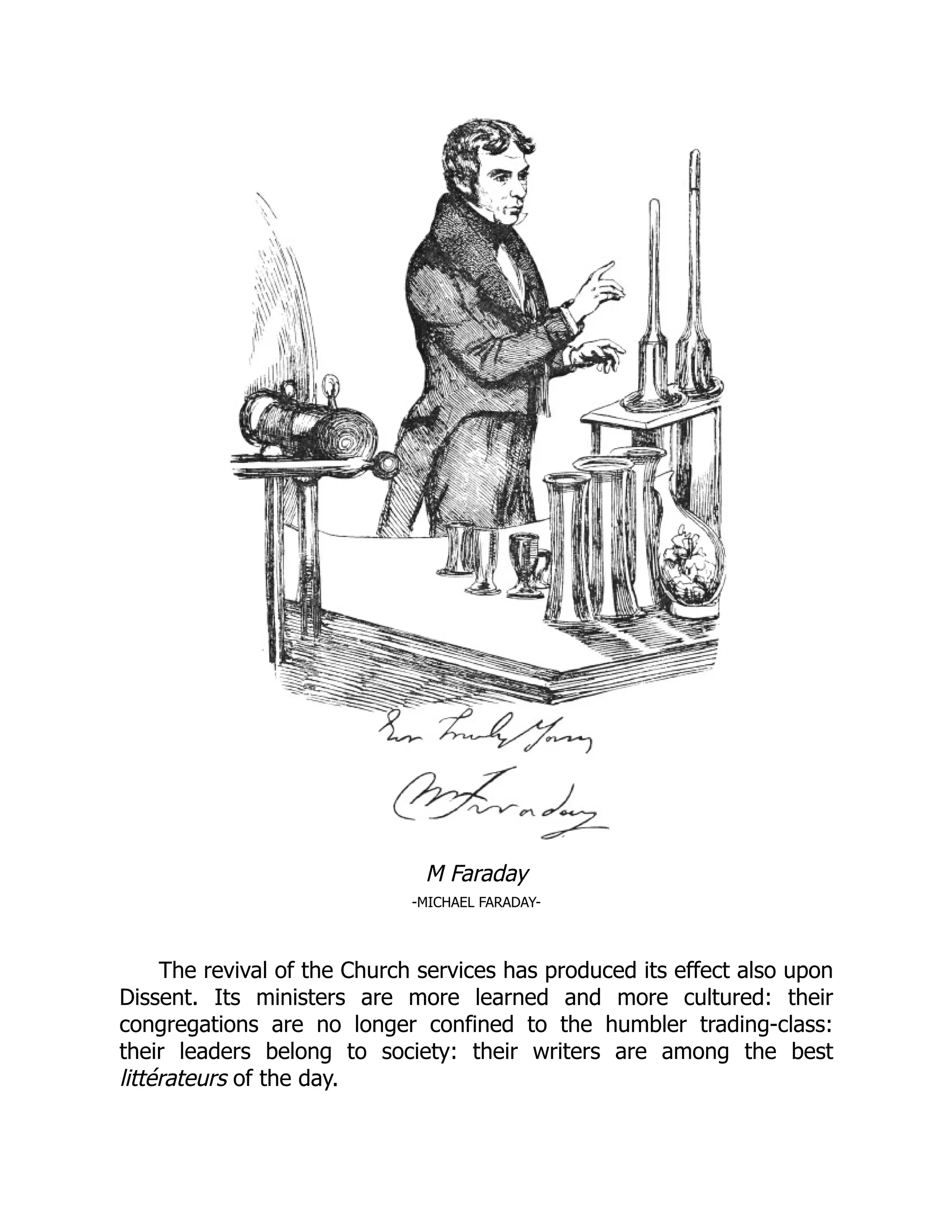
M Faraday
-MICHAEL FARADAY-
The revival of the Church services has produced its effect also upon
Dissent. Its ministers are more learned and more cultured: their
congregations are no longer confined to the humbler trading-class:
their leaders belong to society: their writers are among the best
littérateurs of the day.
That the science of warfare, by sea and land, has also changed, is
a doubtful advantage. Yet wars are short, which is, in itself, an
immeasurable gain. The thin red line will be seen no more: nor the
splendid great man-o’-war, with a hundred guns and a crew of a
thousand men.
The Universities, which, fifty years ago, belonged wholly to the
Church, are now thrown open. The Fellowships and Scholarships of the
Colleges were then mostly appropriated: they are now free, and the
range of studies has been immensely widened.
As for the advance in physical and medical science I am not
qualified to speak. But everybody knows that it has been enormous:
while, in surgery, the discovery of anæsthetics has removed from life
one of its most appalling horrors.
In literature, though new generations of writers have appeared and
passed away, we have still with us the two great poets who, fifty years
ago, had already begun their work. The Victorian era can boast of such
names as Carlyle, Macaulay, Thackeray, Dickens, Tennyson, and
Browning, in the first rank of men of letters; those of Darwin, Faraday,
and Huxley in science. Besides these there has been an immense
crowd of men and women who belong to the respectable second rank—
to enumerate whom would take pages. Who can say if any of them will
live beyond the century, and if any will be remembered in a hundred
years?
We have all grown richer, much richer. ‘The poor,’ says Mr. George,
‘have grown poorer.’ That is most distinctly and emphatically untrue.
Nothing could be more untrue. The poor—that is to say, the working
classes—have grown distinctly better off. They are better housed; they
are better fed; they are more cheaply fed; they are better dressed;
they have a thousand luxuries to which they were formerly strangers;
their children are educated; in most great towns they have free
libraries; they have their own clubs; they are at liberty to combine and
to hold public meetings; they have the Post Office Savings Bank; and,
as for political power, they have all the power there is, because you
cannot give any man more than his vote.
Formerly they demanded the Six Points of the Charter, and thought
that universal happiness would follow on their acquisition. We have
now got most of the Six Points, and we do not care much about the
rest. Yet happiness is not by any means universal. Some there are who
still think that by more tinkering of the machinery the happiness of the
people will be assured. Others there are who consider that political and
social wisdom, on the possession of which by our rulers the welfare of
the people does mainly depend, is outside and independent of the
machinery.
Is it nothing, again, that the people have found out their own
country? Formerly their lives were spent wholly in the place where they
were born; they knew no other. Now the railways carry them cheaply
everywhere. In one small town of Lancashire the factory-hands alone
spend 30,000l. a year in excursions. The railways, far more than the
possession of a vote, had given the people a knowledge of their
strength.
The civil service of the country is no longer in the patronage of the
Government. There are few spoils left to the victors; there are no
sinecures left; except in the Crown Colonies, there are few places to be
given away. It is, however, very instructive to remark that, wherever
there is a place to be given away, it is invariably, just as of old, and
without the least difference of party, whether Conservatives or Liberals
are in power, filled up by jobbery, favouritism, and private interest.
You have been told how they have introduced vast reforms in Law.
Prisons for debt have been abolished; yet men are still imprisoned for
debt. Happily I know little about the administration of Law. Some time
ago, however, I was indirectly interested in an action in the High Court
of Justice, the conduct and result of which gave me much food for
reflection. It was an action for quite a small sum of money. Yet a year
and a half elapsed between the commencement of the action and its
hearing. The verdict carried costs. The costs amounted to three times
the sum awarded to the plaintiff. That seems to be a delightful
condition of things when you cannot get justice to listen to you for a
year and a half, and when it may cost a defendant three times the
amount disputed in order to defend what he knows—though his
counsel may fail to make a jury understand the case—to be just and
right. I humbly submit, as the next reform in Law, that Justice shall
have no holidays, so as to expedite actions, and that the verdict shall in
no case carry costs, so as to cheapen them.
As for our recreations, we no longer bawl comic songs at taverns,
and there is no Vauxhall. On the other hand, the music-hall is certainly
no improvement on the tavern; the ‘Colonies’ was perhaps a more
respectable Vauxhall; the comic opera may be better than the old
extravaganza, but I am not certain that it is; there are the Crystal
Palace, the Aquarium, and the Albert Hall also in place of Vauxhall; and
there are outdoor amusements unknown fifty years ago—lawn tennis,
cycling, rowing, and athletics of all kinds.
There has been a great upward movement of the professional
class. New professions have come into existence, and the old
professions are more esteemed. It was formerly a poor and beggarly
thing to belong to any other than the three learned professions; a
barrister would not shake hands with a solicitor, a Nonconformist
minister was not met in any society. Artists, writers, journalists, were
considered Bohemians. The teaching of anything was held in contempt;
to become a teacher was a confession of the direst poverty—there
were thousands of poor girls eating out their hearts because they had
to ‘go out’ as governesses. There were no High Schools for girls; there
were no colleges for them.
Slavery has gone. There are now no slaves in Christendom, save in
the island of Cuba. Fifty years ago an American went mad if you threw
in his teeth the ‘Institution;’ either he defended it with zeal, or else he
charged England with having introduced it into the country: in the
Southern States it was as much as a man’s life was worth to say a word
against it; travellers went South on purpose that they might see slaves
put up to auction, mothers parted from their children, and all the stock
horrors. Then they came home and wrote about it, and held up their
hands and cried, ‘Oh, isn’t it dreadful?’ The negro slavery is gone, and
now there is only left the slavery of the women who work. When will
that go too? And how can it be swept away?
Public executions gone: pillory gone—the last man pilloried was in
the year 1830: no more flogging in the army: the Factory Acts passed:
all these are great gains. A greater is the growth of sympathy with all
those who suffer, whether wrongfully or by misfortune, or through their
own misdoings. This growth of sympathy is due especially to the works
of certain novelists belonging to the Victorian age. It is producing all
kinds of good works—the unselfish devotion of men and women to
work among the poor: teaching of every description: philanthropy
which does not stop short with the cheque: charity which is organized:
measures for prevention: support of hospitals and convalescent homes:
the introduction of Art and Music to the working classes.
All these changes seem to be gains. Have there been no losses?
In the nature of things there could not fail to be losses. Some of
the old politeness has been lost, though there are still men with the
fine manners of our grandfathers: the example of the women who
speak, who write, who belong to professions, and are, generally,
aggressive, threatens to change the manners of all women: they have
already become more assured, more self-reliant, less deferent to men’s
opinion—the old deference of men to women was, of course, merely
conventional. They no longer dread the necessity of working for
themselves; they plunge boldly into the arena prepared to meet with
no consideration on the score of sex. If a woman writes a bad book, for
instance, no critic hesitates to pronounce it bad because a woman has
written it. Whatever work man does woman tries to do. They boldly
deny any inferiority of intellect, though no woman has ever produced
any work which puts her anywhere near the highest intellectual level.
They claim a complete equality which they have hitherto failed to
prove. Some of them even secretly whisper of natural superiority. They
demand their vote. Perhaps, before long, they will be in both Houses,
and then man will be speedily relegated to his proper place, which will
be that of the executive servant. Oh! happy, happy time!
It is said that we have lost the old leisure of life. As for that, and
the supposed drive and hurry of modern life, I do not believe in it. That
is to say, the competition is fierce and the struggle hard. But these are
no new things. It is a commonplace to talk of the leisure and calm of
the eighteenth century—it cannot be too often repeated that in 1837
we were still in that century—I declare that in all my reading about
social life in the eighteenth century I have failed to discover that
leisure. From Queen Anne to Queen Victoria I have searched for it, and
I cannot find it. The leisure of the eighteenth century exists, in fact,
only in the brain of painter and poet. Life was hard; labour was
incessant, and lasted the whole day long; the shopmen lived in the
shop—they even slept in it; the mill people worked all day long and far
into the night. If I look about the country, I see in town and village the
poor man oppressed and driven by his employer: I see the labourer in
a blind revenge setting fire to the ricks; I see the factory hand
destroying the machinery; I see everywhere discontent, poverty,
privilege, patronage, and profligacy; I hear the shrieks of the wretches
flogged at the cart tail, the screams of the women flogged at Bridewell.
I see the white faces of the poor creatures brought out to be hung up
in rows for stealing bread; I see the fighting of the press-gang; I see
the soldiers and sailors flogged into sullen obedience; I see hatred of
the Church, hatred of the governing class, hatred of the rich, hatred of
employers—where, with all these things, is there room for leisure?
Leisure means peace, contentment, plenty, wealth, and ease. What
peace, what contentment was there in those days?
The decay of the great agricultural interest is a calamity which has
been coming upon us slowly, though with a continually accelerated
movement. This is the reason, I suppose, why the country regards it
with so strange an apathy. It is not only that the landlords are rapidly
encountering ruin, that the farmers are losing all their capital, and that
labourers are daily turned out of work and driven away to the great
towns; the very existence of the country towns is threatened; the
investments which depend on rent and estates are threatened; colleges
and charities are losing their endowments; worst of all, the rustic, the
backbone and support of the country, who has always supplied all our
armies with all our soldiers, is fast disappearing from the land. I
confess that, if something does not happen to stay the ruin of
agriculture in these Islands, I think the end of their greatness will not
be far off. Perhaps I think and speak as a fool; but it seems to me that
a cheap loaf is dearly bought if, among other blessings, it deprives the
countryside of its village folk, strong and healthy, and the empire of its
stalwart soldiers. As for the House of Lords and the English aristocracy,
they cannot survive the day when the farms cannot even support the
hands that till the soil, and are left untilled and uncultivated.
* * * * *
There are, to make an end, two changes especially for which we
can never be sufficiently thankful. The first is the decay of the old
Calvinism; that gone, the chief terror of life is gone too; the chief sting
of death is gone; the terrible, awful question which reasoning man
could not refrain from asking is gone too.
The second change is the transference of the power to the people.
All the power that there is we have given to the people, who are now
waiting for a prophet to teach them how best to use it. I trust I am
under no illusions; Democracy has many dangers and many evils; but
these seem to me not so bad as those others which we have shaken
off. One must not expect a Millennium; mistakes will doubtless be
committed, and those bad ones. Besides, a change in the machinery
does not change the people who run that machinery. There will be the
tyranny of the Caucus to be faced and trampled down; we must
endure, with all his vices and his demagogic arts, the professional
politician whose existence depends on his party; we must expect—and
ceaselessly fight against—bribery and wholesale corruption when a
class of these professional politicians, poor, unscrupulous, and
grasping, will be continually, by every evil art, by every lying statement,
by every creeping baseness, endeavouring to climb unto power—such
there are already among us; we shall have to awaken from apathy, and
keep awake, those who are anxious to avoid the arena of politics, yet,
by education, position, and natural abilities, are called upon to lead. Yet
who, even in the face of the certain dangers, the certain mistakes, of
Democracy, shall say that great, terrible, and most disastrous mistakes
have not been made by an Aristocracy? There is always hope where
there is freedom; let us trust in the common-sense of the nation, and
remain steadfast in that trust.
VALUABLE AND INTERESTING WORKS
FOR
PUBLIC & PRIVATE LIBRARIES,
Published by HARPER & BROTHERS, New York.
☛ For a full List of Books suitable for Libraries published by Harper &
Brothers, see Harper’s Catalogue, which may be had gratuitously
on application to the publishers personally, or by letter enclosing
Ten Cents in postage stamps.
☛ Harper & Brothers will send their publications by mail, postage
prepaid, on receipt of the price.
MACAULAY’S ENGLAND. The History of England from the
Accession of James II. By Thomas Babington Macaulay.
New Edition, from New Electrotype Plates. 5 vols., in
a Box, 8vo, Cloth, with Paper Labels, Uncut Edges
and Gilt Tops, $10 00; Sheep, $12 50; Half Calf, $21
25. Sold only in Sets. Cheap Edition, 5 vols., 12mo,
Cloth, $2 50.
MACAULAY’S MISCELLANEOUS WORKS. The
Miscellaneous Works of Lord Macaulay. From New
Electrotype Plates. 5 vols., in a Box, 8vo, Cloth, with
Paper Labels, Uncut Edges and Gilt Tops, $10 00;
Sheep, $12 50; Half Calf, $21 25. Sold only in Sets.
HUME’S ENGLAND. History of England, from the Invasion
of Julius Cæsar to the Abdication of James II., 1688.
By David Hume. New and Elegant Library Edition, from
New Electrotype Plates. 6 vols., in a Box. 8vo, Cloth,
with Paper Labels, Uncut Edges and Gilt Tops, $12
00; Sheep, $15 00; Half Calf, $25 50. Sold only in
Sets. Popular Edition, 6 vols., in a Box, 12mo, Cloth,
$3 00.
GIBBON’S ROME. The History of the Decline and Fall of
the Roman Empire. By Edward Gibbon. With Notes by
Dean Milman, M. Guizot, and Dr. William Smith. New
Edition, from New Electrotype Plates. 6 vols., 8vo,
Cloth, with Paper Labels, Uncut Edges and Gilt Tops,
$12 00; Sheep, $15 00; Half Calf, $25 50. Sold only
in Sets. Popular Edition, 6 vols., in a Box, 12mo,
Cloth, $3 00; Sheep, $6 00.
GOLDSMITH’S WORKS. The Works of Oliver Goldsmith.
Edited by Peter Cunningham, F.S.A. From New
Electrotype Plates. 4 vols., 8vo, Cloth, Paper Labels,
Uncut Edges and Gilt Tops, $8 00; Sheep, $10 00;
Half Calf, $17 00.
MOTLEY’S LETTERS. The Correspondence of John
Lothrop Motley, D.C.L., Author of “The United
Netherlands,” “John of Barneveld,” “The Rise of the
Dutch Republic,” etc. Edited by George William Curtis.
With Portrait. Two Volumes, 8vo, Cloth.
MOTLEY’S DUTCH REPUBLIC. The Rise of the Dutch
Republic. A History. By John Lothrop Motley, LL.D.,
D.C.L. With a Portrait of William of Orange. Cheap
Edition, 3 vols., in a Box, 8vo, Cloth, with Paper
Labels, Uncut Edges and Gilt Tops, $6 00; Sheep, $7
50; Half Calf, $12 75. Sold only in Sets. Original
Library Edition, 3 vols., 8vo, Cloth, $10 50.
MOTLEY’S UNITED NETHERLANDS. History of the United
Netherlands: From the Death of William the Silent to
the Twelve Years’ Truce—1584–1609. With a full
View of the English-Dutch Struggle against Spain,
and of the Origin and Destruction of the Spanish
Armada. By John Lothrop Motley, LL.D., D.C.L.
Portraits. Cheap Edition, 4 vols., in a Box, 8vo, Cloth,
with Paper Labels, Uncut Edges and Gilt Tops, $8 00;
Sheep, $10 00; Half Calf, $17 00. Sold only in Sets.
Original Library Edition, 4 vols., 8vo, Cloth, $14 00.
MOTLEY’S JOHN OF BARNEVELD. The Life and Death of
John of Barneveld, Advocate of Holland. With a View
of the Primary Causes and Movements of the “Thirty
Years’ War.” By John Lothrop Motley, LL.D., D.C.L.
Illustrated. Cheap Edition, 2 vols., in a Box, 8vo,
Cloth, with Paper Labels, Uncut Edges and Gilt Tops,
$4 00; Sheep, $5 00; Half Calf, $8 50. Sold only in
Sets. Original Library Edition, 2 vols., 8vo, Cloth, $7
00.
HILDRETH’S UNITED STATES. History of the United
States. First Series: From the Discovery of the
Continent to the Organization of the Government
under the Federal Constitution. Second Series: From
the Adoption of the Federal Constitution to the End
of the Sixteenth Congress. By Richard Hildreth.
Popular Edition, 6 vols., in a Box, 8vo, Cloth, with
Paper Labels, Uncut Edges and Gilt Tops, $12 00;
Sheep, $15 00; Half Calf, $25 50. Sold only in Sets.
TREVELYAN’S LIFE OF MACAULAY. The Life and Letters of
Lord Macaulay. By his Nephew, G. Otto Trevelyan,
M.P. With Portrait on Steel. 2 vols., 8vo, Cloth, Uncut
Edges and Gilt Tops, $5 00; Sheep, $6 00; Half Calf,
$9 50. Popular Edition, 2 vols. in one, 12mo, Cloth,
$1 75.
TREVELYAN’S LIFE OF FOX. The Early History of Charles
James Fox. By George Otto Trevelyan. 8vo, Cloth,
Uncut Edges and Gilt Tops, $2 50; Half Calf, $4 75.
WRITINGS AND SPEECHES OF SAMUEL J. TILDEN.
Edited by John Bigelow. 2 vols., 8vo, Cloth, Gilt Tops
and Uncut Edges, $6 00 per set.
GENERAL DIX’S MEMOIRS. Memoirs of John Adams Dix.
Compiled by his Son, Morgan Dix. With Five Steel-
plate Portraits. 2 vols, 8vo, Cloth, Gilt Tops and
Uncut Edges, $5 00.
HUNT’S MEMOIR OF MRS. LIVINGSTON. A Memoir of
Mrs. Edward Livingston. With Letters hitherto
Unpublished. By Louise Livingston Hunt. 12mo, Cloth,
$1 25.
GEORGE ELIOT’S LIFE. George Eliot’s Life, Related in her
Letters and Journals. Arranged and Edited by her
Husband, J. W. Cross. Portraits and Illustrations. In
Three Volumes. 12mo, Cloth, $3 75. New Edition,
with Fresh Matter. (Uniform with “Harper’s Library
Edition” of George Eliot’s Works.)
PEARS’S FALL OF CONSTANTINOPLE. The Fall of
Constantinople. Being the Story of the Fourth
Crusade. By Edwin Pears, LL.B. 8vo, Cloth, $2 50.
RANKE’S UNIVERSAL HISTORY. The Oldest Historical
Group of Nations and the Greeks. By Leopold von
Ranke. Edited by G. W. Prothero, Fellow and Tutor of
King’s College, Cambridge. Vol. I. 8vo, Cloth, $2 50.
LIFE AND TIMES OF THE REV. SYDNEY SMITH. A Sketch
of the Life and Times of the Rev. Sydney Smith.
Based on Family Documents and the Recollections of
Personal Friends. By Stuart J. Reid. With Steel-plate
Portrait and Illustrations. 8vo, Cloth, $3 00.
STORMONTH’S ENGLISH DICTIONARY. A Dictionary of
the English Language, Pronouncing, Etymological,
and Explanatory: embracing Scientific and other
Terms, Numerous Familiar Terms, and a Copious
Selection of Old English Words. By the Rev. James
Stormonth. The Pronunciation Revised by the Rev.
P. H. Phelp, M.A. Imperial 8vo, Cloth, $6 00; Half
Roan, $7 00; Full Sheep, $7 50. (New Edition.)
PARTON’S CARICATURE. Caricature and Other Comic Art,
in All Times and Many Lands. By James Parton. 203
Illustrations. 8vo, Cloth, Uncut Edges and Gilt Tops,
$5 00; Half Calf, $7 25.
DU CHAILLU’S LAND OF THE MIDNIGHT SUN. Summer
and Winter Journeys in Sweden, Norway, Lapland,
and Northern Finland. By Paul B. Du Chaillu.
Illustrated. 2 vols., 8vo, Cloth, $7 50; Half Calf, $12
00.
LOSSING’S CYCLOPÆDIA OF UNITED STATES HISTORY.
From the Aboriginal Period to 1876. By B. J. Lossing,
LL.D. Illustrated by 2 Steel Portraits and over 1000
Engravings. 2 vols., Royal 8vo, Cloth, $10 00; Sheep,
$12 00; Half Morocco, $15 00. (Sold by Subscription
only.)
LOSSING’S FIELD-BOOK OF THE REVOLUTION. Pictorial
Field-Book of the Revolution; or, Illustrations by Pen
and Pencil of the History, Biography, Scenery, Relics,
and Traditions of the War for Independence. By
Benson J. Lossing. 2 vols., 8vo, Cloth, $14 00; Sheep
or Roan, $15 00; Half Calf, $18 00.
LOSSING’S FIELD-BOOK OF THE WAR OF 1812. Pictorial
Field-Book of the War of 1812; or, Illustrations by
Pen and Pencil of the History, Biography, Scenery,
Relics, and Traditions of the last War for American
Independence. By Benson J. Lossing. With several
hundred Engravings. 1088 pages, 8vo, Cloth, $7 00;
Sheep or Roan, $8 50; Half Calf, $10 00.
MÜLLER’S POLITICAL HISTORY OF RECENT TIMES
(1816–1875). With Special Reference to Germany.
By William Müller. Translated, with an Appendix
covering the Period from 1876 to 1881, by the Rev.
John P. Peters, Ph.D. 12mo, Cloth, $3 00.
STANLEY’S THROUGH THE DARK CONTINENT. Through
the Dark Continent; or, The Sources of the Nile,
Around the Great Lakes of Equatorial Africa, and
Down the Livingstone River to the Atlantic Ocean.
149 Illustrations and 10 Maps. By H. M. Stanley. 2
vols., 8vo, Cloth, $10 00; Sheep, $12 00; Half
Morocco, $15 00.
STANLEY’S CONGO. The Congo and the Founding of its
Free State, a Story of Work and Exploration. With
over One Hundred Full-page and smaller
Illustrations, Two Large Maps, and several smaller
ones. By H. M. Stanley. 2 vols., 8vo, Cloth, $10 00;
Sheep, $12 00; Half Morocco, $15 00.
GREEN’S ENGLISH PEOPLE. History of the English People.
By John Richard Green, M.A. With Maps. 4 vols., 8vo,
Cloth, $10 00; Sheep, $12 00; Half Calf, $19 00.
GREEN’S MAKING OF ENGLAND. The Making of England.
By John Richard Green. With Maps. 8vo, Cloth, $2 50;
Sheep, $3 00; Half Calf, $3 75.
GREEN’S CONQUEST OF ENGLAND. The Conquest of
England. By John Richard Green. With Maps. 8vo,
Cloth, $2 50; Sheep, $3 00; Half Calf, $3 75.
ENGLISH MEN OF LETTERS. Edited by John Morley.
The following volumes are now ready. Others will
follow:
Johnson. By L. Stephen.—Gibbon. By J. C. Morison.—Scott. By
R. H. Hutton.—Shelley. By J. A. Symonds.—Goldsmith. By W.
Black.—Hume. By Professor Huxley.—Defoe. By W. Minto.—Burns.
By Principal Shairp.—Spenser. By R. W. Church.—Thackeray. By A.
Trollope.—Burke. By J. Morley.—Milton. By M. Pattison.—Southey.
By E. Dowden.—Chaucer. By A. W. Ward.—Bunyan. By J. A.
Froude.—Cowper. By G. Smith.—Pope. By L. Stephen.—Byron. By
J. Nichols.—Locke. By T. Fowler.—Wordsworth. By F. W. H. Myers.
—Hawthorne. By Henry James, Jr.—Dryden. By G. Saintsbury.—
Landor. By S. Colvin.—De Quincey. By D. Masson.—Lamb. By A.
Ainger.—Bentley. By R. C. Jebb.—Dickens. By A. W. Ward.—Gray.
By E. W. Gosse.—Swift. By L. Stephen.—Sterne. By H. D. Traill.—
Macaulay. By J. C. Morison.—Fielding. By A. Dobson.—Sheridan. By
Mrs. Oliphant.—Addison. By W. J. Courthope.—Bacon. By R. W.
Church.—Coleridge. By H. D. Traill.—Sir Philip Sidney. By J. A.
Symonds.—Keats. By Sidney Colvin. 12mo, Cloth, 75 cents per
volume.
Popular Edition, 36 volumes in 12, $12 00.
REBER’S HISTORY OF ANCIENT ART. History of Ancient
Art.
By Dr. Franz von Reber. Revised by the Author. Translated
and Augmented by Joseph Thacher Clarke. With 310
Illustrations and a Glossary of Technical Terms. 8vo,
Cloth, $3 50.
REBER’S MEDIÆVAL ART. History of Mediæval Art. By Dr.
Franz von Reber. Translated and Augmented by
Joseph Thacher Clarke. With 422 Illustrations, and a
Glossary of Technical Terms. 8vo, Cloth, $5 00.
NEWCOMB’S ASTRONOMY. Popular Astronomy. By Simon
Newcomb, LL.D. With 112 Engravings, and 5 Maps of
the Stars. 8vo, Cloth, $2 50; School Edition, 12mo,
Cloth, $1 30.
DAVIS’S INTERNATIONAL LAW. Outlines of International
Law, with an Account of its Origin and Sources, and
of its Historical Development. By Geo. B. Davis,
U.S.A., Assistant Professor of Law at the United
States Military Academy. Crown 8vo, Cloth, $2 00.
CESNOLA’S CYPRUS. Cyprus: its Ancient Cities, Tombs,
and Temples. A Narrative of Researches and
Excavations during Ten Years’ Residence in that
Island. By L. P. di Cesnola. With Portrait, Maps, and
400 Illustrations. 8vo, Cloth, Extra, Uncut Edges and
Gilt Tops, $7 50; Half Calf, $10 00.
TENNYSON’S COMPLETE POEMS. The Complete Poetical
Works of Alfred, Lord Tennyson. With an
Introductory Sketch by Anne Thackeray Ritchie. With
Portraits and Illustrations. 8vo, Extra Cloth, Bevelled,
Gilt Edges, $2 50.
LEA’S HISTORY OF THE INQUISITION. History of the
Inquisition of the Middle Ages. By Henry Charles Lea.
Three Volumes. 8vo, Cloth, Uncut Edges and Gilt
Tops, $3 00 per volume.
GROTE’S HISTORY OF GREECE. 12 vols., 12mo, Cloth,
$18 00; Sheep, $22 80; Half Calf, $39 00.
FLAMMARION’S ATMOSPHERE. Translated from the
French of Camille Flammarion. With 10 Chromo-
Lithographs and 86 Wood-cuts. 8vo, Cloth, $6 00;
Half Calf, $8 25.
BAKER’S ISMAÏLIA: a Narrative of the Expedition to
Central Africa for the Suppression of the Slave-trade,
organized by Ismaïl, Khedive of Egypt. By Sir Samuel
W. Baker. With Maps, Portraits, and Illustrations. 8vo,
Cloth, $5 00; Half Calf, $7 25.
LIVINGSTONE’S ZAMBESI. Narrative of an Expedition to
the Zambesi and its Tributaries, and of the Discovery
of the Lakes Shirwa and Nyassa, 1858 to 1864. By
David and Charles Livingstone. Ill’d. 8vo, Cloth, $5 00;
Sheep, $5 50; Half Calf, $7 25.
LIVINGSTONE’S LAST JOURNALS. The Last Journals of
David Livingstone, in Central Africa, from 1865 to his
Death. Continued by a Narrative of his Last
Moments, obtained from his Faithful Servants Chuma
and Susi. By Horace Waller. With Portrait, Maps, and
Illustrations. 8vo, Cloth, $5 00; Sheep, $6 00.
CHARNAY’S ANCIENT CITIES OF THE NEW WORLD. The
Ancient Cities of the New World: Being Voyages and
Explorations in Mexico and Central America, from
1857 to 1882. By Désiré Charnay. Translated by J.
Gonino and Helen S. Conant. Illustrations and Map.
Royal 8vo, Ornamental Cloth, Uncut Edges, Gilt Tops,
$6 00.
“THE FRIENDLY EDITION” of Shakespeare’s Works.
Edited by W. J. Rolfe. In 20 vols. Illustrated. 16mo,
Gilt Tops and Uncut Edges, Sheets, $27 00; Cloth,
$30 00; Half Calf, $60 00 per Set.
GIESELER’S ECCLESIASTICAL HISTORY. A Text-Book of
Church History. By Dr. John C. L. Gieseler. Translated
from the Fourth Revised German Edition. Revised
and Edited by Rev. Henry B. Smith, D.D. Vols. I., II.,
III., and IV., 8vo, Cloth, $2 25 each; Vol. V., 8vo,
Cloth, $3 00. Complete Sets, 5 vols., Sheep, $14 50;
Half Calf, $23 25.
CURTIS’S LIFE OF BUCHANAN. Life of James Buchanan,
Fifteenth President of the United States. By George
Ticknor Curtis. With Two Steel Plate Portraits. 2 vols.,
8vo, Cloth, Uncut Edges and Gilt Tops, $6 00.
COLERIDGE’S WORKS. The Complete Works of Samuel
Taylor Coleridge. With an Introductory Essay upon
his Philosophical and Theological Opinions. Edited by
Professor W. G. T. Shedd. With Steel Portrait, and an
Index. 7 vols., 12mo, Cloth, $2 00 per volume; $12
00 per set; Half Calf, $24 25.
Transcriber’s Notes
Punctuation and spelling were made consistent when
a predominant preference was found in this book;
otherwise they were not changed.
Simple typographical errors were corrected;
occasional unbalanced quotation marks retained.
Ambiguous hyphens at the ends of lines were
retained; occurrences of inconsistent hyphenation have
not been changed.
Illustrations have been moved to appear between
paragraphs. In versions of this eBook that support links,
the List of Illustrations links to the correct images, not
necessarily to the listed page numbers.
The printed captions of illustrations usually are
shown here in upper-case, as they were in the original
book. Some illustrations bore signatures, rather than
printed captions; those are shown here in lower-case,
followed by the full names, taken from the List of
Illustrations.
Many captions in the original book did not exactly
match the words in the List of Illustrations; those
differences have been retained here.
The symbols in the lists of books at the beginning
and end of this eBooks are right-pointing hands.
*** END OF THE PROJECT GUTENBERG EBOOK FIFTY YEARS AGO
***
Updated editions will replace the previous one—the old editions
will be renamed.
Creating the works from print editions not protected by U.S.
copyright law means that no one owns a United States
copyright in these works, so the Foundation (and you!) can copy
and distribute it in the United States without permission and
without paying copyright royalties. Special rules, set forth in the
General Terms of Use part of this license, apply to copying and
distributing Project Gutenberg™ electronic works to protect the
PROJECT GUTENBERG™ concept and trademark. Project
Gutenberg is a registered trademark, and may not be used if
you charge for an eBook, except by following the terms of the
trademark license, including paying royalties for use of the
Project Gutenberg trademark. If you do not charge anything for
copies of this eBook, complying with the trademark license is
very easy. You may use this eBook for nearly any purpose such
as creation of derivative works, reports, performances and
research. Project Gutenberg eBooks may be modified and
printed and given away—you may do practically ANYTHING in
the United States with eBooks not protected by U.S. copyright
law. Redistribution is subject to the trademark license, especially
commercial redistribution.
START: FULL LICENSE
THE FULL PROJECT GUTENBERG LICENSE
Welcome to our website – the perfect destination for book lovers and
knowledge seekers. We believe that every book holds a new world,
offering opportunities for learning, discovery, and personal growth.
That’s why we are dedicated to bringing you a diverse collection of
books, ranging from classic literature and specialized publications to
self-development guides and children's books.
More than just a book-buying platform, we strive to be a bridge
connecting you with timeless cultural and intellectual values. With an
elegant, user-friendly interface and a smart search system, you can
quickly find the books that best suit your interests. Additionally,
our special promotions and home delivery services help you save time
and fully enjoy the joy of reading.
Join us on a journey of knowledge exploration, passion nurturing, and
personal growth every day!
testbankbell.com

Crafting and Executing Strategy Concepts and Readings Thompson 19th Edition Solutions Manual

  • 1.
    Download the fullversion and explore a variety of test banks or solution manuals at https://testbankbell.com Crafting and Executing Strategy Concepts and Readings Thompson 19th Edition Solutions Manual _____ Follow the link below to get your download now _____ http://testbankbell.com/product/crafting-and-executing- strategy-concepts-and-readings-thompson-19th-edition- solutions-manual/ Access testbankbell.com now to download high-quality test banks or solution manuals

  • 2.
    We have selectedsome products that you may be interested in Click the link to download now or visit testbankbell.com for more options!. Crafting and Executing Strategy Concepts and Readings Thompson 19th Edition Test Bank http://testbankbell.com/product/crafting-and-executing-strategy- concepts-and-readings-thompson-19th-edition-test-bank/ Test Bank for Crafting and Executing Strategy 19th Edition by Thompson http://testbankbell.com/product/test-bank-for-crafting-and-executing- strategy-19th-edition-by-thompson/ Solution Manual for Crafting and Executing Strategy Concepts and Cases 22th by Thompson http://testbankbell.com/product/solution-manual-for-crafting-and- executing-strategy-concepts-and-cases-22th-by-thompson/ Test Bank for Selling Today: Partnering to Create Value, 14th Edition Gerald L. Manning http://testbankbell.com/product/test-bank-for-selling-today- partnering-to-create-value-14th-edition-gerald-l-manning/
  • 3.
    Solution Manual forHuman Relations: Interpersonal, Job- Oriented Skills, Fourth Canadian Edition, 4/E 4th Edition Andrew J. DuBrin, Terri M. Geerinck http://testbankbell.com/product/solution-manual-for-human-relations- interpersonal-job-oriented-skills-fourth-canadian-edition-4-e-4th- edition-andrew-j-dubrin-terri-m-geerinck/ Test Bank for Human Development A Life-Span View, 5th Edition: Kail http://testbankbell.com/product/test-bank-for-human-development-a- life-span-view-5th-edition-kail/ Solution Manual for Campbell Essential Biology with Physiology 4th Edition by Simon http://testbankbell.com/product/solution-manual-for-campbell- essential-biology-with-physiology-4th-edition-by-simon/ Test Bank for Technology In Action Complete 14th Edition Evans http://testbankbell.com/product/test-bank-for-technology-in-action- complete-14th-edition-evans/ Solution Manual for Macroeconomics 7th Edition Olivier Blanchard http://testbankbell.com/product/solution-manual-for- macroeconomics-7th-edition-olivier-blanchard/
  • 4.
    Test Bank forFundamentals of Corporate Finance, 2nd Edition: Parrino http://testbankbell.com/product/test-bank-for-fundamentals-of- corporate-finance-2nd-edition-parrino/
  • 5.
    Crafting and ExecutingStrategy Concepts and Readings Thompson 19th Edition Solutions Manual Full download chapter at: https://testbankbell.com/product/crafting-and- executing-strategy-concepts-and-readings-thompson-19th-edition- solutions-manual/
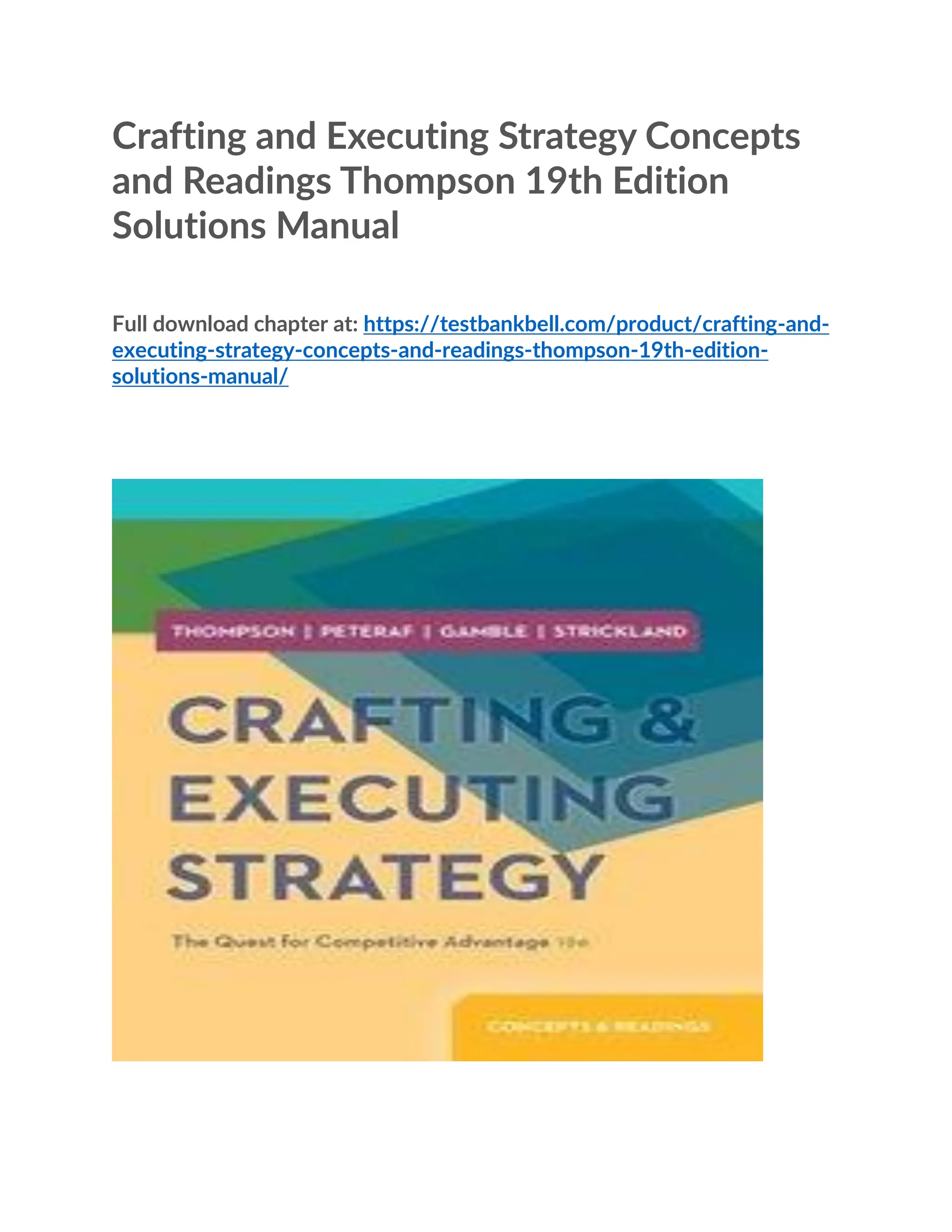
  • 6.
    1. Cover 2. Title 3.Copyright 4. Dedication 5. About the Authors 6. Preface 7. The Business Strategy Game or GLO-BUS Simulation Exercises 8. Brief Contents 9. Contents 10. Part 1: Concepts and Techniques for Crafting and Executing Strategy 11. Chapter 1 What Is Strategy and Why Is It Important? 12. What do We Mean by Strategy? 13. Strategy Is about Competing Differently 14. Strategy and the Quest for Competitive Advantage 15. Why a Company’s Strategy Evolves over Time 16. A Company’s Strategy Is Partly Proactive and Partly Reactive 17. A Company’s Strategy and Its Business Model 18. What Makes a Strategy a Winner? 19. Why Crafting and Executing Strategy are Important Tasks 20. Good Strategy + Good Strategy Execution = Good Management 21. The Road Ahead 22. Illustration Capsules 23. 1.1 Starbucks’s Strategy in the Coffeehouse Market 24. 1.2 Pandora, SiriusXM, and Over-the-Air Broadcast Radio: Three Contrasting Business Models 25. Chapter 2 Charting a Company’s Direction: Its Vision, Mission, Objectives, and Strategy 26. What does The Strategy-Making, Strategy-Executing Process Entail? 27. Stage 1: Developing a Strategic Vision, Mission Statement, and Set of Core Values 28. Developing a Strategic Vision 29. Communicating the Strategic Vision 30. Developing a Company Mission Statement 31. Linking the Vision and Mission with Company Values 32. Stage 2: Setting Objectives 33. The Imperative of Setting Stretch Objectives 34. What Kinds of Objectives to Set 35. The Need for a Balanced Approach to Objective Setting 36. Setting Objectives for Every Organizational Level 37. Stage 3: Crafting a Strategy 38. Strategy Making Involves Managers at All Organizational Levels 39. A Company’s Strategy-Making Hierarchy 40. Uniting the Strategy-Making Hierarchy 41. A Strategic Vision + Mission + Objectives + Strategy = A Strategic Plan 42. Stage 4: Executing the Strategy 43. Stage 5: Evaluating Performance and Initiating Corrective Adjustments
  • 7.
    44. Corporate Governance:The Role of The Board of Directors in the Strategy-Crafting, Strategy-Executing Process 45. Illustration Capsules 46. 2.1 Examples of Strategic Visions—How Well Do They Measure Up? 47. 2.2 Patagonia, Inc.: A Values-Driven Company 48. 2.3 Examples of Company Objectives 49. 2.4 Corporate Governance Failures at Volkswagen 50. Chapter 3 Evaluating a Company’s External Environment 51. The Strategically Relevant Factors in The Company’s Macro-Environment 52. Assessing The Company’s Industry and Competitive Environment 53. The Five Forces Framework 54. Competitive Pressures Created by the Rivalry among Competing Sellers 55. The Choice of Competitive Weapons 56. Competitive Pressures Associated with the Threat of New Entrants 57. Competitive Pressures from the Sellers of Substitute Products 58. Competitive Pressures Stemming from Supplier Bargaining Power 59. Competitive Pressures Stemming from Buyer Bargaining Power and Price Sensitivity 60. Is the Collective Strength of the Five Competitive Forces Conducive to Good Profitability? 61. Matching Company Strategy to Competitive Conditions 62. Complementors and The Value Net 63. Industry Dynamics and The Forces Driving Change 64. Identifying the Forces Driving Industry Change 65. Assessing the Impact of the Forces Driving Industry Change 66. Adjusting the Strategy to Prepare for the Impacts of Driving Forces 67. Strategic Group Analysis 68. Using Strategic Group Maps to Assess the Market Positions of Key Competitors 69. The Value of Strategic Group Maps 70. Competitor Analysis 71. Key Success Factors 72. The Industry Outlook for Profitability 73. Illustration Capsules 74. 3.1 Comparative Market Positions of Selected Companies in the Casual Dining Industry: A Strategic Group Map Example 75. Chapter 4 Evaluating a Company’s Resources, Capabilities, and Competitiveness 76. Question 1: How Well is The Company’s Present Strategy Working? 77. QUESTION 2: WHAT ARE THE COMPANY’S Most Important Resources and Capabilities, and Will They Give The Company a Lasting Competitive Advantage Over Rival Companies? 78. Identifying the Company’s Resources and Capabilities 79. Assessing the Competitive Power of a Company’s Resources and Capabilities 80. Question 3: What are The Company’s Strengths and Weaknesses in Relation to The Market Opportunities and External Threats? 81. Identifying a Company’s Internal Strengths 82. Identifying Company Weaknesses and Competitive Deficiencies 83. Identifying a Company’s Market Opportunities
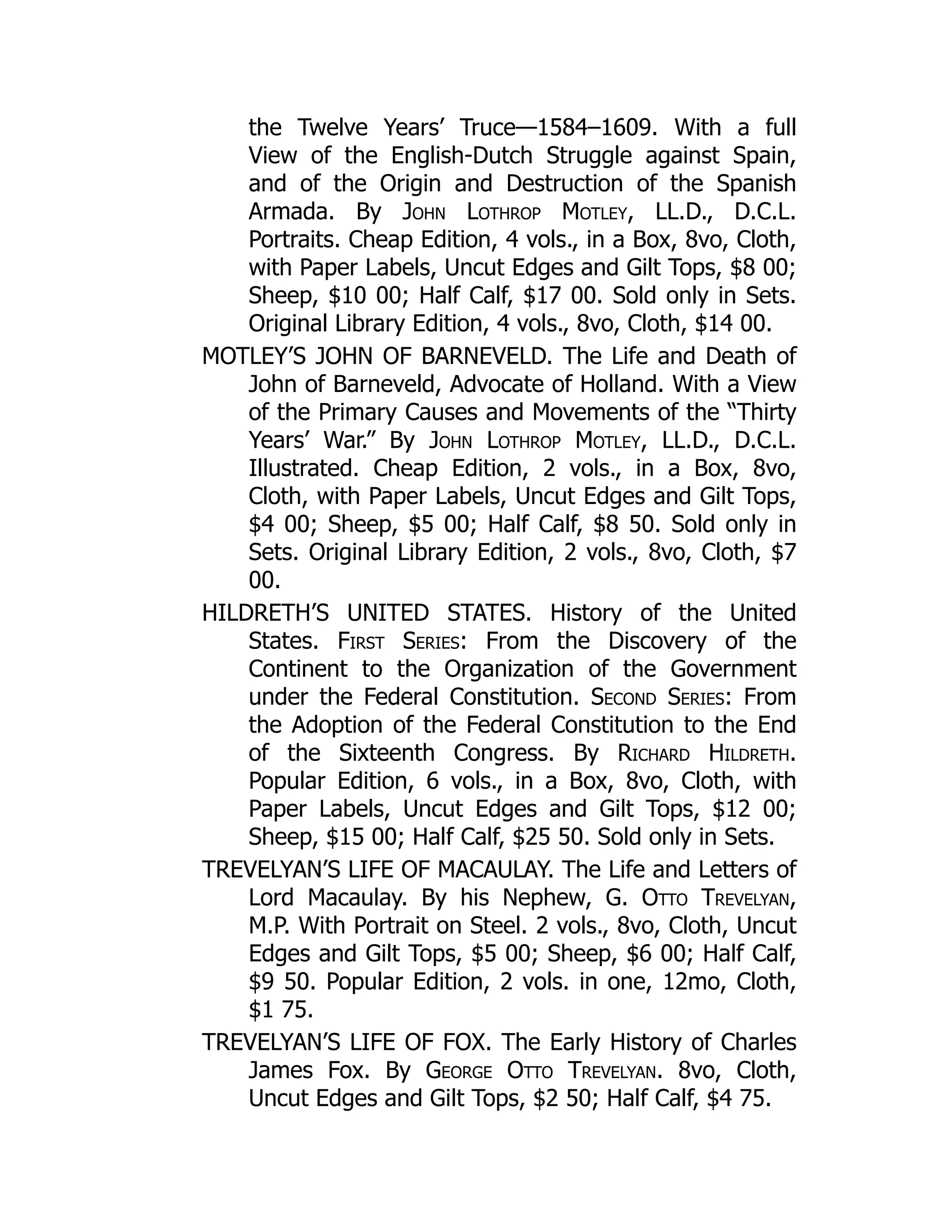
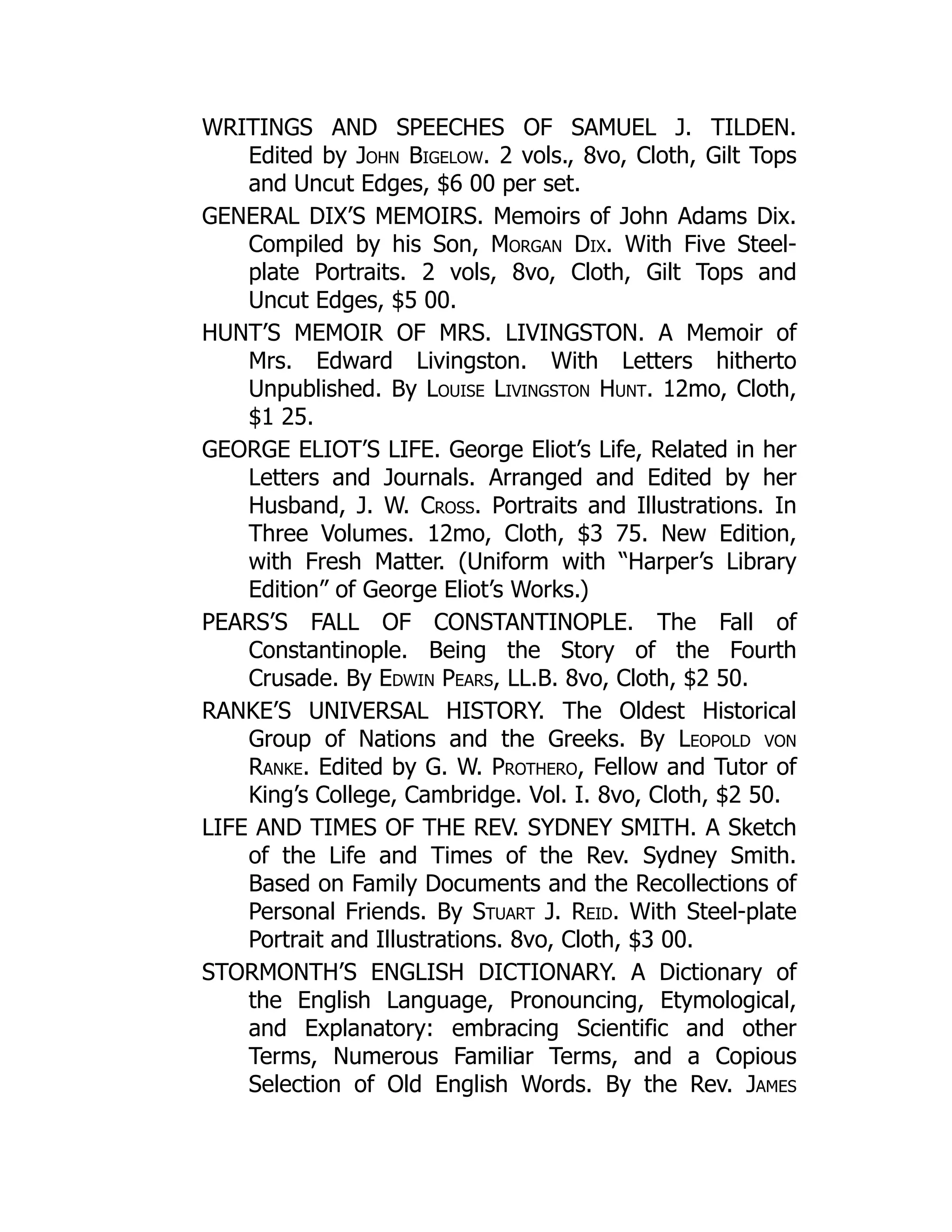
  • 8.
    84. Identifying theThreats to a Company’s Future Profitability 85. What Do the SWOT Listings Reveal? 86. Question 4: How do a Company’s Value Chain Activities Impact Its Cost Structure and Customer Value Proposition? 87. The Concept of a Company Value Chain 88. The Value Chain System 89. Benchmarking: A Tool for Assessing Whether the Costs and Effectiveness of a Company’s Value Chain Activities Are in Line 90. Strategic Options for Remedying a Cost or Value Disadvantage 91. Translating Proficient Performance of Value Chain Activities into Competitive Advantage 92. Question 5: Is the Company Competitively Stronger or Weaker Than Key Rivals? 93. Strategic Implications of Competitive Strength Assessments 94. Question 6: What Strategic Issues and Problems Merit Front-Burner Managerial Attention? 95. Illustration Capsules 96. 4.1 The Value Chain for Boll & Branch 97. 4.2 Delivered-Cost Benchmarking in the Cement Industry 98. Chapter 5 The Five Generic Competitive Strategies 99. Types of Generic Competitive Strategies 100. Low-Cost Provider Strategies 101. The Two Major Avenues for Achieving a Cost Advantage 102. The Keys to Being a Successful Low-Cost Provider 103. When a Low-Cost Provider Strategy Works Best 104. Pitfalls to Avoid in Pursuing a Low-Cost Provider Strategy 105. Broad Differentiation Strategies 106. Managing the Value Chain to Create the Differentiating Attributes 107. Delivering Superior Value via a Broad Differentiation Strategy 108. When a Differentiation Strategy Works Best 109. Pitfalls to Avoid in Pursuing a Differentiation Strategy 110. Focused (Or Market Niche) Strategies 111. A Focused Low-Cost Strategy 112. A Focused Differentiation Strategy 113. When a Focused Low-Cost or Focused Differentiation Strategy Is Attractive 114. The Risks of a Focused Low-Cost or Focused Differentiation Strategy 115. Best-Cost Provider Strategies 116. When a Best-Cost Provider Strategy Works Best 117. The Risk of a Best-Cost Provider Strategy 118. The Contrasting Features of The Five Generic Competitive Strategies: A Summary 119. Successful Competitive Strategies Are Resource-Based 120. Illustration Capsules 121. 5.1 Amazon’s Path to Becoming the Low-Cost Provider in E-commerce 122. 5.2 Clinícas del Azúcar’s Focused Low-Cost Strategy 123. 5.3 Canada Goose’s Focused Differentiation Strategy 124. 5.4 American Giant’s Best-Cost Provider Strategy
  • 9.
    125. Chapter 6Strengthening a Company’s Competitive Position: Strategic Moves, Timing, and Scope of Operations 126. Launching Strategic Offensives to Improve a Company’s Market Position 127. Choosing the Basis for Competitive Attack 128. Choosing Which Rivals to Attack 129. Blue-Ocean Strategy—a Special Kind of Offensive 130. Defensive Strategies—Protecting Market Position and Competitive Advantage 131. Blocking the Avenues Open to Challengers 132. Signaling Challengers That Retaliation Is Likely 133. Timing a Company’s Strategic Moves 134. The Potential for First-Mover Advantages 135. The Potential for Late-Mover Advantages or First-Mover Disadvantages 136. To Be a First Mover or Not 137. Strengthening a Company’s Market Position via Its Scope of Operations 138. Horizontal Merger and Acquisition Strategies 139. Why Mergers and Acquisitions Sometimes Fail to Produce Anticipated Results 140. Vertical Integration Strategies 141. The Advantages of a Vertical Integration Strategy 142. The Disadvantages of a Vertical Integration Strategy 143. Weighing the Pros and Cons of Vertical Integration 144. Outsourcing Strategies: Narrowing The Scope of Operations 145. The Risk of Outsourcing Value Chain Activities 146. Strategic Alliances and Partnerships 147. Capturing the Benefits of Strategic Alliances 148. The Drawbacks of Strategic Alliances and Partnerships 149. How to Make Strategic Alliances Work 150. Illustration Capsules 151. 6.1 Bonobos’s Blue-Ocean Strategy in the U.S. Men’s Fashion Retail Industry 152. 6.2 Uber’s First-Mover Advantage in Mobile Ride-Hailing Services 153. 6.3 Bristol-Myers Squibb’s “String-of-Pearls” Horizontal Acquisition Strategy 154. 6.4 Kaiser Permanente’s Vertical Integration Strategy 155. Chapter 7 Strategies for Competing in International Markets 156. Why Companies Decide to Enter Foreign Markets 157. Why Competing Across National Borders Makes Strategy Making more Complex 158. Home-Country Industry Advantages and the Diamond Model 159. Opportunities for Location-Based Advantages 160. The Impact of Government Policies and Economic Conditions in Host Countries 161. The Risks of Adverse Exchange Rate Shifts 162. Cross-Country Differences in Demographic, Cultural, and Market Conditions 163. Strategic Options for Entering International Markets 164. Export Strategies 165. Licensing Strategies 166. Franchising Strategies
  • 10.
    167. Foreign SubsidiaryStrategies 168. Alliance and Joint Venture Strategies 169. International Strategy: The Three Main Approaches 170. Multidomestic Strategies—a “Think-Local, Act-Local” Approach 171. Global Strategies—a “Think-Global, Act-Global” Approach 172. Transnational Strategies—a “Think-Global, Act-Local” Approach 173. International Operations and The Quest for Competitive Advantage 174. Using Location to Build Competitive Advantage 175. Sharing and Transferring Resources and Capabilities across Borders to Build Competitive Advantage 176. Benefiting from Cross-Border Coordination 177. Cross-Border Strategic Moves 178. Using Profit Sanctuaries to Wage a Strategic Offensive 179. Using Profit Sanctuaries to Defend against International Rivals 180. Strategies for Competing in The Markets of Developing Countries 181. Strategy Options for Competing in Developing-Country Markets 182. Defending Against Global Giants: Strategies for Local Companies in Developing Countries 183. Illustration Capsules 184. 7.1 Walgreens Boots Alliance, Inc.: Entering Foreign Markets via Alliance Followed by Merger 185. 7.2 Four Seasons Hotels: Local Character, Global Service 186. 7.3 How Ctrip Successfully Defended against International Rivals to Become China’s Largest Online Travel Agency 187. Chapter 8 Corporate Strategy: Diversification and the Multibusiness Company 188. What does Crafting a Diversification Strategy Entail? 189. When to Consider Diversifying 190. Building Shareholder Value: The Ultimate Justification for Diversifying 191. Approaches to Diversifying The Business Lineup 192. Diversifying by Acquisition of an Existing Business 193. Entering a New Line of Business through Internal Development 194. Using Joint Ventures to Achieve Diversification 195. Choosing a Mode of Entry 196. Choosing The Diversification Path: Related Versus Unrelated Businesses 197. Diversification into Related Businesses 198. Identifying Cross-Business Strategic Fit along the Value Chain 199. Strategic Fit, Economies of Scope, and Competitive Advantage 200. Diversification into Unrelated Businesses 201. Building Shareholder Value via Unrelated Diversification 202. The Path to Greater Shareholder Value through Unrelated Diversification 203. The Drawbacks of Unrelated Diversification 204. Misguided Reasons for Pursuing Unrelated Diversification 205. Combination Related–Unrelated Diversification Strategies 206. Evaluating The Strategy of a Diversified Company 207. Step 1: Evaluating Industry Attractiveness 208. Step 2: Evaluating Business Unit Competitive Strength
  • 11.
    209. Step 3:Determining the Competitive Value of Strategic Fit in Diversified Companies 210. Step 4: Checking for Good Resource Fit 211. Step 5: Ranking Business Units and Assigning a Priority for Resource Allocation 212. Step 6: Crafting New Strategic Moves to Improve Overall Corporate Performance 213. Illustration Capsules 214. 8.1 The Kraft–Heinz Merger: Pursuing the Benefits of Cross-Business Strategic Fit 215. 8.2 Restructuring for Better Performance at Hewlett-Packard (HP) 216. Chapter 9 Ethics, Corporate Social Responsibility, Environmental Sustainability, and Strategy 217. What do We Mean by Business Ethics? 218. Where do Ethical Standards Come From—Are They Universal or Dependent on Local Norms? 219. The School of Ethical Universalism 220. The School of Ethical Relativism 221. Ethics and Integrative Social Contracts Theory 222. How and Why Ethical Standards Impact The Tasks of Crafting and Executing Strategy 223. Drivers of Unethical Business Strategies and Behavior 224. Why Should Company Strategies be Ethical? 225. The Moral Case for an Ethical Strategy 226. The Business Case for Ethical Strategies 227. Strategy, Corporate Social Responsibility, and Environmental Sustainability 228. The Concepts of Corporate Social Responsibility and Good Corporate Citizenship 229. What Do We Mean by Sustainability and Sustainable Business Practices? 230. Crafting Corporate Social Responsibility and Sustainability Strategies 231. The Moral Case for Corporate Social Responsibility and Environmentally Sustainable Business Practices 232. The Business Case for Corporate Social Responsibility and Environmentally Sustainable Business Practices 233. Illustration Capsules 234. 9.1 IKEA’s Global Supplier Standards: Maintaining Low Costs While Fighting the Root Causes of Child Labor 235. 9.2 How Novo Nordisk Puts Its Ethical Principles into Practice 236. 9.3 Warby Parker: Combining Corporate Social Responsibility with Affordable Fashion 237. 9.4 Unilever’s Focus on Sustainability 238. Chapter 10 Building an Organization Capable of Good Strategy Execution: People, Capabilities, and Structure 239. A Framework for Executing Strategy 240. The Principal Components of the Strategy Execution Process
  • 12.
    241. Building anOrganization Capable of Good Strategy Execution: Three Key Actions 242. Staffing The Organization 243. Putting Together a Strong Management Team 244. Recruiting, Training, and Retaining Capable Employees 245. Developing and Building Critical Resources and Capabilities 246. Three Approaches to Building and Strengthening Capabilities 247. The Strategic Role of Employee Training 248. Strategy Execution Capabilities and Competitive Advantage 249. Matching Organizational Structure to The Strategy 250. Deciding Which Value Chain Activities to Perform Internally and Which to Outsource 251. Aligning the Firm’s Organizational Structure with Its Strategy 252. Determining How Much Authority to Delegate 253. Facilitating Collaboration with External Partners and Strategic Allies 254. Further Perspectives on Structuring the Work Effort 255. Illustration Capsules 256. 10.1 Management Development at Deloitte Touche Tohmatsu Limited 257. 10.2 Zara’s Strategy Execution Capabilities 258. 10.3 Which Value Chain Activities Does Apple Outsource and Why? 259. Chapter 11 Managing Internal Operations: Actions That Promote Good Strategy Execution 260. Allocating Resources to The Strategy Execution Effort 261. Instituting Policies and Procedures that Facilitate Strategy Execution 262. Adopting Best Practices and Employing Process Management Tools 263. How the Process of Identifying and Incorporating Best Practices Works 264. Business Process Reengineering, Total Quality Management, and Six Sigma Quality Programs: Tools for Promoting Operating Excellence 265. Capturing the Benefits of Initiatives to Improve Operations 266. Installing Information and Operating Systems 267. Instituting Adequate Information Systems, Performance Tracking, and Controls 268. Using Rewards and Incentives to Promote Better Strategy Execution 269. Incentives and Motivational Practices That Facilitate Good Strategy Execution 270. Striking the Right Balance between Rewards and Punishment 271. Linking Rewards to Achieving the Right Outcomes 272. Illustration Capsules 273. 11.1 Charleston Area Medical Center’s Six Sigma Program 274. 11.2 How the Best Companies to Work for Motivate and Reward Employees 275. 11.3 Nucor Corporation: Tying Incentives Directly to Strategy Execution 276. Chapter 12 Corporate Culture and Leadership: Keys to Good Strategy Execution 277. Instilling A Corporate Culture Conducive to Good Strategy Execution 278. Identifying the Key Features of a Company’s Corporate Culture 279. Strong versus Weak Cultures 280. Why Corporate Cultures Matter to the Strategy Execution Process
  • 13.
    281. Healthy CulturesThat Aid Good Strategy Execution 282. Unhealthy Cultures That Impede Good Strategy Execution 283. Changing a Problem Culture 284. Leading The Strategy Execution Process 285. Staying on Top of How Well Things Are Going 286. Mobilizing the Effort for Excellence in Strategy Execution 287. Leading the Process of Making Corrective Adjustments 288. A Final Word on Leading The Process of Crafting and Executing Strategy 289. Illustration Capsules 290. 12.1 Strong Guiding Principles Drive the High-Performance Culture at Epic 291. 12.2 Culture Transformation at América Latina Logística 292. Part 2: Cases in Crafting and Executing Strategy 293. Case 1 Mystic Monk Coffee 294. Case 2 Airbnb in 2016: A Business Model for the Sharing Economy 295. Case 3 Amazon.com’s Business Model and Its Evolution 296. Case 4 Costco Wholesale in 2016: Mission, Business Model, and Strategy 297. Case 5 Competition in the Craft Beer Industry in 2016 298. Case 6 TOMS Shoes in 2016: An Ongoing Dedication to Social Responsibility 299. Case 7 Fitbit, Inc.: Has the Company Outgrown Its Strategy? 300. Case 8 Under Armour’s Strategy in 2016—How Big a Factor Can the Company Become in the $250 Billion Global Market for Sports Apparel and Footwear? 301. Case 9 lululemon athletica, inc. in 2016: Can the Company Get Back on Track? 302. Case 10 Etsy, Inc.: Reimagining Innovation 303. Case 11 Gap Inc.: Can It Develop a Strategy to Connect with Consumers in 2016? 304. Case 12 Uber in 2016: Can It Remain the Dominant Leader of the World’s Fast-Emerging Ridesharing Industry? 305. Case 13 Panera Bread Company in 2016: Is the Company’s Strategy to Rejuvenate the Company’s Growth Working? 306. Case 14 Chipotle Mexican Grill in 2016: Can the Company Recover from Its E. Coli Disaster and Grow Customer Traffic Again? 307. Case 15 GoPro’s Struggle for Survival in 2016 308. Case 16 Tesla Motors in 2016: Will Its Strategy Be Defeated by Low Gasoline Prices and Mounting Competition? 309. Case 17 The South African Win Industry in 2016: Where Does It Go from Here? 310. Case 18 Ford Motor Company: New Strategies for International Growth 311. Case 19 The Green Music Center at Sonoma State University 312. Case 20 Ricoh Canada Inc. 313. Case 21 Mondelēz International: Has Corporate Restructuring Produced Shareholder Value? 314. Case 22 LVMH in 2016: Its Diversification into Luxury Goods 315. Case 23 Robin Hood 316. Case 24 Dilemma at Devil’s Den 317. Case 25 Southwest Airlines in 2016: Culture, Values, and Operating Practices
  • 14.
    318. Case 26Rosen Hotels & Resorts: Delivering Superior Customer Service 319. Case 27 Nucor Corporation in 2016: Contending with the Challenges of Low- Cost Foreign Imports and Weak Demand for Steel Products 320. Case 28 Tim Cook’s Leadership and Management Style: Building His Own Legacy at Apple 321. Case 29 NCAA Football: Is It Worth It? 322. Case 30 Rhino Poaching in South Africa: Do National Parks Have Sufficient Resources to Fight Wildlife Crime? 323. Case 31 Conflict Palm Oil and PepsiCo’s Ethical Dilemma 324. Guide To Case Analysis 325. Indexes 326. Company Index 327. Name Index 328. Subject Index
  • 15.
    Exploring the Varietyof Random Documents with Different Content
  • 16.
    ‘law’s delay,’ had,a few years before, thrust his way into the presence of Lord Eldon, and begged for a decision in a cause waiting for judgment which had been before the Court ever since the Lord Chancellor, then nearly eighty, was a schoolboy. Everyone remembers ‘Miss Flite,’ who expected a judgment—‘on the Day of Judgment,’ and Gridley ‘the man from Shropshire:’ both are true types of the Chancery suitors of fifty, thirty, twenty years ago. It would be wearisome indeed to detail the stages through which a Chancery suit dragged its slow length along. The ‘eternal’ bills, with which it began—and ended—cross bills, answers, interrogatories, replies, rejoinders, injunctions, decrees, references to masters, masters’ reports, exceptions to masters’ reports, were veritably ‘a mountain of costly nonsense.’ And when we remember that the intervals between the various stages were often measured by years —that every death made a bill of review, or, worse still, a supplemental suit, necessary—we can realise the magnitude of the evil. The mere comparison of the ‘bills’ in Chancery with the ‘bills of mortality’ shows that with proper management a suit need never have come to an end. There is a story for which the late Mr. Chitty is responsible, that an attorney on the marriage of his son handed him over a Chancery suit with some common law actions. A couple of years afterwards the son asked his father for some more business. ‘Why, I gave you that capital Chancery suit,’ replied his father; ‘what more can you want?’ ‘Yes, sir,’ said the son; ‘but I have wound up the Chancery suit and given my client great satisfaction, and he is in possession of the estate.’ ‘What, you improvident fool!’ rejoined the father indignantly. ‘That suit was in my family for twenty-five years, and would have continued so for so much longer if I had kept it. I shall not encourage such a fellow.’ As in Butler’s time it might still be said:—
  • 17.
    So lawyers, lestthe Bear defendant, And plaintiff Dog, should make an end on’t, Do stave and tail with writ of error, Reverse of judgment, and demurrer, To let them breathe awhile, and then Cry Whoop! and set them on again. In fact, like ‘Jarndyce and Jarndyce,’ hundreds of suits struggled on until they expired of inanition, the costs having swallowed up the estate. Such were the inevitable delays fifty years ago, that no one could enter into a Chancery suit with the least prospect of being alive at its termination. It was no small part of the duty of the respectable members of the legal profession to keep their clients out of Chancery. It was, perhaps, inevitable that this grievance should have been made the shuttlecock of party, that personalities should have obscured it, that, instead of the system, the men who were almost as much its victims as the suitors should have been blamed. Many successive Lord Chancellors in this way came in for much undeserved obloquy. The plain truth was, they were overworked. Besides their political functions, they had to preside in the Lords over appeals from themselves, the Master of the Rolls, and the Vice- Chancellor; they had some heavy work in bankruptcy and lunacy. The number of days that could be devoted to sitting as a Chancery judge of first instance was, therefore, necessarily small. That this was the keynote of the difficulty was shown by the marked improvement which followed upon the appointment of two additional Vice-Chancellors in 1841. In that year, too, another scandal was done away with by the abolition of the Six Clerks’ office—a characteristic part of the unwieldy machine. The depositaries of the practice of the Court, the Six Clerks and their underlings, the ‘Clerks in Court,’ were responsible for much of the delay which arose. The ‘Six Clerks’ were paid by fees, and their places were worth nearly two thousand a year, for which they did practically nothing, all their duties being discharged by deputy. No one, it was said, ever saw one of the ‘Six Clerks.’ Even in their office they were not known. The
  • 18.
    Masters in Chancerywere, too, in those days almost as important functionaries as the judges themselves. Judges’ Chambers were not then in existence, and much of the work which now comes before the judges was disposed of by a master, as well as such business as the investigation of titles, the taking of accounts, and the purely administrative functions of the Court. All these duties they discharged with closed doors and free from any supervision worth talking about. They, too, were paid by fees, their receipts amounting to an immense sum, and it was to them that the expense of proceedings was largely due. The agitation for their abolition, although not crowned with success until fifteen years later, was in full blast fifty years ago. At law, matters were little better. ‘Justice was strangled in the nets of form.’ The Courts of King’s Bench, Common Pleas, and Exchequer were not only at conflict with Equity, but in a lesser degree with each other. The old fictions by which they ousted each other’s jurisdiction lasted down to 1831, when, by statute, a uniformity of process was established. It seems nowadays to savour of the Middle Ages, that in order to bring an action in the King’s Bench it should have been necessary for the writ to describe the cause of action to be ‘trespass,’ and then to mention the real cause of action in an ac etiam clause. The reason for this absurd formality was that, ‘trespass’ still being an offence of a criminal nature, the defendant was constructively in the custody of the Marshal of the Marshalsea, and therefore within the jurisdiction of the King’s Bench. In the same way a civil matter was brought before the Court of Exchequer by the pretence that the plaintiff was a debtor to the King, and was less able to pay by reason of the defendant’s conduct. The statement, although in ninety-nine cases out of a hundred a mere fiction, was not allowed to be contradicted. But the fact that the jurisdiction of the Court of Common Pleas was thus entrenched upon was less serious than it might have been, since in that court the serjeants still had exclusive audience; and, distinguished as were the members of the Order of the Coif, it is easy to understand that the public preferred to have their pick of the Bar.
  • 19.
    But a muchmore serious matter was the block in the Courts. This perennial grievance seems to have then been chiefly due to the shortness of the terms during which alone legal questions could be decided. Nisi prius trials only could be disposed of in the vacations. Points of law or practice, however, cropped up in those days in even the simplest matter, and, since these often had to stand over from term to term, the luckless litigants were fortunate indeed if they had not to wait for years before the question in dispute was finally disposed of. The Common Law Procedure, moreover, literally bristled with technicalities. It was a system of solemn juggling. The real and imaginary causes of action were so mixed up together, the ‘pleadings’ required such a mass of senseless falsehood, that it is perfectly impossible that the parties to the action could have the least apprehension of what they were doing. Then no two different causes of action could be joined, but each had to be prosecuted separately through all its stages. None of the parties interested were competent to give evidence. It was not until 1851 that the plaintiff and the defendant, often the only persons who could give any account of the matter, could go into the witness-box. Mistakes in such a state of things were, of course, of common occurrence, and in those days mistakes were fatal. Proceedings by way of appeal were equally hazardous and often impracticable. The Exchequer Chamber could only take cognisance of ‘error’ raised by a ‘bill of exceptions;’ and even at this time the less that is said about that triumph of special pleading the better. The House of Lords could only sit as a Court of Error upon points which had run the gauntlet of the Exchequer Chamber. But perhaps the crowning grievance of all—a grievance felt equally keenly by suitors at law and in equity—arose from the limited powers of the Courts. If there were a remedy at law for any given wrong, for instance, the Court of Chancery could give no relief. In the same way, if it turned out, as it often did, that a plaintiff should have sued in equity instead of proceeding at law, he was promptly nonsuited. Law could not grant an injunction; equity could not construe an Act of Parliament.
  • 20.
    There were then,as we have said, no County Courts. The Courts of Requests, of which there were not a hundred altogether, only had jurisdiction for the recovery of debts under 40s. We have already given an illustration of the methods of Palace Court, which may serve as a type of these minor courts of record. Indeed, with the exception of the City of London, which was before the times in this respect, there was throughout the kingdom a denial of justice. Those who could not afford to pay the Westminster price had to go without. For in those days all matters intended to be heard at the Assizes were in form prepared for trial at Westminster. The ‘record’ was delivered to the officers of the King’s Bench, Common Pleas, or Exchequer, and the cause was set down for trial at Westminster, nisi prius in the meantime the judges happened to go on circuit into the county in which the cause of action arose,—in which event one of them would take down the record, try the action with a jury of the county, pronounce judgment according to the verdict, and bring back verdict and judgment, to be enrolled in due course at Westminster. In equity, things were even worse. There was, except in the counties palatine of Durham and Lancaster, no local equitable jurisdiction. And it was commonly said, and said with obvious truth, that no sum of less than 500l. was worth suing for or defending in the Court of Chancery. Divorce was then the ‘luxury of the wealthy.’ An action for the recovery of damages against the co-respondent, and a suit in the Ecclesiastical Courts for a separation ‘from bed and board,’ themselves both tedious and costly, after having been successfully prosecuted, had to be followed by a Divorce Bill, which had to pass through all its stages in both Lords and Commons, before a divorce a vinculo matrimonii could be obtained. There is a hoary anecdote which usefully illustrates how this pressed upon the poor. ‘Prisoner at the bar,’ said a judge to a man who had just been convicted of bigamy, his wife having run away with another man, ‘the institutions of your country have provided you with a remedy. You should have sued the adulterer at the Assizes, and recovered a verdict against him, and then taken proceedings by your proctor in the Ecclesiastical
  • 21.
    Courts. After theirsuccessful termination you might have applied to Parliament for a Divorce Act, and your counsel would have been heard at the Bar of the House.’ ‘But, my lord,’ said the disconsolate bigamist, ‘I cannot afford to bring actions or obtain Acts of Parliament; I am only a very poor man.’ ‘Prisoner,’ rejoined the judge, with a twinkle in his eye, ‘it is the glory of the law of England that it knows no distinction between rich and poor.’ Yet it was not until twenty years after the Queen came to the throne that the Court for Divorce and Matrimonial Causes was created. Probate, too, and all matters and suits relating to testacy and intestacy, were disposed of in the Ecclesiastical Courts,—tribunals were attached to the archbishops, bishops, and archdeacons. The Court of Arches, the supreme Ecclesiastical Court for the Province of Canterbury, the Prerogative Court, where all contentious testamentary causes were tried, as well as the Admiralty Courts, were held at Doctors’ Commons. It was a curious mixture of spiritual and legal functions. The judges and officers of the Court were often clergy without any knowledge of the law. They were paid by fees, and, according to the common practice of those days, often discharged their duties by deputy. The advocates who practised before them were, too, anything but ‘learned in the law.’ They wore in Court, if of Oxford, scarlet robes and hoods lined with taffety, and if of Cambridge, white miniver and round black velvet caps. The proctors wore black robes and hoods lined with fur. The procedure was similar to that in vogue in the Common Law Courts, but the nomenclature was entirely different. The substitute for punishment was ‘penance,’ and the consequence of non-submission ‘excommunication,’ which, in addition to spiritual pains, incapacitated the delinquent from bringing any action, and at the end of forty days rendered him liable to imprisonment by the Court of Chancery. The practical result was that both penance and excommunication were indirect methods of extracting money payments. But the whole system was full of abuses, and when, twenty years later, these courts were shorn of all their important functions, it was with the universal concurrence of the public. Until then there were many who
  • 22.
    shared the opinionof De Foe’s intelligent foreigner, that ‘England was a fine country, but a man called Doctors’ Commons was the devil, for there was no getting out of his clutches, let one’s cause be never so good, without paying a great deal of money.’ In bankruptcy, a severity which was simply ferocious prevailed. Traders owing more than 300l., and a little later all traders, could obtain a discharge upon full disclosure and surrender of all their property; but even then the proceedings were protracted to an almost interminable length. The machinery was both cumbrous and costly. Down to 1831 the bankruptcy law in London was administered by Commissioners appointed separately for each case by the Lord Chancellor. In that year a Court of Review was established, with a chief judge and two minor judges; and this to some extent controlled and supervised the proceedings of the Commissioners, now a permanent body. In the country, however, the old procedure prevailed; but the amount of business done was ridiculously small, creditors preferring, as they always probably will do, to write off the bad debts rather than to attempt to recover them by the aid of the bankruptcy law. The system, moreover, bristled with pains and penalties. If a bankrupt, as alleged, did not surrender to his commission within forty-two days of notice; nor make discovery of his estate and effects; nor deliver up his books and papers, he was to be deemed a felon and liable to be transported for life. An adjudication—the first stage in the proceedings—was granted upon the mere affidavit of a creditor, a fiat was issued, the Commissioners held a meeting, and, without hearing the debtor at all, declared him a bankrupt. It was thus quite possible for a trader to find himself in the Gazette, and ultimately in prison, although perfectly solvent. He had his remedies, it is true. He could bring an action of trespass or false imprisonment against the Commissioners. He could make things uncomfortable for the assignee, by impeaching the validity of the adjudication. But in any case a delay extending perhaps over many years was inevitable before the matter was decided.
  • 23.
    ‘Insolvent debtors,’ asthose not in trade were distinguished, were in yet worse case. Imprisonment on ‘mesne process’ or, in plain English, on the mere affidavit of a creditor, was the leading principle of this branch of the bankruptcy law; and in prison the debtor remained until he found security or paid. The anomaly which exempted real estate from the payment of debts had been removed in 1825; and, since then, a debtor, actually in prison, could obtain a release from confinement by a surrender of all his real and personal property, although he remained liable for all the unpaid portion of his debts whenever the Court should be satisfied of his ability to pay them. Everything, moreover, depended upon the creditor. He still had an absolute option, after verdict and judgment, of taking the body of the debtor in satisfaction, and the early records of the Court for the Relief of Insolvent Debtors show how weak and impotent were the remedies provided by the Legislature. It was not until twenty years later that the full benefits of bankruptcy were extended to persons who had become indebted without fraud or culpable negligence. Enough has already been said of the state of the debtors’ prisons. It is sufficient to add here that in the second year of the Queen nearly four thousand persons were arrested for debt in London alone, and of these nearly four hundred remained permanently in prison. It was, however, in the administration of the criminal law that the harsh temper of the times reached its zenith. Both as regards procedure and penalties, justice then dealt hardly indeed with persons accused of crimes. In cases of felony, for instance, the prisoner could not, down to 1836, be defended by counsel, and had, therefore, to speak for himself. Now think what this meant! The whole proceedings, from arrest to judgment, were—for the matter of that they still are—highly artificial and technical. The prisoner, often poor and uneducated, was generally unaccustomed to sustained thought. The indictment, which was only read over to him, was often almost interminable in length, with a separate count for each offence, and all the counts mixed and varied in every way that a subtle ingenuity could suggest. Defences depended as largely for their success upon the prisoner taking advantage of some technical
  • 24.
    flaw (which, inmany cases, had to be done before pleading to the indictment), as upon his establishing his innocence upon the facts. But what chance had an illiterate prisoner of detecting even a fundamental error when he was not allowed a copy of the document? In fact, in the words of Mr. Justice Stephen, the most eminent living authority upon the history of our criminal law,’ it is scarcely a parody to say that from the earliest times down to our own days the law relating to indictments was much the same as if some small proportion of the prisoners convicted had been allowed to toss-up for their liberty.’ There might, further, be the grossest errors of law, as laid down by the judge to the jury, or of fact upon the evidence, without the prisoner having any remedy. Neither the evidence nor the judge’s directions appeared upon the face of the ‘record,’ and it was only for some irregularity upon the record that a writ of error would lie. A curious practice, however, gradually sprang up, whereby substantial miscarriage of justice was often averted. If a legal point of any difficulty arose in any criminal case heard at the Assizes, or elsewhere, the judge respited the prisoner, or postponed judgment, and reported the matter to the judges. The point reserved was then argued before the judges by counsel, not in court, but at Serjeants’ Inn, of which all the judges were members. If it was decided that the prisoner had been improperly convicted, he received a free pardon. It was this tribunal which was in 1848 erected into the Court for Crown Cases Reserved. The outcry against capital punishment for minor felonies was still in full blast. The history of this legislation is extremely curious. The value of human life was slowly raised. It had, thanks to the noble efforts of Sir Samuel Romilly, ceased to be a capital offence to steal from a shop to the amount of 5s.; but public opinion was still more enlightened than the laws. A humane judge compelled to pass sentence of death upon a woman convicted of stealing from a dwelling-house to the value of 40s., shocked when the wretched victim fainted away, cried out, ‘Good woman, good woman, I don’t mean to hang you. I don’t mean to hang you. Will nobody tell her I
  • 25.
    don’t mean tohang her?’ Jurors perjured themselves rather than subject anybody to this awful penalty. In 1833 Lord Suffield, in the House of Lords, declared, ‘I hold in my hand a list of 555 perjured verdicts delivered at the Old Bailey in fifteen years, for the single offence of stealing from dwelling-houses; the value stolen being in these cases sworn above the value of 40s. but the verdicts returned being to the value of 39s. only.’ Human life was, then, appraised at 5l. But juries were equal to the occasion. Disregarding the actual amount stolen, they substituted for the old verdict ‘Guilty of stealing to the value of 39s.’—‘Guilty of stealing to the value of 4l. 19s.’ Here is an illustration. A man was convicted at the Old Bailey of robbing his employers to the amount of 1,000l. The evidence was overwhelming. Property worth 200l. was found in his own room; 300l. more was traced to the man to whom he had sold it. The jury found him guilty of stealing to the amount of 4l. 19s. He was again indicted for stealing 25l., and again convicted of stealing less than 5l. In the remaining indictments the prosecutors allowed him to plead guilty to the same extent. In the same way, for years prior to 1832, when the death penalty for forgery was abolished—except in the cases of wills and powers of attorney relating to the public funds —juries refused to convict. ‘Prisoner at the bar,’ said Chief Baron Richards to a man acquitted at Carnarvon Assizes for forging Bank of England notes, ‘although you have been acquitted by a jury of your countrymen of the crime of forgery, I am as convinced of your guilt as that two and two make four.’ And the jury privately admitted that they were of the same opinion. In short, the severity of the penal code was a positive danger to the community. Professed thieves made a rich harvest by getting themselves indicted capitally, because they then felt sure of escape. The sentence, moreover, could not be carried out. It became usual in all cases except murder to merely order it to be recorded, which had the effect of a reprieve. Here are some figures. In the three years ended December 31, 1833, there were 896 commitments in London and Middlesex on capital offences and only twelve executions. In 1834, 1835, and 1836 there were 823 commitments and no executions. With the first year of the Queen a more merciful régime was begun. Six offences—forgery in all cases;
  • 26.
    rioting; rescuing murderers;inciting to mutiny; smuggling with arms; and kidnapping slaves—were declared not capital. But it was not until 1861 that all these blots were finally erased from the Statute Book. Among other mediæval barbarities, the dissection of a murderer’s body was not abolished until 1861, but it was made optional in 1832. Hanging in chains was done away with in 1834. The pillory, a punishment limited to perjury since 1816, was altogether abolished in 1837. The stocks had been generally superseded by the treadmill ten years earlier. Common assaults and many misdemeanours were, on the other hand, much more leniently dealt with in those days than they are in our own. As late as 1847 a case occurred in which a ruffian pounded his wife with his fists so that she remained insensible for three days. Yet, since he used no weapon, he could only be convicted of a common assault and imprisoned without hard labour. But it was not perhaps an unmixed evil that the powers of the magistrates were then very limited. The ‘Great Unpaid,’ as they were then universally known, were a bye-word. Their proceedings, both at Petty and Quarter Sessions, were disgraced by ignorance, rashness, and class prejudice. Summary jurisdiction was then, fortunately, only in its infancy.
  • 27.
    CHAPTER XIX. CONCLUSION. The considerationof the country as it was would not be complete without some comparison with the country as it is. But I will make this comparison as brief as possible. In the Church, the old Calvinism is well-nigh dead: even the Low Church of the present day would have seemed, fifty years ago, a kind of veiled Popery. And the Church has grown greater and stronger. She will be greater and stronger still when she enlarges her borders to admit the great bodies of Nonconformists. The old grievances exist no longer: there are no pluralists: there is no non-resident Vicar: the small benefices are improved: Church architecture has revived: the Church services are rendered with loving and jealous care: the old reproaches are no longer hurled at the clergy: fat and lazy shepherds they certainly are not: careless and perfunctory they cannot now be called: even if they are less scholarly, which must be sorrowfully admitted, they are more earnest.
  • 28.
    M Faraday -MICHAEL FARADAY- Therevival of the Church services has produced its effect also upon Dissent. Its ministers are more learned and more cultured: their congregations are no longer confined to the humbler trading-class: their leaders belong to society: their writers are among the best littérateurs of the day.
  • 29.
    That the scienceof warfare, by sea and land, has also changed, is a doubtful advantage. Yet wars are short, which is, in itself, an immeasurable gain. The thin red line will be seen no more: nor the splendid great man-o’-war, with a hundred guns and a crew of a thousand men. The Universities, which, fifty years ago, belonged wholly to the Church, are now thrown open. The Fellowships and Scholarships of the Colleges were then mostly appropriated: they are now free, and the range of studies has been immensely widened. As for the advance in physical and medical science I am not qualified to speak. But everybody knows that it has been enormous: while, in surgery, the discovery of anæsthetics has removed from life one of its most appalling horrors. In literature, though new generations of writers have appeared and passed away, we have still with us the two great poets who, fifty years ago, had already begun their work. The Victorian era can boast of such names as Carlyle, Macaulay, Thackeray, Dickens, Tennyson, and Browning, in the first rank of men of letters; those of Darwin, Faraday, and Huxley in science. Besides these there has been an immense crowd of men and women who belong to the respectable second rank— to enumerate whom would take pages. Who can say if any of them will live beyond the century, and if any will be remembered in a hundred years? We have all grown richer, much richer. ‘The poor,’ says Mr. George, ‘have grown poorer.’ That is most distinctly and emphatically untrue. Nothing could be more untrue. The poor—that is to say, the working classes—have grown distinctly better off. They are better housed; they are better fed; they are more cheaply fed; they are better dressed; they have a thousand luxuries to which they were formerly strangers; their children are educated; in most great towns they have free libraries; they have their own clubs; they are at liberty to combine and to hold public meetings; they have the Post Office Savings Bank; and, as for political power, they have all the power there is, because you cannot give any man more than his vote.
  • 30.
    Formerly they demandedthe Six Points of the Charter, and thought that universal happiness would follow on their acquisition. We have now got most of the Six Points, and we do not care much about the rest. Yet happiness is not by any means universal. Some there are who still think that by more tinkering of the machinery the happiness of the people will be assured. Others there are who consider that political and social wisdom, on the possession of which by our rulers the welfare of the people does mainly depend, is outside and independent of the machinery. Is it nothing, again, that the people have found out their own country? Formerly their lives were spent wholly in the place where they were born; they knew no other. Now the railways carry them cheaply everywhere. In one small town of Lancashire the factory-hands alone spend 30,000l. a year in excursions. The railways, far more than the possession of a vote, had given the people a knowledge of their strength. The civil service of the country is no longer in the patronage of the Government. There are few spoils left to the victors; there are no sinecures left; except in the Crown Colonies, there are few places to be given away. It is, however, very instructive to remark that, wherever there is a place to be given away, it is invariably, just as of old, and without the least difference of party, whether Conservatives or Liberals are in power, filled up by jobbery, favouritism, and private interest. You have been told how they have introduced vast reforms in Law. Prisons for debt have been abolished; yet men are still imprisoned for debt. Happily I know little about the administration of Law. Some time ago, however, I was indirectly interested in an action in the High Court of Justice, the conduct and result of which gave me much food for reflection. It was an action for quite a small sum of money. Yet a year and a half elapsed between the commencement of the action and its hearing. The verdict carried costs. The costs amounted to three times the sum awarded to the plaintiff. That seems to be a delightful condition of things when you cannot get justice to listen to you for a year and a half, and when it may cost a defendant three times the amount disputed in order to defend what he knows—though his counsel may fail to make a jury understand the case—to be just and
  • 31.
    right. I humblysubmit, as the next reform in Law, that Justice shall have no holidays, so as to expedite actions, and that the verdict shall in no case carry costs, so as to cheapen them. As for our recreations, we no longer bawl comic songs at taverns, and there is no Vauxhall. On the other hand, the music-hall is certainly no improvement on the tavern; the ‘Colonies’ was perhaps a more respectable Vauxhall; the comic opera may be better than the old extravaganza, but I am not certain that it is; there are the Crystal Palace, the Aquarium, and the Albert Hall also in place of Vauxhall; and there are outdoor amusements unknown fifty years ago—lawn tennis, cycling, rowing, and athletics of all kinds. There has been a great upward movement of the professional class. New professions have come into existence, and the old professions are more esteemed. It was formerly a poor and beggarly thing to belong to any other than the three learned professions; a barrister would not shake hands with a solicitor, a Nonconformist minister was not met in any society. Artists, writers, journalists, were considered Bohemians. The teaching of anything was held in contempt; to become a teacher was a confession of the direst poverty—there were thousands of poor girls eating out their hearts because they had to ‘go out’ as governesses. There were no High Schools for girls; there were no colleges for them. Slavery has gone. There are now no slaves in Christendom, save in the island of Cuba. Fifty years ago an American went mad if you threw in his teeth the ‘Institution;’ either he defended it with zeal, or else he charged England with having introduced it into the country: in the Southern States it was as much as a man’s life was worth to say a word against it; travellers went South on purpose that they might see slaves put up to auction, mothers parted from their children, and all the stock horrors. Then they came home and wrote about it, and held up their hands and cried, ‘Oh, isn’t it dreadful?’ The negro slavery is gone, and now there is only left the slavery of the women who work. When will that go too? And how can it be swept away? Public executions gone: pillory gone—the last man pilloried was in the year 1830: no more flogging in the army: the Factory Acts passed:
  • 32.
    all these aregreat gains. A greater is the growth of sympathy with all those who suffer, whether wrongfully or by misfortune, or through their own misdoings. This growth of sympathy is due especially to the works of certain novelists belonging to the Victorian age. It is producing all kinds of good works—the unselfish devotion of men and women to work among the poor: teaching of every description: philanthropy which does not stop short with the cheque: charity which is organized: measures for prevention: support of hospitals and convalescent homes: the introduction of Art and Music to the working classes. All these changes seem to be gains. Have there been no losses? In the nature of things there could not fail to be losses. Some of the old politeness has been lost, though there are still men with the fine manners of our grandfathers: the example of the women who speak, who write, who belong to professions, and are, generally, aggressive, threatens to change the manners of all women: they have already become more assured, more self-reliant, less deferent to men’s opinion—the old deference of men to women was, of course, merely conventional. They no longer dread the necessity of working for themselves; they plunge boldly into the arena prepared to meet with no consideration on the score of sex. If a woman writes a bad book, for instance, no critic hesitates to pronounce it bad because a woman has written it. Whatever work man does woman tries to do. They boldly deny any inferiority of intellect, though no woman has ever produced any work which puts her anywhere near the highest intellectual level. They claim a complete equality which they have hitherto failed to prove. Some of them even secretly whisper of natural superiority. They demand their vote. Perhaps, before long, they will be in both Houses, and then man will be speedily relegated to his proper place, which will be that of the executive servant. Oh! happy, happy time! It is said that we have lost the old leisure of life. As for that, and the supposed drive and hurry of modern life, I do not believe in it. That is to say, the competition is fierce and the struggle hard. But these are no new things. It is a commonplace to talk of the leisure and calm of the eighteenth century—it cannot be too often repeated that in 1837 we were still in that century—I declare that in all my reading about social life in the eighteenth century I have failed to discover that
  • 33.
    leisure. From QueenAnne to Queen Victoria I have searched for it, and I cannot find it. The leisure of the eighteenth century exists, in fact, only in the brain of painter and poet. Life was hard; labour was incessant, and lasted the whole day long; the shopmen lived in the shop—they even slept in it; the mill people worked all day long and far into the night. If I look about the country, I see in town and village the poor man oppressed and driven by his employer: I see the labourer in a blind revenge setting fire to the ricks; I see the factory hand destroying the machinery; I see everywhere discontent, poverty, privilege, patronage, and profligacy; I hear the shrieks of the wretches flogged at the cart tail, the screams of the women flogged at Bridewell. I see the white faces of the poor creatures brought out to be hung up in rows for stealing bread; I see the fighting of the press-gang; I see the soldiers and sailors flogged into sullen obedience; I see hatred of the Church, hatred of the governing class, hatred of the rich, hatred of employers—where, with all these things, is there room for leisure? Leisure means peace, contentment, plenty, wealth, and ease. What peace, what contentment was there in those days? The decay of the great agricultural interest is a calamity which has been coming upon us slowly, though with a continually accelerated movement. This is the reason, I suppose, why the country regards it with so strange an apathy. It is not only that the landlords are rapidly encountering ruin, that the farmers are losing all their capital, and that labourers are daily turned out of work and driven away to the great towns; the very existence of the country towns is threatened; the investments which depend on rent and estates are threatened; colleges and charities are losing their endowments; worst of all, the rustic, the backbone and support of the country, who has always supplied all our armies with all our soldiers, is fast disappearing from the land. I confess that, if something does not happen to stay the ruin of agriculture in these Islands, I think the end of their greatness will not be far off. Perhaps I think and speak as a fool; but it seems to me that a cheap loaf is dearly bought if, among other blessings, it deprives the countryside of its village folk, strong and healthy, and the empire of its stalwart soldiers. As for the House of Lords and the English aristocracy,
  • 34.
    they cannot survivethe day when the farms cannot even support the hands that till the soil, and are left untilled and uncultivated. * * * * * There are, to make an end, two changes especially for which we can never be sufficiently thankful. The first is the decay of the old Calvinism; that gone, the chief terror of life is gone too; the chief sting of death is gone; the terrible, awful question which reasoning man could not refrain from asking is gone too. The second change is the transference of the power to the people. All the power that there is we have given to the people, who are now waiting for a prophet to teach them how best to use it. I trust I am under no illusions; Democracy has many dangers and many evils; but these seem to me not so bad as those others which we have shaken off. One must not expect a Millennium; mistakes will doubtless be committed, and those bad ones. Besides, a change in the machinery does not change the people who run that machinery. There will be the tyranny of the Caucus to be faced and trampled down; we must endure, with all his vices and his demagogic arts, the professional politician whose existence depends on his party; we must expect—and ceaselessly fight against—bribery and wholesale corruption when a class of these professional politicians, poor, unscrupulous, and grasping, will be continually, by every evil art, by every lying statement, by every creeping baseness, endeavouring to climb unto power—such there are already among us; we shall have to awaken from apathy, and keep awake, those who are anxious to avoid the arena of politics, yet, by education, position, and natural abilities, are called upon to lead. Yet who, even in the face of the certain dangers, the certain mistakes, of Democracy, shall say that great, terrible, and most disastrous mistakes have not been made by an Aristocracy? There is always hope where there is freedom; let us trust in the common-sense of the nation, and remain steadfast in that trust.
  • 36.
    VALUABLE AND INTERESTINGWORKS FOR PUBLIC & PRIVATE LIBRARIES, Published by HARPER & BROTHERS, New York. ☛ For a full List of Books suitable for Libraries published by Harper & Brothers, see Harper’s Catalogue, which may be had gratuitously on application to the publishers personally, or by letter enclosing Ten Cents in postage stamps. ☛ Harper & Brothers will send their publications by mail, postage prepaid, on receipt of the price. MACAULAY’S ENGLAND. The History of England from the Accession of James II. By Thomas Babington Macaulay. New Edition, from New Electrotype Plates. 5 vols., in a Box, 8vo, Cloth, with Paper Labels, Uncut Edges and Gilt Tops, $10 00; Sheep, $12 50; Half Calf, $21 25. Sold only in Sets. Cheap Edition, 5 vols., 12mo, Cloth, $2 50. MACAULAY’S MISCELLANEOUS WORKS. The Miscellaneous Works of Lord Macaulay. From New Electrotype Plates. 5 vols., in a Box, 8vo, Cloth, with Paper Labels, Uncut Edges and Gilt Tops, $10 00; Sheep, $12 50; Half Calf, $21 25. Sold only in Sets.
  • 37.
    HUME’S ENGLAND. Historyof England, from the Invasion of Julius Cæsar to the Abdication of James II., 1688. By David Hume. New and Elegant Library Edition, from New Electrotype Plates. 6 vols., in a Box. 8vo, Cloth, with Paper Labels, Uncut Edges and Gilt Tops, $12 00; Sheep, $15 00; Half Calf, $25 50. Sold only in Sets. Popular Edition, 6 vols., in a Box, 12mo, Cloth, $3 00. GIBBON’S ROME. The History of the Decline and Fall of the Roman Empire. By Edward Gibbon. With Notes by Dean Milman, M. Guizot, and Dr. William Smith. New Edition, from New Electrotype Plates. 6 vols., 8vo, Cloth, with Paper Labels, Uncut Edges and Gilt Tops, $12 00; Sheep, $15 00; Half Calf, $25 50. Sold only in Sets. Popular Edition, 6 vols., in a Box, 12mo, Cloth, $3 00; Sheep, $6 00. GOLDSMITH’S WORKS. The Works of Oliver Goldsmith. Edited by Peter Cunningham, F.S.A. From New Electrotype Plates. 4 vols., 8vo, Cloth, Paper Labels, Uncut Edges and Gilt Tops, $8 00; Sheep, $10 00; Half Calf, $17 00. MOTLEY’S LETTERS. The Correspondence of John Lothrop Motley, D.C.L., Author of “The United Netherlands,” “John of Barneveld,” “The Rise of the Dutch Republic,” etc. Edited by George William Curtis. With Portrait. Two Volumes, 8vo, Cloth. MOTLEY’S DUTCH REPUBLIC. The Rise of the Dutch Republic. A History. By John Lothrop Motley, LL.D., D.C.L. With a Portrait of William of Orange. Cheap Edition, 3 vols., in a Box, 8vo, Cloth, with Paper Labels, Uncut Edges and Gilt Tops, $6 00; Sheep, $7 50; Half Calf, $12 75. Sold only in Sets. Original Library Edition, 3 vols., 8vo, Cloth, $10 50. MOTLEY’S UNITED NETHERLANDS. History of the United Netherlands: From the Death of William the Silent to
  • 38.
    the Twelve Years’Truce—1584–1609. With a full View of the English-Dutch Struggle against Spain, and of the Origin and Destruction of the Spanish Armada. By John Lothrop Motley, LL.D., D.C.L. Portraits. Cheap Edition, 4 vols., in a Box, 8vo, Cloth, with Paper Labels, Uncut Edges and Gilt Tops, $8 00; Sheep, $10 00; Half Calf, $17 00. Sold only in Sets. Original Library Edition, 4 vols., 8vo, Cloth, $14 00. MOTLEY’S JOHN OF BARNEVELD. The Life and Death of John of Barneveld, Advocate of Holland. With a View of the Primary Causes and Movements of the “Thirty Years’ War.” By John Lothrop Motley, LL.D., D.C.L. Illustrated. Cheap Edition, 2 vols., in a Box, 8vo, Cloth, with Paper Labels, Uncut Edges and Gilt Tops, $4 00; Sheep, $5 00; Half Calf, $8 50. Sold only in Sets. Original Library Edition, 2 vols., 8vo, Cloth, $7 00. HILDRETH’S UNITED STATES. History of the United States. First Series: From the Discovery of the Continent to the Organization of the Government under the Federal Constitution. Second Series: From the Adoption of the Federal Constitution to the End of the Sixteenth Congress. By Richard Hildreth. Popular Edition, 6 vols., in a Box, 8vo, Cloth, with Paper Labels, Uncut Edges and Gilt Tops, $12 00; Sheep, $15 00; Half Calf, $25 50. Sold only in Sets. TREVELYAN’S LIFE OF MACAULAY. The Life and Letters of Lord Macaulay. By his Nephew, G. Otto Trevelyan, M.P. With Portrait on Steel. 2 vols., 8vo, Cloth, Uncut Edges and Gilt Tops, $5 00; Sheep, $6 00; Half Calf, $9 50. Popular Edition, 2 vols. in one, 12mo, Cloth, $1 75. TREVELYAN’S LIFE OF FOX. The Early History of Charles James Fox. By George Otto Trevelyan. 8vo, Cloth, Uncut Edges and Gilt Tops, $2 50; Half Calf, $4 75.
  • 39.
    WRITINGS AND SPEECHESOF SAMUEL J. TILDEN. Edited by John Bigelow. 2 vols., 8vo, Cloth, Gilt Tops and Uncut Edges, $6 00 per set. GENERAL DIX’S MEMOIRS. Memoirs of John Adams Dix. Compiled by his Son, Morgan Dix. With Five Steel- plate Portraits. 2 vols, 8vo, Cloth, Gilt Tops and Uncut Edges, $5 00. HUNT’S MEMOIR OF MRS. LIVINGSTON. A Memoir of Mrs. Edward Livingston. With Letters hitherto Unpublished. By Louise Livingston Hunt. 12mo, Cloth, $1 25. GEORGE ELIOT’S LIFE. George Eliot’s Life, Related in her Letters and Journals. Arranged and Edited by her Husband, J. W. Cross. Portraits and Illustrations. In Three Volumes. 12mo, Cloth, $3 75. New Edition, with Fresh Matter. (Uniform with “Harper’s Library Edition” of George Eliot’s Works.) PEARS’S FALL OF CONSTANTINOPLE. The Fall of Constantinople. Being the Story of the Fourth Crusade. By Edwin Pears, LL.B. 8vo, Cloth, $2 50. RANKE’S UNIVERSAL HISTORY. The Oldest Historical Group of Nations and the Greeks. By Leopold von Ranke. Edited by G. W. Prothero, Fellow and Tutor of King’s College, Cambridge. Vol. I. 8vo, Cloth, $2 50. LIFE AND TIMES OF THE REV. SYDNEY SMITH. A Sketch of the Life and Times of the Rev. Sydney Smith. Based on Family Documents and the Recollections of Personal Friends. By Stuart J. Reid. With Steel-plate Portrait and Illustrations. 8vo, Cloth, $3 00. STORMONTH’S ENGLISH DICTIONARY. A Dictionary of the English Language, Pronouncing, Etymological, and Explanatory: embracing Scientific and other Terms, Numerous Familiar Terms, and a Copious Selection of Old English Words. By the Rev. James
  • 40.
    Stormonth. The PronunciationRevised by the Rev. P. H. Phelp, M.A. Imperial 8vo, Cloth, $6 00; Half Roan, $7 00; Full Sheep, $7 50. (New Edition.) PARTON’S CARICATURE. Caricature and Other Comic Art, in All Times and Many Lands. By James Parton. 203 Illustrations. 8vo, Cloth, Uncut Edges and Gilt Tops, $5 00; Half Calf, $7 25. DU CHAILLU’S LAND OF THE MIDNIGHT SUN. Summer and Winter Journeys in Sweden, Norway, Lapland, and Northern Finland. By Paul B. Du Chaillu. Illustrated. 2 vols., 8vo, Cloth, $7 50; Half Calf, $12 00. LOSSING’S CYCLOPÆDIA OF UNITED STATES HISTORY. From the Aboriginal Period to 1876. By B. J. Lossing, LL.D. Illustrated by 2 Steel Portraits and over 1000 Engravings. 2 vols., Royal 8vo, Cloth, $10 00; Sheep, $12 00; Half Morocco, $15 00. (Sold by Subscription only.) LOSSING’S FIELD-BOOK OF THE REVOLUTION. Pictorial Field-Book of the Revolution; or, Illustrations by Pen and Pencil of the History, Biography, Scenery, Relics, and Traditions of the War for Independence. By Benson J. Lossing. 2 vols., 8vo, Cloth, $14 00; Sheep or Roan, $15 00; Half Calf, $18 00. LOSSING’S FIELD-BOOK OF THE WAR OF 1812. Pictorial Field-Book of the War of 1812; or, Illustrations by Pen and Pencil of the History, Biography, Scenery, Relics, and Traditions of the last War for American Independence. By Benson J. Lossing. With several hundred Engravings. 1088 pages, 8vo, Cloth, $7 00; Sheep or Roan, $8 50; Half Calf, $10 00. MÜLLER’S POLITICAL HISTORY OF RECENT TIMES (1816–1875). With Special Reference to Germany. By William Müller. Translated, with an Appendix
  • 41.
    covering the Periodfrom 1876 to 1881, by the Rev. John P. Peters, Ph.D. 12mo, Cloth, $3 00. STANLEY’S THROUGH THE DARK CONTINENT. Through the Dark Continent; or, The Sources of the Nile, Around the Great Lakes of Equatorial Africa, and Down the Livingstone River to the Atlantic Ocean. 149 Illustrations and 10 Maps. By H. M. Stanley. 2 vols., 8vo, Cloth, $10 00; Sheep, $12 00; Half Morocco, $15 00. STANLEY’S CONGO. The Congo and the Founding of its Free State, a Story of Work and Exploration. With over One Hundred Full-page and smaller Illustrations, Two Large Maps, and several smaller ones. By H. M. Stanley. 2 vols., 8vo, Cloth, $10 00; Sheep, $12 00; Half Morocco, $15 00. GREEN’S ENGLISH PEOPLE. History of the English People. By John Richard Green, M.A. With Maps. 4 vols., 8vo, Cloth, $10 00; Sheep, $12 00; Half Calf, $19 00. GREEN’S MAKING OF ENGLAND. The Making of England. By John Richard Green. With Maps. 8vo, Cloth, $2 50; Sheep, $3 00; Half Calf, $3 75. GREEN’S CONQUEST OF ENGLAND. The Conquest of England. By John Richard Green. With Maps. 8vo, Cloth, $2 50; Sheep, $3 00; Half Calf, $3 75. ENGLISH MEN OF LETTERS. Edited by John Morley. The following volumes are now ready. Others will follow: Johnson. By L. Stephen.—Gibbon. By J. C. Morison.—Scott. By R. H. Hutton.—Shelley. By J. A. Symonds.—Goldsmith. By W. Black.—Hume. By Professor Huxley.—Defoe. By W. Minto.—Burns. By Principal Shairp.—Spenser. By R. W. Church.—Thackeray. By A. Trollope.—Burke. By J. Morley.—Milton. By M. Pattison.—Southey. By E. Dowden.—Chaucer. By A. W. Ward.—Bunyan. By J. A. Froude.—Cowper. By G. Smith.—Pope. By L. Stephen.—Byron. By
  • 42.
    J. Nichols.—Locke. ByT. Fowler.—Wordsworth. By F. W. H. Myers. —Hawthorne. By Henry James, Jr.—Dryden. By G. Saintsbury.— Landor. By S. Colvin.—De Quincey. By D. Masson.—Lamb. By A. Ainger.—Bentley. By R. C. Jebb.—Dickens. By A. W. Ward.—Gray. By E. W. Gosse.—Swift. By L. Stephen.—Sterne. By H. D. Traill.— Macaulay. By J. C. Morison.—Fielding. By A. Dobson.—Sheridan. By Mrs. Oliphant.—Addison. By W. J. Courthope.—Bacon. By R. W. Church.—Coleridge. By H. D. Traill.—Sir Philip Sidney. By J. A. Symonds.—Keats. By Sidney Colvin. 12mo, Cloth, 75 cents per volume. Popular Edition, 36 volumes in 12, $12 00. REBER’S HISTORY OF ANCIENT ART. History of Ancient Art. By Dr. Franz von Reber. Revised by the Author. Translated and Augmented by Joseph Thacher Clarke. With 310 Illustrations and a Glossary of Technical Terms. 8vo, Cloth, $3 50. REBER’S MEDIÆVAL ART. History of Mediæval Art. By Dr. Franz von Reber. Translated and Augmented by Joseph Thacher Clarke. With 422 Illustrations, and a Glossary of Technical Terms. 8vo, Cloth, $5 00. NEWCOMB’S ASTRONOMY. Popular Astronomy. By Simon Newcomb, LL.D. With 112 Engravings, and 5 Maps of the Stars. 8vo, Cloth, $2 50; School Edition, 12mo, Cloth, $1 30. DAVIS’S INTERNATIONAL LAW. Outlines of International Law, with an Account of its Origin and Sources, and of its Historical Development. By Geo. B. Davis, U.S.A., Assistant Professor of Law at the United States Military Academy. Crown 8vo, Cloth, $2 00. CESNOLA’S CYPRUS. Cyprus: its Ancient Cities, Tombs, and Temples. A Narrative of Researches and Excavations during Ten Years’ Residence in that Island. By L. P. di Cesnola. With Portrait, Maps, and 400 Illustrations. 8vo, Cloth, Extra, Uncut Edges and Gilt Tops, $7 50; Half Calf, $10 00.
  • 43.
    TENNYSON’S COMPLETE POEMS.The Complete Poetical Works of Alfred, Lord Tennyson. With an Introductory Sketch by Anne Thackeray Ritchie. With Portraits and Illustrations. 8vo, Extra Cloth, Bevelled, Gilt Edges, $2 50. LEA’S HISTORY OF THE INQUISITION. History of the Inquisition of the Middle Ages. By Henry Charles Lea. Three Volumes. 8vo, Cloth, Uncut Edges and Gilt Tops, $3 00 per volume. GROTE’S HISTORY OF GREECE. 12 vols., 12mo, Cloth, $18 00; Sheep, $22 80; Half Calf, $39 00. FLAMMARION’S ATMOSPHERE. Translated from the French of Camille Flammarion. With 10 Chromo- Lithographs and 86 Wood-cuts. 8vo, Cloth, $6 00; Half Calf, $8 25. BAKER’S ISMAÏLIA: a Narrative of the Expedition to Central Africa for the Suppression of the Slave-trade, organized by Ismaïl, Khedive of Egypt. By Sir Samuel W. Baker. With Maps, Portraits, and Illustrations. 8vo, Cloth, $5 00; Half Calf, $7 25. LIVINGSTONE’S ZAMBESI. Narrative of an Expedition to the Zambesi and its Tributaries, and of the Discovery of the Lakes Shirwa and Nyassa, 1858 to 1864. By David and Charles Livingstone. Ill’d. 8vo, Cloth, $5 00; Sheep, $5 50; Half Calf, $7 25. LIVINGSTONE’S LAST JOURNALS. The Last Journals of David Livingstone, in Central Africa, from 1865 to his Death. Continued by a Narrative of his Last Moments, obtained from his Faithful Servants Chuma and Susi. By Horace Waller. With Portrait, Maps, and Illustrations. 8vo, Cloth, $5 00; Sheep, $6 00. CHARNAY’S ANCIENT CITIES OF THE NEW WORLD. The Ancient Cities of the New World: Being Voyages and Explorations in Mexico and Central America, from
  • 44.
    1857 to 1882.By Désiré Charnay. Translated by J. Gonino and Helen S. Conant. Illustrations and Map. Royal 8vo, Ornamental Cloth, Uncut Edges, Gilt Tops, $6 00. “THE FRIENDLY EDITION” of Shakespeare’s Works. Edited by W. J. Rolfe. In 20 vols. Illustrated. 16mo, Gilt Tops and Uncut Edges, Sheets, $27 00; Cloth, $30 00; Half Calf, $60 00 per Set. GIESELER’S ECCLESIASTICAL HISTORY. A Text-Book of Church History. By Dr. John C. L. Gieseler. Translated from the Fourth Revised German Edition. Revised and Edited by Rev. Henry B. Smith, D.D. Vols. I., II., III., and IV., 8vo, Cloth, $2 25 each; Vol. V., 8vo, Cloth, $3 00. Complete Sets, 5 vols., Sheep, $14 50; Half Calf, $23 25. CURTIS’S LIFE OF BUCHANAN. Life of James Buchanan, Fifteenth President of the United States. By George Ticknor Curtis. With Two Steel Plate Portraits. 2 vols., 8vo, Cloth, Uncut Edges and Gilt Tops, $6 00. COLERIDGE’S WORKS. The Complete Works of Samuel Taylor Coleridge. With an Introductory Essay upon his Philosophical and Theological Opinions. Edited by Professor W. G. T. Shedd. With Steel Portrait, and an Index. 7 vols., 12mo, Cloth, $2 00 per volume; $12 00 per set; Half Calf, $24 25.
  • 45.
    Transcriber’s Notes Punctuation andspelling were made consistent when a predominant preference was found in this book; otherwise they were not changed. Simple typographical errors were corrected; occasional unbalanced quotation marks retained. Ambiguous hyphens at the ends of lines were retained; occurrences of inconsistent hyphenation have not been changed. Illustrations have been moved to appear between paragraphs. In versions of this eBook that support links, the List of Illustrations links to the correct images, not necessarily to the listed page numbers. The printed captions of illustrations usually are shown here in upper-case, as they were in the original book. Some illustrations bore signatures, rather than printed captions; those are shown here in lower-case, followed by the full names, taken from the List of Illustrations. Many captions in the original book did not exactly match the words in the List of Illustrations; those differences have been retained here. The symbols in the lists of books at the beginning and end of this eBooks are right-pointing hands.
  • 47.
    *** END OFTHE PROJECT GUTENBERG EBOOK FIFTY YEARS AGO *** Updated editions will replace the previous one—the old editions will be renamed. Creating the works from print editions not protected by U.S. copyright law means that no one owns a United States copyright in these works, so the Foundation (and you!) can copy and distribute it in the United States without permission and without paying copyright royalties. Special rules, set forth in the General Terms of Use part of this license, apply to copying and distributing Project Gutenberg™ electronic works to protect the PROJECT GUTENBERG™ concept and trademark. Project Gutenberg is a registered trademark, and may not be used if you charge for an eBook, except by following the terms of the trademark license, including paying royalties for use of the Project Gutenberg trademark. If you do not charge anything for copies of this eBook, complying with the trademark license is very easy. You may use this eBook for nearly any purpose such as creation of derivative works, reports, performances and research. Project Gutenberg eBooks may be modified and printed and given away—you may do practically ANYTHING in the United States with eBooks not protected by U.S. copyright law. Redistribution is subject to the trademark license, especially commercial redistribution. START: FULL LICENSE
  • 48.
    THE FULL PROJECTGUTENBERG LICENSE
  • 49.
    Welcome to ourwebsite – the perfect destination for book lovers and knowledge seekers. We believe that every book holds a new world, offering opportunities for learning, discovery, and personal growth. That’s why we are dedicated to bringing you a diverse collection of books, ranging from classic literature and specialized publications to self-development guides and children's books. More than just a book-buying platform, we strive to be a bridge connecting you with timeless cultural and intellectual values. With an elegant, user-friendly interface and a smart search system, you can quickly find the books that best suit your interests. Additionally, our special promotions and home delivery services help you save time and fully enjoy the joy of reading. Join us on a journey of knowledge exploration, passion nurturing, and personal growth every day! testbankbell.com