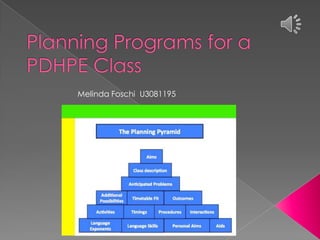
Melinda Foschi U3081195
 Teaching and learning programs need
  to represent the implementation of
  school curriculum planning.
 Needs to include the outcome groups
  being developed, and the learning
  experiences with suitable content and
  planned assessment.
 The teaching program documents a
  teachers decisions about what to teach
  and what students should learn.
 The decisions made will be assisted by a
  teachers knowledge of the students
  learning needs.
 Teaching program requirements may be
  met by “units of work”, where the unit fits
  with a schools overall curriculum
  planning.
 Planning assessment in the teaching
  program assists teachers in keeping
  assessment manageable.
 PDHPE Years 7-10:
 Sexual Health
 Road Safety Education
 Drug Education
 Mental Health
 Body Image and Healthy Food Habits
 Child Protection and Personal Safety.
 Considerations When Developing a
  Scope and Sequence
 Consider whole school activities for
  students (for example, assessment and
  examination schedules). Planned dates
  for these events need to be identified
 Consider the availability of school
  community resources for example
  equipment.
 Clearly identify students learning needs
 Class size, students interests, teachers
  expertise and costs need to be
  considered.
 Ensure teaching and learning strategies
  are devised and provide students with
  sufficient opportunities to learn the
  content (learn about) and use their skills
  to apply the content (learn to).
 Syllabus needs to be consulted at all
  times to ensure teaching and learning
  programs meet the requirements.
 When evaluating programs as “Have the
  learning experiences provided in the
  programs allowed students to learn what
  the syllabus expected?”
 Select only 3-4 outcomes per unit as
  learning will remain focused and create a
  deep understanding and knowledge.
 Consider the best sequence for exploring
  the content. Allow for integration of
  concepts to ensure relevance to students
  lives. There is no need for it to be in the
  order of the written syllabus.
   Blogs
   Chat rooms
   Diaries/ journals
   Magazines
   DVDs
   1. Finish the Scene – students watch part of
    a scene, for example where a character is
    having trouble dealing with a significant
    challenge. Students then write the script for
    the remainder of the scene.
 2. Play the role – students take the role of
  the character and act out the
  remainder of the scene.
 3. Fast Forward – students predict what
  happens next.
 Phase 1 – understand the content
 Phase 2 – planning and resourcing
 Phase 3 – implementation
 Phase 4 – monitoring
 Phase 5 – evaluation
 Students
 Strategies
 Groupings
 Timing
 Materials
 Success
 Sequence
 Before you Plan:
 1. Get to know your students – identify
  clearly who you are going to educate
  and their learning styles.
 2. Know your objectives – what do your
  students expect to learn? What do you
  want them to learn by the end of lesson?
 3. Over plan the class – include attention
  getters to bring the focus right to you
  when you need it.
 Creating your Plan.
 1. write your overview – outline the big
  ideas for the class. For example road
  safety, the causes and minimising risk.
 2. set out the objective – clear and
  consicise outlining the concrete steps
  throughout the lesson. For example,
  background knowledge on road safety,
  cause (why?) and how to minimise the
  risk through group activity.
   3. Plan your timeline – beak plan into
    sections according to how much time
    you have within the lesson.
   727. Nutrition
   Phys Ed, level: Elementary
    Posted Mon Nov 30 22:03:08 PST 1998 by Janna Elder (jkbelder@aol.com and
    jelder@hal.calc.k12.la.us ).
    Food Pyramid
    W.T. Henning Elementary, Sulphur,LA USA
    Materials Required: Book-Berenstein Bears and Too Much Junk Food,Chart paper
    and marker,copy of food pyramid,magazines a
    Activity Time: 1-2 45 minute lessons
    Concepts Taught: Recognizing good food choices
    TLW - distinguish between healthy foods and junk foods.
    - understand the need for healthy food choices.
    - create a food pyramid in a cooperative group.
   PROCEDURE: Introduce the Food Pyramid. Have a poster and/or use an internet
    site that has a picture of the pyramid.
    Discuss how the pyramid works and the need for a balanced diet.
    Brainstorm and come up with several Healthy Foods and several Junk Foods. List
    the foods on a chart.
    Read the story The Berenstein Bears and Too Much Junk Food by Stan and Jan
    Berenstein.
    Discuss the story. Ask questions about the food choices. Add foods in story to the
    chart. Relate the Healthy Foods to the Food Pyramid.
    Divide the class into cooperative groups.Give each group a poster with the
    pyramid on it. Have each group find pictures of food to illustrate each section.
    Display the posters upon completion.
    As a reward for working together and learning about foods have a healthy food
    snack available.
   EVALUATION: Observation of students working
    in groups.The completion of the food pyramids.
    Listening to discussions of food choices.
    Listening to discussions of what we need to
    have good food choices in our diets.

    MATERIALS:Book:Berenstein Bears and Too
    Much Junk Food by Stan and Jan Berenstein.
    Chart Paper and Marker
    Picture of Food Pyramid
    Food Pyramids for groups to complete
    Magazines and newspapers
    Scissors and Glue
    Healthy Snack such as apple slices and peanut
    butter
 Tile – Road Risks
 Year 8
 Lesson No. – 1
 Length – 2 of 50 mins
 Outcomes – Students will describe the
  nature of health and analyse how health
  issues may impact on you people (4.6)
 Skill – decision making
 Students will learn about – exploring risk,
  strategies to minimise harm and road
  safety.
Students will learn to:   Lesson Sequence         Teaching and Learning
                                                  Strategies


Explore the concept of Warm up/ opening           Direct Teaching
risk                                              Write down both the
                       Think, Pair, Share         positive and negative
                                                  types of risk that
                                                  adolescents take.
Explain how potential     Critical questions:     Small Group Work
for harm can be                                   Hand out “critical
increases as the result   Initial Stimulus        question” cards to
of an interaction of      Questions for Lessons   focus on issues around
factors                                           YP and risk.
 Conclusion – How can we overcome
  this? Homework is to complete “Positive
  Communication” worksheet .
 Resources – A3 paper for group work,
  question cards and Worksheet 10.1
 Assessment
 Evaluation and Reflection.
 http://www.youtube.com/watch?v=qJ2-
  aF8EY8k
 http://www.youtube.com/watch?v=kO2
  E9Fm9rVc

Sport Coaching Pedagogy

  • 1.
  • 2.
     Teaching andlearning programs need to represent the implementation of school curriculum planning.  Needs to include the outcome groups being developed, and the learning experiences with suitable content and planned assessment.
  • 3.
     The teachingprogram documents a teachers decisions about what to teach and what students should learn.  The decisions made will be assisted by a teachers knowledge of the students learning needs.
  • 4.
     Teaching programrequirements may be met by “units of work”, where the unit fits with a schools overall curriculum planning.  Planning assessment in the teaching program assists teachers in keeping assessment manageable.
  • 5.
     PDHPE Years7-10:  Sexual Health  Road Safety Education  Drug Education  Mental Health  Body Image and Healthy Food Habits  Child Protection and Personal Safety.
  • 6.
     Considerations WhenDeveloping a Scope and Sequence  Consider whole school activities for students (for example, assessment and examination schedules). Planned dates for these events need to be identified  Consider the availability of school community resources for example equipment.
  • 7.
     Clearly identifystudents learning needs  Class size, students interests, teachers expertise and costs need to be considered.
  • 8.
     Ensure teachingand learning strategies are devised and provide students with sufficient opportunities to learn the content (learn about) and use their skills to apply the content (learn to).  Syllabus needs to be consulted at all times to ensure teaching and learning programs meet the requirements.
  • 9.
     When evaluatingprograms as “Have the learning experiences provided in the programs allowed students to learn what the syllabus expected?”  Select only 3-4 outcomes per unit as learning will remain focused and create a deep understanding and knowledge.  Consider the best sequence for exploring the content. Allow for integration of concepts to ensure relevance to students lives. There is no need for it to be in the order of the written syllabus.
  • 10.
    Blogs  Chat rooms  Diaries/ journals  Magazines  DVDs  1. Finish the Scene – students watch part of a scene, for example where a character is having trouble dealing with a significant challenge. Students then write the script for the remainder of the scene.
  • 11.
     2. Playthe role – students take the role of the character and act out the remainder of the scene.  3. Fast Forward – students predict what happens next.
  • 12.
     Phase 1– understand the content  Phase 2 – planning and resourcing  Phase 3 – implementation  Phase 4 – monitoring  Phase 5 – evaluation
  • 13.
     Students  Strategies Groupings  Timing  Materials  Success  Sequence
  • 14.
     Before youPlan:  1. Get to know your students – identify clearly who you are going to educate and their learning styles.  2. Know your objectives – what do your students expect to learn? What do you want them to learn by the end of lesson?  3. Over plan the class – include attention getters to bring the focus right to you when you need it.
  • 15.
     Creating yourPlan.  1. write your overview – outline the big ideas for the class. For example road safety, the causes and minimising risk.  2. set out the objective – clear and consicise outlining the concrete steps throughout the lesson. For example, background knowledge on road safety, cause (why?) and how to minimise the risk through group activity.
  • 16.
    3. Plan your timeline – beak plan into sections according to how much time you have within the lesson.
  • 17.
    727. Nutrition  Phys Ed, level: Elementary Posted Mon Nov 30 22:03:08 PST 1998 by Janna Elder (jkbelder@aol.com and jelder@hal.calc.k12.la.us ). Food Pyramid W.T. Henning Elementary, Sulphur,LA USA Materials Required: Book-Berenstein Bears and Too Much Junk Food,Chart paper and marker,copy of food pyramid,magazines a Activity Time: 1-2 45 minute lessons Concepts Taught: Recognizing good food choices TLW - distinguish between healthy foods and junk foods. - understand the need for healthy food choices. - create a food pyramid in a cooperative group.  PROCEDURE: Introduce the Food Pyramid. Have a poster and/or use an internet site that has a picture of the pyramid. Discuss how the pyramid works and the need for a balanced diet. Brainstorm and come up with several Healthy Foods and several Junk Foods. List the foods on a chart. Read the story The Berenstein Bears and Too Much Junk Food by Stan and Jan Berenstein. Discuss the story. Ask questions about the food choices. Add foods in story to the chart. Relate the Healthy Foods to the Food Pyramid. Divide the class into cooperative groups.Give each group a poster with the pyramid on it. Have each group find pictures of food to illustrate each section. Display the posters upon completion. As a reward for working together and learning about foods have a healthy food snack available.
  • 18.
    EVALUATION: Observation of students working in groups.The completion of the food pyramids. Listening to discussions of food choices. Listening to discussions of what we need to have good food choices in our diets. MATERIALS:Book:Berenstein Bears and Too Much Junk Food by Stan and Jan Berenstein. Chart Paper and Marker Picture of Food Pyramid Food Pyramids for groups to complete Magazines and newspapers Scissors and Glue Healthy Snack such as apple slices and peanut butter
  • 19.
     Tile –Road Risks  Year 8  Lesson No. – 1  Length – 2 of 50 mins  Outcomes – Students will describe the nature of health and analyse how health issues may impact on you people (4.6)  Skill – decision making  Students will learn about – exploring risk, strategies to minimise harm and road safety.
  • 20.
    Students will learnto: Lesson Sequence Teaching and Learning Strategies Explore the concept of Warm up/ opening Direct Teaching risk Write down both the Think, Pair, Share positive and negative types of risk that adolescents take. Explain how potential Critical questions: Small Group Work for harm can be Hand out “critical increases as the result Initial Stimulus question” cards to of an interaction of Questions for Lessons focus on issues around factors YP and risk.
  • 21.
     Conclusion –How can we overcome this? Homework is to complete “Positive Communication” worksheet .  Resources – A3 paper for group work, question cards and Worksheet 10.1  Assessment  Evaluation and Reflection.
  • 24.
     http://www.youtube.com/watch?v=qJ2- aF8EY8k  http://www.youtube.com/watch?v=kO2 E9Fm9rVc