Strategies for
Publishing Scientific
Paper
DR. Herlina Jayadianti, ST, MT
UPN “Veteran” Yogyakarta
11/08/2015herlinajayadiati
PROBLEM
11/08/2015herlinajayadiati
Why write and publish research
papers?
Ideally –
to share research findings and discoveries
Practically –
 to get funding
 to get promoted
 to get a job
 to keep your job
11/08/2015herlinajayadiati
..it was dark and stormy..
11/08/2015herlinajayadiati
HOW TO START?
I HATE WRITING
I’m very busy doing things i don’t need to do
In order to avoid
Doing anything I’m actually supposed to be doing
11/08/2015herlinajayadiati
Reasons for not writing
• I don’t have any time for writing
• I can’t write in my office
• I don’t have an idea to write
• My english is poor
• I am not ambitious
• My teaching comes first
• I review paper regularly, but i don’t write my self
• I don’t want to play the publications game
• I am too tired when I get home to do any writing
• I recent giving up so much of my personal time
• I do alot of writing, just not for publication
• .......etc
11/08/2015herlinajayadiati
HOW to write
Points to ponder prior
writing to impact journal
Target readers?
What is my paper
trying to say
Points to
ponder
A new message?
Is the message of
value or potential
value or trivial
Why writing
this paper
11/08/2015herlinajayadiati
The five STEPS
Identity the
suitable journal
Sending process
Waiting feedback
Article
preparation
Correction/rebuttal
if needed
11/08/2015herlinajayadiati
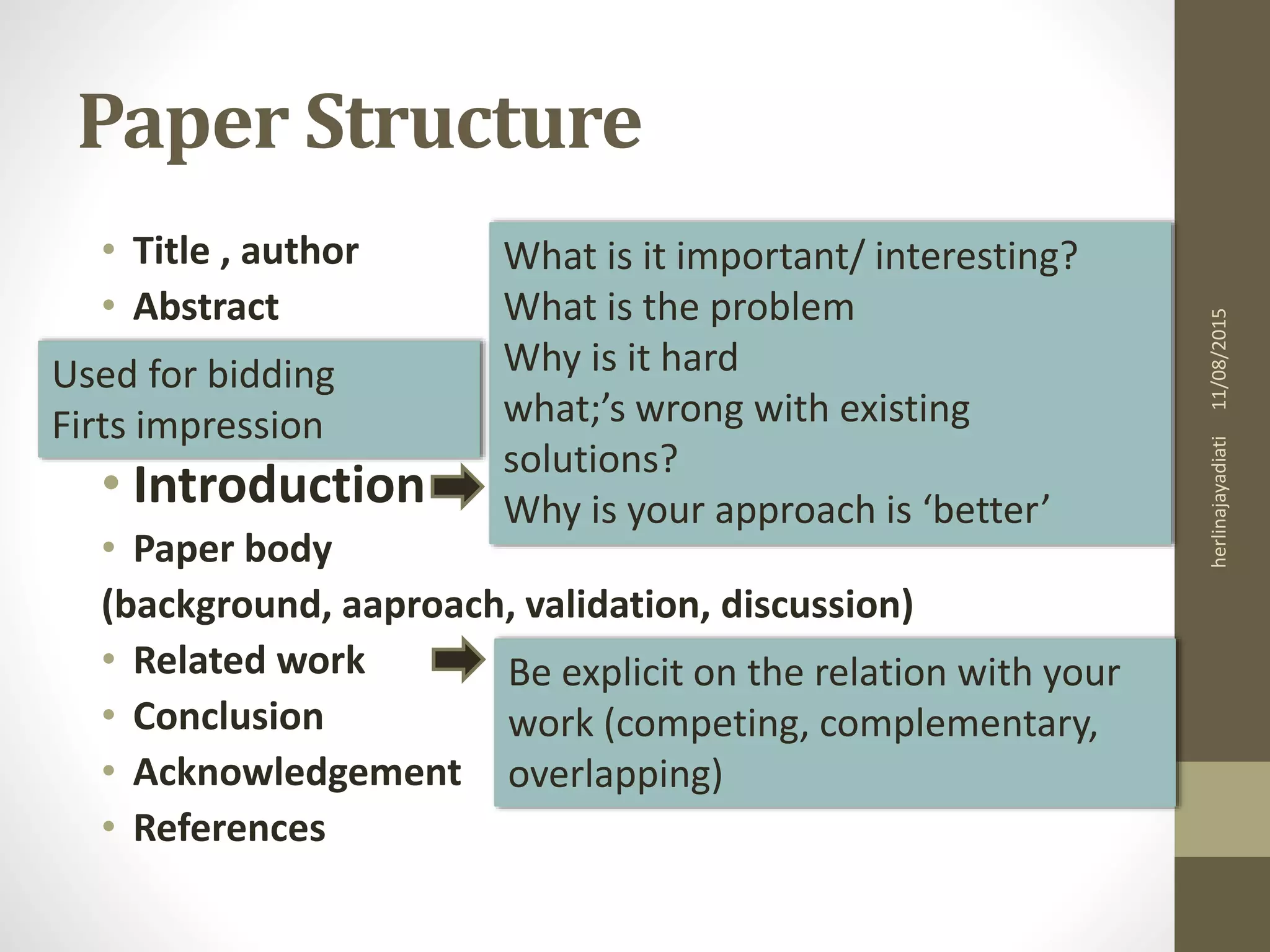
Paper Structure
• Title , author
• Abstract
• Introduction
• Paper body
(background, aaproach, validation, discussion)
• Related work
• Conclusion
• Acknowledgement
• References
What is it important/ interesting?
What is the problem
Why is it hard
what;’s wrong with existing
solutions?
Why is your approach is ‘better’
Used for bidding
Firts impression
Be explicit on the relation with your
work (competing, complementary,
overlapping)
11/08/2015herlinajayadiati
Note : Papers are a means to
an end not a goal
• Don’t think about publications
first
•Do exciting
research, and the
paper will come
• But do write early (e.g.
Progress report)
11/08/2015herlinajayadiati
Great Journal
14
Kinds of Scientific Publications
• PhD Thesis
Aspects to be Assessed for a Thesis:
background knowledge
original contributions (amount of work)
methodology
presentation (writing)
Conference Publications
Focus on a piece of work with limited discussion
Journal Publications
More complete (extensive) discussion
• Monographs / Book chapters / Text books
15
Where to publish your work
• Journals
Ranking of journals
Review process of journals
Publication cycle
• Conferences
Ranking of conferences
Review process of conferences
a good journal / conference tends to have rigorous
review process and long review time
 Submit your papers
to good places
 Competition of some
conferences are
much more fierce
than journals.
What constitutes a good
journal?
• Impact factor –
average number of times published papers
are cited up to two years after publication.
(ISI, citation index, Thompson sicientific, JCR)
• Immediacy Index –
average number of times published papers
are cited during year of publication.
11/08/2015herlinajayadiati
Source: dor.umc.edu/.../WritingandpublishingaresearcharticleAdair.ppt
Citation Index Services
Web of Science (ISI)
Elsevier (SCOPUS)
DOAj
Google Scholar
Low
wide
Low/high
highCoverage
Quality
11/08/2015herlinajayadiati
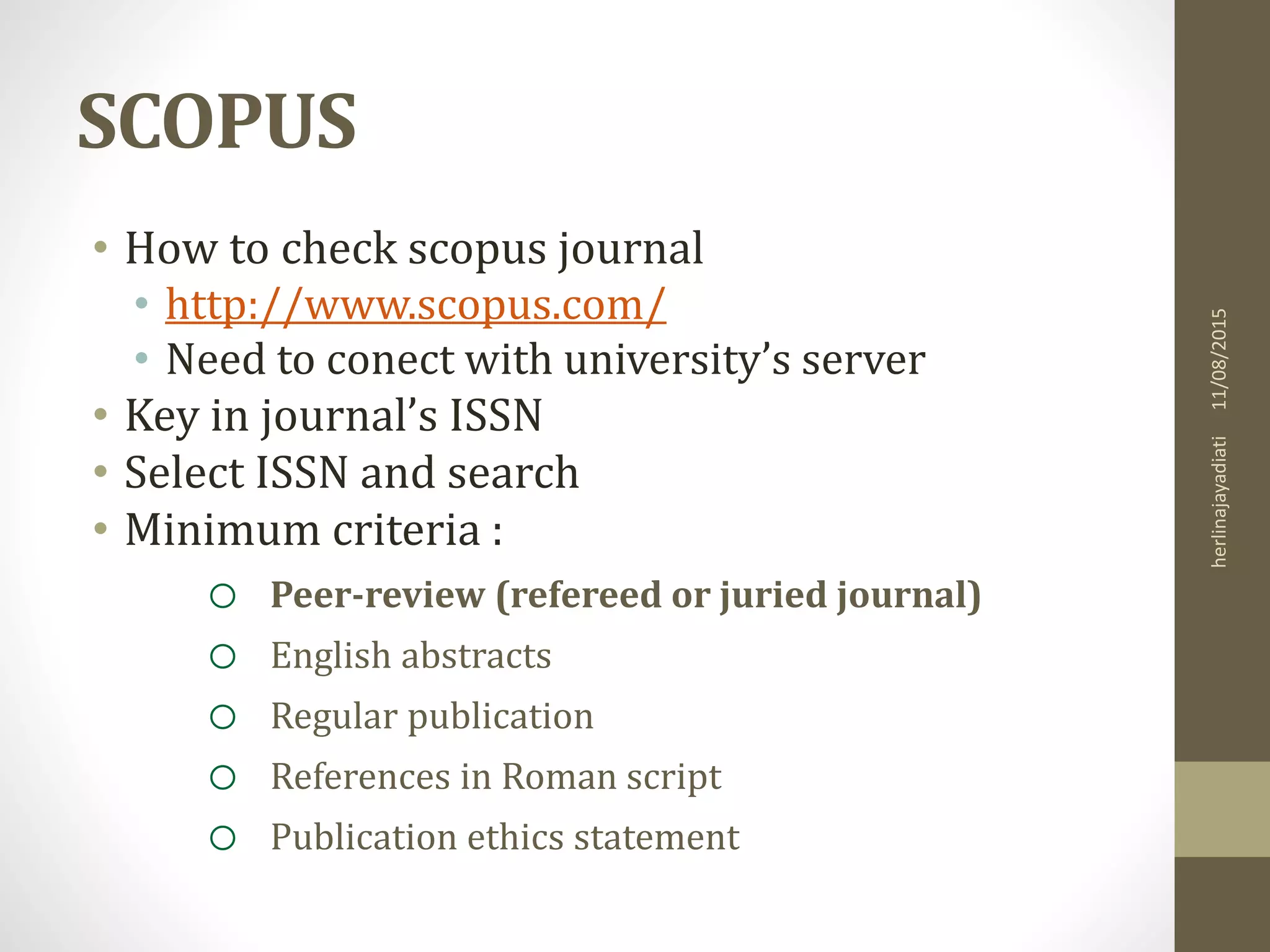
SCOPUS
• How to check scopus journal
• http://www.scopus.com/
• Need to conect with university’s server
• Key in journal’s ISSN
• Select ISSN and search
• Minimum criteria :
o Peer-review (refereed or juried journal)
o English abstracts
o Regular publication
o References in Roman script
o Publication ethics statement
11/08/2015herlinajayadiati
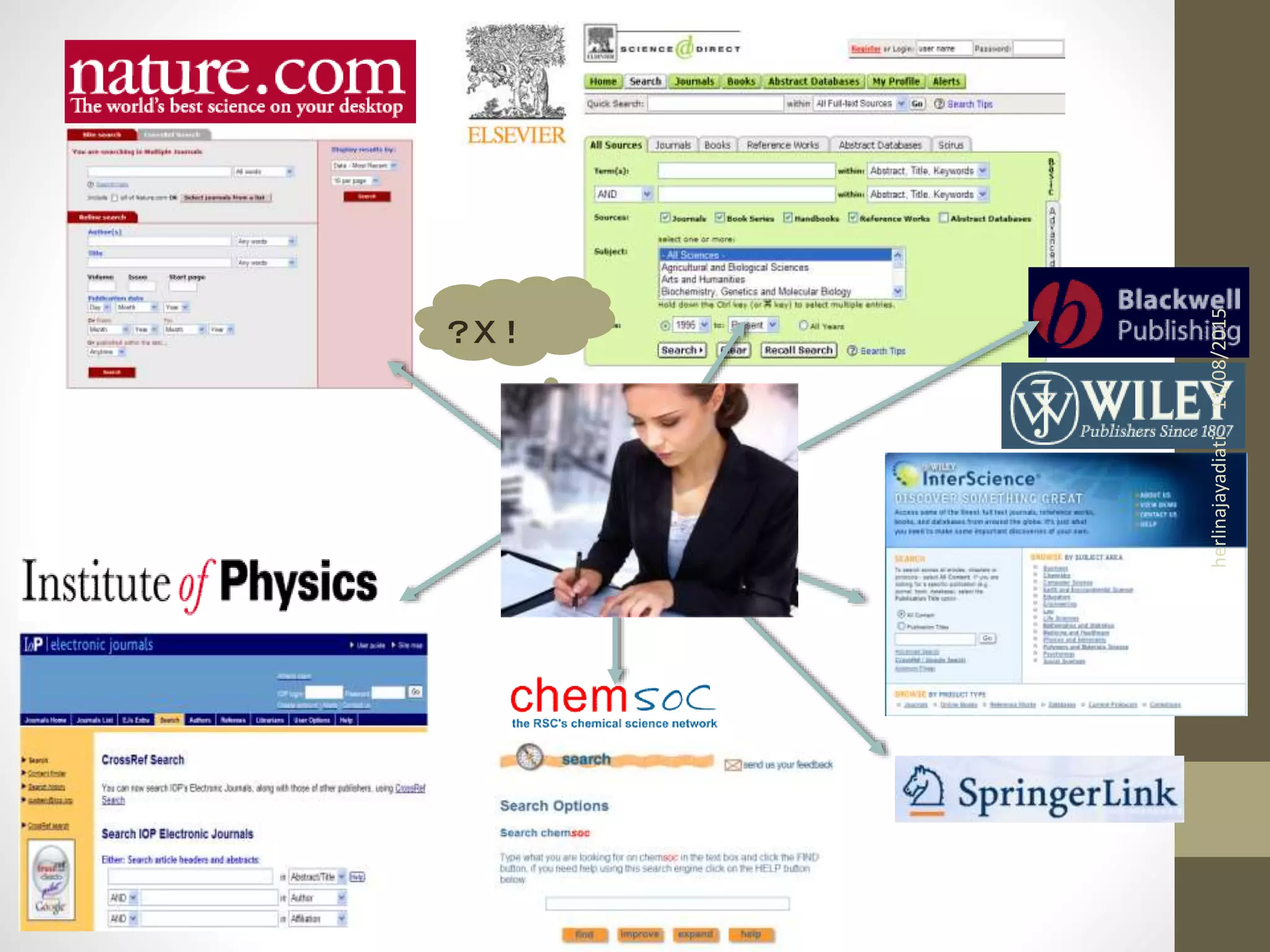
?X!
11/08/2015herlinajayadiati
How to check ISI journal
• http://isiknowledge.com
• Click at “additional resources”
• Click at “journal citation report”
• Select ‘search for a specific journal’ and click submit
11/08/2015herlinajayadiati
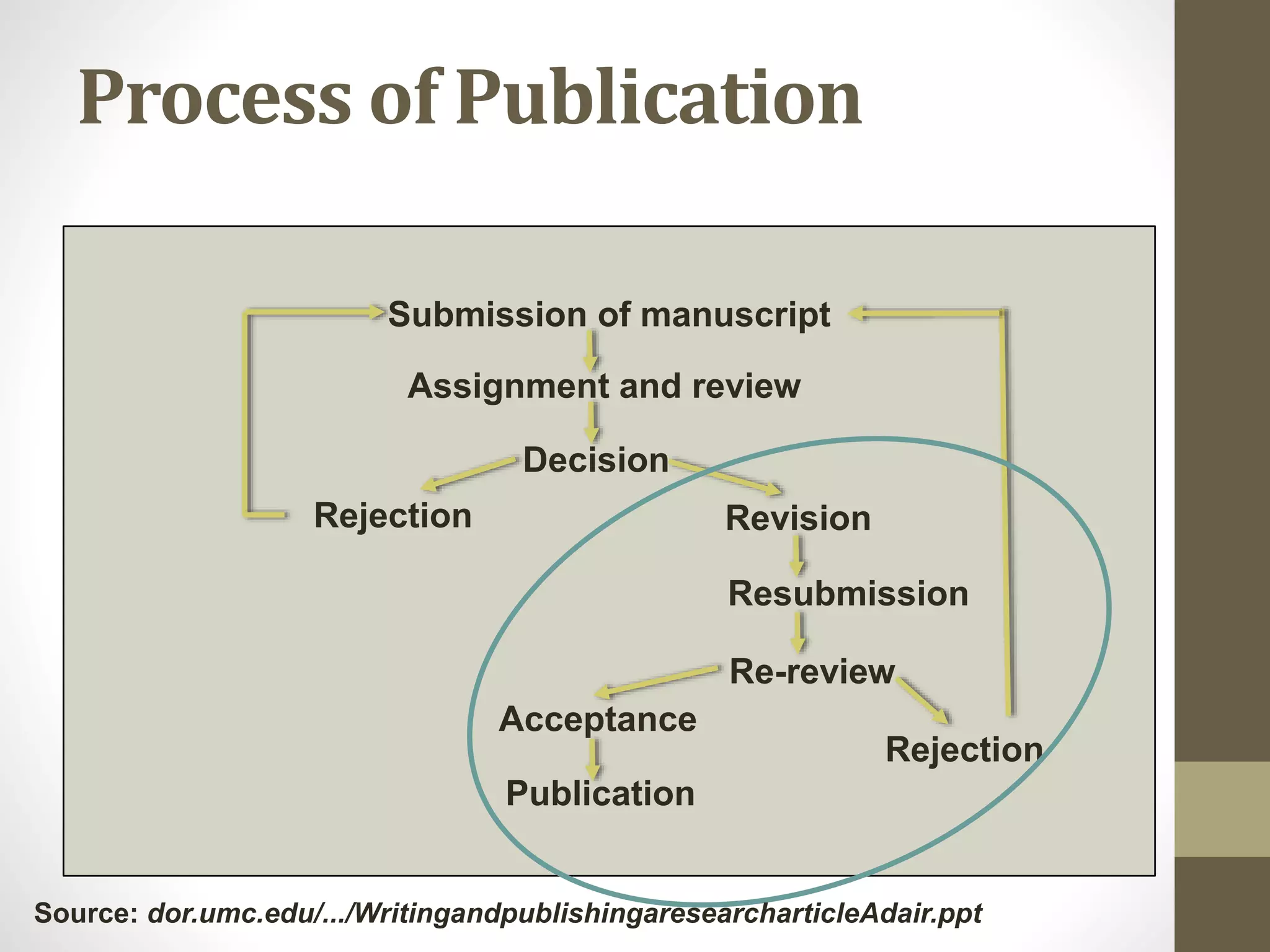
Submission of manuscript
Assignment and review
Decision
Revision
Resubmission
Re-review
Acceptance
Publication
Rejection
Rejection
Source: dor.umc.edu/.../WritingandpublishingaresearcharticleAdair.ppt
Process of Publication
What do editors want from
papers?
• Importance
• Originality
• Relevance to readers
• Usefulness to readers and, ultimately, to
patients
• Truth
• Excitement/ “wow” factor
• Clear and engaging writing
11/08/2015herlinajayadiati
...long road...?
11/08/2015herlinajayadiati
Rejection
• All author get rejections
• Rejection is a path to acceptance
• Do not take it personaly or blame the
reviewer
• Do use the feedback to improve
Broader, more general result
Better motivation and applications
Stronger theory
More compelling evaluation
.......etc
11/08/2015herlinajayadiati
Some Key Tips
• Ingredients of good science
• Novelty of idea (timing)
• Comprehensive review of literature
• Strong data; strong analysis/stats input
• Thought provoking discussion recognizing limitations of
one’s work
• Ingredients of good writing
• Good organization
• Appropriate use of tables & figures
• Right length
• Right audience
Modified from Bourne PE. Plos Comput Biol 2005
Networking is important
• Start early, make use of Social Networking tools
• Facebook
• LinkedIn
• Social networks for scientists
• SSRN, Academics.edu, Researchgate
11/08/2015herlinajayadiati
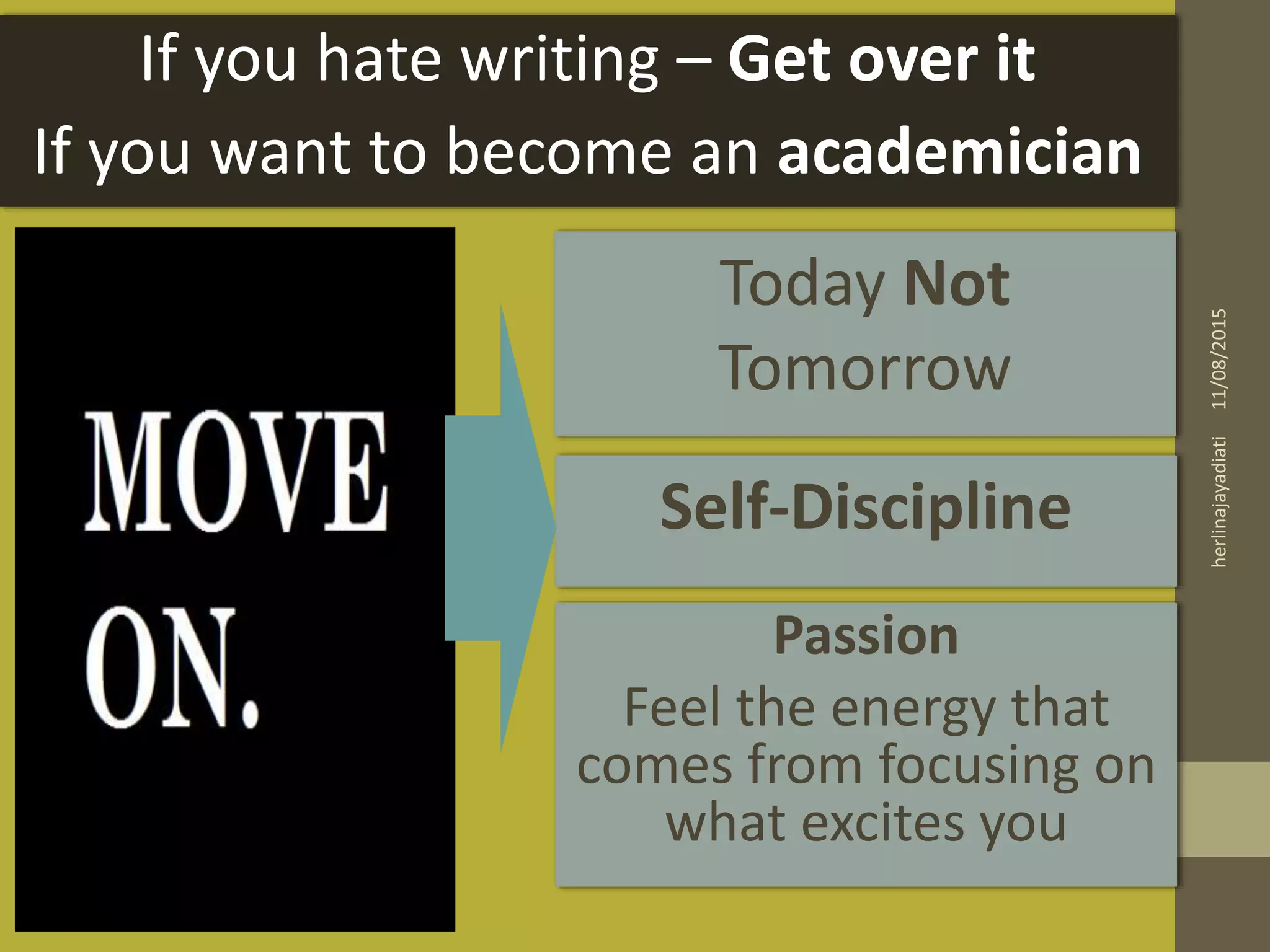
If you hate writing – Get over it
If you want to become an academician
Today Not
Tomorrow
Self-Discipline
Passion
Feel the energy that
comes from focusing on
what excites you
11/08/2015herlinajayadiati
Conclusions
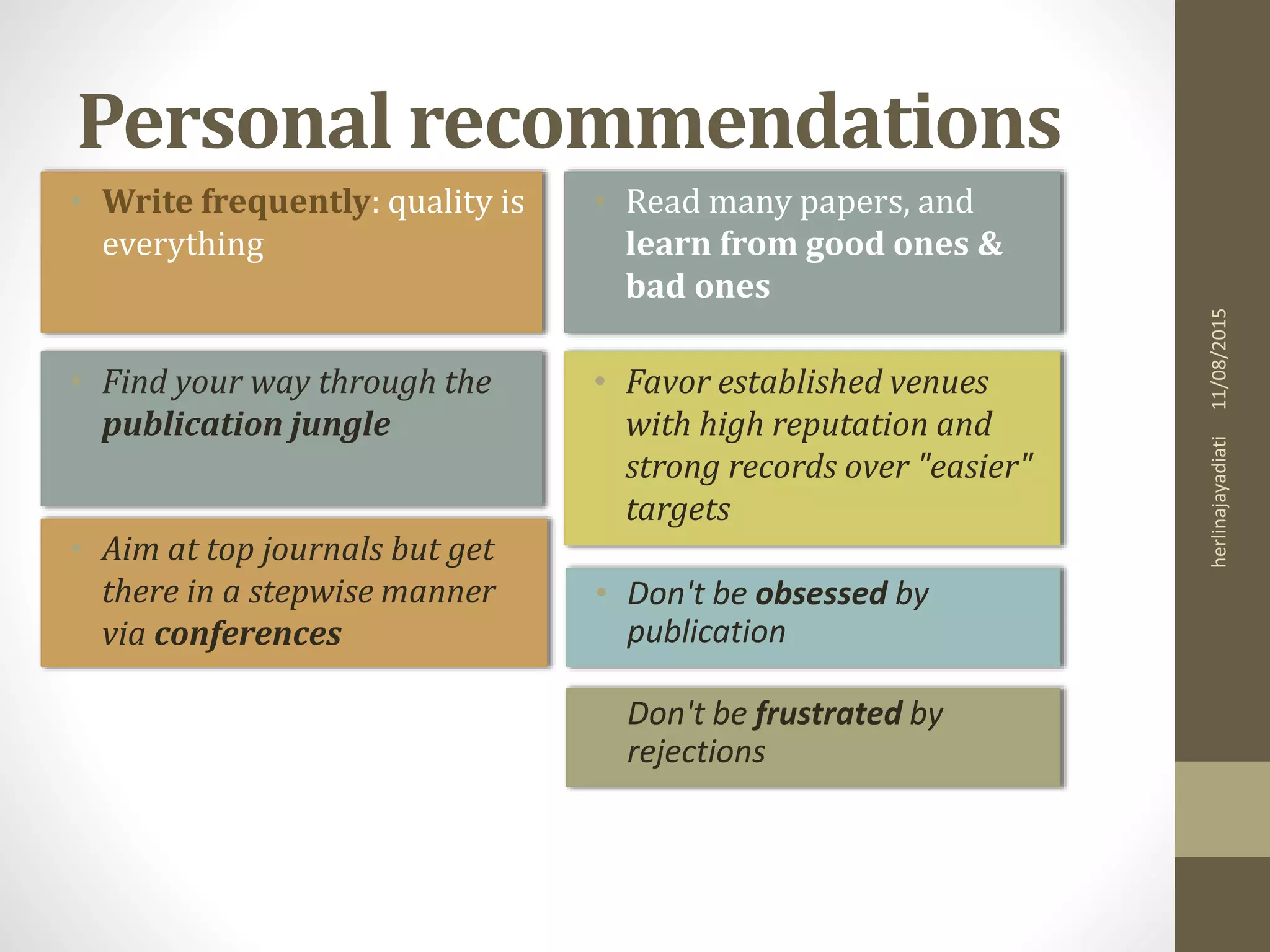
Personal recommendations
• Find your way through the
publication jungle
• Favor established venues
with high reputation and
strong records over "easier"
targets
• Aim at top journals but get
there in a stepwise manner
via conferences
• Don't be frustrated by
rejections
• Don't be obsessed by
publication
11/08/2015herlinajayadiati
• Read many papers, and
learn from good ones &
bad ones
• Write frequently: quality is
everything
Journal indexed
by SCOPUS
11/08/2015herlinajayadiati
Publications publish by
SpringerLink
11/08/2015herlinajayadiati
Publications indexed by SCOPUS
Jayadianti, H., Nugroho, L.E., Santosa, P.,Widayat,W., Pinto, C.S., 2014, Solving Problem of Ambiguity Terms
Using Ontology, Information An international interdisciplinary journal, Volume 17 number 8, August 2014
(Printed in japan), ISSN 1343 4500 (print), ISSN 1344 8994 (electronic), Indexed by scopus, Jdream,
Mathematical rewiews, Zentrablatt MATH, Proquest, Swets, EBSCO, Published by international information
institute www.information-iii.org
Jayadianti, H., Nugroho, L.E., Santosa, P., Widayat,W., Pinto, C.S., 2013, Leveraging Knowledge from Different
CommunitiesUsing Ontologies, The 2013 World Conference on Information Systems and Technologies
(WORLDCIST13) Algarve Portugal 27-29 March 2013, Published on SPRINGER book -, ISBN: 978-3-642-36980-
3 (Print) 978-3-642-36981-0 (Online), Indexed by scopus, Jdream, Mathematical rewiews, Zentrablatt MATH,
Proquest, Swets, EBSCO, http://www.aisti.eu/worldcist13/ ,http://link.springer.com/book/10.1007/978-3-642-
36981-0/page/1, http://link.springer.com/book/10.1007/978-3-642-369810/page/1#page-1
Jayadianti, H., Nugroho, L.E., Santosa, P., Widayat,W., Pinto, C.S., 2013, Semantic Interrelation in Distributed
SystemThrough Green Computing Ontology, The International Conference on Information Technology and
Electrical Engineering (ICITEE), The IEEE Xplore digital library, IEEE Catalogue Number : CFP13TEF-ART; ISBN:
978-14799-0425-9, http://icitee2013.te.ugm.ac.id/
Jayadianti, H., Nugroho, L.E., Santosa, P., Widayat,W., Pinto, C.S., 2012, Integrating Large knowledge
repositories in Multi agent ontologies, 2nd International Workshop on Exploiting Large Knowledge Repositories
(E-LKR), Jaume I University of Castellon de la Plana, Comunidad Valenciana, Spain and supported by OXFORD
University UK, Indexed by scopus, Jdream, Mathematical rewiews, Zentrablatt MATH, Proquest, Swets,
EBSCO, http://www.cs.ox.ac.uk/isg/conferences/ELKR2012/, http://ceur-ws.org/Vol-882/
Jayadianti, H., Nugroho, L.E., Santosa, P., Widayat,W., Pinto, C.S., 2012, Ontology encourage problem solving of
data heterogeneity, semantic heterogeneity and data inequality using ontology, The 7th Mediterranean
conference of Information system (MCIS), Universidade do Minho Campus de Azurem Guimaraes Portugal,
Indexed by scopus, Jdream, Mathematical rewiews, Zentrablatt MATH, Proquest, Swets,
EBSCO,http://repositorium.sdum.uminho.pt/bitstream/1822/23089/1/mcis2012_submission_82.pdf
11/08/2015herlinajayadiati
Reviewer for the paper indexed
by Scopus
• The 2014 World Conference on Information Systems and Technologies
(WorldCIST'14), Madeira Island, Portugal
http://www.aisti.eu/worldcist14/index.php/committees Indexed by
scopus, Jdream, Mathematical rewiews, Zentrablatt MATH, Proquest,
Swets, EBSCO, Published by international information institute
(published in Springer book chapter)
• WorldCIST'15 - 3rd World Conference on Information Systems and
Technologies, São Miguel, Azores, Portugal, 1 - 3 April
2015.http://www.aisti.eu/worldcist15/index.php/committees - ISI
journal - Indexed by scopus, Jdream, Mathematical rewiews, Zentrablatt
MATH, Proquest, Swets, EBSCO, Published by international information
institute (published in Springer book chapter)
 The Seventh International Conference on Information November 25 -
28, 2015, GIS NTU Convention Center, National Taiwan University, Taipei,
Taiwan- support by International Information Institute
http://www.information-iii.org/committee.html Indexed by scopus,
Jdream, Mathematical rewiews, Zentrablatt MATH, Proquest, Swets,
EBSCO, Published by international information institute -
11/08/2015herlinajayadiati
“There is no way to get
experience except through
experience.”

Strategies for publishing scientific paper

  • 1.
    Strategies for Publishing Scientific Paper DR.Herlina Jayadianti, ST, MT UPN “Veteran” Yogyakarta 11/08/2015herlinajayadiati
  • 2.
  • 3.
    Why write andpublish research papers? Ideally – to share research findings and discoveries Practically –  to get funding  to get promoted  to get a job  to keep your job
  • 4.
  • 5.
    ..it was darkand stormy.. 11/08/2015herlinajayadiati
  • 6.
    HOW TO START? IHATE WRITING I’m very busy doing things i don’t need to do In order to avoid Doing anything I’m actually supposed to be doing 11/08/2015herlinajayadiati
  • 7.
    Reasons for notwriting • I don’t have any time for writing • I can’t write in my office • I don’t have an idea to write • My english is poor • I am not ambitious • My teaching comes first • I review paper regularly, but i don’t write my self • I don’t want to play the publications game • I am too tired when I get home to do any writing • I recent giving up so much of my personal time • I do alot of writing, just not for publication • .......etc 11/08/2015herlinajayadiati
  • 8.
  • 9.
    Points to ponderprior writing to impact journal Target readers? What is my paper trying to say Points to ponder A new message? Is the message of value or potential value or trivial Why writing this paper 11/08/2015herlinajayadiati
  • 10.
    The five STEPS Identitythe suitable journal Sending process Waiting feedback Article preparation Correction/rebuttal if needed 11/08/2015herlinajayadiati
  • 11.
    Paper Structure • Title, author • Abstract • Introduction • Paper body (background, aaproach, validation, discussion) • Related work • Conclusion • Acknowledgement • References What is it important/ interesting? What is the problem Why is it hard what;’s wrong with existing solutions? Why is your approach is ‘better’ Used for bidding Firts impression Be explicit on the relation with your work (competing, complementary, overlapping) 11/08/2015herlinajayadiati
  • 12.
    Note : Papersare a means to an end not a goal • Don’t think about publications first •Do exciting research, and the paper will come • But do write early (e.g. Progress report) 11/08/2015herlinajayadiati
  • 13.
  • 14.
    14 Kinds of ScientificPublications • PhD Thesis Aspects to be Assessed for a Thesis: background knowledge original contributions (amount of work) methodology presentation (writing) Conference Publications Focus on a piece of work with limited discussion Journal Publications More complete (extensive) discussion • Monographs / Book chapters / Text books
  • 15.
    15 Where to publishyour work • Journals Ranking of journals Review process of journals Publication cycle • Conferences Ranking of conferences Review process of conferences a good journal / conference tends to have rigorous review process and long review time  Submit your papers to good places  Competition of some conferences are much more fierce than journals.
  • 16.
    What constitutes agood journal? • Impact factor – average number of times published papers are cited up to two years after publication. (ISI, citation index, Thompson sicientific, JCR) • Immediacy Index – average number of times published papers are cited during year of publication. 11/08/2015herlinajayadiati Source: dor.umc.edu/.../WritingandpublishingaresearcharticleAdair.ppt
  • 17.
    Citation Index Services Webof Science (ISI) Elsevier (SCOPUS) DOAj Google Scholar Low wide Low/high highCoverage Quality 11/08/2015herlinajayadiati
  • 18.
    SCOPUS • How tocheck scopus journal • http://www.scopus.com/ • Need to conect with university’s server • Key in journal’s ISSN • Select ISSN and search • Minimum criteria : o Peer-review (refereed or juried journal) o English abstracts o Regular publication o References in Roman script o Publication ethics statement 11/08/2015herlinajayadiati
  • 19.
  • 20.
    How to checkISI journal • http://isiknowledge.com • Click at “additional resources” • Click at “journal citation report” • Select ‘search for a specific journal’ and click submit 11/08/2015herlinajayadiati
  • 21.
    Submission of manuscript Assignmentand review Decision Revision Resubmission Re-review Acceptance Publication Rejection Rejection Source: dor.umc.edu/.../WritingandpublishingaresearcharticleAdair.ppt Process of Publication
  • 22.
    What do editorswant from papers? • Importance • Originality • Relevance to readers • Usefulness to readers and, ultimately, to patients • Truth • Excitement/ “wow” factor • Clear and engaging writing 11/08/2015herlinajayadiati
  • 23.
  • 24.
    Rejection • All authorget rejections • Rejection is a path to acceptance • Do not take it personaly or blame the reviewer • Do use the feedback to improve Broader, more general result Better motivation and applications Stronger theory More compelling evaluation .......etc 11/08/2015herlinajayadiati
  • 25.
    Some Key Tips •Ingredients of good science • Novelty of idea (timing) • Comprehensive review of literature • Strong data; strong analysis/stats input • Thought provoking discussion recognizing limitations of one’s work • Ingredients of good writing • Good organization • Appropriate use of tables & figures • Right length • Right audience Modified from Bourne PE. Plos Comput Biol 2005
  • 26.
    Networking is important •Start early, make use of Social Networking tools • Facebook • LinkedIn • Social networks for scientists • SSRN, Academics.edu, Researchgate 11/08/2015herlinajayadiati
  • 27.
    If you hatewriting – Get over it If you want to become an academician Today Not Tomorrow Self-Discipline Passion Feel the energy that comes from focusing on what excites you 11/08/2015herlinajayadiati
  • 28.
  • 29.
    Personal recommendations • Findyour way through the publication jungle • Favor established venues with high reputation and strong records over "easier" targets • Aim at top journals but get there in a stepwise manner via conferences • Don't be frustrated by rejections • Don't be obsessed by publication 11/08/2015herlinajayadiati • Read many papers, and learn from good ones & bad ones • Write frequently: quality is everything
  • 30.
  • 31.
  • 32.
    Publications indexed bySCOPUS Jayadianti, H., Nugroho, L.E., Santosa, P.,Widayat,W., Pinto, C.S., 2014, Solving Problem of Ambiguity Terms Using Ontology, Information An international interdisciplinary journal, Volume 17 number 8, August 2014 (Printed in japan), ISSN 1343 4500 (print), ISSN 1344 8994 (electronic), Indexed by scopus, Jdream, Mathematical rewiews, Zentrablatt MATH, Proquest, Swets, EBSCO, Published by international information institute www.information-iii.org Jayadianti, H., Nugroho, L.E., Santosa, P., Widayat,W., Pinto, C.S., 2013, Leveraging Knowledge from Different CommunitiesUsing Ontologies, The 2013 World Conference on Information Systems and Technologies (WORLDCIST13) Algarve Portugal 27-29 March 2013, Published on SPRINGER book -, ISBN: 978-3-642-36980- 3 (Print) 978-3-642-36981-0 (Online), Indexed by scopus, Jdream, Mathematical rewiews, Zentrablatt MATH, Proquest, Swets, EBSCO, http://www.aisti.eu/worldcist13/ ,http://link.springer.com/book/10.1007/978-3-642- 36981-0/page/1, http://link.springer.com/book/10.1007/978-3-642-369810/page/1#page-1 Jayadianti, H., Nugroho, L.E., Santosa, P., Widayat,W., Pinto, C.S., 2013, Semantic Interrelation in Distributed SystemThrough Green Computing Ontology, The International Conference on Information Technology and Electrical Engineering (ICITEE), The IEEE Xplore digital library, IEEE Catalogue Number : CFP13TEF-ART; ISBN: 978-14799-0425-9, http://icitee2013.te.ugm.ac.id/ Jayadianti, H., Nugroho, L.E., Santosa, P., Widayat,W., Pinto, C.S., 2012, Integrating Large knowledge repositories in Multi agent ontologies, 2nd International Workshop on Exploiting Large Knowledge Repositories (E-LKR), Jaume I University of Castellon de la Plana, Comunidad Valenciana, Spain and supported by OXFORD University UK, Indexed by scopus, Jdream, Mathematical rewiews, Zentrablatt MATH, Proquest, Swets, EBSCO, http://www.cs.ox.ac.uk/isg/conferences/ELKR2012/, http://ceur-ws.org/Vol-882/ Jayadianti, H., Nugroho, L.E., Santosa, P., Widayat,W., Pinto, C.S., 2012, Ontology encourage problem solving of data heterogeneity, semantic heterogeneity and data inequality using ontology, The 7th Mediterranean conference of Information system (MCIS), Universidade do Minho Campus de Azurem Guimaraes Portugal, Indexed by scopus, Jdream, Mathematical rewiews, Zentrablatt MATH, Proquest, Swets, EBSCO,http://repositorium.sdum.uminho.pt/bitstream/1822/23089/1/mcis2012_submission_82.pdf 11/08/2015herlinajayadiati
  • 33.
    Reviewer for thepaper indexed by Scopus • The 2014 World Conference on Information Systems and Technologies (WorldCIST'14), Madeira Island, Portugal http://www.aisti.eu/worldcist14/index.php/committees Indexed by scopus, Jdream, Mathematical rewiews, Zentrablatt MATH, Proquest, Swets, EBSCO, Published by international information institute (published in Springer book chapter) • WorldCIST'15 - 3rd World Conference on Information Systems and Technologies, São Miguel, Azores, Portugal, 1 - 3 April 2015.http://www.aisti.eu/worldcist15/index.php/committees - ISI journal - Indexed by scopus, Jdream, Mathematical rewiews, Zentrablatt MATH, Proquest, Swets, EBSCO, Published by international information institute (published in Springer book chapter)  The Seventh International Conference on Information November 25 - 28, 2015, GIS NTU Convention Center, National Taiwan University, Taipei, Taiwan- support by International Information Institute http://www.information-iii.org/committee.html Indexed by scopus, Jdream, Mathematical rewiews, Zentrablatt MATH, Proquest, Swets, EBSCO, Published by international information institute - 11/08/2015herlinajayadiati
  • 34.
    11/08/2015herlinajayadiati “There is noway to get experience except through experience.”