Building
Competitive
Advantage
Johnson & Johnson Italy
Case Study
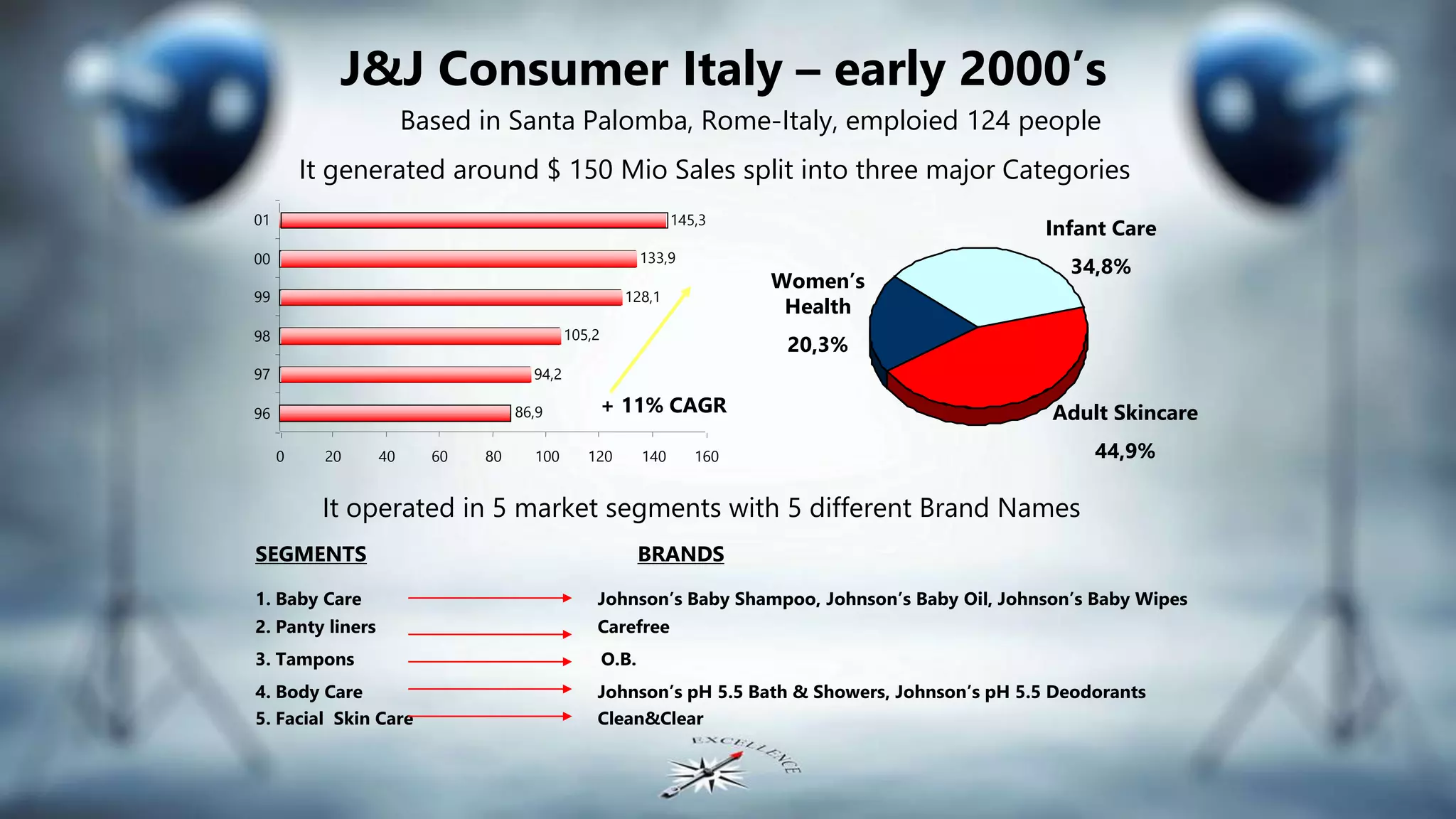
J&J Consumer Italy – early 2000’s
Based in Santa Palomba, Rome-Italy, emploied 124 people
It generated around $ 150 Mio Sales split into three major Categories
86,9
94,2
105,2
128,1
133,9
145,3
0 20 40 60 80 100 120 140 160
96
97
98
99
00
01
+ 11% CAGR
Women’s
Health
20,3%
Infant Care
34,8%
Adult Skincare
44,9%
It operated in 5 market segments with 5 different Brand Names
SEGMENTS BRANDS
1. Baby Care Johnson’s Baby Shampoo, Johnson’s Baby Oil, Johnson’s Baby Wipes
2. Panty liners Carefree
3. Tampons O.B.
4. Body Care Johnson’s pH 5.5 Bath & Showers, Johnson’s pH 5.5 Deodorants
5. Facial Skin Care Clean&Clear
LEADER CHALLANGER FOLLOWER
FOLLOWER NICHER ALL OTHERS
Johnson’s Brands Position
LEADER CHALLANGER FOLLOWER FOLLOWER
FOLLOWER FOLLOWER ALL OTHERS
LEADER CHALLANGER FOLLOWER
FOLLOWER ALL OTHERS
BABY MARKET LINERS MARKET
BODY CARE MARKET FACE CARE MARKET
CAREFREE 26%
CHALLANGER
LEADER CHALLANGER FOLLOWER
JOHNSON BABY 80%
LEADER
JOHNSON pH 5.5 6%
FOLLOWER
CLEAN & CLEAR 2%
NICHER
Theoretical Relation between
Market Share and Ranking
Critical factors to be considered to assess the competitive strenght of a Brand:
1) concentration/fragmentation of the market – i.e. Share of the leader (s);
2) level of competitiveness of the players – i.e. multinationals vs. local manufacturers;
3) qualification of the “market” – i.e. segments/categories included/excluded.
Market share thresholds have to be necessarily flexible.
LEADER 40+ % CHALLENGER 30+ % FOLLOWER 20+ % NICHER 10+ %
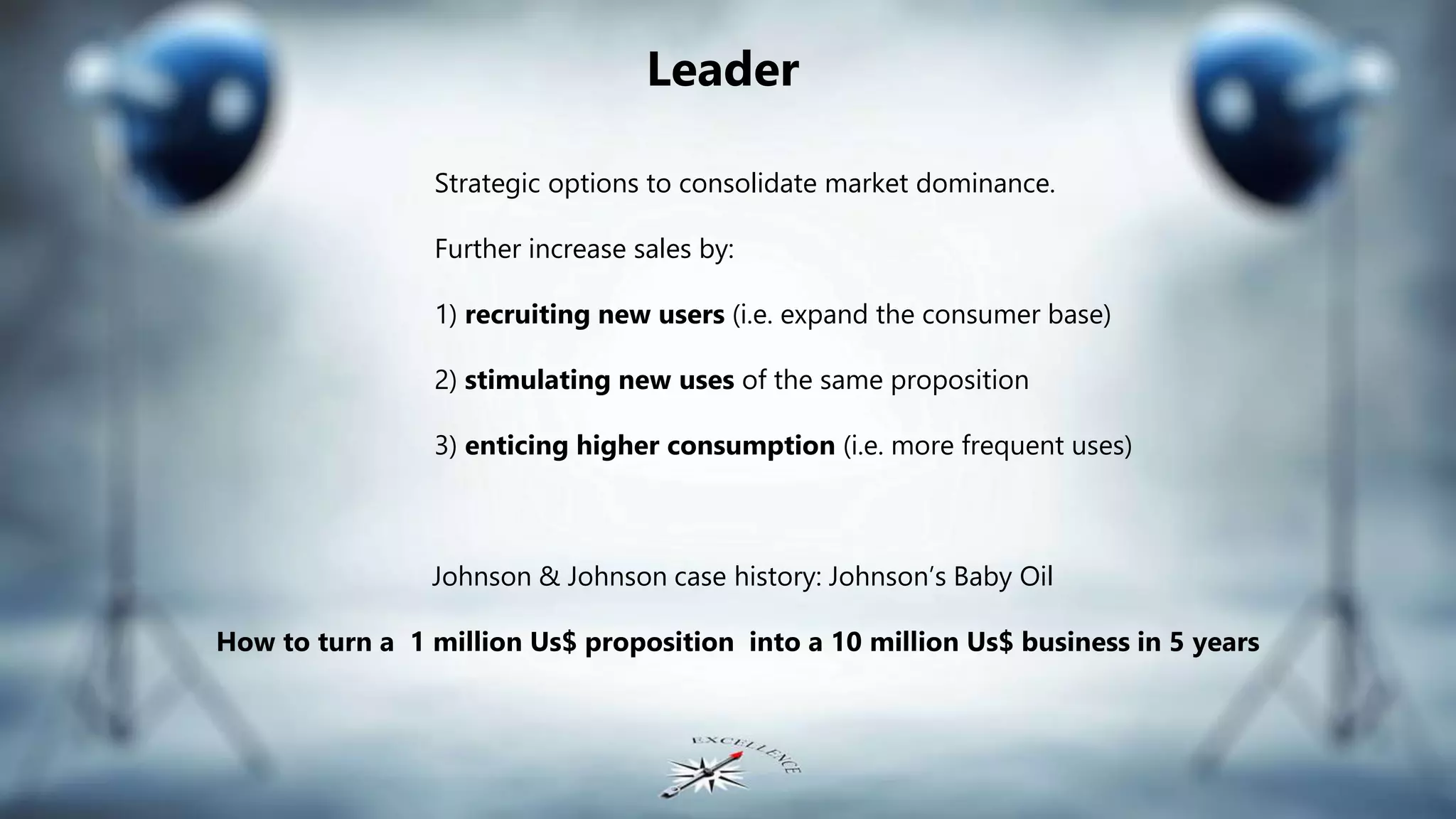
Strategic options to consolidate market dominance.
Further increase sales by:
1) recruiting new users (i.e. expand the consumer base)
2) stimulating new uses of the same proposition
3) enticing higher consumption (i.e. more frequent uses)
Johnson & Johnson case history: Johnson’s Baby Oil
How to turn a 1 million Us$ proposition into a 10 million Us$ business in 5 years
Leader
Johnson’s Baby Oil: History
• Launched in March 1967
• Positioned as
a baby product
limited target: newborn only
removing cradle cap and preventing
skin irritation/redness
narrow consumption pattern
for occasional and diversified use
infrequent usage occasions
• Supported via consumer/trade promotions, no adverts
IN 1996 JOHNSON’S BABY OIL WAS A MINOR PRODUCT OF THE BABY LINE
WITH A MARGINAL SHARE IN THE MOISTURIZING CATEGORY
• Re-positioned as
an adult product
broader target
for superior moisturization (hydrates
ten times more than creams and lotions)
wider consumption pattern
for daily use
very frequent usage occasions
• Packaging rejuvenation, appropriate sizing, dedicated,
POS material
Johnson’s Baby Oil: Re-Positioning
Johnson’s Baby Oil: Ad Support
Idx vs.
PY
Wks
on Air
GRP's
2001 150 14 1771
2000 141 8 1096
1999 178 7 1029
1998 129 4 697
1997 120 5 689
Sales Market
Share - %
IRI
Consumption
per capita
W.Dist’n
Us$ K %B/(W)
vs. PY
Baby Adult Us $ cents %
1996 1006 10 80.8 n.a. 1.9 58
1997 1840 83 82.1 2.4 4.3 62
1998 2201 20 78.7 3.0 6.1 66
1999 4810 119 85.4 4.4 9.4 75
2000 6363 32 89.6 5.8 14.0 85
2001 10046 58 92.7 8.5 22.3 89
The Results: Sales & Share
Challenger
Several strategic options to buid up market share at the expense of the other players:
1) Introduce innovations targeting a new user’s base (i.e. expand the consumer base)
2) Improve dramatically value for money (i.e. better quality-higher price)
3) Outperform competitors in media pressure (i.e. nurture trial and frequency of consumption)
4) Progressively reduce price (i.e. start a “price war”)
Johnson & Johnson case history: Carefree Panty Liners
How to turn around a declining business.
Carefree: History
First Brand to be launched in late 70’s
After 10 years of leadership a major
competitor entered the market with a
complete line up and started eroding share
by:
Introducing better performing propositions
Investing massively in advertising
(outpacing Carefree investments)
DURING 90’s CAREFREE LOST
10 POINTS OF MARKET SHARE
AND CATEGORY LEADERSHIP
Carefree: Reaction
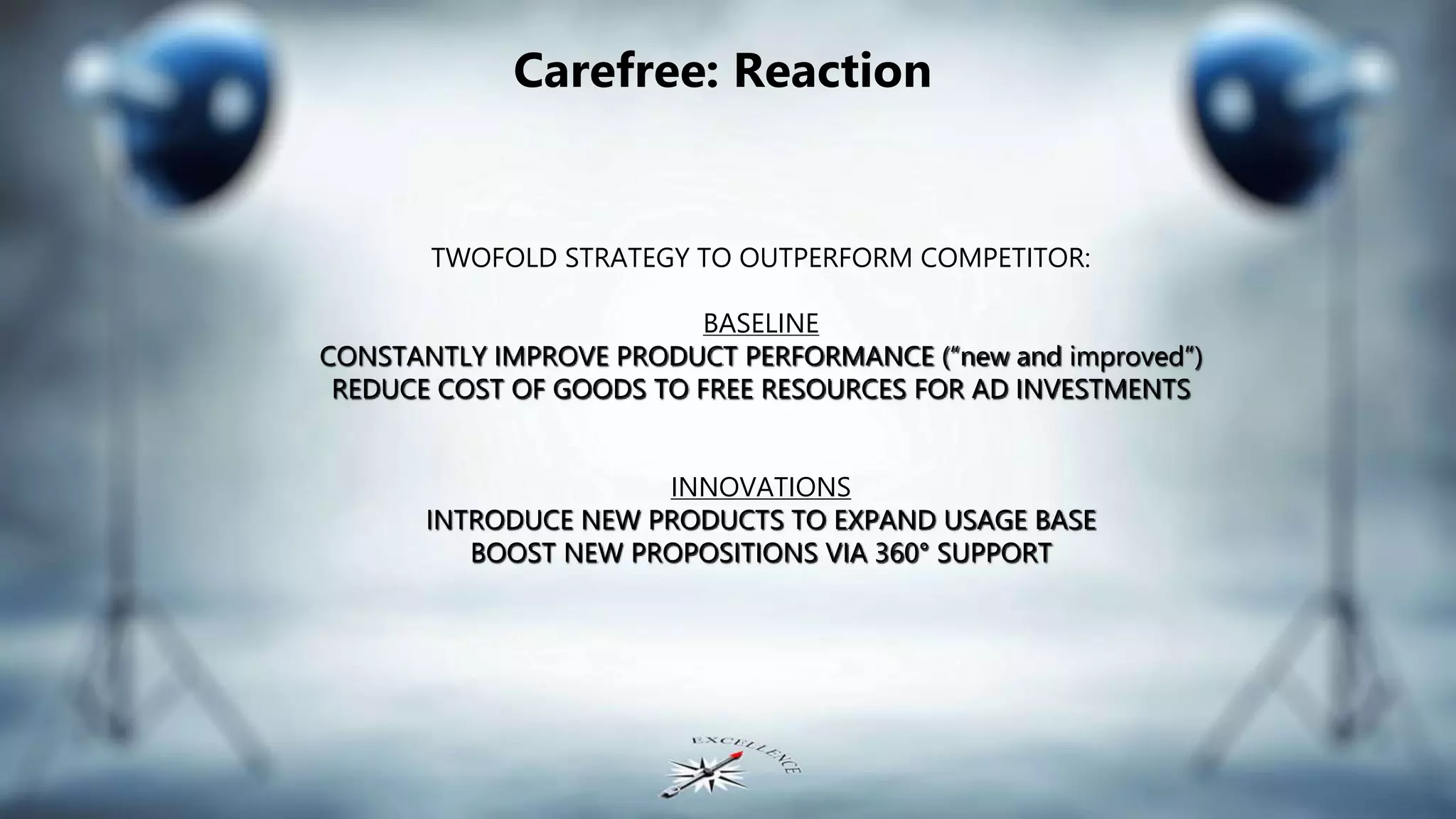
TWOFOLD STRATEGY TO OUTPERFORM COMPETITOR:
BASELINE
CONSTANTLY IMPROVE PRODUCT PERFORMANCE (“new and improved”)
REDUCE COST OF GOODS TO FREE RESOURCES FOR AD INVESTMENTS
INNOVATIONS
INTRODUCE NEW PRODUCTS TO EXPAND USAGE BASE
BOOST NEW PROPOSITIONS VIA 360° SUPPORT
2 Major Improvements in 2 Years
BEG 2000
Superiority & uniqueness
achieved through:
1) Product transpirability
2) Ergonomic shape
MID 2001
Superiority & uniqueness
achieved through:
1) New and softer cover
2) CottonFeel ™
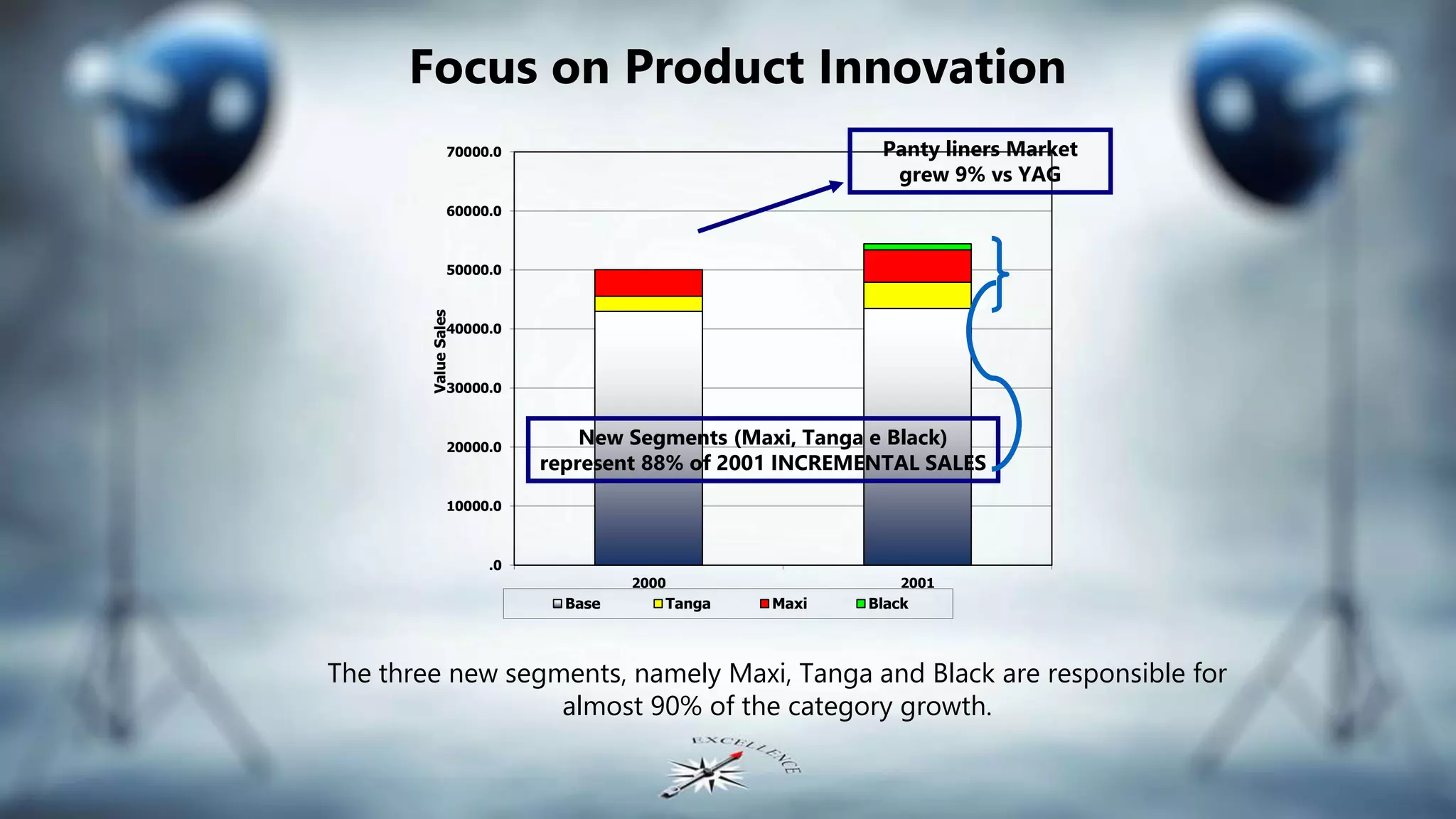
Focus on Product Innovation
.0
10000.0
20000.0
30000.0
40000.0
50000.0
60000.0
70000.0
2000 2001
ValueSales
Base Tanga Maxi Black
Panty liners Market
grew 9% vs YAG
New Segments (Maxi, Tanga e Black)
represent 88% of 2001 INCREMENTAL SALES
The three new segments, namely Maxi, Tanga and Black are responsible for
almost 90% of the category growth.
Carefree: 2 Years After Results
Follower
Generally characterized by a quick roll-out of leader’s new propositions (e.g. Private Labels).
Indirectly responsible of increased speed to market.
Three main options for followers:
1) Simply copy (easy, fast, proven succesful in the short term)
2) Copy to adapt (seeds of segmentation)
3) Copy to improve (leapfrog strategy – outpace competitors with the next generation poducts)
Johnson & Johnson case history: Johnson’s pH 5.5 Bath & Shower gels
How to expand in a very fragmented market building on solid Equity.
Market Potential Assessment
Revitalizing
Cleansing
Relaxing
Short
Self-caring
Soothing
Long
60% OF TOTAL
MARKET SALES
Energizing
Embellishment
Identify the Source of Business
Self-caring
Revitalizing
Cleansing
Relaxing
Short
Energizing
Soothing
Embellishment
Long
Johnson’s
(before)
Badedas
Nivea
Palmolive
NR
Dove
NR
Palmolive
Nivea
Johnson’s
(after)
Upgrade the Positioning
Benefit:
Cleanses and moisturises your skin, for a noticeably natural softness, lasting the whole day.
Reason why:
Contains natural milk and honey renown for their moisturizing and nourishing properties.
JOHNSON’S pH 5.5
“Naturally Soft”
Nicher
Niche strategy is recommended when:
1) Companies/Brands can’t afford to overtake entry barriers
2) There is the opportunity to sub-segment the Category
3) Company/Brand have a very specializied knowledge to capitalize on.
Johnson & Johnson Italy decided to enter the Facial Skin Care Market in 1999 with Clean&Clear
• Huge Market dominated by consolidated Brands (Nivea, Dove and Oil of Olay)
• Very fragmented category with propositions fulfilling barely every need
• Acne treatment still not fully expolited
• Clean & Clear positioned as the “teen skin specialist” at a premium price
• Currently well entrenched in the segments and constantly growing.
Recipe of Success
Innovation:
one of the few proven tools able to expand user’s and usage base.
In 2001 55% of revenues are coming from propositions introduced in the past three
years.
Product Superiority:
consumer perception of a better product (vs. competitors).
100% of new products introduced in the last five years conveyed superiority vs.
main competitor.
Cost Control:
a continuous program of cost reduction is the one and only way to have resources
to invest in advertising and R&D.
Gross Profit CAGR form 1999: 2 pts
Advertising Support:
Making consumers aware of the proposition features.
Incidence of advertising on sales increase in three years from 8 to more than 10%.

Strategies

  • 1.
  • 2.
    J&J Consumer Italy– early 2000’s Based in Santa Palomba, Rome-Italy, emploied 124 people It generated around $ 150 Mio Sales split into three major Categories 86,9 94,2 105,2 128,1 133,9 145,3 0 20 40 60 80 100 120 140 160 96 97 98 99 00 01 + 11% CAGR Women’s Health 20,3% Infant Care 34,8% Adult Skincare 44,9% It operated in 5 market segments with 5 different Brand Names SEGMENTS BRANDS 1. Baby Care Johnson’s Baby Shampoo, Johnson’s Baby Oil, Johnson’s Baby Wipes 2. Panty liners Carefree 3. Tampons O.B. 4. Body Care Johnson’s pH 5.5 Bath & Showers, Johnson’s pH 5.5 Deodorants 5. Facial Skin Care Clean&Clear
  • 3.
    LEADER CHALLANGER FOLLOWER FOLLOWERNICHER ALL OTHERS Johnson’s Brands Position LEADER CHALLANGER FOLLOWER FOLLOWER FOLLOWER FOLLOWER ALL OTHERS LEADER CHALLANGER FOLLOWER FOLLOWER ALL OTHERS BABY MARKET LINERS MARKET BODY CARE MARKET FACE CARE MARKET CAREFREE 26% CHALLANGER LEADER CHALLANGER FOLLOWER JOHNSON BABY 80% LEADER JOHNSON pH 5.5 6% FOLLOWER CLEAN & CLEAR 2% NICHER
  • 4.
    Theoretical Relation between MarketShare and Ranking Critical factors to be considered to assess the competitive strenght of a Brand: 1) concentration/fragmentation of the market – i.e. Share of the leader (s); 2) level of competitiveness of the players – i.e. multinationals vs. local manufacturers; 3) qualification of the “market” – i.e. segments/categories included/excluded. Market share thresholds have to be necessarily flexible. LEADER 40+ % CHALLENGER 30+ % FOLLOWER 20+ % NICHER 10+ %
  • 5.
    Strategic options toconsolidate market dominance. Further increase sales by: 1) recruiting new users (i.e. expand the consumer base) 2) stimulating new uses of the same proposition 3) enticing higher consumption (i.e. more frequent uses) Johnson & Johnson case history: Johnson’s Baby Oil How to turn a 1 million Us$ proposition into a 10 million Us$ business in 5 years Leader
  • 6.
    Johnson’s Baby Oil:History • Launched in March 1967 • Positioned as a baby product limited target: newborn only removing cradle cap and preventing skin irritation/redness narrow consumption pattern for occasional and diversified use infrequent usage occasions • Supported via consumer/trade promotions, no adverts IN 1996 JOHNSON’S BABY OIL WAS A MINOR PRODUCT OF THE BABY LINE WITH A MARGINAL SHARE IN THE MOISTURIZING CATEGORY
  • 7.
    • Re-positioned as anadult product broader target for superior moisturization (hydrates ten times more than creams and lotions) wider consumption pattern for daily use very frequent usage occasions • Packaging rejuvenation, appropriate sizing, dedicated, POS material Johnson’s Baby Oil: Re-Positioning
  • 8.
    Johnson’s Baby Oil:Ad Support Idx vs. PY Wks on Air GRP's 2001 150 14 1771 2000 141 8 1096 1999 178 7 1029 1998 129 4 697 1997 120 5 689
  • 9.
    Sales Market Share -% IRI Consumption per capita W.Dist’n Us$ K %B/(W) vs. PY Baby Adult Us $ cents % 1996 1006 10 80.8 n.a. 1.9 58 1997 1840 83 82.1 2.4 4.3 62 1998 2201 20 78.7 3.0 6.1 66 1999 4810 119 85.4 4.4 9.4 75 2000 6363 32 89.6 5.8 14.0 85 2001 10046 58 92.7 8.5 22.3 89 The Results: Sales & Share
  • 10.
    Challenger Several strategic optionsto buid up market share at the expense of the other players: 1) Introduce innovations targeting a new user’s base (i.e. expand the consumer base) 2) Improve dramatically value for money (i.e. better quality-higher price) 3) Outperform competitors in media pressure (i.e. nurture trial and frequency of consumption) 4) Progressively reduce price (i.e. start a “price war”) Johnson & Johnson case history: Carefree Panty Liners How to turn around a declining business.
  • 11.
    Carefree: History First Brandto be launched in late 70’s After 10 years of leadership a major competitor entered the market with a complete line up and started eroding share by: Introducing better performing propositions Investing massively in advertising (outpacing Carefree investments) DURING 90’s CAREFREE LOST 10 POINTS OF MARKET SHARE AND CATEGORY LEADERSHIP
  • 12.
    Carefree: Reaction TWOFOLD STRATEGYTO OUTPERFORM COMPETITOR: BASELINE CONSTANTLY IMPROVE PRODUCT PERFORMANCE (“new and improved”) REDUCE COST OF GOODS TO FREE RESOURCES FOR AD INVESTMENTS INNOVATIONS INTRODUCE NEW PRODUCTS TO EXPAND USAGE BASE BOOST NEW PROPOSITIONS VIA 360° SUPPORT
  • 13.
    2 Major Improvementsin 2 Years BEG 2000 Superiority & uniqueness achieved through: 1) Product transpirability 2) Ergonomic shape MID 2001 Superiority & uniqueness achieved through: 1) New and softer cover 2) CottonFeel ™
  • 14.
    Focus on ProductInnovation .0 10000.0 20000.0 30000.0 40000.0 50000.0 60000.0 70000.0 2000 2001 ValueSales Base Tanga Maxi Black Panty liners Market grew 9% vs YAG New Segments (Maxi, Tanga e Black) represent 88% of 2001 INCREMENTAL SALES The three new segments, namely Maxi, Tanga and Black are responsible for almost 90% of the category growth.
  • 15.
    Carefree: 2 YearsAfter Results
  • 16.
    Follower Generally characterized bya quick roll-out of leader’s new propositions (e.g. Private Labels). Indirectly responsible of increased speed to market. Three main options for followers: 1) Simply copy (easy, fast, proven succesful in the short term) 2) Copy to adapt (seeds of segmentation) 3) Copy to improve (leapfrog strategy – outpace competitors with the next generation poducts) Johnson & Johnson case history: Johnson’s pH 5.5 Bath & Shower gels How to expand in a very fragmented market building on solid Equity.
  • 17.
  • 18.
    Identify the Sourceof Business Self-caring Revitalizing Cleansing Relaxing Short Energizing Soothing Embellishment Long Johnson’s (before) Badedas Nivea Palmolive NR Dove NR Palmolive Nivea Johnson’s (after)
  • 19.
    Upgrade the Positioning Benefit: Cleansesand moisturises your skin, for a noticeably natural softness, lasting the whole day. Reason why: Contains natural milk and honey renown for their moisturizing and nourishing properties. JOHNSON’S pH 5.5 “Naturally Soft”
  • 20.
    Nicher Niche strategy isrecommended when: 1) Companies/Brands can’t afford to overtake entry barriers 2) There is the opportunity to sub-segment the Category 3) Company/Brand have a very specializied knowledge to capitalize on. Johnson & Johnson Italy decided to enter the Facial Skin Care Market in 1999 with Clean&Clear • Huge Market dominated by consolidated Brands (Nivea, Dove and Oil of Olay) • Very fragmented category with propositions fulfilling barely every need • Acne treatment still not fully expolited • Clean & Clear positioned as the “teen skin specialist” at a premium price • Currently well entrenched in the segments and constantly growing.
  • 21.
    Recipe of Success Innovation: oneof the few proven tools able to expand user’s and usage base. In 2001 55% of revenues are coming from propositions introduced in the past three years. Product Superiority: consumer perception of a better product (vs. competitors). 100% of new products introduced in the last five years conveyed superiority vs. main competitor. Cost Control: a continuous program of cost reduction is the one and only way to have resources to invest in advertising and R&D. Gross Profit CAGR form 1999: 2 pts Advertising Support: Making consumers aware of the proposition features. Incidence of advertising on sales increase in three years from 8 to more than 10%.