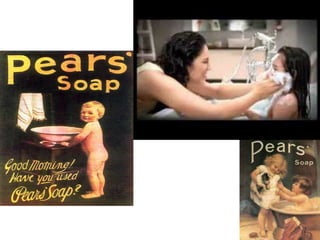
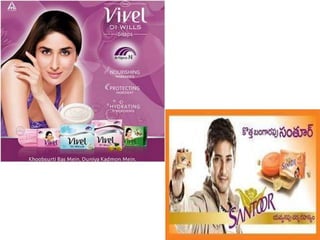








Soaps
Consumer
Behavior

Presented

By:
VijayKumar Mishra (98)
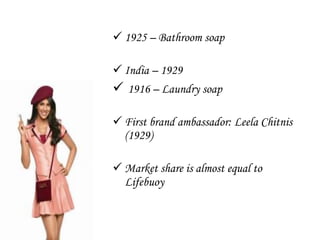
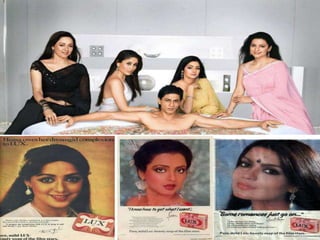
 1925 – Bathroom soap
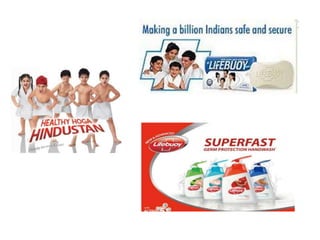
 India – 1929

 1916 – Laundry soap
 First brand ambassador: Leela Chitnis
(1929)
 Market share is almost equal to
Lifebuoy
•

•

•

•

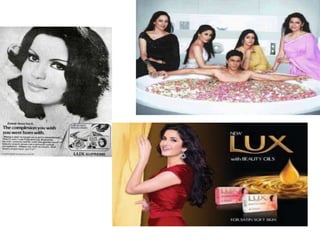
Strength
1. Strong market research (Door to door sampling – once in a year – Rural and Urban area)
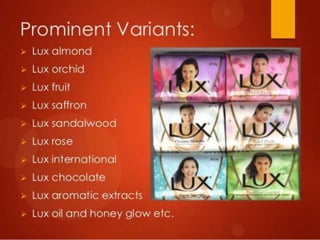
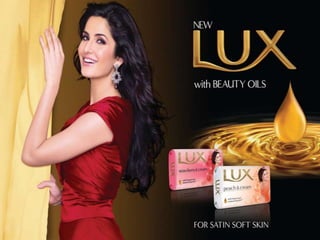
2. Many variants (Almond oil, Orchid extracts, Milk cream, Fruit extracts, Saffron
sandalwood oil and Honey)
3. Dynamically continuous innovations – New variants and innovative promotions (22 carat
gold coin promotion – “Chance Hai”)
4. Strong brand promotion but relatively lower prices – Winning combination
5. Lux soap brand is sold in over 100 countries.
Weakness
1.Mainly positioned as beauty soap targeted towards women, lack unisex appeal
2.Some variation like the sunscreen, international variant did not do well in the market
3.Not much popular in rural areas
Opportunity
1.Soap industry is growing by 10% in India
2.Liquid body wash is currently in growth stage – Lux should come out with more variants in
this segment
3.Large market share – Strong hold over the market
Threats
1.High internal competition (Pears – Beauty segment)
2.New entrants in this segment
3.Maturity stage – threat of slipping down to decline stage – if constant reinvention is not
carried out
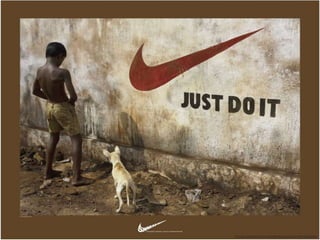
Godrej “Ganga”
 Ganga soap was launched with much
fanfare in 1993.
 Western Media's projection or prejudice.
 BBC & National geography.

 The soap attained salvation in the early
2000.
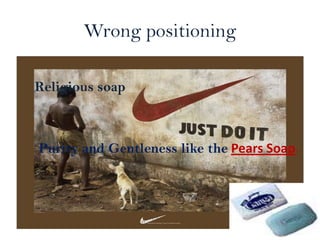
Wrong positioning
Religious soap

Purity and Gentleness like the Pears Soap.
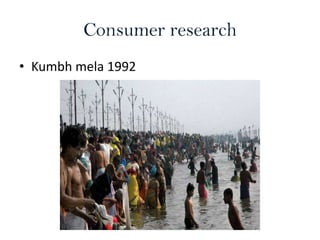
Consumer research
• Kumbh mela 1992
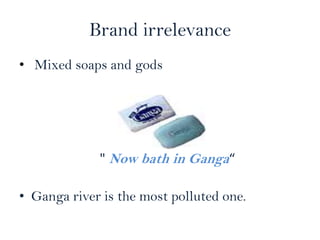
Brand irrelevance
• Mixed soaps and gods

" Now bath in Ganga“

• Ganga river is the most polluted one.
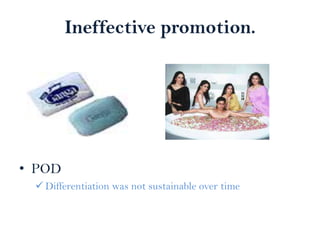
Ineffective promotion.

• POD
 Differentiation was not sustainable over time
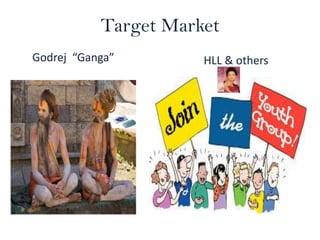
Target Market
Godrej “Ganga”

HLL & others
Results
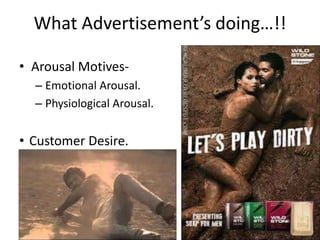
What Advertisement’s doing…!!
• Arousal Motives– Emotional Arousal.
– Physiological Arousal.

• Customer Desire.
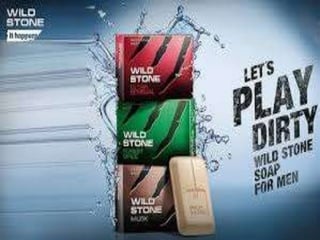
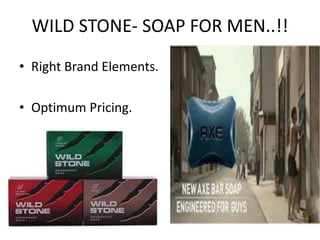
WILD STONE- SOAP FOR MEN..!!
• Right Brand Elements.
• Optimum Pricing.
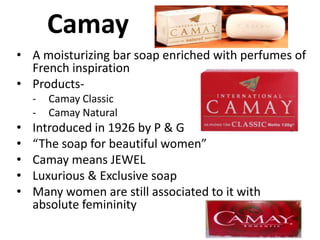
Camay
• A moisturizing bar soap enriched with perfumes of
French inspiration
• Products-

•
•
•
•
•

Camay Classic
Camay Natural

Introduced in 1926 by P & G
“The soap for beautiful women”
Camay means JEWEL
Luxurious & Exclusive soap
Many women are still associated to it with
absolute femininity
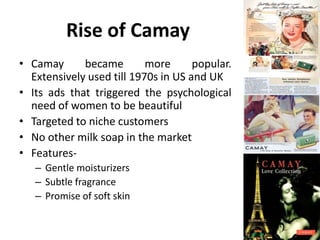
Rise of Camay
• Camay
became
more
popular.
Extensively used till 1970s in US and UK
• Its ads that triggered the psychological
need of women to be beautiful
• Targeted to niche customers
• No other milk soap in the market
• Features– Gentle moisturizers
– Subtle fragrance
– Promise of soft skin
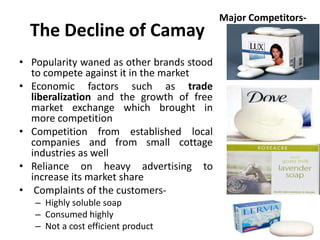
The Decline of Camay
• Popularity waned as other brands stood
to compete against it in the market
• Economic factors such as trade
liberalization and the growth of free
market exchange which brought in
more competition
• Competition from established local
companies and from small cottage
industries as well
• Reliance on heavy advertising to
increase its market share
• Complaints of the customers– Highly soluble soap
– Consumed highly
– Not a cost efficient product

Major Competitors-
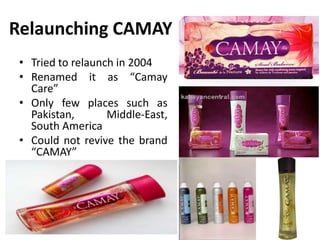
Relaunching CAMAY
• Tried to relaunch in 2004
• Renamed it as “Camay
Care”
• Only few places such as
Pakistan,
Middle-East,
South America
• Could not revive the brand
“CAMAY”
Evolution of brand ‘Dove’
•
•
•
•

1957- Launched in market
1970’s- Popularity increased as milder soap
1980’s- Started its global rollout
1990’s- “Litmus test” spots began in 1991Opened up to markets in 55 countries by 1994Sold in 80 countries by 1996
• 1995-2001- Extension of dove range of products
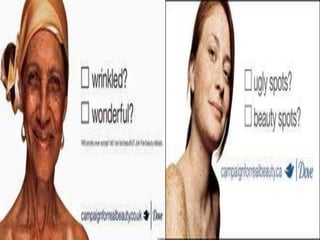
• 2002- Campaign for real beauty
• 2005- Self-Esteem campaign
Dove’s Identity
•
•
•
•

Feature- Moisturizing bar not a soap
Attributes- Exfoliates, calming
Colours- White, pink, light green
Benefits- Milder effect on skin, reliable for
daily use in the long-run
• Performance- High level of satisfaction for
users with dry skin
Dove Logo
• Dove logo is perfect representation of
softness, gentleness, sophistication
• Image of dove or peace pigeon symbolizes
purity and softness of a dove and its products
Tagline of a Dove
• The tagline changed from “one-quarter
cleansing cream” to “one-quarter moisturizing
cream”

• The tagline is also supported by the
advertising campaign which shows
moisturizing milk being poured into the bar
Dove Personality
• Feminity and Mildness- The brand, logo even
the tagline says that that it is simple and
feminine

• Self-acceptance and confidence- Enable
women to celebrate the real inner beauty and
beauty at every age
Dove Connect with intended
customers
• It’s not a soap. It’s a beauty bar
• It’s Ad campaign makes the user feel
pampered
• Real beauty campaign was able to connect
with women on an unmatched scale
Ad Campaign
• Campaign for real beauty
• Message- Real beauty can only be found on
the inside and every women deserves to feel
beautiful
• Image- Real beauty is portrayed by women
who do not have a sensuous model
• Result- A dialogue between Dove and its
consumers about the definition of beauty
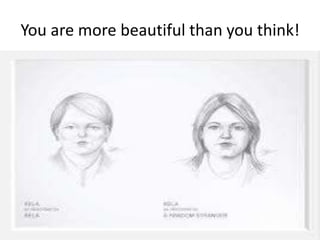
You are more beautiful than you think!
.

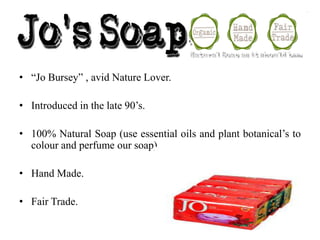
• “Jo Bursey” , avid Nature Lover.
• Introduced in the late 90’s.

• 100% Natural Soap (use essential oils and plant botanical’s to
colour and perfume our soap).
• Hand Made.
• Fair Trade.
.
Reasons For Failure
•
•
•
•
•

Poor marketing.
No Opinion Leader.
Less Volume.
Competitors.
Technological Disadvantage.

ConsumEr BEhaviour’s aFFECtED
i)
ii)
iii)
iv)

Economic
Cognitive
Passive
Emotional.
Soap ( cb)

Soap ( cb)

  • 1.
  • 15.
     1925 –Bathroom soap  India – 1929  1916 – Laundry soap  First brand ambassador: Leela Chitnis (1929)  Market share is almost equal to Lifebuoy
  • 20.
    • • • • Strength 1. Strong marketresearch (Door to door sampling – once in a year – Rural and Urban area) 2. Many variants (Almond oil, Orchid extracts, Milk cream, Fruit extracts, Saffron sandalwood oil and Honey) 3. Dynamically continuous innovations – New variants and innovative promotions (22 carat gold coin promotion – “Chance Hai”) 4. Strong brand promotion but relatively lower prices – Winning combination 5. Lux soap brand is sold in over 100 countries. Weakness 1.Mainly positioned as beauty soap targeted towards women, lack unisex appeal 2.Some variation like the sunscreen, international variant did not do well in the market 3.Not much popular in rural areas Opportunity 1.Soap industry is growing by 10% in India 2.Liquid body wash is currently in growth stage – Lux should come out with more variants in this segment 3.Large market share – Strong hold over the market Threats 1.High internal competition (Pears – Beauty segment) 2.New entrants in this segment 3.Maturity stage – threat of slipping down to decline stage – if constant reinvention is not carried out
  • 22.
    Godrej “Ganga”  Gangasoap was launched with much fanfare in 1993.  Western Media's projection or prejudice.  BBC & National geography.  The soap attained salvation in the early 2000.
  • 24.
    Wrong positioning Religious soap Purityand Gentleness like the Pears Soap.
  • 25.
  • 26.
    Brand irrelevance • Mixedsoaps and gods " Now bath in Ganga“ • Ganga river is the most polluted one.
  • 27.
    Ineffective promotion. • POD Differentiation was not sustainable over time
  • 28.
  • 29.
  • 31.
    What Advertisement’s doing…!! •Arousal Motives– Emotional Arousal. – Physiological Arousal. • Customer Desire.
  • 32.
    WILD STONE- SOAPFOR MEN..!! • Right Brand Elements. • Optimum Pricing.
  • 33.
    Camay • A moisturizingbar soap enriched with perfumes of French inspiration • Products- • • • • • Camay Classic Camay Natural Introduced in 1926 by P & G “The soap for beautiful women” Camay means JEWEL Luxurious & Exclusive soap Many women are still associated to it with absolute femininity
  • 34.
    Rise of Camay •Camay became more popular. Extensively used till 1970s in US and UK • Its ads that triggered the psychological need of women to be beautiful • Targeted to niche customers • No other milk soap in the market • Features– Gentle moisturizers – Subtle fragrance – Promise of soft skin
  • 35.
    The Decline ofCamay • Popularity waned as other brands stood to compete against it in the market • Economic factors such as trade liberalization and the growth of free market exchange which brought in more competition • Competition from established local companies and from small cottage industries as well • Reliance on heavy advertising to increase its market share • Complaints of the customers– Highly soluble soap – Consumed highly – Not a cost efficient product Major Competitors-
  • 36.
    Relaunching CAMAY • Triedto relaunch in 2004 • Renamed it as “Camay Care” • Only few places such as Pakistan, Middle-East, South America • Could not revive the brand “CAMAY”
  • 38.
    Evolution of brand‘Dove’ • • • • 1957- Launched in market 1970’s- Popularity increased as milder soap 1980’s- Started its global rollout 1990’s- “Litmus test” spots began in 1991Opened up to markets in 55 countries by 1994Sold in 80 countries by 1996 • 1995-2001- Extension of dove range of products • 2002- Campaign for real beauty • 2005- Self-Esteem campaign
  • 40.
    Dove’s Identity • • • • Feature- Moisturizingbar not a soap Attributes- Exfoliates, calming Colours- White, pink, light green Benefits- Milder effect on skin, reliable for daily use in the long-run • Performance- High level of satisfaction for users with dry skin
  • 41.
    Dove Logo • Dovelogo is perfect representation of softness, gentleness, sophistication • Image of dove or peace pigeon symbolizes purity and softness of a dove and its products
  • 42.
    Tagline of aDove • The tagline changed from “one-quarter cleansing cream” to “one-quarter moisturizing cream” • The tagline is also supported by the advertising campaign which shows moisturizing milk being poured into the bar
  • 43.
    Dove Personality • Feminityand Mildness- The brand, logo even the tagline says that that it is simple and feminine • Self-acceptance and confidence- Enable women to celebrate the real inner beauty and beauty at every age
  • 44.
    Dove Connect withintended customers • It’s not a soap. It’s a beauty bar • It’s Ad campaign makes the user feel pampered • Real beauty campaign was able to connect with women on an unmatched scale
  • 45.
    Ad Campaign • Campaignfor real beauty • Message- Real beauty can only be found on the inside and every women deserves to feel beautiful • Image- Real beauty is portrayed by women who do not have a sensuous model • Result- A dialogue between Dove and its consumers about the definition of beauty
  • 47.
    You are morebeautiful than you think!
  • 48.
    . • “Jo Bursey”, avid Nature Lover. • Introduced in the late 90’s. • 100% Natural Soap (use essential oils and plant botanical’s to colour and perfume our soap). • Hand Made. • Fair Trade.
  • 49.
  • 50.
    Reasons For Failure • • • • • Poormarketing. No Opinion Leader. Less Volume. Competitors. Technological Disadvantage. ConsumEr BEhaviour’s aFFECtED i) ii) iii) iv) Economic Cognitive Passive Emotional.