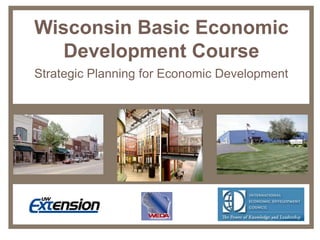
Wisconsin Basic Economic
   Development Course
Strategic Planning for Economic Development
Economic development is not the
 act of marketing industrial sites.
It is the art of building places that
           attract talented
people, business, innovation, and
             investment,
       in ways that benefit all
        community residents.

Strategic Planning  Wisconsin Basic Economic Development Course  Madison, Wisconsin  10-13 September 2012   2
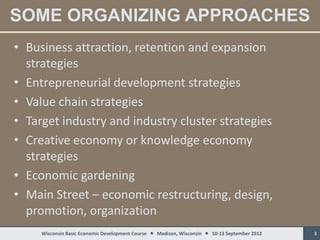
SOME ORGANIZING APPROACHES
• Business attraction, retention and expansion
  strategies
• Entrepreneurial development strategies
• Value chain strategies
• Target industry and industry cluster strategies
• Creative economy or knowledge economy
  strategies
• Economic gardening
• Main Street – economic restructuring, design,
  promotion, organization
     Wisconsin Basic Economic Development Course  Madison, Wisconsin  10-13 September 2012   3
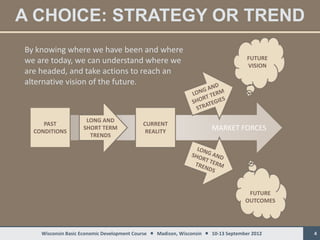
A CHOICE: STRATEGY OR TREND
By knowing where we have been and where
we are today, we can understand where we                                             FUTURE
                                                                                     VISION
are headed, and take actions to reach an
alternative vision of the future.


                     LONG AND
     PAST                                   CURRENT
  CONDITIONS
                    SHORT TERM
                                             REALITY                   MARKET FORCES
                      TRENDS


                                                                                     FUTURE
                                                                                    OUTCOMES


    Wisconsin Basic Economic Development Course  Madison, Wisconsin  10-13 September 2012    4
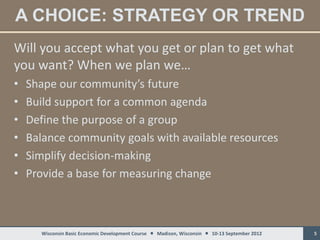
A CHOICE: STRATEGY OR TREND
Will you accept what you get or plan to get what
you want? When we plan we…
•   Shape our community’s future
•   Build support for a common agenda
•   Define the purpose of a group
•   Balance community goals with available resources
•   Simplify decision-making
•   Provide a base for measuring change


      Wisconsin Basic Economic Development Course  Madison, Wisconsin  10-13 September 2012   5
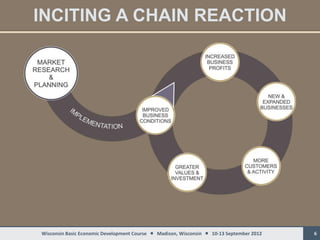
INCITING A CHAIN REACTION


Wisconsin Basic Economic Development Course  Madison, Wisconsin  10-13 September 2012   6
WHAT IS A STRATEGIC PLAN?
A “roadmap” to where your community can be.
•   Based on past and current situation and trends
•   Forward-looking
•   Vision based in reality
•   Defined by organizational mission and values
•   Establishes goals and objectives
•   Lays out key initiatives with action steps
•   Identifies needs and assigns responsibilities
•   Identifies measures and benchmarking standards
•   Includes a process for evaluation and adjustment
       Wisconsin Basic Economic Development Course  Madison, Wisconsin  10-13 September 2012   7
PRE-PLANNING ACTIONS
The following activities will set the stage for the
planning process:
• Determine who (individual or team) will convene the
  strategic planning process
• Establish a scope of work – what will be the result of
  the strategic planning process
• Determine who (internal or external) will conduct the
  strategic planning process
• Identify a methodology, activities, and schedule for the
  planning process

     Wisconsin Basic Economic Development Course  Madison, Wisconsin  10-13 September 2012   8
POTENTIAL STRUCTURES
• Project Management Team – Usually made up of staff,
  may work on plan elements or liaison with consultant
• Steering Committee – existing board or appointed
  committee overseeing process and providing direction
• Advisory Committee –broad representation to review
  issues and make recommendations
• Task Forces – made up of people with specialized skills
  or knowledge to oversee specific work activities
• Implementation Committee–a separate committee
  created to oversee the implementation process


     Wisconsin Basic Economic Development Course  Madison, Wisconsin  10-13 September 2012   9
SHOULD YOU USE A CONSULTANT?
• Advantages
  – Specialized knowledge and resources (ex., industries and
    approaches, access to databases and analytical software)
  – Brings an outside perspective
  – Experience with the planning process
  – Neutral party who may be able to build consensus
  – Can bring credibility to the plan
• Disadvantages
  – Differing quality of consultants and the effort they make
  – May miss the nuances of local politics
  – Cost (strategic plans will start at $20,000 for a simple one)

    Wisconsin Basic Economic Development Course  Madison, Wisconsin  10-13 September 2012   10
HAVE A COMMUNICATION PLAN
You need to manage how the story is told to the
community
• Create a relationship with the media
• Use the internet – website, blog, forum, email
• Publish periodic newsletters or flyers
• Talk to local organizations and at public meetings
• Post information – library, post office, government
  buildings, project sites, etc.
• Respond constructively to criticism


     Wisconsin Basic Economic Development Course  Madison, Wisconsin  10-13 September 2012   11
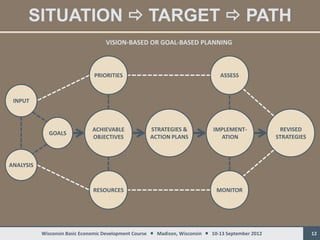
SITUATION  TARGET  PATH
                                    VISION-BASED OR GOAL-BASED PLANNING


                               PRIORITIES                                        ASSESS


 INPUT


                               ACHIEVABLE            STRATEGIES &             IMPLEMENT-              REVISED
             GOALS
                               OBJECTIVES            ACTION PLANS               ATION                STRATEGIES


ANALYSIS


                               RESOURCES                                        MONITOR


           Wisconsin Basic Economic Development Course  Madison, Wisconsin  10-13 September 2012                12
SCENARIO PLANNING
An approach used independently or with other planning
techniques
• Identify significant trends or external forces
• Imagine alternative futures and consider how they may
  impact the organization and its goals
• Suggest ways to respond to these scenarios
• Identify common threads in the responses
• Select the most likely changes and implement
  strategies to anticipate them


     Wisconsin Basic Economic Development Course  Madison, Wisconsin  10-13 September 2012   13
ISSUE-BASED PLANNING
Short term in nature; tends to be used when
organizations face internal challenges (ex., lack of
credibility, poor customer service perception)
•   Identify current issues facing the organization
•   Suggest reasonable approaches to address the issues
•   Compile adopted approaches into a plan
•   Monitor results and adjust as necessary


      Wisconsin Basic Economic Development Course  Madison, Wisconsin  10-13 September 2012   14
ALIGNMENT PLANNING
Short term in nature; often used to tweak
strategies or resolve internal conflicts or
inefficiencies
• Begin by outlining mission, programs, and required
  resources
• Identify what is working and what is not; consistencies
  and inconsistencies
• Determine what adjustments should be made


     Wisconsin Basic Economic Development Course  Madison, Wisconsin  10-13 September 2012   15
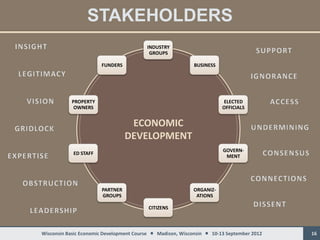
STAKEHOLDERS
                                         INDUSTRY
                                          GROUPS

                       FUNDERS                              BUSINESS


           PROPERTY                                                    ELECTED
            OWNERS                                                     OFFICIALS


                                  ECONOMIC
                                 DEVELOPMENT
                                                                       GOVERN-
            ED STAFF
                                                                        MENT


                       PARTNER                              ORGANIZ-
                       GROUPS                                ATIONS

                                          CITIZENS


Wisconsin Basic Economic Development Course  Madison, Wisconsin  10-13 September 2012   16
SEEKING STAKEHOLDER INPUT
•   Surveys – business/workforce/citizen
•   One-on-one interviews
•   Focus group sessions
•   Workshops or open house events
•   Exercises – targeted or general audiences
•   Public informational meetings or listening sessions
•   Blogs and online forums
•   Media monitoring


       Wisconsin Basic Economic Development Course  Madison, Wisconsin  10-13 September 2012   17
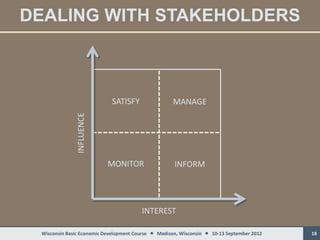
DEALING WITH STAKEHOLDERS


                            SATISFY                 MANAGE
               INFLUENCE


                           MONITOR                   INFORM


                                        INTEREST

 Wisconsin Basic Economic Development Course  Madison, Wisconsin  10-13 September 2012   18
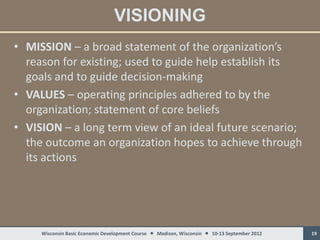
VISIONING
• MISSION – a broad statement of the organization’s
  reason for existing; used to guide help establish its
  goals and to guide decision-making
• VALUES – operating principles adhered to by the
  organization; statement of core beliefs
• VISION – a long term view of an ideal future scenario;
  the outcome an organization hopes to achieve through
  its actions


     Wisconsin Basic Economic Development Course  Madison, Wisconsin  10-13 September 2012   19
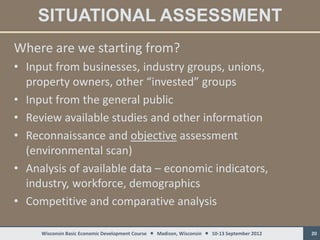
SITUATIONAL ASSESSMENT
Where are we starting from?
• Input from businesses, industry groups, unions,
  property owners, other “invested” groups
• Input from the general public
• Review available studies and other information
• Reconnaissance and objective assessment
  (environmental scan)
• Analysis of available data – economic indicators,
  industry, workforce, demographics
• Competitive and comparative analysis

     Wisconsin Basic Economic Development Course  Madison, Wisconsin  10-13 September 2012   20
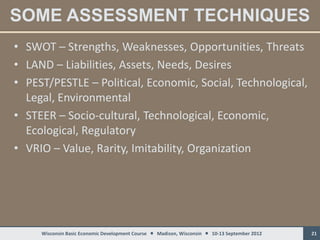
SOME ASSESSMENT TECHNIQUES
• SWOT – Strengths, Weaknesses, Opportunities, Threats
• LAND – Liabilities, Assets, Needs, Desires
• PEST/PESTLE – Political, Economic, Social, Technological,
  Legal, Environmental
• STEER – Socio-cultural, Technological, Economic,
  Ecological, Regulatory
• VRIO – Value, Rarity, Imitability, Organization


     Wisconsin Basic Economic Development Course  Madison, Wisconsin  10-13 September 2012   21
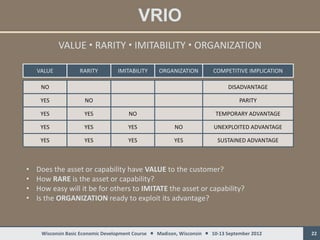
VRIO
            VALUE  RARITY  IMITABILITY  ORGANIZATION

    VALUE           RARITY         IMITABILITY     ORGANIZATION         COMPETITIVE IMPLICATION

     NO                                                                       DISADVANTAGE

     YES              NO                                                           PARITY

     YES             YES               NO                                TEMPORARY ADVANTAGE

     YES             YES               YES               NO              UNEXPLOITED ADVANTAGE

     YES             YES               YES               YES              SUSTAINED ADVANTAGE


•   Does the asset or capability have VALUE to the customer?
•   How RARE is the asset or capability?
•   How easy will it be for others to IMITATE the asset or capability?
•   Is the ORGANIZATION ready to exploit its advantage?


     Wisconsin Basic Economic Development Course  Madison, Wisconsin  10-13 September 2012      22
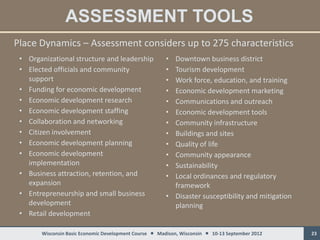
ASSESSMENT TOOLS
Place Dynamics – Assessment considers up to 275 characteristics
 • Organizational structure and leadership             • Downtown business district
 • Elected officials and community                     • Tourism development
   support                                             • Work force, education, and training
 • Funding for economic development                    • Economic development marketing
 • Economic development research                       • Communications and outreach
 • Economic development staffing                       • Economic development tools
 • Collaboration and networking                        • Community infrastructure
 • Citizen involvement                                 • Buildings and sites
 • Economic development planning                       • Quality of life
 • Economic development                                • Community appearance
   implementation                                      • Sustainability
 • Business attraction, retention, and                 • Local ordinances and regulatory
   expansion                                             framework
 • Entrepreneurship and small business                 • Disaster susceptibility and mitigation
   development                                           planning
 • Retail development

       Wisconsin Basic Economic Development Course  Madison, Wisconsin  10-13 September 2012    23
SETTING GOALS
Goal – the general purpose toward which an
endeavor is directed
• Long term, broader in scope, and may be intangible
  (as contrasted with objectives)
• Keep it simple – what, why, and how
• Keep it positive – focus on what you will achieve; not
  what you will avoid


     Wisconsin Basic Economic Development Course  Madison, Wisconsin  10-13 September 2012   24
DETERMINING OBJECTIVES
Objective – An observable outcome contributing to
the achievement of goals.
• SMART – Specific, Measurable, Achievable, Realistic,
  Timed
• By [DATE], [WHO] will [WHAT] resulting in [RESULTS] by [DATE].
• Have we anticipated obstacles?
• Is it already being done by some other group?
• Will it lead to constructive action?
• Will the results be commensurate with the effort?


      Wisconsin Basic Economic Development Course  Madison, Wisconsin  10-13 September 2012   25
GOAL/OBJECTIVE SETTING TOOLS
• Affinity Technique – process used in groups to identify
  issues and group them into related themes around which
  goals and objectives can be developed
• Nominal Process Technique – a tool used to gather
  stakeholder comments and jointly rank them
• Goal Grid – a tool used to sort issues and determine what
  to achieve, preserve, avoid, or eliminate
• CATWOE – a process for considering multiple viewpoints in
  decision-making


     Wisconsin Basic Economic Development Course  Madison, Wisconsin  10-13 September 2012   26
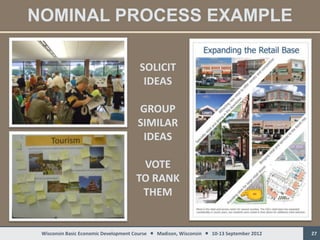
NOMINAL PROCESS EXAMPLE

                                       SOLICIT
                                        IDEAS

                                      GROUP
                                      SIMILAR
                                       IDEAS

                                       VOTE
                                      TO RANK
                                       THEM


 Wisconsin Basic Economic Development Course  Madison, Wisconsin  10-13 September 2012   27
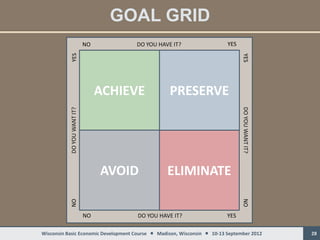
GOAL GRID
                             NO        DO YOU HAVE IT?                   YES


           YES


                                                                               YES
                                  ACHIEVE         PRESERVE


                                                                               DO YOU WANT IT?
           DO YOU WANT IT?


                                  AVOID          ELIMINATE


                                                                               NO
           NO


                             NO         DO YOU HAVE IT?                  YES

Wisconsin Basic Economic Development Course  Madison, Wisconsin  10-13 September 2012          28
CATWOE
• CUSTOMERS – beneficiaries of actions – may be several
  different groups
• ACTORS – people involved in implementation
• TRANSFORMATION – the changes that will result, inputs
  and outputs, process steps
• WORLD VIEW – the “big picture” into which the
  situation fits
• OWNER – decision makers, people who can help or
  hinder progress
• ENVIRONMENTAL CONSTRAINTS- logistical, technical,
  legal, financial, etc.
     Wisconsin Basic Economic Development Course  Madison, Wisconsin  10-13 September 2012   29
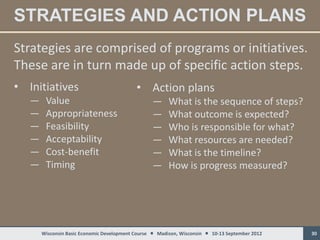
STRATEGIES AND ACTION PLANS
Strategies are comprised of programs or initiatives.
These are in turn made up of specific action steps.
• Initiatives                               • Action plans
   —    Value                                     —      What is the sequence of steps?
   —    Appropriateness                           —      What outcome is expected?
   —    Feasibility                               —      Who is responsible for what?
   —    Acceptability                             —      What resources are needed?
   —    Cost-benefit                              —      What is the timeline?
   —    Timing                                    —      How is progress measured?


       Wisconsin Basic Economic Development Course  Madison, Wisconsin  10-13 September 2012   30
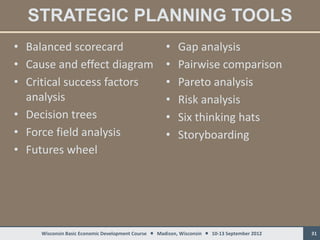
STRATEGIC PLANNING TOOLS
• Balanced scorecard                                  •   Gap analysis
• Cause and effect diagram                            •   Pairwise comparison
• Critical success factors                            •   Pareto analysis
  analysis                                            •   Risk analysis
• Decision trees                                      •   Six thinking hats
• Force field analysis                                •   Storyboarding
• Futures wheel


     Wisconsin Basic Economic Development Course  Madison, Wisconsin  10-13 September 2012   31
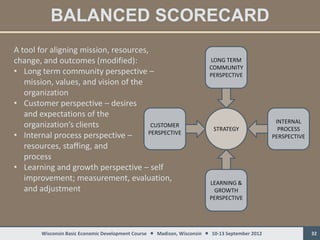
BALANCED SCORECARD
A tool for aligning mission, resources,
change, and outcomes (modified):                                          LONG TERM
                                                                          COMMUNITY
• Long term community perspective –                                       PERSPECTIVE
   mission, values, and vision of the
   organization
• Customer perspective – desires
   and expectations of the
                                                                                                   INTERNAL
   organization’s clients               CUSTOMER
                                                                           STRATEGY                 PROCESS
• Internal process perspective –       PERSPECTIVE
                                                                                                  PERSPECTIVE
   resources, staffing, and
   process
• Learning and growth perspective – self
   improvement; measurement, evaluation,                                  LEARNING &
   and adjustment                                                          GROWTH
                                                                          PERSPECTIVE


        Wisconsin Basic Economic Development Course  Madison, Wisconsin  10-13 September 2012                 32
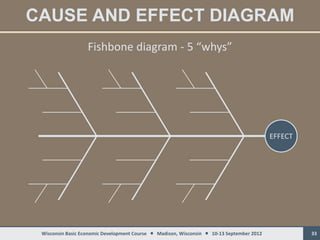
CAUSE AND EFFECT DIAGRAM
                   Fishbone diagram - 5 “whys”


                                                                                           EFFECT


 Wisconsin Basic Economic Development Course  Madison, Wisconsin  10-13 September 2012            33
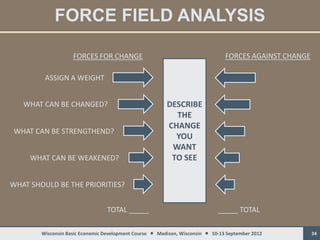
FORCE FIELD ANALYSIS

                    FORCES FOR CHANGE                                           FORCES AGAINST CHANGE

         ASSIGN A WEIGHT


   WHAT CAN BE CHANGED?                                  DESCRIBE
                                                           THE
                                                         CHANGE
 WHAT CAN BE STRENGTHEND?
                                                           YOU
                                                          WANT
     WHAT CAN BE WEAKENED?                                TO SEE

WHAT SHOULD BE THE PRIORITIES?


                                 TOTAL _____                                 _____ TOTAL

        Wisconsin Basic Economic Development Course  Madison, Wisconsin  10-13 September 2012         34
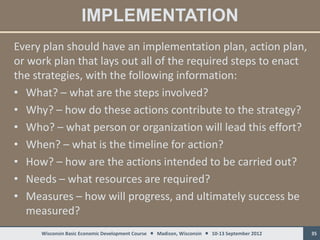
IMPLEMENTATION
Every plan should have an implementation plan, action plan,
or work plan that lays out all of the required steps to enact
the strategies, with the following information:
• What? – what are the steps involved?
• Why? – how do these actions contribute to the strategy?
• Who? – what person or organization will lead this effort?
• When? – what is the timeline for action?
• How? – how are the actions intended to be carried out?
• Needs – what resources are required?
• Measures – how will progress, and ultimately success be
   measured?
     Wisconsin Basic Economic Development Course  Madison, Wisconsin  10-13 September 2012   35
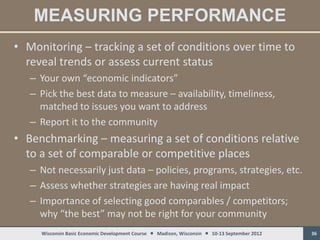
MEASURING PERFORMANCE
• Monitoring – tracking a set of conditions over time to
  reveal trends or assess current status
   – Your own “economic indicators”
   – Pick the best data to measure – availability, timeliness,
     matched to issues you want to address
   – Report it to the community
• Benchmarking – measuring a set of conditions relative
  to a set of comparable or competitive places
   – Not necessarily just data – policies, programs, strategies, etc.
   – Assess whether strategies are having real impact
   – Importance of selecting good comparables / competitors;
     why “the best” may not be right for your community
     Wisconsin Basic Economic Development Course  Madison, Wisconsin  10-13 September 2012   36
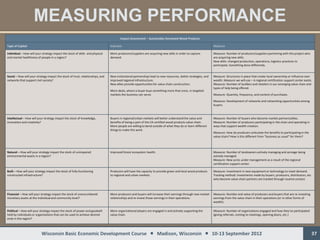
MEASURING PERFORMANCE
                                                                                       Impact Assessment – Sustainably Harvested Wood Products

Type of Capital                                                                 Indicator                                                                      Measure

Individual – How will your strategy impact the stock of skills and physical     More producers/suppliers are acquiring new skills in order to capture          Measure: Number of producers/suppliers partnering with this project who
and mental healthiness of people in a region?                                   demand.                                                                        are acquiring new skills.
                                                                                                                                                               New skills: changed production, operations, logistics practices to
                                                                                                                                                               participate. Something done differently.


Social – How will your strategy impact the stock of trust, relationships, and   New institutional partnerships lead to new resources, better strategies, and   Measure: Structures in place that create local ownership or influence over
networks that support civil society?                                            improved regional infrastructure.                                              wealth. Measure we will use – A regional certification support center exists.
                                                                                New allies provide opportunities for value chain construction.                 Measure: Number of builders and retailers in our emerging value chain and
                                                                                                                                                               types of help being offered.
                                                                                More deals, where a buyer buys something more than once, in targeted
                                                                                markets the business can serve.                                                Measure: Quantity, frequency, and content of purchases.

                                                                                                                                                               Measure: Development of networks and networking opportunities among
                                                                                                                                                               buyers.


Intellectual – How will your strategy impact the stock of knowledge,            Buyers in regional/urban markets will better understand the value and          Measure: Number of buyers who become market partners/allies.
innovation and creativity?                                                      benefits of being a part of the CA certified wood products value chain.        Measure: Number of producers participating in the chain and operating in
                                                                                More people are willing to bend outside of what they do or learn different     ways that support wealth creation.
                                                                                things to make this work.
                                                                                                                                                               Measure: How do producers articulate the benefits to participating in the
                                                                                                                                                               value chain? How is this different from “business as usual” for them?


Natural – How will your strategy impact the stock of unimpaired                 Improved forest ecosystem health.                                              Measure: Number of landowners actively managing and acreage being
environmental assets in a region?                                                                                                                              actively managed.
                                                                                                                                                               Measure: New acres under management as a result of the regional
                                                                                                                                                               certification support center.

Built – How will your strategy impact the stock of fully functioning            Producers will have the capacity to provide green and local wood products      Measure: Investment in new equipment or technology to meet demand.
constructed infrastructure?                                                     to regional and urban markets.                                                 Tracking method: Investments made by buyers, producers, distributors, etc.
                                                                                                                                                               who become value chain partners are tracked through routine contact.


Financial – How will your strategy impact the stock of unencumbered             More producers and buyers will increase their earnings through new market      Measure: Number and value of producers and buyers that are re-investing
monetary assets at the individual and community level?                          relationships and re-invest those earnings in their operations.                earnings from the value chain in their operations (or in other forms of
                                                                                                                                                               wealth).

Political – How will your strategy impact the stock of power and goodwill       More organizational players are engaged in and actively supporting the         Measure: Number of organizations engaged and how they’ve participated
held by individuals or organizations that can be used to achieve desired        value chain.                                                                   (giving referrals, coming to meetings, opening doors, etc.)
ends in the region?


                           Wisconsin Basic Economic Development Course  Madison, Wisconsin  10-13 September 2012                                                                                                                         37
EVALUATION & ADJUSTMENT
• Annual review
   – What is the current condition and how does it compare to last
     year, and the base year of the plan?
   – Have timelines been followed and initiatives been carried out
     as outlined in the plan?
   – Have the strategies and initiatives in the plan had the results
     that were anticipated?
   – Have circumstances changed significantly enough to warrant
     changes to the strategies?
• Five-year review
   – More comprehensive review of progress and conditions
   – Update goals, strategies, initiatives, work plan

     Wisconsin Basic Economic Development Course  Madison, Wisconsin  10-13 September 2012   38
KEYS TO SUCCESS
• Commitment from internal and external leadership
• Broad support from
  industry, organizations, partners, and the public at-
  large
• Basis in economic reality
• Attainable objectives linked to capability and funding
• Focused on the most appropriate activities
• Flexibility to adapt as circumstances change


     Wisconsin Basic Economic Development Course  Madison, Wisconsin  10-13 September 2012   39
FAILURE – PLANNING PROCESS
• Failure to develop an understanding of the procedure before the
  planning process begins
• Not providing meaningful engagement the people and
  organizations who will be impacted during the planning process
• Not including a broad cross-section of leadership in the planning
  process
• Failure to develop goals as a basis for planning
• Becoming engrossed in current problems and losing sight of the
  long term
• Creating a wish-list of action items, but failing to address key
  problems
• Failing to make realistic plans
• Focusing on short term measures that ignore long term issues

      Wisconsin Basic Economic Development Course  Madison, Wisconsin  10-13 September 2012   40
FAILURE - IMPLEMENTATION
• Failure to ensure that leaders understand what the plan is and
  what it can accomplish
• Not giving managers and department staff sufficient information
  and guidance to implement the plan
• Not incorporating the plan organization-wide to ensure
  consistent actions and decision-making
• Failing to use plans to measure the performance of those
  charged with implementation
• Doing periodic planning and then forgetting it – letting plans “sit
  on the shelf”
• And of course… it could be that the plan is just not very good


      Wisconsin Basic Economic Development Course  Madison, Wisconsin  10-13 September 2012   41
ADDRESSING SUSTAINABILITY
• ECONOMY – COMMUNITY – ENVIRONMENT
• It is more – much more – than promoting so-called
  “green industry” or green building practices
• How do we use our resources to maximize the benefit
  to all, both now and in the future?
• How do we build long term value and competitive
  advantage within our community and its businesses?
• POLICY COHERENCE – a great place to start


     Wisconsin Basic Economic Development Course  Madison, Wisconsin  10-13 September 2012   42
QUESTIONS?

                           MICHAEL STUMPF, CEcD, AICP
                           Principal – Place Dynamics LLC

                      Michael.stumpf@placedynamics.com

                                    (262) 510-2131
                                    (720) 413-5801

                              www.placedynamics.com


Wisconsin Basic Economic Development Course  Madison, Wisconsin  10-13 September 2012   43

Strategic Planning Presentation

  • 1.
    Wisconsin Basic Economic Development Course Strategic Planning for Economic Development
  • 2.
    Economic development isnot the act of marketing industrial sites. It is the art of building places that attract talented people, business, innovation, and investment, in ways that benefit all community residents. Strategic Planning  Wisconsin Basic Economic Development Course  Madison, Wisconsin  10-13 September 2012 2
  • 3.
    SOME ORGANIZING APPROACHES •Business attraction, retention and expansion strategies • Entrepreneurial development strategies • Value chain strategies • Target industry and industry cluster strategies • Creative economy or knowledge economy strategies • Economic gardening • Main Street – economic restructuring, design, promotion, organization Wisconsin Basic Economic Development Course  Madison, Wisconsin  10-13 September 2012 3
  • 4.
    A CHOICE: STRATEGYOR TREND By knowing where we have been and where we are today, we can understand where we FUTURE VISION are headed, and take actions to reach an alternative vision of the future. LONG AND PAST CURRENT CONDITIONS SHORT TERM REALITY MARKET FORCES TRENDS FUTURE OUTCOMES Wisconsin Basic Economic Development Course  Madison, Wisconsin  10-13 September 2012 4
  • 5.
    A CHOICE: STRATEGYOR TREND Will you accept what you get or plan to get what you want? When we plan we… • Shape our community’s future • Build support for a common agenda • Define the purpose of a group • Balance community goals with available resources • Simplify decision-making • Provide a base for measuring change Wisconsin Basic Economic Development Course  Madison, Wisconsin  10-13 September 2012 5
  • 6.
    INCITING A CHAINREACTION Wisconsin Basic Economic Development Course  Madison, Wisconsin  10-13 September 2012 6
  • 7.
    WHAT IS ASTRATEGIC PLAN? A “roadmap” to where your community can be. • Based on past and current situation and trends • Forward-looking • Vision based in reality • Defined by organizational mission and values • Establishes goals and objectives • Lays out key initiatives with action steps • Identifies needs and assigns responsibilities • Identifies measures and benchmarking standards • Includes a process for evaluation and adjustment Wisconsin Basic Economic Development Course  Madison, Wisconsin  10-13 September 2012 7
  • 8.
    PRE-PLANNING ACTIONS The followingactivities will set the stage for the planning process: • Determine who (individual or team) will convene the strategic planning process • Establish a scope of work – what will be the result of the strategic planning process • Determine who (internal or external) will conduct the strategic planning process • Identify a methodology, activities, and schedule for the planning process Wisconsin Basic Economic Development Course  Madison, Wisconsin  10-13 September 2012 8
  • 9.
    POTENTIAL STRUCTURES • ProjectManagement Team – Usually made up of staff, may work on plan elements or liaison with consultant • Steering Committee – existing board or appointed committee overseeing process and providing direction • Advisory Committee –broad representation to review issues and make recommendations • Task Forces – made up of people with specialized skills or knowledge to oversee specific work activities • Implementation Committee–a separate committee created to oversee the implementation process Wisconsin Basic Economic Development Course  Madison, Wisconsin  10-13 September 2012 9
  • 10.
    SHOULD YOU USEA CONSULTANT? • Advantages – Specialized knowledge and resources (ex., industries and approaches, access to databases and analytical software) – Brings an outside perspective – Experience with the planning process – Neutral party who may be able to build consensus – Can bring credibility to the plan • Disadvantages – Differing quality of consultants and the effort they make – May miss the nuances of local politics – Cost (strategic plans will start at $20,000 for a simple one) Wisconsin Basic Economic Development Course  Madison, Wisconsin  10-13 September 2012 10
  • 11.
    HAVE A COMMUNICATIONPLAN You need to manage how the story is told to the community • Create a relationship with the media • Use the internet – website, blog, forum, email • Publish periodic newsletters or flyers • Talk to local organizations and at public meetings • Post information – library, post office, government buildings, project sites, etc. • Respond constructively to criticism Wisconsin Basic Economic Development Course  Madison, Wisconsin  10-13 September 2012 11
  • 12.
    SITUATION  TARGET PATH VISION-BASED OR GOAL-BASED PLANNING PRIORITIES ASSESS INPUT ACHIEVABLE STRATEGIES & IMPLEMENT- REVISED GOALS OBJECTIVES ACTION PLANS ATION STRATEGIES ANALYSIS RESOURCES MONITOR Wisconsin Basic Economic Development Course  Madison, Wisconsin  10-13 September 2012 12
  • 13.
    SCENARIO PLANNING An approachused independently or with other planning techniques • Identify significant trends or external forces • Imagine alternative futures and consider how they may impact the organization and its goals • Suggest ways to respond to these scenarios • Identify common threads in the responses • Select the most likely changes and implement strategies to anticipate them Wisconsin Basic Economic Development Course  Madison, Wisconsin  10-13 September 2012 13
  • 14.
    ISSUE-BASED PLANNING Short termin nature; tends to be used when organizations face internal challenges (ex., lack of credibility, poor customer service perception) • Identify current issues facing the organization • Suggest reasonable approaches to address the issues • Compile adopted approaches into a plan • Monitor results and adjust as necessary Wisconsin Basic Economic Development Course  Madison, Wisconsin  10-13 September 2012 14
  • 15.
    ALIGNMENT PLANNING Short termin nature; often used to tweak strategies or resolve internal conflicts or inefficiencies • Begin by outlining mission, programs, and required resources • Identify what is working and what is not; consistencies and inconsistencies • Determine what adjustments should be made Wisconsin Basic Economic Development Course  Madison, Wisconsin  10-13 September 2012 15
  • 16.
    STAKEHOLDERS INDUSTRY GROUPS FUNDERS BUSINESS PROPERTY ELECTED OWNERS OFFICIALS ECONOMIC DEVELOPMENT GOVERN- ED STAFF MENT PARTNER ORGANIZ- GROUPS ATIONS CITIZENS Wisconsin Basic Economic Development Course  Madison, Wisconsin  10-13 September 2012 16
  • 17.
    SEEKING STAKEHOLDER INPUT • Surveys – business/workforce/citizen • One-on-one interviews • Focus group sessions • Workshops or open house events • Exercises – targeted or general audiences • Public informational meetings or listening sessions • Blogs and online forums • Media monitoring Wisconsin Basic Economic Development Course  Madison, Wisconsin  10-13 September 2012 17
  • 18.
    DEALING WITH STAKEHOLDERS SATISFY MANAGE INFLUENCE MONITOR INFORM INTEREST Wisconsin Basic Economic Development Course  Madison, Wisconsin  10-13 September 2012 18
  • 19.
    VISIONING • MISSION –a broad statement of the organization’s reason for existing; used to guide help establish its goals and to guide decision-making • VALUES – operating principles adhered to by the organization; statement of core beliefs • VISION – a long term view of an ideal future scenario; the outcome an organization hopes to achieve through its actions Wisconsin Basic Economic Development Course  Madison, Wisconsin  10-13 September 2012 19
  • 20.
    SITUATIONAL ASSESSMENT Where arewe starting from? • Input from businesses, industry groups, unions, property owners, other “invested” groups • Input from the general public • Review available studies and other information • Reconnaissance and objective assessment (environmental scan) • Analysis of available data – economic indicators, industry, workforce, demographics • Competitive and comparative analysis Wisconsin Basic Economic Development Course  Madison, Wisconsin  10-13 September 2012 20
  • 21.
    SOME ASSESSMENT TECHNIQUES •SWOT – Strengths, Weaknesses, Opportunities, Threats • LAND – Liabilities, Assets, Needs, Desires • PEST/PESTLE – Political, Economic, Social, Technological, Legal, Environmental • STEER – Socio-cultural, Technological, Economic, Ecological, Regulatory • VRIO – Value, Rarity, Imitability, Organization Wisconsin Basic Economic Development Course  Madison, Wisconsin  10-13 September 2012 21
  • 22.
    VRIO VALUE  RARITY  IMITABILITY  ORGANIZATION VALUE RARITY IMITABILITY ORGANIZATION COMPETITIVE IMPLICATION NO DISADVANTAGE YES NO PARITY YES YES NO TEMPORARY ADVANTAGE YES YES YES NO UNEXPLOITED ADVANTAGE YES YES YES YES SUSTAINED ADVANTAGE • Does the asset or capability have VALUE to the customer? • How RARE is the asset or capability? • How easy will it be for others to IMITATE the asset or capability? • Is the ORGANIZATION ready to exploit its advantage? Wisconsin Basic Economic Development Course  Madison, Wisconsin  10-13 September 2012 22
  • 23.
    ASSESSMENT TOOLS Place Dynamics– Assessment considers up to 275 characteristics • Organizational structure and leadership • Downtown business district • Elected officials and community • Tourism development support • Work force, education, and training • Funding for economic development • Economic development marketing • Economic development research • Communications and outreach • Economic development staffing • Economic development tools • Collaboration and networking • Community infrastructure • Citizen involvement • Buildings and sites • Economic development planning • Quality of life • Economic development • Community appearance implementation • Sustainability • Business attraction, retention, and • Local ordinances and regulatory expansion framework • Entrepreneurship and small business • Disaster susceptibility and mitigation development planning • Retail development Wisconsin Basic Economic Development Course  Madison, Wisconsin  10-13 September 2012 23
  • 24.
    SETTING GOALS Goal –the general purpose toward which an endeavor is directed • Long term, broader in scope, and may be intangible (as contrasted with objectives) • Keep it simple – what, why, and how • Keep it positive – focus on what you will achieve; not what you will avoid Wisconsin Basic Economic Development Course  Madison, Wisconsin  10-13 September 2012 24
  • 25.
    DETERMINING OBJECTIVES Objective –An observable outcome contributing to the achievement of goals. • SMART – Specific, Measurable, Achievable, Realistic, Timed • By [DATE], [WHO] will [WHAT] resulting in [RESULTS] by [DATE]. • Have we anticipated obstacles? • Is it already being done by some other group? • Will it lead to constructive action? • Will the results be commensurate with the effort? Wisconsin Basic Economic Development Course  Madison, Wisconsin  10-13 September 2012 25
  • 26.
    GOAL/OBJECTIVE SETTING TOOLS •Affinity Technique – process used in groups to identify issues and group them into related themes around which goals and objectives can be developed • Nominal Process Technique – a tool used to gather stakeholder comments and jointly rank them • Goal Grid – a tool used to sort issues and determine what to achieve, preserve, avoid, or eliminate • CATWOE – a process for considering multiple viewpoints in decision-making Wisconsin Basic Economic Development Course  Madison, Wisconsin  10-13 September 2012 26
  • 27.
    NOMINAL PROCESS EXAMPLE SOLICIT IDEAS GROUP SIMILAR IDEAS VOTE TO RANK THEM Wisconsin Basic Economic Development Course  Madison, Wisconsin  10-13 September 2012 27
  • 28.
    GOAL GRID NO DO YOU HAVE IT? YES YES YES ACHIEVE PRESERVE DO YOU WANT IT? DO YOU WANT IT? AVOID ELIMINATE NO NO NO DO YOU HAVE IT? YES Wisconsin Basic Economic Development Course  Madison, Wisconsin  10-13 September 2012 28
  • 29.
    CATWOE • CUSTOMERS –beneficiaries of actions – may be several different groups • ACTORS – people involved in implementation • TRANSFORMATION – the changes that will result, inputs and outputs, process steps • WORLD VIEW – the “big picture” into which the situation fits • OWNER – decision makers, people who can help or hinder progress • ENVIRONMENTAL CONSTRAINTS- logistical, technical, legal, financial, etc. Wisconsin Basic Economic Development Course  Madison, Wisconsin  10-13 September 2012 29
  • 30.
    STRATEGIES AND ACTIONPLANS Strategies are comprised of programs or initiatives. These are in turn made up of specific action steps. • Initiatives • Action plans — Value — What is the sequence of steps? — Appropriateness — What outcome is expected? — Feasibility — Who is responsible for what? — Acceptability — What resources are needed? — Cost-benefit — What is the timeline? — Timing — How is progress measured? Wisconsin Basic Economic Development Course  Madison, Wisconsin  10-13 September 2012 30
  • 31.
    STRATEGIC PLANNING TOOLS •Balanced scorecard • Gap analysis • Cause and effect diagram • Pairwise comparison • Critical success factors • Pareto analysis analysis • Risk analysis • Decision trees • Six thinking hats • Force field analysis • Storyboarding • Futures wheel Wisconsin Basic Economic Development Course  Madison, Wisconsin  10-13 September 2012 31
  • 32.
    BALANCED SCORECARD A toolfor aligning mission, resources, change, and outcomes (modified): LONG TERM COMMUNITY • Long term community perspective – PERSPECTIVE mission, values, and vision of the organization • Customer perspective – desires and expectations of the INTERNAL organization’s clients CUSTOMER STRATEGY PROCESS • Internal process perspective – PERSPECTIVE PERSPECTIVE resources, staffing, and process • Learning and growth perspective – self improvement; measurement, evaluation, LEARNING & and adjustment GROWTH PERSPECTIVE Wisconsin Basic Economic Development Course  Madison, Wisconsin  10-13 September 2012 32
  • 33.
    CAUSE AND EFFECTDIAGRAM Fishbone diagram - 5 “whys” EFFECT Wisconsin Basic Economic Development Course  Madison, Wisconsin  10-13 September 2012 33
  • 34.
    FORCE FIELD ANALYSIS FORCES FOR CHANGE FORCES AGAINST CHANGE ASSIGN A WEIGHT WHAT CAN BE CHANGED? DESCRIBE THE CHANGE WHAT CAN BE STRENGTHEND? YOU WANT WHAT CAN BE WEAKENED? TO SEE WHAT SHOULD BE THE PRIORITIES? TOTAL _____ _____ TOTAL Wisconsin Basic Economic Development Course  Madison, Wisconsin  10-13 September 2012 34
  • 35.
    IMPLEMENTATION Every plan shouldhave an implementation plan, action plan, or work plan that lays out all of the required steps to enact the strategies, with the following information: • What? – what are the steps involved? • Why? – how do these actions contribute to the strategy? • Who? – what person or organization will lead this effort? • When? – what is the timeline for action? • How? – how are the actions intended to be carried out? • Needs – what resources are required? • Measures – how will progress, and ultimately success be measured? Wisconsin Basic Economic Development Course  Madison, Wisconsin  10-13 September 2012 35
  • 36.
    MEASURING PERFORMANCE • Monitoring– tracking a set of conditions over time to reveal trends or assess current status – Your own “economic indicators” – Pick the best data to measure – availability, timeliness, matched to issues you want to address – Report it to the community • Benchmarking – measuring a set of conditions relative to a set of comparable or competitive places – Not necessarily just data – policies, programs, strategies, etc. – Assess whether strategies are having real impact – Importance of selecting good comparables / competitors; why “the best” may not be right for your community Wisconsin Basic Economic Development Course  Madison, Wisconsin  10-13 September 2012 36
  • 37.
    MEASURING PERFORMANCE Impact Assessment – Sustainably Harvested Wood Products Type of Capital Indicator Measure Individual – How will your strategy impact the stock of skills and physical More producers/suppliers are acquiring new skills in order to capture Measure: Number of producers/suppliers partnering with this project who and mental healthiness of people in a region? demand. are acquiring new skills. New skills: changed production, operations, logistics practices to participate. Something done differently. Social – How will your strategy impact the stock of trust, relationships, and New institutional partnerships lead to new resources, better strategies, and Measure: Structures in place that create local ownership or influence over networks that support civil society? improved regional infrastructure. wealth. Measure we will use – A regional certification support center exists. New allies provide opportunities for value chain construction. Measure: Number of builders and retailers in our emerging value chain and types of help being offered. More deals, where a buyer buys something more than once, in targeted markets the business can serve. Measure: Quantity, frequency, and content of purchases. Measure: Development of networks and networking opportunities among buyers. Intellectual – How will your strategy impact the stock of knowledge, Buyers in regional/urban markets will better understand the value and Measure: Number of buyers who become market partners/allies. innovation and creativity? benefits of being a part of the CA certified wood products value chain. Measure: Number of producers participating in the chain and operating in More people are willing to bend outside of what they do or learn different ways that support wealth creation. things to make this work. Measure: How do producers articulate the benefits to participating in the value chain? How is this different from “business as usual” for them? Natural – How will your strategy impact the stock of unimpaired Improved forest ecosystem health. Measure: Number of landowners actively managing and acreage being environmental assets in a region? actively managed. Measure: New acres under management as a result of the regional certification support center. Built – How will your strategy impact the stock of fully functioning Producers will have the capacity to provide green and local wood products Measure: Investment in new equipment or technology to meet demand. constructed infrastructure? to regional and urban markets. Tracking method: Investments made by buyers, producers, distributors, etc. who become value chain partners are tracked through routine contact. Financial – How will your strategy impact the stock of unencumbered More producers and buyers will increase their earnings through new market Measure: Number and value of producers and buyers that are re-investing monetary assets at the individual and community level? relationships and re-invest those earnings in their operations. earnings from the value chain in their operations (or in other forms of wealth). Political – How will your strategy impact the stock of power and goodwill More organizational players are engaged in and actively supporting the Measure: Number of organizations engaged and how they’ve participated held by individuals or organizations that can be used to achieve desired value chain. (giving referrals, coming to meetings, opening doors, etc.) ends in the region? Wisconsin Basic Economic Development Course  Madison, Wisconsin  10-13 September 2012 37
  • 38.
    EVALUATION & ADJUSTMENT •Annual review – What is the current condition and how does it compare to last year, and the base year of the plan? – Have timelines been followed and initiatives been carried out as outlined in the plan? – Have the strategies and initiatives in the plan had the results that were anticipated? – Have circumstances changed significantly enough to warrant changes to the strategies? • Five-year review – More comprehensive review of progress and conditions – Update goals, strategies, initiatives, work plan Wisconsin Basic Economic Development Course  Madison, Wisconsin  10-13 September 2012 38
  • 39.
    KEYS TO SUCCESS •Commitment from internal and external leadership • Broad support from industry, organizations, partners, and the public at- large • Basis in economic reality • Attainable objectives linked to capability and funding • Focused on the most appropriate activities • Flexibility to adapt as circumstances change Wisconsin Basic Economic Development Course  Madison, Wisconsin  10-13 September 2012 39
  • 40.
    FAILURE – PLANNINGPROCESS • Failure to develop an understanding of the procedure before the planning process begins • Not providing meaningful engagement the people and organizations who will be impacted during the planning process • Not including a broad cross-section of leadership in the planning process • Failure to develop goals as a basis for planning • Becoming engrossed in current problems and losing sight of the long term • Creating a wish-list of action items, but failing to address key problems • Failing to make realistic plans • Focusing on short term measures that ignore long term issues Wisconsin Basic Economic Development Course  Madison, Wisconsin  10-13 September 2012 40
  • 41.
    FAILURE - IMPLEMENTATION •Failure to ensure that leaders understand what the plan is and what it can accomplish • Not giving managers and department staff sufficient information and guidance to implement the plan • Not incorporating the plan organization-wide to ensure consistent actions and decision-making • Failing to use plans to measure the performance of those charged with implementation • Doing periodic planning and then forgetting it – letting plans “sit on the shelf” • And of course… it could be that the plan is just not very good Wisconsin Basic Economic Development Course  Madison, Wisconsin  10-13 September 2012 41
  • 42.
    ADDRESSING SUSTAINABILITY • ECONOMY– COMMUNITY – ENVIRONMENT • It is more – much more – than promoting so-called “green industry” or green building practices • How do we use our resources to maximize the benefit to all, both now and in the future? • How do we build long term value and competitive advantage within our community and its businesses? • POLICY COHERENCE – a great place to start Wisconsin Basic Economic Development Course  Madison, Wisconsin  10-13 September 2012 42
  • 43.
    QUESTIONS? MICHAEL STUMPF, CEcD, AICP Principal – Place Dynamics LLC Michael.stumpf@placedynamics.com (262) 510-2131 (720) 413-5801 www.placedynamics.com Wisconsin Basic Economic Development Course  Madison, Wisconsin  10-13 September 2012 43