
Chapter 1
Strategic management
Defining strategic management
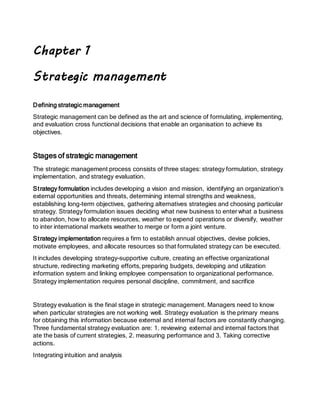
Strategic management can be defined as the art and science of formulating, implementing,
and evaluation cross functional decisions that enable an organisation to achieve its
objectives.
Stages of strategic management
The strategic management process consists of three stages: strategy formulation, strategy
implementation, and strategy evaluation.
Strategy formulation includes developing a vision and mission, identifying an organization’s
external opportunities and threats, determining internal strengths and weakness,
establishing long-term objectives, gathering alternatives strategies and choosing particular
strategy. Strategy formulation issues deciding what new business to enter what a business
to abandon, how to allocate resources, weather to expend operations or diversify, weather
to inter international markets weather to merge or form a joint venture.
Strategy implementation requires a firm to establish annual objectives, devise policies,
motivate employees, and allocate resources so that formulated strategy can be executed.
It includes developing strategy-supportive culture, creating an effective organizational
structure, redirecting marketing efforts, preparing budgets, developing and utilization
information system and linking employee compensation to organizational performance.
Strategy implementation requires personal discipline, commitment, and sacrifice
Strategy evaluation is the final stage in strategic management. Managers need to know
when particular strategies are not working well. Strategy evaluation is the primary means
for obtaining this information because external and internal factors are constantly changing.
Three fundamental strategy evaluation are: 1. reviewing external and internal factors that
ate the basis of current strategies, 2. measuring performance and 3. Taking corrective
actions.
Integrating intuition and analysis
2 | P a g e
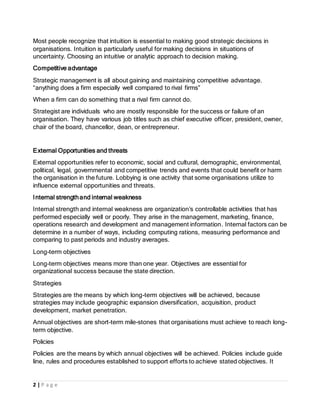
Most people recognize that intuition is essential to making good strategic decisions in
organisations. Intuition is particularly useful for making decisions in situations of
uncertainty. Choosing an intuitive or analytic approach to decision making.
Competitive advantage
Strategic management is all about gaining and maintaining competitive advantage.
“anything does a firm especially well compared to rival firms”
When a firm can do something that a rival firm cannot do.
Strategist are individuals who are mostly responsible for the success or failure of an
organisation. They have various job titles such as chief executive officer, president, owner,
chair of the board, chancellor, dean, or entrepreneur.
External Opportunities and threats
External opportunities refer to economic, social and cultural, demographic, environmental,
political, legal, governmental and competitive trends and events that could benefit or harm
the organisation in the future. Lobbying is one activity that some organisations utilize to
influence external opportunities and threats.
Internal strengthand internal weakness
Internal strength and internal weakness are organization’s controllable activities that has
performed especially well or poorly. They arise in the management, marketing, finance,
operations research and development and management information. Internal factors can be
determine in a number of ways, including computing rations, measuring performance and
comparing to past periods and industry averages.
Long-term objectives
Long-term objectives means more than one year. Objectives are essential for
organizational success because the state direction.
Strategies
Strategies are the means by which long-term objectives will be achieved, because
strategies may include geographic expansion diversification, acquisition, product
development, market penetration.
Annual objectives are short-term mile-stones that organisations must achieve to reach long-
term objective.
Policies
Policies are the means by which annual objectives will be achieved. Policies include guide
line, rules and procedures established to support efforts to achieve stated objectives. It
3 | P a g e
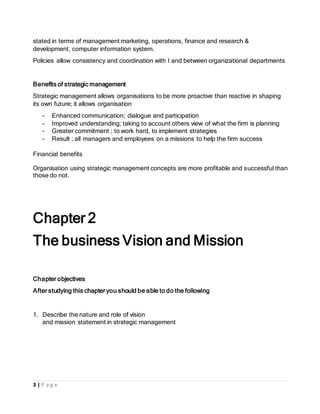
stated in terms of management marketing, operations, finance and research &
development, computer information system.
Policies allow consistency and coordination with I and between organizational departments
Benefits of strategic management
Strategic management allows organisations to be more proactive than reactive in shaping
its own future; it allows organisation
- Enhanced communication; dialogue and participation
- Improved understanding; taking to account others view of what the firm is planning
- Greater commitment ; to work hard, to implement strategies
- Result ; all managers and employees on a missions to help the firm success
Financial benefits
Organisation using strategic management concepts are more profitable and successful than
those do not.
Chapter 2
The business Vision and Mission
Chapter objectives
After studying this chapter you should be able to do the following
1. Describe the nature and role of vision
and mission statement in strategic management
4 | P a g e
What do we want to become?
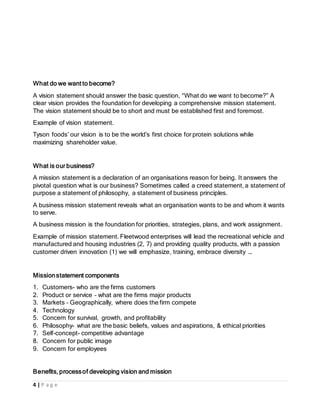
A vision statement should answer the basic question, “What do we want to become?” A
clear vision provides the foundation for developing a comprehensive mission statement.
The vision statement should be to short and must be established first and foremost.
Example of vision statement.
Tyson foods’ our vision is to be the world’s first choice for protein solutions while
maximizing shareholder value.
What is our business?
A mission statement is a declaration of an organisations reason for being. It answers the
pivotal question what is our business? Sometimes called a creed statement, a statement of
purpose a statement of philosophy, a statement of business principles.
A business mission statement reveals what an organisation wants to be and whom it wants
to serve.
A business mission is the foundation for priorities, strategies, plans, and work assignment.
Example of mission statement. Fleetwood enterprises will lead the recreational vehicle and
manufactured and housing industries (2, 7) and providing quality products, with a passion
customer driven innovation (1) we will emphasize, training, embrace diversity ….
Missionstatement components
1. Customers- who are the firms customers
2. Product or service – what are the firms major products
3. Markets – Geographically, where does the firm compete
4. Technology
5. Concern for survival, growth, and profitability
6. Philosophy- what are the basic beliefs, values and aspirations, & ethical priorities
7. Self-concept- competitive advantage
8. Concern for public image
9. Concern for employees
Benefits, processof developing vision and mission
5 | P a g e
The process of developing mission and vision should create an emotional bond and sence
of mission between the organisation and employees. Commitment to company’s strategy
and intellectual agreement on the strategy to be pursued.
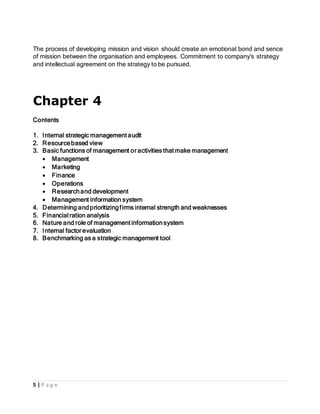
Chapter 4
Contents
1. Internal strategic management audit
2. Resourcebased view
3. Basic functions of management or activities that make management
ď‚· Management
ď‚· Marketing
ď‚· Finance
ď‚· Operations
ď‚· Researchand development
ď‚· Management information system
4. Determining andprioritizingfirms internal strength and weaknesses
5. Financialration analysis
6. Nature and role of management informationsystem
7. Internal factor evaluation
8. Benchmarking as a strategic management tool
6 | P a g e
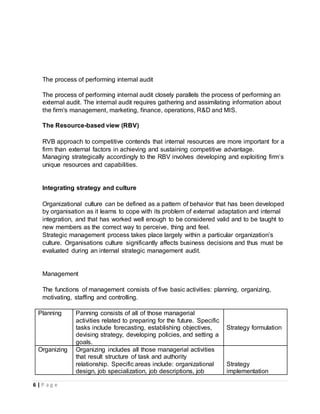
The process of performing internal audit
The process of performing internal audit closely parallels the process of performing an
external audit. The internal audit requires gathering and assimilating information about
the firm’s management, marketing, finance, operations, R&D and MIS.
The Resource-based view (RBV)
RVB approach to competitive contends that internal resources are more important for a
firm than external factors in achieving and sustaining competitive advantage.
Managing strategically accordingly to the RBV involves developing and exploiting firm’s
unique resources and capabilities.
Integrating strategy and culture
Organizational culture can be defined as a pattern of behavior that has been developed
by organisation as it learns to cope with its problem of external adaptation and internal
integration, and that has worked well enough to be considered valid and to be taught to
new members as the correct way to perceive, thing and feel.
Strategic management process takes place largely within a particular organization’s
culture. Organisations culture significantly affects business decisions and thus must be
evaluated during an internal strategic management audit.
Management
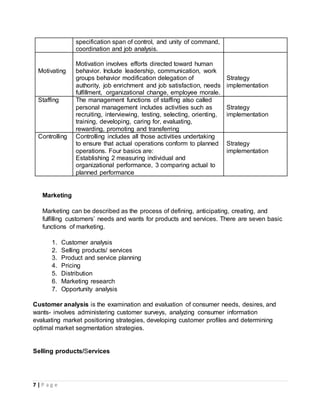
The functions of management consists of five basic activities: planning, organizing,
motivating, staffing and controlling.
Planning Panning consists of all of those managerial
activities related to preparing for the future. Specific
tasks include forecasting, establishing objectives,
devising strategy, developing policies, and setting a
goals.
Strategy formulation
Organizing Organizing includes all those managerial activities
that result structure of task and authority
relationship. Specific areas include: organizational
design, job specialization, job descriptions, job
Strategy
implementation
7 | P a g e
specification span of control, and unity of command,
coordination and job analysis.
Motivating
Motivation involves efforts directed toward human
behavior. Include leadership, communication, work
groups behavior modification delegation of
authority, job enrichment and job satisfaction, needs
fulfillment, organizational change, employee morale.
Strategy
implementation
Staffing The management functions of staffing also called
personal management includes activities such as
recruiting, interviewing, testing, selecting, orienting,
training, developing, caring for, evaluating,
rewarding, promoting and transferring
Strategy
implementation
Controlling Controlling includes all those activities undertaking
to ensure that actual operations conform to planned
operations. Four basics are:
Establishing 2 measuring individual and
organizational performance, 3 comparing actual to
planned performance
Strategy
implementation
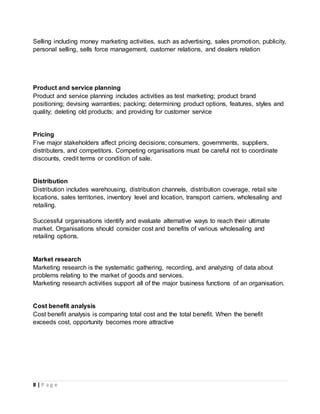
Marketing
Marketing can be described as the process of defining, anticipating, creating, and
fulfilling customers’ needs and wants for products and services. There are seven basic
functions of marketing.
1. Customer analysis
2. Selling products/ services
3. Product and service planning
4. Pricing
5. Distribution
6. Marketing research
7. Opportunity analysis
Customer analysis is the examination and evaluation of consumer needs, desires, and
wants- involves administering customer surveys, analyzing consumer information
evaluating market positioning strategies, developing customer profiles and determining
optimal market segmentation strategies.
Selling products/Services
8 | P a g e
Selling including money marketing activities, such as advertising, sales promotion, publicity,
personal selling, sells force management, customer relations, and dealers relation
Product and service planning
Product and service planning includes activities as test marketing; product brand
positioning; devising warranties; packing; determining product options, features, styles and
quality; deleting old products; and providing for customer service
Pricing
Five major stakeholders affect pricing decisions; consumers, governments, suppliers,
distributers, and competitors. Competing organisations must be careful not to coordinate
discounts, credit terms or condition of sale.
Distribution
Distribution includes warehousing, distribution channels, distribution coverage, retail site
locations, sales territories, inventory level and location, transport carriers, wholesaling and
retailing.
Successful organisations identify and evaluate alternative ways to reach their ultimate
market. Organisations should consider cost and benefits of various wholesaling and
retailing options.
Market research
Marketing research is the systematic gathering, recording, and analyzing of data about
problems relating to the market of goods and services.
Marketing research activities support all of the major business functions of an organisation.
Cost benefit analysis
Cost benefit analysis is comparing total cost and the total benefit. When the benefit
exceeds cost, opportunity becomes more attractive
9 | P a g e
Finance/accounting
Financial condition is always considered the single best measure of a firm’s competitive
position and overall attractiveness to investors. Determining organizational strength and
weakness is essential to formulating strategies. A firm’s liquidity, leverage, working capital,
profitability, asset utilization, cash flow and equity can eliminate some strategies as being
feasible alternatives.
Functions of finance/ accounting
The functions of finance/accounting comprise there decisions:
ď‚· Investment decisions
ď‚· Financing decisions
ď‚· Dividend decisions
The investment decisions also called capital budgeting, is the allocation and
reallocation of capital and resources to projects, products, assets, and divisions of an
organisation.
The financing decision determines the best capital structure for the firm and includes
examining various methods by which the firm can raise capital for example by issuing
stock, increasing debt, selling assets, or using combination of these approaches.
Dividend decisions concern issues such as the percentage of earnings paid to
stockholders, the stability of dividends paid over time, and the repurchase or issuance
of stock. The financial ratios that are helpful in evaluating a firm’s dividend decisions are
the earnings-per-share ratio and the dividend per share ratio.
Production/Operations
Production operations management deals with inputs, transformations, and outputs that
vary across industry and markets. A manufacturing operations converts inputs such as
labour, raw materials, machines and capital into finished goods.
10 | P a g e
Research and development
Organisations invest in R&D they believe that such as investment will lead to superior
product or service and will give them competitive advantage.
The overall mission of R&D is to support existing business, helping launch new business,
developing new products, improving product quality, improving manufacturing efficiency,
and deepening or broadening the company’s technological capabilities.
Management information system
A management information system’s purpose is to improve the performance of the
enterprise by improving the quality of managerial decisions. An effective information
collects and codes, stores, synthesize and presents information in such a manner that
answers strategic and operational questions.
Management information gathers data about marketing, finance, production and personnel
matters internally and social, culture, demographic, environmental, economic, political,
legal, technological and competitive factors externally. Data are integrated in ways to
support managerial decisions.
Value chain analysis
VCA refers to the process whereby a firm determines the costs associated with the
organizational activities from purchasing raw materials to manufacturing products to
marketing those products.
11 | P a g e
Chapter 5
Strategies in action
1. The value of establishing long-term objectives.
2. Identify 16 types of business of business trategies
3. Identify umerous examples of organisation strategies
4.
12 | P a g e
Long-term objectives
Objectives should be quantitative, realistic, understandable, challenging, hierarchical,
obtainable, and congruent among organizational units. Objectives are commonly in
terms such as growth assets, growth in sales, market share and social responsibility.
The benefitsof havingclear objectives
1. Provide direction
2. Allow synergy
3. Establish priorities
4. Reduce
5. Congruent across departments
Financialverses Strategic Objectives
Two types of objectives are especially common in organisations. Financial and strategic
objectives.
1. Financial objectives are include those associated with growth in revenues,
growth in earning share, higher dividends, larger profit earning. While
2. Strategic objectives are include such as larger market shire, quicker on time
delivery that rival firms. Lower costs than rival firms, higher product quality that
rivals firms.
The balanced scorecard
Developed 1993 by Harvard university professors Kaplan and Norton. The banlanced
scorecard is a strategy evaluation and control technique. However an effective Balanced
Scorecard contains a carefully chosen combination of strategic and financial objectives
tailored to the business. It is a tool to manage and evaluate strategy.
Types of strategies
1. Forward integration- gaining ownership or increased control over distributors or
retails
2. Backward integration- seeking ownership or increased control of a firms suppliers
13 | P a g e
3. Horizontal integration- seeking ownership or increased control over competitors
4. Market penetration- seeking increased market share for present products or services
in present markets through greater marketing efforts
5. Product development- seeking increased sales by improving present products or
service or developing new ones.
6. Related diversification- adding new but related products or services
7. Unrelated diversification- adding new, unrelated products or services
8. Retrenchment- regrouping though cost and asset reduction to reverse declining
sales and profit
9. Divesture- selling a division or part of the organisation
10.Liquidation- selling all of a company’s assets, in part, for their tangible worth.
Level of strategies
In large firms there are four levels of strategies:
ď‚· Corporate
ď‚· Divisional
ď‚· Functional, and operational
Levels of strategies
Large company Small company
Backward integration- A form of vertical integration that involves the purchase of
suppliers.
Companies will pursue backward integration when it will result in improved efficiency and
cost savings. For example, backward integration might cut transportation costs, improve
profit margins and make the firm more competitive.
14 | P a g e
Forward integration- A business strategy that involves a form of vertical integration whereby
activities are expanded to include control of the direct distribution of its products.
Horizontal integration- The acquisition of additional business activities that are at the
same level of the value chain in similar or different industries. This can be achieved by
internal or external expansion. Because the different firms are involved in the same stage of
production, horizontal integration allows them to share resources at that level.
Intensive strategies
Market penetration, market development, and product development are sometimes referred
to as intensive strategies because they require intensive efforts if a firm’s competitive
position with existing products to improve.
Market penetration
A market penetration is a strategy seeks to increase market share for present products
in present markets through greater marketing efforts.
Market development
Market development is a business strategy whereby a business attempts to find new
segment of buyers or markets as potential customers for its existing products and services.
Such as entering new geographic market though the availability of destruction channels.
Product development
Product development is a strategy that seeks increased sales by improving or modifying
present products or services and it entails large research and development expenditure.
Diversification strategies
There are two types of this strategy; related and unrelated.
Related diversification- Aprocess that takes place when a business expands its activities
into product lines that are similar to those it currently offers. For example, a manufacturer of
computers might begin making calculators as a form of related diversification of its existing
business.
Unrelated diversification- Unrelated Diversification is a form of diversification when the
business adds new or unrelated product lines and penetrates new markets. For example, if
the shoe producer enters the business of clothing manufacturing.
15 | P a g e
Defensive strategies
Defensive strategies are also includes, Retrenchment, Divesture and liquidation.
Retrenchment- when an organisation regroups through cost and asset reduction to reserve
declining sales and profits. Retrenchment entails selling off land and building to raise need
cash, reducing employees, and instituting expense control system.
Divesture- Divestitures are a way for a company to manage its portfolio of
assets. As companies grow they may find they are trying to focus on too many lines of
business, and that they must close some operational business units in order
to focus on more profitable lines.
Liquidation- When a business or firm is terminated or bankrupt, its assets are sold and
the proceeds pay creditors. Any leftovers are distributed to shareholders.
Michael Porter’s Five Generic Strategies
Type 1: Cost leadership – Low cost
Type 2: Cost leadership – Best Value
Type 3: Differentiation
Type 4 Focus – Low cost
Type 5 Focus – Best value
Cost leadership- Strategy used by businesses to create a low cost of operation within their
niche. The use of this strategy is primarily to gain an advantage over competitors by
reducing operation costs below that of others in the same industry.
Differential strategy- A strategy employed by businesses to increase the
perceived value of their brand or products as a way to entice buyers to choose their
products over similar products offered by their competitors.
Focused differentiation is the second of two focus strategies. A focused differentiation
strategy requires offering unique features that fulfill the demands of a narrow market.
As with a focused low-cost strategy, narrow markets are defined in different ways in different
settings.
Means for Achieving Strategies
16 | P a g e
1. Cooperation among Competitors
2. Joint venture/Partnering
3. Merger/ Acquisition
4. First mover advantages
5. Outsourcing

Strategic managment

  • 1.
    Chapter 1 Strategic management Definingstrategic management Strategic management can be defined as the art and science of formulating, implementing, and evaluation cross functional decisions that enable an organisation to achieve its objectives. Stages of strategic management The strategic management process consists of three stages: strategy formulation, strategy implementation, and strategy evaluation. Strategy formulation includes developing a vision and mission, identifying an organization’s external opportunities and threats, determining internal strengths and weakness, establishing long-term objectives, gathering alternatives strategies and choosing particular strategy. Strategy formulation issues deciding what new business to enter what a business to abandon, how to allocate resources, weather to expend operations or diversify, weather to inter international markets weather to merge or form a joint venture. Strategy implementation requires a firm to establish annual objectives, devise policies, motivate employees, and allocate resources so that formulated strategy can be executed. It includes developing strategy-supportive culture, creating an effective organizational structure, redirecting marketing efforts, preparing budgets, developing and utilization information system and linking employee compensation to organizational performance. Strategy implementation requires personal discipline, commitment, and sacrifice Strategy evaluation is the final stage in strategic management. Managers need to know when particular strategies are not working well. Strategy evaluation is the primary means for obtaining this information because external and internal factors are constantly changing. Three fundamental strategy evaluation are: 1. reviewing external and internal factors that ate the basis of current strategies, 2. measuring performance and 3. Taking corrective actions. Integrating intuition and analysis
  • 2.
    2 | Pa g e Most people recognize that intuition is essential to making good strategic decisions in organisations. Intuition is particularly useful for making decisions in situations of uncertainty. Choosing an intuitive or analytic approach to decision making. Competitive advantage Strategic management is all about gaining and maintaining competitive advantage. “anything does a firm especially well compared to rival firms” When a firm can do something that a rival firm cannot do. Strategist are individuals who are mostly responsible for the success or failure of an organisation. They have various job titles such as chief executive officer, president, owner, chair of the board, chancellor, dean, or entrepreneur. External Opportunities and threats External opportunities refer to economic, social and cultural, demographic, environmental, political, legal, governmental and competitive trends and events that could benefit or harm the organisation in the future. Lobbying is one activity that some organisations utilize to influence external opportunities and threats. Internal strengthand internal weakness Internal strength and internal weakness are organization’s controllable activities that has performed especially well or poorly. They arise in the management, marketing, finance, operations research and development and management information. Internal factors can be determine in a number of ways, including computing rations, measuring performance and comparing to past periods and industry averages. Long-term objectives Long-term objectives means more than one year. Objectives are essential for organizational success because the state direction. Strategies Strategies are the means by which long-term objectives will be achieved, because strategies may include geographic expansion diversification, acquisition, product development, market penetration. Annual objectives are short-term mile-stones that organisations must achieve to reach long- term objective. Policies Policies are the means by which annual objectives will be achieved. Policies include guide line, rules and procedures established to support efforts to achieve stated objectives. It
  • 3.
    3 | Pa g e stated in terms of management marketing, operations, finance and research & development, computer information system. Policies allow consistency and coordination with I and between organizational departments Benefits of strategic management Strategic management allows organisations to be more proactive than reactive in shaping its own future; it allows organisation - Enhanced communication; dialogue and participation - Improved understanding; taking to account others view of what the firm is planning - Greater commitment ; to work hard, to implement strategies - Result ; all managers and employees on a missions to help the firm success Financial benefits Organisation using strategic management concepts are more profitable and successful than those do not. Chapter 2 The business Vision and Mission Chapter objectives After studying this chapter you should be able to do the following 1. Describe the nature and role of vision and mission statement in strategic management
  • 4.
    4 | Pa g e What do we want to become? A vision statement should answer the basic question, “What do we want to become?” A clear vision provides the foundation for developing a comprehensive mission statement. The vision statement should be to short and must be established first and foremost. Example of vision statement. Tyson foods’ our vision is to be the world’s first choice for protein solutions while maximizing shareholder value. What is our business? A mission statement is a declaration of an organisations reason for being. It answers the pivotal question what is our business? Sometimes called a creed statement, a statement of purpose a statement of philosophy, a statement of business principles. A business mission statement reveals what an organisation wants to be and whom it wants to serve. A business mission is the foundation for priorities, strategies, plans, and work assignment. Example of mission statement. Fleetwood enterprises will lead the recreational vehicle and manufactured and housing industries (2, 7) and providing quality products, with a passion customer driven innovation (1) we will emphasize, training, embrace diversity …. Missionstatement components 1. Customers- who are the firms customers 2. Product or service – what are the firms major products 3. Markets – Geographically, where does the firm compete 4. Technology 5. Concern for survival, growth, and profitability 6. Philosophy- what are the basic beliefs, values and aspirations, & ethical priorities 7. Self-concept- competitive advantage 8. Concern for public image 9. Concern for employees Benefits, processof developing vision and mission
  • 5.
    5 | Pa g e The process of developing mission and vision should create an emotional bond and sence of mission between the organisation and employees. Commitment to company’s strategy and intellectual agreement on the strategy to be pursued. Chapter 4 Contents 1. Internal strategic management audit 2. Resourcebased view 3. Basic functions of management or activities that make management  Management  Marketing  Finance  Operations  Researchand development  Management information system 4. Determining andprioritizingfirms internal strength and weaknesses 5. Financialration analysis 6. Nature and role of management informationsystem 7. Internal factor evaluation 8. Benchmarking as a strategic management tool
  • 6.
    6 | Pa g e The process of performing internal audit The process of performing internal audit closely parallels the process of performing an external audit. The internal audit requires gathering and assimilating information about the firm’s management, marketing, finance, operations, R&D and MIS. The Resource-based view (RBV) RVB approach to competitive contends that internal resources are more important for a firm than external factors in achieving and sustaining competitive advantage. Managing strategically accordingly to the RBV involves developing and exploiting firm’s unique resources and capabilities. Integrating strategy and culture Organizational culture can be defined as a pattern of behavior that has been developed by organisation as it learns to cope with its problem of external adaptation and internal integration, and that has worked well enough to be considered valid and to be taught to new members as the correct way to perceive, thing and feel. Strategic management process takes place largely within a particular organization’s culture. Organisations culture significantly affects business decisions and thus must be evaluated during an internal strategic management audit. Management The functions of management consists of five basic activities: planning, organizing, motivating, staffing and controlling. Planning Panning consists of all of those managerial activities related to preparing for the future. Specific tasks include forecasting, establishing objectives, devising strategy, developing policies, and setting a goals. Strategy formulation Organizing Organizing includes all those managerial activities that result structure of task and authority relationship. Specific areas include: organizational design, job specialization, job descriptions, job Strategy implementation
  • 7.
    7 | Pa g e specification span of control, and unity of command, coordination and job analysis. Motivating Motivation involves efforts directed toward human behavior. Include leadership, communication, work groups behavior modification delegation of authority, job enrichment and job satisfaction, needs fulfillment, organizational change, employee morale. Strategy implementation Staffing The management functions of staffing also called personal management includes activities such as recruiting, interviewing, testing, selecting, orienting, training, developing, caring for, evaluating, rewarding, promoting and transferring Strategy implementation Controlling Controlling includes all those activities undertaking to ensure that actual operations conform to planned operations. Four basics are: Establishing 2 measuring individual and organizational performance, 3 comparing actual to planned performance Strategy implementation Marketing Marketing can be described as the process of defining, anticipating, creating, and fulfilling customers’ needs and wants for products and services. There are seven basic functions of marketing. 1. Customer analysis 2. Selling products/ services 3. Product and service planning 4. Pricing 5. Distribution 6. Marketing research 7. Opportunity analysis Customer analysis is the examination and evaluation of consumer needs, desires, and wants- involves administering customer surveys, analyzing consumer information evaluating market positioning strategies, developing customer profiles and determining optimal market segmentation strategies. Selling products/Services
  • 8.
    8 | Pa g e Selling including money marketing activities, such as advertising, sales promotion, publicity, personal selling, sells force management, customer relations, and dealers relation Product and service planning Product and service planning includes activities as test marketing; product brand positioning; devising warranties; packing; determining product options, features, styles and quality; deleting old products; and providing for customer service Pricing Five major stakeholders affect pricing decisions; consumers, governments, suppliers, distributers, and competitors. Competing organisations must be careful not to coordinate discounts, credit terms or condition of sale. Distribution Distribution includes warehousing, distribution channels, distribution coverage, retail site locations, sales territories, inventory level and location, transport carriers, wholesaling and retailing. Successful organisations identify and evaluate alternative ways to reach their ultimate market. Organisations should consider cost and benefits of various wholesaling and retailing options. Market research Marketing research is the systematic gathering, recording, and analyzing of data about problems relating to the market of goods and services. Marketing research activities support all of the major business functions of an organisation. Cost benefit analysis Cost benefit analysis is comparing total cost and the total benefit. When the benefit exceeds cost, opportunity becomes more attractive
  • 9.
    9 | Pa g e Finance/accounting Financial condition is always considered the single best measure of a firm’s competitive position and overall attractiveness to investors. Determining organizational strength and weakness is essential to formulating strategies. A firm’s liquidity, leverage, working capital, profitability, asset utilization, cash flow and equity can eliminate some strategies as being feasible alternatives. Functions of finance/ accounting The functions of finance/accounting comprise there decisions:  Investment decisions  Financing decisions  Dividend decisions The investment decisions also called capital budgeting, is the allocation and reallocation of capital and resources to projects, products, assets, and divisions of an organisation. The financing decision determines the best capital structure for the firm and includes examining various methods by which the firm can raise capital for example by issuing stock, increasing debt, selling assets, or using combination of these approaches. Dividend decisions concern issues such as the percentage of earnings paid to stockholders, the stability of dividends paid over time, and the repurchase or issuance of stock. The financial ratios that are helpful in evaluating a firm’s dividend decisions are the earnings-per-share ratio and the dividend per share ratio. Production/Operations Production operations management deals with inputs, transformations, and outputs that vary across industry and markets. A manufacturing operations converts inputs such as labour, raw materials, machines and capital into finished goods.
  • 10.
    10 | Pa g e Research and development Organisations invest in R&D they believe that such as investment will lead to superior product or service and will give them competitive advantage. The overall mission of R&D is to support existing business, helping launch new business, developing new products, improving product quality, improving manufacturing efficiency, and deepening or broadening the company’s technological capabilities. Management information system A management information system’s purpose is to improve the performance of the enterprise by improving the quality of managerial decisions. An effective information collects and codes, stores, synthesize and presents information in such a manner that answers strategic and operational questions. Management information gathers data about marketing, finance, production and personnel matters internally and social, culture, demographic, environmental, economic, political, legal, technological and competitive factors externally. Data are integrated in ways to support managerial decisions. Value chain analysis VCA refers to the process whereby a firm determines the costs associated with the organizational activities from purchasing raw materials to manufacturing products to marketing those products.
  • 11.
    11 | Pa g e Chapter 5 Strategies in action 1. The value of establishing long-term objectives. 2. Identify 16 types of business of business trategies 3. Identify umerous examples of organisation strategies 4.
  • 12.
    12 | Pa g e Long-term objectives Objectives should be quantitative, realistic, understandable, challenging, hierarchical, obtainable, and congruent among organizational units. Objectives are commonly in terms such as growth assets, growth in sales, market share and social responsibility. The benefitsof havingclear objectives 1. Provide direction 2. Allow synergy 3. Establish priorities 4. Reduce 5. Congruent across departments Financialverses Strategic Objectives Two types of objectives are especially common in organisations. Financial and strategic objectives. 1. Financial objectives are include those associated with growth in revenues, growth in earning share, higher dividends, larger profit earning. While 2. Strategic objectives are include such as larger market shire, quicker on time delivery that rival firms. Lower costs than rival firms, higher product quality that rivals firms. The balanced scorecard Developed 1993 by Harvard university professors Kaplan and Norton. The banlanced scorecard is a strategy evaluation and control technique. However an effective Balanced Scorecard contains a carefully chosen combination of strategic and financial objectives tailored to the business. It is a tool to manage and evaluate strategy. Types of strategies 1. Forward integration- gaining ownership or increased control over distributors or retails 2. Backward integration- seeking ownership or increased control of a firms suppliers
  • 13.
    13 | Pa g e 3. Horizontal integration- seeking ownership or increased control over competitors 4. Market penetration- seeking increased market share for present products or services in present markets through greater marketing efforts 5. Product development- seeking increased sales by improving present products or service or developing new ones. 6. Related diversification- adding new but related products or services 7. Unrelated diversification- adding new, unrelated products or services 8. Retrenchment- regrouping though cost and asset reduction to reverse declining sales and profit 9. Divesture- selling a division or part of the organisation 10.Liquidation- selling all of a company’s assets, in part, for their tangible worth. Level of strategies In large firms there are four levels of strategies:  Corporate  Divisional  Functional, and operational Levels of strategies Large company Small company Backward integration- A form of vertical integration that involves the purchase of suppliers. Companies will pursue backward integration when it will result in improved efficiency and cost savings. For example, backward integration might cut transportation costs, improve profit margins and make the firm more competitive.
  • 14.
    14 | Pa g e Forward integration- A business strategy that involves a form of vertical integration whereby activities are expanded to include control of the direct distribution of its products. Horizontal integration- The acquisition of additional business activities that are at the same level of the value chain in similar or different industries. This can be achieved by internal or external expansion. Because the different firms are involved in the same stage of production, horizontal integration allows them to share resources at that level. Intensive strategies Market penetration, market development, and product development are sometimes referred to as intensive strategies because they require intensive efforts if a firm’s competitive position with existing products to improve. Market penetration A market penetration is a strategy seeks to increase market share for present products in present markets through greater marketing efforts. Market development Market development is a business strategy whereby a business attempts to find new segment of buyers or markets as potential customers for its existing products and services. Such as entering new geographic market though the availability of destruction channels. Product development Product development is a strategy that seeks increased sales by improving or modifying present products or services and it entails large research and development expenditure. Diversification strategies There are two types of this strategy; related and unrelated. Related diversification- Aprocess that takes place when a business expands its activities into product lines that are similar to those it currently offers. For example, a manufacturer of computers might begin making calculators as a form of related diversification of its existing business. Unrelated diversification- Unrelated Diversification is a form of diversification when the business adds new or unrelated product lines and penetrates new markets. For example, if the shoe producer enters the business of clothing manufacturing.
  • 15.
    15 | Pa g e Defensive strategies Defensive strategies are also includes, Retrenchment, Divesture and liquidation. Retrenchment- when an organisation regroups through cost and asset reduction to reserve declining sales and profits. Retrenchment entails selling off land and building to raise need cash, reducing employees, and instituting expense control system. Divesture- Divestitures are a way for a company to manage its portfolio of assets. As companies grow they may find they are trying to focus on too many lines of business, and that they must close some operational business units in order to focus on more profitable lines. Liquidation- When a business or firm is terminated or bankrupt, its assets are sold and the proceeds pay creditors. Any leftovers are distributed to shareholders. Michael Porter’s Five Generic Strategies Type 1: Cost leadership – Low cost Type 2: Cost leadership – Best Value Type 3: Differentiation Type 4 Focus – Low cost Type 5 Focus – Best value Cost leadership- Strategy used by businesses to create a low cost of operation within their niche. The use of this strategy is primarily to gain an advantage over competitors by reducing operation costs below that of others in the same industry. Differential strategy- A strategy employed by businesses to increase the perceived value of their brand or products as a way to entice buyers to choose their products over similar products offered by their competitors. Focused differentiation is the second of two focus strategies. A focused differentiation strategy requires offering unique features that fulfill the demands of a narrow market. As with a focused low-cost strategy, narrow markets are defined in different ways in different settings. Means for Achieving Strategies
  • 16.
    16 | Pa g e 1. Cooperation among Competitors 2. Joint venture/Partnering 3. Merger/ Acquisition 4. First mover advantages 5. Outsourcing