Strategic Management
VARUN
CHANDOK
A MAN WHO CANNOT SIT STILL……AND
CANNOT SAY NO………IS NOT FIT FOR
BUSINESS
Thought of the Day
Strategy
 In business, strategy means an overall plan of an
organisation which uses its resources to establish
a favourable position and compete successfully
against it‟s rivals.
 According to Willam F.Glueck, “ Strategy is a
comprehensive and integrated plan designed to
assure that the basic objectives of the enterprise
are achieved”
 According to Alfred Chandler, “ Strategy is the
determination of the long term goals of an
enterprise, and the adoption of courses of action
and the allocation of resources necessary for
carrying out these goals”
Nature
 Strategy is a major course of action through which an
organization relates itself to its environment particularly the external factors.
 Strategy is the blend of internal and external factors. To meet the opportunities and
threats provided by the external factors, internal factors are matched with them.
 Strategy is the combination of actions aimed to meet a particular condition, to solve
certain problems or to achieve a desirable end.
 Due to its dependence on environmental variables, strategy may
involve a contradictory action. An organization may take contradictory actions. For
example, a firm is engaged in closing down of some of its business and at the same
time expanding some
 Strategy is future oriented. Strategic actions are required for new situations which
have not arisen before
 Strategy requires some systems and norms for its efficient adoption in any
organization
 Strategy provides overall framework for guiding enterprise.
http://www.scribd.com/doc/23775560/2/Nature-of-Strategy-%E2%80%93
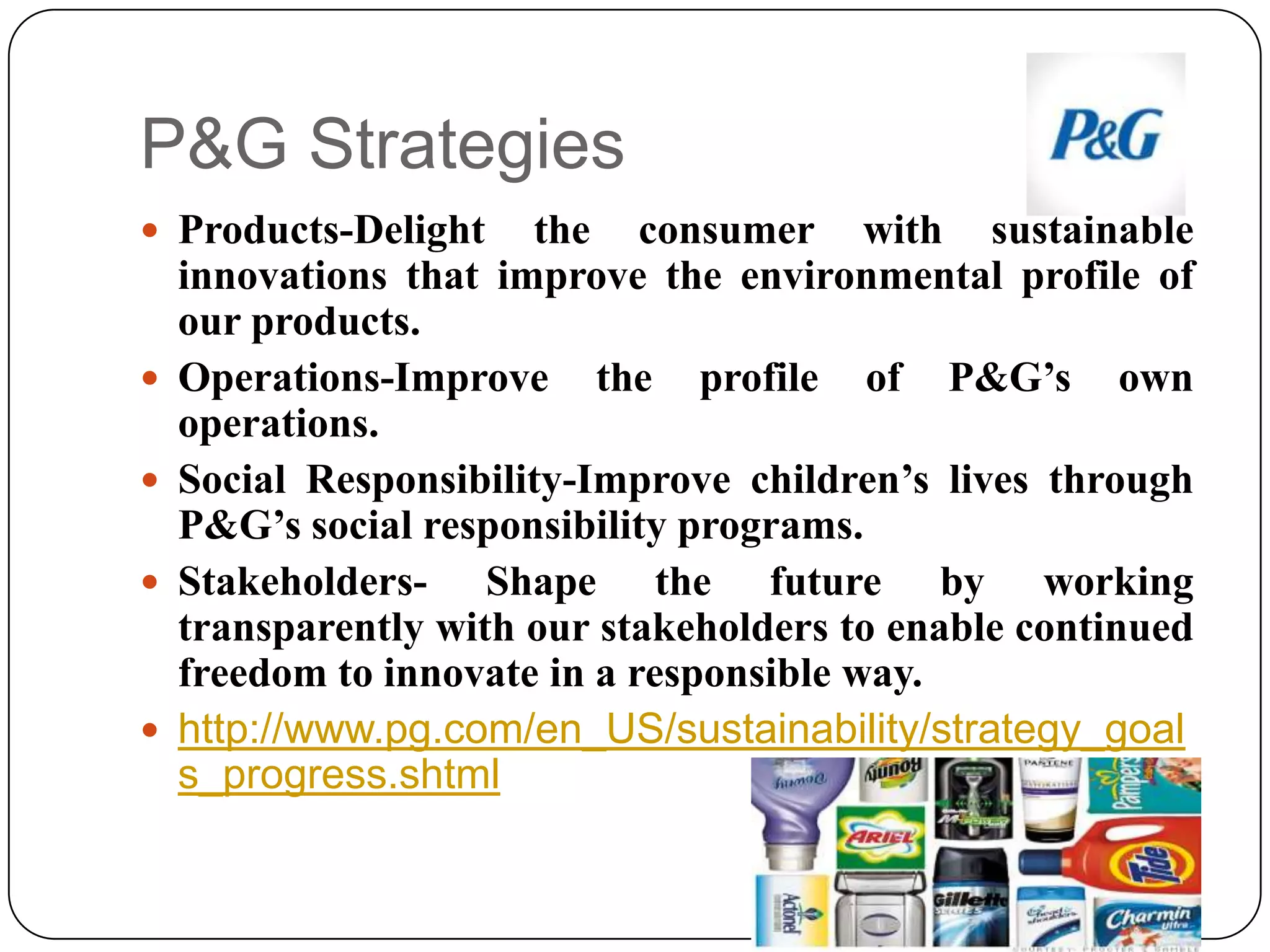
P&G Strategies
 Products-Delight the consumer with sustainable
innovations that improve the environmental profile of
our products.
 Operations-Improve the profile of P&G’s own
operations.
 Social Responsibility-Improve children’s lives through
P&G’s social responsibility programs.
 Stakeholders- Shape the future by working
transparently with our stakeholders to enable continued
freedom to innovate in a responsible way.
 http://www.pg.com/en_US/sustainability/strategy_goal
s_progress.shtml
In summary, A Strategy is:---
A strategy could be:
* A plan or course of action or set of decision rules
making a pattern………….
* The pattern related to the organization's activities
which are derived from the policies, objectives and
goals,
* related to pursuing those activities which move an
organization from its current position to the desired
future state,
* Concerned with the resources necessary for
implementing a plan or following a course of action,
* Connected to the Strategic positioning (desired
future position of the organization) of a firm
* a planned coordination of the firm‟s major goals and
actions, in time and space that continuously co-align
the firm with its environment.
Business Policy
 According to Christensen, “ It is the study of the
functions and responsibilities of senior
management, the crucial problems that affect
success in the total enterprise, and the decisions
that determine the direction of the organisation
and shape its future. The problems of policy in
business have to do with the choice of
purposes, the moulding of orgnaisational identity
and character, the continuous definition of what
needs to be done and the mobilisation of
resources for the attainment of goals in the face
of competition”
Policy and strategy
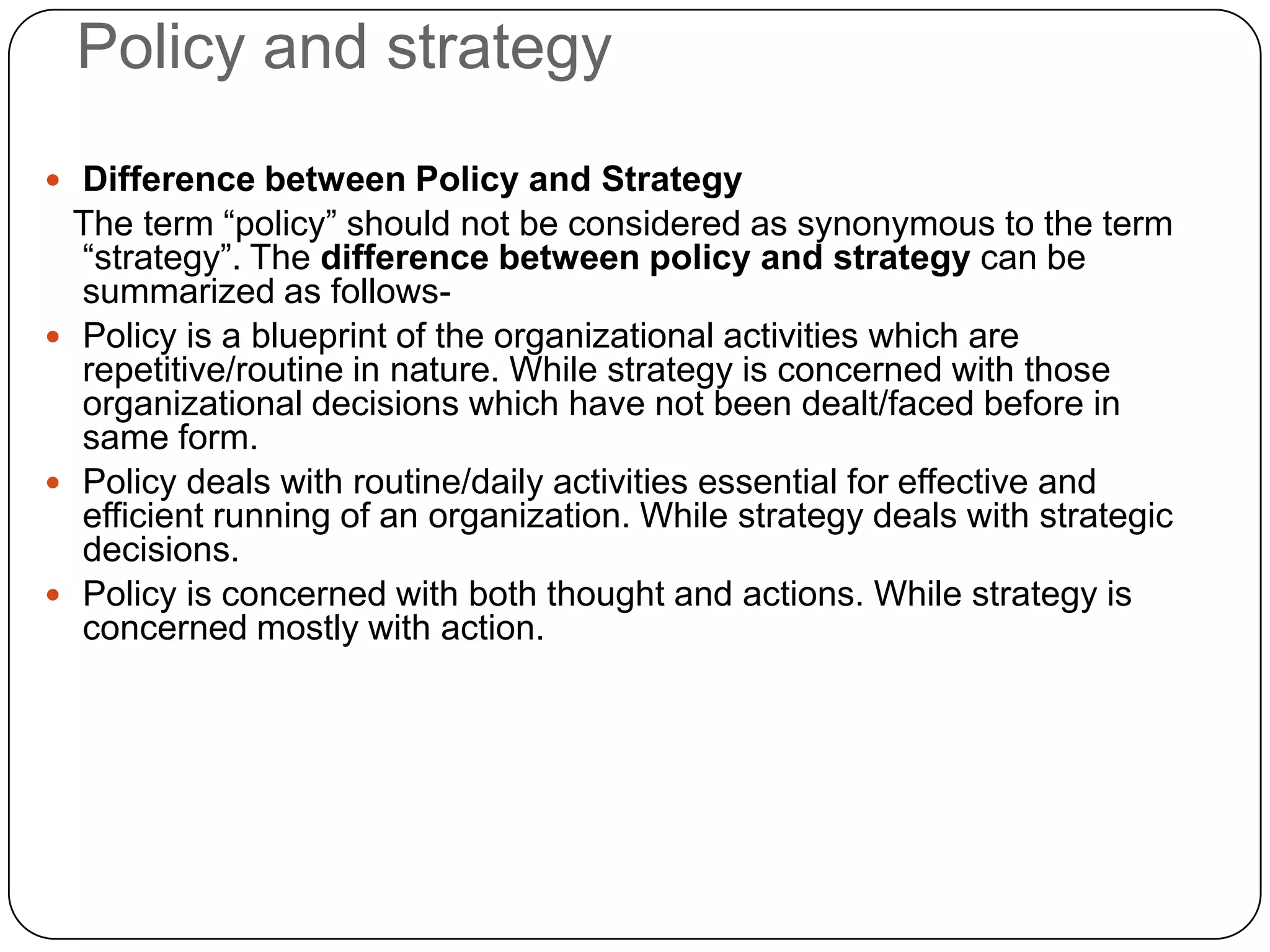
 Difference between Policy and Strategy
The term “policy” should not be considered as synonymous to the term
“strategy”. The difference between policy and strategy can be
summarized as follows-
 Policy is a blueprint of the organizational activities which are
repetitive/routine in nature. While strategy is concerned with those
organizational decisions which have not been dealt/faced before in
same form.
 Policy deals with routine/daily activities essential for effective and
efficient running of an organization. While strategy deals with strategic
decisions.
 Policy is concerned with both thought and actions. While strategy is
concerned mostly with action.
What is Strategic Management
 According to Jauch and Glueck, “ Strategic
management is a stream of decisions and actions
which lead to the development of an effective
strategy or strategies to help in achieving the
corporate objective.
 According to Robinson, “Strategic Management is
the set of decisions and actions resulting in
formulation and implementation of strategies
designed to achieve the objectives of an
organisations”
Importance of strategy
 Better and effective control of uncertainty
 Enhancing organisational effectiveness
 Framework For Operational Planning
 Clarity in Direction of Activities
 Personnel Satisfaction
http://www.marketing91.com/role-of-strategy/
SBI STRATEGY
SBI eyes home loans of state govt employees
Mumbai May 05, 2006The State Bank of India
(SBI) has adopted an innovative strategy to
expand its home loan portfolio and at the same
time ensure good credit quality. The country‟s
largest bank is in talks to buy home loans given
by state governments to their
employees. Banking sources said SBI is close in
signing an agreement with the Kerala government
for purchasing home loans of its staff.
Difference Between SBU and
SBA
 According to Sharplin, “ SBU is any part of a
business organisation which is treated separately
for strategic management purpose”.
 Strategic business area- A distinctive segment of
the environment in which the firm does or may
want to do business”
Strategic decision making
 Strategic decision making is the task of senior
management.
 It is one of the most important function of a senior
management
 Conventional Decision making
Defining objectives
Searching for alternatives
Evaluation of alternatives
Selection of alternative
 Strategic decision making
1. Strategic decisions are highly complex
2. The basic thrust of strategic decision making is to
make a choice regarding the courses of action to
adopt
3. The fundamental strategic decisions relates to the
choice of mission i.e. WHAT IS OUR BUSINESS?
WHAT IT WILL BE? AND WHAT SHOULD IT BE?
4. Also here senior management is faced with
problem of selecting the best alternative
5. Apart from this senior management has to make
important strategic decisions related with the
environmental threats and the available
opportunities.
Issues in Strategic Decision
making
 Criteria for decision making- Focus on objectives
Concept of maximisation- Objectives are set at the
highest point
Concept of satisfying- Objectives are set in such a
manner that the firm can achieve them realistically
Concept of incrementalism- Process of decision making
is complex. Adoption of small, logical and incremental
steps
 Rationality in decision making
 Creativity in decision making- Help of Brainstorming
 Variability in decision making- Depending on situation
 Person related factors in decision making
Process of Strategic
Management
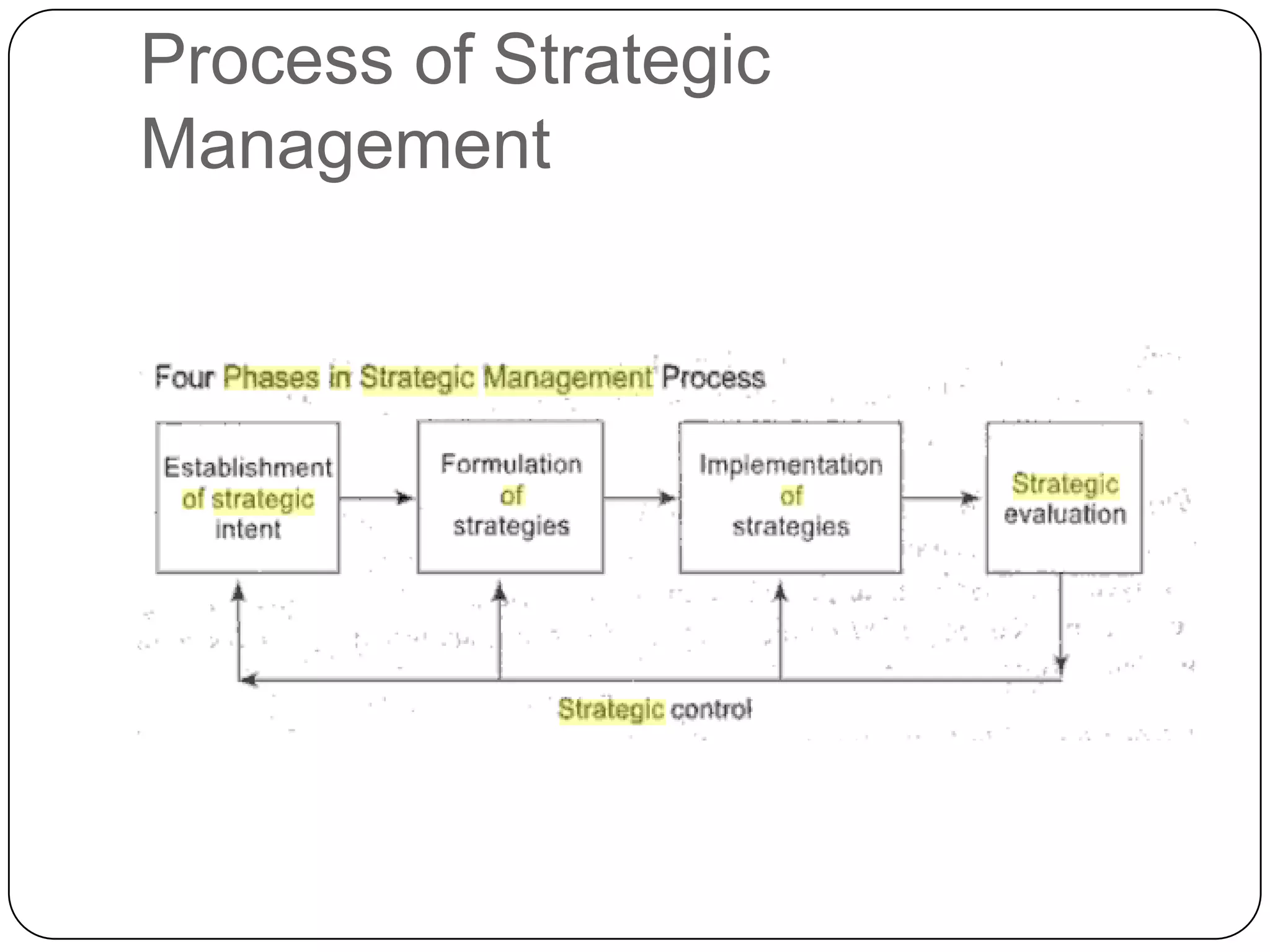
 Establishing the hierarchy of strategic intent:-
Creating and communicating a vision- What organisation
whishes to achieve in long run
Designing a mission statement- Relates organisation to
society
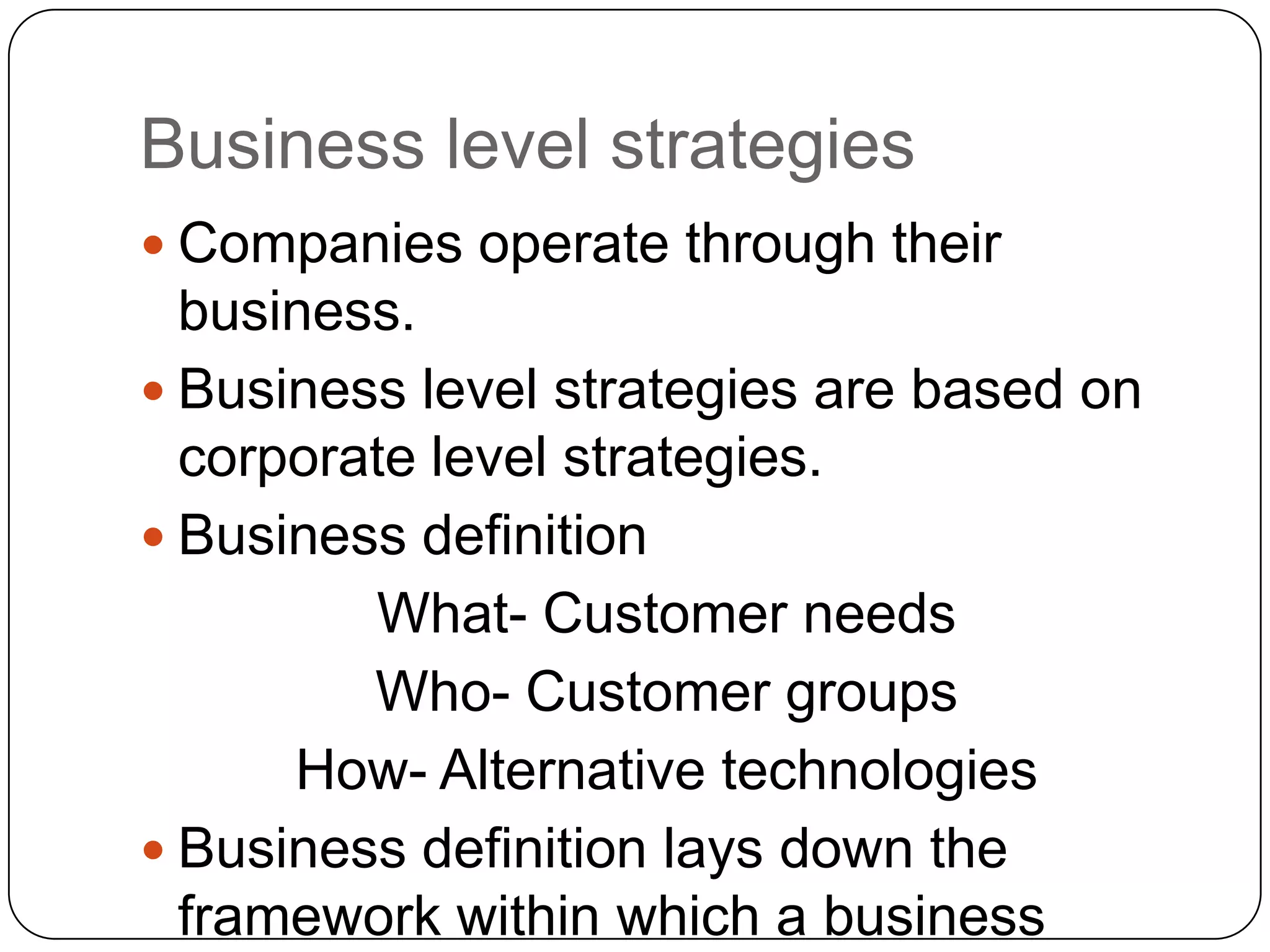
Defining the business- In terms of Customer needs, customer
groups and alternatives technologies
Setting objectives
 Formulation of strategies
Performing environmental appraisal
Doing organisational appraisal
Considering corporate level strategies
Considering business level strategies
Undertaking strategic analysis
Exercising strategic choice
Formulating strategies
Preparing strategic plan
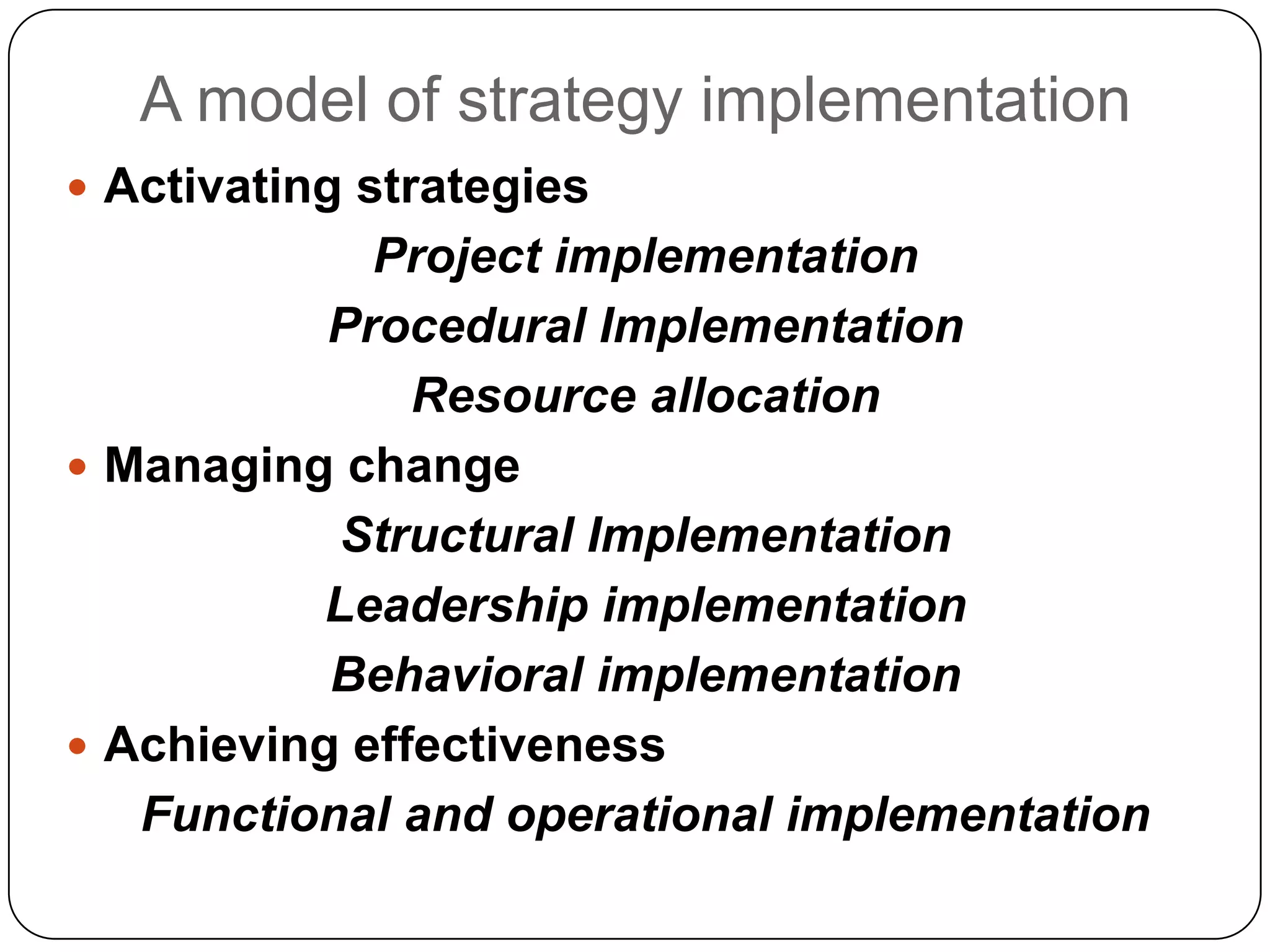
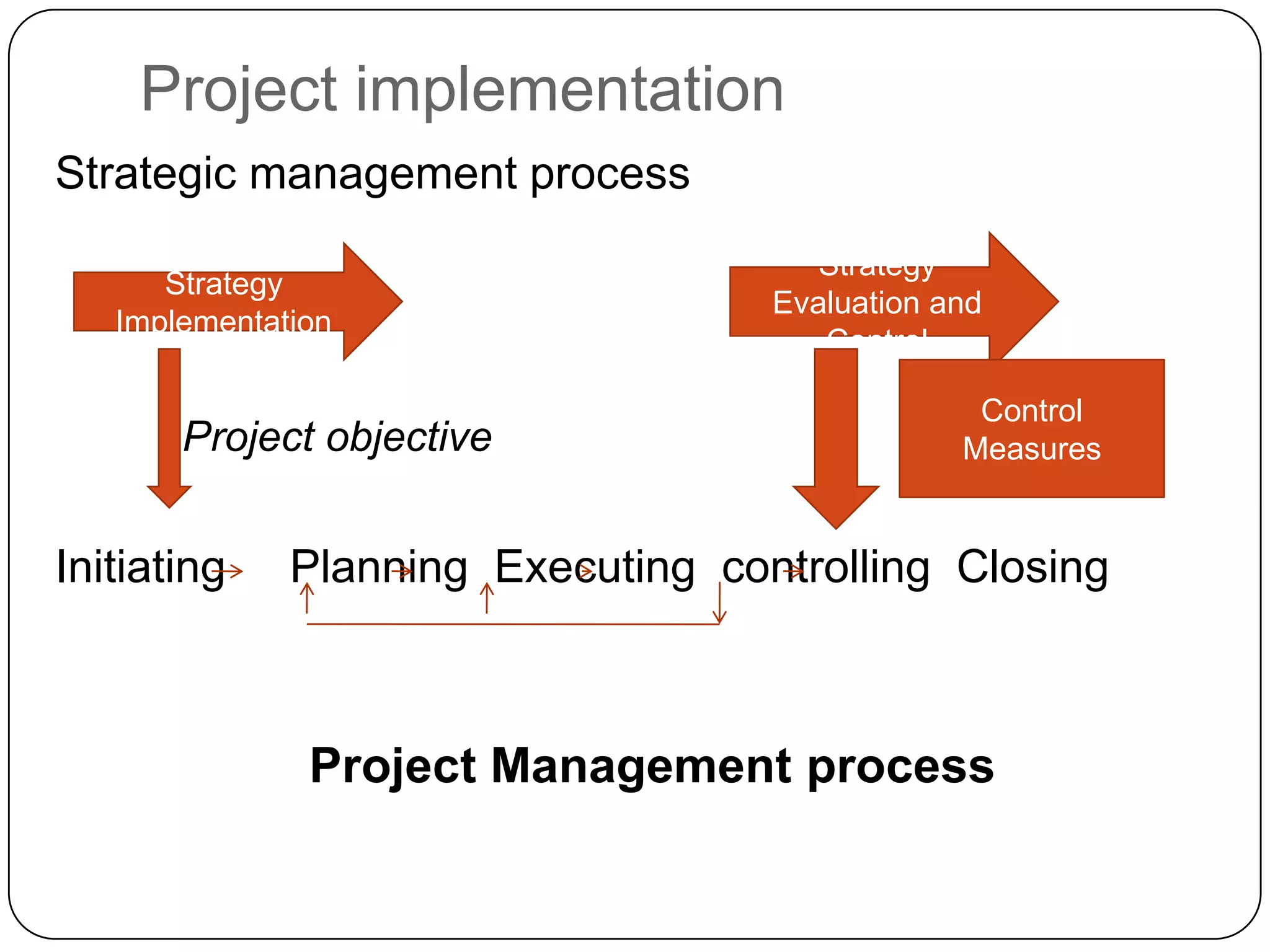
 Implementation of strategies
Project
Procedural
Resource allocation
Structural
Behavioural
Functional and operational
 Performing strategic evaluation and control
Performing strategic evaluation
Exercising strategic control
Reformulating strategies
Models of the strategic management process
 Project implementation- Setting
up the organisation
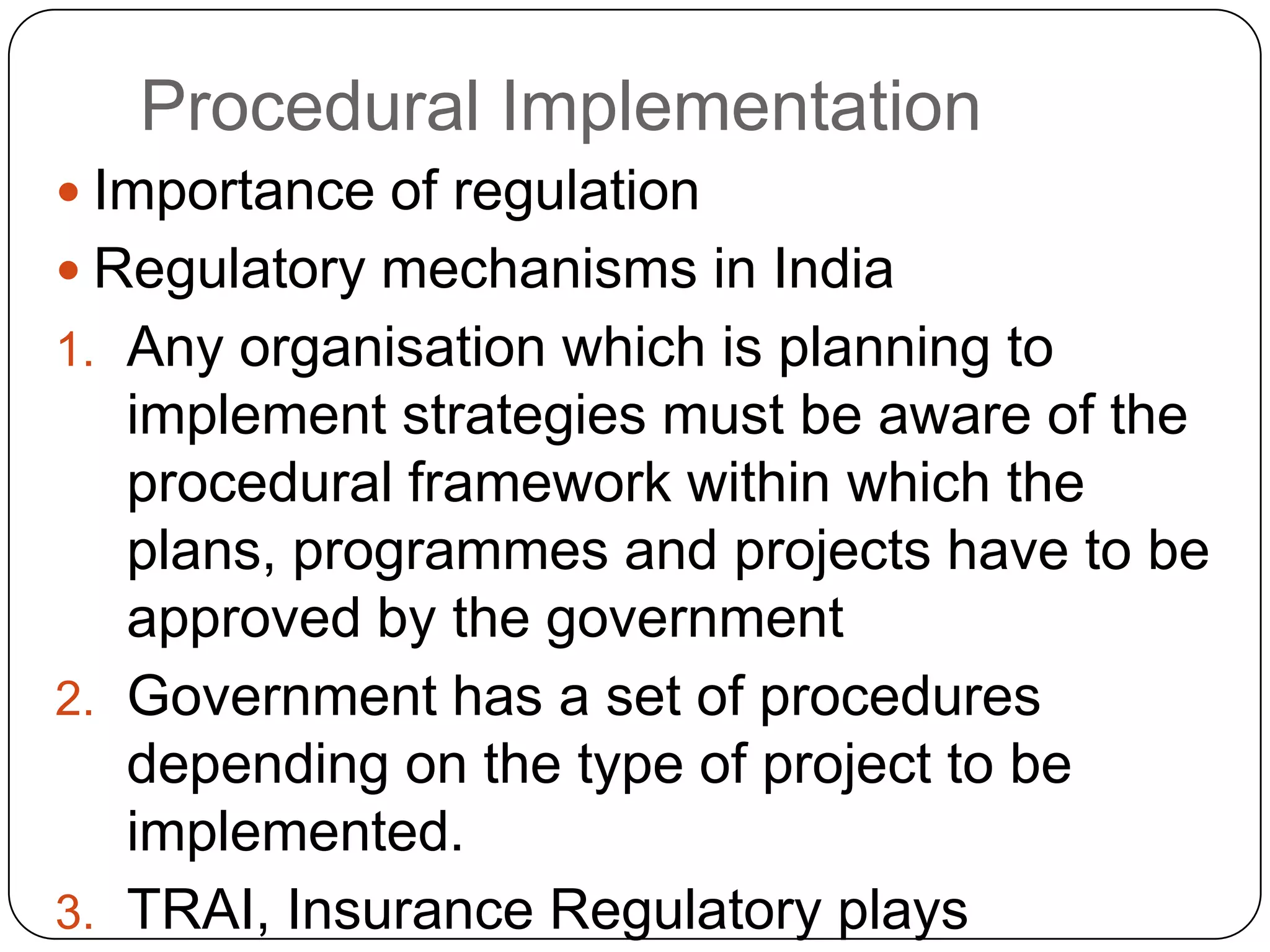
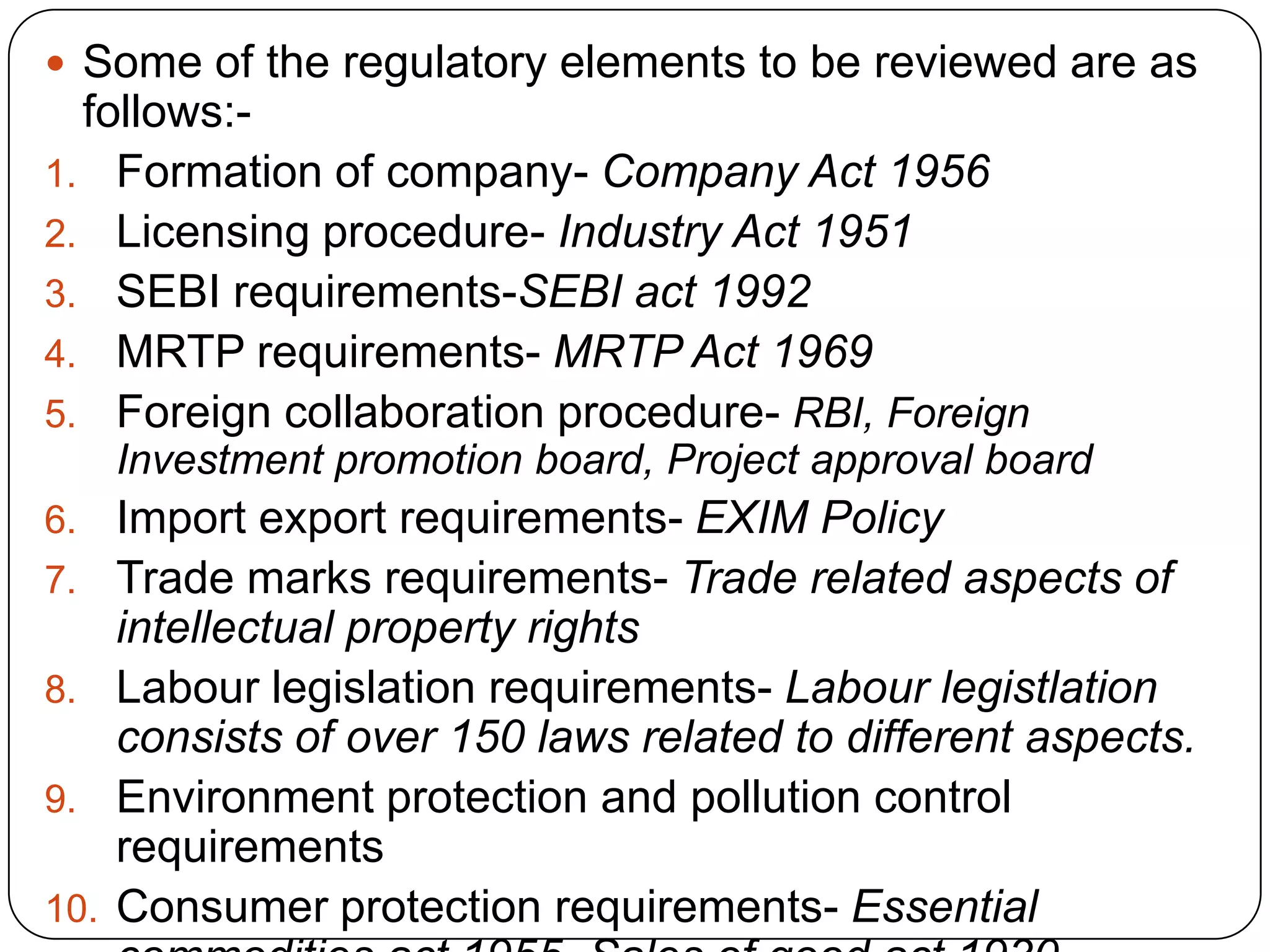
 Procedural implementation-
Different aspects of the
regulatory framework
 Resource allocation
 Structural-Designing
appropriate organisational
structural
 Behavioural aspect consider
the leadership style and
culture, personal value,
business ethics and social
responsibility
 Functional aspect relates to the
policies to be formulated in
different functional areas and
operational implementation
Working model of strategic
management process
Levels at which strategy operates
 Societal strategies-
Strategies plan above corporate strategies
How the corporation relates itself to society in terms of a
need that it strives to fulfill.
Corporate level strategies could be based on societal
strategies
 Operational level strategies
Set below the functional level strategies
e.g. A functional strategy at the marketing level could be
subdivided into sales, distribution, pricing, product and
advertising strategies
Who are strategist
 These are individuals who are primarily
involved in the formulation,
implementation and evaluation of
strategy.
 In limited sense, all managers are
strategist
 There are also persons outside the
organisation who are also involved in
various aspect of strategic management.
Role of strategist
 Role of BOD
1. The ultimate authority of an organisation rest with
the BOD
2. These are appointed by the owners of the
organisation, Govt, shareholders or even by the
parent company.
3. These are responsible for providing guidance and
establishing the directives according to which the
managers of the organisation operate.
4. The board has to act according to the rules,
procedure of an organisation
5. The board is required to direct but many operational
matters like technology collaboration, new product
development may be brought to them.
6. Their role is to guide senior management and
Role of CEO
 One of the most important strategist
 Involved in formation and evaluation of strategy
 He can be MD, President or GM of an organisation
 CEO performs the strategic task-action which are
necessary to provide a direction to the organisation so
that it achieve the purpose
 He plays an important role in setting mission, objectives
of the organisation
Role modeling approach
Chief architect of organisational purpose, strategist or planner
Organisational leader, organiser or organisational builder
Chief administrator, coordinator, motivator, mentor
Role of CEO
 Other approach- Directly or indirectly describe the
role of a CEO in terms of:-
1. How time is spent
2. Qualities and personality
3. Communication style
4. Demographic characteristic- age, education,
intelligence, experience and so on………
5. Managerial style
Role of entrepreneurs
 The entrepreneur always searches for change, respond
to it and exploits it as an opportunity
 An entrepreneur is a person who start a new business
and is having a high level of achievement
 They can be found in small as well as in large
organisations
 They are proactive and provide a direction to the
organisation, set objectives and formulate a strategy
 Strategic decision making is quick and the entrepreneur
generate a sense of purpose among their subordinates.
Role of senior management
 Chief executive and various functional heads can
be included in it.
 Some of the members of the senior management
act as a directors on the board.
 They are responsible for implementing of strategies
and their evaluation.
 They may be included in Adhoc committees for
some special projects.
 When assigned specific responsibilities, senior
managers look after modernisation, technology
upgradation, diversification, expansion, plan
implementation and new product development
Role of SBU Executives
 Help in managing diversified company
 Each business is having a clearly defined product
market segment and adopt a unique strategy
 They are considered as a chief executive of that
particular business unit.
 They are responsible for formulation and
implementation of strategies of their business unit.
 There can be separate management board in order to
review the performance of each profit center.
Role of corporate planning staff
 Corporate planning staff play a supportive role in
strategic management
 It helps the management in formulating, implementing
and evaluation of strategies.
 They also communicate the strategy plan and conduct
special studies or research pertaining to strategic
management.
 It is important to note that corporate planning staff is
not responsible for strategic management and usually
does not initiate the process on its own.
Role of consultants
 Many small organisation which do not have corporate
planning staff look for external help for formulating the
startegies.
 These consultants may be individuals, academicians
or consultancy companies.
 According to Management Consultants Association of
India, management consultancy is a professional
service performed by trained persons to advice and
assist managers to improve their performance.
 These people will give unbiased, objective opinion.
 McKinsey, BCG, KPMG
Role of a middle level managers
 These people rarely play an active role in
strategic management.
 They are the implementors of decisions taken
above, followers of policy.
 They implement all the functional strategies.
 Sometime they can also contribute to the
generations of ideas, development of strategic
alternative, refinement of business, functional and
development plans etc.
Role of Executive Assistant
 An executive assistant is a person who assist the chief
executive in the performance of his duties in various
ways.
 They can help the chief executive in collection of data,
its analysis, suggesting alternatives, projects and
report etc.
 These people also act as a filter for the information
coming from different sources.
 It is the function of executive assistant to monitor the
changes taking place.
 But in a company where corporate planning
department exist, this function is not assigned to the
Strategic Intent
 By strategic intent, we refer to the purpose the
organisation strives for.
 Strategic intent could be in the form of vision,
mission statement.
 At the business level, these could be expressed as
the business definition.
 When stated in exact term, its an expression of aims
to be achieved operationally, these may be goals
and objectives.
 Strategic intent encompasses an active
management process that includes: focusing the
organisation‟s attention on the essence of winning….
Concept of stretch, leverage and
fit
 Stretch- The company need to Stretch. As of
today there is a misfit between resources and
aspirations.
 Leverage- It refers to concentrating,
accumulating, complementing (balancing),
conserving and recovering resources in such a
manner that the meager resource base is
stretched to meet the aspirations.
 Fit- Positioning the firm my matching its
organisational resources to its
environment.(SWOT)
Vision
Vision
 Aspirations expressed as strategic intent should lead to
results.
 It is what the firm would like to become
 It is a mental perception of the kind of environment an
individual, or an organisation, aspires to create within a
broad time horizon.
Benefits:-
 Good visions are aspiring
 Company knows what it want to be……
 Good visions help in the creating of a common identity and
a shared sense of purpose.
 Good visions are competitive, original and unique
 Good Vision foster risk taking and experimentation
 Good vision foster long term thinking
Process of envisioning
 According to Collins, a well conceived vision consists
of two major components: core ideology and
envisioned future.
 The core ideology defined the character of an
organisation that remains unchangeable as it passes
through technology, competition.(Core values and core
purpose)
 Envisioned future consists of two components i.e.
Long term audacious goal
Vivid description of what it will be like to achieve that
goal
Mission
 Mission is what an organisation is and why it exists.
 Organisation relate their existence to satisfy a need of
the society.
 Mission is a statement which defined the role that an
organisation plays in the society
 According to Thompson, “ It is an essential purpose of
the organisation, concerning particularly why it is in
existence, the nature of the business it is in and the
customers it seeks to serve and satisfy”.
Mission statements of various
companies
 Companies often list their vision and their mission
statements on their sites. The difference between a mission
statement and a vision statement is that a mission
statement focuses on a company‟s present state while a
vision statement focuses on a company‟s future. However,
some companies tend to blend these statements. The
following are some of the top technology-based company
mission statements:
 Amazon: Amazon‟s vision is to be earth‟s most customer
centric company; to build a place where people can come to
find and discover anything they might want to buy
online. (They list this as their mission as a combination
mission/vision on their site).
 Apple: Apple is committed to bringing the best personal
computing experience to students, educators, creative
professionals and consumers around the world through its
innovative hardware, software and Internet offerings.
 Dell: Dell‟s mission is to be the most successful
computer company in the world at delivering the best
customer experience in markets we serve.
 Facebook: Facebook‟s mission is to give people the
power to share and make the world more open and
connected.
 Google: Google‟s mission is to organize the world„s
information and make it universally accessible and
useful.
 Microsoft: Microsoft‟s mission is to enable people and
businesses throughout the world to realize their full
potential.
 Skype: Skype‟s mission is to be the fabric of real-time
communication on the web.
 Yahoo!: Yahoo!‟s mission is to be the most essential
global Internet service for consumers and businesses
 http://drdianehamilton.wordpress.com/2011/01/13/top-
How mission statements are
formulated and communicated?????
 An entrepreneur has a perception of the type of
organisation that he wants his company to be.
Mission statements could be formulated on the basis
of the vision that the entrepreneur decided in the
initial stages of an organisation‟s growth.
 Major strategists could also contribute to the
development of a mission statement like CEO……
 One can also take the help of various consultants…..
 Mission example:--- TO BE A VIBRANT
ORGANISATION, KEEPING ITS CUSTOMERS AND
EMPLOYEES SATISFIED IN TERMS OF SERVICES
AND WORK REWARD;GIVING ADEQUATE
RETURNS ON INVESTMENT TO THE
 Communicating the mission statement is as important
as formulating it.
 High visibility of the mission statements posted on
multiple locations is an effective tactic to aid mission
familiarity and recognition by employees.
 Methods of communicating Mission statement-
ANNUAL REPORTS, POSTERS, EMPLOYEE
MANNUALS, COMPANY INFORMATION KITS, WORD
OF MOUTH PUBLICITY, SEMINARS, WORKSHOPS,
NEWSLETTERS, ADVERTISEMENT.
 A mission statement is generally formulated for long
span of time but it may become unclear as the
organisation grows and add new products, market and
technologies. In such a case Mission statement has to
be reconsidered and re-examined.
Features of Mission Statement
 It should be feasible- Should not be an impossible
statement
 It should be precise- Hero Cycles mission statement,
“Its our mission to strive for synergy between
technology, systems and human resources, to
produce products and services that meet the
quality, performance and price aspirations of our
customers. While doing so, we maintain the
highest standards of ethics and societal
responsibilities”
 It should be clear
 It should be motivating- Bank of Baroda‟s strategic
vision 2010, includes the mission of „pursuing best
 It should be distinctive
 It should indicate the major components of strategy-
The mission of HCL Infosystems is: “To provide world
class information technology solutions and services to
enable our customers to serve their customers better”.
 It should indicate how objectives are to be
accomplished- LG electronics has its mission of
becoming „2 by 10‟.
Business Definition
 What is our business??????
 According to Derek Bell, “ A Business can be defined
along the three dimensions i.e. customer group i.e. who
is being satisfied (children, men, women), customer
need (what is being satisfied) and Alternative
technologies(how the need will be satisfied).
 A business definition can indicate the choice of
objectives, helps in exercising a choice among
different strategic alternatives, facilitate functional
policy implementation and suggest an appropriate
organisational structure.
Levels at which business could be
defined
 It can be defined at SBU or corporate level.
 A single business firm is active in only one area so its
business definition is simple.
 At the corporate level, the business definition will
concern itself with the wider meaning of customer
groups, customer function and alternative technologies.
On the other hand a highly diversified company
organised on a divisional basis could benefit by having
a business definition at the SBU level.
 Business definition offer unique insights to companies
operating in competitive markets where the customer is
an important external stakeholder of the firm.
Product/Service concept
 A product/service concept is the manner in which a
company assesses the user‟s perception of its product
or service.
 Such a perception is based on how the product or
service provides functions that satisfy customer needs.
 For e.g. Motorola wished to make the mobile phone not
just a device for making a phone call but offering
SEAMLESS MOBILITY making it possible to perform a
variety of functions such as pay bills, buy tickets or use
mobile phone for personal identification.
 NIIT saw itself not as a computer training institution but
as a service- providing organisation, seeking to
understand and implement the concept of knowledge
transfer across the gamut of IT led human activity.
Business Model
 Business model are often expressed in the form of a
question: HOW DOES THE ORGANISATION MAKE
MONEY????
 Business model has an important relationship with the
strategy of the organisation.
 Strategies result in choices and a business model can
be used to help ,analyse and communicate these
strategic choices.
 The success of WAL MART as a retailer, GOOGLE as
a search engine, DELL COMPUTERS as an internet
based marketer is attributed to their respective
business models.
Goals and objectives
 Goals denote what an organisation hopes to
accomplish in a future period of time
 Objectives are the ends that state specifically how the
goals shall be achieved.
 Objectives are concrete and specific in contrast to
goals that are generalised.
 Objectives makes the goal operational.
 Goals may be qualitative while objectives tend to be
quantitative.
Role of objectives
 Objectives defines the organisation‟s relationship with
its environment
 Objective help an organisation pursue its vision and
mission
 Objectives provide the basis for strategic decision
making
 Objectives provide the standard for performance
appraisal
Characteristics of objectives
 It should be understandable
 It should be specific
 It should be related to time frame
 It should be measurable
 It should be challenging
Issues in Objective Setting
 Specificity
1.Objectives may be stated at a different levels of
specificity
2Objectives might be broadly stated as goals or they
might be stated as targets. 3Specificity is related to the
organisational level for which a set of objectives has
been stated(Corporate, functional and operational)
 Multiplicity
1.Objectives deals with a number of performance areas, a
variety of them have to be formulated to cover all
aspects of the functioning of an organisation.
2.The issue of multiplicity deals with different types of
objectives with respect to organisational levels (Higher
Issues in Objective Setting
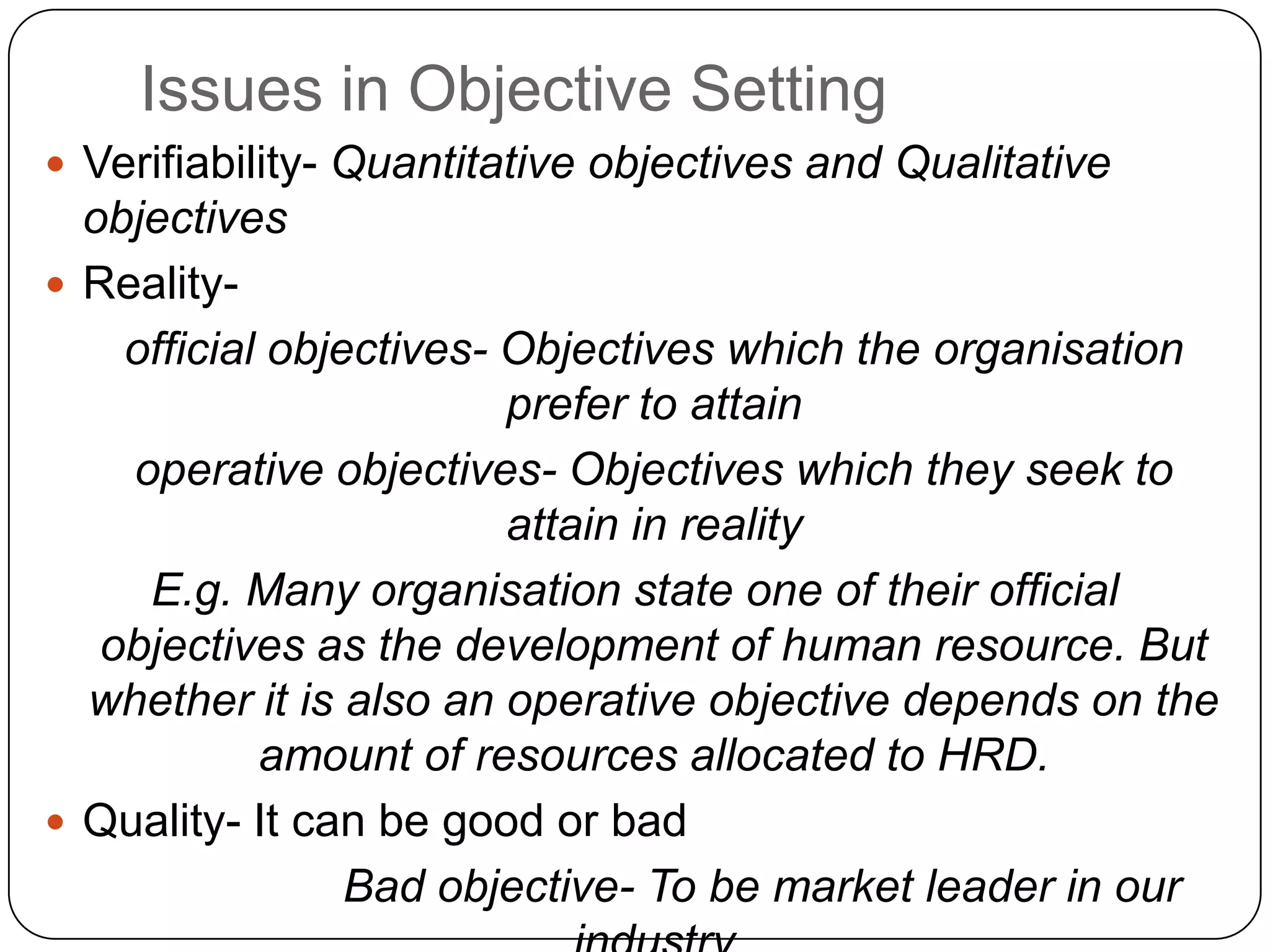
 Verifiability- Quantitative objectives and Qualitative
objectives
 Reality-
official objectives- Objectives which the organisation
prefer to attain
operative objectives- Objectives which they seek to
attain in reality
E.g. Many organisation state one of their official
objectives as the development of human resource. But
whether it is also an operative objective depends on the
amount of resources allocated to HRD.
 Quality- It can be good or bad
Bad objective- To be market leader in our
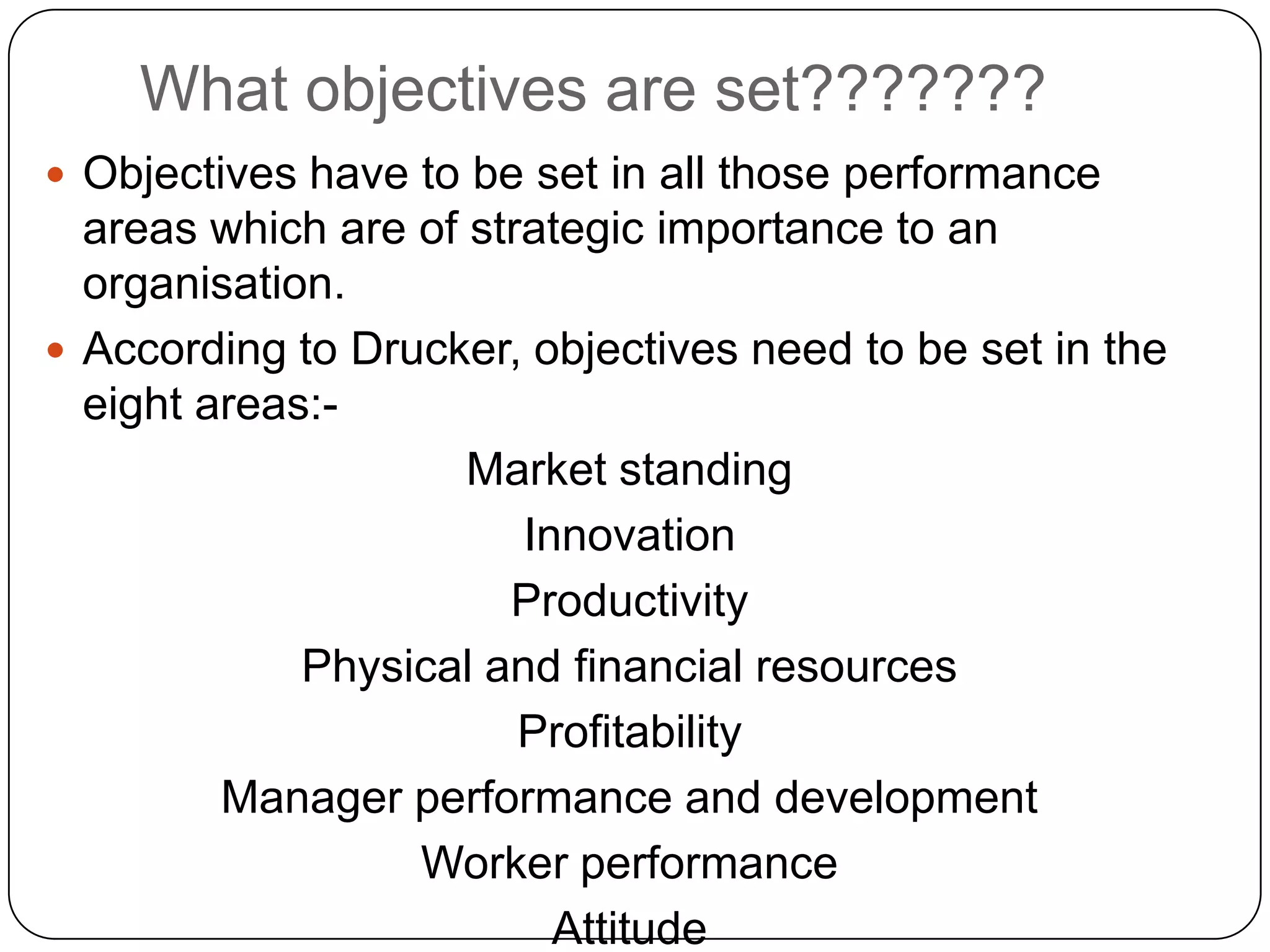
What objectives are set???????
 Objectives have to be set in all those performance
areas which are of strategic importance to an
organisation.
 According to Drucker, objectives need to be set in the
eight areas:-
Market standing
Innovation
Productivity
Physical and financial resources
Profitability
Manager performance and development
Worker performance
Attitude
How objectives are formulated
 The forces in the environment
Different Stakeholders
 Realities of enterprise resources and internal power
relationship
1.Objectives are set keeping in mind the available
resources (material and human) of a company
2.It also depend upon the decisional power hold by
different group of strategist
 The value system of the top executive
Values are beliefs, perceptions about WHAT IS GOOD
AND BAD, DESIRABLE AND UNDESIRABLE.
 Awareness by the management
Awareness of past objectives
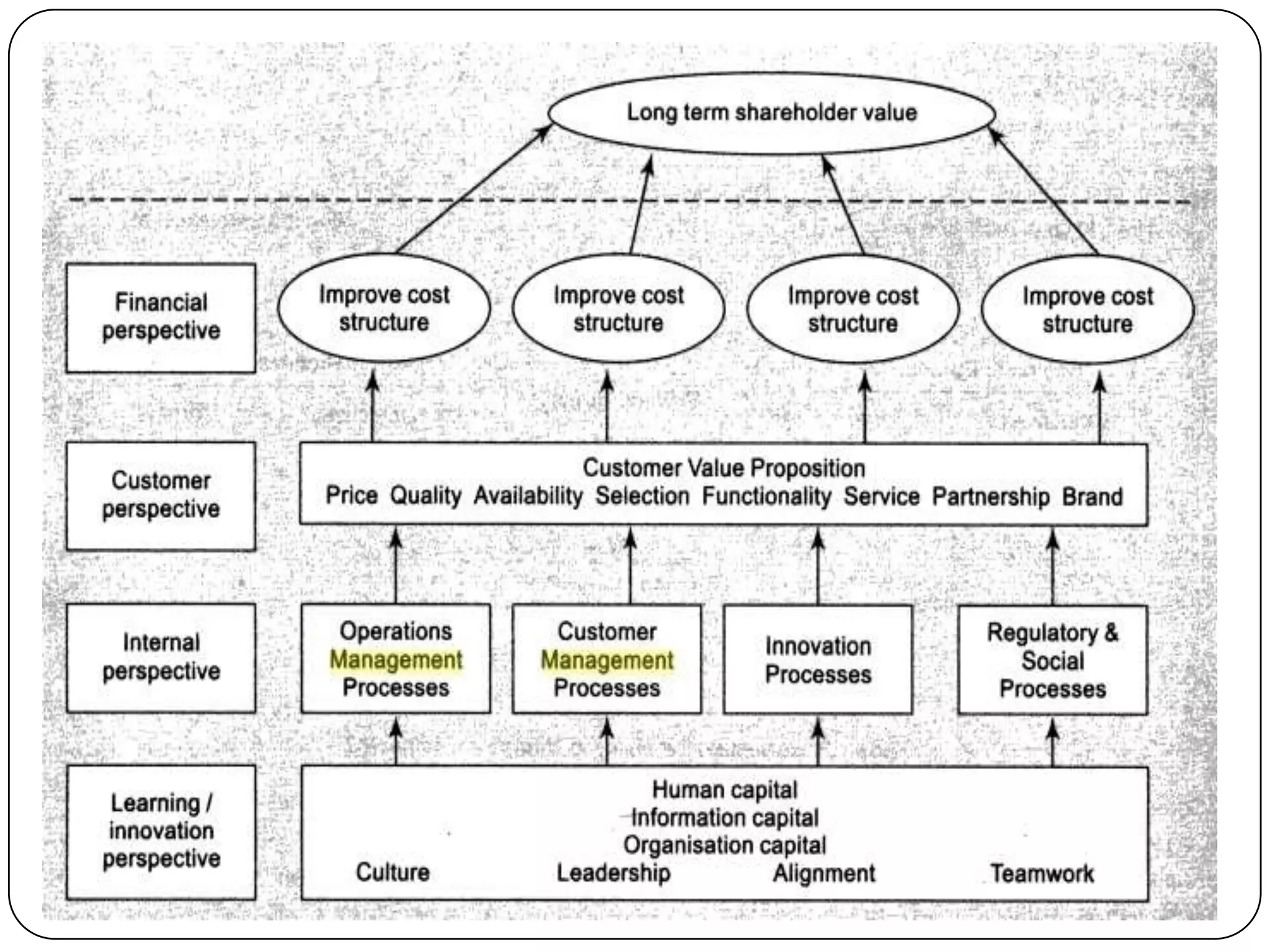
Balanced Scorecard approach to objective-setting
 It was developed by Robert S. Kaplan and David Norton
 “The Balanced Scorecard translates an organization‟s
mission and strategy into a comprehensive set of
performance measures that provides the framework for a
strategic measurement and management system”
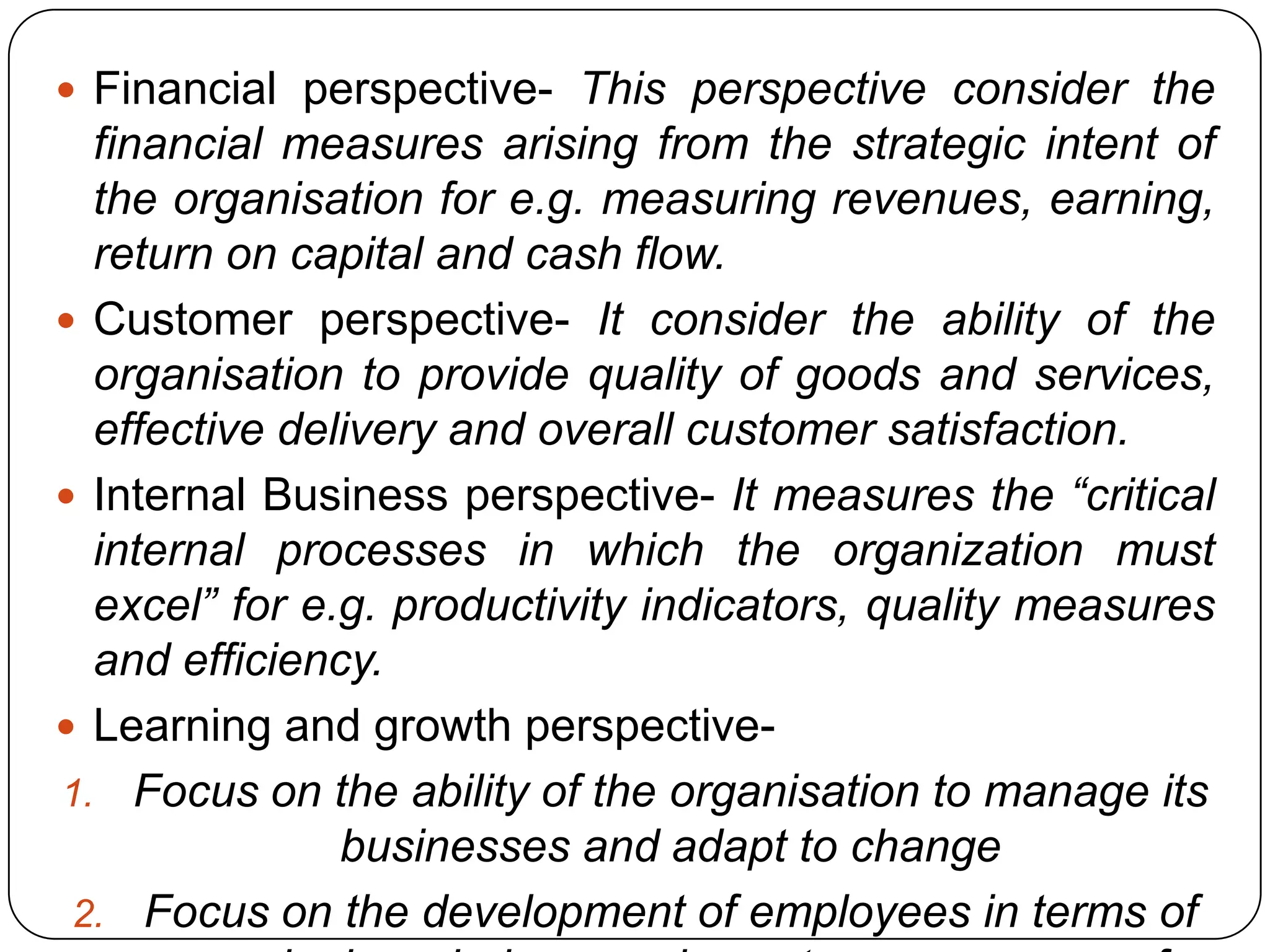
 Financial perspective- This perspective consider the
financial measures arising from the strategic intent of
the organisation for e.g. measuring revenues, earning,
return on capital and cash flow.
 Customer perspective- It consider the ability of the
organisation to provide quality of goods and services,
effective delivery and overall customer satisfaction.
 Internal Business perspective- It measures the “critical
internal processes in which the organization must
excel” for e.g. productivity indicators, quality measures
and efficiency.
 Learning and growth perspective-
1. Focus on the ability of the organisation to manage its
businesses and adapt to change
2. Focus on the development of employees in terms of
Development of scorecard
1. The development of scorecard begins with the
establishment of the organisation‟s strategic intent
including vision and mission
2. The design of balance scorecard is determined by
identifying the specific measures related to the four
perspectives. The specific strategies should be
formulated and implemented,
3. The following step involves mapping the strategy
through the indentification of organisational activities
that are derived from the strategies.
4. In the final stage, metrics that can be used to
accurately measure the performance of the
organisation in a specific areas are established
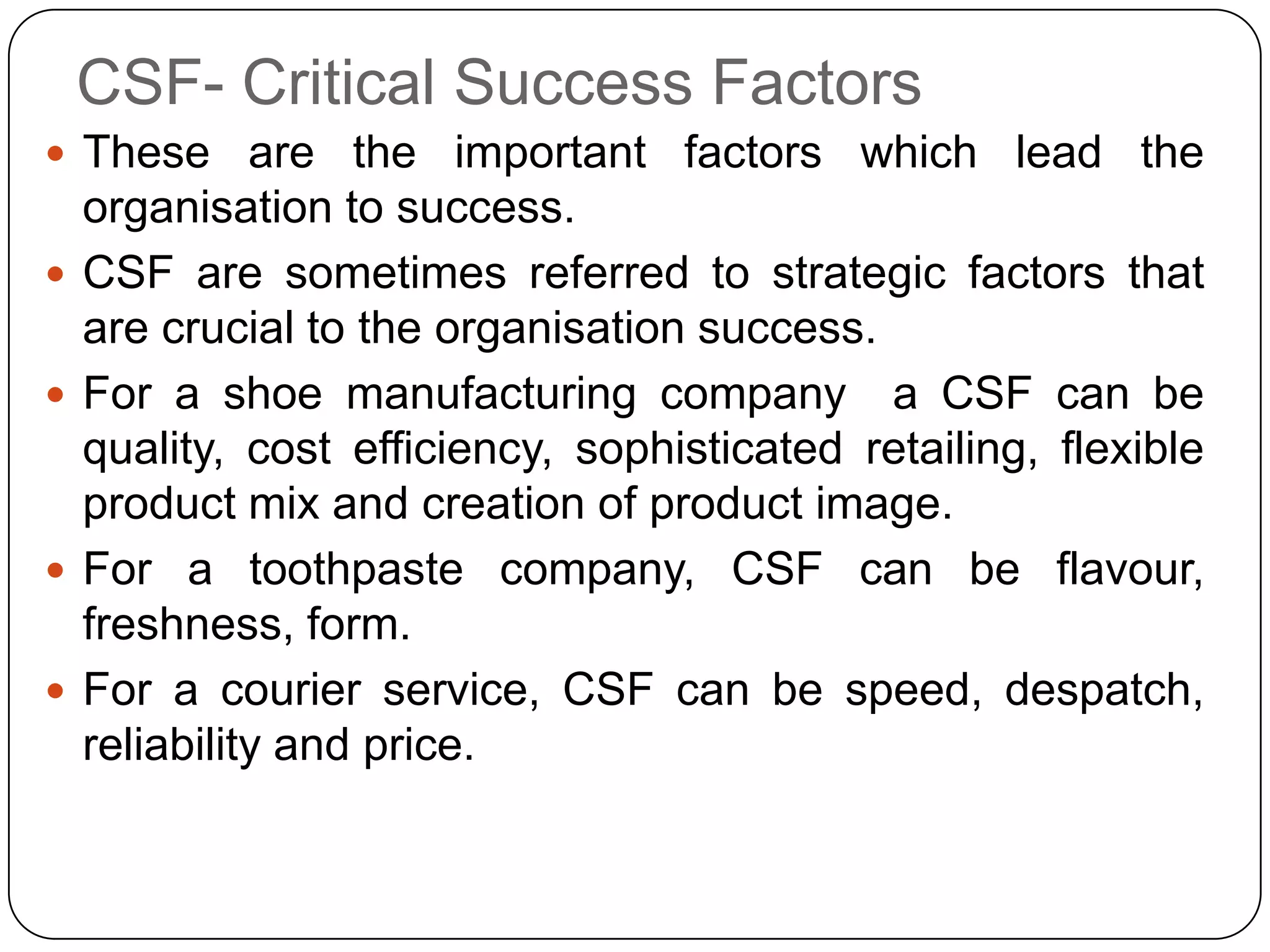
CSF- Critical Success Factors
 These are the important factors which lead the
organisation to success.
 CSF are sometimes referred to strategic factors that
are crucial to the organisation success.
 For a shoe manufacturing company a CSF can be
quality, cost efficiency, sophisticated retailing, flexible
product mix and creation of product image.
 For a toothpaste company, CSF can be flavour,
freshness, form.
 For a courier service, CSF can be speed, despatch,
reliability and price.
KPI- Key performance indicators
 KPI are the measures in terms of which the CSF are
evaluated
 For e.g. A shoe manufacturing company has a high
manufacturing quality as a critical success factor and he
can compare this factor with recall rate after delivery,
product reject rate, on-time delivery etc. This form the
KPI.
 KPI depend upon the vision set by an organisation. For
e.g.
For a profitable company in industry- Its KPI will be pre-
tax profit
For a responsible corporate citizen- Its KPI will be the
per cent of profit contributed to community
 KPI give everyone in the organisation a clear picture of
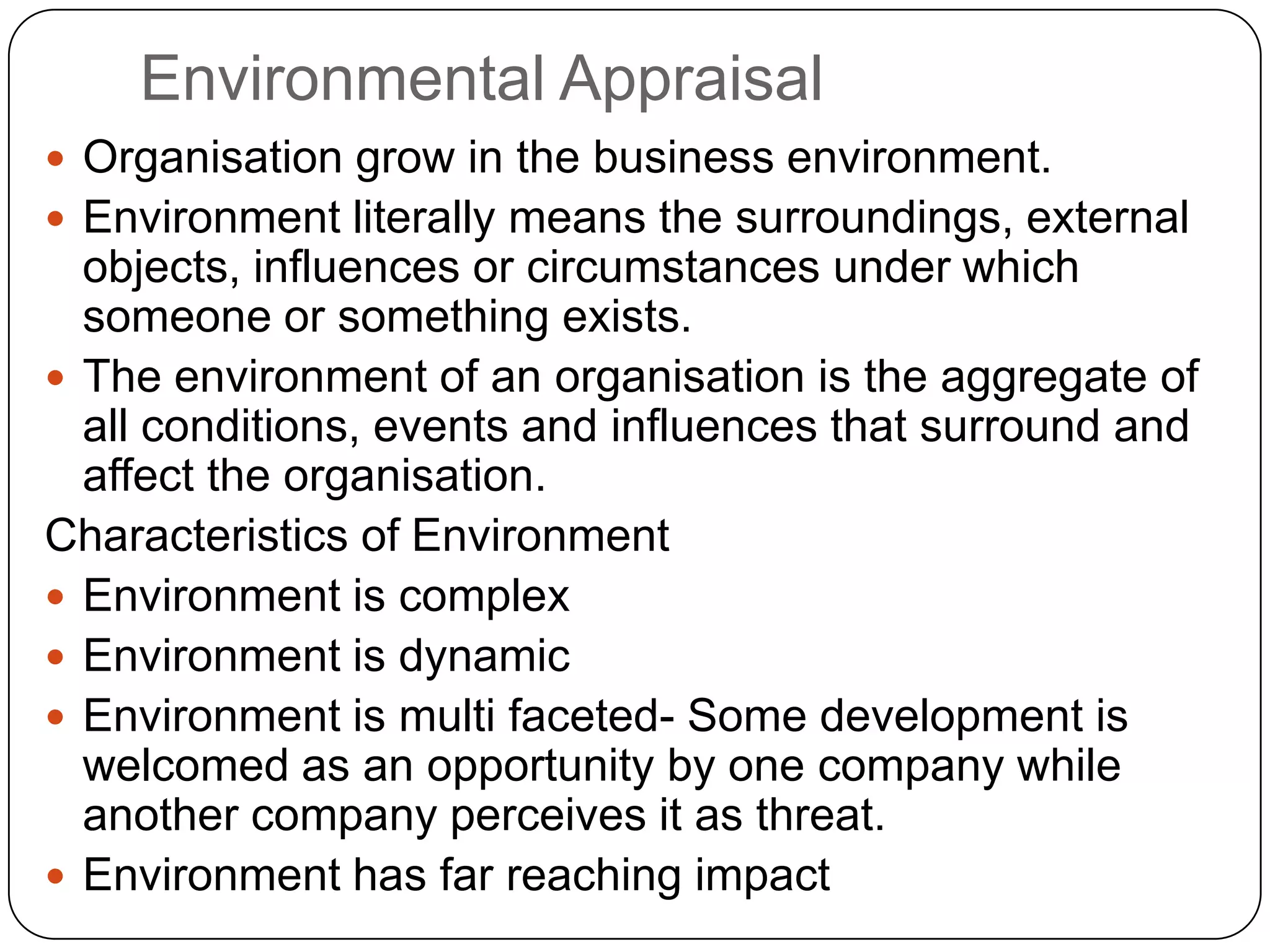
Environmental Appraisal
 Organisation grow in the business environment.
 Environment literally means the surroundings, external
objects, influences or circumstances under which
someone or something exists.
 The environment of an organisation is the aggregate of
all conditions, events and influences that surround and
affect the organisation.
Characteristics of Environment
 Environment is complex
 Environment is dynamic
 Environment is multi faceted- Some development is
welcomed as an opportunity by one company while
another company perceives it as threat.
 Environment has far reaching impact
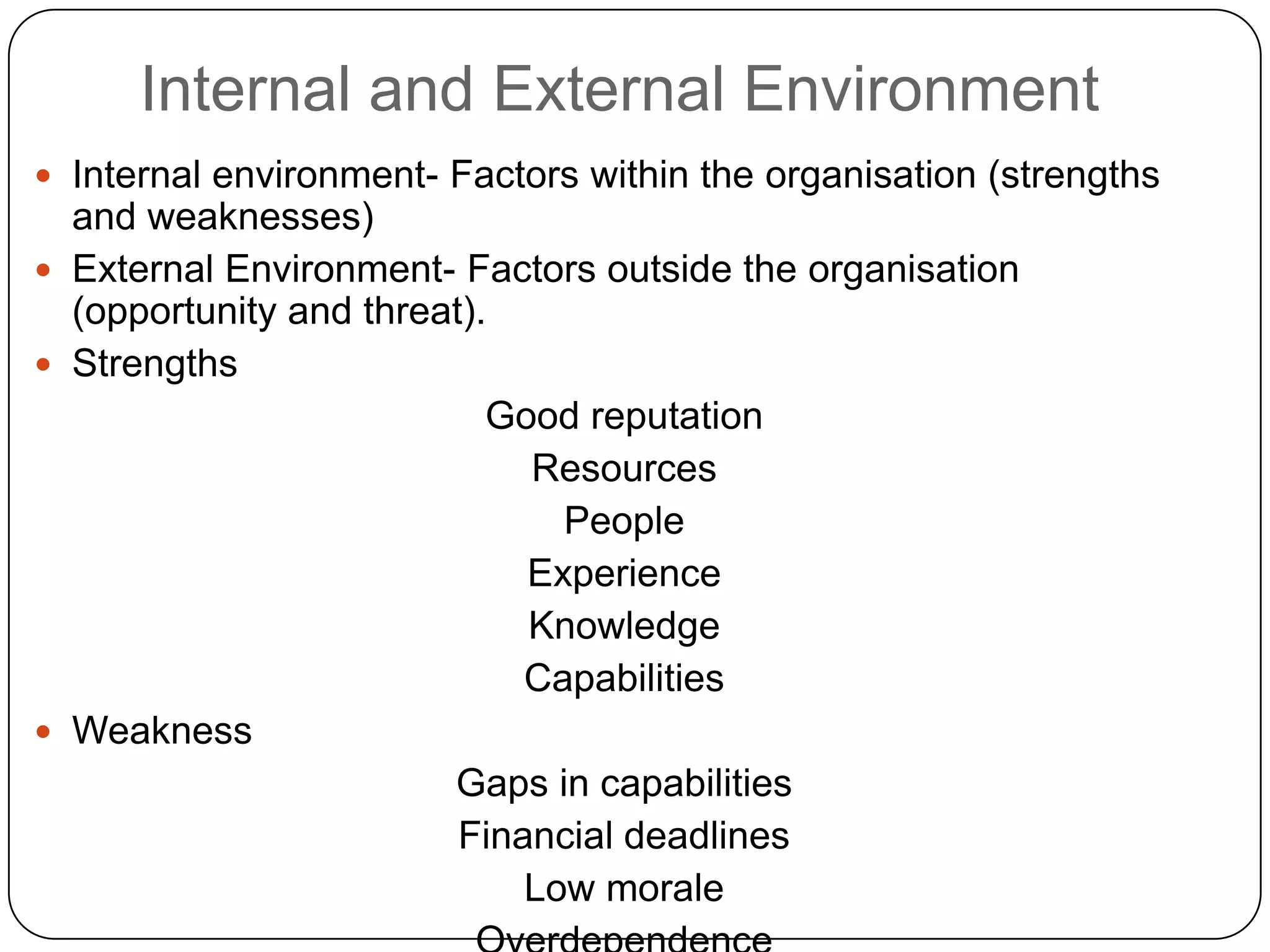
Internal and External Environment
 Internal environment- Factors within the organisation (strengths
and weaknesses)
 External Environment- Factors outside the organisation
(opportunity and threat).
 Strengths
Good reputation
Resources
People
Experience
Knowledge
Capabilities
 Weakness
Gaps in capabilities
Financial deadlines
Low morale
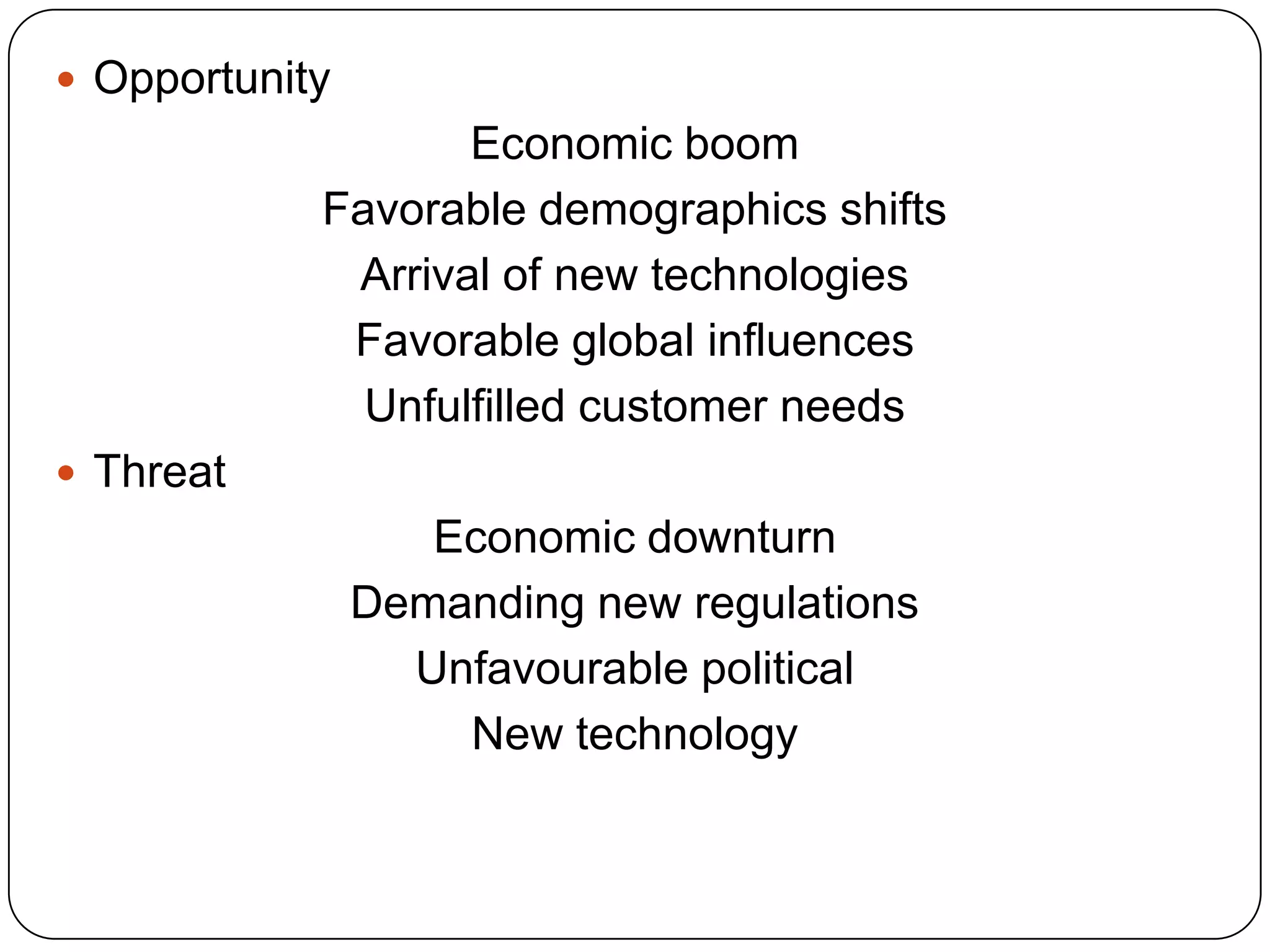
 Opportunity
Economic boom
Favorable demographics shifts
Arrival of new technologies
Favorable global influences
Unfulfilled customer needs
 Threat
Economic downturn
Demanding new regulations
Unfavourable political
New technology
SWOT ANALYSIS
 SWOT Analysis evolved during 1960s at Stanford Research
Institute
 SWOT analysis process
1.Setting the objectives of the organisation or its unit
2.Identifying its strength, weaknesses, opportunity and threats
3.ASKING FOUR QUESTIONS
Q1 HOW DO WE MAXIMISE OUR STRENGTH
Q2 HOW DO WE MINIMISE OUR WEAKNESSES
Q3 HOW DO WE CAPITALISE ON THE OPPORTUNITIES IN
OUR EXTERNAL ENVIRONMENT
Q4 HOW DO WE PROTECT OURSELVES FROM THREATS
IN OUR EXTERNAL ENVIRONMENT
4. Recommending strategies
Benefits
 Simple to use
 Low cost
 Flexible and can be adapted to varying situations
 Leads to clarification of issues
 Development of goal oriented alternatives
 Useful as a starting point for strategic analysis
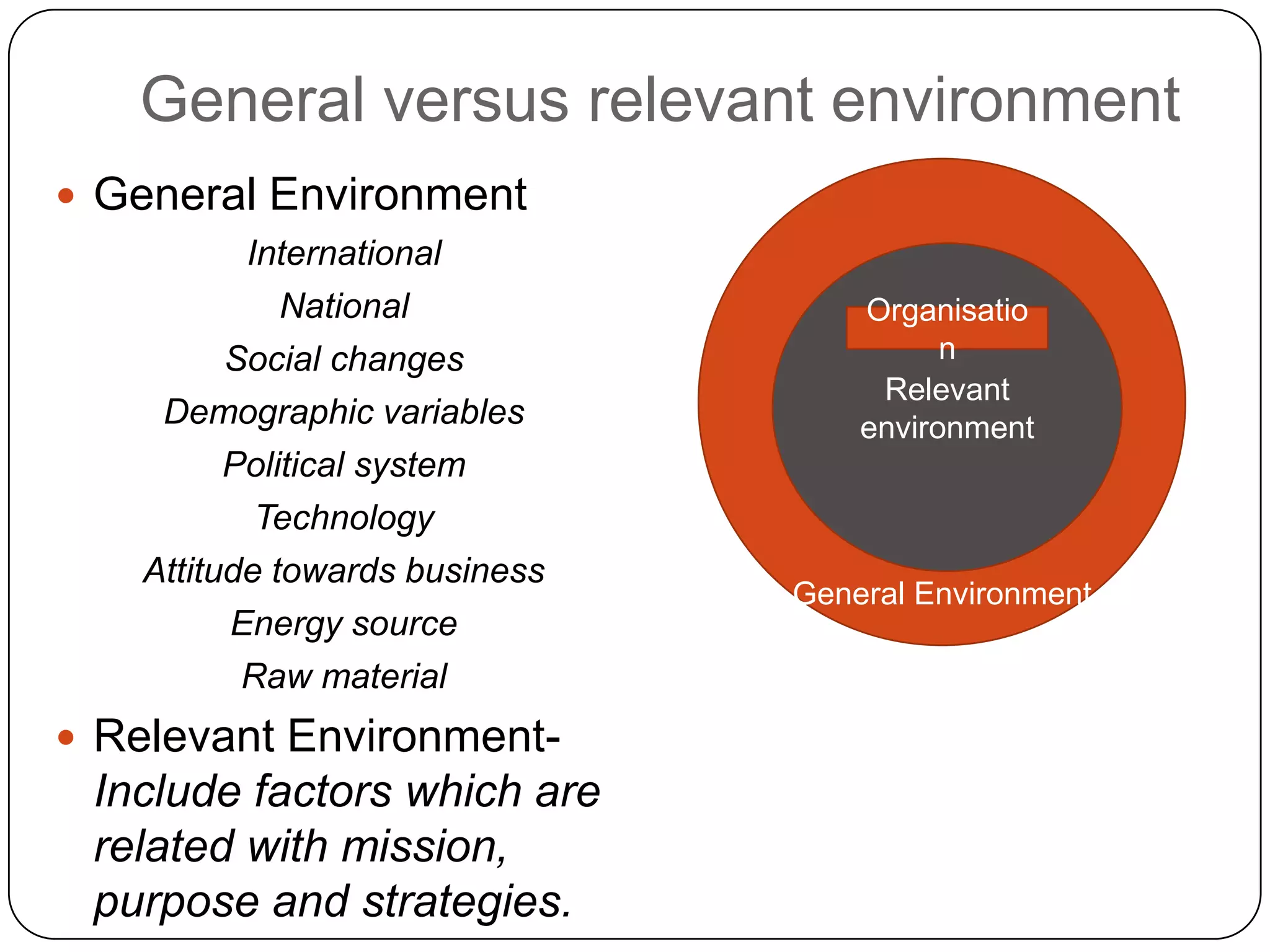
General versus relevant environment
 General Environment
International
National
Social changes
Demographic variables
Political system
Technology
Attitude towards business
Energy source
Raw material
 Relevant Environment-
Include factors which are
related with mission,
purpose and strategies.
General Environment
Relevant
environment
Organisatio
n
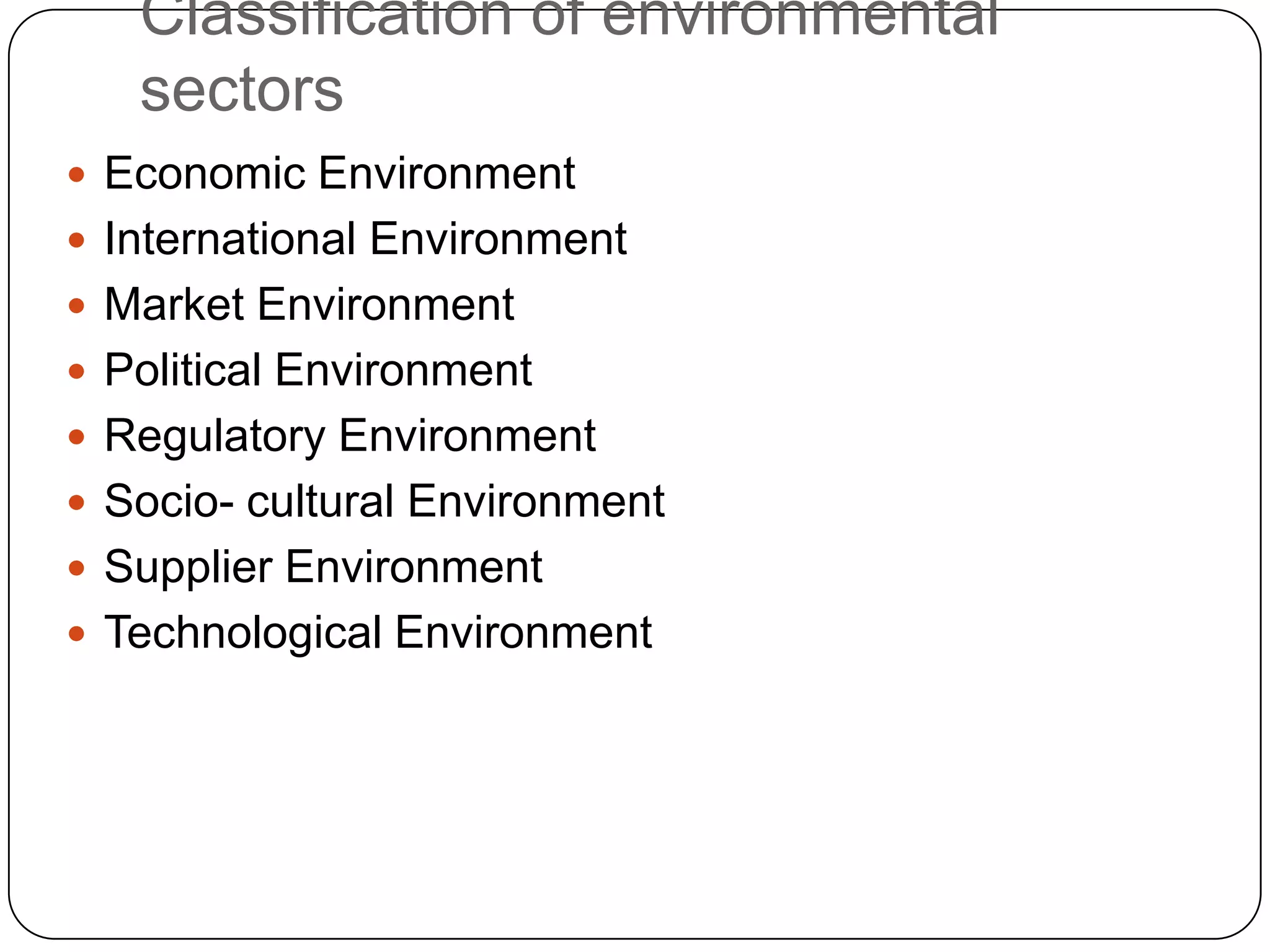
Classification of environmental
sectors
 Economic Environment
 International Environment
 Market Environment
 Political Environment
 Regulatory Environment
 Socio- cultural Environment
 Supplier Environment
 Technological Environment
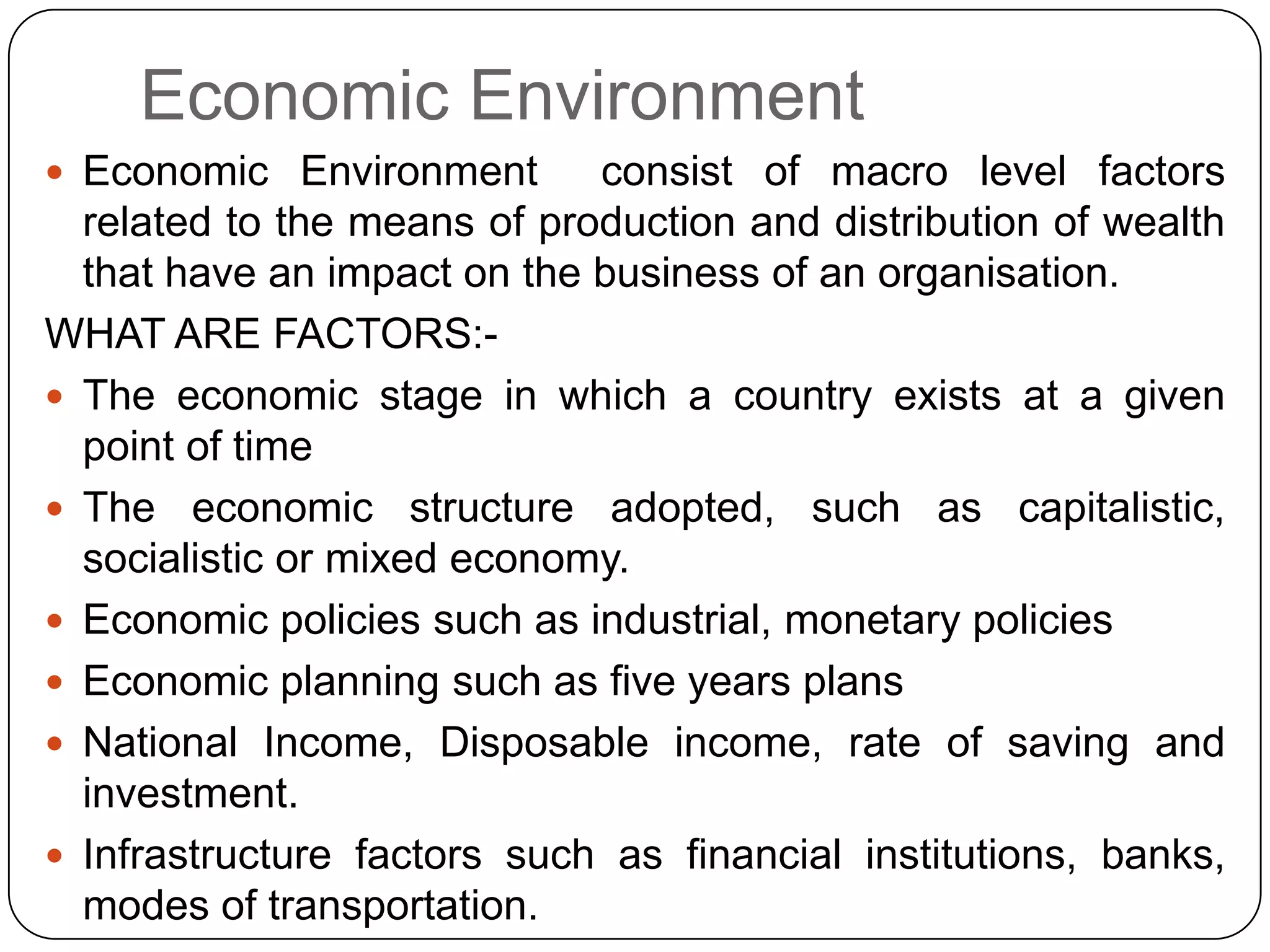
Economic Environment
 Economic Environment consist of macro level factors
related to the means of production and distribution of wealth
that have an impact on the business of an organisation.
WHAT ARE FACTORS:-
 The economic stage in which a country exists at a given
point of time
 The economic structure adopted, such as capitalistic,
socialistic or mixed economy.
 Economic policies such as industrial, monetary policies
 Economic planning such as five years plans
 National Income, Disposable income, rate of saving and
investment.
 Infrastructure factors such as financial institutions, banks,
modes of transportation.
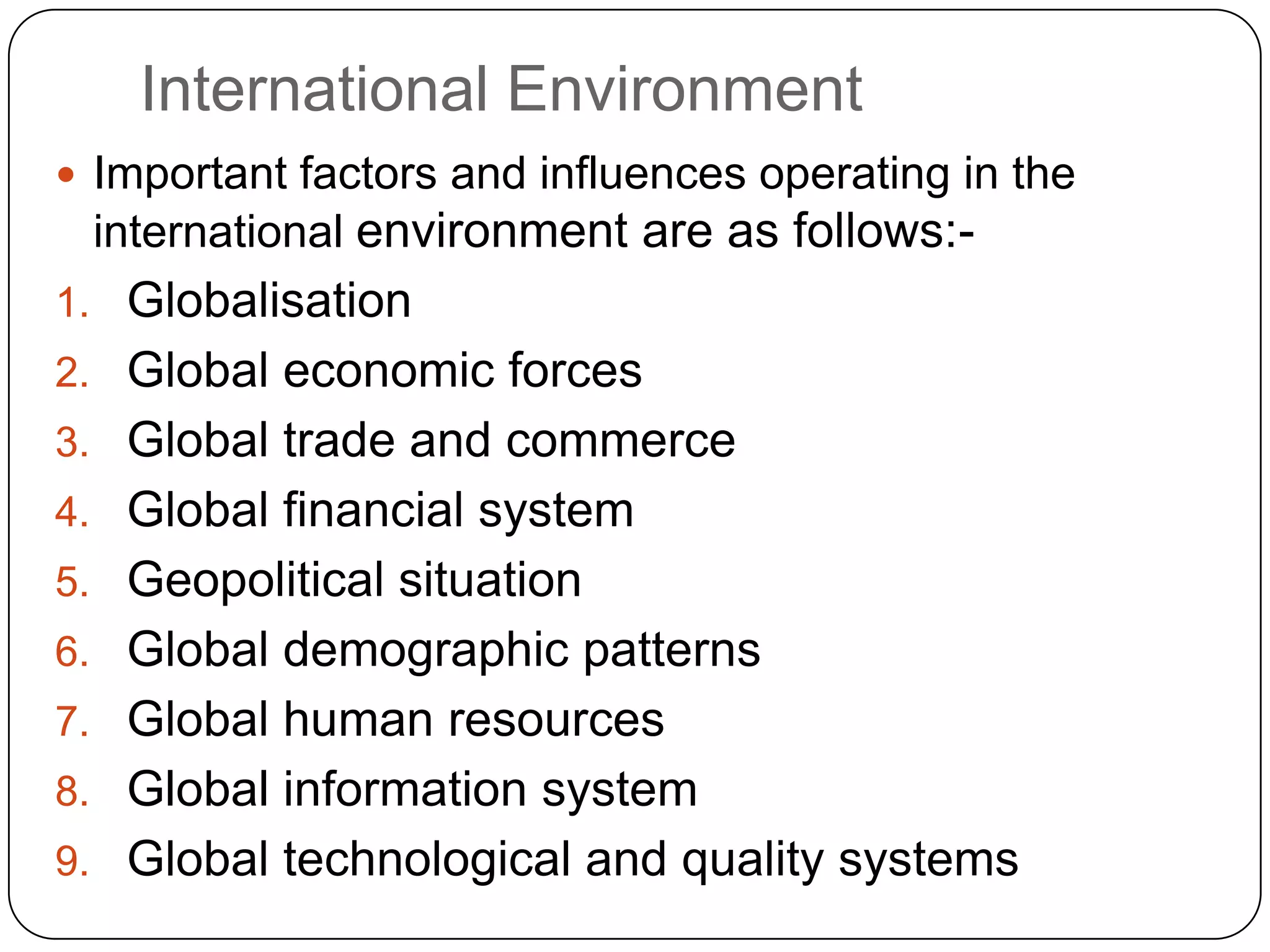
International Environment
 Important factors and influences operating in the
international environment are as follows:-
1. Globalisation
2. Global economic forces
3. Global trade and commerce
4. Global financial system
5. Geopolitical situation
6. Global demographic patterns
7. Global human resources
8. Global information system
9. Global technological and quality systems
Market Environment
 Important factors and influences operating in the
market environment are as follows:-
1. Customer needs, preferences, perceptions,
attitudes
2. Product factors such as demand, image, features,
utility, function, design, life cycle, price, promotion,
distribution etc
3. Marketing intermediary factors such as levels and
quality of customer service, middleman etc.
4. Different types of competitors, entry and exit of
major competitors
Political Environment
 Important factors and influences operating in the
political environment are as follows:-
1. Nature of political system
2. The political structure
3. Political philosophy, government‟s role in business, its
policies.
Regulatory Environment
 Constitutional framework, fundamental rights
 Policies related to licensing, monopolies, foreign
investment
 Policies related to pricing and their control
 Policies related to import and export
Supplier environment
 Some of the important factors and influences operating
in the supplier environment are as follows:-
1. Cost, availability and continuity of supply of raw
material, parts and components
2. Cost and availability of finance
3. Cost, reliability and dependability of human resource
4. Cost, availability and the existence of sources and
means for supply of machinery, spare parts and after
sale service
5. Infrastructural support and ease of availability of the
different factors of production, bargaining power of
suppliers.
Technological environment
1. Sources of technology like company sources,
external sources, foreign sources, cost of
technology acquisition.
2. Technological development, stages of
development, change of technology
3. Impact of technology on human beings and its
environmental effects.
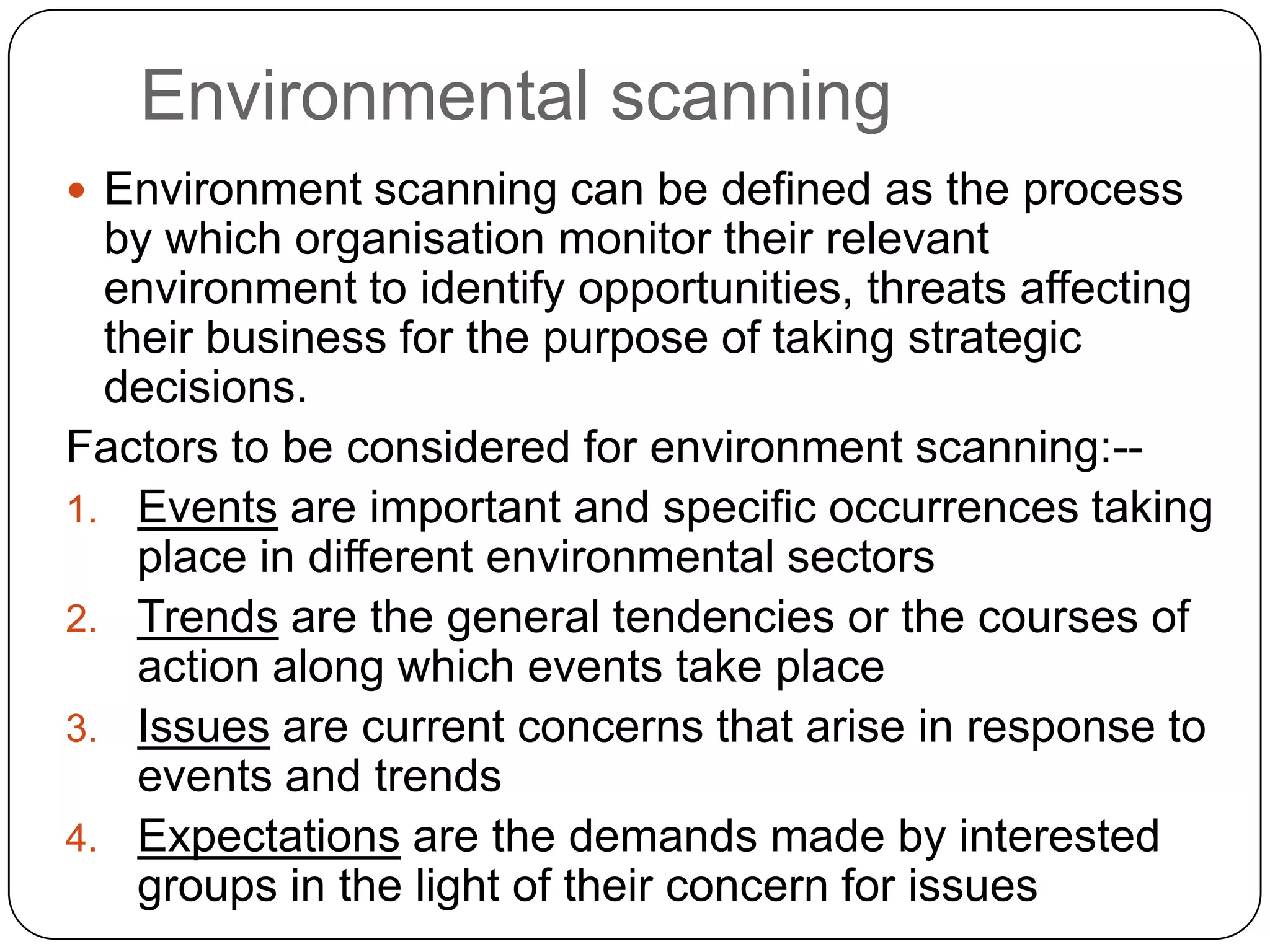
Environmental scanning
 Environment scanning can be defined as the process
by which organisation monitor their relevant
environment to identify opportunities, threats affecting
their business for the purpose of taking strategic
decisions.
Factors to be considered for environment scanning:--
1. Events are important and specific occurrences taking
place in different environmental sectors
2. Trends are the general tendencies or the courses of
action along which events take place
3. Issues are current concerns that arise in response to
events and trends
4. Expectations are the demands made by interested
groups in the light of their concern for issues
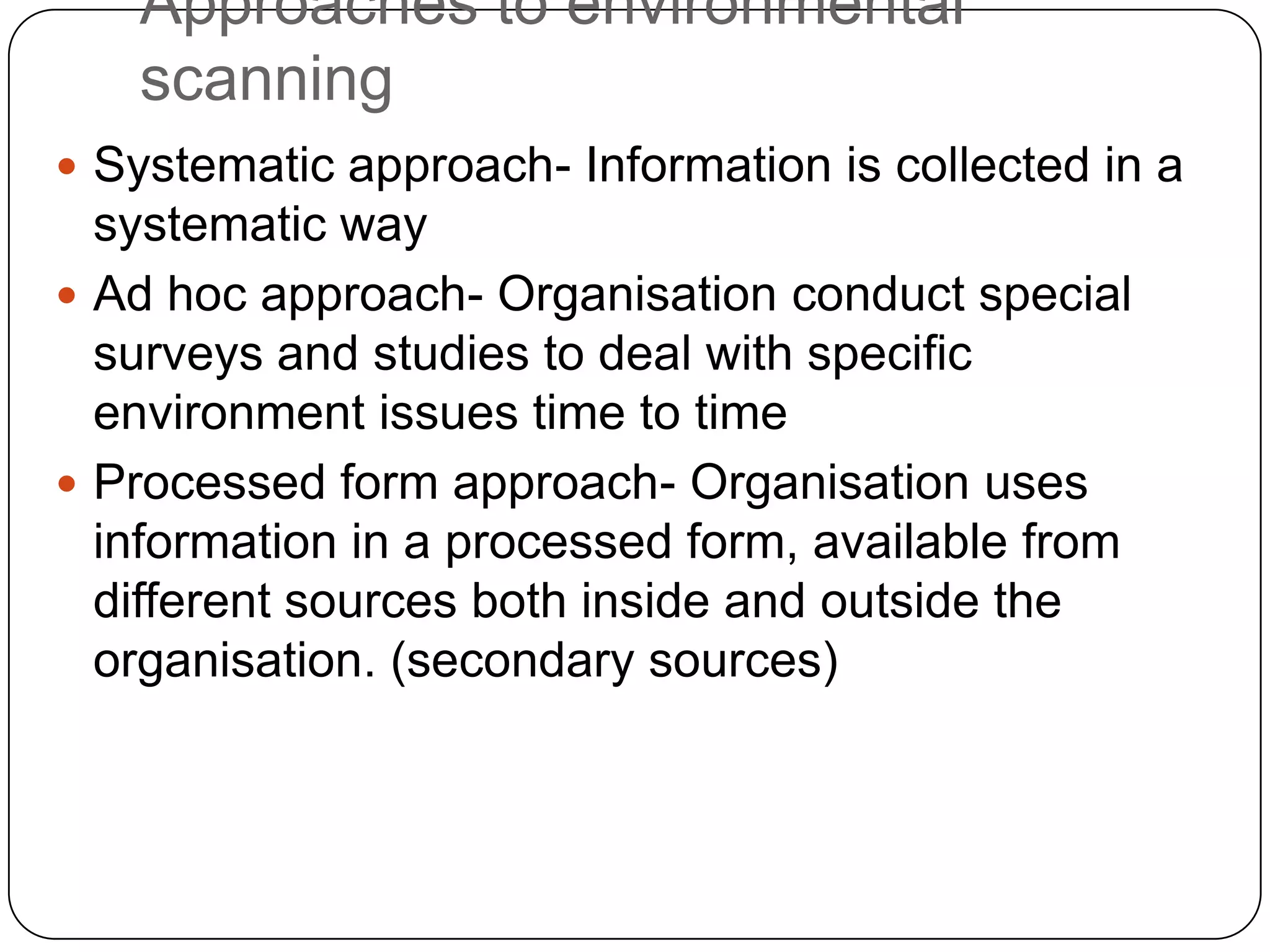
Approaches to environmental
scanning
 Systematic approach- Information is collected in a
systematic way
 Ad hoc approach- Organisation conduct special
surveys and studies to deal with specific
environment issues time to time
 Processed form approach- Organisation uses
information in a processed form, available from
different sources both inside and outside the
organisation. (secondary sources)
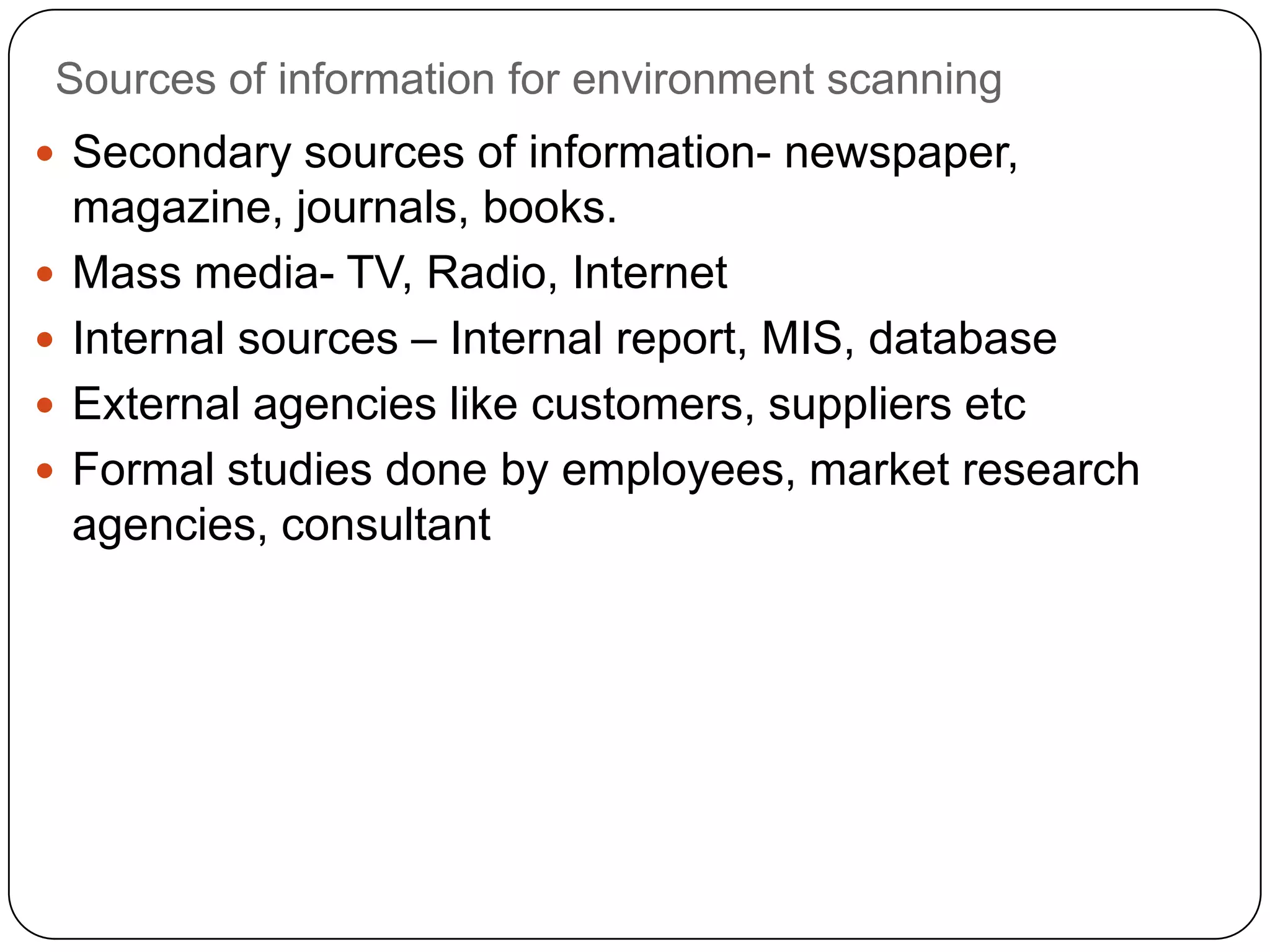
Sources of information for environment scanning
 Secondary sources of information- newspaper,
magazine, journals, books.
 Mass media- TV, Radio, Internet
 Internal sources – Internal report, MIS, database
 External agencies like customers, suppliers etc
 Formal studies done by employees, market research
agencies, consultant
ETOP- Environmental Threat and opportunity profile
(Glueck)
1. The preparation of ETOP involves dividing the
environment into different sectors and then analysing
the impact of each sector on the organisation.
2. A comprehensive ETOP requires subdividing each
environmental sector into subfactors and then the
impact of each subfactor on the organisation is
described in the form of a statement.
3. The preparation of ETOP provides clear picture to the
strategists about which sectors and the different
factors in each sector have a favourable impact on
the organisation.
4. By the means of ETOP, the organisation knows where
it stands with respect to its environment.
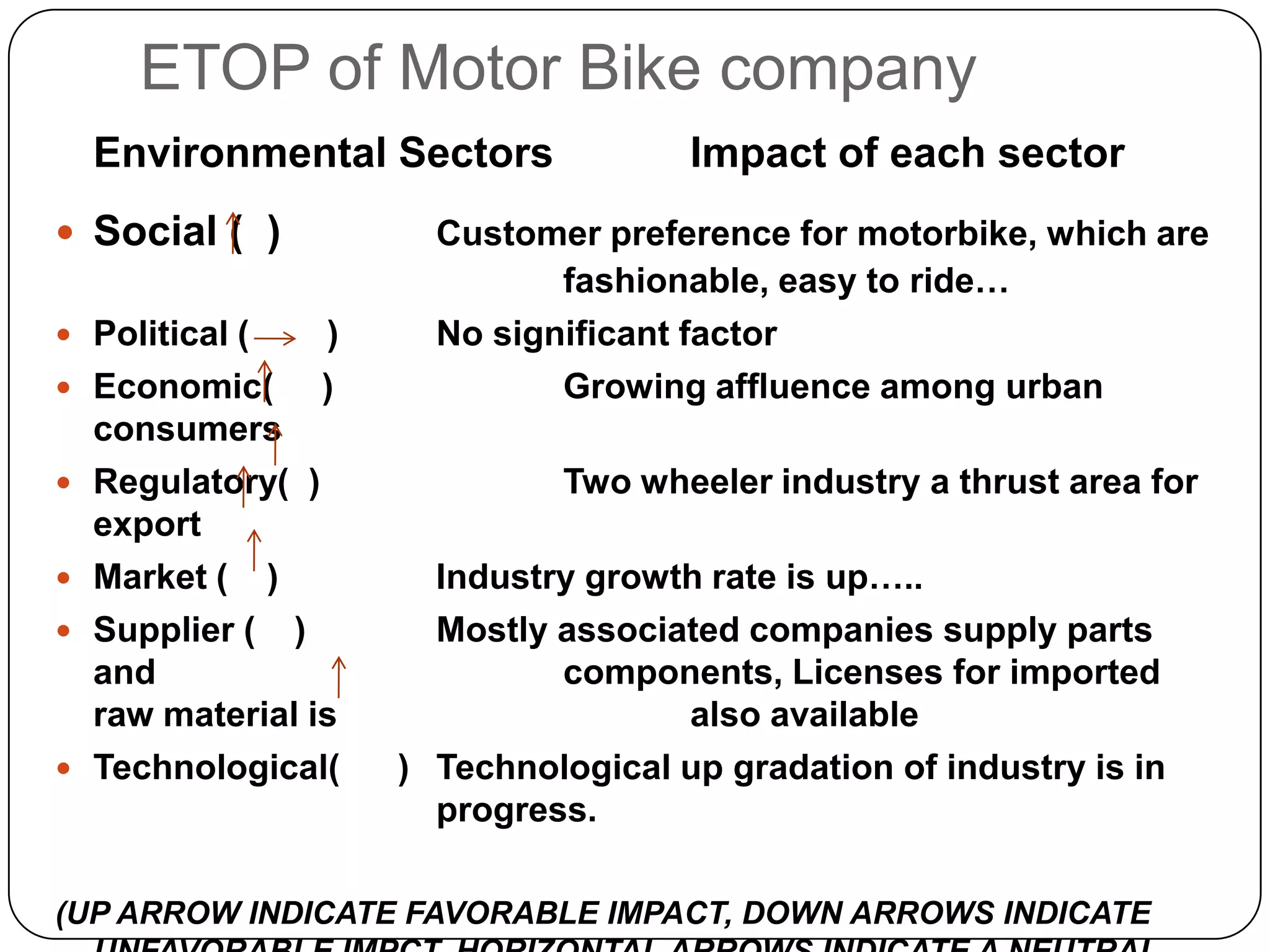
ETOP of Motor Bike company
Environmental Sectors Impact of each sector
 Social ( ) Customer preference for motorbike, which are
fashionable, easy to ride…
 Political ( ) No significant factor
 Economic( ) Growing affluence among urban
consumers
 Regulatory( ) Two wheeler industry a thrust area for
export
 Market ( ) Industry growth rate is up…..
 Supplier ( ) Mostly associated companies supply parts
and components, Licenses for imported
raw material is also available
 Technological( ) Technological up gradation of industry is in
progress.
(UP ARROW INDICATE FAVORABLE IMPACT, DOWN ARROWS INDICATE
Points to remember while preparing
ETOP
 Issue selection- Focus on the issue which have been
selected. Some of the important issues may be those
related to market share, competitive pricing, customer
preference, technological changes, economic policies,
competitive trends etc.
 Accuracy of data- Data should be collected from good
sources. The relevance, importance, manageability and low
cost of data are some of the important factors.
 Impact studies- Impact studies should be conducted
focusing on the various opportunities and threats and the
critical issues selected. It may include study of probable
effect on the company‟s strengths and weaknesses,
competitive position, accomplishment of vision and mission.
 Before the formulation of strategies can be undertaken, the
Internal Environment
 Internal analysis is the process of reviewing organisational
resources, scanning organisational activities and identifying
strengths and capabilities.
 Internal analysis stands for resource audit, value chain
analysis and core competence.
 Internal diagnosis is the process by which strategist
determine how to exploit the opportunities and meet the
threats.
 In other words Corporate appraisal is the process through
which managers analyse the various factors of their
organisation to evaluate their relative strengths and
weaknesses in order to meet the opportunities and threats of
environment.
 The appraisal of the external environment of a firm helps it to
think of what it might choose to do and the appraisal of
Dynamics of Internal
Environment
 Organisation uses different types of resources and
positive interplay of these resources can produces
synergy within an organisation.
 These interplay leads to the development of
strengths and weaknesses over a period of time.
 Some of these strengths make an organisation
especially competent in a particular area of its
activity causing it to develop competencies.
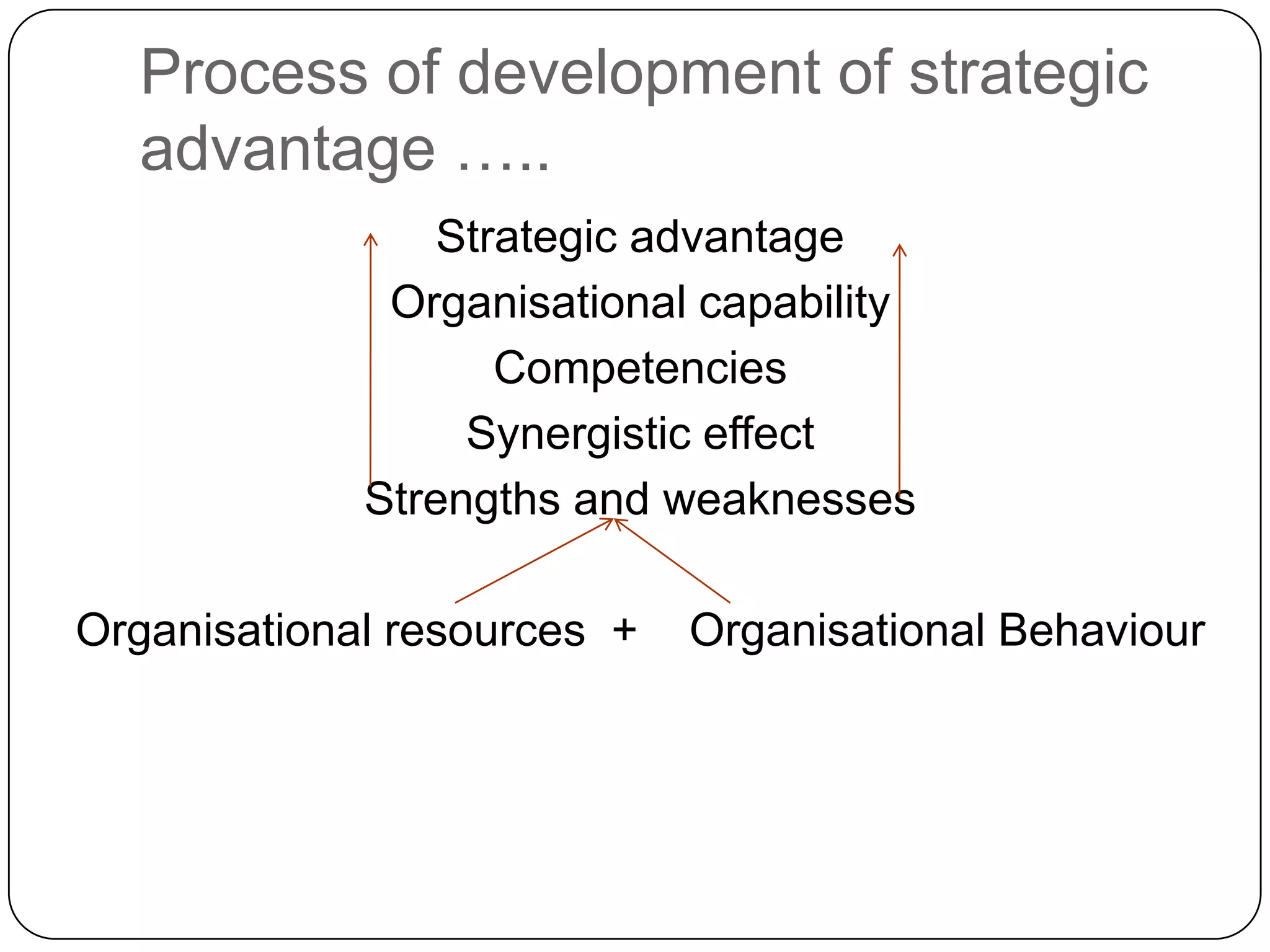
Process of development of strategic
advantage …..
Strategic advantage
Organisational capability
Competencies
Synergistic effect
Strengths and weaknesses
Organisational resources + Organisational Behaviour
Organisational Resources
 A firm is a bundle of bundle of resources- tangible and
intangible and include all assests, capabilities,
organisational process, information, knowledge etc.
 PHYSICAL RESOURCES- Technology, plant, equipment,
geographical location, access to raw material….
 HUMAN RESOURCES- Training, experiences, intelligence,
relationships etc.
 ORGANISATIONAL RESOURCES- Formal systems,
structures as well as informal relations among groups.
 Resources can lead the organisation to the ultimate
strategic advantage.
 According to Barney (Developer of resource based theory)-
“Firms possess resources of which those that are valuable
and rare enable them to achieve strategic advantage.
Organisational Behaviour
 Organisational behaviour is unique in the sense that it
leads to the development of a special identity and
character of an organisation.
 Some of the important forces that affect organisational
behaviour are the quality of leadership, management
philosophy, values and culture, quality of work
environment, organisation climate etc…
 The resources and the behaviour of the organisation
can provide a synergy effect in the development of an
organisation. They can collectively produce strengths
and weaknesses.
Strengths and weaknesses
 Strength is an inherent capability which an
organisation can use to gain strategic advantage.
 A weakness is an inherent limitation which creates a
strategic disadvantage for an organisation.
 Strengths and weaknesses do not exist in isolation but
combine within a functional area and also across
different functional area.
Synergistic Effect
 Synergy is an idea that the whole is greater or lesser
than the sum of its parts. It can be expressed as „the
two plus two is equal to five or three effect‟
 It is the inherent nature of organisation that strengths
and weaknesses, like resources and behaviour, do
not exist indivudally but combine in a variety of ways.
 Two strong points in a functional area add up to
something more than double the strengths. Likewise
two weaknesses acting in tandem result in more than
double the damage.
Competencies
 Competencies are special qualities possessed by an
organisation that make them withstand the pressures
of competition in the marketplace
 Unique resources, core capabilities, knowledge
 When a specific ability is possessed by a particular
organisation exclusively or relatively in large measure,
it is called a distinctive competence
 A firm should build its competencies around the CSF
Organisational Capability
 Organisational capability is the inherent capacity or
potential of an organisation to use its strengths and
weaknesses in order to exploit the opportunities and
face the threats in its external environment.
 It is the skill of the organisation to coordinate
resources and putting them to productive use.
 Organisational capability is the capacity or potential of
an organisationa and it means that it is a mesurable
attribute( total resources and behaviour, strengths and
weaknessess etc)
Strategic and competitive advantage
 Strategic advantage are the outcomes of organisational
capabilities.
 Strategic disadvantage are penalties in the form of
financial loss or damage to market share.
 Strategic advantages are measurable in absolute terms
using the parameters in which they are expressed for
e.g. profitability could be used to measure strategic
advantage..
Organisational Capability factors
 Capabilities are most often developed in specific
functional areas such as marketing or operations or
even in R&D.
 Organisational capability factors are the strategic
strengths and weaknesses existing in different
functional areas within an organisation, which are of
crucial importance to strategy formulation and
implementation.
 It is feasible to measure and compare capabilities in
different functional areas.
Financial capability
 Financial capability factors relate to the availability,
usages and management of funds.
 Factors related to sources of funds- Capital structure,
procurement of capital, controllership, financing pattern,
working capital availability, borrowings, capital and
credit availability, reserves, surplus, relationship with
lenders, banks and financial institutions.
 Factors related to usage of funds- Capital investment,
current assets, loans and advances, relationship with
shareholders.
 Factors related to management of funds- Financial
accounting and budgeting systems, state of financial
health, cash, credit, return and risk management, cost
reduction.
Marketing capability
 These factors related with pricing, promotion and
distribution of products or services
 Product related factors- Variety, differentiation, mix
quality, positioning, packaging
 Price related factors- Pricing policies and objectives
 Place related factors- Distribution, transportation,
marketing channels, marketing intermediaries
 Promotion related factors- Sales promotion,
advertising, public relation
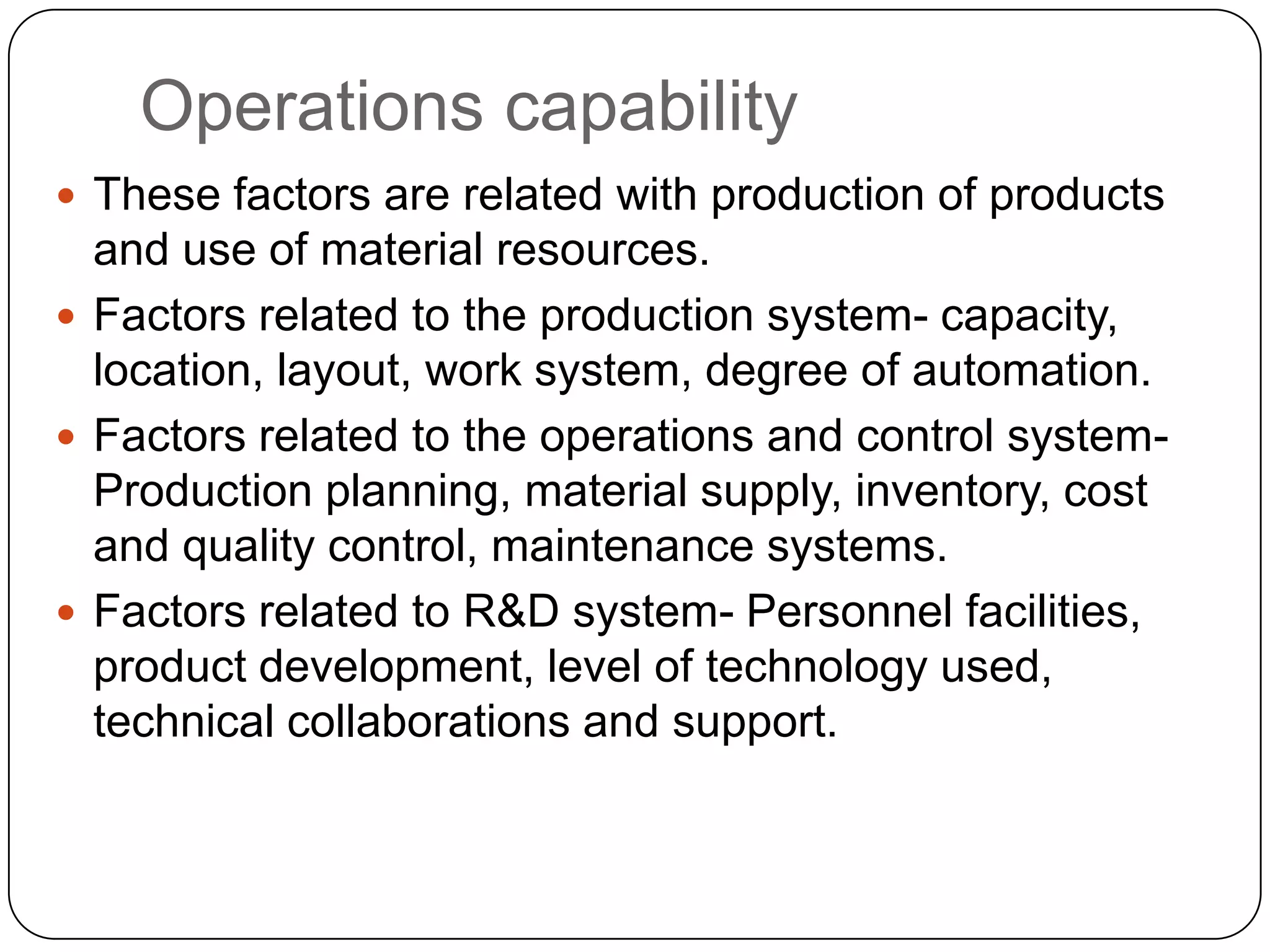
Operations capability
 These factors are related with production of products
and use of material resources.
 Factors related to the production system- capacity,
location, layout, work system, degree of automation.
 Factors related to the operations and control system-
Production planning, material supply, inventory, cost
and quality control, maintenance systems.
 Factors related to R&D system- Personnel facilities,
product development, level of technology used,
technical collaborations and support.
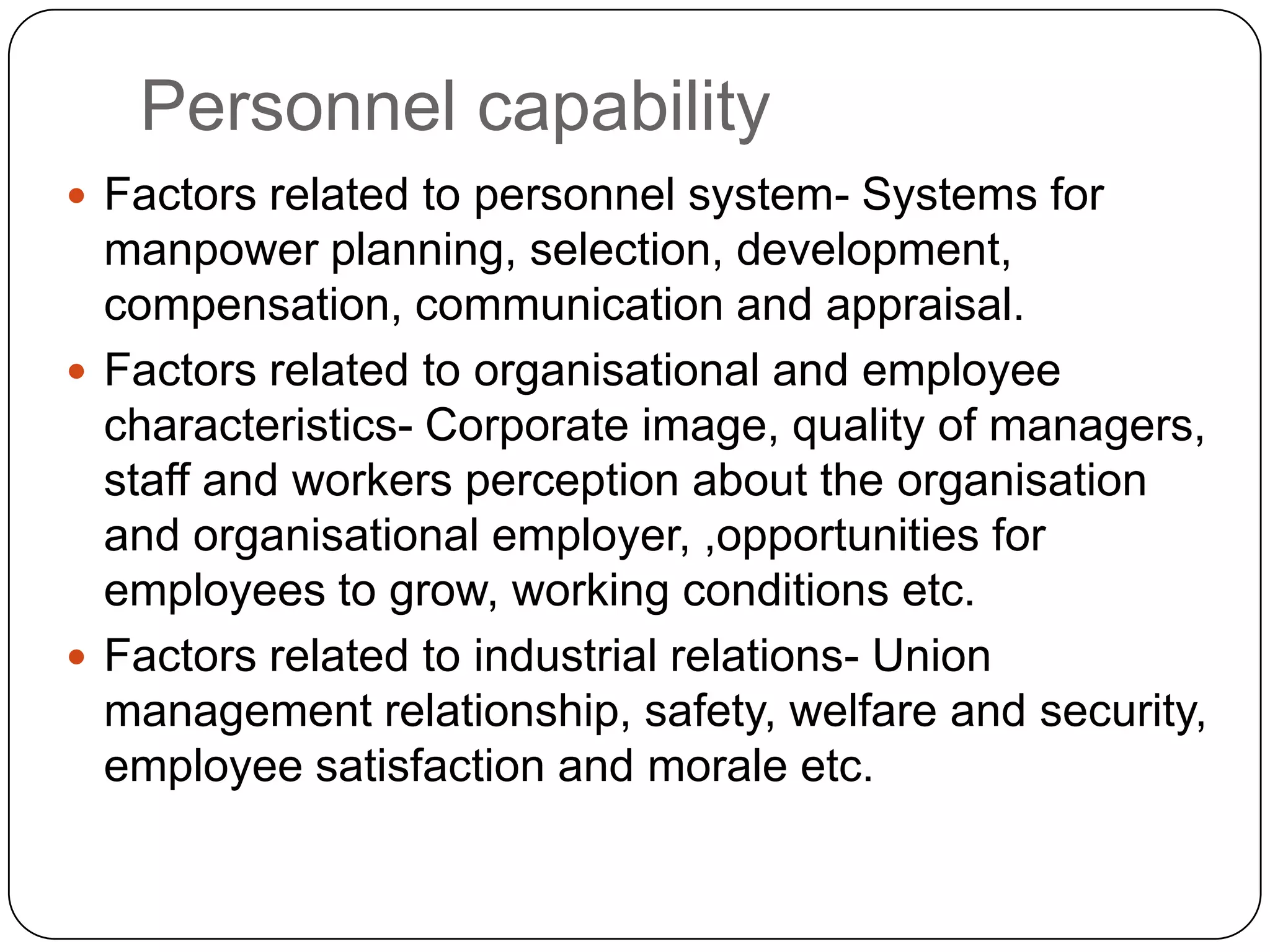
Personnel capability
 Factors related to personnel system- Systems for
manpower planning, selection, development,
compensation, communication and appraisal.
 Factors related to organisational and employee
characteristics- Corporate image, quality of managers,
staff and workers perception about the organisation
and organisational employer, ,opportunities for
employees to grow, working conditions etc.
 Factors related to industrial relations- Union
management relationship, safety, welfare and security,
employee satisfaction and morale etc.
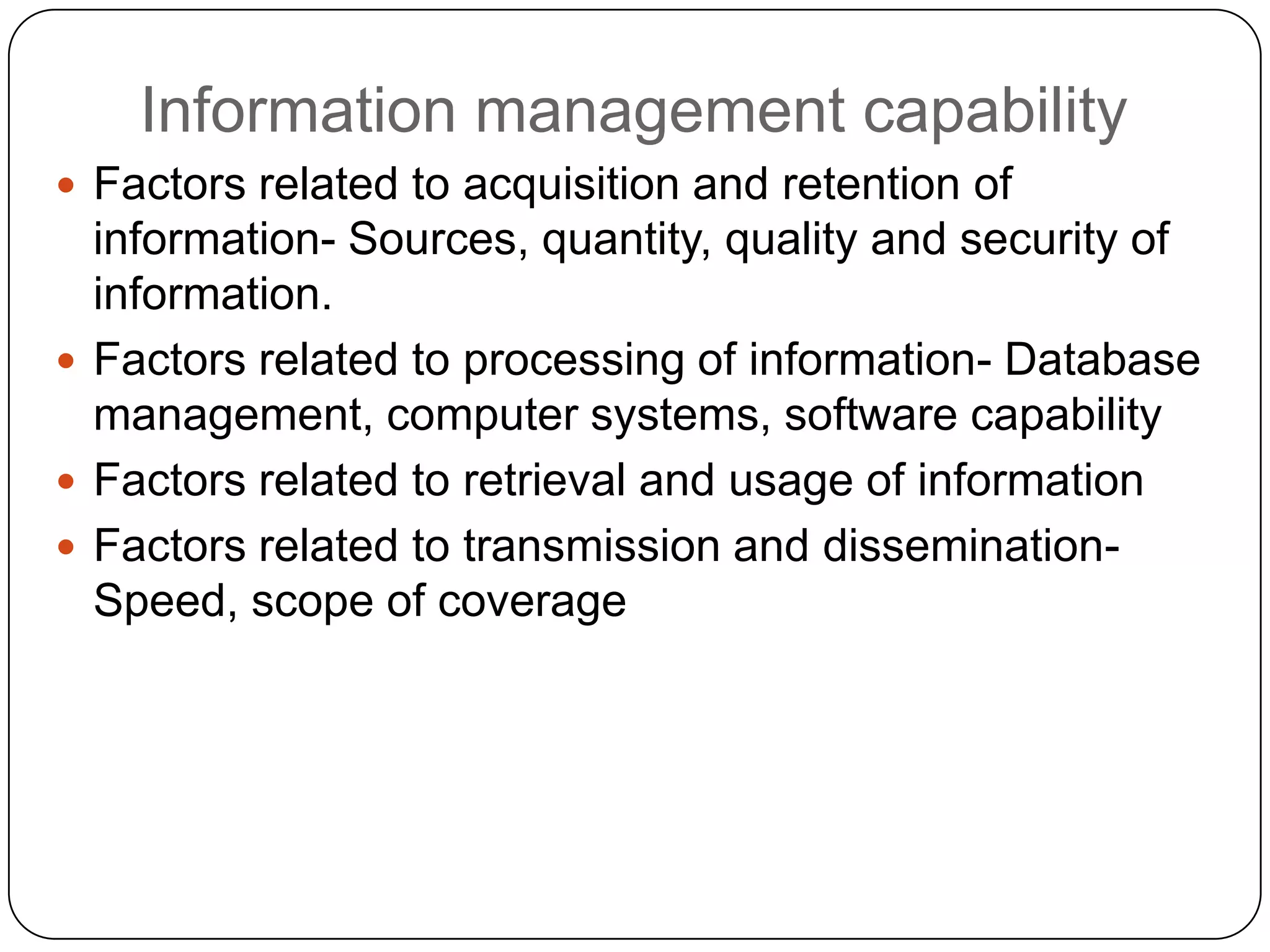
Information management capability
 Factors related to acquisition and retention of
information- Sources, quantity, quality and security of
information.
 Factors related to processing of information- Database
management, computer systems, software capability
 Factors related to retrieval and usage of information
 Factors related to transmission and dissemination-
Speed, scope of coverage
General Management Capability
 Factors related to the general management system
Strategic management system, Strategic intent, strategy
formulation and implementation, strategy evaluation
system, Corporate planning system
 Factors related to general managers
Values, Personal goals, capacity to work, risk propensity
 Factors related to external relationship
Rapport with government, regulatory agencies, financial
institutions, PR, sense of social responsibility
 Factors related to organisational climate
Culture, balance of vested interest
example----HUL Vs P&G
MUMBAI: It was quick and it was smart.
It was an ambush in the skies that Hindustan
Unilever
launched against archrival Procter & Gamble.
The story starts on July 23, when Mumbai woke
up to hoardings that screamed: „A Mystery
Shampoo!! 80% women say is better than
anything else‟. P&G, it was later found, was
planning to unveil the new Pantene on August
1.
HUL saw an opportunity to score a point.
They ambushed P&G. On July 28, even as
the P&G hoardings stood tall on its skyline,
Mumbai woke up to another hoarding that
was upfront, and suggestive of its source of
inspiration. It said: „There is no mystery. Dove
is the No.1 shampoo‟. Dove is one of the four
brands in HUL‟s shampoo portfolio.
For instance, when Coke bagged the official
sponsorship rights to the 1996 cricket world
cup in the subcontinent, Pepsi came up with
Methods and techniques used for
organisational appraisal
 Organisational appraisal is different from performance
evaluation as earlier is more comprehensive and is for
long term and also tells what organisation needs to do
in order to grow.
 The emphasis of performance evaluation is on
assessing current behaviour with respect to efficiency
and effectiveness of the organisation.
 Internal Analysis
 Comparative analysis
 Comprehensive analysis
Internal analysis
 VRIO framework
 Value chain analysis
 Quantitative analysis
Financial analysis
Non-financial analysis
 Qualitative analysis
VRIO framework
 Contributed by Barney also known as the founder of
resource based theory.
 V- VALUABLE, R-RARE, I-INIMITABLE, O-
ORGANISED FOR USAGE
 Valuable
The organisational capabilities that help to generate
revenues by capitalising opportunities and reducing
cost
For e.g. Amicable relationship with Government or after
sale service
 Rare
The organisational capabilities exclusively possessed by
firms
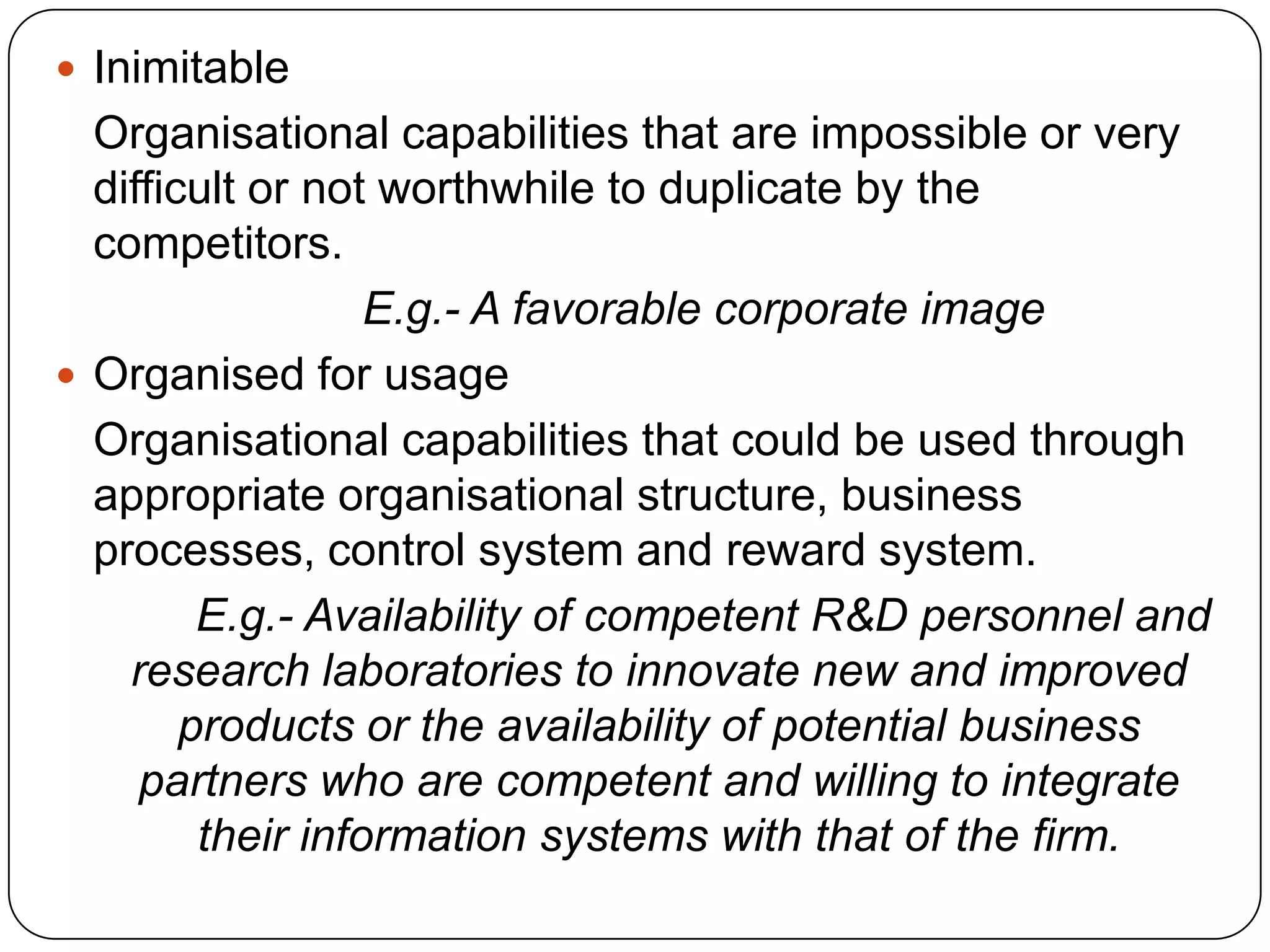
 Inimitable
Organisational capabilities that are impossible or very
difficult or not worthwhile to duplicate by the
competitors.
E.g.- A favorable corporate image
 Organised for usage
Organisational capabilities that could be used through
appropriate organisational structure, business
processes, control system and reward system.
E.g.- Availability of competent R&D personnel and
research laboratories to innovate new and improved
products or the availability of potential business
partners who are competent and willing to integrate
their information systems with that of the firm.
Value chain analysis
 Strengths and weaknesses are determined by
understanding the series of activities.
 Porter is credited for this framework.
 A value chain is a set of interlinked value creating
activities performed by an organisation
 These activities may begin with purchase of raw
material till the finished or end product.
 Here, activities are divided into two parts i.e. Primary
activities and supportive activities
Primary activities
 Inbound logistics- Receiving, storing and transporting
inputs going into production process
 Operations- Transformation of raw material into finished
products
 Outbound logistics- Activities including
receiving, storing and transporting outputs going out of
production process.(material handling, order
processing, physical distribution etc)
 Marketing and sales- Activities that an organisation
uses to market or sell its products.
 Service- Activities used for enhancing and maintaining
product‟s value. (installation, repair, customer training
etc)
Support activities
 Firm infrastructure- Accounting, finance, planning,
general management, legal support and managing
government relations.
 HRM- Recruitment, selection, training, development,
appraising and compensating
 Technology development- R&D, product design,
process design, equipment design.
 Procurement- Procuring inputs needed to produce
products or product services. (Machinery,
equipments, raw material etc)
Value chain analysis
 Identifying the activities that make up the organisation‟s
value chain and classifying them into primary and
secondary activities
 Identifying the things done in those activities that
contribute in providing value for the customer
 Identifying how the value contribution can be increased
so that it costs less to provide the same or more value.
 Identifying how the value configuration could be
improved by innovatively reconfiguring or recombining
activities.
 The main purpose of value chain analysis is to promote
those activities that create more value to the customer
at less cost and reducing those activities that provide
less value and cost more or the organisation can
outsource these activities to external party who can
Limitations of Value chain
analysis
 This technique looks simple but difficult to implement
 It applies to the industrial organisation and needs to be
adapted for application to service organisation.
 The concept of value is hazy. It is difficult to say what
constitute value for the customer.
 This analysis requires collecting data from various
sources and it may increase the cost.
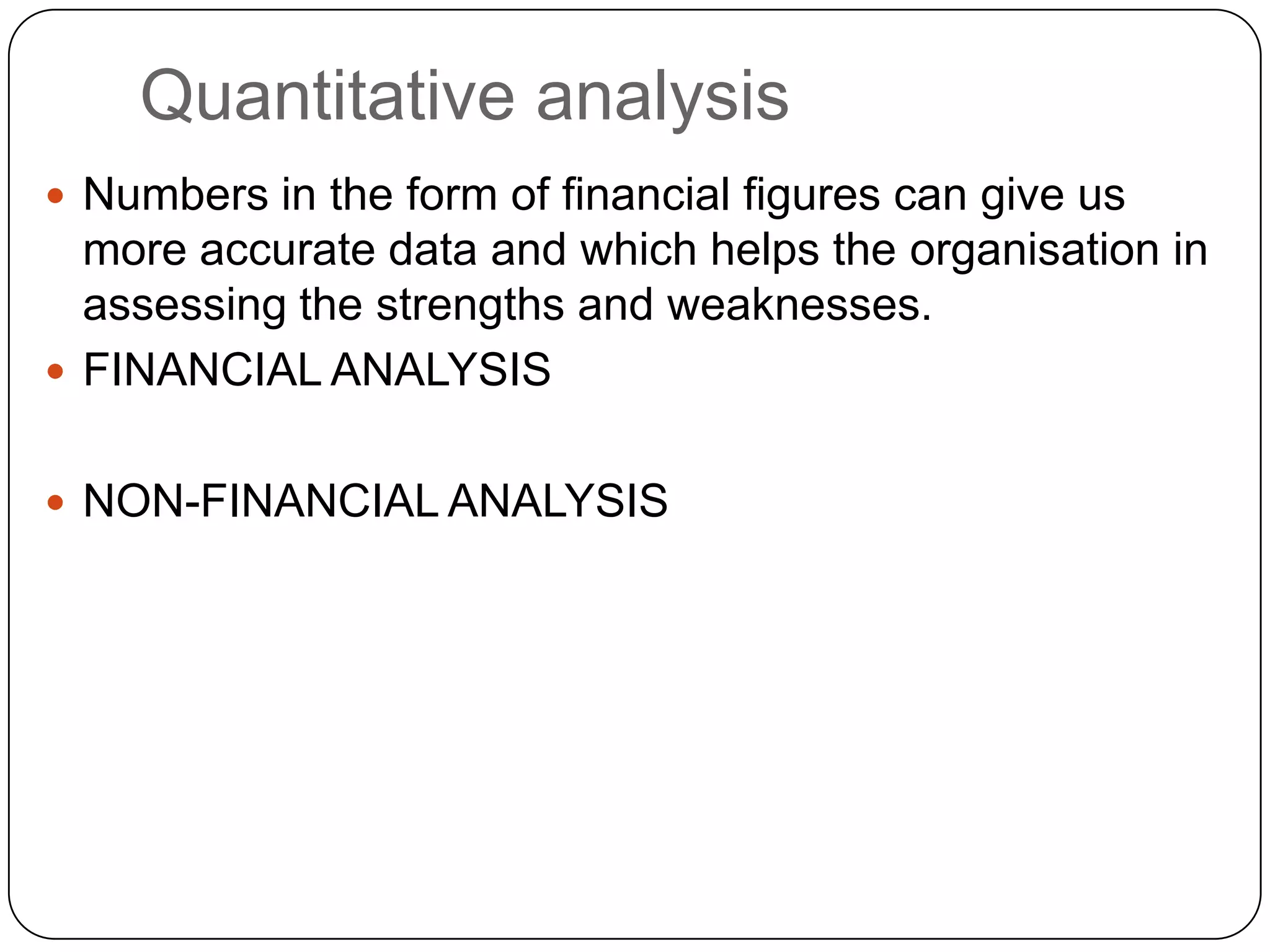
Quantitative analysis
 Numbers in the form of financial figures can give us
more accurate data and which helps the organisation in
assessing the strengths and weaknesses.
 FINANCIAL ANALYSIS
 NON-FINANCIAL ANALYSIS
Financial analysis
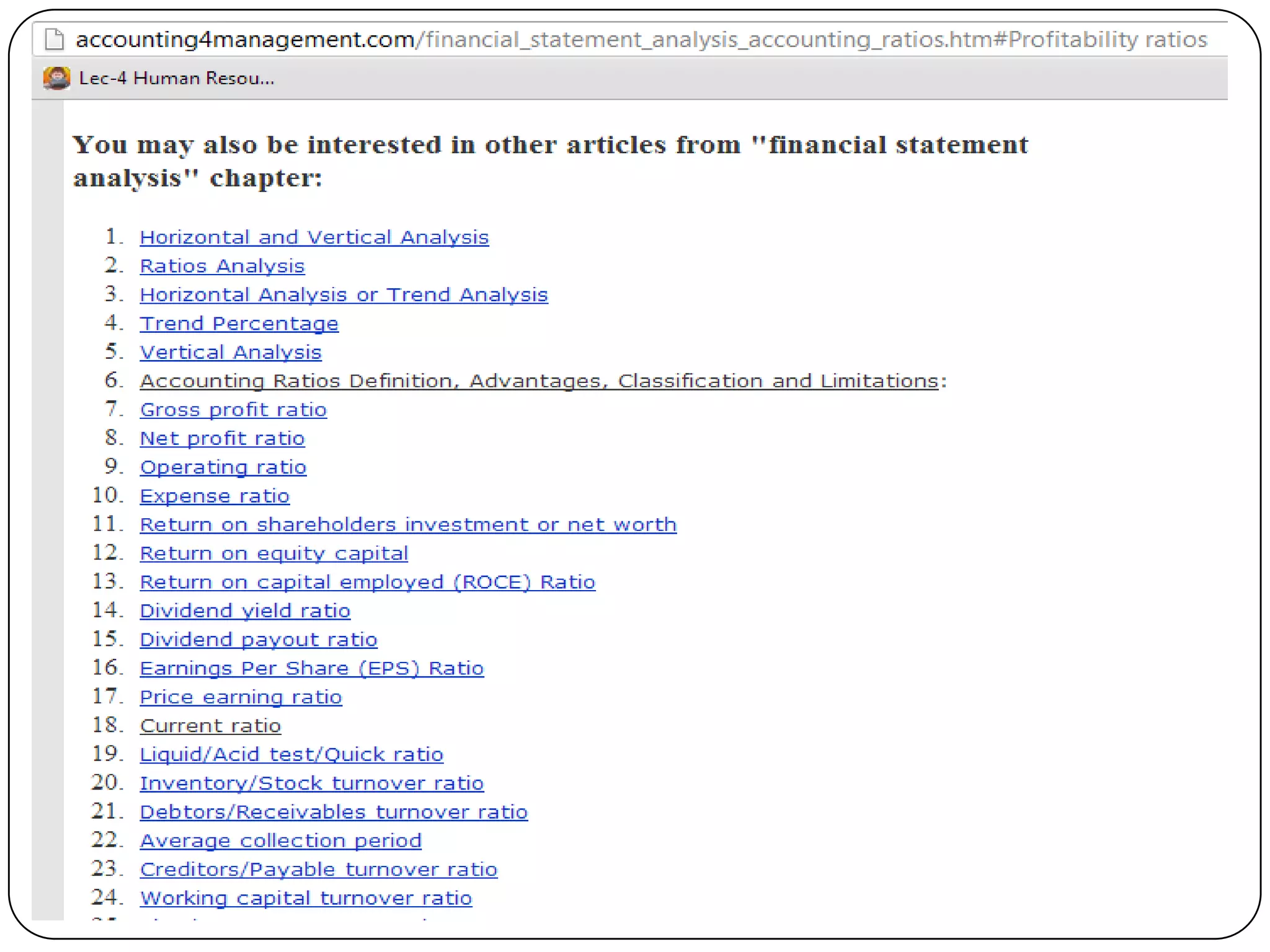
 Ratio analysis-
1. This analysis helps the organisation in assessing liquidity,
profitability.
2. Ratio analysis is used on the basis of the reasonable
assumptions that ratios cover all the important aspects of an
organisation‟s activities.
3. Ratios tell the whole story of changes in the financial condition
of the business
 EVA (Economic value added analysis)
1. It is used to determine wealth of the company
2. EVA is defined as the system of corporate management that
defines profitability in terms of return on capital above the cost
of servicing the capital employed
3. EVA is the representation of the simple idea that an
organisation needs to earn more from business than the cost of
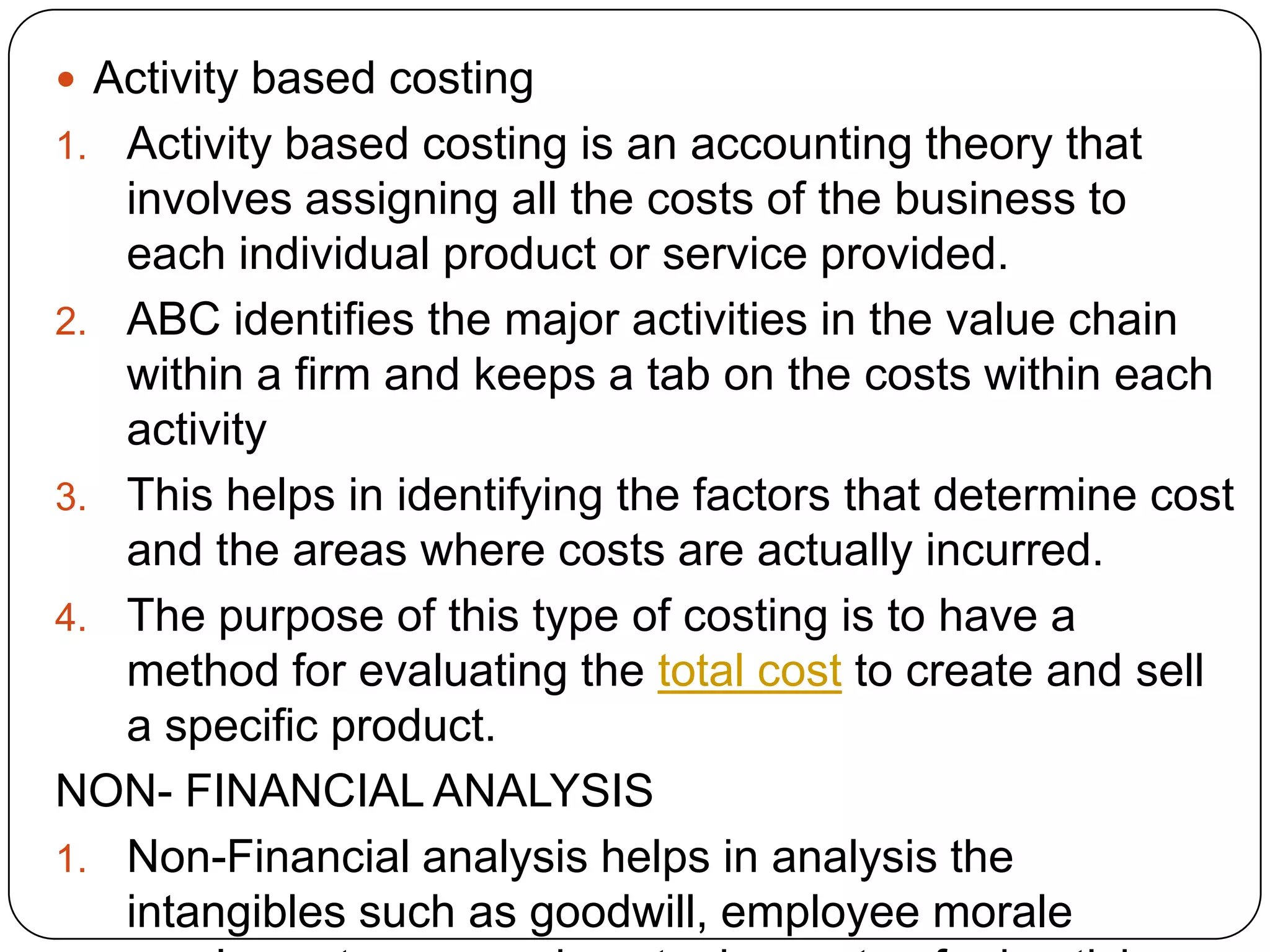
 Activity based costing
1. Activity based costing is an accounting theory that
involves assigning all the costs of the business to
each individual product or service provided.
2. ABC identifies the major activities in the value chain
within a firm and keeps a tab on the costs within each
activity
3. This helps in identifying the factors that determine cost
and the areas where costs are actually incurred.
4. The purpose of this type of costing is to have a
method for evaluating the total cost to create and sell
a specific product.
NON- FINANCIAL ANALYSIS
1. Non-Financial analysis helps in analysis the
intangibles such as goodwill, employee morale
Qualitative analysis
 Most of the Strengths and weaknesses of an
organisation cannot be expressed in quantitative terms
and for this reason, organisation can go in for qualitative
analysis.
 Comparative analysis- From competitor point of view
Historical analysis
Industry Norms
Benchmarking
 Historical analysis
1.Go to the history of the organisation
2.Frequently, the performance of companies is shown in
terms of comparative figures over the last year
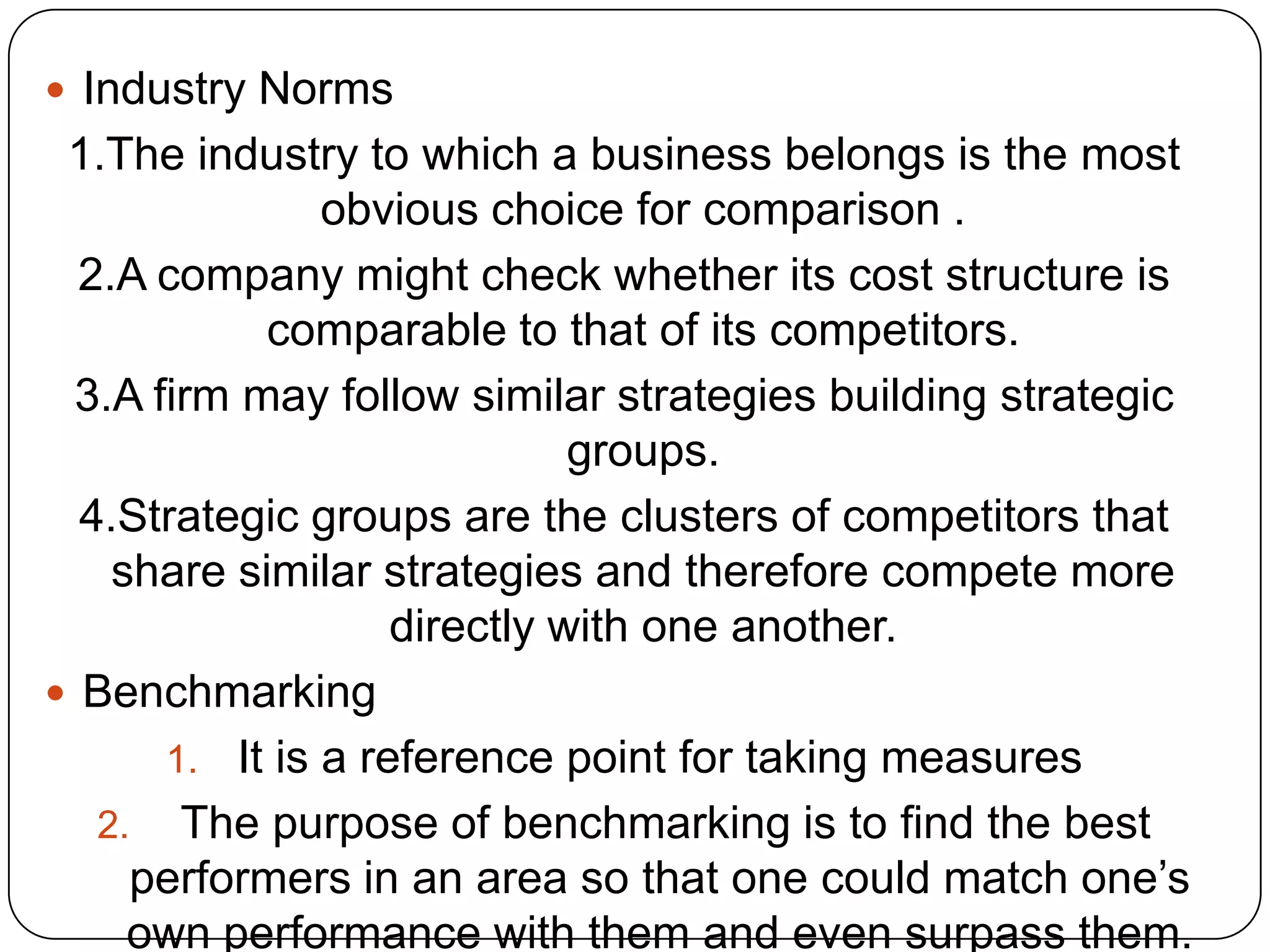
 Industry Norms
1.The industry to which a business belongs is the most
obvious choice for comparison .
2.A company might check whether its cost structure is
comparable to that of its competitors.
3.A firm may follow similar strategies building strategic
groups.
4.Strategic groups are the clusters of competitors that
share similar strategies and therefore compete more
directly with one another.
 Benchmarking
1. It is a reference point for taking measures
2. The purpose of benchmarking is to find the best
performers in an area so that one could match one‟s
own performance with them and even surpass them.
WHAT TO BE COMPARED
 Performance benchmarking- Comparing performance
 Process benchmarking- Comparing process
(methods/practices)
 Strategic benchmarking- Comparing long term, significant
decisions and actions undertaken by other organisation
__________________________________________________
_
 Internal benchmarking- Comparison between departments of
the same organisation.
 Competitive benchmarking- Direct comparison of own
performance against the best competitors.
 Functional benchmarking- It is the comparison of functions
against non-competitive organisation within the same sector.
 Generic benchmarking- It is the comparison of own
processes against the best practice anywhere, in any type of
organisation. (For example, an insurance company may
Benchmark a bank loan application process against its
Comprehensive analysis
 KEY FACTOR RATING
 BUSINESS INTELLIGENCE SYSTEM
 BALANCE SCORECARD
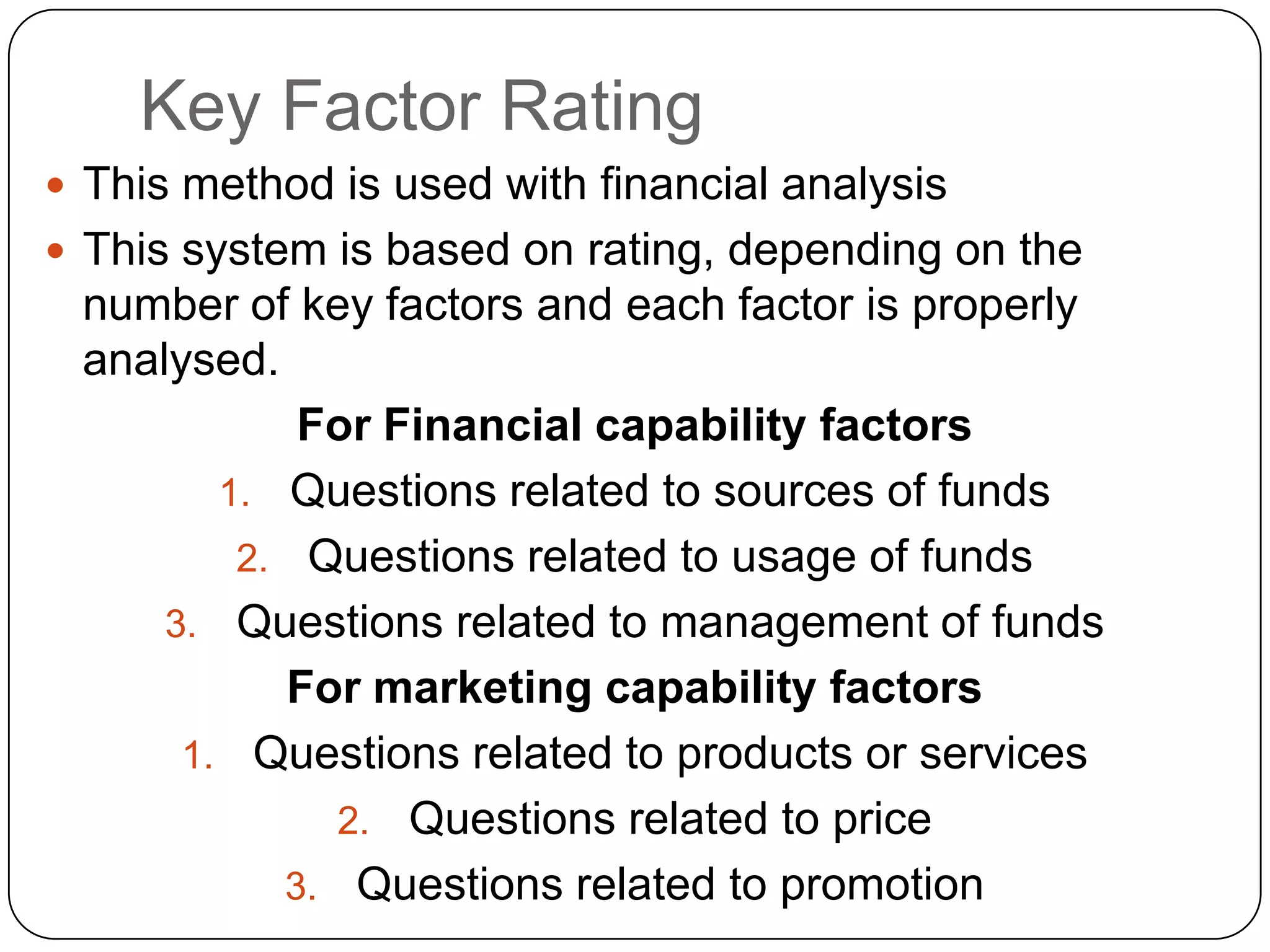
Key Factor Rating
 This method is used with financial analysis
 This system is based on rating, depending on the
number of key factors and each factor is properly
analysed.
For Financial capability factors
1. Questions related to sources of funds
2. Questions related to usage of funds
3. Questions related to management of funds
For marketing capability factors
1. Questions related to products or services
2. Questions related to price
3. Questions related to promotion
 For operational capability factors
1. Questions related to the production system
2. Questions related to operations and control
3. Questions related to the R&D system
 For personnel capability factors
1. Questions related to the personnel system
2. Questions related to organisational and employee
characteristics
3. Questions related to industrial relations
 For Information management capability factors
1. Questions related to acquisition and retention of
information
2. Questions related to processing of information
3. Questions related to retrieval and usage of information
4. Questions related to transmission and dissemination
 For general management capability factors
1. Questions related to general management system
2. Questions related to general managers
3. Questions related to external relationship
4. Questions related to organisational climate
Business intelligence systems
 Business intelligence is used for discovering
knowledge from various internal and external
repositories available to an organisation to support
effective decision making
 This system was developed by Horward J. Dresner of
the Gartner Group and according to him “BI is a broad
category of applications and technologies for
gathering, storing, analysing and providing access to
data to help enterprise users make better business
decisions.”
 Gartner ranked the strategic use of BI in the following
order
1. Corporate performance management
2. Optimising customer relations, monitoring business
Balance Scorecard
 Financial perspective- This perspective consider the
financial measures arising from the strategic intent of
the organisation for e.g. measuring revenues, return on
capital and cash flow.
 Customer perspective- It consider the ability of the
organisation to provide quality of goods and services,
effective delivery and overall customer satisfaction.
 Internal Business perspective- It measures the “critical
internal processes in which the organization must
excel” for e.g. productivity indicators, quality measures
and efficiency.
 Learning and growth perspective-
1. Focus on the ability of the organisation to manage its
businesses and adapt to change
2. Focus on the development of employees in terms of
 Balance scorecard is considered as a set of measures
that give top managers a fast and comprehensive view
of the business and it includes financial measures that
tell the results of actions already taken
 Balance scorecard can be used as a means to identify
the strengths and weaknesses in an organisation by
keeping the score of strengths and weaknesses in
critical areas of performance.
 It enables quantitative as well as qualitative analysis of
the organisation.
Structuring organisational appraisal
 SAP (strategic advantage profile)- Here the
results of the organisational appraisal are
presented in a summarised form.
 Organisational capability profile-
1. Assessing company‟s strengths and
weakness in dealing with the opportunities
and threats in the external environment.
2. Here the strategists assess the various
functional areas or capability factors and its
sub factors along a scale ranging from
values -5 to +5.
Strategic advantage profile
 On the basis of Organisational Capability Profile,
the organisation can go in for strategic advantage
profile
 SAP provides a picture of more critical areas
which can have a relationship with the strategic
posture of the firm in the future.
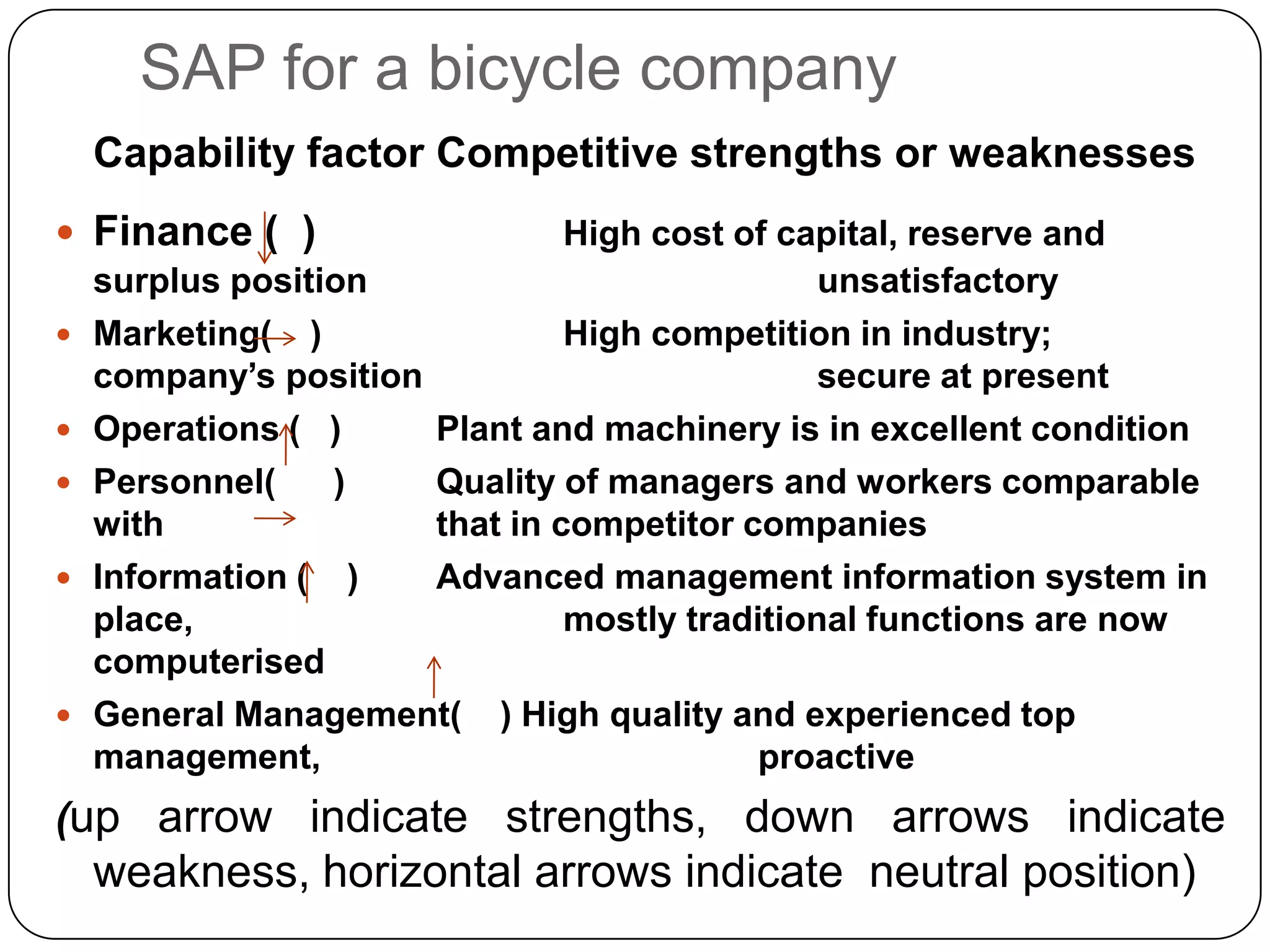
SAP for a bicycle company
Capability factor Competitive strengths or weaknesses
 Finance ( ) High cost of capital, reserve and
surplus position unsatisfactory
 Marketing( ) High competition in industry;
company’s position secure at present
 Operations ( ) Plant and machinery is in excellent condition
 Personnel( ) Quality of managers and workers comparable
with that in competitor companies
 Information ( ) Advanced management information system in
place, mostly traditional functions are now
computerised
 General Management( ) High quality and experienced top
management, proactive
(up arrow indicate strengths, down arrows indicate
weakness, horizontal arrows indicate neutral position)
Identification of CSF
 CSF are the factors unique to a company that
influence the success of that company.
 These factors differ from industry to industry.
 These can be also called core competencies(
Core competencies refers unique strengths of the
company that competition can not easily match or
imitate.
 Core competencies is a bundle of skills and
techniques that help the company to provide a
particular benefit to customers.
Attributes of CSF
 Core competencies is base for all products
 Core competencies makes or mars the success
 Core competencies is bundle of skills and
technologies
 Core competencies cannot be copies easily.
Corporate level strategies
 Organisational Appraisal and Environmental appraisal will
lead to the generation of these strategies.
 The choice of strategy is wide as it will depend on the
strengths, weakness along with the opportunity and threat to
the organisation
 Corporate level strategy involve:-
Allocating resources among the different businesses of a firm
Transferring resources from one set of businesses to others
Managing and nurturing portfolio of businesses
 Corporate strategy will exercise the choice of direction that
an organisation adopts.
 After doing the business analysis, the firm is having a wide
options available to them in terms of strategic alternatives.(
Strategic alternatives revolve around the question of whether
to continue or change the business, the enterprise is
currently in or improve the efficiency and effectiveness with
Four strategic alternatives:---
 Expansion strategies
 Stability strategies
 Retrenchment strategies
 Combination strategies
 All the above strategies cover customer group,
customer function and alternative technologies
Expansion strategy
 This strategy is adopted when organisation aims high
growth and wants to improve overall performance.
Reasons for adopting expansion strategies:--
1.It may become essential when the environment demands
increase in pace of activity
2.Chief executives may take pride in presiding over
organisational perceived to be growth-oriented
3. Increasing size may lead to more control over the market
along with the competitors
Expansion strategy in the form of customer group, function
and alternative technology (Customer groups relate to „who‟
is being satisfied, customer
needs describe „what‟ is being satisfied, and alternative
Expansion strategies
 Expansion through concentration
 Expansion through integration
 Expansion through diversification
 Expansion through cooperation
 Expansion through internationalization
 Expansion through digitalisation
Concentration strategies
 It involves converging resources in one or more of a
firm‟s business in terms of their respective customer
group, customer function and alternative technologies.
 A strategic approach in which a business focuses on
a single market or product. This allows the company to
invest more resources in production and marketing in
that one area, but carries the risk of significant losses in
the event of a drop in demand or increase in the level
of competition.
 Ansoff‟ Product- Market Matrix
Product
Market
Present New
Present Market
Penetration
Product
development
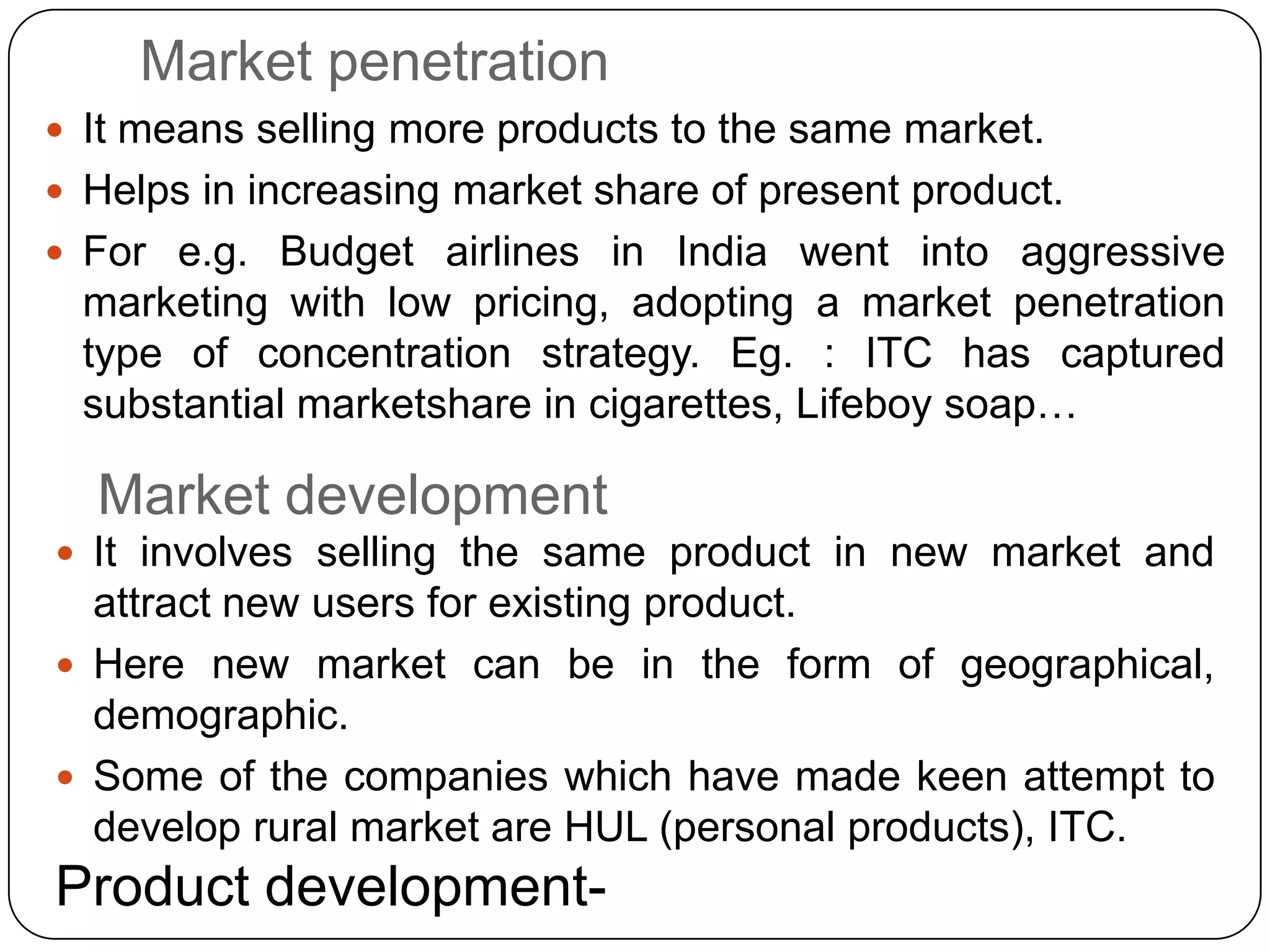
Market penetration
 It means selling more products to the same market.
 Helps in increasing market share of present product.
 For e.g. Budget airlines in India went into aggressive
marketing with low pricing, adopting a market penetration
type of concentration strategy. Eg. : ITC has captured
substantial marketshare in cigarettes, Lifeboy soap…
Market development
 It involves selling the same product in new market and
attract new users for existing product.
 Here new market can be in the form of geographical,
demographic.
 Some of the companies which have made keen attempt to
develop rural market are HUL (personal products), ITC.
Product development-
Integration strategies
 It means combining activities related to the present
activity of a firm.
 One can take the help of value chain analysis
 Here integration strategies are designed on the basis
of present set of customer functions and customer
group.
 Integration strategy is also a subset of diversification
strategy.
 Reasons for adopting this strategy-Transaction cost
economics
 Here the company may go in for MAKE OR BUY
decision.
 Horizontal integration
1. Here the organisation moves beyond its boundaries
into the domain of the industry it is operating in.
2. When an organisation takes up the same type of
products at the same level of production or marketing
process, it is said to follow a strategy of horizontal
integration (acquisition or merger).
3. It may involves buying a competitor‟s business in
order to increase the market share and remain in the
same industry.
Benefits
1. Product differentiation
2. Increased market power
3. Reduction in industrial rivalry
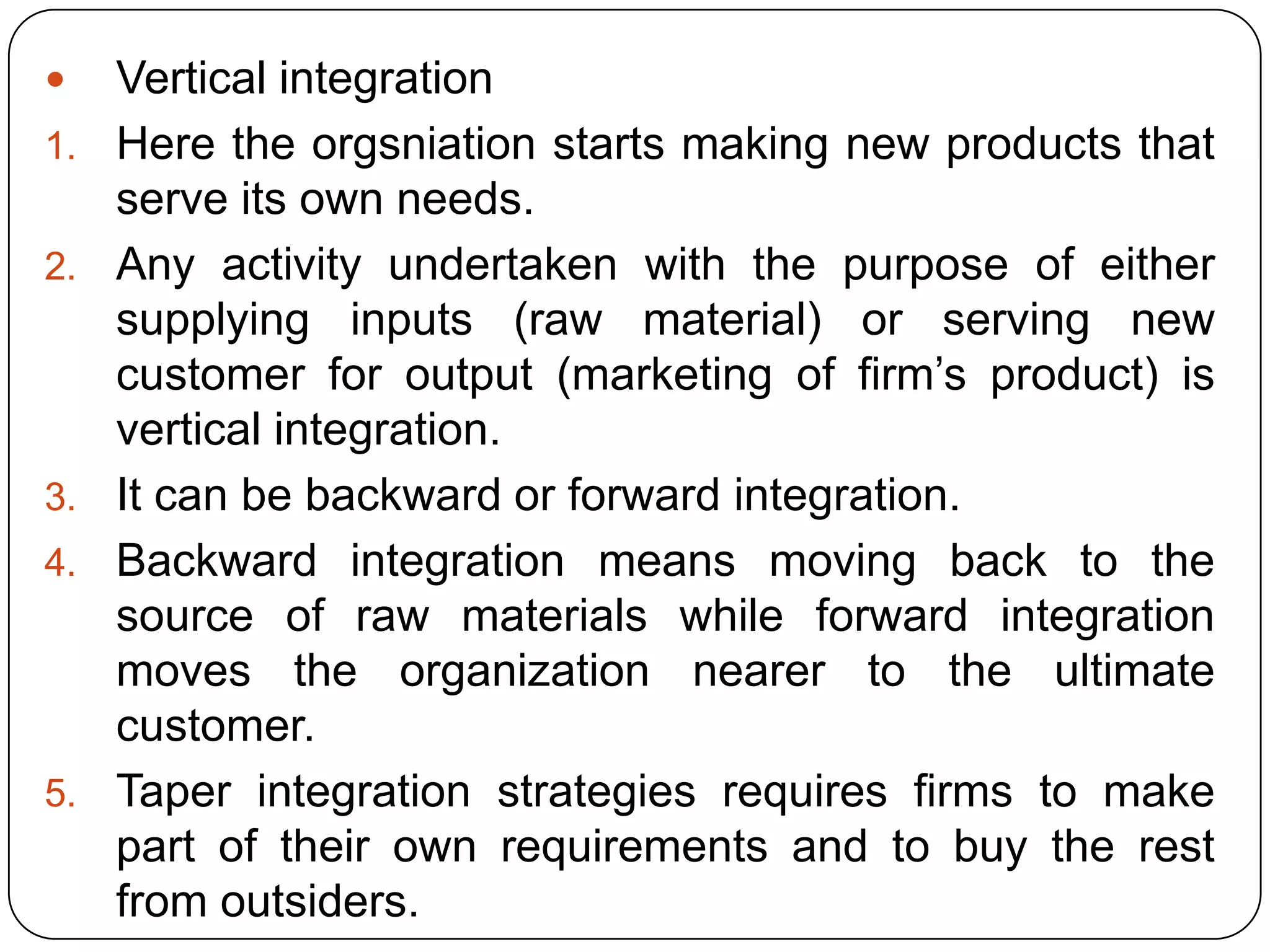
 Vertical integration
1. Here the orgsniation starts making new products that
serve its own needs.
2. Any activity undertaken with the purpose of either
supplying inputs (raw material) or serving new
customer for output (marketing of firm‟s product) is
vertical integration.
3. It can be backward or forward integration.
4. Backward integration means moving back to the
source of raw materials while forward integration
moves the organization nearer to the ultimate
customer.
5. Taper integration strategies requires firms to make
part of their own requirements and to buy the rest
from outsiders.
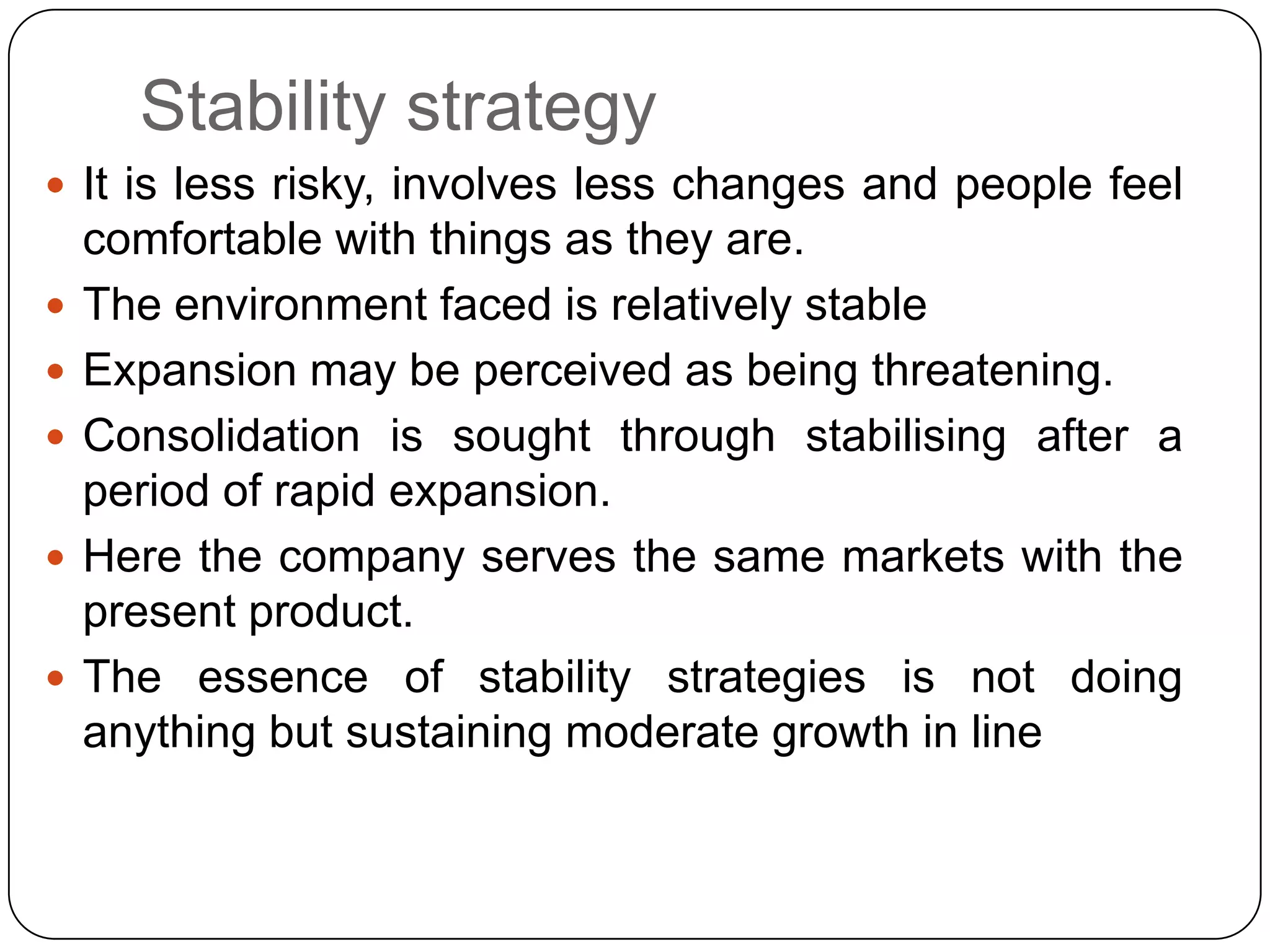
Stability strategy
 It is less risky, involves less changes and people feel
comfortable with things as they are.
 The environment faced is relatively stable
 Expansion may be perceived as being threatening.
 Consolidation is sought through stabilising after a
period of rapid expansion.
 Here the company serves the same markets with the
present product.
 The essence of stability strategies is not doing
anything but sustaining moderate growth in line
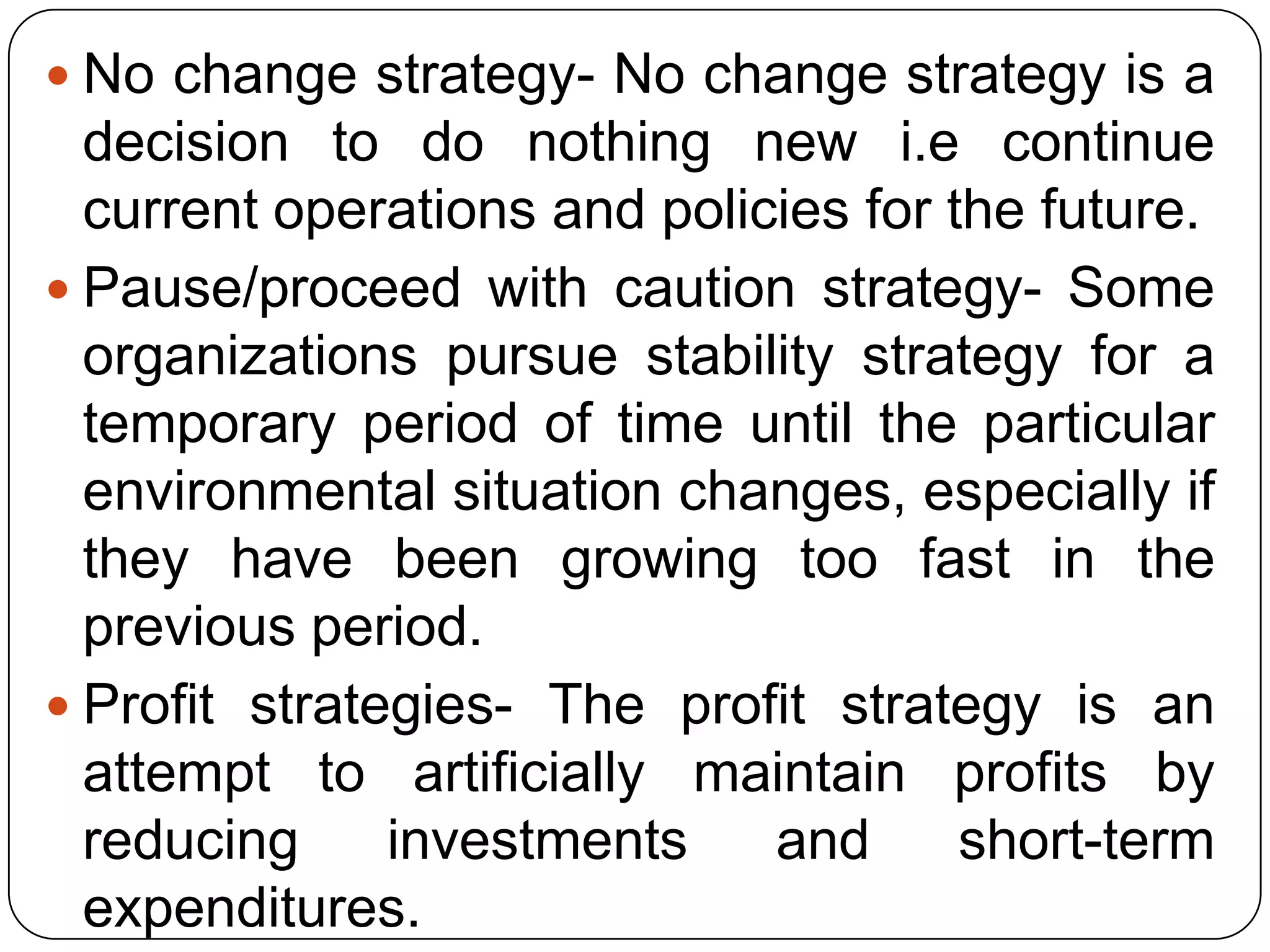
 No change strategy- No change strategy is a
decision to do nothing new i.e continue
current operations and policies for the future.
 Pause/proceed with caution strategy- Some
organizations pursue stability strategy for a
temporary period of time until the particular
environmental situation changes, especially if
they have been growing too fast in the
previous period.
 Profit strategies- The profit strategy is an
attempt to artificially maintain profits by
reducing investments and short-term
expenditures.
Retrenchment strategy
 Here the organisation contracts its activities
 The management no longer wishes to remain in
business due to continuous losses.
 The environment faced is threatening.
 Stability can be ensured by reallocation of resources
from unprofitable to profitable businesses.
 Turnaround strategies- If your company is steadily
losing profit or market share, a turnaround strategy may
be needed. There are two forms of turnarounds: First,
one may choose contractions (cutting labor costs and
Marketing). Second, they may decide to consolidate
 Divestment strategies- This is a form of retrenchment
strategy used by businesses when they downsize the
scope of their business activities. Divestment usually
involves eliminating a portion of a business. Firms may
elect to sell, close a strategic business unit, major
operating division, or product line. This move often is
the final decision to eliminate unrelated, unprofitable, or
unmanageable operations.
 Liquidation strategies- sell the business
Combination strategy
 Mixture of stability, expansion and
retrenchment strategies.
 The organisation is large and faces
complex environment.
 The organisation is composed of
different businesses, each of which lies
in a different industry, requiring a
different response.
Expansion Strategy- Diversification
strategy
 When new products are made for the new market the
diversification takes place.
 By adopting diversification, an organisation does
something in terms of newness of products or markets.
 It can be of Concentric (Related) and Conglomerate
(Unrelated) diversification.
 Related or concentric diversification- Here, an
organisation takes up an activity in such a manner that it
is related to the existing business definition or if the new
business is related with the existing business definition.
Marketing related concentric diversification- Common
distribution channels
Technology related concentric diversification
Marketing and technology related concentric
diversification
 Conglomerate or unrelated diversification-
1.When an organisation adopts a strategy which
requires taking up those activities which are unrelated
to the existing business definition of any of its
businesses either in terms of their respective customer
groups, customer function or alternative technologies, it
is conglomerate diversification.
2.Can go for this strategy if the company has excess
capital
Expansion through
Internationalization
 Here the firm goes beyond the national market.
 A firm should assess the international environment.
 Porter‟s Model of competitive advantage of Nations-
Four national characteristics create an environment
that is conducive to create globally competitive firm in a
particular industry.
1. Factor conditions- Special factors of production such
a s natural resources, raw materials, labour etc.
2. Demand conditions- The nature and size of the
buyer‟s need in the domestic market.
3. Related and supporting industries- The existence of
related and supporting industries to the ones in which
a nation excels.
4. Firm strategy, structure and rivalry- The conditions in
the nation determining how firms are created,
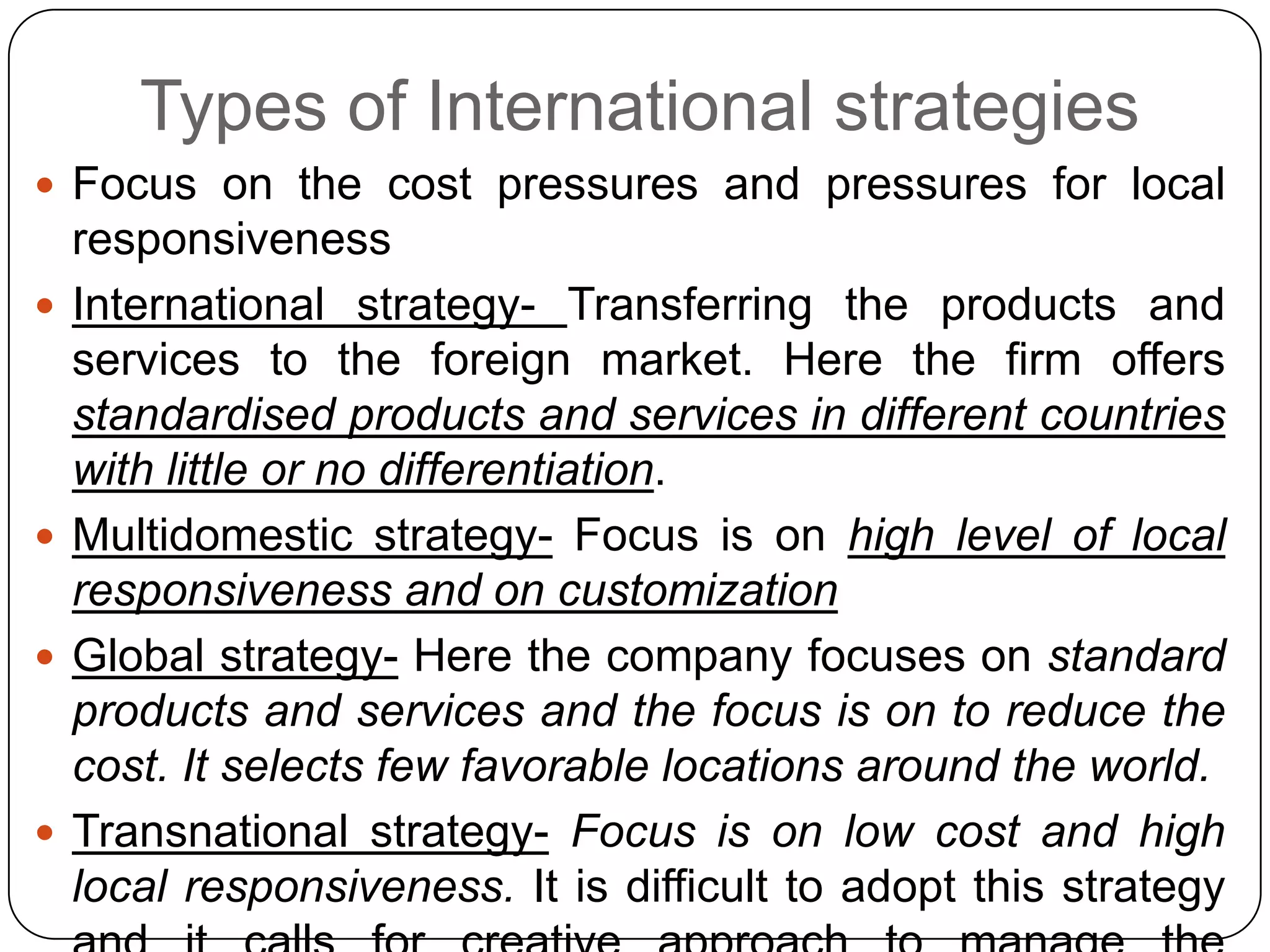
Types of International strategies
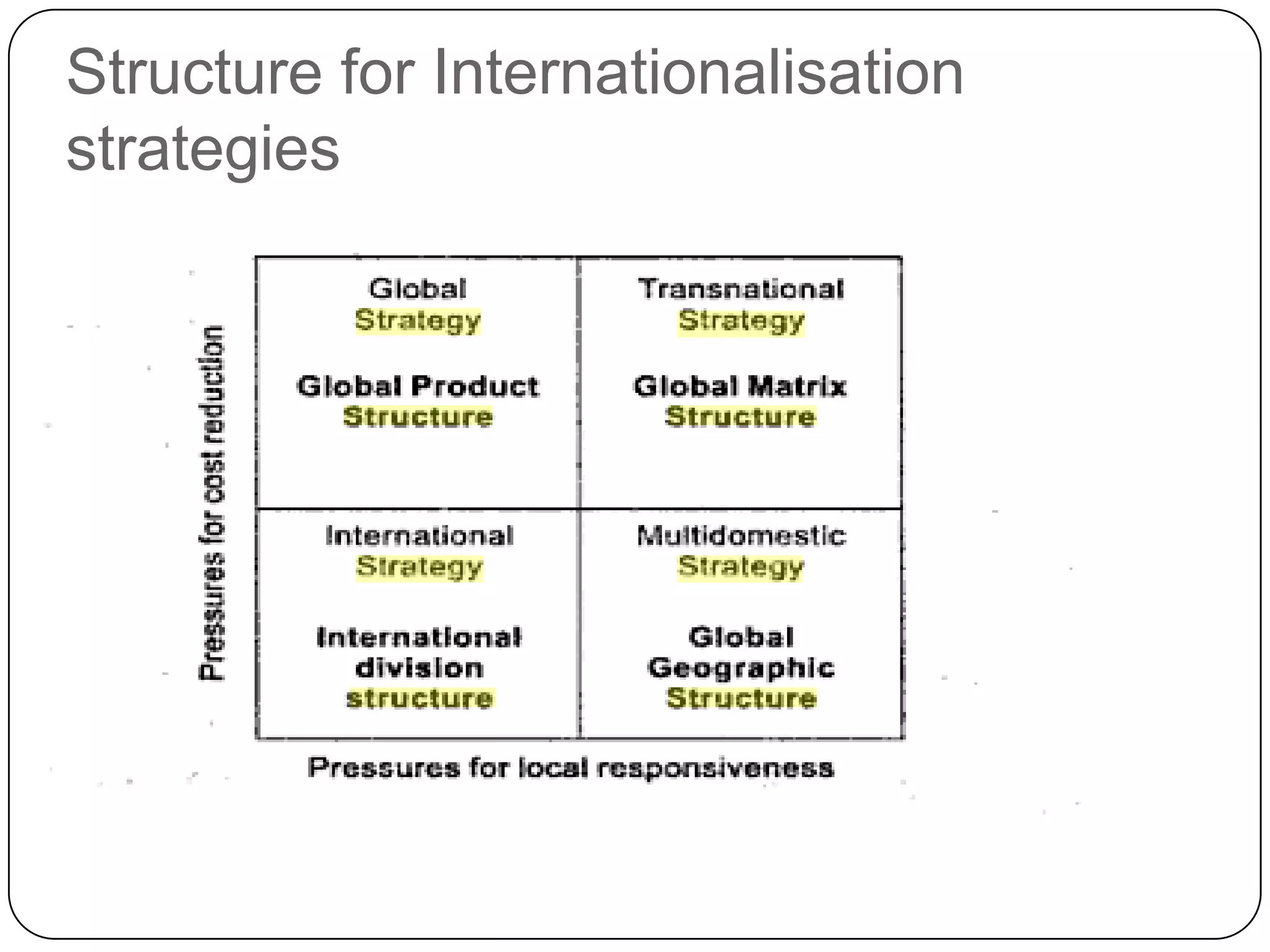
 Focus on the cost pressures and pressures for local
responsiveness
 International strategy- Transferring the products and
services to the foreign market. Here the firm offers
standardised products and services in different countries
with little or no differentiation.
 Multidomestic strategy- Focus is on high level of local
responsiveness and on customization
 Global strategy- Here the company focuses on standard
products and services and the focus is on to reduce the
cost. It selects few favorable locations around the world.
 Transnational strategy- Focus is on low cost and high
local responsiveness. It is difficult to adopt this strategy
and it calls for creative approach to manage the
production and marketing of products and services.
International entry modes
 Export entry modes- Here the firm produces in the
home country and market in the overseas market.
 Contractual entry modes
Licensing- Here the international company transfers
knowledge, technology for a limited period of time in
return for some form of payment.
Franchising- It is the right to use a business format or a
brand name
Investment entry modes- Joint ventures or independent
ventures
Strategic decisions in
Internationalisation
 Which International markets to enter???
 Timing of entry into international market.
 Scale of entry into international markets….
ADVANTAGES
 Economies of scale
 Expansion
 Access to resources overseas
DISADVANTAGES
 High risk
 Difficulty in managing cultural diversity
 Higher distribution cost
 Trade barriers
Cooperative strategies
Mergers and acquisitions
Joint ventures
Strategic alliances
Merger and acquisition strategies
 Mergers- It takes place when the objectives of the
buyer firm and the seller firms are matched.
 A merger is a combination of two or more
organisations in which one acquires the assets and
liabilities of the other in exchange for shares or cash
or both the organisations are dissolved and assets
and liabilities are combined and new stock is issued.
 Acquisition or takeover- These are based on the
strong motivation of the buyer firm to acquire.
 Takeover can be in the form of hostile takeovers and
friendly takeovers.
Types of mergers and
acquisitions
 Horizontal mergers- Mergers between two or
more organisations in the same business
 Concentric mergers- It take place when there is a
combination of two or more organisations related
to each other either in terms of customer
functions, customer groups or alternative
technologies.
 Vertical mergers- Not necessary the same
business
 Conglomerate mergers- For e.g. footwear
company combine with pharmaceutical firm.
Important issues in mergers and
acquisitions
 Strategic issues- Synergistic effects, strategic
advantages and distinctive competencies….
 Financial issues- Sources of finance for
acquisition, share price of target firm, growths
prospects of target firm, quality and integrity of
top management….
 Managerial issues
 Legal issues
 Tata Chemicals buys British salt
 Reliance Power and Reliance Natural Resources
merger
 Airtel‟s acquisition of Zain in Africa
 ICICI Bank buys Bank of Rajasthan
 The Reliance – BP deal
 Mahindra & Mahindra acquires Ssangyong
Joint Venture strategies
 A Joint venture could be considered as
an entity resulting from a long term
contractual agreement between two or
more parties, to undertake mutually
beneficial economic activities, exercise
joint control.
Conditions for joint venture
 When an activity is uneconomical for an
organisation to do alone.
 When the risk of the business has to be shared.
 When the distinctive competencies of two or more
organisations can be brought together.
Types of joint ventures
 Between two organisations in one industry.
 Between two organisations across different
industries.
 Between an Indian organisation and a foreign
organisation in India.
 Between an Indian organisation and a foreign
organisation in that foreign country.
 Between an Indian organisation and a foreign
organisation in third foreign country.
Strategic alliances
 Two or more firms unite to pursue a set of
agreed upon goals but remain independent
subsequent to the formation of the alliance.
 The partner firm share the benefits of the
alliance and control over the performance of
assigned tasks.
 The partner firms contribute on a continuing
basis in one or more strategic areas.
Digitalisation strategies
 Computerisation
 Electronisation
 Digitalisation
 E Channel pattern
 Click and brick pattern
 E Portal pattern
 E market
Stability strategy
 This strategy is followed by small and medium sized
enterprise.
 These strategies can be used for short term and
when such organisations are satisfied with their
current performance.
 No change strategy
To continue with present business business definition
Here taking no decision sometimes, is a decision too….
Useful in predictable and certain external environment
There is no significant opportunity or threat in the
market
Useful for a niche market
 Profit strategy
Focus on only profit
Useful for a short period of time
Firm can go in for reducing investment, cut costs, raise
price oin order to face temporary difficulties
Sustain profitability by whatever means.
 Pause/Proceed with caution strategy
Useful for firm that wish to test the ground before moving
ahead with a full fledged corporate strategy.
Can apply before going in for consolidation
It is a temporary strategy just like profit strategy
Following this strategy is a conscious attempt to adjourn
major strategic changes or when the organisation is
ready to move on with rapid force again
 Retrenchment strategies
Here the organisation reduces the scope of its activities
Major external factors leading to decline:-
1. New organisation form
2. New technologies
3. New business models
4. Demand saturation
5. Changing customer needs and preferences
6. Emergence of substitute products
Major internal factors leading to decline:-
1. Ineffective top management
2. Inappropriate strategies
3. High cost
4. Ineffective sales and marketing
5. Wrong organisation design
 Turnaround strategies
o This can be Internal(focus on improving internal efficiency)
or external
Managing turnaround
o CEO and management handles the entire turnaround
strategy with the support of external consultant. CEO must
have a good credibility with the banks and financial
institutions.
o Can go in for a person deputed by the banks and financial
institutions
o Replace the existing team and CEO or merge the sick
organisation with a healthy one.
Approaches to Turnaround
Issue order for change
Change product mix
Focus on R&D
Remove obsolete machinery
 Divestment strategy
o Sale or liquidation of a portion of business
o It can be SBU or a major division
o This strategy is followed if the organisation failed in
implementing turnaround strategy.
Reasons for Divestment
o Business which was earlier acquired proves to be a
mismatch and cannot be integrated within the company.
o Persistent negative cash flow from a particular business
o Intense competition
o Not able to adopt new technology
o Better alternative may be available for the firm
 Liquidation strategy
o Close down the organisation and sell its assets
o Should be considered as a last solution
o It may lead to serious consequences such as loss of
employment, termination of opportunities where an
organisation could pursue
o Small scale units can be easily liquidated but its is very
difficult to liquidate medium or large size organisation in
Indian for several following reasons:----
1. Govt. may not allow for liquidation
2. Pressure of trade union
3. Company management, banks, financial institutions,
creditors
 Combination strategy
o Mixture of stability, expansion and retrenchment
strategy
Corporate restructuring
 Synonyms of restructuring are
revamping, regrouping…..
 It can take place at the macro level( reduction
of subsidies, dismantling of price control) and
micro level ( Business level
restructuring, financial
restructuring, organisational restructuring).
 Business level restructuring- Changes in the
organisation‟s set of businesses in order to
create more profitable enterprise.
 Financial restructuring
Reasons for corporate
restructuring
 At business level
An organisation may go in for
restructuring in its business portfolio.
Business portfolio changes could lead to
the organisational acquiring new
businesses and divesting some others.
It may go in for combination strategy
Business level strategies
 Companies operate through their
business.
 Business level strategies are based on
corporate level strategies.
 Business definition
What- Customer needs
Who- Customer groups
How- Alternative technologies
 Business definition lays down the
framework within which a business
Business level strategies
 Business level strategies are the course
of action adopted by an organisation for
each of its business separately, to serve
identified customer groups and provide
value to the customer by satisfying their
needs.
 According to Porter, “ Competition
includes a group of competitors
producing products and services that
compete directly with each other. It is
the industry where competitive
Industry structure
 According to Porter, industry structure is
determined by the competitive forces.
Threat of new entrants
 The most attractive segment is one in which
entry barriers are high and exit barriers are
low i.e. few new firms can enter the industry
and poor performing firms can easily exit.
 If the entry and exit barriers are low, firms
easily enter and leave the industry and the
returns are stable or low.
 The worst case is when the entry barriers
are low and exit barriers are high. Here firms
enter during good times but hard to leave
during bad times.For e.g. aviation sector.
Threat of substitute products
 A substitute product is a product that
appears to be different but can satisfy the
same need as another product.
 A segment is unattractive when there are
actual or potential substitutes for the
product.
 Substitutes place a limit on price and profits.
Bargaining Power of Buyers
 A segment is unattractive if buyers possess
strong or growing bargaining power.
 Buyers bargaining power grows when they
become more aware, when the buyer
switching costs are low, when buyers are
price sensitive.
 To protect themselves, sellers might select
buyers who have the least power to
negotiate or to switch to other suppliers.
Suppliers growing bargaining
power
 Suppliers affect an industry through their ability to
raise prices or reduce the quality of purchasing
goods and services.
 A supplier or supplier group is powerful if some of
the following factors are apply:
 The supplier industry is dominated by a few
companies, but it sells to many(petroleum
industry)
 Its product or service is unique and/or it has built
up switching costs( word processing software)
 Suppliers are able to integrate forward and
compete directly with their present customers.
Positioning of firm in industry
 Positioning of firm depends upon the two variables:-
(Competitive advantage)
1. One type of positioning approach may be of
offering mass produced products, distributed
through mass marketing and resulting in lower cost
per unit.
2. Other type of positioning approach could be
marketing higher prices products of a limited
variety and focusing on customer groups who are
willing to pay higher price.
3. The business need to differentiate its products and
services on some tangibles basis from what its
rivals have to offer so that customer purchases the
(Competitive scope)
1.It is the range of products, distribution
channels, types of buyers, geographical
area served.
2. Competitive scope is important as industry is
segmented, have different needs and
require different sets of competencies and
strategies to satisfy the needs of customers
Generic Business Strategy
 Business strategy is dependent upon industry structure
and the positioning of the firm in the industry.
 Competitive advantage is derived from two approached
i.e. lower cost and differentiation.
Cost leadership business
strategy
 Competitive advantage of an organisation lies in its
lower cost of products and services.
 This is referred to as cost leadership.
 Customer always prefer a lower cost product
particularly if it offers the same utility to them as
comparable products available in the market.
Achieving cost leadership
 Accurate demand forecasting
 Attaining economies of scale
 High level of standardization of products
 Aiming at the average customers
 Investment in cost saving technologies
Differentiation business strategy
 Adding special features in the product or
service.
 Competitors are not able to offer the same
features of product or service.
 Customer always prefer differentiated
product or service.
 A differentiator may charge premium price
for its product and service.
 Should be able to grab the attention of the
customer towards differentiation…..
 Achieving differentiation
1. Adding features that offer utility for the
customer and match her tastes and
preferences
2. Organisation can add features that lower
overall cost of the buyer
3. Organisation can add features that raises
the performance of the product
4. Organisation can incorporate features that
increase the buyer satisfaction
5. Organisation can add features that enhance
the prestige among the buyer community
Conditions under which differentiation is
used
1. Market is too large and organisations
are offering standardised products and
services
2. Customer needs and preferences are
too diversified to be satisfied by
standardised product
3. It is possible for the organisation to
charge premium price
4. The nature of product/service is such
Focus business strategy
 Focus business strategy may rely on either
cost leadership or differentiation but cater to
a narrow segment of the total market
 Focus strategies can be called niche
strategies
 The most commonly used bases for
identifying customer groups are the
demographic characteristics (age, gender,
income, occupation etc), geographic
segmentation (rural/urban or northern
Achieving focus
1. Choosing niches by identifying gaps
not covered by cost leaders and
differentiators
2. Creating superior skills for catering to
such niche markets
3. Creating superior efficiency for
serving such niche markets
4. Achieving lower cost/differentiation as
compared to competitors in serving
niche markets
Conditions under which focus strategies are
used
1. Uniqueness in the segment which could
either be geographical, demographic or
based on lifestyle
2. Potential of growth in niche market
3. Major players are not interested in the
niche market
4. Focusing organisation has necessary skill
and expertise to serve the niche segment
Tactics for business strategies
 A tactic is a sub strategy
 It is a specific operating plan detailing
how a strategy is to be implemented in
terms of when and where it is to be put
into action.
 Two types of tactics:-
Timing tactic
Location tactic
Timing tactic
 When to make a business strategy move is often as
important as what move to make.
 Timing of the application of a business strategy is
also important.
 A business strategy of low cost, differentiation or
focus may be a right move but only if it is made at
the right time.
First Movers and Late movers
 First movers- First company to manufacture and sell
a new product or service is called the pioneer or the
first mover organisation.(eBay was the first company
to take the auction process online, Coca-Cola was
the first cola producer, and began selling its product
to the public in 1886)
Advantages of first movers:-
 Can establish position as market leader
 Moving first in the industry results in commitments to
suppliers of raw material, new technology, distribution
channels.
 Develop an image of being a pioneer.
 First time customers are likely to remain loyal
Disadvantages:-
 Being a pioneer is often costlier than being a follower
 Late movers can imitate technology
 Technology change is often rapid creating obsolescence
for the first movers
 Customer loyalty may be at risk
Market location tactics
 Where to compete
 Market location could be classified according to the role
that organisations play in the target market and the
types of business tactics they adopt.
 Market leaders
 Market challenger
 Market follower
 Market nichers
Competitive strategies for market leaders- Expanding the total
market
• New customers
1. A company can search for new users among three groups:
-----those who might use it but do not (market penetration
strategy), those who have never used it (new market
segment strategy) or those who live elsewhere
(geographical-expansion strategy).
• Various strategies to increase more usage
1. Usage can be increased by increasing the level or quantity
of consumption or increase the frequency of consumption,
through packaging or product design, identifying additional
opportunities to use the brand.
2. Help of advertisement for communicating the advantages
of using brand.
• Defending market share
1. While trying to expand total market size, the dominant firm
Market challenger strategy
 Focus on increase market share and attack
the market leader.
• It can attack firms of its own size that are
not doing the job and are underfinanced.
• It can attack small local and regional firms.
• Choosing a general attack strategy
1. Frontal attack- Here the attacker matches
its opponent‟s product, advertising, price
and distribution.
2. Flank attack- An enemy‟s weak spots are
targeted.
e.g segmental- Japanese automaker put
3 Encirclement attack- The
encirclement attack is an attempt to
capture a wide slice of enemy‟s
territory.
4 By pass attack- It means bypassing
the enemy and attacking easier
markets to broaden one‟s resource
base. For e.g. Pepsi used a bypass
strategy against coke by purchasing
orange juice giant Tropicana.
5 Guerrilla attack- Small attacks to
harass and demoralise the opponent
Market Follower Strategies
 A strategy of product imitation………….
 A innovator bears the expense of developing
the new product , getting it into distribution
and informing and educating the market.
Another firm can come along and copy or
improve market leadership.
 As there is a risk to be attacked by the
market challengers, the market follower
should keep its manufacturing cost low and
quality high.
 E.g. Friendster –> Facebook
Market Follower Strategies
• Counterfeiter
1. The counterfeiter duplicates the leader‟s product
and packages and sells it. Music record firms,
apple computers and Rolex have been facing a
counterfeiter problem, especially in Asia.
2. Cloner- The cloner copy the leader‟s products,
name and packaging with slight variations.
3. Imitator- The imitator copies some things from the
leader but maintains differentiation in terms of
packaging, advertising, pricing.
4. Adapter- The adapter takes the leader‟s products
and adapts or improves them. The adapter may
chose to sell to different markets
Market Nicher startegies
 An alternative to being a follower in a large market
is to be a leader in a small market, or niche.
 Nichers have three tasks: creating niches,
expanding niches and protecting niches.
 For e.g. Computer mouse maker Logitech is only a
fraction the size of giant microsoft, yet through
skillful niching, it dominates the PC mouse market
with microsoft as its runner up.
 e.g. Restaurants offering all food are example of
Mass Marketing. White Pizza Hut has targeted
Pizza Market out of thousands of food products. It
is called Niche Marketing.
Strategic analysis and choice
 Strategic choice is a part of decision making
process.
 Decision making process consists of setting
objectives, generating alternatives, choosing one or
more alternative and implementation.
 The choice is based on certain criteria.
 Strategic choice is the decision to select from
among the grand strategies considered, the
strategy which will best meet the enterprise‟s
objectives. The decision involves focusing on a few
alternatives, considering the selection factors,
evaluating the alternatives against these criteria
and making actual choice.
Strategic analysis
 Strategic analysis helps in solving
following questions:---
Q Which industry to enter and to leave?
Q Which business to
create/acquire/divest?
Q Which products and markets to retain,
grow, divest?
Steps in strategic analysis:-
Focusing on strategic
alternatives
Analysing the strategic
alternatives
Evaluating the strategic
alternatives
Choosing from among the
strategic alternatives
Focusing on strategic alternatives
 Narrow down the choice
 Considering too many alternatives would
make the process unproductive.
 Decision maker should focus on a reasonable
number of alternatives.
 Focusing on alternatives could be done by
visualizing the future state and working
backwards and this can be done through gap
analysis.
Future state- Set the objective for future period
of time
Performance gap- At corporate level
 Gap can be wide or narrow
 Choice of alternatives will depend upon
this gap.
 When the gap is narrow stability
strategies would seem to be a feasible
alternative but if the gap is large due to
expected environmental opportunities, a
firm can go in for expansion strategy.
 A firm can go in for combination
strategies if the environment is complex.
Performance gap- At business
level
 Choice between low cost or
differentiation or focussed.
 Organisation should go in for proper
analysis of industry before going in for
any choice.
 An organisation can also go in for
business definition i.e. customer group,
customer function and alternative
technologies and it enables the decision
alternatives
 Thorough analysis of strategic alternatives
 A strategist should analyse the strategic
alternatives on the basis of certain factors and that
can be called selection factors.
 Selection factors can be divided into objective and
subjective factors.Evaluating the strategic
alternatives
 Narrowing the choice leads to few alternatives
 Evaluation of strategic alternatives involves
bringing together the analysis done on the basis of
objective and subjective factors..
Choosing from among the strategic alternatives
 BOSTON CONSULTING GROUP (BCG) MATRIX is developed by
BRUCE HENDERSON of the BOSTON CONSULTING GROUP IN
THE EARLY 1970’s.
According to this technique, businesses or
products are classified as low or high
performers depending upon their market
growth rate and relative market share.
It is widely used method of portfolio
management and helps businesses evaluate
their business portfolios to estimate their
profitability. The matrix provides diversified
organisations with an effective framework for
evaluating the relative performance of their
various businesses.
BOSTON CONSULTING GROUP
MATRIX
THE BCG GROWTH-SHARE
MATRIX
 It is a portfolio planning model
which is based on the observation
that a company‟s business units
can be classified in to four
categories:
 Stars
 Question marks
 Cash cows
 Dogs
STARS
High growth, High market share
 High market share in
a rapidly growing
market.
 Profitable position
 This requires a huge
investment and
working capital in
order to keep
growing.
 Profits generated by
stars are used to
finance their growth.
CASH COWS
Low growth,High marketshare
 Cash Cows are businesses that
have a high market share in a
market which is growing slowly.
They can be the stars of yesterday.
 They generate more cash than
required.
 As the growth of the market is low,
the business need not invest huge
sums of money to maintain its
position in the market.
 High profits that a cash cow
generates can be used to support
question marks and stars.
DOGS
Low growth, Low market share
 BCG matrix suggest that
organisations should
either not invest in them
or should consider
selling them as soon as
possible.
 Dogs do not have
potential to bring in
much cash.
 Number of dogs in the
company should be
minimized.
QUESTION MARKS
High growth , Low market share
 The business unit in the
question mark category
has a low market share in
a rapidly growing market.
 The future of such a
business unit is
uncertain.
 But on the other positive
side, a rapidly growing
market may compel the
business unit to invest
heavily in its operations.
 If the unit want to
increase its share, it call
for a huge investment.
Porter‟s five force model
 Threat of potential entrants
 Threat of potential substitutes
 Bargaining power of buyers
 Bargaining power of suppliers
 Rivalry among existing firms in the industry
Industry Competitors
 Rivalries naturally develop between companies
competing in the same market.
 Various tools for e.g. advertising, introducing new
products, more services and warranties.
Pressure from substitute
products
• Substitute products are the natural result of industry
competition and they place a limit on profitability within
the industry.
• A substitute product involves the search for a product
that can do the same function as the product the
industry already produces.
Bargaining power of suppliers
 Suppliers affect price and product quality.
 Suppliers tend to powerful when there are only
few players in the industry, when there are no
substitutes for their products or services or when
their products or services are critical to the
buyer‟s business.
 The profit potential for business operating in an
industry is reduced if the bargaining power of
suppliers is high.
Bargaining power of buyers
 Buyers can force price down, demand higher quality
products or services.
 Buyers exercise more power when they are in large
volume.
 Customers tend to be a powerful entity when:--
There purchase form a large chunk of seller‟s total
sales.
They make bulk purchases
When product is manufactured by various suppliers in
the industry
Threat of new entrants
 New entrant have substantial resources and bring
additional production capacity.
 Can go for price wars
 The threat of new entrant depends on how
difficult it is to enter the market.(Barriers)…
GE Nine cell matrix
 This corporate portfolio analysis
technique is based on the efforts of
GE company of United States
supported by McKinsey & Company.
 Three zones depicted by different colors:
green, yellow & red.
 Also know as spot light strategy matrix.
GE Nine Cell Planning Grid
High
Medium
Low
Strong Average Weak
IndustryAttractiveness
Business Strength/ Competitive Position
Green
Invest /
Expand
Yellow
Wait and
see
Red
stop
Strategic Signal
Lead
Try
harder
Grow
Improve
Or
quit
Proceed
with
care
Generate
cash
Withdraw
In
phases
Withdraw
Withdraw
In
phases
Dimensions of GE Nine Cell Planning Grid
Industry Attractiveness:
 Market size & growth rate
 Industry profit margin
 Competition
 Seasonality & cyclicality
 Economies of scale
 Technology
 Social factors
 Environmental factors
 Legal factors
 Human factors
Business strength :
 Market share
 Profit margin
 Ability to compete
 Customer & market knowledge
 Competitive position
 Technology
 Management caliber to measure business strength
Subjective factors influencing strategic choice
 Commitment to past strategies
 Attitude of CEO towards risk
 Degree of firm‟s external dependence- Interference by
Government
 Internal political consideration- Impact of Unions
 Time constraints
When to exercise a strategic choice?
When a particular strategic choice is to be made?
For what time period is a strategic choice to be made?
Do the executives have enough time to collect
necessary information and consider all possible
alternatives?
 Competitive reactions
 Corporate culture
Hofer‟s product market evolution
matrix
 According to Hofer and Schendel, "The Principal
difficulty with GE Business Screen is that it does
not depict the positions of new businesses that
are just starting to grow in new industries.”
 In such instances, it may be preferable to use a
fifteen-cell matrix in which businesses are plotted
in terms of their competitive position and their
stage of product/market evolution".
 Hofer propose a 15 cell matrix that consider the
stages of development of the product or market and
the competitive position of different businesses in a
company‟s corporate portfolio.
 Business units are placed on
a grid showing their stage or
their competitive position.
 Circles represent the industry
and the pie represent market
share of business unit.
 The vertical line present the
stages of product-market
evolution and horizontal axis
represent position of SBU.
 Five business have been
shown with their respective
market shares with regard to
industry size.
 Business A represents a
product/market that has a
high potential and deserves
expansion.
 Business B has a strong
competitive position but has a
product that is entering the
shake out stage and thus
need expansion strategy.
 Business C is probably a
„dog‟.
 Business D can be used for
cash generation and could be
Hofer‟s matrix considered the
following variables:---
 Market and consumer behavior variables like:----
Buyer needs
Purchase frequency
Buyer concentration
Market segmentation
Market size
Buyer loyalty
 Industry structure variables like:-
Rate of technological change
Type of products
Barriers to entry
Degree of product differentiation
Transportation/distribution costs
Economy of scale
 Competitor variables like:-
Degree of specialization within the industry
Degree of capacity utilization
Degree of seller concentration
 Supplier variables like:-
Degree of supplier concentration
Major changes in availability of raw materials
 Broader environment variables
Interest rates
Money supply
 Organisational variables like:
Quality of products
Market share
Shell Directional policy matrix
 The Shell Directional Policy Matrix is another
refinement upon the Boston Matrix.
 Along the horizontal axis are prospects for sector
profitability, and along the vertical axis is a company's
competitive capability.
 While General Electric and McKinsey were developing
the business screen, Shell – one of the world‟s largest
petrochemical companies, developed a matrix, which
would come to be known as the Shell directional policy
matrix.
Shell Directional policy matrix
 This model is positioned in 3x3 matrix
 The vertical axis represents company‟s
competitive position i.e. weak, strong, average.
 The horizontal axis represent the business sector
prospects i.e. unattractive, average, attractive.
Unattractive Average Attractive
Weak Divestment Phased withdrawal Double or quit
Average Phased withdrawal Custodial Try harder
Strong Cash generation Growth Market leadership
Company's
competitive
capabilities
Business sector
prospects
 Competitive capability is determined on the
basis of market position, production
capability and product research and
development.
 The profitability prospects of a business are
determined on the basis of market growth
rate, market quality and environmental
prospects.
 Divestment
Companies competitive capabilities are weak
Business prospects are also unattractive
Represent dog position
Investment should be withdrawn immediately
 Phased withdrawal
Investment should be withdrawn in phased manner
 Double or quit
Invest more to exploit the prospects of the business
sector or quit
 Phased withdrawal- move cash to SBU's with greater
potential.
 Custodial
1.Prospects of the business and competitive capability is
also average
2.Hold the position
3. When the position is more clear, either the SBU can
continue in such business or withdraw the investment
by focusing on other profitable businesses.
 Try Harder-could be vulnerable over a longer period of
time, but fine for now, Strengthen the capabilities
 Cash generation- Even more like a cash cow,
milk here for expansion elsewhere
 Growth
Require infusion of additional funds, R&D
activities, capacity expansion and adopt
growth strategy with caution.
 Market leadership- major resources are
focused upon the SBU
Strategy Implementation
 Strategy implementation concerns the managerial
exercise of putting a freshly chosen strategy into
place.
 Strategies have to be implemented through
implementation.
Nature of implementation
Action orientation
Strategy implementation involves putting the formulated
strategy into action through management process
Comprehensive in scope
Strategy implementation covers wide range of activities
and functions
Demanding skills
Wide ranging involvement- Involvement of middle
Barriers to strategy
implementation
 Poor strategy
 Not having guidelines or a model to
guide implementation efforts
 Poor or inadequate information
sharing
 Unclear responsibility and
accountability
 Working against the organisational
power structure.
Interrelationship of formulation and
implementation
Strategy formulation(Thought)
Backward Linkages
Strategy Implementation(Action)
Forw
-ard
Link
a-
ges
A model of strategy implementation
 Activating strategies
Project implementation
Procedural Implementation
Resource allocation
 Managing change
Structural Implementation
Leadership implementation
Behavioral implementation
 Achieving effectiveness
Functional and operational implementation
Activating strategy
 Strategy Leads to various
plans
 Programme includes goals,
policies, procedures, rules
and regulations to be taken to
put a plan into action.
 Programmes leads to the
formulation of projects.
 Here the time schedule and
cost is predetermined.
 Projects require budgets for
proper implementation.
Project implementation
Strategic management process
Project objective
Initiating Planning Executing controlling Closing
Project Management process
Strategy
Implementation
Strategy
Evaluation and
Control
Control
Measures
Procedural Implementation
 Importance of regulation
 Regulatory mechanisms in India
1. Any organisation which is planning to
implement strategies must be aware of the
procedural framework within which the
plans, programmes and projects have to be
approved by the government
2. Government has a set of procedures
depending on the type of project to be
implemented.
3. TRAI, Insurance Regulatory plays
 Some of the regulatory elements to be reviewed are as
follows:-
1. Formation of company- Company Act 1956
2. Licensing procedure- Industry Act 1951
3. SEBI requirements-SEBI act 1992
4. MRTP requirements- MRTP Act 1969
5. Foreign collaboration procedure- RBI, Foreign
Investment promotion board, Project approval board
6. Import export requirements- EXIM Policy
7. Trade marks requirements- Trade related aspects of
intellectual property rights
8. Labour legislation requirements- Labour legistlation
consists of over 150 laws related to different aspects.
9. Environment protection and pollution control
requirements
10. Consumer protection requirements- Essential
Resource Allocation
 It include procurement, distribution of financial,
human, and physical resources to strategic tasks.
 Organisation resources constitute the foundation for
the creation of strengths weaknesses, synergistic
advantages, core competencies, organisational
capability .
Strategic budgeting
 Three approaches to resource allocation through
budgeting
1. Top down approach
2. Bottom up approach
3. Mix approach
Factors affecting resource allocation
Objectives of the
organisation
Preference of dominant
strategists
Internal politics
External influence
Structural consideration
 An organisational structure is the arrangement
of tasks and sub tasks required to implement a
strategy.
 Organisation structure specifies three key
components:-
1. It identifies formal relationship including a
number of levels in hierarchy
2. It specifies the grouping of individuals into
departments and department into total
organisation
3. It consists of design of systems to ensure
effective communication, coordination and
integration of efforts across departments.
Structure and strategy
 Structure of the organisation should be such that it
enables the smooth implementation of strategy, should
be flexible and facilitates the choice of future strategies.
Why is structural implementation
needed?????
Strategic plan is implemented
New strategies put in place
Implementation of new strategies
Mismatch occur
Performance decline
Effectiveness is reduced
Structure is changed
Performance improves
Types of organisational
structures
 Entrepreneurial structure
Functional structure
Divisional structure
SBU structure
CEO
SBU1 SBU2 SBU3
Division A Division B Division A Division B Division A
Division B
Matrix Structure
Structures for strategies
 Structures for business strategies
 Structure for corporate strategy
1. Structure for integration strategies
2. Structure for diversification strategies
3. Structures for international strategies
4. Structure for coorperative strategies
5. Structure for digitalisation strategies
Structure for integration strategies
 Importance of horizontal and vertical integration
Structure for diversification strategies
 These strategies are implemented through SB or
multidivisional.
• Can be Related (SBU) or unrelated (Multidivisional)
Structure for Internationalisation
strategies
Types of International strategies
 Focus on the cost pressures and pressures for local
responsiveness
 International strategy- Transferring the products and
services to the foreign market. Here the firm offers
standardised products and services in different countries
with little or no differentiation.
 Multidomestic strategy- Focus is on high level of local
responsiveness and on customization
 Global strategy- Here the company focuses on standard
products and services and the focus is on to reduce the
cost. It selects few favorable locations around the world.
 Transnational strategy- Focus is on low cost and high
local responsiveness. It is difficult to adopt this strategy
International strategy
CEO
Finance - HRM - Marketing - Operations - International
Division
CEO
Finance HRM Marketing
Operations
Product Division A Product Division B Product Division
Global strategy
Multidomestic Strategy
CEO
Region A Region B Region C
CEO
Region A Region B Region C Region D
SBU1
SBU1
SBU1
Organisation system
 An organisation system is a set of interacting elements
devised to accomplish a process. An organisational
process is a series of actions undertaken to achieve a
predetermined result.
 Systems have sub systems for e.g. a production
system may have sub system of materials handling,
assembly and inspection.
 System can be of:
Information system
Control system (Establishing standard, measuring actual performance,
evaluation actual performance with standards, determine corrective action)
Reward system
Strategic leadership
 Organisaitonal leaders influence the behaviour of
the subordinates
 Strategic leaders manage the strategic
management process that is designed to help the
organisation achieve its objectives
 These are the managers operating at the various
levels.
 Corporate level- CEO
 Business level- General managers or Vice
president
 Functional level- Marketing manager, Finance
manager etc.
 Operational level- Managers responsible for
Task of strategic leader
 Determine strategic direction
 Effectively managing the organisational
resource portfolio
 Sustaining an effective organisational
structure
 Following ethical practiceRole of strategic leader
 Role of CEO
 Role of Senior managers
 Role of Business level executive
 Role of functional and operational managers
Corporate Culture and Strategic Management
 Organisational culture is the set of important
assumptions that members of an organisation share
in common.
 A culture is followed by beliefs and values
 Beliefs are considered to be assumptions about the
reality and are derived by experience.
 Values are considered to be assumptions about
ideals that are desirable.
 Shared things- The way people dress
 Shared saying- Lets get down to work
 Shared action- Service oriented approach
 Shared feeling- Hard work is rewarded here
 Business ethics are ethics that refer to
the moral rules and regulations
governing the business world.
 In other words, they are the moral
values that guide the way business
make decisions.
 Good ethics are a cornerstone of
sustainable marketing.
 The unethical practices followed by the
companies‟ harms not only customers
Business Ethics
 For Investors- the Company should
ensure safety of their client money and
timely payment of interest.
 For Employees- the company should go
for a better provision of fair opportunities
in promotions and training, good working
environment and timely payment of
salaries.
Ethical Business Practices
 For Customers -the company should
provide complete information of the
service and product to their customers
and personal information of the
customers should not be used for
personal gain.
 Competition-unscrupulous tactics,
competitor bashing and wrong methods
should be avoided while handling
competitors.
Environment: Polluting industries
should ensure compliance with
the government norms regarding
air, water and noise pollution.
Government-the company should
follow all the Rules and
regulations regarding taxes and
unlawful activities like corruption
and bribing.
 Dishonesty or deception.
 Distortion of facts to mislead and
creation of false documents to show
increased profits.
 Manipulating people emotionally
 Greed to amass excessive profit.
 Lack of transparency and resistance to
investigation.
 Harming the environment by exceeding
the government prescribed norms for
Unethical Practices
Personal Values and business ethics
 Personal values refer to a conception of what an
individual regards as desirable.
 A value is a part of person personality.
 Personal values are imbibed from parents, teachers,
elders and as an individual grows.
 Business ethics is a study of how personal moral
norms apply to activities and goals of a commercial
enterprise.
 A major task of leadership is to inculcate personal
values and business ethics to the organisational
members.
 Values and ethics shape the corporate culture and
dictate the way how power will be used and it also
Inculcating values and ethics
 Considering values and ethics in recruitment
and selection to ensure compatibility of the
character
 Incorporating the statement of values and
code of ethics into employee training and
educational programmes
 Example setting by top management in terms
of actions and behaviors to reinforce values
 Communication of the values and code of
ethics through wide publicity
 Constant monitoring of compliance by
Social responsibility and strategic management
 Strategic planning provides answers to What an
organisation might and can do……..
 Personal values justify what an organisation wants
to do…..
 Social responsibility along with the business ethics
tells what an organisation ought to do…….
 Corporate Social Responsibility (CSR) is about
how companies manage the business
processes to produce an overall positive impact
on society.
 Corporate social responsibility in the context of
business can be explained as: ‘Operating a
business in a manner that meets or exceeds the
 Corporate Social Responsibility (CSR) requires the
companies to give attention to social and
environmental aspects.
 On the other side, Business undertakings need a
good business climate and a stable social
environment.
 Indian Government has issued “Corporate Social
Responsibility Voluntary Guidelines 2009” for
voluntary adoption by the Companies.
 Many big Indian corporations are engaged in CSR
activities and many major CSR initiatives have been
launched in India since the mid-1990s.
 Among these is the first voluntary code of corporate
governance, “Desirable Corporate Governance: A
Spreading the CSR movement
 1. Motivating companies to contribute to society by
organising seminars and conferences on subjects of social
concern and role of the corporate sector.
 2. Integrating the work done by various organizations,
NGOs, Corporate Sector, Govt. and International Agencies.
Some of the Non government organizations operating in
India are Give India, Lepra society, Udaan etc.
 3. Encouraging individuals and institutions to participate in
social development by bestowing awards and recognizing
their contribution.
 4. A CSR strategy provides the opportunity to demonstrate
the human face of business.
 5. In implementing the CSR strategies, companies should
recognize, respect local and cultural differences and at the
same time maintaining high and consistent global standards
 According to Confederation of Indian Industry
(CII), approximately Rs. 3,000 crores (around
600 million US $) is the extent of corporate
philanthropic spending in India per year.
 As part of its Citizenship Program, Citi India
invited over 30 children in the age group of 8-
14 years as its special guests on 12th
April,2010 to watch IPL Cricket match
between Deccan Chargers and Royal
Challengers Bangalore in Nagpur.
Companies performing the role of social
responsibility in India and Abroad
 The decision of ITC to extend „e-
Choupal‟ to 15 other states in the
country shows their commitment to the
objective of rural development in India.
 RIL's project for physically challenged
children at Surat, near the Hazira
Manufacturing Division, is fast emerging
as a global model of public-private
partnership, supporting physically
challenged children's education with a
local NGO. Project 'Jagruti' is being
implemented to tackle dyslexia in Surat.
ICICI Bank promotes its CSR
initiatives through a well established
department called the Social
Initiative Group (SIG).
contribution by Azim Premji of Rs.
8,846 crore to his foundation for
education, is the largest-ever
donation by an Indian and has
attracted the spotlight on
philanthropy.
 1) Brook Bond India providing Rupees Rs.10
(30cents) to SOS children‟s villages of India
on purchase of every 500 grams pack of its
tea.
 2) Jet Airways, the largest private sector
airlines raising funds through it‟s flight
collection programme for Save the Children.
 3) CRY Citibank Card which gives a
percentage (of what customers spend ) to
CRY, an Indian NGO working with children,
as contribution on customer‟s behalf.
 4). FedEx donating USD 33,000 to CRY for
Examples of cause related marketing
Functional and Operational implementation
 Functional strategies are carried out through functional
and operational implementation.
 There are five functional areas i.e. finance, marketing,
operations, personnel and information management.
 Functional strategies deals with the plan designed to
achieve objectives in a specific functional area.
 Functional strategies are derived from business and
corporate strategies.
 Operational implementation is the approach adopted by
an organisation to achieve operational effectiveness.
 Concept of vertical fit and horizontal fit……
Functional plans and policies
Financial plans and policies
 Sources of funds
 Usage of funds
 Management of funds- Budgeting
Marketing plans and policies
 Product
 Pricing
 Place
 Promotion
Operational plans and policies
 Production system
 Operational planning and control- Material supply,
cost & Quality management, maintenance of plants
and equipments.
 Research and development- For product
development, personnel, level of technology used
etc….
Personnel plans and policies
 Personnel system- Manpower planning, selection,
development, compensation, appraisal..
 Organisational and employee characteristics-
Corporate image, quality of managers, staff and
workers etc…
 Industrial relations- Union management relationship,
safety, welfare, security, government, political
Information management plans and
policies
 Factors related to acquisition and retention of
information
 Factors related to processing of information- Software
capability
 Factors related usage of information
 Factors related to transmission and dissemination
Operational implementation
 This is the stage at which the most tangible work is
done
 The success of corporate and business strategy
depends on how operational implementation is done.
 Operational effectiveness
1. Productivity- The relative amount of input needed to
secure given amount of output(JIT)….
2. Processes- These are the courses of action used for
operational implementation(Value chain analysis,
Business process reengineering, Quality management
system or TQM)….
3. People- They are the stakeholders in the organisation
4. Pace- It is the speed of operational implementation
 BusinessProcess reengineering(BPR)is a more
radical approach to improvement thantotal quality
management(TQM).
 Instead of tweaking the existing system in a series of
incremental improvements, in process re engineering
a business process is diagramed in detail, questioned,
and then completely redesigned to eliminate
unnecessary steps, to reduce opportunities for errors,
and to reduce costs.
 Six sigma
six sigmais a quality standard that establishes a goal
of no more than3.4 defects per million units or
procedures.
 JIT
Just In Time (JIT)is a production and inventory
control system in which materials are purchased and
units are produced only as needed to meet actual
customer demand.
 TQM
Total quality management(TQM)is an improvement
program which provides tools and techniques for
continuous improvement based on facts and analysis.
Strategic evaluation and control
 Strategic evaluation and control could be defined as the
process of determining the effectiveness of a given
strategy in achieving the organisational objectives and
taking corrective action wherever required.
 The importance of strategic evaluation lies in its ability
to coordinate the tasks performed by individual
managers and also by SBU or the whole organisation.
Importance of strategic evaluation:-----
1. Need for feedback, appraisal and reward
2. Check on validity of strategic choice
3. Match between decisions taken by the managers and
intended strategy
4. Helpful in successful completion of strategic
management process.
Strategic control
 Strategic control takes into account the changing
assumptions that determined a strategy, continually
evaluating the strategy as it is being implemented and
taking the steps to adjust the strategy to the new
requirements.
 Strategic control are early warning systems and differ
from post action controls that evaluate only after the
implementation has been completed.
 Four basic types of strategic controls are:---
Premise control
Implementation control
Strategic surveillance
Special alert control
Premise control
 Every strategy is based on certain assumptions about
environmental and organisational factors.
 Any change in these factors can affect the strategy to a
large extent.
 Premise control is necessary to identify the key
assumptions and keep track of any change in them.
Implementation control
• Implementation control is aimed at evaluating whether
the plans, programmes, projects are actually guiding
the organisation towards its objectives or not. Also
these is a proper control on the allocation of resources.
Strategic surveillance
 It is designed to monitor broad range of events inside
and outside the company that are likely to threaten the
course of a firm‟s strategy.
 It can be done by collecting information.
Special alert control
 Crisis management
 Sudden fall of government, instant change in
competitor‟s position, unfortunate industrial disaster,
breach of information security, or natural disaster.
Operational control
 Process of evaluation
Setting standard of performance- Quantitative &
qualitative
Measurement of performance
Analysing variances- compare with budget
Taking corrective action
Checking of performance, checking the standards,
reformulating strategies, plans and objectives….
Techniques of strategic evaluation and control
 Strategic Momentum control
Mainly used in stable environment
Assumptions are still valid
1.Responsibility Control centers
Revenue, expense, profit and investment centers
2 The Underlying success factors
Focus is on CSF
3 Generic strategies
Firm follow the strategies which are similar to others firms
 Strategic Leap control
Environment is unstable
1. Strategic issue management
Try to find the issue which can impact the ability of
organisation to achieve its objective
2. Strategic field analysis
Try to find out synergies
3 Systems modelling
Computer based models that simulate essentials
features of organisations
4 Scenarios
Perceptions about the likely environment a firm could
Evaluation Techniques for operational control
 Internal analysis
Value chain analysis
Financial analysis
Quantitative and Qualitative analysis
Strengths and weaknesses of a firm
 Comprehensive analysis
Key factor rating
Business intelligence system
Balance scorecard approach- Customer perspective,
Internal business perspective, innovation and Learning and
financial perspective
 Comparative analysis
Historical analysis
Industry norms
Benchmarking
Special Purpose Techniques
 Network techniques
CPM, PERT
 MBO
 Auditing
Role of organisational systems in evaluation
 Role of information system
Information used for monitoring and reporting
 Role of control system
Setting standards, measuring performance, analysing
variances, taking corrective actions
 Role of reward system
Appraisal of performance of individuals
Managers are encouraged to work hard
Strategic management BY  VARUN CHANDOK

Strategic management BY VARUN CHANDOK

  • 1.
  • 2.
    A MAN WHOCANNOT SIT STILL……AND CANNOT SAY NO………IS NOT FIT FOR BUSINESS Thought of the Day
  • 3.
    Strategy  In business,strategy means an overall plan of an organisation which uses its resources to establish a favourable position and compete successfully against it‟s rivals.  According to Willam F.Glueck, “ Strategy is a comprehensive and integrated plan designed to assure that the basic objectives of the enterprise are achieved”  According to Alfred Chandler, “ Strategy is the determination of the long term goals of an enterprise, and the adoption of courses of action and the allocation of resources necessary for carrying out these goals”
  • 4.
    Nature  Strategy isa major course of action through which an organization relates itself to its environment particularly the external factors.  Strategy is the blend of internal and external factors. To meet the opportunities and threats provided by the external factors, internal factors are matched with them.  Strategy is the combination of actions aimed to meet a particular condition, to solve certain problems or to achieve a desirable end.  Due to its dependence on environmental variables, strategy may involve a contradictory action. An organization may take contradictory actions. For example, a firm is engaged in closing down of some of its business and at the same time expanding some  Strategy is future oriented. Strategic actions are required for new situations which have not arisen before  Strategy requires some systems and norms for its efficient adoption in any organization  Strategy provides overall framework for guiding enterprise. http://www.scribd.com/doc/23775560/2/Nature-of-Strategy-%E2%80%93
  • 8.
    P&G Strategies  Products-Delightthe consumer with sustainable innovations that improve the environmental profile of our products.  Operations-Improve the profile of P&G’s own operations.  Social Responsibility-Improve children’s lives through P&G’s social responsibility programs.  Stakeholders- Shape the future by working transparently with our stakeholders to enable continued freedom to innovate in a responsible way.  http://www.pg.com/en_US/sustainability/strategy_goal s_progress.shtml
  • 9.
    In summary, AStrategy is:--- A strategy could be: * A plan or course of action or set of decision rules making a pattern…………. * The pattern related to the organization's activities which are derived from the policies, objectives and goals, * related to pursuing those activities which move an organization from its current position to the desired future state, * Concerned with the resources necessary for implementing a plan or following a course of action, * Connected to the Strategic positioning (desired future position of the organization) of a firm * a planned coordination of the firm‟s major goals and actions, in time and space that continuously co-align the firm with its environment.
  • 10.
    Business Policy  Accordingto Christensen, “ It is the study of the functions and responsibilities of senior management, the crucial problems that affect success in the total enterprise, and the decisions that determine the direction of the organisation and shape its future. The problems of policy in business have to do with the choice of purposes, the moulding of orgnaisational identity and character, the continuous definition of what needs to be done and the mobilisation of resources for the attainment of goals in the face of competition”
  • 13.
    Policy and strategy Difference between Policy and Strategy The term “policy” should not be considered as synonymous to the term “strategy”. The difference between policy and strategy can be summarized as follows-  Policy is a blueprint of the organizational activities which are repetitive/routine in nature. While strategy is concerned with those organizational decisions which have not been dealt/faced before in same form.  Policy deals with routine/daily activities essential for effective and efficient running of an organization. While strategy deals with strategic decisions.  Policy is concerned with both thought and actions. While strategy is concerned mostly with action.
  • 14.
    What is StrategicManagement  According to Jauch and Glueck, “ Strategic management is a stream of decisions and actions which lead to the development of an effective strategy or strategies to help in achieving the corporate objective.  According to Robinson, “Strategic Management is the set of decisions and actions resulting in formulation and implementation of strategies designed to achieve the objectives of an organisations”
  • 15.
    Importance of strategy Better and effective control of uncertainty  Enhancing organisational effectiveness  Framework For Operational Planning  Clarity in Direction of Activities  Personnel Satisfaction http://www.marketing91.com/role-of-strategy/
  • 16.
    SBI STRATEGY SBI eyeshome loans of state govt employees Mumbai May 05, 2006The State Bank of India (SBI) has adopted an innovative strategy to expand its home loan portfolio and at the same time ensure good credit quality. The country‟s largest bank is in talks to buy home loans given by state governments to their employees. Banking sources said SBI is close in signing an agreement with the Kerala government for purchasing home loans of its staff.
  • 18.
    Difference Between SBUand SBA  According to Sharplin, “ SBU is any part of a business organisation which is treated separately for strategic management purpose”.  Strategic business area- A distinctive segment of the environment in which the firm does or may want to do business”
  • 19.
    Strategic decision making Strategic decision making is the task of senior management.  It is one of the most important function of a senior management  Conventional Decision making Defining objectives Searching for alternatives Evaluation of alternatives Selection of alternative
  • 20.
     Strategic decisionmaking 1. Strategic decisions are highly complex 2. The basic thrust of strategic decision making is to make a choice regarding the courses of action to adopt 3. The fundamental strategic decisions relates to the choice of mission i.e. WHAT IS OUR BUSINESS? WHAT IT WILL BE? AND WHAT SHOULD IT BE? 4. Also here senior management is faced with problem of selecting the best alternative 5. Apart from this senior management has to make important strategic decisions related with the environmental threats and the available opportunities.
  • 21.
    Issues in StrategicDecision making  Criteria for decision making- Focus on objectives Concept of maximisation- Objectives are set at the highest point Concept of satisfying- Objectives are set in such a manner that the firm can achieve them realistically Concept of incrementalism- Process of decision making is complex. Adoption of small, logical and incremental steps  Rationality in decision making  Creativity in decision making- Help of Brainstorming  Variability in decision making- Depending on situation  Person related factors in decision making
  • 22.
  • 23.
     Establishing thehierarchy of strategic intent:- Creating and communicating a vision- What organisation whishes to achieve in long run Designing a mission statement- Relates organisation to society Defining the business- In terms of Customer needs, customer groups and alternatives technologies Setting objectives  Formulation of strategies Performing environmental appraisal Doing organisational appraisal Considering corporate level strategies Considering business level strategies Undertaking strategic analysis Exercising strategic choice Formulating strategies Preparing strategic plan
  • 24.
     Implementation ofstrategies Project Procedural Resource allocation Structural Behavioural Functional and operational  Performing strategic evaluation and control Performing strategic evaluation Exercising strategic control Reformulating strategies
  • 25.
    Models of thestrategic management process  Project implementation- Setting up the organisation  Procedural implementation- Different aspects of the regulatory framework  Resource allocation  Structural-Designing appropriate organisational structural  Behavioural aspect consider the leadership style and culture, personal value, business ethics and social responsibility  Functional aspect relates to the policies to be formulated in different functional areas and operational implementation
  • 26.
    Working model ofstrategic management process
  • 27.
    Levels at whichstrategy operates
  • 28.
     Societal strategies- Strategiesplan above corporate strategies How the corporation relates itself to society in terms of a need that it strives to fulfill. Corporate level strategies could be based on societal strategies  Operational level strategies Set below the functional level strategies e.g. A functional strategy at the marketing level could be subdivided into sales, distribution, pricing, product and advertising strategies
  • 29.
    Who are strategist These are individuals who are primarily involved in the formulation, implementation and evaluation of strategy.  In limited sense, all managers are strategist  There are also persons outside the organisation who are also involved in various aspect of strategic management.
  • 30.
    Role of strategist Role of BOD 1. The ultimate authority of an organisation rest with the BOD 2. These are appointed by the owners of the organisation, Govt, shareholders or even by the parent company. 3. These are responsible for providing guidance and establishing the directives according to which the managers of the organisation operate. 4. The board has to act according to the rules, procedure of an organisation 5. The board is required to direct but many operational matters like technology collaboration, new product development may be brought to them. 6. Their role is to guide senior management and
  • 31.
    Role of CEO One of the most important strategist  Involved in formation and evaluation of strategy  He can be MD, President or GM of an organisation  CEO performs the strategic task-action which are necessary to provide a direction to the organisation so that it achieve the purpose  He plays an important role in setting mission, objectives of the organisation Role modeling approach Chief architect of organisational purpose, strategist or planner Organisational leader, organiser or organisational builder Chief administrator, coordinator, motivator, mentor
  • 32.
    Role of CEO Other approach- Directly or indirectly describe the role of a CEO in terms of:- 1. How time is spent 2. Qualities and personality 3. Communication style 4. Demographic characteristic- age, education, intelligence, experience and so on……… 5. Managerial style
  • 33.
    Role of entrepreneurs The entrepreneur always searches for change, respond to it and exploits it as an opportunity  An entrepreneur is a person who start a new business and is having a high level of achievement  They can be found in small as well as in large organisations  They are proactive and provide a direction to the organisation, set objectives and formulate a strategy  Strategic decision making is quick and the entrepreneur generate a sense of purpose among their subordinates.
  • 34.
    Role of seniormanagement  Chief executive and various functional heads can be included in it.  Some of the members of the senior management act as a directors on the board.  They are responsible for implementing of strategies and their evaluation.  They may be included in Adhoc committees for some special projects.  When assigned specific responsibilities, senior managers look after modernisation, technology upgradation, diversification, expansion, plan implementation and new product development
  • 35.
    Role of SBUExecutives  Help in managing diversified company  Each business is having a clearly defined product market segment and adopt a unique strategy  They are considered as a chief executive of that particular business unit.  They are responsible for formulation and implementation of strategies of their business unit.  There can be separate management board in order to review the performance of each profit center.
  • 36.
    Role of corporateplanning staff  Corporate planning staff play a supportive role in strategic management  It helps the management in formulating, implementing and evaluation of strategies.  They also communicate the strategy plan and conduct special studies or research pertaining to strategic management.  It is important to note that corporate planning staff is not responsible for strategic management and usually does not initiate the process on its own.
  • 37.
    Role of consultants Many small organisation which do not have corporate planning staff look for external help for formulating the startegies.  These consultants may be individuals, academicians or consultancy companies.  According to Management Consultants Association of India, management consultancy is a professional service performed by trained persons to advice and assist managers to improve their performance.  These people will give unbiased, objective opinion.  McKinsey, BCG, KPMG
  • 38.
    Role of amiddle level managers  These people rarely play an active role in strategic management.  They are the implementors of decisions taken above, followers of policy.  They implement all the functional strategies.  Sometime they can also contribute to the generations of ideas, development of strategic alternative, refinement of business, functional and development plans etc.
  • 39.
    Role of ExecutiveAssistant  An executive assistant is a person who assist the chief executive in the performance of his duties in various ways.  They can help the chief executive in collection of data, its analysis, suggesting alternatives, projects and report etc.  These people also act as a filter for the information coming from different sources.  It is the function of executive assistant to monitor the changes taking place.  But in a company where corporate planning department exist, this function is not assigned to the
  • 40.
    Strategic Intent  Bystrategic intent, we refer to the purpose the organisation strives for.  Strategic intent could be in the form of vision, mission statement.  At the business level, these could be expressed as the business definition.  When stated in exact term, its an expression of aims to be achieved operationally, these may be goals and objectives.  Strategic intent encompasses an active management process that includes: focusing the organisation‟s attention on the essence of winning….
  • 41.
    Concept of stretch,leverage and fit  Stretch- The company need to Stretch. As of today there is a misfit between resources and aspirations.  Leverage- It refers to concentrating, accumulating, complementing (balancing), conserving and recovering resources in such a manner that the meager resource base is stretched to meet the aspirations.  Fit- Positioning the firm my matching its organisational resources to its environment.(SWOT)
  • 42.
  • 44.
    Vision  Aspirations expressedas strategic intent should lead to results.  It is what the firm would like to become  It is a mental perception of the kind of environment an individual, or an organisation, aspires to create within a broad time horizon. Benefits:-  Good visions are aspiring  Company knows what it want to be……  Good visions help in the creating of a common identity and a shared sense of purpose.  Good visions are competitive, original and unique  Good Vision foster risk taking and experimentation  Good vision foster long term thinking
  • 45.
    Process of envisioning According to Collins, a well conceived vision consists of two major components: core ideology and envisioned future.  The core ideology defined the character of an organisation that remains unchangeable as it passes through technology, competition.(Core values and core purpose)  Envisioned future consists of two components i.e. Long term audacious goal Vivid description of what it will be like to achieve that goal
  • 46.
    Mission  Mission iswhat an organisation is and why it exists.  Organisation relate their existence to satisfy a need of the society.  Mission is a statement which defined the role that an organisation plays in the society  According to Thompson, “ It is an essential purpose of the organisation, concerning particularly why it is in existence, the nature of the business it is in and the customers it seeks to serve and satisfy”.
  • 47.
    Mission statements ofvarious companies  Companies often list their vision and their mission statements on their sites. The difference between a mission statement and a vision statement is that a mission statement focuses on a company‟s present state while a vision statement focuses on a company‟s future. However, some companies tend to blend these statements. The following are some of the top technology-based company mission statements:  Amazon: Amazon‟s vision is to be earth‟s most customer centric company; to build a place where people can come to find and discover anything they might want to buy online. (They list this as their mission as a combination mission/vision on their site).  Apple: Apple is committed to bringing the best personal computing experience to students, educators, creative professionals and consumers around the world through its innovative hardware, software and Internet offerings.
  • 48.
     Dell: Dell‟smission is to be the most successful computer company in the world at delivering the best customer experience in markets we serve.  Facebook: Facebook‟s mission is to give people the power to share and make the world more open and connected.  Google: Google‟s mission is to organize the world„s information and make it universally accessible and useful.  Microsoft: Microsoft‟s mission is to enable people and businesses throughout the world to realize their full potential.  Skype: Skype‟s mission is to be the fabric of real-time communication on the web.  Yahoo!: Yahoo!‟s mission is to be the most essential global Internet service for consumers and businesses  http://drdianehamilton.wordpress.com/2011/01/13/top-
  • 49.
    How mission statementsare formulated and communicated?????  An entrepreneur has a perception of the type of organisation that he wants his company to be. Mission statements could be formulated on the basis of the vision that the entrepreneur decided in the initial stages of an organisation‟s growth.  Major strategists could also contribute to the development of a mission statement like CEO……  One can also take the help of various consultants…..  Mission example:--- TO BE A VIBRANT ORGANISATION, KEEPING ITS CUSTOMERS AND EMPLOYEES SATISFIED IN TERMS OF SERVICES AND WORK REWARD;GIVING ADEQUATE RETURNS ON INVESTMENT TO THE
  • 50.
     Communicating themission statement is as important as formulating it.  High visibility of the mission statements posted on multiple locations is an effective tactic to aid mission familiarity and recognition by employees.  Methods of communicating Mission statement- ANNUAL REPORTS, POSTERS, EMPLOYEE MANNUALS, COMPANY INFORMATION KITS, WORD OF MOUTH PUBLICITY, SEMINARS, WORKSHOPS, NEWSLETTERS, ADVERTISEMENT.  A mission statement is generally formulated for long span of time but it may become unclear as the organisation grows and add new products, market and technologies. In such a case Mission statement has to be reconsidered and re-examined.
  • 51.
    Features of MissionStatement  It should be feasible- Should not be an impossible statement  It should be precise- Hero Cycles mission statement, “Its our mission to strive for synergy between technology, systems and human resources, to produce products and services that meet the quality, performance and price aspirations of our customers. While doing so, we maintain the highest standards of ethics and societal responsibilities”  It should be clear  It should be motivating- Bank of Baroda‟s strategic vision 2010, includes the mission of „pursuing best
  • 52.
     It shouldbe distinctive  It should indicate the major components of strategy- The mission of HCL Infosystems is: “To provide world class information technology solutions and services to enable our customers to serve their customers better”.  It should indicate how objectives are to be accomplished- LG electronics has its mission of becoming „2 by 10‟.
  • 53.
    Business Definition  Whatis our business??????  According to Derek Bell, “ A Business can be defined along the three dimensions i.e. customer group i.e. who is being satisfied (children, men, women), customer need (what is being satisfied) and Alternative technologies(how the need will be satisfied).  A business definition can indicate the choice of objectives, helps in exercising a choice among different strategic alternatives, facilitate functional policy implementation and suggest an appropriate organisational structure.
  • 54.
    Levels at whichbusiness could be defined  It can be defined at SBU or corporate level.  A single business firm is active in only one area so its business definition is simple.  At the corporate level, the business definition will concern itself with the wider meaning of customer groups, customer function and alternative technologies. On the other hand a highly diversified company organised on a divisional basis could benefit by having a business definition at the SBU level.  Business definition offer unique insights to companies operating in competitive markets where the customer is an important external stakeholder of the firm.
  • 55.
    Product/Service concept  Aproduct/service concept is the manner in which a company assesses the user‟s perception of its product or service.  Such a perception is based on how the product or service provides functions that satisfy customer needs.  For e.g. Motorola wished to make the mobile phone not just a device for making a phone call but offering SEAMLESS MOBILITY making it possible to perform a variety of functions such as pay bills, buy tickets or use mobile phone for personal identification.  NIIT saw itself not as a computer training institution but as a service- providing organisation, seeking to understand and implement the concept of knowledge transfer across the gamut of IT led human activity.
  • 56.
    Business Model  Businessmodel are often expressed in the form of a question: HOW DOES THE ORGANISATION MAKE MONEY????  Business model has an important relationship with the strategy of the organisation.  Strategies result in choices and a business model can be used to help ,analyse and communicate these strategic choices.  The success of WAL MART as a retailer, GOOGLE as a search engine, DELL COMPUTERS as an internet based marketer is attributed to their respective business models.
  • 57.
    Goals and objectives Goals denote what an organisation hopes to accomplish in a future period of time  Objectives are the ends that state specifically how the goals shall be achieved.  Objectives are concrete and specific in contrast to goals that are generalised.  Objectives makes the goal operational.  Goals may be qualitative while objectives tend to be quantitative.
  • 58.
    Role of objectives Objectives defines the organisation‟s relationship with its environment  Objective help an organisation pursue its vision and mission  Objectives provide the basis for strategic decision making  Objectives provide the standard for performance appraisal Characteristics of objectives  It should be understandable  It should be specific  It should be related to time frame  It should be measurable  It should be challenging
  • 59.
    Issues in ObjectiveSetting  Specificity 1.Objectives may be stated at a different levels of specificity 2Objectives might be broadly stated as goals or they might be stated as targets. 3Specificity is related to the organisational level for which a set of objectives has been stated(Corporate, functional and operational)  Multiplicity 1.Objectives deals with a number of performance areas, a variety of them have to be formulated to cover all aspects of the functioning of an organisation. 2.The issue of multiplicity deals with different types of objectives with respect to organisational levels (Higher
  • 60.
    Issues in ObjectiveSetting  Verifiability- Quantitative objectives and Qualitative objectives  Reality- official objectives- Objectives which the organisation prefer to attain operative objectives- Objectives which they seek to attain in reality E.g. Many organisation state one of their official objectives as the development of human resource. But whether it is also an operative objective depends on the amount of resources allocated to HRD.  Quality- It can be good or bad Bad objective- To be market leader in our
  • 61.
    What objectives areset???????  Objectives have to be set in all those performance areas which are of strategic importance to an organisation.  According to Drucker, objectives need to be set in the eight areas:- Market standing Innovation Productivity Physical and financial resources Profitability Manager performance and development Worker performance Attitude
  • 62.
    How objectives areformulated  The forces in the environment Different Stakeholders  Realities of enterprise resources and internal power relationship 1.Objectives are set keeping in mind the available resources (material and human) of a company 2.It also depend upon the decisional power hold by different group of strategist  The value system of the top executive Values are beliefs, perceptions about WHAT IS GOOD AND BAD, DESIRABLE AND UNDESIRABLE.  Awareness by the management Awareness of past objectives
  • 63.
    Balanced Scorecard approachto objective-setting  It was developed by Robert S. Kaplan and David Norton  “The Balanced Scorecard translates an organization‟s mission and strategy into a comprehensive set of performance measures that provides the framework for a strategic measurement and management system”
  • 64.
     Financial perspective-This perspective consider the financial measures arising from the strategic intent of the organisation for e.g. measuring revenues, earning, return on capital and cash flow.  Customer perspective- It consider the ability of the organisation to provide quality of goods and services, effective delivery and overall customer satisfaction.  Internal Business perspective- It measures the “critical internal processes in which the organization must excel” for e.g. productivity indicators, quality measures and efficiency.  Learning and growth perspective- 1. Focus on the ability of the organisation to manage its businesses and adapt to change 2. Focus on the development of employees in terms of
  • 66.
    Development of scorecard 1.The development of scorecard begins with the establishment of the organisation‟s strategic intent including vision and mission 2. The design of balance scorecard is determined by identifying the specific measures related to the four perspectives. The specific strategies should be formulated and implemented, 3. The following step involves mapping the strategy through the indentification of organisational activities that are derived from the strategies. 4. In the final stage, metrics that can be used to accurately measure the performance of the organisation in a specific areas are established
  • 67.
    CSF- Critical SuccessFactors  These are the important factors which lead the organisation to success.  CSF are sometimes referred to strategic factors that are crucial to the organisation success.  For a shoe manufacturing company a CSF can be quality, cost efficiency, sophisticated retailing, flexible product mix and creation of product image.  For a toothpaste company, CSF can be flavour, freshness, form.  For a courier service, CSF can be speed, despatch, reliability and price.
  • 68.
    KPI- Key performanceindicators  KPI are the measures in terms of which the CSF are evaluated  For e.g. A shoe manufacturing company has a high manufacturing quality as a critical success factor and he can compare this factor with recall rate after delivery, product reject rate, on-time delivery etc. This form the KPI.  KPI depend upon the vision set by an organisation. For e.g. For a profitable company in industry- Its KPI will be pre- tax profit For a responsible corporate citizen- Its KPI will be the per cent of profit contributed to community  KPI give everyone in the organisation a clear picture of
  • 69.
    Environmental Appraisal  Organisationgrow in the business environment.  Environment literally means the surroundings, external objects, influences or circumstances under which someone or something exists.  The environment of an organisation is the aggregate of all conditions, events and influences that surround and affect the organisation. Characteristics of Environment  Environment is complex  Environment is dynamic  Environment is multi faceted- Some development is welcomed as an opportunity by one company while another company perceives it as threat.  Environment has far reaching impact
  • 70.
    Internal and ExternalEnvironment  Internal environment- Factors within the organisation (strengths and weaknesses)  External Environment- Factors outside the organisation (opportunity and threat).  Strengths Good reputation Resources People Experience Knowledge Capabilities  Weakness Gaps in capabilities Financial deadlines Low morale
  • 71.
     Opportunity Economic boom Favorabledemographics shifts Arrival of new technologies Favorable global influences Unfulfilled customer needs  Threat Economic downturn Demanding new regulations Unfavourable political New technology
  • 72.
    SWOT ANALYSIS  SWOTAnalysis evolved during 1960s at Stanford Research Institute  SWOT analysis process 1.Setting the objectives of the organisation or its unit 2.Identifying its strength, weaknesses, opportunity and threats 3.ASKING FOUR QUESTIONS Q1 HOW DO WE MAXIMISE OUR STRENGTH Q2 HOW DO WE MINIMISE OUR WEAKNESSES Q3 HOW DO WE CAPITALISE ON THE OPPORTUNITIES IN OUR EXTERNAL ENVIRONMENT Q4 HOW DO WE PROTECT OURSELVES FROM THREATS IN OUR EXTERNAL ENVIRONMENT 4. Recommending strategies
  • 73.
    Benefits  Simple touse  Low cost  Flexible and can be adapted to varying situations  Leads to clarification of issues  Development of goal oriented alternatives  Useful as a starting point for strategic analysis
  • 75.
    General versus relevantenvironment  General Environment International National Social changes Demographic variables Political system Technology Attitude towards business Energy source Raw material  Relevant Environment- Include factors which are related with mission, purpose and strategies. General Environment Relevant environment Organisatio n
  • 76.
    Classification of environmental sectors Economic Environment  International Environment  Market Environment  Political Environment  Regulatory Environment  Socio- cultural Environment  Supplier Environment  Technological Environment
  • 77.
    Economic Environment  EconomicEnvironment consist of macro level factors related to the means of production and distribution of wealth that have an impact on the business of an organisation. WHAT ARE FACTORS:-  The economic stage in which a country exists at a given point of time  The economic structure adopted, such as capitalistic, socialistic or mixed economy.  Economic policies such as industrial, monetary policies  Economic planning such as five years plans  National Income, Disposable income, rate of saving and investment.  Infrastructure factors such as financial institutions, banks, modes of transportation.
  • 78.
    International Environment  Importantfactors and influences operating in the international environment are as follows:- 1. Globalisation 2. Global economic forces 3. Global trade and commerce 4. Global financial system 5. Geopolitical situation 6. Global demographic patterns 7. Global human resources 8. Global information system 9. Global technological and quality systems
  • 79.
    Market Environment  Importantfactors and influences operating in the market environment are as follows:- 1. Customer needs, preferences, perceptions, attitudes 2. Product factors such as demand, image, features, utility, function, design, life cycle, price, promotion, distribution etc 3. Marketing intermediary factors such as levels and quality of customer service, middleman etc. 4. Different types of competitors, entry and exit of major competitors
  • 80.
    Political Environment  Importantfactors and influences operating in the political environment are as follows:- 1. Nature of political system 2. The political structure 3. Political philosophy, government‟s role in business, its policies. Regulatory Environment  Constitutional framework, fundamental rights  Policies related to licensing, monopolies, foreign investment  Policies related to pricing and their control  Policies related to import and export
  • 81.
    Supplier environment  Someof the important factors and influences operating in the supplier environment are as follows:- 1. Cost, availability and continuity of supply of raw material, parts and components 2. Cost and availability of finance 3. Cost, reliability and dependability of human resource 4. Cost, availability and the existence of sources and means for supply of machinery, spare parts and after sale service 5. Infrastructural support and ease of availability of the different factors of production, bargaining power of suppliers.
  • 82.
    Technological environment 1. Sourcesof technology like company sources, external sources, foreign sources, cost of technology acquisition. 2. Technological development, stages of development, change of technology 3. Impact of technology on human beings and its environmental effects.
  • 83.
    Environmental scanning  Environmentscanning can be defined as the process by which organisation monitor their relevant environment to identify opportunities, threats affecting their business for the purpose of taking strategic decisions. Factors to be considered for environment scanning:-- 1. Events are important and specific occurrences taking place in different environmental sectors 2. Trends are the general tendencies or the courses of action along which events take place 3. Issues are current concerns that arise in response to events and trends 4. Expectations are the demands made by interested groups in the light of their concern for issues
  • 84.
    Approaches to environmental scanning Systematic approach- Information is collected in a systematic way  Ad hoc approach- Organisation conduct special surveys and studies to deal with specific environment issues time to time  Processed form approach- Organisation uses information in a processed form, available from different sources both inside and outside the organisation. (secondary sources)
  • 85.
    Sources of informationfor environment scanning  Secondary sources of information- newspaper, magazine, journals, books.  Mass media- TV, Radio, Internet  Internal sources – Internal report, MIS, database  External agencies like customers, suppliers etc  Formal studies done by employees, market research agencies, consultant
  • 86.
    ETOP- Environmental Threatand opportunity profile (Glueck) 1. The preparation of ETOP involves dividing the environment into different sectors and then analysing the impact of each sector on the organisation. 2. A comprehensive ETOP requires subdividing each environmental sector into subfactors and then the impact of each subfactor on the organisation is described in the form of a statement. 3. The preparation of ETOP provides clear picture to the strategists about which sectors and the different factors in each sector have a favourable impact on the organisation. 4. By the means of ETOP, the organisation knows where it stands with respect to its environment.
  • 87.
    ETOP of MotorBike company Environmental Sectors Impact of each sector  Social ( ) Customer preference for motorbike, which are fashionable, easy to ride…  Political ( ) No significant factor  Economic( ) Growing affluence among urban consumers  Regulatory( ) Two wheeler industry a thrust area for export  Market ( ) Industry growth rate is up…..  Supplier ( ) Mostly associated companies supply parts and components, Licenses for imported raw material is also available  Technological( ) Technological up gradation of industry is in progress. (UP ARROW INDICATE FAVORABLE IMPACT, DOWN ARROWS INDICATE
  • 88.
    Points to rememberwhile preparing ETOP  Issue selection- Focus on the issue which have been selected. Some of the important issues may be those related to market share, competitive pricing, customer preference, technological changes, economic policies, competitive trends etc.  Accuracy of data- Data should be collected from good sources. The relevance, importance, manageability and low cost of data are some of the important factors.  Impact studies- Impact studies should be conducted focusing on the various opportunities and threats and the critical issues selected. It may include study of probable effect on the company‟s strengths and weaknesses, competitive position, accomplishment of vision and mission.  Before the formulation of strategies can be undertaken, the
  • 89.
    Internal Environment  Internalanalysis is the process of reviewing organisational resources, scanning organisational activities and identifying strengths and capabilities.  Internal analysis stands for resource audit, value chain analysis and core competence.  Internal diagnosis is the process by which strategist determine how to exploit the opportunities and meet the threats.  In other words Corporate appraisal is the process through which managers analyse the various factors of their organisation to evaluate their relative strengths and weaknesses in order to meet the opportunities and threats of environment.  The appraisal of the external environment of a firm helps it to think of what it might choose to do and the appraisal of
  • 90.
    Dynamics of Internal Environment Organisation uses different types of resources and positive interplay of these resources can produces synergy within an organisation.  These interplay leads to the development of strengths and weaknesses over a period of time.  Some of these strengths make an organisation especially competent in a particular area of its activity causing it to develop competencies.
  • 91.
    Process of developmentof strategic advantage ….. Strategic advantage Organisational capability Competencies Synergistic effect Strengths and weaknesses Organisational resources + Organisational Behaviour
  • 92.
    Organisational Resources  Afirm is a bundle of bundle of resources- tangible and intangible and include all assests, capabilities, organisational process, information, knowledge etc.  PHYSICAL RESOURCES- Technology, plant, equipment, geographical location, access to raw material….  HUMAN RESOURCES- Training, experiences, intelligence, relationships etc.  ORGANISATIONAL RESOURCES- Formal systems, structures as well as informal relations among groups.  Resources can lead the organisation to the ultimate strategic advantage.  According to Barney (Developer of resource based theory)- “Firms possess resources of which those that are valuable and rare enable them to achieve strategic advantage.
  • 93.
    Organisational Behaviour  Organisationalbehaviour is unique in the sense that it leads to the development of a special identity and character of an organisation.  Some of the important forces that affect organisational behaviour are the quality of leadership, management philosophy, values and culture, quality of work environment, organisation climate etc…  The resources and the behaviour of the organisation can provide a synergy effect in the development of an organisation. They can collectively produce strengths and weaknesses.
  • 94.
    Strengths and weaknesses Strength is an inherent capability which an organisation can use to gain strategic advantage.  A weakness is an inherent limitation which creates a strategic disadvantage for an organisation.  Strengths and weaknesses do not exist in isolation but combine within a functional area and also across different functional area.
  • 95.
    Synergistic Effect  Synergyis an idea that the whole is greater or lesser than the sum of its parts. It can be expressed as „the two plus two is equal to five or three effect‟  It is the inherent nature of organisation that strengths and weaknesses, like resources and behaviour, do not exist indivudally but combine in a variety of ways.  Two strong points in a functional area add up to something more than double the strengths. Likewise two weaknesses acting in tandem result in more than double the damage.
  • 96.
    Competencies  Competencies arespecial qualities possessed by an organisation that make them withstand the pressures of competition in the marketplace  Unique resources, core capabilities, knowledge  When a specific ability is possessed by a particular organisation exclusively or relatively in large measure, it is called a distinctive competence  A firm should build its competencies around the CSF
  • 97.
    Organisational Capability  Organisationalcapability is the inherent capacity or potential of an organisation to use its strengths and weaknesses in order to exploit the opportunities and face the threats in its external environment.  It is the skill of the organisation to coordinate resources and putting them to productive use.  Organisational capability is the capacity or potential of an organisationa and it means that it is a mesurable attribute( total resources and behaviour, strengths and weaknessess etc)
  • 98.
    Strategic and competitiveadvantage  Strategic advantage are the outcomes of organisational capabilities.  Strategic disadvantage are penalties in the form of financial loss or damage to market share.  Strategic advantages are measurable in absolute terms using the parameters in which they are expressed for e.g. profitability could be used to measure strategic advantage..
  • 99.
    Organisational Capability factors Capabilities are most often developed in specific functional areas such as marketing or operations or even in R&D.  Organisational capability factors are the strategic strengths and weaknesses existing in different functional areas within an organisation, which are of crucial importance to strategy formulation and implementation.  It is feasible to measure and compare capabilities in different functional areas.
  • 100.
    Financial capability  Financialcapability factors relate to the availability, usages and management of funds.  Factors related to sources of funds- Capital structure, procurement of capital, controllership, financing pattern, working capital availability, borrowings, capital and credit availability, reserves, surplus, relationship with lenders, banks and financial institutions.  Factors related to usage of funds- Capital investment, current assets, loans and advances, relationship with shareholders.  Factors related to management of funds- Financial accounting and budgeting systems, state of financial health, cash, credit, return and risk management, cost reduction.
  • 101.
    Marketing capability  Thesefactors related with pricing, promotion and distribution of products or services  Product related factors- Variety, differentiation, mix quality, positioning, packaging  Price related factors- Pricing policies and objectives  Place related factors- Distribution, transportation, marketing channels, marketing intermediaries  Promotion related factors- Sales promotion, advertising, public relation
  • 102.
    Operations capability  Thesefactors are related with production of products and use of material resources.  Factors related to the production system- capacity, location, layout, work system, degree of automation.  Factors related to the operations and control system- Production planning, material supply, inventory, cost and quality control, maintenance systems.  Factors related to R&D system- Personnel facilities, product development, level of technology used, technical collaborations and support.
  • 103.
    Personnel capability  Factorsrelated to personnel system- Systems for manpower planning, selection, development, compensation, communication and appraisal.  Factors related to organisational and employee characteristics- Corporate image, quality of managers, staff and workers perception about the organisation and organisational employer, ,opportunities for employees to grow, working conditions etc.  Factors related to industrial relations- Union management relationship, safety, welfare and security, employee satisfaction and morale etc.
  • 104.
    Information management capability Factors related to acquisition and retention of information- Sources, quantity, quality and security of information.  Factors related to processing of information- Database management, computer systems, software capability  Factors related to retrieval and usage of information  Factors related to transmission and dissemination- Speed, scope of coverage
  • 105.
    General Management Capability Factors related to the general management system Strategic management system, Strategic intent, strategy formulation and implementation, strategy evaluation system, Corporate planning system  Factors related to general managers Values, Personal goals, capacity to work, risk propensity  Factors related to external relationship Rapport with government, regulatory agencies, financial institutions, PR, sense of social responsibility  Factors related to organisational climate Culture, balance of vested interest
  • 106.
    example----HUL Vs P&G MUMBAI:It was quick and it was smart. It was an ambush in the skies that Hindustan Unilever launched against archrival Procter & Gamble. The story starts on July 23, when Mumbai woke up to hoardings that screamed: „A Mystery Shampoo!! 80% women say is better than anything else‟. P&G, it was later found, was planning to unveil the new Pantene on August 1. HUL saw an opportunity to score a point. They ambushed P&G. On July 28, even as the P&G hoardings stood tall on its skyline, Mumbai woke up to another hoarding that was upfront, and suggestive of its source of inspiration. It said: „There is no mystery. Dove is the No.1 shampoo‟. Dove is one of the four brands in HUL‟s shampoo portfolio. For instance, when Coke bagged the official sponsorship rights to the 1996 cricket world cup in the subcontinent, Pepsi came up with
  • 107.
    Methods and techniquesused for organisational appraisal  Organisational appraisal is different from performance evaluation as earlier is more comprehensive and is for long term and also tells what organisation needs to do in order to grow.  The emphasis of performance evaluation is on assessing current behaviour with respect to efficiency and effectiveness of the organisation.  Internal Analysis  Comparative analysis  Comprehensive analysis
  • 108.
    Internal analysis  VRIOframework  Value chain analysis  Quantitative analysis Financial analysis Non-financial analysis  Qualitative analysis
  • 109.
    VRIO framework  Contributedby Barney also known as the founder of resource based theory.  V- VALUABLE, R-RARE, I-INIMITABLE, O- ORGANISED FOR USAGE  Valuable The organisational capabilities that help to generate revenues by capitalising opportunities and reducing cost For e.g. Amicable relationship with Government or after sale service  Rare The organisational capabilities exclusively possessed by firms
  • 110.
     Inimitable Organisational capabilitiesthat are impossible or very difficult or not worthwhile to duplicate by the competitors. E.g.- A favorable corporate image  Organised for usage Organisational capabilities that could be used through appropriate organisational structure, business processes, control system and reward system. E.g.- Availability of competent R&D personnel and research laboratories to innovate new and improved products or the availability of potential business partners who are competent and willing to integrate their information systems with that of the firm.
  • 111.
    Value chain analysis Strengths and weaknesses are determined by understanding the series of activities.  Porter is credited for this framework.  A value chain is a set of interlinked value creating activities performed by an organisation  These activities may begin with purchase of raw material till the finished or end product.  Here, activities are divided into two parts i.e. Primary activities and supportive activities
  • 112.
    Primary activities  Inboundlogistics- Receiving, storing and transporting inputs going into production process  Operations- Transformation of raw material into finished products  Outbound logistics- Activities including receiving, storing and transporting outputs going out of production process.(material handling, order processing, physical distribution etc)  Marketing and sales- Activities that an organisation uses to market or sell its products.  Service- Activities used for enhancing and maintaining product‟s value. (installation, repair, customer training etc)
  • 113.
    Support activities  Firminfrastructure- Accounting, finance, planning, general management, legal support and managing government relations.  HRM- Recruitment, selection, training, development, appraising and compensating  Technology development- R&D, product design, process design, equipment design.  Procurement- Procuring inputs needed to produce products or product services. (Machinery, equipments, raw material etc)
  • 115.
    Value chain analysis Identifying the activities that make up the organisation‟s value chain and classifying them into primary and secondary activities  Identifying the things done in those activities that contribute in providing value for the customer  Identifying how the value contribution can be increased so that it costs less to provide the same or more value.  Identifying how the value configuration could be improved by innovatively reconfiguring or recombining activities.  The main purpose of value chain analysis is to promote those activities that create more value to the customer at less cost and reducing those activities that provide less value and cost more or the organisation can outsource these activities to external party who can
  • 116.
    Limitations of Valuechain analysis  This technique looks simple but difficult to implement  It applies to the industrial organisation and needs to be adapted for application to service organisation.  The concept of value is hazy. It is difficult to say what constitute value for the customer.  This analysis requires collecting data from various sources and it may increase the cost.
  • 117.
    Quantitative analysis  Numbersin the form of financial figures can give us more accurate data and which helps the organisation in assessing the strengths and weaknesses.  FINANCIAL ANALYSIS  NON-FINANCIAL ANALYSIS
  • 118.
    Financial analysis  Ratioanalysis- 1. This analysis helps the organisation in assessing liquidity, profitability. 2. Ratio analysis is used on the basis of the reasonable assumptions that ratios cover all the important aspects of an organisation‟s activities. 3. Ratios tell the whole story of changes in the financial condition of the business  EVA (Economic value added analysis) 1. It is used to determine wealth of the company 2. EVA is defined as the system of corporate management that defines profitability in terms of return on capital above the cost of servicing the capital employed 3. EVA is the representation of the simple idea that an organisation needs to earn more from business than the cost of
  • 120.
     Activity basedcosting 1. Activity based costing is an accounting theory that involves assigning all the costs of the business to each individual product or service provided. 2. ABC identifies the major activities in the value chain within a firm and keeps a tab on the costs within each activity 3. This helps in identifying the factors that determine cost and the areas where costs are actually incurred. 4. The purpose of this type of costing is to have a method for evaluating the total cost to create and sell a specific product. NON- FINANCIAL ANALYSIS 1. Non-Financial analysis helps in analysis the intangibles such as goodwill, employee morale
  • 121.
    Qualitative analysis  Mostof the Strengths and weaknesses of an organisation cannot be expressed in quantitative terms and for this reason, organisation can go in for qualitative analysis.  Comparative analysis- From competitor point of view Historical analysis Industry Norms Benchmarking  Historical analysis 1.Go to the history of the organisation 2.Frequently, the performance of companies is shown in terms of comparative figures over the last year
  • 122.
     Industry Norms 1.Theindustry to which a business belongs is the most obvious choice for comparison . 2.A company might check whether its cost structure is comparable to that of its competitors. 3.A firm may follow similar strategies building strategic groups. 4.Strategic groups are the clusters of competitors that share similar strategies and therefore compete more directly with one another.  Benchmarking 1. It is a reference point for taking measures 2. The purpose of benchmarking is to find the best performers in an area so that one could match one‟s own performance with them and even surpass them.
  • 124.
    WHAT TO BECOMPARED  Performance benchmarking- Comparing performance  Process benchmarking- Comparing process (methods/practices)  Strategic benchmarking- Comparing long term, significant decisions and actions undertaken by other organisation __________________________________________________ _  Internal benchmarking- Comparison between departments of the same organisation.  Competitive benchmarking- Direct comparison of own performance against the best competitors.  Functional benchmarking- It is the comparison of functions against non-competitive organisation within the same sector.  Generic benchmarking- It is the comparison of own processes against the best practice anywhere, in any type of organisation. (For example, an insurance company may Benchmark a bank loan application process against its
  • 125.
    Comprehensive analysis  KEYFACTOR RATING  BUSINESS INTELLIGENCE SYSTEM  BALANCE SCORECARD
  • 126.
    Key Factor Rating This method is used with financial analysis  This system is based on rating, depending on the number of key factors and each factor is properly analysed. For Financial capability factors 1. Questions related to sources of funds 2. Questions related to usage of funds 3. Questions related to management of funds For marketing capability factors 1. Questions related to products or services 2. Questions related to price 3. Questions related to promotion
  • 127.
     For operationalcapability factors 1. Questions related to the production system 2. Questions related to operations and control 3. Questions related to the R&D system  For personnel capability factors 1. Questions related to the personnel system 2. Questions related to organisational and employee characteristics 3. Questions related to industrial relations
  • 128.
     For Informationmanagement capability factors 1. Questions related to acquisition and retention of information 2. Questions related to processing of information 3. Questions related to retrieval and usage of information 4. Questions related to transmission and dissemination  For general management capability factors 1. Questions related to general management system 2. Questions related to general managers 3. Questions related to external relationship 4. Questions related to organisational climate
  • 129.
    Business intelligence systems Business intelligence is used for discovering knowledge from various internal and external repositories available to an organisation to support effective decision making  This system was developed by Horward J. Dresner of the Gartner Group and according to him “BI is a broad category of applications and technologies for gathering, storing, analysing and providing access to data to help enterprise users make better business decisions.”  Gartner ranked the strategic use of BI in the following order 1. Corporate performance management 2. Optimising customer relations, monitoring business
  • 130.
  • 131.
     Financial perspective-This perspective consider the financial measures arising from the strategic intent of the organisation for e.g. measuring revenues, return on capital and cash flow.  Customer perspective- It consider the ability of the organisation to provide quality of goods and services, effective delivery and overall customer satisfaction.  Internal Business perspective- It measures the “critical internal processes in which the organization must excel” for e.g. productivity indicators, quality measures and efficiency.  Learning and growth perspective- 1. Focus on the ability of the organisation to manage its businesses and adapt to change 2. Focus on the development of employees in terms of
  • 132.
     Balance scorecardis considered as a set of measures that give top managers a fast and comprehensive view of the business and it includes financial measures that tell the results of actions already taken  Balance scorecard can be used as a means to identify the strengths and weaknesses in an organisation by keeping the score of strengths and weaknesses in critical areas of performance.  It enables quantitative as well as qualitative analysis of the organisation.
  • 133.
    Structuring organisational appraisal SAP (strategic advantage profile)- Here the results of the organisational appraisal are presented in a summarised form.  Organisational capability profile- 1. Assessing company‟s strengths and weakness in dealing with the opportunities and threats in the external environment. 2. Here the strategists assess the various functional areas or capability factors and its sub factors along a scale ranging from values -5 to +5.
  • 134.
    Strategic advantage profile On the basis of Organisational Capability Profile, the organisation can go in for strategic advantage profile  SAP provides a picture of more critical areas which can have a relationship with the strategic posture of the firm in the future.
  • 135.
    SAP for abicycle company Capability factor Competitive strengths or weaknesses  Finance ( ) High cost of capital, reserve and surplus position unsatisfactory  Marketing( ) High competition in industry; company’s position secure at present  Operations ( ) Plant and machinery is in excellent condition  Personnel( ) Quality of managers and workers comparable with that in competitor companies  Information ( ) Advanced management information system in place, mostly traditional functions are now computerised  General Management( ) High quality and experienced top management, proactive (up arrow indicate strengths, down arrows indicate weakness, horizontal arrows indicate neutral position)
  • 136.
    Identification of CSF CSF are the factors unique to a company that influence the success of that company.  These factors differ from industry to industry.  These can be also called core competencies( Core competencies refers unique strengths of the company that competition can not easily match or imitate.  Core competencies is a bundle of skills and techniques that help the company to provide a particular benefit to customers.
  • 137.
    Attributes of CSF Core competencies is base for all products  Core competencies makes or mars the success  Core competencies is bundle of skills and technologies  Core competencies cannot be copies easily.
  • 138.
    Corporate level strategies Organisational Appraisal and Environmental appraisal will lead to the generation of these strategies.  The choice of strategy is wide as it will depend on the strengths, weakness along with the opportunity and threat to the organisation  Corporate level strategy involve:- Allocating resources among the different businesses of a firm Transferring resources from one set of businesses to others Managing and nurturing portfolio of businesses  Corporate strategy will exercise the choice of direction that an organisation adopts.  After doing the business analysis, the firm is having a wide options available to them in terms of strategic alternatives.( Strategic alternatives revolve around the question of whether to continue or change the business, the enterprise is currently in or improve the efficiency and effectiveness with
  • 139.
    Four strategic alternatives:--- Expansion strategies  Stability strategies  Retrenchment strategies  Combination strategies  All the above strategies cover customer group, customer function and alternative technologies
  • 140.
    Expansion strategy  Thisstrategy is adopted when organisation aims high growth and wants to improve overall performance. Reasons for adopting expansion strategies:-- 1.It may become essential when the environment demands increase in pace of activity 2.Chief executives may take pride in presiding over organisational perceived to be growth-oriented 3. Increasing size may lead to more control over the market along with the competitors Expansion strategy in the form of customer group, function and alternative technology (Customer groups relate to „who‟ is being satisfied, customer needs describe „what‟ is being satisfied, and alternative
  • 141.
    Expansion strategies  Expansionthrough concentration  Expansion through integration  Expansion through diversification  Expansion through cooperation  Expansion through internationalization  Expansion through digitalisation
  • 142.
    Concentration strategies  Itinvolves converging resources in one or more of a firm‟s business in terms of their respective customer group, customer function and alternative technologies.  A strategic approach in which a business focuses on a single market or product. This allows the company to invest more resources in production and marketing in that one area, but carries the risk of significant losses in the event of a drop in demand or increase in the level of competition.  Ansoff‟ Product- Market Matrix Product Market Present New Present Market Penetration Product development
  • 144.
    Market penetration  Itmeans selling more products to the same market.  Helps in increasing market share of present product.  For e.g. Budget airlines in India went into aggressive marketing with low pricing, adopting a market penetration type of concentration strategy. Eg. : ITC has captured substantial marketshare in cigarettes, Lifeboy soap… Market development  It involves selling the same product in new market and attract new users for existing product.  Here new market can be in the form of geographical, demographic.  Some of the companies which have made keen attempt to develop rural market are HUL (personal products), ITC. Product development-
  • 145.
    Integration strategies  Itmeans combining activities related to the present activity of a firm.  One can take the help of value chain analysis  Here integration strategies are designed on the basis of present set of customer functions and customer group.  Integration strategy is also a subset of diversification strategy.  Reasons for adopting this strategy-Transaction cost economics  Here the company may go in for MAKE OR BUY decision.
  • 146.
     Horizontal integration 1.Here the organisation moves beyond its boundaries into the domain of the industry it is operating in. 2. When an organisation takes up the same type of products at the same level of production or marketing process, it is said to follow a strategy of horizontal integration (acquisition or merger). 3. It may involves buying a competitor‟s business in order to increase the market share and remain in the same industry. Benefits 1. Product differentiation 2. Increased market power 3. Reduction in industrial rivalry
  • 147.
     Vertical integration 1.Here the orgsniation starts making new products that serve its own needs. 2. Any activity undertaken with the purpose of either supplying inputs (raw material) or serving new customer for output (marketing of firm‟s product) is vertical integration. 3. It can be backward or forward integration. 4. Backward integration means moving back to the source of raw materials while forward integration moves the organization nearer to the ultimate customer. 5. Taper integration strategies requires firms to make part of their own requirements and to buy the rest from outsiders.
  • 148.
    Stability strategy  Itis less risky, involves less changes and people feel comfortable with things as they are.  The environment faced is relatively stable  Expansion may be perceived as being threatening.  Consolidation is sought through stabilising after a period of rapid expansion.  Here the company serves the same markets with the present product.  The essence of stability strategies is not doing anything but sustaining moderate growth in line
  • 149.
     No changestrategy- No change strategy is a decision to do nothing new i.e continue current operations and policies for the future.  Pause/proceed with caution strategy- Some organizations pursue stability strategy for a temporary period of time until the particular environmental situation changes, especially if they have been growing too fast in the previous period.  Profit strategies- The profit strategy is an attempt to artificially maintain profits by reducing investments and short-term expenditures.
  • 150.
    Retrenchment strategy  Herethe organisation contracts its activities  The management no longer wishes to remain in business due to continuous losses.  The environment faced is threatening.  Stability can be ensured by reallocation of resources from unprofitable to profitable businesses.
  • 151.
     Turnaround strategies-If your company is steadily losing profit or market share, a turnaround strategy may be needed. There are two forms of turnarounds: First, one may choose contractions (cutting labor costs and Marketing). Second, they may decide to consolidate  Divestment strategies- This is a form of retrenchment strategy used by businesses when they downsize the scope of their business activities. Divestment usually involves eliminating a portion of a business. Firms may elect to sell, close a strategic business unit, major operating division, or product line. This move often is the final decision to eliminate unrelated, unprofitable, or unmanageable operations.  Liquidation strategies- sell the business
  • 152.
    Combination strategy  Mixtureof stability, expansion and retrenchment strategies.  The organisation is large and faces complex environment.  The organisation is composed of different businesses, each of which lies in a different industry, requiring a different response.
  • 153.
    Expansion Strategy- Diversification strategy When new products are made for the new market the diversification takes place.  By adopting diversification, an organisation does something in terms of newness of products or markets.  It can be of Concentric (Related) and Conglomerate (Unrelated) diversification.  Related or concentric diversification- Here, an organisation takes up an activity in such a manner that it is related to the existing business definition or if the new business is related with the existing business definition. Marketing related concentric diversification- Common distribution channels Technology related concentric diversification Marketing and technology related concentric diversification
  • 154.
     Conglomerate orunrelated diversification- 1.When an organisation adopts a strategy which requires taking up those activities which are unrelated to the existing business definition of any of its businesses either in terms of their respective customer groups, customer function or alternative technologies, it is conglomerate diversification. 2.Can go for this strategy if the company has excess capital
  • 155.
    Expansion through Internationalization  Herethe firm goes beyond the national market.  A firm should assess the international environment.  Porter‟s Model of competitive advantage of Nations- Four national characteristics create an environment that is conducive to create globally competitive firm in a particular industry. 1. Factor conditions- Special factors of production such a s natural resources, raw materials, labour etc. 2. Demand conditions- The nature and size of the buyer‟s need in the domestic market. 3. Related and supporting industries- The existence of related and supporting industries to the ones in which a nation excels. 4. Firm strategy, structure and rivalry- The conditions in the nation determining how firms are created,
  • 156.
    Types of Internationalstrategies  Focus on the cost pressures and pressures for local responsiveness  International strategy- Transferring the products and services to the foreign market. Here the firm offers standardised products and services in different countries with little or no differentiation.  Multidomestic strategy- Focus is on high level of local responsiveness and on customization  Global strategy- Here the company focuses on standard products and services and the focus is on to reduce the cost. It selects few favorable locations around the world.  Transnational strategy- Focus is on low cost and high local responsiveness. It is difficult to adopt this strategy and it calls for creative approach to manage the production and marketing of products and services.
  • 157.
    International entry modes Export entry modes- Here the firm produces in the home country and market in the overseas market.  Contractual entry modes Licensing- Here the international company transfers knowledge, technology for a limited period of time in return for some form of payment. Franchising- It is the right to use a business format or a brand name Investment entry modes- Joint ventures or independent ventures
  • 158.
    Strategic decisions in Internationalisation Which International markets to enter???  Timing of entry into international market.  Scale of entry into international markets…. ADVANTAGES  Economies of scale  Expansion  Access to resources overseas DISADVANTAGES  High risk  Difficulty in managing cultural diversity  Higher distribution cost  Trade barriers
  • 159.
    Cooperative strategies Mergers andacquisitions Joint ventures Strategic alliances
  • 160.
    Merger and acquisitionstrategies  Mergers- It takes place when the objectives of the buyer firm and the seller firms are matched.  A merger is a combination of two or more organisations in which one acquires the assets and liabilities of the other in exchange for shares or cash or both the organisations are dissolved and assets and liabilities are combined and new stock is issued.  Acquisition or takeover- These are based on the strong motivation of the buyer firm to acquire.  Takeover can be in the form of hostile takeovers and friendly takeovers.
  • 161.
    Types of mergersand acquisitions  Horizontal mergers- Mergers between two or more organisations in the same business  Concentric mergers- It take place when there is a combination of two or more organisations related to each other either in terms of customer functions, customer groups or alternative technologies.  Vertical mergers- Not necessary the same business  Conglomerate mergers- For e.g. footwear company combine with pharmaceutical firm.
  • 162.
    Important issues inmergers and acquisitions  Strategic issues- Synergistic effects, strategic advantages and distinctive competencies….  Financial issues- Sources of finance for acquisition, share price of target firm, growths prospects of target firm, quality and integrity of top management….  Managerial issues  Legal issues
  • 163.
     Tata Chemicalsbuys British salt  Reliance Power and Reliance Natural Resources merger  Airtel‟s acquisition of Zain in Africa  ICICI Bank buys Bank of Rajasthan  The Reliance – BP deal  Mahindra & Mahindra acquires Ssangyong
  • 164.
    Joint Venture strategies A Joint venture could be considered as an entity resulting from a long term contractual agreement between two or more parties, to undertake mutually beneficial economic activities, exercise joint control.
  • 165.
    Conditions for jointventure  When an activity is uneconomical for an organisation to do alone.  When the risk of the business has to be shared.  When the distinctive competencies of two or more organisations can be brought together.
  • 166.
    Types of jointventures  Between two organisations in one industry.  Between two organisations across different industries.  Between an Indian organisation and a foreign organisation in India.  Between an Indian organisation and a foreign organisation in that foreign country.  Between an Indian organisation and a foreign organisation in third foreign country.
  • 167.
    Strategic alliances  Twoor more firms unite to pursue a set of agreed upon goals but remain independent subsequent to the formation of the alliance.  The partner firm share the benefits of the alliance and control over the performance of assigned tasks.  The partner firms contribute on a continuing basis in one or more strategic areas.
  • 168.
    Digitalisation strategies  Computerisation Electronisation  Digitalisation  E Channel pattern  Click and brick pattern  E Portal pattern  E market
  • 169.
    Stability strategy  Thisstrategy is followed by small and medium sized enterprise.  These strategies can be used for short term and when such organisations are satisfied with their current performance.  No change strategy To continue with present business business definition Here taking no decision sometimes, is a decision too…. Useful in predictable and certain external environment There is no significant opportunity or threat in the market Useful for a niche market
  • 170.
     Profit strategy Focuson only profit Useful for a short period of time Firm can go in for reducing investment, cut costs, raise price oin order to face temporary difficulties Sustain profitability by whatever means.  Pause/Proceed with caution strategy Useful for firm that wish to test the ground before moving ahead with a full fledged corporate strategy. Can apply before going in for consolidation It is a temporary strategy just like profit strategy Following this strategy is a conscious attempt to adjourn major strategic changes or when the organisation is ready to move on with rapid force again
  • 171.
     Retrenchment strategies Herethe organisation reduces the scope of its activities Major external factors leading to decline:- 1. New organisation form 2. New technologies 3. New business models 4. Demand saturation 5. Changing customer needs and preferences 6. Emergence of substitute products Major internal factors leading to decline:- 1. Ineffective top management 2. Inappropriate strategies 3. High cost 4. Ineffective sales and marketing 5. Wrong organisation design
  • 172.
     Turnaround strategies oThis can be Internal(focus on improving internal efficiency) or external Managing turnaround o CEO and management handles the entire turnaround strategy with the support of external consultant. CEO must have a good credibility with the banks and financial institutions. o Can go in for a person deputed by the banks and financial institutions o Replace the existing team and CEO or merge the sick organisation with a healthy one. Approaches to Turnaround Issue order for change Change product mix Focus on R&D Remove obsolete machinery
  • 173.
     Divestment strategy oSale or liquidation of a portion of business o It can be SBU or a major division o This strategy is followed if the organisation failed in implementing turnaround strategy. Reasons for Divestment o Business which was earlier acquired proves to be a mismatch and cannot be integrated within the company. o Persistent negative cash flow from a particular business o Intense competition o Not able to adopt new technology o Better alternative may be available for the firm
  • 174.
     Liquidation strategy oClose down the organisation and sell its assets o Should be considered as a last solution o It may lead to serious consequences such as loss of employment, termination of opportunities where an organisation could pursue o Small scale units can be easily liquidated but its is very difficult to liquidate medium or large size organisation in Indian for several following reasons:---- 1. Govt. may not allow for liquidation 2. Pressure of trade union 3. Company management, banks, financial institutions, creditors  Combination strategy o Mixture of stability, expansion and retrenchment strategy
  • 175.
    Corporate restructuring  Synonymsof restructuring are revamping, regrouping…..  It can take place at the macro level( reduction of subsidies, dismantling of price control) and micro level ( Business level restructuring, financial restructuring, organisational restructuring).  Business level restructuring- Changes in the organisation‟s set of businesses in order to create more profitable enterprise.  Financial restructuring
  • 176.
    Reasons for corporate restructuring At business level An organisation may go in for restructuring in its business portfolio. Business portfolio changes could lead to the organisational acquiring new businesses and divesting some others. It may go in for combination strategy
  • 177.
    Business level strategies Companies operate through their business.  Business level strategies are based on corporate level strategies.  Business definition What- Customer needs Who- Customer groups How- Alternative technologies  Business definition lays down the framework within which a business
  • 178.
    Business level strategies Business level strategies are the course of action adopted by an organisation for each of its business separately, to serve identified customer groups and provide value to the customer by satisfying their needs.  According to Porter, “ Competition includes a group of competitors producing products and services that compete directly with each other. It is the industry where competitive
  • 179.
    Industry structure  Accordingto Porter, industry structure is determined by the competitive forces.
  • 180.
    Threat of newentrants  The most attractive segment is one in which entry barriers are high and exit barriers are low i.e. few new firms can enter the industry and poor performing firms can easily exit.  If the entry and exit barriers are low, firms easily enter and leave the industry and the returns are stable or low.  The worst case is when the entry barriers are low and exit barriers are high. Here firms enter during good times but hard to leave during bad times.For e.g. aviation sector.
  • 181.
    Threat of substituteproducts  A substitute product is a product that appears to be different but can satisfy the same need as another product.  A segment is unattractive when there are actual or potential substitutes for the product.  Substitutes place a limit on price and profits.
  • 182.
    Bargaining Power ofBuyers  A segment is unattractive if buyers possess strong or growing bargaining power.  Buyers bargaining power grows when they become more aware, when the buyer switching costs are low, when buyers are price sensitive.  To protect themselves, sellers might select buyers who have the least power to negotiate or to switch to other suppliers.
  • 183.
    Suppliers growing bargaining power Suppliers affect an industry through their ability to raise prices or reduce the quality of purchasing goods and services.  A supplier or supplier group is powerful if some of the following factors are apply:  The supplier industry is dominated by a few companies, but it sells to many(petroleum industry)  Its product or service is unique and/or it has built up switching costs( word processing software)  Suppliers are able to integrate forward and compete directly with their present customers.
  • 184.
    Positioning of firmin industry  Positioning of firm depends upon the two variables:- (Competitive advantage) 1. One type of positioning approach may be of offering mass produced products, distributed through mass marketing and resulting in lower cost per unit. 2. Other type of positioning approach could be marketing higher prices products of a limited variety and focusing on customer groups who are willing to pay higher price. 3. The business need to differentiate its products and services on some tangibles basis from what its rivals have to offer so that customer purchases the
  • 185.
    (Competitive scope) 1.It isthe range of products, distribution channels, types of buyers, geographical area served. 2. Competitive scope is important as industry is segmented, have different needs and require different sets of competencies and strategies to satisfy the needs of customers
  • 186.
    Generic Business Strategy Business strategy is dependent upon industry structure and the positioning of the firm in the industry.  Competitive advantage is derived from two approached i.e. lower cost and differentiation.
  • 187.
    Cost leadership business strategy Competitive advantage of an organisation lies in its lower cost of products and services.  This is referred to as cost leadership.  Customer always prefer a lower cost product particularly if it offers the same utility to them as comparable products available in the market. Achieving cost leadership  Accurate demand forecasting  Attaining economies of scale  High level of standardization of products  Aiming at the average customers  Investment in cost saving technologies
  • 188.
    Differentiation business strategy Adding special features in the product or service.  Competitors are not able to offer the same features of product or service.  Customer always prefer differentiated product or service.  A differentiator may charge premium price for its product and service.  Should be able to grab the attention of the customer towards differentiation…..
  • 189.
     Achieving differentiation 1.Adding features that offer utility for the customer and match her tastes and preferences 2. Organisation can add features that lower overall cost of the buyer 3. Organisation can add features that raises the performance of the product 4. Organisation can incorporate features that increase the buyer satisfaction 5. Organisation can add features that enhance the prestige among the buyer community
  • 190.
    Conditions under whichdifferentiation is used 1. Market is too large and organisations are offering standardised products and services 2. Customer needs and preferences are too diversified to be satisfied by standardised product 3. It is possible for the organisation to charge premium price 4. The nature of product/service is such
  • 191.
    Focus business strategy Focus business strategy may rely on either cost leadership or differentiation but cater to a narrow segment of the total market  Focus strategies can be called niche strategies  The most commonly used bases for identifying customer groups are the demographic characteristics (age, gender, income, occupation etc), geographic segmentation (rural/urban or northern
  • 192.
    Achieving focus 1. Choosingniches by identifying gaps not covered by cost leaders and differentiators 2. Creating superior skills for catering to such niche markets 3. Creating superior efficiency for serving such niche markets 4. Achieving lower cost/differentiation as compared to competitors in serving niche markets
  • 193.
    Conditions under whichfocus strategies are used 1. Uniqueness in the segment which could either be geographical, demographic or based on lifestyle 2. Potential of growth in niche market 3. Major players are not interested in the niche market 4. Focusing organisation has necessary skill and expertise to serve the niche segment
  • 194.
    Tactics for businessstrategies  A tactic is a sub strategy  It is a specific operating plan detailing how a strategy is to be implemented in terms of when and where it is to be put into action.  Two types of tactics:- Timing tactic Location tactic
  • 195.
    Timing tactic  Whento make a business strategy move is often as important as what move to make.  Timing of the application of a business strategy is also important.  A business strategy of low cost, differentiation or focus may be a right move but only if it is made at the right time. First Movers and Late movers  First movers- First company to manufacture and sell a new product or service is called the pioneer or the first mover organisation.(eBay was the first company to take the auction process online, Coca-Cola was the first cola producer, and began selling its product to the public in 1886)
  • 196.
    Advantages of firstmovers:-  Can establish position as market leader  Moving first in the industry results in commitments to suppliers of raw material, new technology, distribution channels.  Develop an image of being a pioneer.  First time customers are likely to remain loyal Disadvantages:-  Being a pioneer is often costlier than being a follower  Late movers can imitate technology  Technology change is often rapid creating obsolescence for the first movers  Customer loyalty may be at risk
  • 197.
    Market location tactics Where to compete  Market location could be classified according to the role that organisations play in the target market and the types of business tactics they adopt.  Market leaders  Market challenger  Market follower  Market nichers
  • 198.
    Competitive strategies formarket leaders- Expanding the total market • New customers 1. A company can search for new users among three groups: -----those who might use it but do not (market penetration strategy), those who have never used it (new market segment strategy) or those who live elsewhere (geographical-expansion strategy). • Various strategies to increase more usage 1. Usage can be increased by increasing the level or quantity of consumption or increase the frequency of consumption, through packaging or product design, identifying additional opportunities to use the brand. 2. Help of advertisement for communicating the advantages of using brand. • Defending market share 1. While trying to expand total market size, the dominant firm
  • 199.
    Market challenger strategy Focus on increase market share and attack the market leader. • It can attack firms of its own size that are not doing the job and are underfinanced. • It can attack small local and regional firms. • Choosing a general attack strategy 1. Frontal attack- Here the attacker matches its opponent‟s product, advertising, price and distribution. 2. Flank attack- An enemy‟s weak spots are targeted. e.g segmental- Japanese automaker put
  • 200.
    3 Encirclement attack-The encirclement attack is an attempt to capture a wide slice of enemy‟s territory. 4 By pass attack- It means bypassing the enemy and attacking easier markets to broaden one‟s resource base. For e.g. Pepsi used a bypass strategy against coke by purchasing orange juice giant Tropicana. 5 Guerrilla attack- Small attacks to harass and demoralise the opponent
  • 201.
    Market Follower Strategies A strategy of product imitation………….  A innovator bears the expense of developing the new product , getting it into distribution and informing and educating the market. Another firm can come along and copy or improve market leadership.  As there is a risk to be attacked by the market challengers, the market follower should keep its manufacturing cost low and quality high.  E.g. Friendster –> Facebook
  • 202.
    Market Follower Strategies •Counterfeiter 1. The counterfeiter duplicates the leader‟s product and packages and sells it. Music record firms, apple computers and Rolex have been facing a counterfeiter problem, especially in Asia. 2. Cloner- The cloner copy the leader‟s products, name and packaging with slight variations. 3. Imitator- The imitator copies some things from the leader but maintains differentiation in terms of packaging, advertising, pricing. 4. Adapter- The adapter takes the leader‟s products and adapts or improves them. The adapter may chose to sell to different markets
  • 203.
    Market Nicher startegies An alternative to being a follower in a large market is to be a leader in a small market, or niche.  Nichers have three tasks: creating niches, expanding niches and protecting niches.  For e.g. Computer mouse maker Logitech is only a fraction the size of giant microsoft, yet through skillful niching, it dominates the PC mouse market with microsoft as its runner up.  e.g. Restaurants offering all food are example of Mass Marketing. White Pizza Hut has targeted Pizza Market out of thousands of food products. It is called Niche Marketing.
  • 204.
    Strategic analysis andchoice  Strategic choice is a part of decision making process.  Decision making process consists of setting objectives, generating alternatives, choosing one or more alternative and implementation.  The choice is based on certain criteria.  Strategic choice is the decision to select from among the grand strategies considered, the strategy which will best meet the enterprise‟s objectives. The decision involves focusing on a few alternatives, considering the selection factors, evaluating the alternatives against these criteria and making actual choice.
  • 205.
    Strategic analysis  Strategicanalysis helps in solving following questions:--- Q Which industry to enter and to leave? Q Which business to create/acquire/divest? Q Which products and markets to retain, grow, divest?
  • 206.
    Steps in strategicanalysis:- Focusing on strategic alternatives Analysing the strategic alternatives Evaluating the strategic alternatives Choosing from among the strategic alternatives
  • 207.
    Focusing on strategicalternatives  Narrow down the choice  Considering too many alternatives would make the process unproductive.  Decision maker should focus on a reasonable number of alternatives.  Focusing on alternatives could be done by visualizing the future state and working backwards and this can be done through gap analysis. Future state- Set the objective for future period of time
  • 208.
    Performance gap- Atcorporate level  Gap can be wide or narrow  Choice of alternatives will depend upon this gap.  When the gap is narrow stability strategies would seem to be a feasible alternative but if the gap is large due to expected environmental opportunities, a firm can go in for expansion strategy.  A firm can go in for combination strategies if the environment is complex.
  • 209.
    Performance gap- Atbusiness level  Choice between low cost or differentiation or focussed.  Organisation should go in for proper analysis of industry before going in for any choice.  An organisation can also go in for business definition i.e. customer group, customer function and alternative technologies and it enables the decision
  • 210.
    alternatives  Thorough analysisof strategic alternatives  A strategist should analyse the strategic alternatives on the basis of certain factors and that can be called selection factors.  Selection factors can be divided into objective and subjective factors.Evaluating the strategic alternatives  Narrowing the choice leads to few alternatives  Evaluation of strategic alternatives involves bringing together the analysis done on the basis of objective and subjective factors.. Choosing from among the strategic alternatives
  • 211.
     BOSTON CONSULTINGGROUP (BCG) MATRIX is developed by BRUCE HENDERSON of the BOSTON CONSULTING GROUP IN THE EARLY 1970’s. According to this technique, businesses or products are classified as low or high performers depending upon their market growth rate and relative market share. It is widely used method of portfolio management and helps businesses evaluate their business portfolios to estimate their profitability. The matrix provides diversified organisations with an effective framework for evaluating the relative performance of their various businesses. BOSTON CONSULTING GROUP MATRIX
  • 212.
    THE BCG GROWTH-SHARE MATRIX It is a portfolio planning model which is based on the observation that a company‟s business units can be classified in to four categories:  Stars  Question marks  Cash cows  Dogs
  • 214.
    STARS High growth, Highmarket share  High market share in a rapidly growing market.  Profitable position  This requires a huge investment and working capital in order to keep growing.  Profits generated by stars are used to finance their growth.
  • 215.
    CASH COWS Low growth,Highmarketshare  Cash Cows are businesses that have a high market share in a market which is growing slowly. They can be the stars of yesterday.  They generate more cash than required.  As the growth of the market is low, the business need not invest huge sums of money to maintain its position in the market.  High profits that a cash cow generates can be used to support question marks and stars.
  • 216.
    DOGS Low growth, Lowmarket share  BCG matrix suggest that organisations should either not invest in them or should consider selling them as soon as possible.  Dogs do not have potential to bring in much cash.  Number of dogs in the company should be minimized.
  • 217.
    QUESTION MARKS High growth, Low market share  The business unit in the question mark category has a low market share in a rapidly growing market.  The future of such a business unit is uncertain.  But on the other positive side, a rapidly growing market may compel the business unit to invest heavily in its operations.  If the unit want to increase its share, it call for a huge investment.
  • 218.
  • 219.
    Porter‟s five forcemodel  Threat of potential entrants  Threat of potential substitutes  Bargaining power of buyers  Bargaining power of suppliers  Rivalry among existing firms in the industry
  • 220.
    Industry Competitors  Rivalriesnaturally develop between companies competing in the same market.  Various tools for e.g. advertising, introducing new products, more services and warranties. Pressure from substitute products • Substitute products are the natural result of industry competition and they place a limit on profitability within the industry. • A substitute product involves the search for a product that can do the same function as the product the industry already produces.
  • 221.
    Bargaining power ofsuppliers  Suppliers affect price and product quality.  Suppliers tend to powerful when there are only few players in the industry, when there are no substitutes for their products or services or when their products or services are critical to the buyer‟s business.  The profit potential for business operating in an industry is reduced if the bargaining power of suppliers is high.
  • 222.
    Bargaining power ofbuyers  Buyers can force price down, demand higher quality products or services.  Buyers exercise more power when they are in large volume.  Customers tend to be a powerful entity when:-- There purchase form a large chunk of seller‟s total sales. They make bulk purchases When product is manufactured by various suppliers in the industry
  • 223.
    Threat of newentrants  New entrant have substantial resources and bring additional production capacity.  Can go for price wars  The threat of new entrant depends on how difficult it is to enter the market.(Barriers)…
  • 224.
    GE Nine cellmatrix  This corporate portfolio analysis technique is based on the efforts of GE company of United States supported by McKinsey & Company.  Three zones depicted by different colors: green, yellow & red.  Also know as spot light strategy matrix.
  • 225.
    GE Nine CellPlanning Grid High Medium Low Strong Average Weak IndustryAttractiveness Business Strength/ Competitive Position Green Invest / Expand Yellow Wait and see Red stop Strategic Signal Lead Try harder Grow Improve Or quit Proceed with care Generate cash Withdraw In phases Withdraw Withdraw In phases
  • 226.
    Dimensions of GENine Cell Planning Grid Industry Attractiveness:  Market size & growth rate  Industry profit margin  Competition  Seasonality & cyclicality  Economies of scale  Technology  Social factors  Environmental factors  Legal factors  Human factors
  • 227.
    Business strength : Market share  Profit margin  Ability to compete  Customer & market knowledge  Competitive position  Technology  Management caliber to measure business strength
  • 228.
    Subjective factors influencingstrategic choice  Commitment to past strategies  Attitude of CEO towards risk  Degree of firm‟s external dependence- Interference by Government  Internal political consideration- Impact of Unions  Time constraints When to exercise a strategic choice? When a particular strategic choice is to be made? For what time period is a strategic choice to be made? Do the executives have enough time to collect necessary information and consider all possible alternatives?  Competitive reactions  Corporate culture
  • 229.
    Hofer‟s product marketevolution matrix  According to Hofer and Schendel, "The Principal difficulty with GE Business Screen is that it does not depict the positions of new businesses that are just starting to grow in new industries.”  In such instances, it may be preferable to use a fifteen-cell matrix in which businesses are plotted in terms of their competitive position and their stage of product/market evolution".  Hofer propose a 15 cell matrix that consider the stages of development of the product or market and the competitive position of different businesses in a company‟s corporate portfolio.
  • 231.
     Business unitsare placed on a grid showing their stage or their competitive position.  Circles represent the industry and the pie represent market share of business unit.  The vertical line present the stages of product-market evolution and horizontal axis represent position of SBU.
  • 232.
     Five businesshave been shown with their respective market shares with regard to industry size.  Business A represents a product/market that has a high potential and deserves expansion.  Business B has a strong competitive position but has a product that is entering the shake out stage and thus need expansion strategy.  Business C is probably a „dog‟.  Business D can be used for cash generation and could be
  • 233.
    Hofer‟s matrix consideredthe following variables:---  Market and consumer behavior variables like:---- Buyer needs Purchase frequency Buyer concentration Market segmentation Market size Buyer loyalty  Industry structure variables like:- Rate of technological change Type of products Barriers to entry Degree of product differentiation Transportation/distribution costs Economy of scale
  • 234.
     Competitor variableslike:- Degree of specialization within the industry Degree of capacity utilization Degree of seller concentration  Supplier variables like:- Degree of supplier concentration Major changes in availability of raw materials  Broader environment variables Interest rates Money supply  Organisational variables like: Quality of products Market share
  • 235.
    Shell Directional policymatrix  The Shell Directional Policy Matrix is another refinement upon the Boston Matrix.  Along the horizontal axis are prospects for sector profitability, and along the vertical axis is a company's competitive capability.  While General Electric and McKinsey were developing the business screen, Shell – one of the world‟s largest petrochemical companies, developed a matrix, which would come to be known as the Shell directional policy matrix.
  • 236.
    Shell Directional policymatrix  This model is positioned in 3x3 matrix  The vertical axis represents company‟s competitive position i.e. weak, strong, average.  The horizontal axis represent the business sector prospects i.e. unattractive, average, attractive. Unattractive Average Attractive Weak Divestment Phased withdrawal Double or quit Average Phased withdrawal Custodial Try harder Strong Cash generation Growth Market leadership Company's competitive capabilities Business sector prospects
  • 237.
     Competitive capabilityis determined on the basis of market position, production capability and product research and development.  The profitability prospects of a business are determined on the basis of market growth rate, market quality and environmental prospects.
  • 238.
     Divestment Companies competitivecapabilities are weak Business prospects are also unattractive Represent dog position Investment should be withdrawn immediately  Phased withdrawal Investment should be withdrawn in phased manner  Double or quit Invest more to exploit the prospects of the business sector or quit
  • 239.
     Phased withdrawal-move cash to SBU's with greater potential.  Custodial 1.Prospects of the business and competitive capability is also average 2.Hold the position 3. When the position is more clear, either the SBU can continue in such business or withdraw the investment by focusing on other profitable businesses.  Try Harder-could be vulnerable over a longer period of time, but fine for now, Strengthen the capabilities
  • 240.
     Cash generation-Even more like a cash cow, milk here for expansion elsewhere  Growth Require infusion of additional funds, R&D activities, capacity expansion and adopt growth strategy with caution.  Market leadership- major resources are focused upon the SBU
  • 241.
    Strategy Implementation  Strategyimplementation concerns the managerial exercise of putting a freshly chosen strategy into place.  Strategies have to be implemented through implementation. Nature of implementation Action orientation Strategy implementation involves putting the formulated strategy into action through management process Comprehensive in scope Strategy implementation covers wide range of activities and functions Demanding skills Wide ranging involvement- Involvement of middle
  • 242.
    Barriers to strategy implementation Poor strategy  Not having guidelines or a model to guide implementation efforts  Poor or inadequate information sharing  Unclear responsibility and accountability  Working against the organisational power structure.
  • 243.
    Interrelationship of formulationand implementation Strategy formulation(Thought) Backward Linkages Strategy Implementation(Action) Forw -ard Link a- ges
  • 244.
    A model ofstrategy implementation  Activating strategies Project implementation Procedural Implementation Resource allocation  Managing change Structural Implementation Leadership implementation Behavioral implementation  Achieving effectiveness Functional and operational implementation
  • 245.
    Activating strategy  StrategyLeads to various plans  Programme includes goals, policies, procedures, rules and regulations to be taken to put a plan into action.  Programmes leads to the formulation of projects.  Here the time schedule and cost is predetermined.  Projects require budgets for proper implementation.
  • 246.
    Project implementation Strategic managementprocess Project objective Initiating Planning Executing controlling Closing Project Management process Strategy Implementation Strategy Evaluation and Control Control Measures
  • 247.
    Procedural Implementation  Importanceof regulation  Regulatory mechanisms in India 1. Any organisation which is planning to implement strategies must be aware of the procedural framework within which the plans, programmes and projects have to be approved by the government 2. Government has a set of procedures depending on the type of project to be implemented. 3. TRAI, Insurance Regulatory plays
  • 248.
     Some ofthe regulatory elements to be reviewed are as follows:- 1. Formation of company- Company Act 1956 2. Licensing procedure- Industry Act 1951 3. SEBI requirements-SEBI act 1992 4. MRTP requirements- MRTP Act 1969 5. Foreign collaboration procedure- RBI, Foreign Investment promotion board, Project approval board 6. Import export requirements- EXIM Policy 7. Trade marks requirements- Trade related aspects of intellectual property rights 8. Labour legislation requirements- Labour legistlation consists of over 150 laws related to different aspects. 9. Environment protection and pollution control requirements 10. Consumer protection requirements- Essential
  • 249.
    Resource Allocation  Itinclude procurement, distribution of financial, human, and physical resources to strategic tasks.  Organisation resources constitute the foundation for the creation of strengths weaknesses, synergistic advantages, core competencies, organisational capability . Strategic budgeting  Three approaches to resource allocation through budgeting 1. Top down approach 2. Bottom up approach 3. Mix approach
  • 250.
    Factors affecting resourceallocation Objectives of the organisation Preference of dominant strategists Internal politics External influence
  • 251.
    Structural consideration  Anorganisational structure is the arrangement of tasks and sub tasks required to implement a strategy.  Organisation structure specifies three key components:- 1. It identifies formal relationship including a number of levels in hierarchy 2. It specifies the grouping of individuals into departments and department into total organisation 3. It consists of design of systems to ensure effective communication, coordination and integration of efforts across departments.
  • 252.
    Structure and strategy Structure of the organisation should be such that it enables the smooth implementation of strategy, should be flexible and facilitates the choice of future strategies.
  • 253.
    Why is structuralimplementation needed????? Strategic plan is implemented New strategies put in place Implementation of new strategies Mismatch occur Performance decline Effectiveness is reduced Structure is changed Performance improves
  • 254.
    Types of organisational structures Entrepreneurial structure
  • 255.
  • 256.
  • 257.
    SBU structure CEO SBU1 SBU2SBU3 Division A Division B Division A Division B Division A Division B
  • 258.
  • 259.
    Structures for strategies Structures for business strategies
  • 260.
     Structure forcorporate strategy 1. Structure for integration strategies 2. Structure for diversification strategies 3. Structures for international strategies 4. Structure for coorperative strategies 5. Structure for digitalisation strategies
  • 261.
    Structure for integrationstrategies  Importance of horizontal and vertical integration Structure for diversification strategies  These strategies are implemented through SB or multidivisional. • Can be Related (SBU) or unrelated (Multidivisional)
  • 263.
  • 264.
    Types of Internationalstrategies  Focus on the cost pressures and pressures for local responsiveness  International strategy- Transferring the products and services to the foreign market. Here the firm offers standardised products and services in different countries with little or no differentiation.  Multidomestic strategy- Focus is on high level of local responsiveness and on customization  Global strategy- Here the company focuses on standard products and services and the focus is on to reduce the cost. It selects few favorable locations around the world.  Transnational strategy- Focus is on low cost and high local responsiveness. It is difficult to adopt this strategy
  • 265.
    International strategy CEO Finance -HRM - Marketing - Operations - International Division CEO Finance HRM Marketing Operations Product Division A Product Division B Product Division Global strategy
  • 266.
    Multidomestic Strategy CEO Region ARegion B Region C CEO Region A Region B Region C Region D SBU1 SBU1 SBU1
  • 267.
    Organisation system  Anorganisation system is a set of interacting elements devised to accomplish a process. An organisational process is a series of actions undertaken to achieve a predetermined result.  Systems have sub systems for e.g. a production system may have sub system of materials handling, assembly and inspection.  System can be of: Information system Control system (Establishing standard, measuring actual performance, evaluation actual performance with standards, determine corrective action) Reward system
  • 268.
    Strategic leadership  Organisaitonalleaders influence the behaviour of the subordinates  Strategic leaders manage the strategic management process that is designed to help the organisation achieve its objectives  These are the managers operating at the various levels.  Corporate level- CEO  Business level- General managers or Vice president  Functional level- Marketing manager, Finance manager etc.  Operational level- Managers responsible for
  • 269.
    Task of strategicleader  Determine strategic direction  Effectively managing the organisational resource portfolio  Sustaining an effective organisational structure  Following ethical practiceRole of strategic leader  Role of CEO  Role of Senior managers  Role of Business level executive  Role of functional and operational managers
  • 270.
    Corporate Culture andStrategic Management  Organisational culture is the set of important assumptions that members of an organisation share in common.  A culture is followed by beliefs and values  Beliefs are considered to be assumptions about the reality and are derived by experience.  Values are considered to be assumptions about ideals that are desirable.  Shared things- The way people dress  Shared saying- Lets get down to work  Shared action- Service oriented approach  Shared feeling- Hard work is rewarded here
  • 271.
     Business ethicsare ethics that refer to the moral rules and regulations governing the business world.  In other words, they are the moral values that guide the way business make decisions.  Good ethics are a cornerstone of sustainable marketing.  The unethical practices followed by the companies‟ harms not only customers Business Ethics
  • 272.
     For Investors-the Company should ensure safety of their client money and timely payment of interest.  For Employees- the company should go for a better provision of fair opportunities in promotions and training, good working environment and timely payment of salaries. Ethical Business Practices
  • 273.
     For Customers-the company should provide complete information of the service and product to their customers and personal information of the customers should not be used for personal gain.  Competition-unscrupulous tactics, competitor bashing and wrong methods should be avoided while handling competitors.
  • 274.
    Environment: Polluting industries shouldensure compliance with the government norms regarding air, water and noise pollution. Government-the company should follow all the Rules and regulations regarding taxes and unlawful activities like corruption and bribing.
  • 275.
     Dishonesty ordeception.  Distortion of facts to mislead and creation of false documents to show increased profits.  Manipulating people emotionally  Greed to amass excessive profit.  Lack of transparency and resistance to investigation.  Harming the environment by exceeding the government prescribed norms for Unethical Practices
  • 276.
    Personal Values andbusiness ethics  Personal values refer to a conception of what an individual regards as desirable.  A value is a part of person personality.  Personal values are imbibed from parents, teachers, elders and as an individual grows.  Business ethics is a study of how personal moral norms apply to activities and goals of a commercial enterprise.  A major task of leadership is to inculcate personal values and business ethics to the organisational members.  Values and ethics shape the corporate culture and dictate the way how power will be used and it also
  • 277.
    Inculcating values andethics  Considering values and ethics in recruitment and selection to ensure compatibility of the character  Incorporating the statement of values and code of ethics into employee training and educational programmes  Example setting by top management in terms of actions and behaviors to reinforce values  Communication of the values and code of ethics through wide publicity  Constant monitoring of compliance by
  • 278.
    Social responsibility andstrategic management  Strategic planning provides answers to What an organisation might and can do……..  Personal values justify what an organisation wants to do…..  Social responsibility along with the business ethics tells what an organisation ought to do…….  Corporate Social Responsibility (CSR) is about how companies manage the business processes to produce an overall positive impact on society.  Corporate social responsibility in the context of business can be explained as: ‘Operating a business in a manner that meets or exceeds the
  • 279.
     Corporate SocialResponsibility (CSR) requires the companies to give attention to social and environmental aspects.  On the other side, Business undertakings need a good business climate and a stable social environment.  Indian Government has issued “Corporate Social Responsibility Voluntary Guidelines 2009” for voluntary adoption by the Companies.  Many big Indian corporations are engaged in CSR activities and many major CSR initiatives have been launched in India since the mid-1990s.  Among these is the first voluntary code of corporate governance, “Desirable Corporate Governance: A
  • 280.
    Spreading the CSRmovement  1. Motivating companies to contribute to society by organising seminars and conferences on subjects of social concern and role of the corporate sector.  2. Integrating the work done by various organizations, NGOs, Corporate Sector, Govt. and International Agencies. Some of the Non government organizations operating in India are Give India, Lepra society, Udaan etc.  3. Encouraging individuals and institutions to participate in social development by bestowing awards and recognizing their contribution.  4. A CSR strategy provides the opportunity to demonstrate the human face of business.  5. In implementing the CSR strategies, companies should recognize, respect local and cultural differences and at the same time maintaining high and consistent global standards
  • 281.
     According toConfederation of Indian Industry (CII), approximately Rs. 3,000 crores (around 600 million US $) is the extent of corporate philanthropic spending in India per year.  As part of its Citizenship Program, Citi India invited over 30 children in the age group of 8- 14 years as its special guests on 12th April,2010 to watch IPL Cricket match between Deccan Chargers and Royal Challengers Bangalore in Nagpur. Companies performing the role of social responsibility in India and Abroad
  • 282.
     The decisionof ITC to extend „e- Choupal‟ to 15 other states in the country shows their commitment to the objective of rural development in India.  RIL's project for physically challenged children at Surat, near the Hazira Manufacturing Division, is fast emerging as a global model of public-private partnership, supporting physically challenged children's education with a local NGO. Project 'Jagruti' is being implemented to tackle dyslexia in Surat.
  • 283.
    ICICI Bank promotesits CSR initiatives through a well established department called the Social Initiative Group (SIG). contribution by Azim Premji of Rs. 8,846 crore to his foundation for education, is the largest-ever donation by an Indian and has attracted the spotlight on philanthropy.
  • 284.
     1) BrookBond India providing Rupees Rs.10 (30cents) to SOS children‟s villages of India on purchase of every 500 grams pack of its tea.  2) Jet Airways, the largest private sector airlines raising funds through it‟s flight collection programme for Save the Children.  3) CRY Citibank Card which gives a percentage (of what customers spend ) to CRY, an Indian NGO working with children, as contribution on customer‟s behalf.  4). FedEx donating USD 33,000 to CRY for Examples of cause related marketing
  • 285.
    Functional and Operationalimplementation  Functional strategies are carried out through functional and operational implementation.  There are five functional areas i.e. finance, marketing, operations, personnel and information management.  Functional strategies deals with the plan designed to achieve objectives in a specific functional area.  Functional strategies are derived from business and corporate strategies.  Operational implementation is the approach adopted by an organisation to achieve operational effectiveness.  Concept of vertical fit and horizontal fit……
  • 287.
  • 288.
    Financial plans andpolicies  Sources of funds  Usage of funds  Management of funds- Budgeting Marketing plans and policies  Product  Pricing  Place  Promotion
  • 289.
    Operational plans andpolicies  Production system  Operational planning and control- Material supply, cost & Quality management, maintenance of plants and equipments.  Research and development- For product development, personnel, level of technology used etc…. Personnel plans and policies  Personnel system- Manpower planning, selection, development, compensation, appraisal..  Organisational and employee characteristics- Corporate image, quality of managers, staff and workers etc…  Industrial relations- Union management relationship, safety, welfare, security, government, political
  • 290.
    Information management plansand policies  Factors related to acquisition and retention of information  Factors related to processing of information- Software capability  Factors related usage of information  Factors related to transmission and dissemination
  • 291.
    Operational implementation  Thisis the stage at which the most tangible work is done  The success of corporate and business strategy depends on how operational implementation is done.  Operational effectiveness 1. Productivity- The relative amount of input needed to secure given amount of output(JIT)…. 2. Processes- These are the courses of action used for operational implementation(Value chain analysis, Business process reengineering, Quality management system or TQM)…. 3. People- They are the stakeholders in the organisation 4. Pace- It is the speed of operational implementation
  • 292.
     BusinessProcess reengineering(BPR)isa more radical approach to improvement thantotal quality management(TQM).  Instead of tweaking the existing system in a series of incremental improvements, in process re engineering a business process is diagramed in detail, questioned, and then completely redesigned to eliminate unnecessary steps, to reduce opportunities for errors, and to reduce costs.  Six sigma six sigmais a quality standard that establishes a goal of no more than3.4 defects per million units or procedures.
  • 293.
     JIT Just InTime (JIT)is a production and inventory control system in which materials are purchased and units are produced only as needed to meet actual customer demand.  TQM Total quality management(TQM)is an improvement program which provides tools and techniques for continuous improvement based on facts and analysis.
  • 294.
    Strategic evaluation andcontrol  Strategic evaluation and control could be defined as the process of determining the effectiveness of a given strategy in achieving the organisational objectives and taking corrective action wherever required.  The importance of strategic evaluation lies in its ability to coordinate the tasks performed by individual managers and also by SBU or the whole organisation. Importance of strategic evaluation:----- 1. Need for feedback, appraisal and reward 2. Check on validity of strategic choice 3. Match between decisions taken by the managers and intended strategy 4. Helpful in successful completion of strategic management process.
  • 295.
    Strategic control  Strategiccontrol takes into account the changing assumptions that determined a strategy, continually evaluating the strategy as it is being implemented and taking the steps to adjust the strategy to the new requirements.  Strategic control are early warning systems and differ from post action controls that evaluate only after the implementation has been completed.  Four basic types of strategic controls are:--- Premise control Implementation control Strategic surveillance Special alert control
  • 296.
    Premise control  Everystrategy is based on certain assumptions about environmental and organisational factors.  Any change in these factors can affect the strategy to a large extent.  Premise control is necessary to identify the key assumptions and keep track of any change in them. Implementation control • Implementation control is aimed at evaluating whether the plans, programmes, projects are actually guiding the organisation towards its objectives or not. Also these is a proper control on the allocation of resources.
  • 297.
    Strategic surveillance  Itis designed to monitor broad range of events inside and outside the company that are likely to threaten the course of a firm‟s strategy.  It can be done by collecting information. Special alert control  Crisis management  Sudden fall of government, instant change in competitor‟s position, unfortunate industrial disaster, breach of information security, or natural disaster.
  • 298.
    Operational control  Processof evaluation Setting standard of performance- Quantitative & qualitative Measurement of performance Analysing variances- compare with budget Taking corrective action Checking of performance, checking the standards, reformulating strategies, plans and objectives….
  • 299.
    Techniques of strategicevaluation and control  Strategic Momentum control Mainly used in stable environment Assumptions are still valid 1.Responsibility Control centers Revenue, expense, profit and investment centers 2 The Underlying success factors Focus is on CSF 3 Generic strategies Firm follow the strategies which are similar to others firms
  • 300.
     Strategic Leapcontrol Environment is unstable 1. Strategic issue management Try to find the issue which can impact the ability of organisation to achieve its objective 2. Strategic field analysis Try to find out synergies 3 Systems modelling Computer based models that simulate essentials features of organisations 4 Scenarios Perceptions about the likely environment a firm could
  • 301.
    Evaluation Techniques foroperational control  Internal analysis Value chain analysis Financial analysis Quantitative and Qualitative analysis Strengths and weaknesses of a firm  Comprehensive analysis Key factor rating Business intelligence system Balance scorecard approach- Customer perspective, Internal business perspective, innovation and Learning and financial perspective  Comparative analysis Historical analysis Industry norms Benchmarking
  • 302.
    Special Purpose Techniques Network techniques CPM, PERT  MBO  Auditing
  • 303.
    Role of organisationalsystems in evaluation  Role of information system Information used for monitoring and reporting  Role of control system Setting standards, measuring performance, analysing variances, taking corrective actions  Role of reward system Appraisal of performance of individuals Managers are encouraged to work hard