


United Nations Children’s Fund            Working Paper
Regional Office for South Asia


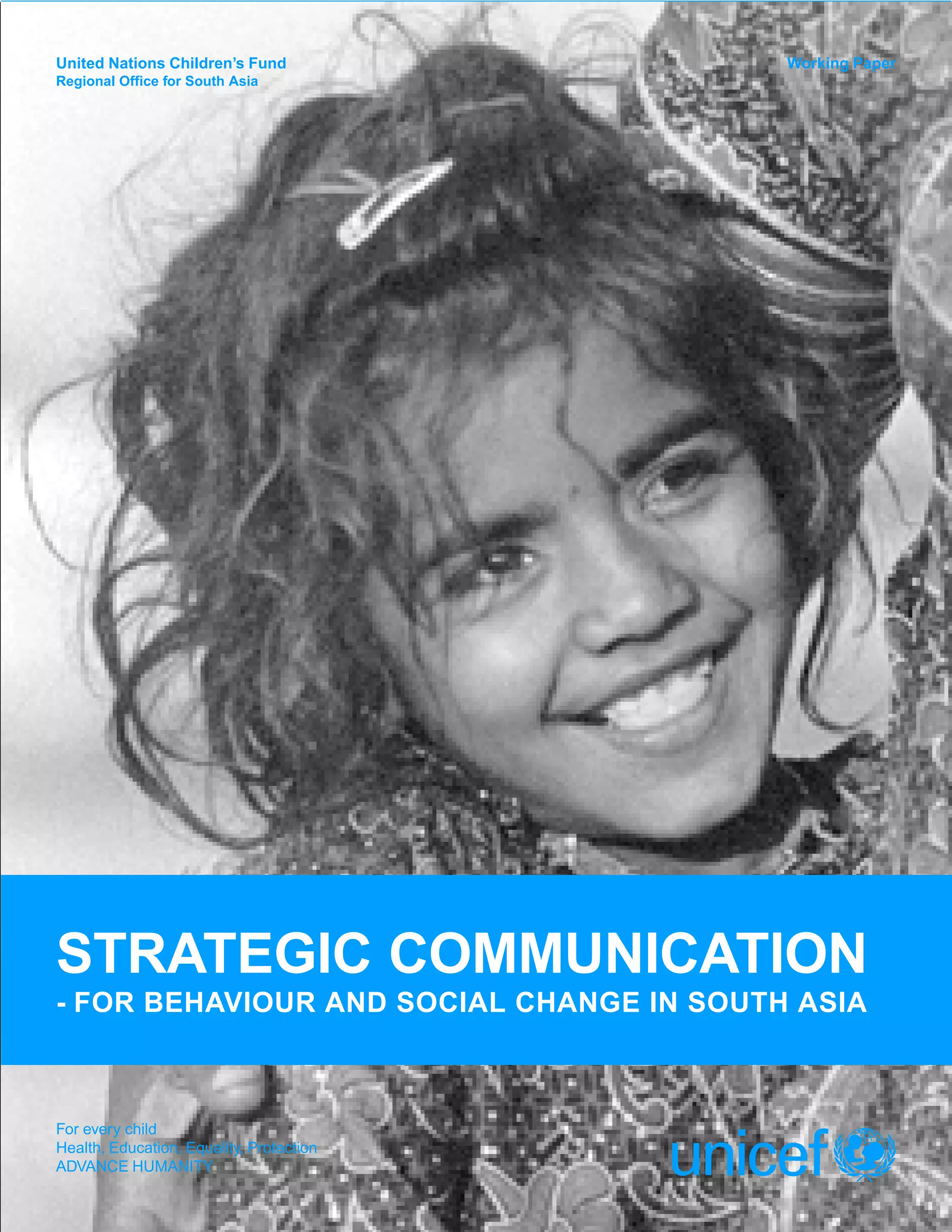
STRATEGIC COMMUNICATION
- FOR BEHAVIOUR AND SOCIAL CHANGE IN SOUTH ASIA


For every child
Health, Education, Equality, Protection
ADVANCE HUMANITY
empty page
Working Paper


STRATEGIC COMMUNICATION
- FOR BEHAVIOUR AND SOCIAL CHANGE IN SOUTH ASIA
This working paper is primarily intended for use by UNICEF staff and partners as an aid to
     improved programming. Working papers are not necessarily edited to the full publication
     standards of the agency.


     ©The United Nations Children's Fund (UNICEF)
     Regional Office for South Asia, February 2005


     For additional copies and further information, please contact
     Regional Advisor, Programme Communication
     UNICEF Regional Office for South Asia (ROSA)
     PO Box 5815, Lekhnath Marg
     Kathmandu, Nepal
     Email: rosa@unicef.org


     Cover photo: © UNICEF / Piers Benatar
     Design and printing: Format Printing Press, Kathmandu, Nepal


ii
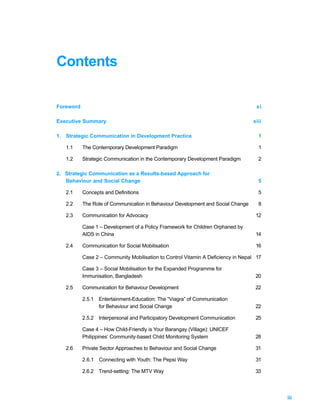
Contents

Foreword                                                                            xi

Executive Summary                                                                 xiii

1. Strategic Communication in Development Practice                                  1

   1.1     The Contemporary Development Paradigm                                    1

   1.2     Strategic Communication in the Contemporary Development Paradigm         2

2. Strategic Communication as a Results-based Approach for
   Behaviour and Social Change                                                      5

   2.1     Concepts and Definitions                                                 5

   2.2     The Role of Communication in Behaviour Development and Social Change     8

   2.3     Communication for Advocacy                                              12

           Case 1 – Development of a Policy Framework for Children Orphaned by
           AIDS in China                                                           14

   2.4     Communication for Social Mobilisation                                   16

           Case 2 – Community Mobilisation to Control Vitamin A Deficiency in Nepal 17

           Case 3 – Social Mobilisation for the Expanded Programme for
           Immunisation, Bangladesh                                                20

   2.5     Communication for Behaviour Development                                 22

           2.5.1 Entertainment-Education: The “Viagra” of Communication
                 for Behaviour and Social Change                                   22

           2.5.2 Interpersonal and Participatory Development Communication         25

           Case 4 – How Child-Friendly is Your Barangay (Village): UNICEF
           Philippines’ Community-based Child Monitoring System                    28

   2.6     Private Sector Approaches to Behaviour and Social Change                31

           2.6.1 Connecting with Youth: The Pepsi Way                              31

           2.6.2 Trend-setting: The MTV Way                                        33


                                                                                         iii
2.7    Planning Strategic Communication                                        35

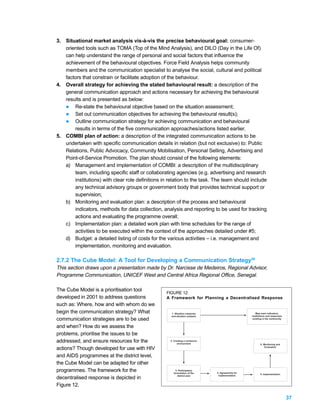
               2.7.1 Communication for Behavioural Impact: Applying Private Sector
                     Experience to Public Health Programmes                            35

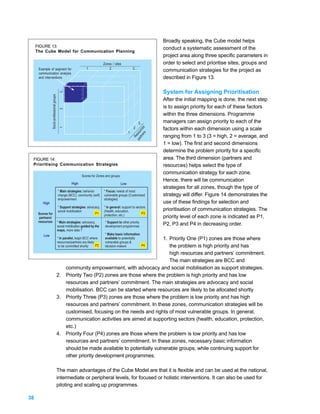
               2.7.2 The Cube Model: A Tool for Developing a Communication Strategy    37

        2.8    Overcoming Challenges of Developing a Communication Strategy            39

               Case 5 – Strategic Communication for HIV Prevention among
               Adolescents and Young People in India                                   39

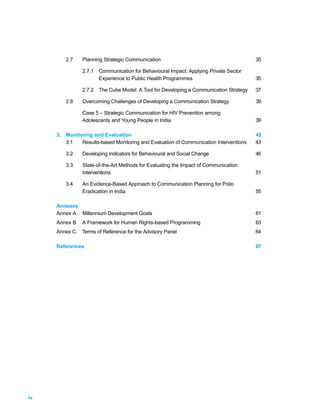
     3. Monitoring and Evaluation                                                      43
        3.1   Results-based Monitoring and Evaluation of Communication Interventions   43

        3.2    Developing Indicators for Behavioural and Social Change                 46

        3.3    State-of-the-Art Methods for Evaluating the Impact of Communication
               Interventions                                                           51

        3.4    An Evidence-Based Approach to Communication Planning for Polio
               Eradication in India                                                    55

     Annexes
     Annex A. Millennium Development Goals                                             61
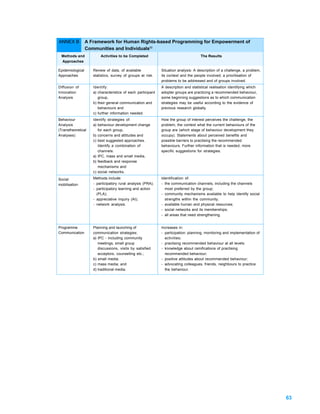
     Annex B. A Framework for Human Rights-based Programming                           63
     Annex C. Terms of Reference for the Advisory Panel                                64

     References                                                                        67


iv
List of Figures


Figure 1:  A Framework for Communication Programmes                           4
Figure 2:  Child-centred Communication                                        5
Figure 3:  Strategic Communication Model                                      7
Figure 4:  Behaviour Adoption Curve                                          11
Figure 5:  Preparing Advocacy Materials                                      13
Figure 6:  Partners and Processes for OVC Policy in China                    15
Figure 7:  Impact of Social Mobilisation on Vitamin A Programme in Nepal     19
Figure 8:  Change in Caretaker Opinion about Vitamin A in Nepal              19
Figure 9:  Integrating PDC with Research and Development Process             29
Figure 10: If MTV Were a Person, It Would Be…                                33
Figure 11: The COMBI Process                                                 36
Figure 12: A Framework for Planning a Decentralised Response                 37
Figure 13: The Cube Model for Communication Planning                         38
Figure 14: Prioritising Communication Strategies                             38
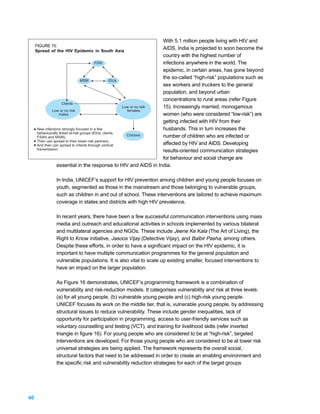
Figure 15: Spread of the HIV Epidemic in South Asia                          40
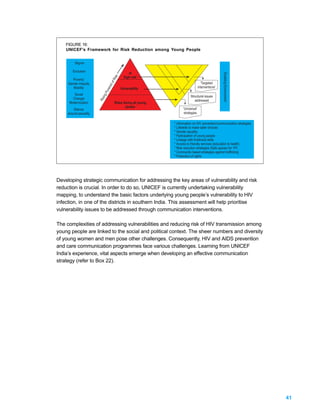
Figure 16: UNICEF's Framework for Risk Reduction among Young People          41
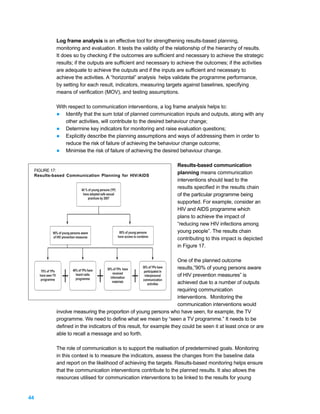
Figure 17: Results-based Communication Planning for HIV/AIDS                 44
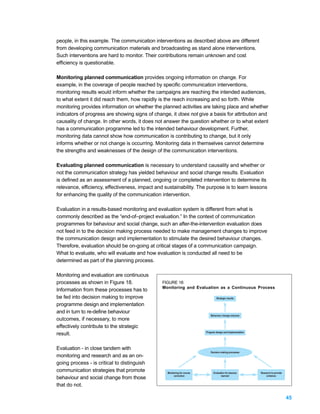
Figure 18: Monitoring and Evaluation as a Continuous Process                 45
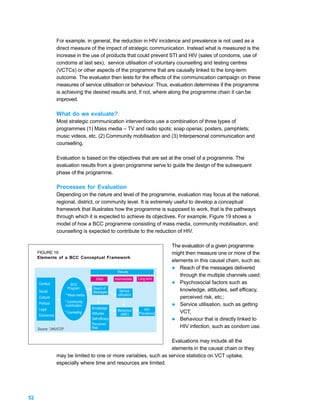
Figure 19: Elements of a BCC Conceptual Framework                            52
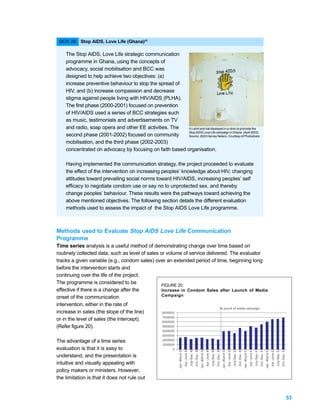
Figure 20: Increase in Condom Sales after Launch of Media Campaign           53
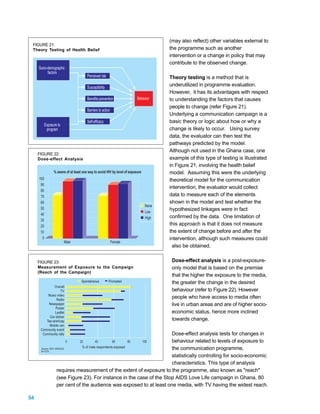
Figure 21: Theory Testing of Health Belief Model                             54
Figure 22: Dose-effect Analysis                                              54
Figure 23: Measurement of Exposure to the Campaign (Reach of the Campaign)   54
Figure 24: Reaching the Unreached for Immunisation                           57
Figure 25: Training Community Mobilisers                                     58
Figure 26: Trends in Booth Coverage June 2003 - April 2004                   59


                                                                                  v
List of Boxes


     Box 1:    The Contemporary Development Paradigm                                 2
     Box 2:    Shifts in the Communication Paradigm                                  3
     Box 3:    Communication Approaches - Some Definitions                           6
     Box 4:    When the Lion Comes, Shout!                                           8
     Box 5:    An Advocacy Strategy Addresses                                       12
     Box 6:    Lessons Learned from Advocacy for Orphans and Vulnerable Children    16
     Box 7:    Elements of a Successful Social Mobilisation Initiative              17
     Box 8:    The Female Community Health Volunteer Initiative Nepal               18
     Box 9:    Lessons Learned from the National Vitamin A Programme Nepal          20
     Box 10:   The Role of the Shebika - The Community Health Volunteer             21
     Box 11:   Lessons Learned from BRACs Social Mobilisation Initiative            22
     Box 12:   How Entertainment Can Influence Behaviours                           24
     Box 13:   Lessons Learned from EE for Behaviour Change                         25
     Box 14:   The Communicator as a Facilitator                                    26
     Box 15:   Stages in Community Organising                                       27
     Box 16:   Challenges to Participatory Development Communication                28
     Box 17:   Enabling Factors for the Sustainability of CBCMS                     30
     Box 18:   Lessons Learned from Pepsi's Experience                              33
     Box 19:   Lessons Learned from MTV's Experience                                35
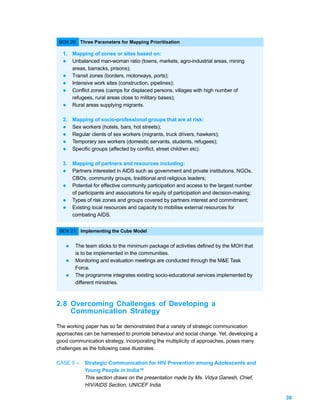
     Box 20:   Three Parameters for Mapping Prioritisation                          39
     Box 21:   Implementing the Cube Model                                          39
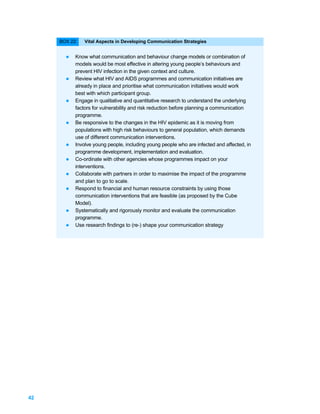
     Box 22:   Vital Aspects in Developing Communication Strategies                 41
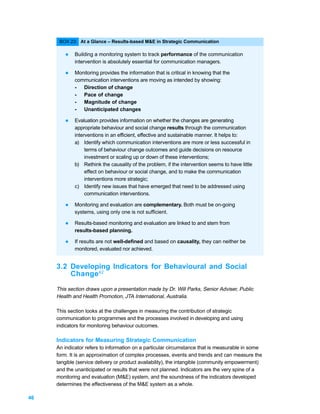
     Box 23:   At a Glance - Results-based M&E in Strategic Communication           46
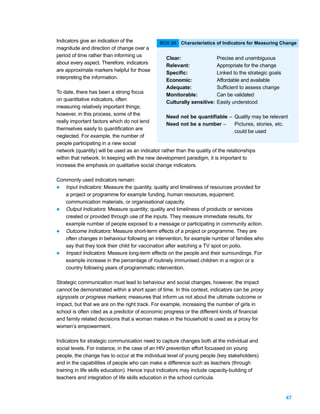
     Box 24:   Characteristics of Indicators for Measuring Change                   47
     Box 25:   Development of a Participatory Monitoring and Evaluation Plan        48
     Box 26:   Data Collection Methods for HIV and AIDS Programmes                  49
     Box 27:   Suggested Methods and Indicators for HIV and AIDS and Immunisation
               Programmes                                                           50
     Box 28:   Stop AIDS, Love Life Ghana                                           53
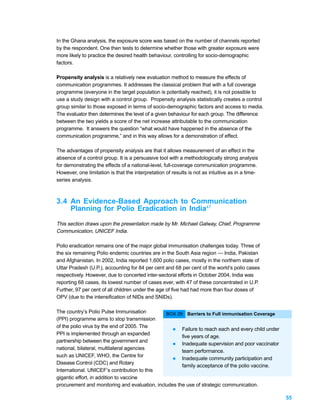
     Box 29:   Barriers to Full Immunisation Coverage                               55
     Box 30:   UNICEF India's 2004 Objectives in Polio Endemic States               56
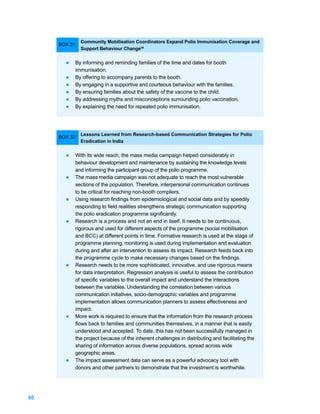
     Box 31:   Community Mobilisation Coordinators Expand Polio Immunisation
               Coverage and Support Behaviour Change                                60
     Box 32:   Lessons Learned from Research-based Communication Strategies
               for Polio Eradication in India                                       60


vi
Acronyms


ABC        Abstinence, Be Faithful, Consistent and Correct Condom Use
ACJA       All Chinese Journalists Association
AED        Academy for Educational Development
AFC        Asian Football Confederation
AIM        AIDS Impact Model
BCC        Behaviour Change Communication
BMC        Block Mobilisation Coordinator
BRAC       Bangladesh Rural Advancement Committee
CATS       Community Audio Towers
CBCMS      Community-based Child Monitoring System
CBO        Community based organisation
CCTV       China Central Television
CDC        Centers for Disease Control and Prevention
CEDAW      Convention on the Elimination of all Forms of Discrimination Against Women
CIDSS      Comprehensive Integrated Delivery of Social Services
CIIR       Catholic Institute for International Relations
CMC        Community Mobilisation Coordinator
CNCCC      China National Committee for the Care of Children
CO         Community Organisers
COMBI      Communication for Behavioural Impact
CPC        Country Programme for Children
CPMA       Chinese Preventive Medicine Association
CRC        Convention on the Rights of the Child
DANIDA     Danish International Development Agency
DILO       Day in the Life Of
DOH        Department of Health
DPT        Diphtheria, Pertussis, Tetanus
DSWD       Department of Social Welfare and Development
EAPRO      East Asia and the Pacific Regional Office
EE         Entertainment Education
EPI        Expanded Programme for Immunisation
FAO        Food and Agricultural Organisation
FCHV       Female Community Health Volunteer
FIC        Fully Immunised Children
FSR        Farming Systems Research
FSW        Female Sex Worker
GIPA       Greater Involvement of People living with HIV/AIDS
HIV/AIDS   Human Immunodeficiency Virus/Acquired Immune Deficiency Syndrome


                                                                                        vii
INGO      International Non-Governmental Organisation
       IDR       Institute for Development Research
       IDU       Intravenous Drug User
       IPC       Interpersonal Communication
       JHU/CCP   Johns Hopkins University/Centre for Communication Programmes
       KABP      Knowledge, Attitudes, Behaviour, Practices
       KAP       Knowledge, Attitudes, Practices
       M-RIP     Massive, Repetitive, Intense, Persistent
       M&E       Monitoring and Evaluation
       MBN       Minimum Basic Needs
       MCA       Ministry for Civil Affairs
       MCHW      Maternal and Child Health Welfare
       MDGs      Millennium Development Goals
       MOH       Ministry of Health
       MOV       Means of Verification
       MPO       Master Plan of Operation
       MSM       Men having Sex with Men
       MTSP      Mid Term Strategic Plan
       MTV       Music Television
       NGO       Non Government Organisation
       NID       National Immunisation Days
       NNVAW     National Network on Violence against Women
       NVAP      National Vitamin A Programme
       OPV       Oral Polio Vaccine
       OVC       Orphaned and Vulnerable Children
       PAR       Participatory Action Research
       PDA       Population and Community Development Association
       PDC       Participatory Development Communication
       PLHA      People Living with HIV and AIDS
       PM&E      Participatory Monitoring and Evaluation
       PMTCT     Prevention of Mother to Child Transmission
       PPI       Pulse Polio Immunisation
       PRA       Participatory Rural Appraisal
       ROSA      Regional Office for South Asia
       SIGNS     Safety Injection Global Network
       SNID      Sub National Immunisation Days
       SMC       Social Mobilisation Coordinator
       SPO       Senior Programme Officer
       SRA       Social Reform Agenda
       STI       Sexually Transmitted Infection
       TOMA      Top of Mind Analysis
       UNDAF     United Nations Development Assistance Framework
       UNFPA     United Nations Population Fund
       UNGASS    United Nations General Assembly Special Session
       UNICEF    United Nations Children's Fund


viii
UP      Uttar Pradesh
USAID   United States Agency for International Development
VCT     Voluntary Counselling and Testing
VCTC    Voluntary Counselling and Testing Centers
VHWs    Voluntary Health Workers
VJs     Video Jockeys
WCARO   West and Central Africa Regional Office
WFFC    World Fit for Children
WHO     World Health Organisation
YP      Young People


                                                             ix
x
Foreword

South Asia has a long tradition of using communication to promote development goals.
Communication approaches have been variously used for promoting immunisation, prevention
of diarrhoeal dehydration and HIV/AIDS, female literacy, among others. These have been in
the form of mass media campaigns, radio programmes, posters, street plays and localized
outreach through communities and NGOs.

Many communication initiatives have succeeded in enhancing public awareness, but have
failed in going beyond awareness, to stimulate positive changes in attitudes and practices
toward creating lasting social change. Communication, to impact on sustainable behaviour
change among individuals and groups on a large scale, needs to be strategic, participatory,
based on evidence from research, results-oriented and well-funded. These are key
considerations for donors and governments as we all strive to achieve the UN Millennium
Development Goals.

To stimulate using strategic communication more effectively, the UNICEF Regional Office for
South Asia (ROSA) and the UNICEF India office, organized an experts' consultation on
Strategic Communication for Behaviour and Social Change in South Asia in New Delhi from 22
to 24 September 2004. This working paper synthesises the latest concepts, strategies and
lessons learned in strategic communication shared at the consultation.

We are grateful to Professor Jane Bertrand, Professor Maria Celeste Cadiz, Dr Everold Hosein,
Mr Milan Kanti Barua, Mr Lloyd Mathias, Dr Will Parks, Mr Vikram Raizada, Mr Guy Scandlen,
Mr Ram Shrestha and Professor Arvind Singhal for sharing their invaluable experiences and
insights at the consultation. Ketan Chitnis, Anuradha Mukherjee and Nirupama Sarma worked
relentless hours writing up the presentations and discussions for this working paper. Ketan
Chitnis edited the draft, and Professor Singhal lent his expert eye in reviewing the final version.

We thank the UNICEF India office for their contribution in organizing the consultation. We also
express our sincere appreciation to all participants as well as our colleagues from UNICEF
country offices, other regional offices and headquarters who contributed to the rich discussions
at the meeting.

UNICEF ROSA is very pleased to share this working paper to inspire greater action in
improving the lives of more children and women in South Asia.


Cecilia Lotse
Regional Director
UNICEF Regional Office for South Asia
                                                                                                      xi
xii
Executive Summary

This working paper captures the essence of the 2004 Experts’ Consultation on Strategic
Communication for Behaviour and Social Change in South Asia, held in New Delhi, India,
22 to 24 September 2004. The meeting, jointly organised by the UNICEF Regional Office for
South Asia (ROSA) and the UNICEF India office, was attended by over 70 participants,
including communication scholars and practitioners from the public and corporate sector,
UNICEF senior staff from South Asia, headquarters and other regional offices.

UNICEF, as an agency with a long tradition in development communication, utilizes an
array of communication approaches, ranging from policy advocacy, social and community
mobilisation, to interpersonal communication and much more. UNICEF espouses the new
development paradigm that advances results-oriented communication to support
development goals. This new thinking requires greater use of different communication
approaches and synergy among the various components of development programmes. It
necessitates that communication interventions are grounded in research and based on
sound documentation, monitoring, and evaluation. This paradigm stresses the importance
of reviewing planning, funding and management processes and staff functions within
UNICEF as critical steps in recasting communication to shape behaviours and contribute to
positive social change on a larger scale, so that more women and children in South Asia
would realize a better quality of life.

The consultation reviewed the latest
                                               Strategic communication is an evidence-based,
concepts and approaches in
                                               results-oriented process, undertaken in consultation
communication for behaviour and social
                                               with the participant group(s). It is intrinsically linked to
change and clarified the role of strategic
                                               other programme elements, cognisant of the local
communication in South Asia.
                                               context and favouring a multiplicity of communication
Communication scholars and
                                               approaches, to stimulate positive and measurable
practitioners shared and debated their
                                               behaviour and social change.
latest experiences and cutting-edge
approaches in strategic communication.
An important step taken at the consultation was to give attention to the meaning of
research in communication planning, as well as the role played by monitoring and
evaluation in a results-based programming environment.

This working paper presents a synthesis of the latest experiences in applying various
communication approaches ranging from mass communication and entertainment
education, interpersonal communication, participatory development communication,
advocacy and social mobilisation that have been used in South Asia and elsewhere. It
showcases examples from HIV and AIDS prevention, care and support and in the promotion
of immunisation. The lessons learned in these two organisational priority areas provide

                                                                                                          xiii
ample lessons in development communication that are relevant for related development
      domains like child protection, education, and maternal and child health.

      The paper suggests effective ways to plan communication programmes and presents
      lessons learned from the private sector. By no means does it suggest that there is a
      singular approach to strategic communication; rather, that strategic communication involves
      a mix of appropriate multiple and synergistic communication approaches that can foster
      individual and social change.

      Communication programmes need to be responsive to peoples’ wants, needs and desires.
      What’s more, communication programmes must be geared to stimulate social change in
      more effective ways through careful communication research, analysis, planning,
      coordination, implementation, management, monitoring and evaluation.

      The crux of the consultation was vested in sessions where participants reflected and shared
      their ideas on how to move the latest thinking into action. Implicit in this paradigm shift in
      programming is the demand to transform the way communication programmes are planned,
      managed and funded. For UNICEF to translate the latest evidence from strategic
      communication into action, the consultation recommended that change is required in the
      following areas:

      1.   Planning of evidence and results-based communication programmes;
      2.   Professionalizing communication functions;
      3.   Modifying management and funding aspects;
      4.   Building stronger partnerships and networks.

      1. Planning of evidence-based and results-based communication
      programmes
      Recommendation # 1:      Communication strategies work best when they are integrated with
                               various strategies for behaviour change or behaviour development,
                               social mobilisation, and advocacy aimed at achieving clearly
                               identified objectives; and when they are linked to other programme
                               elements and service provision.
      Recommendation #2:       Communication strategies need to extend beyond individuals and
                               households to include service providers, traditional and religious
                               leaders, and decision makers at different levels to engender
                               systemic social change.
      Recommendation #3:       Research, monitoring and evaluation are essential, and ought to
                               be part of any strategic communication plan.
      Recommendation #4:        Participatory communication methods yield results, if planned well
                               and if they are responsive to people’s needs.
      Recommendation #5:       Entertainment-education (EE), currently an underused
                               communication strategy in South Asia, has the potential to be
                               more widely used. UNICEF should explore to expand the use of
                               EE, building on the success of animation films in Africa and South
                               Asia (Sara and Meena). Past EE successes have the potential to
                               be scaled up; results ought to be well researched and
                               documented, and lessons learned widely shared.

xiv
2. Professionalizing communication functions and building capacity in
strategic communication
Recommendation #6:  Recognise the need for increased specialisation and segmentation
                    of roles in the field of communication when hiring staff and
                    assigning tasks.
Recommendation #7:  Train staff members and partners from government and NGOs on
                    communication research and analysis, planning, managing,
                    monitoring and evaluating communication programmes for
                    behaviour and social change.
Recommendation #8:  Form a Regional Task Force on Strategic Communication
                    comprising of UNICEF ROSA, UNICEF India and Bangladesh, and
                    selected Senior Programme Officers (SPOs). The task force ought
                    to help coordinate management as well as operational strategic
                    communication issues emanating from the outlined
                    recommendations.
Recommendation #9:  Develop a glossary of terms in strategic communication to
                    establish a shared understanding (and use) of terminology,
                    concepts and theories in communication for behaviour and social
                    change.
Recommendation #10: Form an Advisory Panel of recognized communication experts as
                    an extended technical arm to ROSA to help build capacity for
                    strategic communication in South Asia (see Annex C for tentative
                    Terms of Reference).

3. Management and funding aspects
Recommendation #11:   Integrate strategic communication as a measurable feature in
                      annual work plans, multi-year programme plans and ensure that
                      strategic communication is a distinctive aspect in UNICEF’s
                      Master Plan of Operation (MPO). Where feasible, funds should be
                      in a separate budget (and not part of sectoral programmes) to
                      facilitate research, planning and programming of strategic
                      communication activities.
Recommendation #12:   Improve coordination of communication programmes within
                      UNICEF and with government and other development partners at
                      the onset of the programme planning phase.
Recommendation #13:   Increase financial resources and effective resource planning to
                      harness greater results from communication for behaviour and
                      social change programmes.
Recommendation #14:   Increase investments for formative and summative evaluation, and
                      to feed these results more effectively into strategic communication
                      outcomes.

4. Partnership building and networking
Recommendation #15:   Create a regional forum on strategic communication for UNICEF
                      staff, development partners and academia to share knowledge and
                      improve applied strategic communication to foster behaviour and
                      social change in South Asia.


                                                                                            xv
Recommendation #16:     Explore public-private partnerships to gain wider reach of
                              communication programmes, to facilitate cross-sectoral learning
                              and to leverage new resources for development programmes.

      The above recommendations are wide ranging. Some recommendations are achievable in a
      relatively short period of time, while others may take longer. However, organisational zeal
      has to be at the core to buttress the management and planning of strategic communication
      programmes for UNICEF-supported development programmes in South Asia. Ultimately,
      well researched and planned strategic communication produces results by improving the
      lives of children and women as documented by the various case studies and lessons
      learned in this paper.


xvi
1
Strategic Communication in
Development Practice
This chapter elucidates the vital role of strategic communication, a research-based
communication process, in achieving development goals. It underscores that
communication is as much a science as an art, as much a process as it is about
outcomes. The chapter advocates for increased linkages between epidemiological research
and social science research in planning effective communication interventions while
ensuring quality service delivery.


1.1 The Contemporary Development Paradigm1

This and the next section draw upon the presentation made by Dr. Erma Manoncourt,
Deputy Director, UNICEF India.

The Convention on the Rights of the Child (CRC, 1989) and the Convention on the
Elimination of all Forms of Discrimination Against Women (CEDAW, 1979), which guide
UNICEF’s work, clearly state that every child has the right to live healthy and educated, live
free from violence and fear, protected from abuse and exploitation and be cared for by his or
her own parents, whenever possible. These conventions delineate children’s and women’s
rights as fundamental human rights. UNICEF strives to fulfil these human rights by
integrating the principles of a rights-based approach in all of its work. Communication in all
its diversity plays a vital role in realizing these principles as it entails to bring about more
effectively positive behaviour and social changes so that children can thrive.

Setting goals, both mid- and long-term, is an important step to measure the success or
failure of any programme. Thus, UNICEF programmes are guided by a rights-based
approach on the one hand and results-based management on the other. The World Fit for
Children (WFFC), the outcome document from the 2002 United Nations Special Session on
Children, reaffirmed previously set goals and targets for children by world leaders at the UN
Millennium Summit. The WFFC sets 21 goals that fall into four priority areas: (1) Promoting
healthy lives, (2) providing quality education for all, (3) protecting children against abuse,
exploitation and violence, and (4) reducing HIV infection rates. These four priority areas of
action are crucial for achieving the Millennium Development Goals (MDGs). The MDGs are
a set of eight fundamental development goals with quantifiable targets to be achieved by
2015 (refer to Annex A for an overview). These goals include the reduction of poverty and
hunger, the reduction of child mortality, gender equality and the empowerment of women,
access to education and the prevention of HIV infection, among others.


                                                                                                   1
BOX 1:     The Contemporary Development Paradigm is Guided by


        A Human Rights Perspective
        l     Children’s and women’s rights fundamental to human rights
        l     UN Convention on the Rights of the Child (CRC, 1989)
        l     Convention on the Elimination of all Forms of Discrimination Against Women
              (CEDAW, 1979)

        The Millennium Summit of the United Nations, September 2000
        l     Commitment to reduce global deprivation and promote sustainable human
              development

        The Millennium Development Goals
        l     Quantifiable targets for 2015

        The World Fit for Children
        l     2002 UN General Assembly Special Session (UNGASS) on Children
        l     Placing children first on the development agenda


    The MDGs can only be achieved through the coordinated and synergistic response of a
    wide spectrum of inter-sectoral and inter-agency collaboration. They call upon different UN
    agencies to synergise individual mandates into a harmonised and specific plan geared
    towards achieving the MDGs, while also incorporating national development goals. For
    UNICEF, in particular, this is of significant importance, since six of the eight MDGs fall
    within the scope and mandate of its work.


    1.2 Strategic Communication in the Contemporary
        Development Paradigm

    Global conventions such as CRC and CEDAW are set out to create conducive
    environments for change. They provide frameworks and establish standards. However,
    turning them into development programmes often poses many challenges. Against this
    background, communication is increasingly understood as an enabler of individual and
    social level change to achieve established development goals. Communication in the new
    development paradigm is much more than merely writing press releases or producing radio
    jingles, T-Shirts, posters or pamphlets. It is a concerted strategy derived from and
    intrinsically linked to larger development goals.

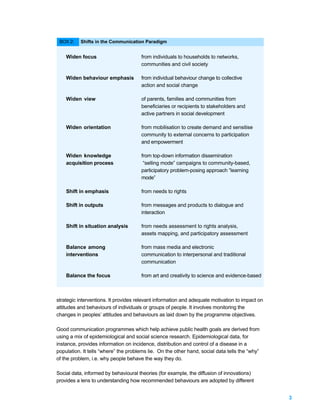
    The accompanying box describes the shift in thinking about strategic communication as it
    relates to the contemporary development paradigm and UNICEF’s programming
    environment; the rights-based approach.

    Communication is as much science as it is an art. The science of communication is a
    research-driven consultative process involving planning, design and implementation of


2
BOX 2:    Shifts in the Communication Paradigm


    Widen focus                       from individuals to households to networks,
                                      communities and civil society

    Widen behaviour emphasis          from individual behaviour change to collective
                                      action and social change

    Widen view                        of parents, families and communities from
                                      beneficiaries or recipients to stakeholders and
                                      active partners in social development

    Widen orientation                 from mobilisation to create demand and sensitise
                                      community to external concerns to participation
                                      and empowerment

    Widen knowledge                   from top-down information dissemination
    acquisition process                “selling mode” campaigns to community-based,
                                      participatory problem-posing approach “learning
                                      mode”

    Shift in emphasis                 from needs to rights

    Shift in outputs                  from messages and products to dialogue and
                                      interaction

    Shift in situation analysis       from needs assessment to rights analysis,
                                      assets mapping, and participatory assessment

    Balance among                     from mass media and electronic
    interventions                     communication to interpersonal and traditional
                                      communication

    Balance the focus                 from art and creativity to science and evidence-based


strategic interventions. It provides relevant information and adequate motivation to impact on
attitudes and behaviours of individuals or groups of people. It involves monitoring the
changes in peoples’ attitudes and behaviours as laid down by the programme objectives.

Good communication programmes which help achieve public health goals are derived from
using a mix of epidemiological and social science research. Epidemiological data, for
instance, provides information on incidence, distribution and control of a disease in a
population. It tells “where” the problems lie. On the other hand, social data tells the “why”
of the problem, i.e. why people behave the way they do.

Social data, informed by behavioural theories (for example, the diffusion of innovations)
provides a lens to understanding how recommended behaviours are adopted by different


                                                                                                 3
individuals within the population over a period of time. Behavioural analysis also explains
             how attitudinal and behavioural challenges can be overcome.

             In addition to epidemiological and social data, evidence-based and scientifically planned
             and monitored strategic communication interventions have to be linked to service
             components of the programme. For instance, a communication initiative which seeks to
             create demand for immunisation programmes is not helpful if vaccination services are not
             easily accessible. Thus, for a programme to be effective both communication and service
             delivery components have to work in close synchrony.

             The artistic side of communication involves designing creative messages and products, and
             identifying effective interpersonal, group and mass-media channels based on the sound
             knowledge of the participants we seek to reach.

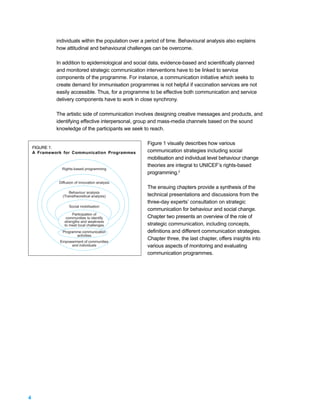
                                                      Figure 1 visually describes how various
    FIGURE 1:
    A Framework for Communication Programmes          communication strategies including social
                                                      mobilisation and individual level behaviour change
                                                      theories are integral to UNICEF’s rights-based
               Rights-based programming
                                                      programming.2
              Diffusion of innovation analysis
                                                      The ensuing chapters provide a synthesis of the
                    Behaviour analysis
                (Transtheoretical analysis)           technical presentations and discussions from the
                                                      three-day experts’ consultation on strategic
                    Social mobilisation
                                                      communication for behaviour and social change.
                      Participation of
                  communities to identify             Chapter two presents an overview of the role of
                 strengths and weakness
                 to meet local challenges             strategic communication, including concepts,
                Programme communication               definitions and different communication strategies.
                       activities
                                                      Chapter three, the last chapter, offers insights into
              Empowerment of communities
                   and individuals                    various aspects of monitoring and evaluating
                                                      communication programmes.


4
2
Strategic Communication as a
Results-based Approach for
Behaviour and Social Change
This chapter reviews the key concepts underpinning strategic communication and
elucidates, through examples and case studies, the role of research-grounded
communication for behaviour and social change. The discussions cover an analysis of the
various communication approaches such as advocacy, social mobilisation, participatory
communication, entertainment-education, integrated social marketing and advertising used
by the public and commercial sectors. The chapter provides lessons learned in developing
and applying communication strategies which support programmes to achieve greater
results for children.


2.1 Concepts and Definitions3 ,4
The section draws upon the presentations made by Dr. Erma Manoncourt, Deputy Director,
UNICEF India and Mr. Guy Scandlen, former UNICEF Regional Programme Communication
Advisor, UNICEF EAPRO and WCARO.

Good communication strategies use concepts that range from psycho-social learning
theories of role modelling communicated via the mass media to the use of advocacy and
social mobilisation. Dialogue with and active participation of individuals are essential
elements in communication for behaviour and social change. Many communication
programmes have for long focused much on the metaphorical “tree” and not enough on the
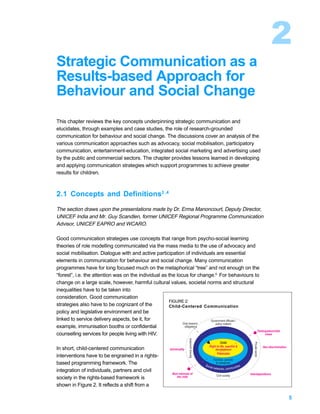
“forest”, i.e. the attention was on the individual as the locus for change.5 For behaviours to
change on a large scale, however, harmful cultural values, societal norms and structural
inequalities have to be taken into
consideration. Good communication
                                                      FIGURE 2:
strategies also have to be cognizant of the           Child-Centered Communication
policy and legislative environment and be
linked to service delivery aspects, be it, for                             Government officials /
                                                             Duty bearers:    policy makers
example, immunisation booths or confidential                  obligations
                                                                                                  Participation/child
counselling services for people living with HIV.                                                         views
                                                                          Service providers


                                                                                                          Child
                                                                                                                                                  Private sector


                                                                                                 Right to life, survival &                                         Non-discrimination
In short, child-centered communication                     Universality                              development
                                                                                                       Titleholder
interventions have to be engrained in a rights-
                                                                                                          Families: parents
based programming framework. The                                                              S oc
                                                                                                             & caregivers
                                                                                                     ia l n e t                        ti e s
                                                                                                                w o rk s, co m m u n i
integration of individuals, partners and civil
                                                             Best interests of                                                                  Interdependence
                                                                the child                                    Civil society
society in the rights-based framework is
shown in Figure 2. It reflects a shift from a

                                                                                                                                                                                        5
focus on the family (usually the mother) alone to recognising that a range of family, social and
    political networks (policy makers, community and religious leaders, service providers) influence
    behaviour outcomes. Underpinning UNICEF’s programmes are the four key principles of the
    CRC: (1) non-discrimination, (2) the best interests of the child, (3) the right to survival and
    development, and (4) participation, with all rights applying to all children at all times.

    Within UNICEF’s child-centered communication programming framework, questions that
    need to be addressed include: How can programmes fulfil the rights of children (for instance
    with regard to survival and development), while finding creative avenues to address resistant
    attitudes among some communities and ensuring community participation, all at the same
    time? How can national governments be encouraged to act upon their obligations towards
    making these rights a reality for all children? And how can these efforts be measured to
    determine any real impact?

    Strategic communication is uniquely situated to foster these development goals and help
    overcome some of the above challenges because it facilitates both individual level and
    societal level changes. It consists of three key approaches –– programme communication
    (also referred to as behaviour change communication), social mobilisation, and advocacy ––
    definitions for which were developed by UNICEF’s Global Communication Team in 1998
    (see Box 3).

     BOX 3:    Communication Approaches - Some Definitions6

       Strategic Communication: is an evidence-based, results-oriented process,
       undertaken in consultation with the participant group(s), intrinsically linked to other
       programme elements, cognisant of the local context and favouring a multiplicity of
       communication approaches, to stimulate positive and measurable behaviour and
       social change.

       Programme communication or behaviour change communication: is a
       research-based consultative process of addressing knowledge, attitudes and practices
       through identifying, analysing and segmenting audiences and participants in
       programmes by providing them with relevant information and motivation through well-
       defined strategies, using an audience-appropriate mix of interpersonal, group and
       mass-media channels, including participatory methods.

       Advocacy: is a continuous and adaptive process of gathering, organising and
       formulating information into argument, to be communicated to decision-makers through
       various interpersonal and media channels, with a view to influencing their decision
       towards raising resources or political and social leadership acceptance and commitment
       for a development programme, thereby preparing a society for its acceptance.

       Social mobilisation: is a process of bringing together all feasible and practical inter-
       sectoral social partners and allies to determine felt-need and raise awareness of, and
       demand for, a particular development objective. It involves enlisting the participation of
       such actors, including institutions, groups, networks and communities, in identifying,
       raising and managing human and material resources, thereby increasing and
       strengthening self-reliance and sustainability of achievements.

6
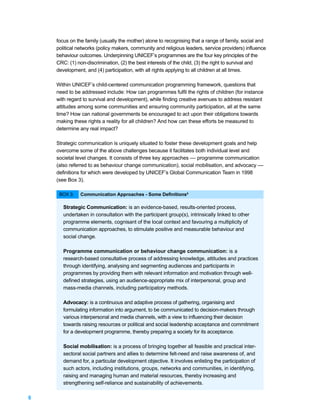
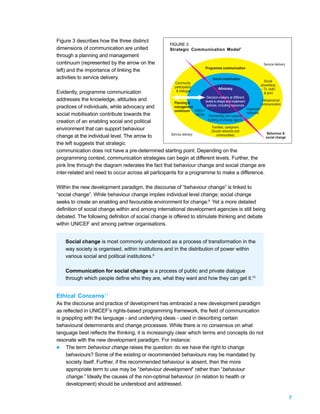
Figure 3 describes how the three distinct
                                                                 FIGURE 3:
dimensions of communication are united                           Strategic Communication Model 7
through a planning and management
continuum (represented by the arrow on the                                                                             Service delivery
                                                                                     Programme communication
left) and the importance of linking the
activities to service delivery.                                                           Social mobilisation
                                                                                                                       Social
                                                                    Community
                                                                                                                     advertising
                                                                    participation            Advocacy                – Tv, radio
Evidently, programme communication                                   & dialogue
                                                                                                                       & print
                                                                           Decision-makers at different
addresses the knowledge, attitudes and                                    levels to shape and implement             Interpersonal
                                                       Planning &                                                  communication
practices of individuals, while advocacy and           management          policies, including resources
                                                                                                         Organized
                                                       continuum CSOs +
social mobilisation contribute towards the                            NGOs Partnership and capacity networks
                                                                            building of change agents
creation of an enabling social and political
                                                                                Families, caregivers
environment that can support behaviour                                         (Social networks and
                                                     Service delivery              communities)                         Behaviour &
change at the individual level. The arrow to                                                                           social change
the left suggests that strategic
communication does not have a pre-determined starting point. Depending on the
programming context, communication strategies can begin at different levels. Further, the
pink line through the diagram reiterates the fact that behaviour change and social change are
inter-related and need to occur across all participants for a programme to make a difference.

Within the new development paradigm, the discourse of “behaviour change” is linked to
“social change”. While behaviour change implies individual level change; social change
seeks to create an enabling and favourable environment for change.8 Yet a more detailed
definition of social change within and among international development agencies is still being
debated. The following definition of social change is offered to stimulate thinking and debate
within UNICEF and among partner organisations.


     Social change is most commonly understood as a process of transformation in the
     way society is organised, within institutions and in the distribution of power within
     various social and political institutions.9

     Communication for social change is a process of public and private dialogue
     through which people define who they are, what they want and how they can get it.10


Ethical Concerns11
As the discourse and practice of development has embraced a new development paradigm
as reflected in UNICEF’s rights-based programming framework, the field of communication
is grappling with the language - and underlying ideas - used in describing certain
behavioural determinants and change processes. While there is no consensus on what
language best reflects the thinking, it is increasingly clear which terms and concepts do not
resonate with the new development paradigm. For instance:
l The term behaviour change raises the question: do we have the right to change
     behaviours? Some of the existing or recommended behaviours may be mandated by
     society itself. Further, if the recommended behaviour is absent, then the more
     appropriate term to use may be “behaviour development” rather than “behaviour
     change.” Ideally the causes of the non-optimal behaviour (in relation to health or
     development) should be understood and addressed.

                                                                                                                                          7
l    Strategic communication is sometimes understood as manipulative, leaving little room
                 for dialogue and discussion with the people being served. However, a careful reading of
                 the definitions reveals continual opportunities for consultation and dialogue, and does
                 not preclude rejection of interventions.
            l    Terms such as audience have passive connotations, while target group carries military
                 connotations. In keeping with the shift toward participatory communication processes
                 the term participant groups is preferred.

            UNICEF ROSA is sensitive to these debates and the present document attempts to use
            terms that reflect the new paradigm.


            2.2 The Role of Communication in Behaviour
                Development and Social Change12
            This section draws upon the presentation made by Dr. Arvind Singhal, Professor and
            Presidential Research Scholar, School of Communication Studies, Ohio University,
            Athens, USA.


BOX 4:    When the Lion Comes, Shout!13                          Media Agenda Setting
                                                                 Museveni’s “shouting” in communication
    Uganda is one of the few developing countries in the         terms refers to the agenda-setting role of
    world that is considered as having effectively               the media. Media, in all its diversity, is a
    responded to HIV and AIDS. What did Uganda do to             primary source of information through
    manage its HIV and AIDS epidemic? President                  which people learn about the world
    Yoweri Museveni of Uganda, who led his country’s             around us. What the media chooses to
    national response, noted the following while                 report, or not to report, often determines
    addressing his fellow African heads of state: “When          what we believe as being salient in the
    the lion comes to your village you don’t make a              world.
    small shout. You make a very large shout. And you
    shout and shout and shout and shout. Further, the             President Museveni’s encouragement to
    village chief [implying the top political, civic, and         shout, therefore, clarifies the importance
    religious leaders] has the responsibility to shout the        of how policy makers should set the
    loudest. So when I learned about the impact of HIV            public, media, and national agenda to
    on my country, as the head of state, it became my             tackle AIDS. It also reiterates the power
    responsibility to shout the loudest”.                         of the media and opinion formers in
                                                                  galvanising political support and action.
                                                                  Uganda’s “shouting” is in stark contrast
            to other countries of the world where political leadership has downplayed the epidemic and
            the media have kept the issue off the reportage. This has prevented community dialogue,
            hampered political action, and contributed to HIV associated stigma and discrimination -
            ultimately all leading to higher rates of HIV infections.

            Evidently, addressing social and public health issues is not only about individual behaviour
            change but also about how the larger society manages and responds. It is about creating
            an enabling political and social environment for change in which the media plays a
            significant role. The quality of media reporting in turn shapes the public and policy
            discourse.

8
Communication for Role Modelling
The Soul City Institute for Health and Development Communication in South Africa
implements an ongoing multi-media communication initiative that addresses national health
issues of priority. Soul City, the popular primetime entertainment-education drama series,
has run on South African television since 1992. In 1999, during the fourth Soul City series, a
new collective behaviour was modelled in the storyline of the drama to tackle domestic
violence.

The serial showed Thabang, a respected
school teacher, repeatedly beating his wife
Matlakala. Despite Matlakala’s bruises and
cries, the neighbours are initially reluctant to
intervene in what they perceive as a “private
matter.” However, one day, the neighbours


                                                                                                                                                    PHOTO: COURTESY OF SOUL CITY SOUTH AFRICA.
are galvanized into action. When Thabang is
beating his wife, they collectively gather
pots and pans from their homes and bang
them relentlessly in protest outside the
couple’s home. Thabang is thus publicly
shamed. Research on domestic violence
                                                  Pot banging in South Africa: A form of protest against domestic violence modelled on TV and
had indicated that women usually recoiled         replicated by audience members.
to the kitchen after the incidence of violence
because the kitchen was seen as a “safe place” for women. Thus, pots and pans were
symbolically turned into agents of liberation for the abused women. A “private” act of
violence was transformed into a “public” action of protest, and a new social behaviour was
modelled that exemplified collective efficacy [drawing upon the psycho-social theory of
social learning.]14 Soul City thus cultivated a new behaviour among its audience members
to collectively address the issue of domestic violence. Social learning theory posits that
people learn new behaviours by observing others, including mass media role models.

Following the broadcast of the pot-banging episode, several instances of community pot
banging to stop partner abuse were reported all over in South Africa. Patrons in a bar in
Thembisa Township adapted pot banging to banging beer bottles when a man tried to
physically abuse his girlfriend.

To harness this multi-level entertainment-education communication strategy, the producers
of Soul City had consciously decided to tackle domestic violence, a national health priority,
after an 18-month formative research process. This included partnering with the National
Network on Violence against Women (NNVAW), a coalition of over 1,500 activists and
community organisations in South Africa. During and following the broadcast of the series,
Soul City and NNVAW implemented a national advocacy campaign to combat domestic
violence. It focused on expediting the implementation of the recently passed Domestic
Violence Act and on enhancing access to existing support services for abused women
through telephone helplines. The advocacy strategy was complimented by concerted social
mobilisation efforts to gain community support through a series of public marches and
mass meetings.


                                                                                                                                                9
Culturally-appropriate Communication Practices
             The concept of positive deviance15 , refined and implemented by Jerry Sternin, Tufts
             University, School of Nutrition Science and Policy, Boston, USA demonstrates how positive
             behaviour by a few individuals in the community [positive deviants] who do things differently
             than others in the community can eventually lead to far-reaching changes within the
             community. The positive deviance inquiry capitalises on existing local knowledge and builds
             on it to tackle health and development problems. Positive deviance principles have been
             implemented in Africa to reduce incidence of the traditional practice of female genital
             mutilation. Similarly, within the context of HIV prevention among young people, youth who
             practice abstinence or monogamy despite peer pressure, are used as positive deviants to
             influence their community of peers.

             In another example, a small number of children in certain economically poor communities in
             Vietnam were well-nourished and healthy as compared to most other children who were
             malnourished in the same communities. On further probing, it was found that mothers of the
             healthier children put small shrimps and crabs, easily available in rice fields, as nutritional
             supplements. These mothers represented positive deviants because they were a minority in
             terms of their feeding practice, yet their deviant behaviour had a positive impact on
             children’s health. Thus an existing health-enhancing feeding practice of a minority group
             was promoted to the rest of the community. As the positive deviant behaviour is practiced
             by families that share a similar cultural background with others in the community, it makes
             the adoption of these behaviours relatively easier.

                                                            Communication is also more effective
     Communication Mantra                                   when using local idioms that are more
                                                            culturally proximate to the audience.
     l View culture as an ally                              President Museveni demonstrates it
     l Build on existing local knowledge                    through the story of a village mobilising
     l Use local idioms that are culturally relevant        its people to act against AIDS by using
     l Identify local solutions within communities          the parable of “shouting loudly when a
     l If possible, amplify what works locally              lion comes to a village.” Likewise in
                                                            Thailand, Senator and chairman of
                                                            Population and Community Development
            Association (PDA) Mr. Mechai Viravaidya has employed the culturally-revered elephant, to
            promote condom use for family planning and HIV prevention.

             In essence, recognising culture as “an ally” rather than as a barrier to support positive
             change, coupled with identifying local solutions within communities are essential elements
             of sound communication strategies.

             Diffusion of Innovations: A Behaviour Change Theory
             This section draws upon a presentation by Mr. Guy Scandlen, former UNICEF Regional
             Programme Communication Advisor, UNICEF EAPRO and WCARO.

             The proponent of the diffusion of innovations theory, the late professor Everett M. Rogers,
             defined diffusion as a social process through which a new idea or product is communicated
             through certain channels over a period of time to individuals, communities and society.16


10
Five key characteristics of a new product, idea or behaviour that contribute toward its
adoption are: (1) relative advantage of adopting the new behaviour (for example, adopting
a vaccine prevents illness), (2) compatibility of the new behaviour in relation to the
individual’s existing social norms (for example, sending a girl child to school may not be
compatible with social norms), (3) complexity of adopting the behaviour (for example one
needs a trained person to administer an injection but iron pills can be taken by the
individual) (4) observability of the adopted behaviour (for example are the results of
adopting an innovation visible to others such as using helmets or going to school) and (5)
trialability which is the opportunity to experiment the behaviour before adopting it on a
sustainable basis (for example trying out using condoms before making it a habit). Within
the public health context, many innovations that are promoted tend to be preventive
innovations such as getting vaccinated to prevent a serious illness. Thus, they tend to have
a slow rate of adoption because potential adopters may not easily perceive its relative
advantage, the adoption may be complex, the outcome is not necessarily observable and
trialability is limited.

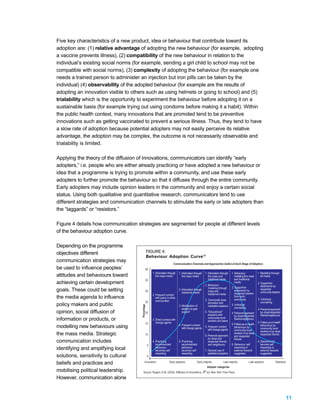
Applying the theory of the diffusion of innovations, communicators can identify “early
adopters,” i.e. people who are either already practicing or have adopted a new behaviour or
idea that a programme is trying to promote within a community, and use these early
adopters to further promote the behaviour so that it diffuses through the entire community.
Early adopters may include opinion leaders in the community and enjoy a certain social
status. Using both qualitative and quantitative research, communicators tend to use
different strategies and communication channels to stimulate the early or late adopters than
the “laggards” or “resistors.”

Figure 4 details how communication strategies are segmented for people at different levels
of the behaviour adoption curve.

Depending on the programme
objectives different                               FIGURE 4:
                                                   Behaviour Adoption Curve 17
communication strategies may
                                                                           Communication Channels and Approaches Useful at Each Stage of Adoption
be used to influence peoples’                 40
                                                       1. Information through   1. Information through   1. Information through   1. Behaviour             1. Modeling through
attitudes and behaviours toward                           the mass media           the mass media           the mass and            modeling thru mass        all media
                                              35                                                            traditional media       and traditional
achieving certain development                                                                            2. Behaviour
                                                                                                                                    media.                 2. Supportive
                                                                                                                                  2. Supportive              statements by
                                                                                                            modeling through                                 respected
goals. These could be setting                 30
                                                                                2. Information through
                                                                                   traditional media        mass and                statements by
                                                                                                                                                             community leaders.
                                                       2. Frequent contact                                  traditional media       respected leaders
the media agenda to influence                             with peers in other                                                       from each
                                                                                                         3. Community level         community.             3. Individual
                                              25          communities                                                                                        counseling.
                                                                                                            animation and
policy makers and public                                                        3. Mobilisation of          motivation sessions   3. Individual
                                      Percentage


                                                                                   leaders to gain                                  counseling.
                                                                                                                                                           4. Personal approach
opinion, social diffusion of                  20                                   support               4. "Educational"
                                                                                                            sessions with
                                                                                                                                  4. Personal approach        by close/respected
                                                                                                                                     by close/respected       friends/neighbours.
                                                                                                            community level
information or products, or                            3. Direct contact with                               workers and peers
                                                                                                                                     friends/neighbours.
                                              15          change agents                                                                                    5. Follow up on health
                                                                                4. Frequent contact                               5. Follow-up on health      behaviours by
modelling new behaviours using                                                     with change agents    5. Frequent contact         behaviours by            community level
                                                                                                            with change agents       community level          workers or by close
the mass media. Strategic                     10                                                                                     workers or by close      respected friends.
                                                                                                         6. Personal approach        and respected
                                                                                                            by close and             friends.
communication includes                                 4. Practicing            5. Practicing               respected friends                              6. Behaviour(s)
                                                   5      recommended              recommended              and neighbours        6. Behaviour self          become self
                                                          behaviour                behaviour                                        rewarding or             rewarding or
identifying and amplifying local                          becomes self             becomes self          7. General use of          external rewards         external rewards
                                                          rewarding                rewarding                satisfied acceptors     suggested.               suggested.
solutions, sensitivity to cultural                 0
                                            Innovators                 Early aceptors            Early majority           Late majority           Late aceptors             Resistors
beliefs and practices and
                                                                                                          Adopter categories
mobilising political leadership.         Source: Rogers, E.M. (2003). Diffusion of innovations, 5th ed. New York: Free Press.
However, communication alone


                                                                                                                                                                                        11
cannot bring about long term changes. Accordingly, providing affordable services is crucial
             to the success of a programme (refer Figure 3). Lastly, communication efforts work best
             when they are multi-pronged, wide spanning, based on formative and evaluative research,
             use audience specific messages and rely on multiple channels to influence changes at
             different levels as demonstrated in more detail in the succeeding sections and case
             studies.


             2.3 Communication for Advocacy18

             This section draws upon a presentation by Mr. Guy Scandlen, former UNICEF Regional
             Programme Communication Advisor, UNICEF EAPRO and WCARO.

             Upon reviewing essential principles in planning an advocacy strategy, this section illustrates
             UNICEF China’s work in using a concerted advocacy strategy to help develop a policy for
             children and young people orphaned by AIDS.

             Advocacy: Influencing Heart and Minds of Decision Makers
             Successful advocacy strategies aim to influence decision makers at various levels; at
             international, regional, national or district levels. Approaches to advocacy usually begin with
             data and reasons for addressing development problems that appeal both to the mind and
             the heart of people in leadership positions. These reasons should also appeal to the self
             interests of all concerned.

BOX 5:     An Advocacy Strategy Addresses                       For an effective advocacy campaign,
                                                                evidence should be used in support of
     l   How much a particular vulnerable population            making arguments. For instance,
         knows about the issue(s) related to a problem          advocacy that uses health economics
         such as vaccine-preventable diseases or HIV            data looks beyond the impacts of health
         infection?                                             conditions alone (burden of disease data)
     l   What do the participants know about the                to the impacts on educational
         ramifications associated with the problem to           development, economic output, national
         health, social welfare, human resources,               development and even human rights.
         economic and local and national development?           Through multiple regression analysis –
     l   How does each of the above ramifications               among other tools – it is possible to
         impact directly on each participant of the             identify causal links between a problem
         vulnerable population?                                 and its social impact.

                                                                  The data on economic and social impact
             due to a disease could be used to develop a basic document such as a comprehensive
             situational analysis report that addresses the above mentioned questions related to the
             issue. From this report, depending on the audience for the advocacy strategy (community
             members, local leaders, regional leaders, and national policy makers) the information that
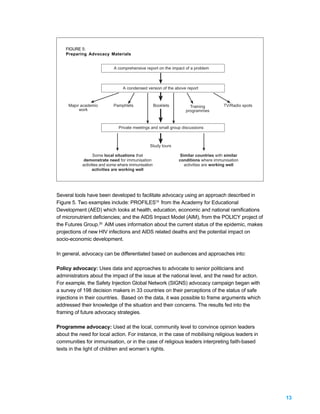
             directly relates to the situation should be used (refer Figure 5). Also, the document is useful
             to produce informational material such as pamphlets, press releases, TV or radio spots or
             even documentaries.


12
FIGURE 5:
    Preparing Advocacy Materials


                            A comprehensive report on the impact of a problem


                                A condensed version of the above report


     Major academic        Pamphlets                Booklets        Training          TV/Radio spots
          work                                                    programmes


                              Private meetings and small group discussions


                                               Study tours

                  Some local situations that                    Similar countries with similar
            demonstrate need for immunisation                  conditions where immunisation
           activities and some where immunisation                 activities are working well
                 activities are working well


Several tools have been developed to facilitate advocacy using an approach described in
Figure 5. Two examples include: PROFILES19 from the Academy for Educational
Development (AED) which looks at health, education, economic and national ramifications
of micronutrient deficiencies; and the AIDS Impact Model (AIM), from the POLICY project of
the Futures Group.20 AIM uses information about the current status of the epidemic, makes
projections of new HIV infections and AIDS related deaths and the potential impact on
socio-economic development.

In general, advocacy can be differentiated based on audiences and approaches into:

Policy advocacy: Uses data and approaches to advocate to senior politicians and
administrators about the impact of the issue at the national level, and the need for action.
For example, the Safety Injection Global Network (SIGNS) advocacy campaign began with
a survey of 198 decision makers in 33 countries on their perceptions of the status of safe
injections in their countries. Based on the data, it was possible to frame arguments which
addressed their knowledge of the situation and their concerns. The results fed into the
framing of future advocacy strategies.

Programme advocacy: Used at the local, community level to convince opinion leaders
about the need for local action. For instance, in the case of mobilising religious leaders in
communities for immunisation, or in the case of religious leaders interpreting faith-based
texts in the light of children and women’s rights.


                                                                                                       13
CASE 1 -     Four Free-One Care: Development of a Policy Framework for Children
                  Orphaned by AIDS in China21,22
                  This section draws upon a presentation made by Ms. Xu Wenquing, Project
                  Officer, HIV/AIDS, UNICEF China.

     In 2001, despite 16 years of the epidemic the Government of China had not yet identified
     HIV and AIDS as a priority issue in the country. The number of children orphaned by AIDS
     was increasing, and projected to be between 130,000 and 260,000 by 2010. UNICEF’s
     challenge was to: (a) initiate high-level advocacy to highlight care and support needs of
     children orphaned or vulnerable due to HIV and AIDS, (b) support the development of a
     national policy, and (c) mobilise action in the form of care and support pilot projects for
     orphaned and vulnerable children (OVC). The following discussion summarizes UNICEF
     China’s experience in using various advocacy strategies that contributed towards a national
     policy for orphaned and vulnerable children.

     Multi-channel Advocacy
     Media advocacy: In March 2003, in order to increase awareness of HIV and AIDS among
     policy makers, UNICEF supported the Chinese Preventive Medicine Association (CPMA) to
     conduct workshops for the All-Chinese Journalists Association (ACJA). The workshop
     advocated for greater understanding and instilling a sense of urgency among the journalists
     to respond to the AIDS epidemic, including reporting in a dignified and rights-based way
     about people living with HIV and AIDS (PLHA) and orphaned and vulnerable children. At the
     workshop, the situation of children who had lost one or both care givers due to AIDS related
     illnesses was for the first time formally discussed in the country. Following this, journalists
     from ten major news organisations developed and shared an internal report on the problems
     confronting PLHA and OVC with the state council, ministers and vice-ministers.

     Involving PLHA: Zhu Jinzhong, an openly living HIV-positive person was invited to
     participate in the “Hope and Help” project. This project includes a UNICEF video package
     for the East Asia and the Pacific region about the reality of living with HIV and AIDS, in the
     words of people who are infected and affected. Mr. Zhu was interviewed on China Central
     Television (CCTV), the main TV channel in the country. He and his wife had fostered six
     children who had lost both parents and other extended family members to AIDS related
     illnesses. Mr. Zhu made a strong plea to mobilise immediate support for basic survival and
     education of the growing number of children in his country that were orphaned due to AIDS.

     Goodwill Ambassadors and Celebrities: During the Asian Football Cup 2004, an event
     was organised with the Asian Football Confederation (AFC). Sir Roger Moore (UNICEF
     Goodwill Ambassador) and Pu Cunxin and Jiang Wenli (National AIDS Ambassadors) were
     invited to raise awareness on and funds for children infected or affected. More than 370
     entrepreneurs and celebrities spent nearly USD 50,000 in table sales and raised another
     USD 50,000 in the auction. UNICEF also launched an innovative pledge campaign, whereby
     the number of goals scored in the tournament was linked to the amount donated by
     participants (including organisations and individuals). UNICEF used the opportunity
     generated by the public interest to raise the profile of projects aimed at children’s issues.


14
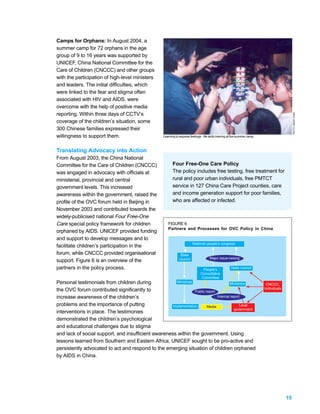
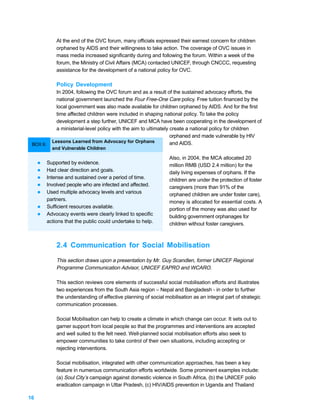
Camps for Orphans: In August 2004, a
summer camp for 72 orphans in the age
group of 9 to 16 years was supported by
UNICEF, China National Committee for the
Care of Children (CNCCC) and other groups
with the participation of high-level ministers
and leaders. The initial difficulties, which
were linked to the fear and stigma often
associated with HIV and AIDS, were
overcome with the help of positive media
reporting. Within three days of CCTV’s


                                                                                                                                                   PHOTO: UNICEF CHINA
coverage of the children’s situation, some
300 Chinese families expressed their
willingness to support them.                          Learning to express feelings - life skills training at the summer camp.


Translating Advocacy into Action
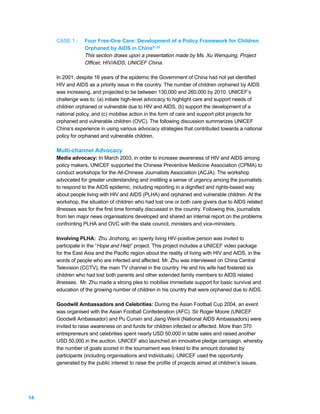
From August 2003, the China National
Committee for the Care of Children (CNCCC)                   Four Free-One Care Policy
was engaged in advocacy with officials at                    The policy includes free testing, free treatment for
ministerial, provincial and central                          rural and poor urban individuals, free PMTCT
government levels. This increased                            service in 127 China Care Project counties, care
awareness within the government, raised the                  and income generation support for poor families,
profile of the OVC forum held in Beijing in                  who are affected or infected.
November 2003 and contributed towards the
widely-publicised national Four Free-One
Care special policy framework for children               FIGURE 6:
                                                         Partners and Processes for OVC Policy in China
orphaned by AIDS. UNICEF provided funding
and support to develop messages and to
                                                                            National people’s congress
facilitate children’s participation in the
forum, while CNCCC provided organisational                         State
                                                                  council                 Major issue-raising
support. Figure 6 is an overview of the
partners in the policy process.                                                     People’s              State council
                                                                                   Consultative
                                                                                   Committee
Personal testimonials from children during             Ministries                        Ministries                              CNCCC,
the OVC forum contributed significantly to                                                                                      Individuals
                                                                  Public report
increase awareness of the children’s                                            Internal report

problems and the importance of putting               Implementation       Media                Local
                                                                                           government
interventions in place. The testimonies
demonstrated the children’s psychological
and educational challenges due to stigma
and lack of social support, and insufficient awareness within the government. Using
lessons learned from Southern and Eastern Africa, UNICEF sought to be pro-active and
persistently advocated to act and respond to the emerging situation of children orphaned
by AIDS in China.


                                                                                                                                              15
At the end of the OVC forum, many officials expressed their earnest concern for children
              orphaned by AIDS and their willingness to take action. The coverage of OVC issues in
              mass media increased significantly during and following the forum. Within a week of the
              forum, the Ministry of Civil Affairs (MCA) contacted UNICEF, through CNCCC, requesting
              assistance for the development of a national policy for OVC.

              Policy Development
              In 2004, following the OVC forum and as a result of the sustained advocacy efforts, the
              national government launched the Four Free-One Care policy. Free tuition financed by the
              local government was also made available for children orphaned by AIDS. And for the first
              time affected children were included in shaping national policy. To take the policy
              development a step further, UNICEF and MCA have been cooperating in the development of
              a ministerial-level policy with the aim to ultimately create a national policy for children
                                                                    orphaned and made vulnerable by HIV
            Lessons Learned from Advocacy for Orphans               and AIDS.
 BOX 6:
            and Vulnerable Children

                                                                  Also, in 2004, the MCA allocated 20
     l    Supported by evidence.                                  million RMB (USD 2.4 million) for the
     l    Had clear direction and goals.                          daily living expenses of orphans. If the
     l    Intense and sustained over a period of time.            children are under the protection of foster
     l    Involved people who are infected and affected.          caregivers (more than 91% of the
     l    Used multiple advocacy levels and various               orphaned children are under foster care),
          partners.                                               money is allocated for essential costs. A
     l    Sufficient resources available.                         portion of the money was also used for
     l    Advocacy events were clearly linked to specific         building government orphanages for
          actions that the public could undertake to help.        children without foster caregivers.


              2.4 Communication for Social Mobilisation
              This section draws upon a presentation by Mr. Guy Scandlen, former UNICEF Regional
              Programme Communication Advisor, UNICEF EAPRO and WCARO.

              This section reviews core elements of successful social mobilisation efforts and illustrates
              two experiences from the South Asia region – Nepal and Bangladesh - in order to further
              the understanding of effective planning of social mobilisation as an integral part of strategic
              communication processes.

              Social Mobilisation can help to create a climate in which change can occur. It sets out to
              garner support from local people so that the programmes and interventions are accepted
              and well suited to the felt need. Well-planned social mobilisation efforts also seek to
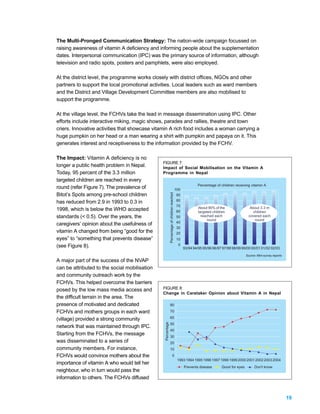
              empower communities to take control of their own situations, including accepting or
              rejecting interventions.

              Social mobilisation, integrated with other communication approaches, has been a key
              feature in numerous communication efforts worldwide. Some prominent examples include:
              (a) Soul City’s campaign against domestic violence in South Africa, (b) the UNICEF polio
              eradication campaign in Uttar Pradesh, (c) HIV/AIDS prevention in Uganda and Thailand

16
BOX 7:    Elements of a Successful Social Mobilisation Initiative


  l   Undertaking research to define the nature of the problem: who is affected and
      where and what is the participants’ understanding and perception of the problem.
  l   Using advocacy strategies to gain support from the highest level of political
      leadership.
  l   Developing communication activities in full consultation with and participation of
      the participant groups as well as opinion leaders.
  l   Working closely with the communities to identify the problem, its impact and
      jointly deciding the proposed activities and ensure timely feedback.


and (d) eliminating the vitamin A deficiency disorder in Nepal. All these exemplary cases
relied on a combination of media and interpersonal communication channels in order to
reach out to and garner support from institutions such as the judiciary or ministries, groups
such as health workers or women’s groups, communities such as local level organisations
and networks such as organised groups of individuals. In addition, these successful efforts
utilised intensive research, political advocacy, large scale communication campaigns and a
conscious effort to involve people in the planning and implementation process.

CASE 2 –    Community Mobilisation to Control Vitamin A Deficiency in Nepal23
            This section draws upon a presentation made by Mr Ram Shrestha, Executive
            Director, Nepal Technical Assistance Group, Kathmandu, Nepal.

In the 1980s Nepal had a high prevalence of vitamin A deficiency. Vitamin A deficiency can
cause blindness and death among children and death from anaemia and haemorrhage
among expectant mothers. Over the last decade, the National Vitamin A Programme in
Nepal has successfully addressed this problem using intensive social mobilisation efforts
supported by health education and outreach work by the female community health
volunteers (FCHVs).

The National Vitamin A Programme (NVAP)
was established in Nepal in 1993, following
the recommendation of national and
international partners to conduct mass
supplementation of vitamin A in 32 focus
districts. The districts were selected based
on several criteria such as high prevalence
of xerophthalmia (drying and degeneration of
                                                                                                     PHOTO: COURTESY OF NTAG.


the cornea leading to blindness), large child
population, and the presence of FCHVs and
NGOs to support the program.24 The NVAP
aimed to provide: (a) vitamin A supplements
                                                Nepali Child taking a vitamin A capsule
to children under five years of age, (b) treat
children with vitamin A treatable conditions such as measles, xerophthalmia and night
blindness and (c) promote consumption of vitamin rich foods through nutrition education.


                                                                                                17
Intensification of Social Mobilisation
              Starting with eight districts in 1993, the programme was expanded to 32-priority districts in
              Nepal by 2002. The FCHVs and the community played a crucial role in the dissemination of
              correct information and acceptance of vitamin A. The vitamin A capsules were distributed
              by the FCHVs once in April during the pre-measles season and approaching the high risk
              season for xerophthalmia, and the second time in October prior to the harvesting season.
              Each round took two days, with fixed-point distribution on the first day followed by home
              visits for missed children on the second day.

              A key feature of the programme is the intensive social mobilisation. The work of the FCHV
              was complemented by the support of diverse community partners such as ward members,
              teachers, students, family members, members of women’s development work, NGOs and
              INGOs, Maternal Child Health Workers (MCHWs), Village Health Workers (VHWs) and
              farmer leaders (farmers who were appointed by the Ministry of Agriculture to serve as peer
              facilitators). For every 100 FCHVs trained, another 171 multi-sectoral staff from various
              sectors such as local development, education and health were trained to supplement the
              ongoing program. This helped ensure that vitamin A messages were disseminated through
              various sections of the community through diverse sectoral partners.

 BOX 8:     The Female Community Health Volunteer Initiative, Nepal


     The female community health volunteer (FCHV) initiative was
     established in Nepal in the late 1980s in response to the
     limited access to health services and Nepal's high infant and
     maternal mortality and fertility rates. With the MOH and
     UNFPA providing the initial impetus, this organised,
     voluntary network of health promoters was created to meet
     the demand for primary health care and family planning at
     the village and ward level. The volunteers were selected from
     the local mother's group and they were required to be at
     least 20 years of age, preferably married, a resident of the
     ward, and willing and capable of serving the community as a
                                                                                                                   PHOTO: COURTESY OF NTAG


     volunteer.

     Nepal's 75 districts are divided into five regions with a total of
     35,217 wards with 3,913 Village Development Committees.
                                                                        Nepal: Female Community Health Volunteer
     Each ward has a FCHV who takes care of 80 households.
     Currently there is a strong network of 44,000 FCHVs in the country.

     The FCHV's dedication and other concerted efforts have led to the programme's success, which
     in turn led to an increase in motivation and higher social status among FCHVs. This contributed
     to sustaining the voluntary initiative. For instance, some of the FCHVs were promoted as
     MCHWs, nominated as female ward members, or they represented the village's health situation
     at village development committee meetings. Further, higher authorities would visit their homes,
     they became "known" in the village, and at times got local media coverage. Thus, through their
     work the FCHVs gained respect and prestige they previously had not enjoyed, giving an
     impetus and commitment to their outreach work.


18
The Multi-Pronged Communication Strategy: The nation-wide campaign focussed on
raising awareness of vitamin A deficiency and informing people about the supplementation
dates. Interpersonal communication (IPC) was the primary source of information, although
television and radio spots, posters and pamphlets, were also employed.

At the district level, the programme works closely with district offices, NGOs and other
partners to support the local promotional activities. Local leaders such as ward members
and the District and Village Development Committee members are also mobilised to
support the programme.

At the village level, the FCHVs take the lead in message dissemination using IPC. Other
efforts include interactive miking, magic shows, parades and rallies, theatre and town
criers. Innovative activities that showcase vitamin A rich food includes a woman carrying a
huge pumpkin on her head or a man wearing a shirt with pumpkin and papaya on it. This
generates interest and receptiveness to the information provided by the FCHV.

The Impact: Vitamin A deficiency is no
                                               FIGURE 7:
longer a public health problem in Nepal.       Impact of Social Mobilisation on the Vitamin A
Today, 95 percent of the 3.3 million           Programme in Nepal
targeted children are reached in every
                                                                                                        Percentage of children receiving vitamin A
round (refer Figure 7). The prevalence of                                                 100
                                                         Percentage of children reached


Bitot’s Spots among pre-school children                                                    90
                                                                                           80
has reduced from 2.9 in 1993 to 0.3 in
                                                                                           70
1998, which is below the WHO accepted                                                                    About 90% of the                 About 3.3 m
                                                                                           60            targeted children                 children
standards (< 0.5). Over the years, the                                                     50              reached each                  covered each
                                                                                                               round                        round
                                                                                           40
caregivers’ opinion about the usefulness of
                                                                                           30
vitamin A changed from being “good for the                                                 20
eyes” to “something that prevents disease”                                                 10
(see Figure 8).                                                                             0
                                                                                                93/94 94/95 95/96 96/97 97/98 98/99 99/00 00/01 01/02 02/03
                                                                                                                                       Source: Mini-survey reports
A major part of the success of the NVAP
can be attributed to the social mobilisation
and community outreach work by the
FCHVs. This helped overcome the barriers
posed by the low mass media access and         FIGURE 8:
                                               Change in Caretaker Opinion about Vitamin A in Nepal
the difficult terrain in the area. The
presence of motivated and dedicated                           80
FCHVs and mothers groups in each ward                         70

(village) provided a strong community                         60
                                                              50
                                                Percentage


network that was maintained through IPC.
                                                              40
Starting from the FCHVs, the message                          30
was disseminated to a series of                               20
community members. For instance,                              10
FCHVs would convince mothers about the                                    0
                                                                                           1993 1994 1995 1996 1997 1998 1999 2000 2001 2002 2003 2004
importance of vitamin A who would tell her
                                                                                                Prevents disease       Good for eyes         Don't know
neighbour, who in turn would pass the
information to others. The FCHVs diffused


                                                                                                                                                                     19
the vitamin A message through diverse local platforms such as teashops, during religious
     festivals and community gatherings, and by engaging other change agents and opinion
     leaders at different levels.

     The case of Vitamin A promotion in Nepal highlights how a multi-sectoral approach,
     grounded in social mobilisation and using IPC and peer health facilitators from the
     community (i.e. FCHVs), can contribute to mass dissemination of health messages and
     widespread adoption of a preventive behaviour (giving children vitamin A supplements).

      BOX 9:    Lessons Learned from the National Vitamin A Programme, Nepal


        l   Involvement of the community in health promotion activities, particularly the
            community peer facilitator role played by the FCHVs.
        l   Prioritisation of IPC and community mobilisation over mass media because of the
            situational context - low reach of mass media and low levels of literacy.
        l   Recognition, respect and reward system for FCHVs.
        l   The convergent and complimentary efforts of the service providers at district,
            village and community levels.
        l   The use of existing community networks, such as mothers groups, schools and
            other local groups to facilitate the diffusion of the messages.
        l   The engagement of diverse change agents and opinion leaders led to a wider
            diffusion of the messages.


     CASE 3 –    Social Mobilisation for the Expanded Programme on Immunisation,
                 Bangladesh25
                 This section draws upon a presentation made by Mr. Milan Kanti Barua,
                 Programme Coordinator, Health, BRAC Bangladesh.

     BRAC, formerly known as the Bangladesh Rural Advancement Committee, began its work in
     the field of health in 1972. Today, BRAC is one of the largest NGOs in the world that has
     trained a large network of village health volunteers and provided health services to more than
     31 million people. The primary objective of BRAC’s work is to reduce maternal and child
     mortality and morbidity and control infectious diseases like tuberculosis, acute respiratory
     infections, diarrhoea and malaria. In order to achieve these objectives, BRAC employs a two-
     pronged strategy: (a) Outreach and education on health and nutritional issues, and (b)
     provision of basic health services.

     BRAC works in close collaboration with the Government of Bangladesh in numerous
     national health programmes and implements its work through:
     l Shastho Shebikas - Frontline multipurpose community health volunteers who go door-
         to-door to educate the community on health issues and provide basic health services.
     l Shastho Karmis - Comprise a secondary level of health workers who function as
         paramedics.
     l Shushasthos - Network of clinical facilities.


20
The Expanded Programme on Immunisation                     The Role of the Shebika – The Community
                                                 BOX 10:
(EPI) and tuberculosis are the two major                   Health Volunteer
components of BRAC’s health work. The
shebikas and shastho karmis have played a          The shebikas or the community health volunteers
critical role in increasing immunisation           play an important part in implementing BRAC’s
coverage. EPI in Bangladesh was initiated in       Health Programme. Each shebika is responsible for
1979, after intensifying its efforts, the          300 households. They undergo three weeks of
programme achieved 62 percent coverage of          basic training before working with the community.
Fully Immunised Children (FIC) by 1990.            Through door-to-door visits and with their active
Over the last few years, the coverage of FIC       involvement in communities, they provide a critical
has remained constant at around 53 per             interpersonal link between health providers and
cent. The major barriers for full immunisation     community members. The shebikas thus occupy
are dropouts, left-outs and invalid doses,         high status within the community. Government field
which still have to be overcome.                   health workers and family planning staff seek their
                                                   support and advice. Their popularity is marked by
A Responsive Communication                         the fact that some volunteers have been elected as
Strategy                                           local government members. BRAC at present has
In the initial phase (1985-1990) of EPI,           an active network of 118,556 volunteers, including
BRAC’s communication strategy included             53,089 shebikas, 53,479 poultry workers and
an integrated approach of using BCC,               11,988 community nutrition workers.
advocacy and social mobilisation. In order to
further the efficacy of outreach programmes,
BRAC focussed on capacity building of service providers. Another key area of focus was
gaining the support of community leaders such as village doctors and imams, while
garnering the partnership of community based organisations (CBOs) and other development
organisations in the area. The culmination of these efforts contributed to a relatively high
national immunisation coverage of 62 percent.

During the next phase (1991-1995), the communication approach was adapted to focus on
low-performing areas. To reach the under-served areas, innovative communication strategies
were implemented and the social mobilisation efforts in low-performing areas and hard-to-
reach areas such as tea estates, haor, char, island and hilly areas were further intensified.
For instance, BRAC established partnerships with the managers of tea estates and
community members from the hilly regions were recruited as volunteers. BRAC continued
to build on the existing development networks and drew upon community leaders to bring
about higher acceptance of vaccines.

The use of shebikas was scaled up in 1991. After 1996, community participation and social
mobilisation efforts were further intensified. To date, BRAC has mobilised 4 million village
organisation members and 100,000 volunteers, including the 53,089 shebikas and 2,400
shastho karmis as part of the EPI.

While not only achieved by BRAC alone, however, in 2003, the DPT3 national coverage -
a proxy indicator for routine immunisation coverage - in Bangladesh was estimated to be
72 per cent. 26


                                                                                                     21
BOX 11: Lessons Learned from BRACs Social Mobilisation Initiative


         l   The shebikas played a critical role as the frontline community health volunteer,
             along with sustained community mobilisation and participation.
         l   The involvement of community leaders, CBOs and local government institutions
             has strengthened community mobilisation.
         l   Inter-sectoral collaboration with workers from programmes such as micro-credit
             and education has helped BRAC ensure volunteer sustainability for over 20
             years. The volunteers are called to assist at EPI sessions, satellite clinics and
             national events.
         l   Rewarding volunteers for their efforts by providing access to a revolving fund for
             treatment and public recognition of volunteers served as a significant incentive.
         l   The multi-layered communication strategy underscored by a strong community
             mobilisation initiative focussing on the hard-to-reach and low-performing areas
             has been successful in reaching the under-served population.


     2.5 Communication for Behaviour Development

     A sound behaviour development communication strategy (or programme communication)
     should be linked with the overall programme framework. It is aimed at changing knowledge,
     attitudes and practices of participant groups and stimulating and facilitating wider social
     change at the local and national level. BCC involves the use of qualitative and quantitative
     research data, disseminating information and measuring change in peoples’ attitudes and
     behaviours. Information need not be limited to factual knowledge. It covers behaviour
     modelling, self-efficacy and empowerment of the people. Past programmes have
     demonstrated that behaviour development strategies are more successful when they are
     tied to social mobilisation and advocacy strategies. Furthermore, such strategies are
     incomplete unless its impact is assessed vis-à-vis the programme objectives.

     This section illustrates two markedly distinct yet contemporary communication strategies
     that capture the essence of the new development paradigm – an integration of inter-sectoral
     partnership with strong community involvement. First is the entertainment education (EE)
     strategy; a multi-layered, innovative and creative approach to social and behavioural
     change. Second is the role of communication in facilitating participatory development, a
     process grounded on the principles of peoples’ right to participate in programmes.

     2.5.1 Entertainment-Education: The “Viagra” of Communication for
     Behaviour and Social Change27
     This section draws upon the presentation made by Dr. Arvind Singhal, Professor and
     Presidential Research Scholar, School of Communication Studies, Ohio University,
     Athens, USA.

     Simplemente Maria– A Television Soap Opera Takes Peru by Storm: BBC’s The
     Archers in Britain was one of the first planned entertainment-education (EE) initiatives
     (beginning in 1951) to diffuse information on new agricultural techniques to farmers.
     However, the widespread interest in the use of EE internationally was trigged by an
     entertainment program in Peru — a commercial soap opera that spun off unanticipated

22
pro-social behaviours among its audience members. Simplemente Maria produced by
PANTEL went on air in 1969 in Peru. A telenovela built around the life of Maria,
Simplemente Maria was the story of Maria, a young rural to urban migrant from the
highlands of Peru, who travels to Lima in search of a better life. Soon Maria, who is
struggling to make ends meet, enrols in adult literacy classes to climb the ladder of social
success. A subtle romance begins to brew between Maria and her instructor, Esteban.

Audience members became highly involved in the story line, and a very unusual
phenomenon was observed in Lima: the number of women, especially migrant maids,
enrolling in adult literacy classes increased. In another twist, Maria takes on sewing, using
a Singer machine as a part-time profession to help raise her child, born from an unplanned
pregnancy. Once again, in Lima, a high number of women, especially migrant maids like
Maria, began to show an interest in learning how to sew. These changes occurred because
the audience began developing para-social relationships with Maria. Para-social interaction
is the process through which media consumers develop seemingly face-to-face
interpersonal relationships with media characters, believing that they know media
characters as their personal friends.

Government agencies cashed in on the popularity of Simplemente Maria, opening more
adult literacy schools and hundreds of sewing centres. The sales of Singer sewing machine
rose sharply during the period when Simplemente Maria was being aired. Also, during this
period, the attitudes of people toward domestic helpers changed in a positive direction.

The pro-social effects — such as increase in adult literacy classes or desire to learn a
vocational skill that happened among the audiences in Peru — were not intended by the
program producers. But these changes occurred because of the popularity and entertaining
value of Simplemente Maria. A key lesson learned was that entertainment can engender
educational and social benefits and such programmes can also be commercially viable.

What is Entertainment-Education?
Entertainment-education (EE) is a research-based communication process or strategy of
deliberately designing and implementing
a programme to entertain even while it
educates in order to increase audience
members’ knowledge about a social
issue, create favourable attitudes, shift
social norms, and change overt
                                                                                                                           PHOTO: COURTESY OF PHOTOSHARE, CCP 1989.


behaviour.28

EE contributes to the process of directed
social change as it can influence
audience members’ awareness,
attitudes, and behaviour with regard to
                                              Popular Nigerian singers King Sunny Ade and Onyeka Onwenu recording a song
specific practices. EE has the potential      about family planning.
to add the “zip” to socially-oriented
communication. Further, because entertainment is fun, exciting, engaging and sticky - it
has a high recall and it keeps audience members engaged even after the communication
activity is over by spurring conversations. Some well-known EE programmes resulting in

                                                                                                                           23
behaviour change include: The Archers radio series in Britain which sought to change the
           farming habits of its viewers and Hum Log television series in India aimed to promote gender
           equality, small family size, and national integration. EE can also influence the audience
           members’ external environment and thus act as a social mobiliser and agenda-setter,
           influencing public and policy initiatives –– as in the case of role modelling against domestic
           violence in Soul City in South Africa.


BOX 12: How Entertainment Can Influence Behaviours
                                                            Institutionalisation and
                                                            Consolidation of Entertainment-
 Popularity     – entertainment enjoys a                    Education
                  universal appeal                           Learning from the lessons from The Archers
 Persuasiveness – entertainment tells us what to             and Simplemente Maria, Miguel Sabido, a
                  think and feel                             Mexican producer-writer, developed a theory-
 Powerfulness   – entertainment has ability to               based method of producing entertainment-
                  make messages sticky                       education soap operas. Between 1975 and
 Profitability  – entertainment delivers audience            1982, he produced seven telenovelas which
                  ratings which translate into ad            generated higher television ratings than
                  revenue                                    regular commercial programmes in Mexico.
 Pervasiveness – entertainment is all around us;             Sabido’s success in Mexico, and his theory-
                  at home and in public places               based framework for implementing
                                                             entertainment-education initiatives inspired
           several EE projects worldwide.29 Today, EE initiatives are pervasive, found in almost all
           countries and dealing with a variety of social issues. The following initiatives worldwide are
           just a few examples that use various media channels to successfully use EE as a strategy
           for behavioural and social change.

           l   Johns Hopkins University/Center for Communication Programs (JHU/CCP) uses different
               forms of entertainment-education programming for reproductive health and other health
               issues. For instance, popular rock music is used to reach young people in many parts
               of the world.
           l   UNICEF’s EE series on the girl child Meena and Sara, demonstrate
               the power of animation. Animation as a genre is culturally sharable
               and replicable and is powerful in reaching diverse audiences in
               multiple countries especially children and young people.
           l   Soul City and Soul Buddyz are good examples of long-running,
               multi-media EE programmes that use not only the mass media but
               work in close coordination with services such as hotlines and shelters for the vulnerable.
           l   Hollywood is also a major player in entertainment-education working with primetime
               programme producers to include pro-social messages in popular soaps such as Bold
               and Beautiful. Hollywood has a wide reach in almost all countries and if popular
               programs can incorporate education themes, they can reach large worldwide audiences.

           Pushing the Boundaries of Entertainment-Education:
           Taru Project, Bihar, India
           Taru, a radio soap opera, named after the protagonist, revolves around the life of a girl in a
           village in Bihar, India. It was aired twice a week in Bihar, Jharkhand, Madhya Pradesh,
           Chattisgarh states of India from February 2002 to February 2003. The objectives of the
           programme were to promote gender equality and reproductive health. The Taru Project was

24
a result of a multitude of partnerships between, Population Communications International,
New York, Ohio University, Athens, USA, All India Radio, Center for Media Studies, New
Delhi, India, and Janani in Bihar. The on-ground partnership with Janani (meaning “caring
mother” in Hindi), an NGO working in the area of reproductive health was a unique feature of
Taru. Janani trains village-based rural health providers (the Rural Medical Practitioners), and
their wives in a three-day crash course on reproductive health. Following this, the NGO
designates these couples as village-level service providers in the 30,000 villages where it
works.

In the week before Taru went on air in
February, 2002, intensive pre-programme
publicity was created using folk
performances in multiple villages in Bihar and
through posters and wall paintings in the rest
of the villages. About 1,000 people attended
each of the folk performances. During the


                                                                                                       PHOTO: COURTESY OF ARVIND SINGHAL.
shows, a quiz was held, with winners being
awarded radio sets and being asked to form
listeners’ clubs. This ground-based
orchestration and the presence of Janani’s
rural providers resulted in Taru enjoying 10
per cent listenership, which translates to     Taru radio listeners club in Bihar, India.

about 20-25 million listeners in the Indian
states of Bihar, Jharkhand, Madhya Pradesh, and Chattisgarh.

 BOX 13: Lessons Learned from EE for Behaviour Change

    l    EE is a universal communication strategy found in almost all cultures as it can
         be adapted or created based on local customs, practices and needs of the
         public.
    l    EE need not be limited to mass media such as TV, radio and music but could be
         successfully advanced through local folk media, arts, photography and so on.
    l    Formative research is needed while conceptualising a good EE strategy.
    l    Summative research in the form of rapid exposure surveys and monitoring of
         changes in attitudes and behaviours is important to assess the effects of EE.
    l    Pre-programme publicity and priming helps overcome the lag in building
         listenership.
    l    Listeners’ groups result in audiences coming together and spurring dialogue and
         discussion about the messages they hear on radio.
    l    EE intervention needs to have a ground-based service delivery partner when the
         practice being promoted needs essential services such as health services.
    l    EE strategy can successfully integrate inter-sectoral partnerships to widen its
         reach, provide services and to monitor and evaluate its impact.


2.5.2 Interpersonal and Participatory Development Communication30
This section draws on the presentation made by Dr. Maria Celeste Cadiz, Dean and
Associate Professor, College of Development Communication, University of the Philippines,
Los Banõs, Philippines.

                                                                                                  25
Interpersonal communication (IPC) refers to face-to-face communication. IPC can either be
           one-on-one or in a small group (e.g. a health worker who dialogues face-to-face with a group
           of village women). Diffusion theory informs us that many people tend to rely on mass media
           to learn about new ideas but they use interpersonal networks to move from knowledge to
           trial and continued practice of a new behaviour. The objectives of IPC are to share
           information, respond to questions and doubts, convince or motivate the listener to adopt
           certain behavioural practices (such as condom use) or use certain health services (such as
           immunisation). IPC involves listening skills, the ability to empathise and be supportive.

                                                               The rights-based framework is governed
 BOX 14: The Communicator as a Facilitator
                                                               by inter-sectoral partnerships between
 l   Participatory development sees the communicator as        various institutions and necessitates
     a facilitator, an enabler of change.                      peoples’ participation at various levels.
 l   Effective behaviour and social change processes           Thus, the participatory development
     depend significantly on attitudes and IPC skills of the   communication (PDC) approach moves
     facilitators.                                             away from a focus on promoting
                                                               changes at the individual level alone.
                    Role of the Facilitator                    PDC promotes social change involving
 l   Facilitates critical thinking and action through a        community-driven initiatives and
     process of search and reflection on causes of and         empowerment. It facilitates information
     solutions for an issue.                                   exchange between various
 l   Ensures team building and collective work.                stakeholders to address a common
 l   Asks questions to encourage a process reflection          problem, implement a joint development
     rather than presenting ready-made solutions.              initiative and identify the required
 l   Provides access to theory or scientific knowledge,        partnerships, knowledge and material
     thus creating a conducive climate for learning in which   conditions at the community level. The
     the group discovers as much as possible for               following overview contrasts the different
     themselves.                                               roles of IPC and PDC in fostering
 l   Plans action with the help of the community.              development.
 l   Disseminates results of participants’ critical thinking
     and social action to a wider audience.                    The traditional view of IPC assumes
                                                               that people act in rational and
 Qualities of a Good Facilitator                               objective manners at all times. On the
 l Social, interpersonal communication skills including        other hand, PDC relies on
    trustworthiness, empathy and understanding of              communication as a holistic process
    community values.                                          that involves various stakeholders and
 l Group processing skills such as encouraging                 accounts for culturally sensitive
    everyone to speak openly, being flexible and assisting     norms. It garners community support
    in problem-solving, organising and planning skills.        to facilitate changes at the individual
 l Knowledge of scientific principles and techniques of        and community level. Communication
    community organising.                                      in PDC is thus used for facilitation and
 l Teaching skills incorporating adult education               it is an enabler of change that uses
    principles and stimulating and facilitating critical       dialogue between participants and
    thinking.                                                  change agents. The traditional view of
 l Technical know-how and a clear vision of development        IPC, on the other hand, treats the
    as a people-centered process.                              community members as audiences
                                                               that are targeted by an intervention.


26
Facilitating Participation through Communication
Community organising is at the crux of participatory development communication. It aims to
empower the community towards collective decision-making and action. A community
gains empowerment through enhanced knowledge and skills to identify and prioritise its
needs and problems, harness its resources to deal with the problems, and take action
collectively,31 rather than being passive recipients of change.

Participatory development communication (PDC)32 is the use of strategic
communication for an effective community organising process. PDC is


                                                                                                                           PHOTO: COURTESY OF ARQUIVOS PAULO FREIRE -
grounded in dialogue between the agents of change (service provider, health
worker, outreach worker) and the community members. Drawing from Paulo


                                                                                                                           INSTITUTO PAULO FREIRE, BRAZIL.
Freire’s work of liberation and consciousness raising, PDC involves
communicating “with” the people and not “to” the people. Communication is a
problem-posing dialogue between equals engaging in praxis (cycle of action
and reflection), not merely information dissemination.
                                                                                  Paulo Freire, Brazilian educator.

As a community-based approach, PDC uses communication to essentially build
relationships with the community and thereby facilitates collective action. PDC thus relies
on effective facilitation by a development worker with good communication skills. It uses
appropriate communication tools and media to extend the dialogue to more participants
than interpersonal communication alone is able to reach and to enhance how people
understand and receive messages exchanged.

Participatory Communication                   BOX 15: Stages in Community Organising
Methods for Community                         Community organizing proceeds in three
Organising                                    stages:
Examples of participatory communication
methods and media include the following:      1. Awakening of the community is achieved through
l Community-managed Media: Use of
                                                 selection of the project area by building relationships
                                                 with the community and its leaders. It understands
   community audio tower (CATS) for a
                                                 the community and its issues through social
   public address system, low-powered
                                                 investigation and integration, formation of a core
   radio broadcasts, cable television,
                                                 group or community organisation and by training
   puppetry, audio visual media used in          and mobilisation of its members. A community
   group meetings, community theatre,            organiser plays a key role by laying the groundwork
   and information technology kiosks.            with key actors in the community to enable them to
l Interactive Theatre: Use of three              take action.
   forms of Augusto Boal’s theatre of the     2. Empowerment occurs when the community actively
   oppressed including image theatre,            participates in programme planning, implementation,
   invisible theatre, and forum theatre.         and evaluation to address issues affecting them.
   These forms involve varying degrees           Involving the community in the Triple-A cycle
   of people’s participation, blurring of        (Assessment, Analysis and Action) is an example of
   lines between actors and audiences,           the community empowerment process.
                                              3. Restructuring relationships of power and hierarchy
   and consciousness-raising of the
                                                 within the community allows for greater equity and
   community. This method calls for skill
                                                 participation among members. It implies that the
   and training in facilitation for
                                                 process has to be self-sustaining and organic to the
   effectiveness.                                community; hence plans and processes to phase
l Peer Educators and Leaders:                    out are integral to this approach.
   Working with already established

                                                                                                                      27
peer educators who represent the community, and supporting and cooperating with
         professional and traditional leaders to gain support from the community.
     l   Inter-sectoral Cooperation: Linking local organisations, including the private sector and
         social marketing organisations; networking with existing programmes to reinforce and
         integrate messages in capturing participants’ interest in the community organising
         process.

     In conclusion, participatory development communication and communicator as a facilitator
     is the outcome of the paradigm shift in the field of communication for development or
     development communication. This shift is in response to the rather limited impact that large
     scale communication campaigns, many of which have been top-down and co-ordinated by
     experts that are removed from the community, have had on changing the health status of
     children and women. Notwithstanding the challenges to ensuring peoples’ participation, a
     community-based programme can yield national level changes as illustrated by the case
     below on child-friendly villages in the Philippines.

      BOX 16: Challenges to Participatory Development Communication

         l   Maintaining participation as a practice right through the process.
         l   The community may not necessarily be receptive to the objectives and mandate
             of a specific project or programme for example, HIV prevention or immunisation.
             However, this is both a challenge and the raison d’etre for participatory
             processes.
         l   Caste, class and other social variables within a heterogeneous community may
             pose difficulties in ensuring equity of participation from all segments of the
             community.
         l   It is critical that the community perceives the benefits and is intrinsically
             committed to the goal of the programme even when there are no incentives.
         l   The overall process requires raising people’s consciousness through IPC and
             relationship building, which is time-consuming and demands intensive resources.


     CASE 4 –     How Child-Friendly is Your Barangay (Village): UNICEF Philippines’
                  Community-based Child Monitoring System33

     The inter-agency midterm review of UNICEF Philippines’ Third Country Programme for
     Children (CPC III) in 1990 pointed out glaring weaknesses in the then existing data system
     on children owing to the dearth of relevant statistics at the village level. It also highlighted
     the need to develop and monitor indicators reflective of the situation at the village, rather
     than at the provincial or city level, as a basis for local planning for village-level participation.

     The Community-based Child Monitoring System (CBCMS), which evolved as a result, was an
     initiative of the country’s National Statistical Coordination Board. The Board conceptualised
     and designed the CBCMS scheme on the basis of national, provincial, and municipal
     consultations from the very start with partner agencies, NGOs, and academic institutions.

     Community Organising at the Village Level (PDC Steps 1-3, refer Figure 9)
     To facilitate villagers’ participation, community organisers (COs) from the local NGOs
     adopted the following processes: community entry, community integration, organisation-

28
building and consolidation, launching village mobilisation, and phase-out. This process
enabled the people to think and work together in improving their social, cultural, economic,
and environmental condition.

Municipal Planning and Development                    FIGURE 9:
                                                      Integrating PDC with Research and Development
Coordinators facilitated entry into the               Process 34
villages by introducing the CBCMS field
                                                                                           - - - D I A G N O S I S - - -
staff to the village chiefs. The staff
                                                                                     1
introduced the CBCMS concept to village                                       Developing a
                                                                                                              2
                                                                                                       Working with the                   3
                                                                                 rel'ship/              com'ty to id               Identifying the            4
                                                                              understanding                                         stakeholders        Indentify the
chiefs, briefing them about the scheme,                                        local setting
                                                                                                          problem
                                                                                                                                                       comm. needs,
                                                                                                                                                        objectives &
encouraging them to ask questions on its                                                                                                                  activities


                                                ---ASSESSMENT---


                                                                                                                                                                          ---PLANNING---
rationale, benefits, and specific roles and                               10                                                                                  5
                                                                     Sharing &                                    Facilitating participation              Indentify
responsibilities. Once convinced, the                              facilitating the                               through communication               appropriate comm.
                                                                    utilization of                                                                          tools
                                                                       results.
village chiefs organised village
                                                                                                                                                              6
assemblies, introducing the concept,                                                                                                                  Preparing & pre-
                                                                                    9                          8                           7           testing comm.
                                                                                                                                                         content &
explaining the importance of the                                               Monitoring,
                                                                             documentation &
                                                                                                         Producing an
                                                                                                        implementation
                                                                                                                                      Facilitating
                                                                                                                                    the building of       materials
                                                                                evaluation                   plan                    partnership
community’s role to identify needs,
                                                                               - - - I N T E RV E N T I O N / E X P E R I M E N TAT I O N - - -
gather relevant data, and use the data for
local planning and programme
implementation.

Working with the Community (PDC Steps 4-6)
The following activities were jointly conducted with the community by the CBCMS staff to
identify locally based communication channels and further garner community support. The
choice of the channel was dependent on what was appropriate for the community:
l Person-to-person and community media channels including village assemblies,
    meetings of people’s organisations such as mothers’ clubs, farmers’ associations, and
    other traditional organisations.
l Support and endorsement by religious and political leaders.
l Radio broadcasts, folk media such as the oral genealogical account of a family in an
    indigenous group.
l Posters designed and prepared by the villagers.


Intervention and Experimentation (PDC Steps 7-9)
The nature of the organisations varied at the community level. Where they existed,
traditional informal structures became the planning and implementing arm for CBCMS. In
one province, volunteer COs helped coordinate village level activities and worked towards
integration of the monitoring system into the official functions of local governments. In the
process, people’s organisations were strengthened through their own selection of officers,
conducting regular meetings, adopting their own constitution and by-laws, obtaining
representation in the village development council, and networking with other organisations
and agencies.

Setting up the monitoring system was relatively faster in communities with existing
people’s organisations compared to those communities where none existed. In these latter
communities, intensive preliminary work lasting up to six months was devoted to helping
people understand the importance of their being able to monitor the situation of their
children and prepare them for their roles and responsibilities.

                                                                                                                                                                                           29
Volunteer monitors went through a skills training programme to learn participatory research
             techniques. Training covered information-gathering, data analysis, and sharing of
             information. The best incentive to boost the volunteers’ morale was the recognition by local
             officials and the people of the volunteers’ contribution to the betterment of the community.
             High drop-out rate among monitors in one village was attributed to local officials not paying
             attention to the results of quarterly monitoring, with some even dissuading volunteers from
             continuing activities due to the lack of financial gain. The quarterly reports on the situation
             on women and children put pressure on the local councils. Action plans were designed to
             address the problems identified during monitoring, such as the identification of sites for
             water tanks in one village.

             The CBCMS also implemented a quick response mechanism, allowing villagers to act on
             pressing problems, such as bringing malnourished children to the nearest health centre. In
             one locality, volunteers produced handicrafts to generate income to sustain the CBCMS. In
             another village, officials organised a contest for a neighbourhood clean-up drive where the
             CBCMS identified environmental sanitation to be a problem.

             Sustaining CBCMS (PDC Step 10)
             In the 14 years since its inception, the CBCMS has evolved. Inter-agency group networking
             composed of the Department of Social Welfare and Development (DSWD), Department of
             Health (DOH), and other government agencies and local units took place. The Minimum
             Basic Needs (MBN) approach as a component to then President Fidel V. Ramos’ Social
             Reform Agenda (SRA) was adopted and various training courses were undertaken
             nationwide to implement it. Institutionalising and expanding the CBCMS’ coverage included:
             l Organising a trainers’ training course to develop a pool of resource persons for the
                  expansion areas.
             l Including the CBCMS within the regular operation of local government units.
             l Designating a leader of the volunteer monitors to serve as a representative in the village
                  development council.


 BOX 17: Enabling Factors for the Sustainability of CBCMS     Under UNICEF and the Government of
                                                              the Philippines’ fifth country programme
     l   Strong support by the local government units.        for children, the old indicators were
     l   Sustained campaigns.                                 translated into “How Child-Friendly is
     l   Presence of well-organised community                 Your Barangay (village)?” indicators.
         organisations.                                       These indicators were used as a basis
     l   High spirit of volunteerism among community          for the annual search for the nation’s
         members.                                             “Most Child-Friendly Municipality” awards
     l   Adequate training of volunteer monitors.             that started in 1999. Today, there are still
     l   Firm determination of community members to           many communities doing community
         improve their situation.                             mapping and demonstrating how the
     l   High responsiveness by the government to the         indicators are being monitored. The level
         community identified needs.                          of development of the CBCMS varies
                                                              according to the economic, political, and
                                                              socio-economic situation in the areas.
             The Minimum Basic Needs approach incorporates the experience of the CBCMS and the
             Comprehensive Integrated Delivery of Social Services (CIDSS) of the Philippines’
             Department of Social Work and Development’s Social Reform Agenda Programme.

30
2.6 Private Sector Approaches to Behaviour and Social
    Change
Myriads of communication strategies have been used for almost a century to influence how
people think, feel and behave. The private sector, which spearheads this process, relies
heavily on evidence-based integrated marketing communication, which includes strategies
such as advertising, direct marketing, personal selling, promotional events and public
relation campaigns to name but a few. This approach to harnessing communication for
selling products and services provides many lessons for promoting behaviour and social
change in the social sector. Many of these principles are represented in the social
marketing literature, whose expert Dr. Philip Kotler and his colleague Dr. Gerald Zaltman
set out to apply commercial ideas to promote social goals, prompted by a question posed
by a fellow researcher, “Why can’t we sell brotherhood as we sell soap?” Social marketing
is as such understood as “the design, implementation, and control of programs calculated
to influence the acceptability of social ideas and involving considerations of product
planning, pricing, communication, distribution and marketing research.”35

While social marketing has been successful to varying degrees in promoting social
products and services, ranging from the use of soaps for hand washing, mosquito nets to
prevent malaria and ORS to treat diarrhoea, contemporary marketing does much more than
selling products. Successful marketers today use communication strategically to set new
trends.

The succeeding cases describe how two large global corporations, Pepsi India and Music
Television (MTV) in India, use innovative communication strategies to set trends and shape
lifestyles among its core audience members. The cases inform the critical role of ongoing
research to feel the pulse of its primary audience, the young people, and how
communication strategies can respond to the audiences’ needs, aspirations and dreams.
While both companies are global in their reach, these case studies highlight the importance
of culturally appropriate and locally resonant communication. Both companies have learned
that communication achieves results when strategies respond to the needs of its audience
and by consistently giving out the same message through different channels to all
intermediaries that influence change. The case studies reinforce the importance of
continuous innovation and use of creative communication to reach the audience, capture its
attention, and retain and expand its reach. In sum, in order to influence people in a
competitive and ever changing environment, communication has to be an ongoing process.

2.6.1 Connecting with Youth: The Pepsi Way36
This section draws on the presentation made by Mr Lloyd Mathias, Executive Vice
President, Marketing, Pepsi Co. India.

The Pepsi Co. India experience over the last 14 years provides many insights into how the
soft drink company has managed to position itself in the market through extensive research
on attitudes and behaviour of its primary users, the young people. The Pepsi story is about
the process of feeding research back into the advertising and marketing strategies not just
to increase sales, but to shape how young people feel and behave and create brand loyalty
towards different consumer products. Pepsi’s communication efforts are geared towards
making consumers drink Pepsi on a regular basis, day after day after day, forming a habit.

                                                                                              31
In India, a country with over 40 per cent of its population below the age of 19, and nearly 20
     per cent of the urban population in the 19-29 year age group, the soft drink industry has a
     consumer market of almost 50 million in these segments alone. With an eye on this huge
     and growing market, Pepsi aimed to position itself as a brand for the young, with the “bull’s
     eye” being the 17 to19 year-olds. The reason the company has zeroed in on such a narrow
     age group, apart from their numbers as potential buyers, is that extensive research has
     informed the soft drink companies how young people think and behave. They know that
     children as young as 10 have already some buying power, yet, Pepsi realised through
     research that most young children between the age group of 10 to 14, tend to see the 17
     year olds as their role models, while young people in their late 20s and early 30s tend to
     reflect back on days when they there about 17 or 18 years old. Thus, reaching out to a 17
     year old through communicative means helps the company reach a much wider audience.
     However, this is not an easy task, given that this target group changes its preferences and
     lifestyles rapidly, and that many consumer products compete for their attention.

     How does Pepsi know the ever changing taste and interest of an 18-year old? More
     importantly, every year a new batch of 18-year olds replaces the older one, therefore how
     does Pepsi know what the core group really likes? The answer lies in conducting on-going
     research. Pepsi uses intensive, in-depth and descriptive qualitative research to understand
     the thinking of youngsters and it uses on-going quantitative data to understand broad trends
     among its audience. For instance, Pepsi’s research is heavily steeped into using in-depth
     interviews with key informants that are trend setters and focus group discussions with the
     average consumers. In addition, every two years, Pepsi invests heavily to conduct lifestyle
     surveys to understand what makes young people “tick”. A combination of the data gathered
     through the different formative research feeds into the communication strategy, message
     design and identifying media channels to reach the core audience.

     Pepsi’s advertising campaigns reflect the findings from the research. When Pepsi entered
     the Indian market in 1990, the country had just entered the era of economic liberalisation
     and global economy after decades of protectionism. Aptly, the launch campaign titled “Are
     You Ready For the Magic,” fused the traditional and the modern, featuring popular pop star
     Remo Fernandes (the modern) with the then popular Hindi film actress Juhi Chawla (the
     traditional). Since then, campaign after campaign has strategically responded to the
     changing Indian culture, particularly the youth culture: thus the use of Hinglish (a hybrid of
     English and Hindi) in their 1992 commercial line Yehi Hai Right Choice Baby, the cocking-a-
     snook at officialdom through their “Nothing Official About It” campaigns during the 1996
     World Cup (when another soft drink company was the official sponsor), and the “Azaadi
     Zindagi Ki” (Freedom of Life) timed to coincide with the 50th year of India’s independence.
     Pepsi has consistently used youth icons that are popular at a given time. With changing
     times and different generation Pepsi engages new faces that capture young people. Pepsi
     has used a generation of mega cricket celebrities ranging from Kapil Dev to Sachin
     Tendulkar to Rahul Dravid and a generation of film stars from Amir Khan to Shahrukh Khan.
     Yet, one aspect that never changes is the use of humour and banking on timeless classics
     such as Amitabh Bachchan, who can strike a cord with people across all ages.

     Overall, Pepsi tries to address young people’s dreams, and notably gives constant
     messages on “how to maximize and get more out of life”. This is done because there is a
     lot of competition vying to cash on young people’s habits and interest. The company

32
operates in a competitive environment,
                                                  BOX 18: Lessons Learned from Pepsi’s Experience
with not only other soft drinks but also
with other impulse products like                   l Private sector invests a considerable amount of
chocolates or potato chips. The intensive              its budget into communication initiatives, including
communication campaigns help the                       continuous and in-depth research.
company keep its finger on the pulse on            l Communication initiatives are geared towards
the nation’s young people. It incorporates             setting trends and building habits.
the findings of its research into the style,       l Use of contemporary and cultural resonate
references and idiom of its advertising                messages.
campaigns that change every six                    l Apply humour to connect with audiences because
months. The mass media advertising                     humour makes a message “stick” in peoples mind.
budget alone costs Rs. 700 million                 l Messages are consistent across media - both
(approximately US $15 million). The                    above the line media (such as TV, Radio,
media campaign is backed with a below                  billboards) and below the line media (such as
the line communication in terms of                     point of purchase).
posters and pamphlets and direct                   l Message consistency is also applied among all
marketing efforts. Importantly, a                      the constituents i.e. consumers, distributors,
distribution network, which is akin to                 vendors, business associates and employees.
service delivery, even in rural areas,
ensures the availability of the drink to all its audience, at any place, all the time.

2.6.2 Trend-setting: The MTV Way37
This section draws upon the presentation made by Mr. Vikram Raizada, Vice President,
Marketing, MTV Networks India.

With a reach of 28 million homes, MTV or Music Television, has been cajoling Indian
viewers with their catch slogan “enjoy” since 1996. MTVs primary target audience comprise
of people aged between15 to 34 years, who form half of their viewership. MTV’s popularity
cuts across other age groups as well: 22 percent in the under-15 age group, 11 percent in
the 35 to 44 age group and 16 percent among those over 45 years. Among their primary
target audience, MTV has been playing a trend-setting role by promoting notions of “what’s
cool” or trendy.

MTV’s initial entry into India was resisted by
                                                FIGURE 10:
audiences for its overly ‘western’ content      If MTV Were a Person, It would be…
and brand image. MTV India responded by
incorporating indigenous programmes that                     Bakra, Cyrus VJs,
                                                                                                      Young, trendy, stylish bright,
                                                             Shows Hindi + Eng
fitted in with the national culture. By the                                                           creative, fun loving, joi de vivre
                                                             music
                                                                                                      latest fashions, flirt, cool guy
second year of its operation in India, 10
                                                                              PHYSIQUE PERSONA
percent of the channel’s programming was
                                               Like a trendy pal                                            Entertainment, Youth
indigenous and resonated with the flavour of                         RELATIONSHIP        CULTURE
                                               Trendsetter                                                  Style, Fusion
Bollywood films (the Mumbai-based Indian
film industry). As of 2004, local
                                                                           REFLECTION SELF IMAGE
programming accounted for 80 to 85 percent
of the channels content; a reflection of the                 Cool cat with it                 Popular

adaptation to audience needs and culturally
appropriate content. Further, the core
audience could relate to MTV as a brand with aspirational and fun traits (Figure 10)

                                                                                                                                      33
Communication Strategies Underpinning MTV’s Approach

     Qualitative research to develop youth-centred programs: Studies such as 2001
     Project Young provided insights into the identity and perception of the music channel
     among youth. A 2003 research provided key indicators about the attitudes of and influences
     on young people. Findings indicated “success and achievement” (equated with money and
     fame) were more important than “self-respect” to the youth. The 2004 Sources of Cool
     study indicated that 9 out of 10 Video Jokeys (VJs) rated as “cool” were from MTV. In
     addition, MTV conducts informal research among youth by dropping in on their favourite
     hangouts and haunts. MTV strives to be constantly in touch with young people by asking
     them to call in, write and visit MTV websites. Feedback and findings from ongoing research
     are strategically used to develop programmes that contribute to building the channel’s
     identity as young people centred.

     On-ground activities to trigger young people’s interest and participation: MTV finds
     innovative ways of engaging young people. These include competitions, concerts, and
     recruitment of “campus jockey’s” to understand the pulse of the youth. MTV also
     encourages the involvement of young interns and young professionals among their
     employees. Young employees understand often better their peers and help to keep the
     programmes suited to the target audience’s interests.

     Promoting and developing star Video Jockeys as trend-setters: The VJ Hunt in 1997
     was the first attempt to scout for a breed of “wise-cracking, glamorous, outrageous” people
     to anchor its shows. The VJ Hunts provided a platform for the channel to interact with young
     people. The selection process was telecast to reach out to, and involve a wider audience.
     Cool VJs and popular programmes contributed to building the image of the channel as
     “young, trendy, fun loving and fashionable.” The new VJs become trend-setters among
     youth. In 2002 the VJ hunt spanned over 17 weeks and involved multi-level promotions such
     as print, outdoor, on-ground auditions, viewer voting and other activities. This allowed for
     interaction with the viewers and involved them in the decision making process. The multi-
     media presence contributed to enhance the youth-centred image of the channel.

     Diversifying: MTV has been used as a platform for launching various other media related
     programmes. The MTV Starhunt was held to select the lead actors for a teenage romantic
     comedy film, while the MTV Gaga was held to discover fresh musical talents. The MTV
     Model Mission has produced three Indian supermodels. The channel’s latest foray is into TV
     serial production in collaboration with leading TV software companies. The auditions in 107
     cities brought together 22,000 aspirants, in the 16 to 30 years age group.

     Going beyond music: Beyond entertainment, the channel has carried social campaigns
     on curbing environmental pollution, leprosy and corruption. The MTV Rock the Vote
     program was aimed to encourage young adult viewers to vote. It has contributed towards
     creating awareness about HIV and AIDS and its star VJ Cyrus Barucha, was part of the
     International HIV/AIDS Conference in 2002 and the compeer for the international week-long
     youth panel discussions on HIV.


34
BOX 19:    Lessons Learned from MTV’s Experience


    l   Adapt to the target audience, preserve local ethos and cater to audience tastes.
    l   Where the target audience is vast and diverse, thorough audience segmentation
        may become difficult. Nonetheless, using mass appeal and promoting a general
        message and a lifestyle or an image can work successfully.
    l   By conducting on-going research and constantly involving audiences in
        providing feedback, companies are able to build a stronger connection with their
        audience.
    l   Involve participants in the production and design of programmes, and create
        platforms for the audience to participate and be actively involved.
    l   Value the experiences and voices of young people to build a stronger
        relationship with them.
    l   Communicate ”with” the participants rather than “to” them.
    l   Young people identify with icons that act as trend-setters. As diffusion of
        innovations literature suggests, higher homophily (similarity) between early
        adopters and the audience is likely to lead to a wider adoption of innovation.
    l   Systematic use of multi-media and multi-pronged communication strategy – a
        combination of mass media with below-the-line communication – to gain high
        visibility and on-ground activities to mobilise and build relationships with the
        audience.


2.7 Planning Strategic Communication
This section discusses the planning and prioritising of elements of communication strategy.
The planning process entails essential steps and processes that ought to be followed in the
development, implementation and evaluation of communication programmes as laid out for
instance in UNICEF’s ACADA model (Assessment, Communication Analysis, Development
of Strategy Plan and Action). In an attempt to broaden the understanding of different
planning approaches and find synergies across sectors and partners, the following section
illustrates WHO’s experience of integrating private sector principles into development
communication. Then, the Cube Model, a prioritisation tool, informs where to begin a
communication strategy in a complex programming environment.

2.7.1 Communication for Behavioural Impact: Applying Private Sector
Experience to Public Health Programmes38
This section draws upon a presentation made by Dr. Everold Hosein, Communication
Advisor, WHO, Mediterranean Centre for Vulnerability Reduction, Tunis, Tunisia.

“If you build, will they come?” If you train technicians to treat tuberculosis and build referral
centres, will people come in droves to seek treatment? The field of public health has long
been riddled with a short-sighted focus on service provision with little emphasis on
understanding peoples’ needs, motivation and their ability to use the services.


                                                                                                    35
The challenge for public health issues is not only to motivate the adoption of new
              behaviours but to also ensure that the new behaviours are maintained. In this context,
              traditional approaches such as IEC had limited impact. Drawing from the success of the
              private sector’s use of a combination of market research, advertising, public advocacy,
              direct marketing, personal selling, and community mobilisation, the World Health
              Organisation (WHO) began using an approach known as Communication-for-Behavioural-
              Impact (COMBI).

              COMBI is a process that strategically blends a variety of societal and personal influences
              and communication interventions to encourage individuals and families to adopt and
              maintain recommended healthy behaviours. COMBI begins with the people and their health
              needs and focuses on the specific behavioural results expected in relation to these needs,
              wants, and desires.

              COMBI recognises that there is no single magical communication intervention, and instead
              relies on a strategic combination of the following five inter-related communication strategies
              (refer figure 11).

                                                                                   1. Public relations/advocacy/
  FIGURE 11:                                                                          administrative mobilisation for putting
  The COMBI Process: Five Integrated Communication
  Actions                                                                             the particular healthy behaviour on the
                                                                                      public and administrative agenda via the
                                     1. Administrative
                                     mobilization/ public                             mass media.
                                     relations/advocacy
                                                                                   2. Community mobilisation including use
                                                                                      of participatory research, community
         5. Point-of-service- promotion                  2. Community mobilization
                                                                                      group meetings, partnership meetings,
                                                                                      traditional media, posters, videos, home
 4. Personal selling/ interpersonal                        3. Advertising             visits.
 communication
                                                                                   3. Sustained appropriate advertising
                                                                                      through multiple media channels, engage
                       M-RIP             Six hits         Not cheap
                                                                                      people in reviewing the benefits of the
                                                                                      recommended behaviour vis-à-vis the
                         “cost” of adopting it. Effective advertising has to be Massive, Repetitive, Intense,
                         Persistent (M-RIP), which requires resources, and based on research it requires at
                         least six “hits’ (exposures) for a person to register a message.
                  4. Personal selling/interpersonal communication/counselling at the community
                         level, in homes and particularly at service points with appropriate informational literature
                         including careful listening to people’s concerns and addressing them.
                  5. Point-of-service promotion emphasising easily accessible solutions/health products
                         to health problems.

              How to Design a COMBI Plan?
              1. Develop the overall programme goal
                 that COMBI will help achieve. For example: “To contribute to the elimination of
                 Lymphatic Filariasis [specific goal] in [location] by the year 2020 [time].”
              2. Behavioural objectives: a statement of specific, measurable, appropriate, realistic
                 and time-bound (SMART) behavioural objectives. For example: “To motivate x numbers
                 of men in the age group of 17-25 to use condoms each and every time they have sex.”

36
3. Situational market analysis vis-à-vis the precise behavioural goal: consumer-
   oriented tools such as TOMA (Top of the Mind Analysis), and DILO (Day in the Life Of)
   can help understand the range of personal and social factors that influence the
   achievement of the behavioural objectives. Force Field Analysis helps community
   members and the communication specialist to analyse the social, cultural and political
   factors that constrain or facilitate adoption of the behaviour.
4. Overall strategy for achieving the stated behavioural result: a description of the
   general communication approach and actions necessary for achieving the behavioural
   results and is presented as below:
   l Re-state the behavioural objective based on the situation assessment;
   l Set out communication objectives for achieving the behavioural result(s);
   l Outline communication strategy for achieving communication and behavioural
       results in terms of the five communication approaches/actions listed earlier.
5. COMBI plan of action: a description of the integrated communication actions to be
   undertaken with specific communication details in relation (but not exclusive) to: Public
   Relations, Public Advocacy, Community Mobilisation, Personal Selling, Advertising and
   Point-of-Service Promotion. The plan should consist of the following elements:
   a) Management and implementation of COMBI: a description of the multidisciplinary
       team, including specific staff or collaborating agencies (e.g. advertising and research
       institutions) with clear role definitions in relation to the task. The team should include
       any technical advisory groups or government body that provides technical support or
       supervision;
   b) Monitoring and evaluation plan: a description of the process and behavioural
       indicators, methods for data collection, analysis and reporting to be used for tracking
       actions and evaluating the programme overall;
   c) Implementation plan: a detailed work plan with time schedules for the range of
       activities to be executed within the context of the approaches detailed under #5;
   d) Budget: a detailed listing of costs for the various activities – i.e. management and
       implementation, monitoring and evaluation.

2.7.2 The Cube Model: A Tool for Developing a Communication Strategy39
This section draws upon a presentation made by Dr. Narcisse de Medeiros, Regional Advisor,
Programme Communication, UNICEF West and Central Africa Regional Office, Senegal.

The Cube Model is a prioritisation tool
                                                  FIGURE 12:
developed in 2001 to address questions            A Framework for Planning a Decentralised Response
such as: Where, how and with whom do we
begin the communication strategy? What               1. Situation response                           Map main indicators,
                                                     and situation analysis                       institutions and responses
communication strategies are to be used                                                            existing in the community


and when? How do we assess the
problems, prioritise the issues to be
addressed, and ensure resources for the             2. Creating a conducive
                                                          environment                                    6. Monitoring and
                                                                                                             Evaluation
actions? Though developed for use with HIV
and AIDS programmes at the district level,
the Cube Model can be adapted for other
programmes. The framework for the                        3. Participatory
                                                       formulation of the     4. Agreements for
                                                                                                         5. Implementation
                                                           district plan       implementation
decentralised response is depicted in
Figure 12.

                                                                                                                               37
Broadly speaking, the Cube model helps
     FIGURE 13:
                                                                                                                     conduct a systematic assessment of the
     The Cube Model for Communication Planning
                                                                                                                     project area along three specific parameters in
                                                                                Zones / sites                        order to select and prioritise sites, groups and
      Example of segment for                                       1                2                  3...
                                                                                                                     communication strategies for the project as
      communication analysis
      and interventions                                                                                              described in Figure 13.
                                             3...


                                                                                                                     System for Assigning Prioritisation
                Socio-professional groups


                                                                                                                     After the initial mapping is done, the next step
                                                                                                                     is to assign priority for each of these factors
                                             2


                                                                                                                     within the three dimensions. Programme
                                                                                                              3...   managers can assign priority to each of the
                                                                                                        2
                                             1


                                                                                                                     factors within each dimension using a scale

                                                                                                            ers es
                                                                                                         rtn rc
                                                                                                   1
                                                                                                       pa esou       ranging from 1 to 3 (3 = high, 2 = average, and
                                                                                                         R

                                                                                                                     1 = low). The first and second dimensions
                                                                                                                     determine the problem priority for a specific
 FIGURE 14:                                                                                                          area. The third dimension (partners and
 Prioritising Communication Strategies                                                                               resources) helps select the type of
                                                                                                                     communication strategy for each zone.
                                                               Scores for Zones and groups
                                                                                                                     Hence, there will be communication
                                                       High                                  Low
                                                                                                                     strategies for all zones, though the type of
                                            * Main strategies: behavior         * Focus: needs of most
                                            change (BCC), community (self)      vulnerable groups (Customized        strategy will differ. Figure 14 demonstrates the
                                            empowerment                         strategies)
         High                                                                                                        use of these findings for selection and
                                            * Support strategies: advocacy,     * In general: support to sectors
                                            social mobilization                 (Health, education,                  prioritisation of communication strategies. The
      Scores for                                                       P1       protection, etc.)            P3
       partners/                                                                                                     priority level of each zone is indicated as P1,
      resources                             * Main strategies: advocacy,         * Support to other priority
                                            social mobilization guided by the    development programmes
                                                                                                                     P2, P3 and P4 in decreasing order.
                                            maps, more data ?
         Low                                                                     * Make basic information
                                            * In parallel, begin BCC where       available to potentially
                                                                                      1. Priority One (P1) zones are those where
                                            resources/partners are likely        vulnerable groups &
                                             to be committed shortly      P2                              P4
                                                                                         the problem is high priority and has
                                                                                 decision makers

                                                                                         high resources and partners’ commitment.
                                                                                         The main strategies are BCC and
                                          community empowerment, with advocacy and social mobilisation as support strategies.
                                       2. Priority Two (P2) zones are those where the problem is high priority and has low
                                          resources and partners’ commitment. The main strategies are advocacy and social
                                          mobilisation. BCC can be started where resources are likely to be allocated shortly
                                       3. Priority Three (P3) zones are those where the problem is low priority and has high
                                          resources and partners’ commitment. In these zones, communication strategies will be
                                          customised, focusing on the needs and rights of most vulnerable groups. In general,
                                          communication activities are aimed at supporting sectors (health, education, protection,
                                          etc.)
                                       4. Priority Four (P4) zones are those where the problem is low priority and has low
                                          resources and partners’ commitment. In these zones, necessary basic information
                                          should be made available to potentially vulnerable groups, while continuing support for
                                          other priority development programmes.

                                       The main advantages of the Cube Model are that it is flexible and can be used at the national,
                                       intermediate or peripheral levels, for focused or holistic interventions. It can also be used for
                                       piloting and scaling up programmes.

38
BOX 20: Three Parameters for Mapping Prioritisation

  1. Mapping of zones or sites based on:
  l Unbalanced man-woman ratio (towns, markets, agro-industrial areas, mining
     areas, barracks, prisons);
  l Transit zones (borders, motorways, ports);
  l Intensive work sites (construction, pipelines);
  l Conflict zones (camps for displaced persons, villages with high number of
     refugees, rural areas close to military bases);
  l Rural areas supplying migrants.


  2. Mapping of socio-professional groups that are at risk:
  l  Sex workers (hotels, bars, hot streets);
  l Regular clients of sex workers (migrants, truck drivers, hawkers);
  l Temporary sex workers (domestic servants, students, refugees);
  l Specific groups (affected by conflict, street children etc).


  3. Mapping of partners and resources including:
  l  Partners interested in AIDS such as government and private institutions, NGOs,
     CBOs, community groups, traditional and religious leaders;
  l Potential for effective community participation and access to the largest number
     of participants and associations for equity of participation and decision-making;
  l Types of risk zones and groups covered by partners interest and commitment;
  l Existing local resources and capacity to mobilise external resources for
     combating AIDS.


 BOX 21: Implementing the Cube Model


   l   The team sticks to the minimum package of activities defined by the MOH that
       is to be implemented in the communities.
   l   Monitoring and evaluation meetings are conducted through the M&E Task
       Force.
   l   The programme integrates existing socio-educational services implemented by
       different ministries.


2.8 Overcoming Challenges of Developing a
    Communication Strategy
The working paper has so far demonstrated that a variety of strategic communication
approaches can be harnessed to promote behaviour and social change. Yet, developing a
good communication strategy, incorporating the multiplicity of approaches, poses many
challenges as the following case illustrates.

CASE 5 –   Strategic Communication for HIV Prevention among Adolescents and
           Young People in India 40
           This section draws on the presentation made by Ms. Vidya Ganesh, Chief,
           HIV/AIDS Section, UNICEF India.

                                                                                         39
With 5.1 million people living with HIV and
     FIGURE 15:
     Spread of the HIV Epidemic in South Asia
                                                                        AIDS, India is projected to soon become the
                                                                        country with the highest number of
                                           FSW                          infections anywhere in the world. The
                                                                        epidemic, in certain areas, has gone beyond
                                                                        the so-called “high-risk” populations such as
                                  MSM               IDUs
                                                                        sex workers and truckers to the general
                                                                        population, and beyond urban
                                                                        concentrations to rural areas (refer Figure
                      Clients
                                                         Low or no risk 15). Increasingly married, monogamous
              Low or no risk                               females
                   males                                                women (who were considered “low-risk”) are
                                                                        getting infected with HIV from their
     New infections strongly focused in a few                           husbands. This in turn increases the
     behaviourally linked at-risk groups (IDUs, clients,
                                                           Children     number of children who are infected or
     FSWs and MSM),
     Then can spread to their lower-risk partners,
     And then can spread to infants through vertical                    affected by HIV and AIDS. Developing
     transmission.                                                      results-oriented communication strategies
                                                                        for behaviour and social change are
                 essential in the response to HIV and AIDS in India.

              In India, UNICEF’s support for HIV prevention among children and young people focuses on
              youth, segmented as those in the mainstream and those belonging to vulnerable groups,
              such as children in and out of school. These interventions are tailored to achieve maximum
              coverage in states and districts with high HIV prevalence.

              In recent years, there have been a few successful communication interventions using mass
              media and outreach and educational activities in schools implemented by various bilateral
              and multilateral agencies and NGOs. These include Jeene Ke Kala (The Art of Living), the
              Right to Know initiative, Jasoos Vijay (Detective Vijay), and Balbir Pasha, among others.
              Despite these efforts, in order to have a significant impact on the HIV epidemic, it is
              important to have multiple communication programmes for the general population and
              vulnerable populations. It is also vital to scale up existing smaller, focused interventions to
              have an impact on the larger population.

              As Figure 16 demonstrates, UNICEF’s programming framework is a combination of
              vulnerability and risk-reduction models. It categorises vulnerability and risk at three levels:
              (a) for all young people, (b) vulnerable young people and (c) high-risk young people.
              UNICEF focuses its work on the middle tier, that is, vulnerable young people, by addressing
              structural issues to reduce vulnerability. These include gender inequalities, lack of
              opportunity for participation in programming, access to user-friendly services such as
              voluntary counselling and testing (VCT), and training for livelihood skills (refer inverted
              triangle in figure 16). For young people who are considered to be at “high-risk”, targeted
              interventions are developed. For those young people who are considered to be at lower risk
              universal strategies are being applied. The framework represents the overall social,
              structural factors that need to be addressed in order to create an enabling environment and
              the specific risk and vulnerability reduction strategies for each of the target groups


40
FIGURE 16:
    UNICEF's Framework for Risk Reduction among Young People


          Stigma

        Exclusion                             at


                                                                                                  ‘Enabling Environment’
                                          'high risk’


                                  isk
        Poverty/


                                 of R
     Gender inequity                                                               'Targeted


                              mid
        Mobility                        Vulnerability                            interventions'


                           yra
                             P
         Social
                                                                        Structural issues
                         ing
        Change/
      Modernization     Ris         Risks facing all young
                                                                           addressed
                                            people
         Silence                                                   'Universal'
     around sexuality                                               strategies

                                                             * Information on HIV prevention/communication strategies
                                                             * Lifeskills to make safer choices
                                                             * Gender equality
                                                             * Participation of young people
                                                             * Linkage with livelihood skills
                                                             * Access to friendly services (education & health)
                                                             * Risk reduction strategies (Safe spaces for YP)
                                                             * Community based strategies against trafficking
                                                             * Protection of rights


Developing strategic communication for addressing the key areas of vulnerability and risk
reduction is crucial. In order to do so, UNICEF is currently undertaking vulnerability
mapping, to understand the basic factors underlying young people’s vulnerability to HIV
infection, in one of the districts in southern India. This assessment will help prioritise
vulnerability issues to be addressed through communication interventions.

The complexities of addressing vulnerabilities and reducing risk of HIV transmission among
young people are linked to the social and political context. The sheer numbers and diversity
of young women and men pose other challenges. Consequently, HIV and AIDS prevention
and care communication programmes face various challenges. Learning from UNICEF
India’s experience, vital aspects emerge when developing an effective communication
strategy (refer to Box 22).


                                                                                                                           41
BOX 22:   Vital Aspects in Developing Communication Strategies


       l   Know what communication and behaviour change models or combination of
           models would be most effective in altering young people’s behaviours and
           prevent HIV infection in the given context and culture.
       l   Review what HIV and AIDS programmes and communication initiatives are
           already in place and prioritise what communication initiatives would work
           best with which participant group.
       l   Engage in qualitative and quantitative research to understand the underlying
           factors for vulnerability and risk reduction before planning a communication
           programme.
       l   Be responsive to the changes in the HIV epidemic as it is moving from
           populations with high risk behaviours to general population, which demands
           use of different communication interventions.
       l   Involve young people, including young people who are infected and affected, in
           programme development, implementation and evaluation.
       l   Co-ordinate with other agencies whose programmes impact on your
           interventions.
       l   Collaborate with partners in order to maximise the impact of the programme
           and plan to go to scale.
       l   Respond to financial and human resource constraints by using those
           communication interventions that are feasible (as proposed by the Cube
           Model).
       l   Systematically and rigorously monitor and evaluate the communication
           programme.
       l   Use research findings to (re-) shape your communication strategy


42
3
Monitoring and Evaluation

Monitoring and evaluation (M&E) is a textual, graphical and numerical information system
used to measure, manage and communicate desired performance levels and programme
achievements over time. It involves the collection, synthesis and analysis related to the
measurement of inputs, outputs, outcomes and impacts as well as of parameters that
affect outputs and outcomes in the programming framework. Communication interventions
are more effective when they are planned using data and assessed using good monitoring
and evaluation tools to achieve results for children.

This chapter illustrates the significance of monitoring and evaluation, the process of
identifying and developing qualitative and quantitative indicators, and the research methods
used to evaluate strategic communication. It concludes by describing how epidemiological
and social research data have been successfully integrated in the design and
implementation of the communication strategy to support India’s polio eradication efforts.


3.1 Results-based Monitoring and Evaluation of
    Communication Interventions41
This section draws upon the presentation made by Ms. Soma de Silva, Regional Monitoring
and Evaluation Officer, UNICEF ROSA, Kathmandu, Nepal.

A results-based monitoring and evaluation system addresses the “so-what?” question in
programming for development cooperation. It addresses issues such as: Are the goals of
the communication programme being achieved? And how is the achievement of the
programme outputs causally linked to changes in the lives of children? This is a shift from
implementation-based monitoring and evaluation that addresses purely the compliance with
programme design and implementation strategy.

Results-based monitoring and evaluation is linked with planning for results. It is an
essential management tool for achieving results. And “what are results?” In the context of
development cooperation, results are progressive changes. In UNICEF country programmes
of cooperation, results are defined as changes in the status of realisation of rights of
children. These are the highest level of results, known as impact. They are supported by a
hierarchical chain of results which are the reduction or removal of causes of the problem
being addressed. In planning a programme, this hierarchy of results is defined based on a
causal analysis of the given problem. Indicators for assessing the progress of each result in
the chain are defined in a measurable or verifiable manner so that they can be assessed
and progress tracked.


                                                                                                43
Log frame analysis is an effective tool for strengthening results-based planning,
               monitoring and evaluation. It tests the validity of the relationship of the hierarchy of results.
               It does so by checking if the outcomes are sufficient and necessary to achieve the strategic
               results; if the outputs are sufficient and necessary to achieve the outcomes; if the activities
               are adequate to achieve the outputs and if the inputs are sufficient and necessary to
               achieve the activities. A “horizontal” analysis helps validate the programme performance,
               by setting for each result, indicators, measuring targets against baselines, specifying
               means of verification (MOV), and testing assumptions.

               With respect to communication interventions, a log frame analysis helps to:
               l Identify that the sum total of planned communication inputs and outputs, along with any
                   other activities, will contribute to the desired behaviour change;
               l Determine key indicators for monitoring and raise evaluation questions;
               l Explicitly describe the planning assumptions and ways of addressing them in order to
                   reduce the risk of failure of achieving the behaviour change outcome;
               l Minimise the risk of failure of achieving the desired behaviour change.


                                                                                                    Results-based communication
     FIGURE 17:
     Results-based Communication Planning for HIV/AIDS
                                                                                                    planning means communication
                                                                                                    interventions should lead to the
                                  60 % of young persons (YP)
                                                                                                    results specified in the results chain
                                   have adopted safe sexual                                         of the particular programme being
                                       practices by 2007
                                                                                                    supported. For example, consider an
                                                                                                    HIV and AIDS programme which
                                                                                                    plans to achieve the impact of
                                                                                                    “reducing new HIV infections among
             90% of young persons aware                         80% of young persons                young people”. The results chain
             of HIV prevention measures                        have access to condoms
                                                                                                    contributing to this impact is depicted
                                                                                                    in Figure 17.

                                                                             One of the planned outcome
                                                                                 30% of YPs have
                                                                             results,”90% of young persons aware
                            40% of YPs have 30% of YPs have
        70% of YPs                                                                participated in
                              heard radio       received
       have seen TV
                                              information
                                                                             of HIV prevention measures” is
                                                                                  interpersonal
        programme             programme                                          communication
                                               materials                     achieved due to a number of outputs
                                                                                    activities
                                                                             requiring communication
                                                                             interventions. Monitoring the
                                                                             communication interventions would
                    involve measuring the proportion of young persons who have seen, for example, the TV
                    programme. We need to define what we mean by “seen a TV programme.” It needs to be
                    defined in the indicators of this result, for example they could be seen it at least once or are
                    able to recall a message and so forth.

               The role of communication is to support the realisation of predetermined goals. Monitoring
               in this context is to measure the indicators, assess the changes from the baseline data
               and report on the likelihood of achieving the targets. Results-based monitoring helps ensure
               that the communication interventions contribute to the planned results. It also allows the
               resources utilised for communication interventions to be linked to the results for young


44
people, in this example. The communication interventions as described above are different
from developing communication materials and broadcasting as stand alone interventions.
Such interventions are hard to monitor. Their contributions remain unknown and cost
efficiency is questionable.

Monitoring planned communication provides ongoing information on change. For
example, in the coverage of people reached by specific communication interventions,
monitoring results would inform whether the campaigns are reaching the intended audiences,
to what extent it did reach them, how rapidly is the reach increasing and so forth. While
monitoring provides information on whether the planned activities are taking place and whether
indicators of progress are showing signs of change, it does not give a basis for attribution and
causality of change. In other words, it does not answer the question whether or to what extent
has a communication programme led to the intended behaviour development. Further,
monitoring data cannot show how communication is contributing to change, but it only
informs whether or not change is occurring. Monitoring data in themselves cannot determine
the strengths and weaknesses of the design of the communication interventions.

Evaluating planned communication is necessary to understand causality and whether or
not the communication strategy has yielded behaviour and social change results. Evaluation
is defined as an assessment of a planned, ongoing or completed intervention to determine its
relevance, efficiency, effectiveness, impact and sustainability. The purpose is to learn lessons
for enhancing the quality of the communication intervention.

Evaluation in a results-based monitoring and evaluation system is different from what is
commonly described as the “end-of–project evaluation.” In the context of communication
programmes for behaviour and social change, such an after-the-intervention evaluation does
not feed in to the decision making process needed to make management changes to improve
the communication design and implementation to stimulate the desired behaviour changes.
Therefore, evaluation should be on-going at critical stages of a communication campaign.
What to evaluate, who will evaluate and how evaluation is conducted all need to be
determined as part of the planning process.

Monitoring and evaluation are continuous
processes as shown in Figure 18.                FIGURE 18:
                                                Monitoring and Evaluation as a Continuous Process
Information from these processes has to
be fed into decision making to improve                                            Strategic results

programme design and implementation
and in turn to re-define behaviour
                                                                              Behaviour change outcome
outcomes, if necessary, to more
effectively contribute to the strategic
                                                                          Program design and implementation
result.

Evaluation - in close tandem with
                                                                             Decision making processes
monitoring and research and as an on-
going process - is critical to distinguish
communication strategies that promote             Monitoring for course         Evaluation for lessons        Research to provide
                                                       correction                      learned                    evidence
behaviour and social change from those
that do not.

                                                                                                                                    45
BOX 23: At a Glance – Results-based M&E in Strategic Communication

        l    Building a monitoring system to track performance of the communication
             intervention is absolutely essential for communication managers.

        l    Monitoring provides the information that is critical in knowing that the
             communication interventions are moving as intended by showing:
             - Direction of change
             - Pace of change
             - Magnitude of change
             - Unanticipated changes

        l    Evaluation provides information on whether the changes are generating
             appropriate behaviour and social change results through the communication
             interventions in an efficient, effective and sustainable manner. It helps to:
             a) Identify which communication interventions are more or less successful in
                  terms of behaviour change outcomes and guide decisions on resource
                  investment or scaling up or down of these interventions;
             b) Rethink the causality of the problem, if the intervention seems to have little
                  effect on behaviour or social change, and to make the communication
                  interventions more strategic;
             c) Identify new issues that have emerged that need to be addressed using
                  communication interventions.

        l    Monitoring and evaluation are complementary. Both must be on-going
             systems, using only one is not sufficient.

        l    Results-based monitoring and evaluation are linked to and stem from
             results-based planning.

        l    If results are not well-defined and based on causality, they can neither be
             monitored, evaluated nor achieved.


     3.2 Developing Indicators for Behavioural and Social
         Change42

     This section draws upon a presentation made by Dr. Will Parks, Senior Adviser, Public
     Health and Health Promotion, JTA International, Australia.

     This section looks at the challenges in measuring the contribution of strategic
     communication to programmes and the processes involved in developing and using
     indicators for monitoring behaviour outcomes.

     Indicators for Measuring Strategic Communication
     An indicator refers to information on a particular circumstance that is measurable in some
     form. It is an approximation of complex processes, events and trends and can measure the
     tangible (service delivery or product availability), the intangible (community empowerment)
     and the unanticipated or results that were not planned. Indicators are the very spine of a
     monitoring and evaluation (M&E) system, and the soundness of the indicators developed
     determines the effectiveness of the M&E system as a whole.

46
Indicators give an indication of the           BOX 24: Characteristics of Indicators for Measuring Change
magnitude and direction of change over a
period of time rather than informing us
                                                  Clear:                  Precise and unambiguous
about every aspect. Therefore, indicators
                                                  Relevant:               Appropriate for the change
are approximate markers helpful for those
                                                  Specific:               Linked to the strategic goals
interpreting the information.
                                                  Economic:               Affordable and available
                                                  Adequate:               Sufficient to assess change
To date, there has been a strong focus
                                                  Monitorable:            Can be validated
on quantitative indicators, often
                                                  Culturally sensitive:   Easily understood
measuring relatively important things;
however, in this process, some of the
                                                  Need not be quantifiable – Quality may be relevant
really important factors which do not lend
                                                  Need not be a number –           Pictures, stories, etc.
themselves easily to quantification are
                                                                                   could be used
neglected. For example, the number of
people participating in a new social
network (quantity) will be used as an indicator rather than the quality of the relationships
within that network. In keeping with the new development paradigm, it is important to
increase the emphasis on qualitative social change indicators.

Commonly used indicators remain:
l Input Indicators: Measure the quantity, quality and timeliness of resources provided for
   a project or programme for example funding, human resources, equipment;
   communication materials, or organisational capacity.
l Output Indicators: Measure quantity; quality and timeliness of products or services
   created or provided through use of the inputs. They measure immediate results, for
   example number of people exposed to a message or participating in community action.
l Outcome Indicators: Measure short-term effects of a project or programme. They are
   often changes in behaviour following an intervention, for example number of families who
   say that they took their child for vaccination after watching a TV spot on polio.
l Impact Indicators: Measure long-term effects on the people and their surroundings. For
   example increase in the percentage of routinely immunised children in a region or a
   country following years of programmatic intervention.

Strategic communication must lead to behaviour and social changes, however, the impact
cannot be demonstrated within a short span of time. In this context, indicators can be proxy
signposts or progress markers; measures that inform us not about the ultimate outcome or
impact, but that we are on the right track. For example, increasing the number of girls in
school is often cited as a predictor of economic progress or the different kinds of financial
and family related decisions that a woman makes in the household is used as a proxy for
women’s empowerment.

Indicators for strategic communication need to capture changes both at the individual and
social levels. For instance, in the case of an HIV prevention effort focussed on young
people, the change has to occur at the individual level of young people (key stakeholders)
and in the capabilities of people who can make a difference such as teachers (through
training in life skills education). Hence input indicators may include capacity-building of
teachers and integration of life skills education in the school curricula.


                                                                                                          47
Indicators should be such that they are comprehensible, measurable, comparable and
     affordable. Identifying key indicators is important, since a multitude of indicators creates
     difficulties of interpretation and inability to focus on the essential aspect. Indicators may
     also be quantitative or pictorial or in the form of stories as mentioned above.

     Planning Measurement of Strategic Communication in the New Paradigm
     With increasing emphasis on community participation and peoples’ empowerment,
     participatory monitoring and evaluation methodologies are gaining increasing acceptance as a
     method for data collection. The community members no longer are an object of research
     rather they are considered as participants who are capable of analysing their own situations
     and designing their own solutions. The methodologies include a range of methods including
     visual (charts, maps, calendars, video, camera), dramatic forms (story telling, songs, dances,
     role plays), diaries, case studies, interviews, observations, and focus group discussion.

     Participatory monitoring and evaluation (PM&E) draws upon over 20 years of participatory
     research traditions such as participatory action research (PAR), participatory rural appraisal
     (PRA), and farming systems research (FSR). During the 1970s, PM&E entered the policy-
     making domain of large donor agencies and development organisations such as USAID,
     DANIDA, FAO and the World Bank to name a few. The beginnings of participatory
     monitoring and evaluation can also be traced to the growing appreciation for individual and
     organisational learning among the private sector. Even though interest in PM&E processes
     has been growing, many local forms still go unnoticed. Communities and community-based
     organisations (CBOs) have long been using these methods for monitoring and evaluation
     (without calling it participatory monitoring and evaluation).

     For any communication programme, a key step is to decide whether participatory
     monitoring and evaluation should be used for evaluation. This decision should be based on
     the extent of stakeholder participation in the programme and the organisational and political
     context. Having decided whether or not to use participatory monitoring and evaluation, a
     core monitoring and evaluation team should be carefully selected keeping in mind the
     background, knowledge and skills of each individual and their ability to work as a team.
     Following which the planning stage is the most critical aspect for the success of
     implementing the monitoring and evaluation process.

      BOX 25: Development of a Participatory Monitoring and Evaluation Plan

       l   Orient stakeholders to M&E and set the agenda – this is achieved through
           planning workshops, informal meetings and sharing background material.
       l   Clarify the question, who wants to know what and why – this is derived from the
           goals of the strategic communication programme related to the problem at hand.
       l   Identify indicators that will provide the information needed – this process begins by
           asking different stakeholders. While choosing indicators it is important to focus on
           the M&E objectives as well as think of alternative indicators and consider what
           resources would be needed.
       l   Choose and adapt data collection methods – this depends on the kind of
           indicators used and data required, available technical expertise, cultural
           appropriateness and objectives of the M&E programme whether it is data
           collection or learning.


48
The process of data collection in the planning process can be spread over a period of few
weeks, months or even years depending on the sampling process, size and scheduling.
The tools, questions and social processes may need to be pre-tested and modified at
times. Once collected, the data needs to be processed and analysed. The final step is
using the monitoring and evaluation results to feed into the programme action plans.

As an illustration, consider how the data              Data Collection Methods for HIV and
collection methods mentioned in Box 26       BOX 26:
                                                       AIDS Programmes
could be used to measure the
communication impact of HIV/AIDS                l   Knowledge, Attitudes, Behaviours, and
programmes. It should be noted that a               Practices (KABP) surveys combined with other
mix of participatory and non-participatory          research methods to assess contextual factors
methods could be used.                              which impact on people’s behaviours (such as
                                                    prevalence of violence against women, socio-
Despite a clear plan, managers need to              economic factors, migration, etc.).
be mindful of the fact that oftentimes          l   Inventory tracking – checking where materials
there is a problem of linking outputs               and products are going.
directly to outcomes. Many factors are at       l   Sexually Transmitted Infection (STIs) Service
play beyond the strategic communication             Assessments.
activities. For instance, communication         l   Condom audits.
processes have little control over local        l   Behavioural Surveillance Surveys.
availability of services such as condoms        l   Tracking surveys – examining the reach and
or vaccines.                                        understanding of key messages.
                                                l   Media coverage analysis – analysing the
Yet, in complex health issues such as               amount and content of particular issues.
immunisation and HIV/AIDS prevention            l   Policy change analysis – monitoring changes
and care, if the impact of the strategic            to government policy and legislation on issues.
communication is not measured and               l   Cost-Benefit and Cost-Effectiveness analysis.
recorded, the opportunity to generate
further success is lost. In order to do so,
we can choose indicators depending on programme goals, context, stakeholders and level
of resources. Combination of indicators can be selected and adapted to suit the
programming environment. The challenge is to remain open to unintended outcomes that
fall outside the framework of assessment that may have been adopted.43

Monitoring and Evaluation Processes and Indicator Development
Framework
In summary, a monitoring and evaluation system needs to ensure that there is a link to the
overall programme goals and the strategic communication objectives. The outcomes should
be measurable in the programme context. It should give primacy to behavioural and social
change indicators, extending beyond family members to volunteers, health workers,
politicians, partners, religious leaders, teachers among others.

The following methods and indicators are intended to foster a debate and negotiation among
UNICEF staff and partners about what according to them can be achieved by strategic
communication in relation of HIV/AIDS prevention and care and Immunisation Plus
programming. The approach selected will have to be relevant and appropriate to the specific
programme in question, further these approaches are not necessarily mutually exclusive.

                                                                                                      49
Suggested Methods and Indicators for HIV and AIDS and
     BOX 27:
               Immunisation Programmes

       l   Outcome mapping: This focuses on one category of results –– changes in
           behaviour of people, groups and organisations with whom a programme works
           directly. These changes are called outcomes. It helps stakeholders adopt a
           learning-based and use-driven view of evaluation. It focuses on the eventual
           changes rather than processes towards the changes (example may include
           post-training competencies in the workplace rather than the number of training
           workshops).

       l   Most significant change: It enables the selection of stories that capture
           changes in the lives of stakeholders, their colleagues and in the character of
           their participation in collective action. The method helps to identify “how” and
           “why” change happens.

       l   Strategic communication capacity indicators: These indicators measure
           the capacity, qualification and experience of managerial staff to conduct social
           mobilisation and communication activities based on their access to technical
           advice and a strategic plan with precise behavioural objectives.

       l   HIV/AIDS social change indicators: A fairly recent but important shift is from
           use of exclusive behavioural indicators to use of social change indicators.
           These range from the capacity of the local health services to offer testing,
           counselling, ensuring safe blood supply; education and prevention programmes
           in schools, prisons, military establishments to decrease in dropout rates of
           AIDS orphans; home-based care programmes within the community; and
           enhancement in the quality of life of people living with HIV/AIDS.44

       l   Stigma and discrimination indicators: Stigma and discrimination are
           significant barriers to HIV prevention and care, manifesting themselves in
           various overt forms: denial of health services such as treatment, quality care
           and support, termination of employment and covert forms (hence difficult to
           capture): physical or social distancing within the family, or even rejection.

       l   National Immunisation Days, routine immunisation, and polio
           surveillance indicators: Indicators include percentage of caretakers of infants
           under one year who knew when the next immunisation was due, the number of
           visits needed to complete childhood immunisation, where to take the child for
           routine immunisation.

       l   Community capacity domains: Community capacity should be seen as both
           a means and an end in itself. At least nine organisational domains have been
           proposed on the basis of literature reviews and field-testing: participation,
           leadership, organisational structure, problem assessment, resource
           mobilisation, “asking why,” links with people and organisations, role of outside
           agents and programme management.


50
l   Social change communication and mobilisation: Indicators for social
        change communication and mobilisation may include expanded public and
        private dialogue and debate, increased leadership role by people disadvantaged
        by the issues addressed by the programme, and people and groups linked with
        similar interests who might otherwise not be in contact.

    l   Monitoring and evaluating advocacy: Developing indicators for advocacy is
        difficult since the changes may not be necessarily quantifiable. Some of the
        approaches are the Institute for Development Research (IDR) framework (three
        main indicators: impact on policy, civil society and democracy), Catholic
        Institute for International Relations (CIIR) framework (three main indicators:
        declaratory, implementation, and capacity building), USAID conceptual
        framework (three main indicators: citizen empowerment, civil society
        strengthening, and policy influence), New Economic Foundation framework (the
        need to work at different levels, and different types of success likely at different
        stages of a campaign), integrated framework on policy, civil society and
        political space (indicators include: policy change, strengthening civil society,
        enlarging democratic space, and supporting people-centre policy making) and
        grassroots development framework (tracking results at three levels: the
        individual, the organisation, and the wider community).


3.3 State-of-the-Art Methods for Evaluating the Impact of
    Communication Interventions45
This section draws upon the presentation made by Dr. Jane Bertrand, Professor and
Director, Centre for Communication Programmes, Johns Hopkins Bloomberg School of
Public Health, Baltimore, USA.

The Nature of Evaluation of Communication Programmes
Most programme planners and donor agencies want to answer the question: did this
programme have an impact? Some are satisfied to demonstrate that change occurred on
specific outcomes related to the project objectives. However, these changes may or may
not have occurred because of the programme. Other factors may also have contributed to
the results. Thus, evaluators try to go one step further to answer the question: did change
occur that is attributable to the communication intervention? This section covers four
methods that are useful in answering this question. It should be noted that this type of
analysis may be limited to those programmes with substantial budgets and access to
research expertise.

Fundamentally communication strategies are aimed at helping achieve behavioural change
either at the individual level or at a social systemic level. However, when measuring the
impact of these efforts, it is not the final health outcome that is measured directly. There
are too many intervening variables that can cause the desired change. Therefore evaluators
instead measure the behaviours that influence or lead to the desired long-term outcome.


                                                                                               51
For example, in general, the reduction in HIV incidence and prevalence is not used as a
                 direct measure of the impact of strategic communication. Instead what is measured is the
                 increase in the use of products that could prevent STI and HIV (sales of condoms, use of
                 condoms at last sex), service utilisation of voluntary counselling and testing centres
                 (VCTCs) or other aspects of the programme that are causally linked to the long-term
                 outcome. The evaluator then tests for the effects of the communication campaign on these
                 measures of service utilisation or behaviour. Thus, evaluation determines if the programme
                 is achieving the desired results and, if not, where along the programme chain it can be
                 improved.

                 What do we evaluate?
                 Most strategic communication interventions use a combination of three types of
                 programmes (1) Mass media – TV and radio spots; soap operas; posters, pamphlets;
                 music videos, etc. (2) Community mobilisation and (3) Interpersonal communication and
                 counselling.

                 Evaluation is based on the objectives that are set at the onset of a programme. The
                 evaluation results from a given programme serve to guide the design of the subsequent
                 phase of the programme.

                 Processes for Evaluation
                 Depending on the nature and level of the programme, evaluation may focus at the national,
                 regional, district, or community level. It is extremely useful to develop a conceptual
                 framework that illustrates how the programme is supposed to work, that is the pathways
                 through which it is expected to achieve its objectives. For example, Figure 19 shows a
                 model of how a BCC programme consisting of mass media, community mobilisation, and
                 counselling is expected to contribute to the reduction of HIV.

                                                                                     The evaluation of a given programme
     FIGURE 19:                                                                      might then measure one or more of the
     Elements of a BCC Conceptual Framework
                                                                                     elements in this causal chain, such as:
                                                                                     l Reach of the messages delivered
                                                          Results
                                                                                        through the multiple channels used;
                                           Initial      Intermediate    Long-term
     Context:              BCC                                                       l Psychosocial factors such as
                         Program:        Reach of
     Social                              Messages          Service                      knowledge, attitudes, self efficacy,
                        * Mass media                      utilization
     Cultural                                                                           perceived risk, etc.;
     Political          * Community
                         mobilization                                                l Service utilisation, such as getting
     Legal                              Knowledge                          HIV
                        * Counseling                      Behaviour                     VCT;
                                        Attitudes          (ABC)        Prevalence
     Economics
                                        Self-efficacy                                l Behaviour that is directly linked to
                                        Perceived
     Source: "JHU/CCP                   Risk                                            HIV infection, such as condom use.

                                                                   Evaluations may include all the
                                                                   elements in the causal chain or they
                 may be limited to one or more variables, such as service statistics on VCT uptake,
                 especially where time and resources are limited.


52
BOX 28: Stop AIDS, Love Life (Ghana)46

    The Stop AIDS, Love Life strategic communication
    programme in Ghana, using the concepts of
    advocacy, social mobilisation and BCC was
    designed to help achieve two objectives: (a)
    increase preventive behaviour to stop the spread of
    HIV, and (b) increase compassion and decrease
    stigma against people living with HIV/AIDS (PLHA).
    The first phase (2000-2001) focused on prevention
    of HIV/AIDS used a series of BCC strategies such
    as music, testimonials and advertisements on TV
    and radio, soap opera and other EE activities. The   A t-shirt and hat displayed in a clinic to promote the
                                                         Stop AIDS Love Life campaign in Ghana. (April 2003).
    second phase (2001-2002) focused on community        Source: 2003 Harvey Nelson, Courtesy of Photoshare.

    mobilisation, and the third phase (2002-2003)
    concentrated on advocacy by focusing on faith based organisation.

    Having implemented the communication strategy, the project proceeded to evaluate
    the effect of the intervention on increasing peoples’ knowledge about HIV, changing
    attitudes toward prevailing social norms toward HIV/AIDS, increasing peoples’ self
    efficacy to negotiate condom use or say no to unprotected sex, and thereby
    change peoples’ behaviour. These results were the pathways toward achieving the
    above mentioned objectives. The following section details the different evaluation
    methods used to assess the impact of the Stop AIDS Love Life programme.


Methods used to Evaluate Stop AIDS Love Life Communication
Programme
Time series analysis is a useful method of demonstrating change over time based on
routinely collected data, such as level of sales or volume of service delivered. The evaluator
tracks a given variable (e.g., condom sales) over an extended period of time, beginning long
before the intervention starts and
continuing over the life of the project.
The programme is considered to be                 FIGURE 20:
effective if there is a change after the          Increase in Condom Sales after Launch of Media
onset of the communication                        Campaign

intervention, either in the rate of
                                                                             Launch of m edia cam paign
increase in sales (the slope of the line)          8000000
                                                   7000000
or in the level of sales (the intercept).          6000000
(Refer figure 20).                                 5000000
                                                         4000000
                                                         3000000
The advantage of a time series                           2000000
                                                         1000000
evaluation is that it is easy to                               0
                                                                   Jan.-M arch 98


                                                                                                                                     Jan.-M arch 99


                                                                                                                                                                                                       Jan.-M arch 00


                                                                                                                                                                                                                                                                         Jan.-M arch 01


                                                                                                                                                                                                                                                                                                                                           Jan.-M arch 02
                                                                                    A pr.-June 98


                                                                                                                                                      A pr.-June 99


                                                                                                                                                                                                                        A pr.-June 00


                                                                                                                                                                                                                                                                                          A pr.-June 01


                                                                                                                                                                                                                                                                                                                                                            A pr.-June 02
                                                                                                                    O ct.-D ec. 98


                                                                                                                                                                                      O ct.-D ec. 99


                                                                                                                                                                                                                                                        O ct.-D ec. 00


                                                                                                                                                                                                                                                                                                                          O ct.-D ec. 01


                                                                                                                                                                                                                                                                                                                                                                                            O ct.-D ec. 02
                                                                                                    July-S ep. 98


                                                                                                                                                                      July-S ep. 99


                                                                                                                                                                                                                                        July-S ep. 00


                                                                                                                                                                                                                                                                                                          July-S ep. 01


                                                                                                                                                                                                                                                                                                                                                                            July-S ep. 02


understand, and the presentation is
intuitive and visually appealing with
policy makers or ministers. However,
the limitation is that it does not rule out


                                                                                                                                                                                                                                                                                                                                                                                                             53
(may also reflect) other variables external to
 FIGURE 21:
 Theory Testing of Health Belief                                                         the programme such as another
                                                                                         intervention or a change in policy that may
                                                                                         contribute to the observed change.
     Socio-demographic
           factors
                                        Perceived risk                                   Theory testing is a method that is
                                        Susceptibility
                                                                                         underutilized in programme evaluation.
                                                                                         However, it has its advantages with respect
                                        Benefits-prevention                Behavior      to understanding the factors that causes
                                                                                         people to change (refer Figure 21).
                                        Barriers to action
                                                                                         Underlying a communication campaign is a
                                        Self-efficacy                                    basic theory or logic about how or why a
           Exposure to
            program                                                                      change is likely to occur. Using survey
                                                                                         data, the evaluator can then test the
                                                                                         pathways predicted by the model.
                                                                                         Although not used in the Ghana case, one
     FIGURE 22:
     Dose-effect Analysis                                                                example of this type of testing is illustrated
                                                                                         in Figure 21, involving the health belief
                 % aware of at least one way to avoid HIV by level of exposure           model. Assuming this were the underlying
     100                                                                                 theoretical model for the communication
      90
                                                                                         intervention, the evaluator would collect
      80
      70                                                                                 data to measure each of the elements
      60                                                                                 shown in the model and test whether the
                                                                                  None
      50                                                                                 hypothesized linkages were in fact
                                                                                  Low
      40
                                                                                  High   confirmed by the data. One limitation of
      30
      20                                                                                 this approach is that it does not measure
      10                                                                                 the extent of change before and after the
       0                                                                                 intervention, although such measures could
                         Male                                Female
                                                                                          also be obtained.


     FIGURE 23:                                                                           Dose-effect analysis is a post-exposure-
     Measurement of Exposure to the Campaign                                              only model that is based on the premise
     (Reach of the Campaign)
                                                                                          that the higher the exposure to the media,
                                    Spontaneous          Prompted                         the greater the change in the desired
              Overall
                    TV                                                                    behaviour (refer to Figure 22). However
          Music video
                Radio
                                                                                          people who have access to media often
          Newspaper                                                                       live in urban areas and are of higher socio-
               Poster
               Leaflet                                                                    economic status, hence more inclined
           Car sticker
         Tee-shirt/cap                                                                    towards change.
           Mobile van
      Community event
       Community rally                                                  Dose-effect analysis tests for changes in
                         0         20        40          60       80    behaviour related to levels of exposure to
                                                                                 100
      Source: 2001 GRHCSS
                                    % of male respondents exposed       the communication programme,
      N=1270
                                                                        statistically controlling for socio-economic
                                                                        characteristics. This type of analysis
                    requires measurement of the extent of exposure to the programme, also known as "reach"
                    (see Figure 23). For instance in the case of the Stop AIDS Love Life campaign in Ghana, 80
                    per cent of the audience was exposed to at least one media, with TV having the widest reach.

54
In the Ghana analysis, the exposure score was based on the number of channels reported
by the respondent. One then tests to determine whether those with greater exposure were
more likely to practice the desired health behaviour, controlling for socio-demographic
factors.

Propensity analysis is a relatively new evaluation method to measure the effects of
communication programmes. It addresses the classical problem that with a full coverage
programme (everyone in the target population is potentially reached), it is not possible to
use a study design with a control group. Propensity analysis statistically creates a control
group similar to those exposed in terms of socio-demographic factors and access to media.
The evaluator then determines the level of a given behaviour for each group. The difference
between the two yields a score of the net increase attributable to the communication
programme. It answers the question “what would have happened in the absence of the
communication programme,” and in this way allows for a demonstration of effect.

The advantages of propensity analysis are that it allows measurement of an effect in the
absence of a control group. It is a persuasive tool with a methodologically strong analysis
for demonstrating the effects of a national-level, full-coverage communication programme.
However, one limitation is that the interpretation of results is not as intuitive as in a time-
series analysis.


3.4 An Evidence-Based Approach to Communication
    Planning for Polio Eradication in India47

This section draws upon the presentation made by Mr. Michael Galway, Chief, Programme
Communication, UNICEF India.

Polio eradication remains one of the major global immunisation challenges today. Three of
the six remaining Polio endemic countries are in the South Asia region — India, Pakistan
and Afghanistan. In 2002, India reported 1,600 polio cases, mostly in the northern state of
Uttar Pradesh (U.P.), accounting for 84 per cent and 68 per cent of the world’s polio cases
respectively. However, due to concerted inter-sectoral efforts in October 2004, India was
reporting 68 cases, its lowest number of cases ever, with 47 of these concentrated in U.P.
Further, 97 per cent of all children under the age of five had had more than four doses of
OPV (due to the intensification of NIDs and SNIDs).

The country’s Polio Pulse Immunisation         BOX 29: Barriers to Full immunisation Coverage
(PPI) programme aims to stop transmission
of the polio virus by the end of 2005. The
                                                  l Failure to reach each and every child under
PPI is implemented through an expanded
                                                      five years of age.
partnership between the government and
                                                  l Inadequate supervision and poor vaccinator
national, bilateral, multilateral agencies
                                                      team performance.
such as UNICEF, WHO, the Centre for
                                                  l Inadequate community participation and
Disease Control (CDC) and Rotary
                                                      family acceptance of the polio vaccine.
International. UNICEF’s contribution to this
gigantic effort, in addition to vaccine
procurement and monitoring and evaluation, includes the use of strategic communication.

                                                                                                  55
UNICEF India’s 2004 Objectives in Polio            However, despite PPI’s wide reach, pockets
BOX 30:                                                       of unimmunised children remain, especially
           Endemic States
                                                              in populations not adequately covered by
     l   90 per cent awareness and acceptance of              health services. Research indicates that 74
         PPI among families and communities of                per cent of the polio cases were among
         children under five years of age.                    children below the age of two and those
     l   100 per cent full immunisation against polio         belonging to the Muslim community.
         among children under five years of age.
     l   70 per cent reduction in resistance and        The challenge confronting UNICEF is to
         reluctance to receiving OPV.                   ensure complete coverage in the
     l   30 per cent increase in booth coverage over    underserved areas. Using the results of
         the November 2003 booth coverage.              intensive and ongoing research, monitoring
                                                        and evaluation, UNICEF’s communication
             strategy focuses on behaviour change communication, social mobilisation and advocacy to
             reach every child.

             Harnessing Research for Programme Planning and Implementation
             In order to have an in-depth understanding of the gaps in the Polio programme, UNICEF
             undertook a number of social studies using a variety of methods: panel studies, focus group
             discussions, in-depth and exit interviews. Research was conducted in 2002 and 2004 in
             collaboration with JHU/CCP and local research agencies based on epidemiological data
             from UNICEF, WHO and government at the community, district and state levels, to
             understand the barriers for immunisation. The findings of the research are being used for
             mid-course corrections in the programme.

             A qualitative study on Knowledge, Attitudes, Practices (KAP) in 2001 helped redefine the
             concept of resistance to understand better why some families accepted polio vaccine while
             others did not. In parts of Uttar Pradesh, resistance to the vaccine was both organised and
             unorganised, fuelled by rumours that the “vaccine might cause impotency.” Common
             misconceptions persist, varying from “polio is God’s curse,” and ”polio drops can cause
             sterility,” to ”it is being given only to Muslim children” and that infants “below one year were
             too young” and ”it was unsafe for sick child.”

             Further, recent studies found that resistance was most acutely felt in areas where Muslim
             families were in a majority, creating a notion that resistance was due to religious objection
             to the programme. The qualitative research was instrumental in helping programme
             managers understand that “resistance was not about religious opposition, but a
             manifestation of family and community anger and frustration over the lack of other health
             and social services”. The common refrain from families was “why do you keep coming back
             with polio drops when we need electricity, roads and jobs.”

             Quantitative research demonstrated a significant correlation between taking a child to the
             booth, and exposure to the media campaign, demonstrating a positive impact of the
             campaign both on intention to immunise and actually carrying out the behaviour.
             Responding to the research findings, UNICEF’s communication strategy involves highly
             visible mass media campaigns and significantly bolstering community mobilisation and
             reaching out to families through interpersonal communication.


56
Social Mobilisation and Research
In the State of Uttar Pradesh (UP) alone, a
network of 3,700 social mobilisers at the
district, block and village level, in areas with
the highest risk of ongoing polio
transmission, interact with the communities
and families on a daily basis. The mobilisers
try to overcome resistance of families to
immunising children and convincing them of
the importance of routine and polio
immunisation. During supplementary
immunisation campaigns (5 across India in
                                                 CMC makes a house visit to convince a family to vaccinate the children against Polio in UP
2004, immunising 165 million children each       Source: UNICEF India.
time), “booth” days are held on Sundays,
followed by a 3 to 5 days ”house to house” campaign. In high-risk areas of UP, a two-person
vaccinator team is accompanied by a community mobilisation coordinator (CMC) to ensure
that no children are left unimmunised. These CMCs are trained in interpersonal
communication skills, they ensure a planned and focussed interaction with families
between the immunisation campaigns. In April 2004, the multi-agency social mobilisation
network included 3,333 UNICEF CMCs, 1,920 CORE CMCs, and 800 volunteers from
Rotary spread across 52 out of the total 70 districts in UP.

In addition, in Muslim-dominated areas where most children are missed during the
immunisation campaign, UNICEF’s advocacy and social mobilisation efforts succeeded in
galvanising the support of religious leaders and educational institutions like Aligarh Muslim
University, Jamia Millia Islamia and Jamia Hamdard universities to overcome myths and
misconceptions around the polio vaccine.

New strategies and tools are being used to reach out to each and every child in the state.
This includes mapping households with
children in a given area, the number of           FIGURE 24:
children in the household and their               Reaching the Unreached for Immunisation
immunisation status. The mapping data is
used to assess and plan outreach, ensuring
that no child is missed out for immunisation.                           Polio round
Maps are prepared by trained community                                                       X houses
                                                         Micro-plan                        list analysis
mobilisers who survey all families in their               update
catchment area (approximately 500
households) to identify all children under the                Routine                   IPC /
age of five and pregnant women. The                        immunization /            mobilization
                                                            health camps               activities
immunisation status of these children are
then recorded and updated following each
polio round. The community mobilisers and                   Opv dose to
                                                          missed children            Newborns and
the accompanying registrar also record                    and newborns              pregnant mothers
reasons for not immunising the children, and
based on this information, a strategy is                                  Child map
mapped out following each polio round to
ensure that all children receive OPV.

                                                                                                                                              57
The maps also indicate networks and
     FIGURE 25:
     Reaching the Unreached for Immunisation
                                                                                                            institutions available in the catchment area
                                                                                                            that can be mobilised to assure parents
                                     Polio/RI cluster                                                       about the safety of the Polio vaccine, the
                                        Training                    Specialist                              importance of immunisation and facilitating
                           k
                      edbac             Division
                   Fe


                                                    Fee rrectio
                                                                                                            their access to existing government health


                                                      co
                                                       dba n
                                SMC/S
                                      RC                                                                    services. Figure 24 illustrates the process


                                                           ck f
      Monitoring


                                                               or
                               BMC
                                                                            TOT                             of reaching out to the unreached
                       CMC                                                                                  segments.
                                                                                  TOT-Training of
                                                                                  trainers held every
                                                                                  quarter
                                                                        The intensive social mobilisation efforts are
                                                                                  T-1- Intensive 3
                                                                                  days training for first
                               T-1    T-2
                                                                        supported by capacity building of frontline
                                                                                  timers

                                                   T-2-1 day training   community mobilisers who are the key
                                                   prior to every round
                                                                        point of contact between the community
                                                                        and the programme. The training of
                   community mobilisers and their supervisors at the block and district level is organised on a
                   monthly basis depending on their needs. First-timers are provided an intensive three-day
                   training, while more experienced community mobilisers are provided a one-day refresher
                   training (refer Figure 25). Constant monitoring is conducted to ensure that feedback from
                   the community is brought back to redesign the outreach programme and implement mid-
                   course corrections.

                   A joint UNICEF-WHO process evaluation of the social mobilisation effort in 2003 helped
                   identify the need for social mapping and intensive inputs needed for interpersonal
                   communication training of the community mobilisers. An ongoing assessment by JHU/CCP
                   is helping UNICEF understand how community mobilisers interact with families, including
                   realizing the need for a stronger emphasis on politeness and dialogue, and dispelling the
                   myths and misconceptions around the Polio vaccine.

                   Research Driven Mass Media Campaigns
                   The social mobilisation and IPC approaches are supported significantly with mass media
                   campaigns featuring film celebrities and sports heroes. The campaigns in 2004 have
                   featured the ever popular Amitabh Bachchan with other celebrities including Aishwarya Rai,
                   Sachin Tendulkar, Hema Malini and Jaya Bachchan during each round of immunisation.

                   Among those exposed to the media, the campaign reached 96 percent of television viewers
                   and 76 percent of radio listeners. Research revealed that those exposed to the campaign
                   were significantly more likely to have immunised their child at the booth. In a study
                   conducted in UP and Delhi in 2004, the polio spots enjoyed a high recall rate (1/3rd could
                   remember without any prompting) and more importantly, majority of the families that
                   immunised their children were motivated to do so after being exposed to TV or radio spots.


58
The Impact
A reduction in polio cases is the ultimate marker of success. Yet, a variety of indicators are
used to assess the overall improvement in performance in immunising children in Uttar
Pradesh. Impact was measured by the increase in the total number of children immunised
over one year (June 2003 to May 2004), which was almost 1 million. Epidemiological data
indicates a rapid reduction in the immunity gap of children in the state, both population wise
and by ethnicity, and data also indicates that there is a marked decrease in the number of
households refusing to accept the vaccine. These results derive from an intensive push to
improve the operational quality of the immunisation campaign, extensive use of research,
better planning, stronger government commitment and focus on the problem, and improved
communication.

Research also indicated that over 70 percent of the interpersonal communication and group
discussions are initiated by the CMC. For example, in all household categories, over 82
percent of the discussion about the safety of PPI for children below the age of five years
was initiated by the CMCs. However, others (non-CMC) initiated discussions around myths
and misconceptions about polio, OPV and PPI during these sessions.

Figure 26 indicates the trend in the booth
coverage during the period June 2003 and          FIGURE 26:
                                                  Trends in Booth Coverage June 2003 to April 2004
April 2004 in CMC clusters, non-CMC
areas in the same districts, and in non-
                                                                         57%                                    60%
SM (social mobilisation) districts in Uttar                                                       59%                       58%
                                                             55%                                  51%
Pradesh. CMC areas consistently                                                      54%                        49%
                                                Percentage


                                                                         48%                                                48%
                                                                                     47%
outperform other areas in terms of
                                                                                                  47%           48%
mobilising families to the booth, despite                                44%
                                                                                     45%
                                                             38%                                                            42%
being assigned to areas with the heaviest
                                                                36%
opposition or reluctance to participate in
the programme. It is a good
                                                             June   September   November       January      February       April
demonstration of the value-adding role of                     CMC Clusters      Non CMC areas in SM districts      Non SM Districts
the CMCs and the social mobilisation
process in motivating families to accept
OPV at the booths.

The contribution of these efforts to the success of the programme is further demonstrated
through epidemiological data over the last three years which indicates that the number of
children not receiving the vaccine has decreased, particularly vulnerable children from
underserved communities in western UP. For instance the percentage of Muslim children
receiving less than four doses of OPV dropped from 29 percent in 2002 to 4 percent in
2004, while the percentage of children receiving no OPV dropped from 5 percent to zero in
the same time period.


                                                                                                                                      59
Community Mobilisation Coordinators Expand Polio Immunisation Coverage and
     BOX 31:
               Support Behaviour Change48


       l   By informing and reminding families of the time and dates for booth
           immunisation.
       l   By offering to accompany parents to the booth.
       l   By engaging in a supportive and courteous behaviour with the families.
       l   By ensuring families about the safety of the vaccine to the child.
       l   By addressing myths and misconceptions surrounding polio vaccination.
       l   By explaining the need for repeated polio immunisation.


               Lessons Learned from Research-based Communication Strategies for Polio
     BOX 32:
               Eradication in India


       l   With its wide reach, the mass media campaign helped considerably in
           behaviour development and maintenance by sustaining the knowledge levels
           and informing the participant group of the polio programme.
       l   The mass media campaign was not adequate to reach the most vulnerable
           sections of the population. Therefore, interpersonal communication continues
           to be critical for reaching non-booth compliers.
       l   Using research findings from epidemiological and social data and by speedily
           responding to field realities strengthens strategic communication supporting
           the polio eradication programme significantly.
       l   Research is a process and not an end in itself. It needs to be continuous,
           rigorous and used for different aspects of the programme (social mobilisation
           and BCC) at different points in time. Formative research is used at the stage of
           programme planning, monitoring is used during implementation and evaluation
           during and after an intervention to assess its impact. Research feeds back into
           the programme cycle to make necessary changes based on the findings.
       l   Research needs to be more sophisticated, innovative, and use rigorous means
           for data interpretation. Regression analysis is useful to assess the contribution
           of specific variables to the overall impact and understand the interactions
           between the variables. Understanding the correlation between various
           communication initiatives, socio-demographic variables and programme
           implementation allows communication planners to assess effectiveness and
           impact.
       l   More work is required to ensure that the information from the research process
           flows back to families and communities themselves, in a manner that is easily
           understood and accepted. To date, this has not been successfully managed in
           the project because of the inherent challenges in distributing and facilitating the
           sharing of information across diverse populations, spread across wide
           geographic areas.
       l   The impact assessment data can serve as a powerful advocacy tool with
           donors and other partners to demonstrate that the investment is worthwhile.


60
Annexes
ANNEX A        Millennium Development Goals49
                   Goals and Targets                                                  Indicators

Goal 1:   Eradicate extreme poverty and hunger
Target 1: Halve, between 1990 and 2015, the proportion        1. Proportion of population below $1 per day (PPP-
          of people whose income is less than one dollar         values)
          a day                                               2. Poverty gap ratio [incidence x depth of poverty]
                                                              3. Share of poorest quintile in national consumption
Target 2: Halve, between 1990 and 2015, the proportion        4. Prevalence of underweight children (under-five years
          of people who suffer from hunger                       of age)
                                                              5. Proportion of population below minimum level of
                                                                 dietary energy consumption
Goal 2:   Achieve universal primary education
Target 3: Ensure that, by 2015, children everywhere,          6. Net enrolment ratio in primary education
          boys and girls alike, will be able to complete a    7. Proportion of pupils starting grade 1 who reach grade 5
          full course of primary schooling                    8. Literacy rate of 15-24 year olds
Goal 3:   Promote gender equality and empower women
Target 4: Eliminate gender disparity in primary and           9. Ratio of girls to boys in primary, secondary and
          secondary education preferably by 2005 and to           tertiary education
          all levels of education no later than 2015          10. Ratio of literate females to males of 15-24 year olds
                                                              11. Share of women in wage employment in the non-
                                                                  agricultural sector
                                                              12. Proportion of seats held by women in national
                                                                  parliament
Goal 4:   Reduce child mortality
Target 5: Reduce by two-thirds, between 1990 and 2015,        13. Under-five mortality rate
          the under-five mortality rate                       14. Infant mortality rate
                                                              15. Proportion of 1 year old children immunised against
                                                                  measles
Goal 5:   Improve maternal health
Target 6: Reduce by three-quarters, between 1990 and          16. Maternal mortality ratio
          2015, the maternal mortality ratio                  17. Proportion of births attended by skilled health personnel

Goal 6:   Combat HIV/AIDS, malaria and other diseases

Target 7: Have halted by 2015, and begun to reverse,          18. HIV prevalence among 15-24 year old pregnant
          the spread of HIV/AIDS                                  women
                                                              19. Contraceptive prevalence rate
                                                              20. Number of children orphaned by HIV/AIDS
Target 8: Have halted by 2015, and begun to reverse,          21. Prevalence and death rates associated with malaria
          the incidence of malaria and other major            22. Proportion of population in malaria risk areas using
          diseases                                                effective malaria prevention and treatment measures
                                                              23. Prevalence and death rates associated with
                                                                  tuberculosis
                                                              24. Proportion of TB cases detected and cured under
                                                                  DOTS (Directly Observed Treatment Short Course)
Goal 7:   Ensure environmental sustainability
Target 9: Integrate the principles of sustainable             25. Proportion of land area covered by forest
          development into country policies and               26. Land area protected to maintain biological diversity
          programmes and reverse the loss of                  27. GDP per unit of energy use (as proxy for energy
          environmental resources                                 efficiency)
                                                              28. Carbon dioxide emissions (per capita)
                                                                  [Plus two figures of global atmospheric pollution:
                                                                  ozone depletion and the accumulation of global
                                                                  warming gases]

Target 10: Halve, by 2015, the proportion of people without   29. Proportion of population with sustainable access to an
           sustainable access to safe drinking water              improved water source


                                                                                                                              61
Goals and Targets                                                              Indicators


       Target 11: By 2020, to have achieved a significant                               31. Proportion of people with access to secure tenure
                  improvement in the lives of at least 100 million                          [Urban/rural disaggregation of several of the above
                  slum dwellers                                                             indicators may be relevant for monitoring
                                                                                            improvement in the lives of slum dwellers]

           Goal 8:      Develop a Global Partnership for Development*
       Target 12: Develop further an open, rule-based,                                     Some of the indicators listed below will be monitored
                  predictable, non-discriminatory trading and                              separately for the Least Developed Countries (LDCs),
                  financial system                                                         Africa, landlocked countries and small island
                  Includes a commitment to good governance,                                developing states.
                  development, and poverty reduction - both                             Official Development Assistance
                  nationally and internationally                                        32. Net ODA as percentage of DAC donors' GNI [targets
       Target 13: Address the Special Needs of the Least                                    of 0.7% in total and 0.15% for LDCs]
                  Developed Countries                                                   33. Proportion of ODA to basic social services (basic
                  Includes: tariff and quota free access for LDC                            education, primary health care, nutrition, safe water
                  exports; enhanced programme of debt relief for                            and sanitation)
                  HIPC and cancellation of official bilateral debt;                     34. Proportion of ODA that is untied
                  and more generous ODA for countries                                   35. Proportion of ODA for environment in small island
                  committed to poverty reduction                                            developing states
       Target 14: Address the Special Needs of landlocked                               36. Proportion of ODA for transport sector in land-locked
                  countries and small island developing states                              countries
                  (through Barbados Programme and 22nd
                                                                                        Market Access
                  General Assembly provisions)
                                                                                        37. Proportion of exports (by value and excluding arms)
       Target 15: Deal comprehensively with the debt problems
                                                                                            admitted free of duties and quotas
                  of developing countries through national and
                                                                                        38. Average tariffs and quotas on agricultural products
                  international measures in order to make debt
                                                                                            and textiles and clothing
                  sustainable in the long term
                                                                                        39. Domestic and export agricultural subsidies in OECD
                                                                                            countries
                                                                                        40. Proportion of ODA provided to help build trade
                                                                                            capacity
                                                                                        Debt Sustainability
                                                                                        41. Proportion of official bilateral HIPC debt cancelled42.
                                                                                            Debt service as a percentage of exports of goods and
                                                                                            services
                                                                                        43. Proportion of ODA provided as debt relief
                                                                                        44. Number of countries reaching HIPC decision and
                                                                                            completion points
       Target 16: In co-operation with developing countries,                            45. Unemployment rate of 15-24 year olds
                  develop and implement strategies for decent
                  and productive work for youth
       Target 17: In co-operation with pharmaceutical companies,                        46. Proportion of population with access to affordable
                  provide access to affordable, essential drugs                             essential drugs on a sustainable basis
                  in developing countries
       Target 18: In co-operation with the private sector, make                         47. Telephone lines per 1000 people
                  available the benefits of new technologies,                           48. Personal computers per 1000 people
                  especially information and communications                                Other Indicators TBD
     * The selection of indicators for Goals 7 and 8 is subject to further refinement


62
ANNEX B           A Framework for Human Rights-based Programming for Empowerment of
                  Communities and Individuals50
 Methods and             Activities to be Completed                                   The Results
 Approaches

Epidemiological      Review of data, of available             Situation analysis: A description of a challenge, a problem,
Approaches           statistics, survey of groups at risk.    its context and the people involved; a prioritisation of
                                                              problems to be addressed and of groups involved.
Diffusion of         Identify:                                A description and statistical realisation identifying which
Innovation           a) characteristics of each participant   adopter groups are practicing a recommended behaviour,
Analysis                group,                                some beginning suggestions as to which communication
                     b) their general communication and       strategies may be useful according to the evidence of
                        behaviours and                        previous research globally.
                     c) further information needed.
Behaviour            Identify strategies of:                  How the group of interest perceives the challenge, the
Analysis             a) behaviour development change          problem, the context what the current behaviours of the
(Transtheoretical       for each group,                       group are (which stage of behaviour development they
Analyses)            b) concerns and attitudes and            occupy). Statements about perceived benefits and
                     c) best suggested approaches.            possible barriers to practising the recommended
                        Identify a combination of             behaviours. Further information that is needed, more
                        channels:                             specific suggestions for strategies.
                     a) IPC, mass and small media,
                     b) feedback and response
                        mechanisms and
                     c) social networks.

Social               Methods include:                         Identification of:
mobilisation         - participatory rural analysis (PRA);    - the communication channels, including the channels
                     - participatory learning and action        most preferred by the group;
                       (PLA);                                 - community mechanisms available to help identify social
                     - appreciative inquiry (AI);               strengths within the community;
                     - network analysis.                      - available human and physical resources;
                                                              - social networks and its memberships;
                                                              - all areas that need strengthening.


Programme            Planning and launching of                Increases in:
Communication        communication strategies:                - participation: planning, monitoring and implementation of
                     a) IPC - including community               activities;
                        meetings, small group                 - practising recommended behaviour at all levels;
                        discussions, visits by satisfied      - knowledge about ramifications of practising
                        acceptors, counselling etc.;            recommended behaviour;
                     b) small media;                          - positive attitudes about recommended behaviour;
                     c) mass media; and                       - advocating colleagues, friends, neighbours to practice
                     d) traditional media.                      the behaviour.


                                                                                                                             63
ANNEX C         Terms of Reference for the Advisory Panel for Behaviour and Social Change


     Purpose

     UNICEF ROSA will set up an Advisory Panel on Strategic Communication for Behaviour and Social Change. The plan was
     endorsed at the Joint ROSA-ICO Experts Consultation on 22-24 September in New Delhi, India, attended by over 70 staff in
     South Asia, including Country Representatives, senior programme officers, programme, programme communication and
     communication officers.

     The panel will be a network of international technical resources with state-of-the-art know-how in strategic communication
     research, analyses, design, monitoring and evaluation, and accessible to UNICEF-supported programmes to help scale up
     interventions for impact and social change.

     There is increasing recognition that UNICEF, as an organisation with a long track record of applying advocacy, social/
     community mobilisation and behaviour change communication, will need to continuously renew its skills and to improve
     capacity to meet new challenges. The organisation also needs to undertake better analysis of overall political, economic and
     social environment and to identify opportunities for advocacy, strategic partnership, public communication as well as
     interpersonal outreach and community participation to improve synergy between programmes, reduce overlap and avoid ad
     hoc interventions, most notably in the IEC tradition that yields little impact.

     The panel will make available expertise not only in tools and methods but also in terms of assessment and analysis and point
     to options for strategic planning and management of the key components, which have proven to work when carried out in
     synchrony towards a programme goal. Within UNICEF, this will necessitate use of these technical analyses and expertise to
     foster strategic collaboration between programme, programme communication and communication staff and partners, and
     more efficient harnessing of technical, human and financial resources towards achieving results and the fulfilment of rights
     of children and women through its country programmes. The strategic use and organisation of these resources rest with the
     Country Representatives and Senior Programme Officers, and are vital steps in ensuring that UNICEF maximises its
     comparative advantages in the context of the new programming environment – the UN Development Assistance Framework
     (UNDAF) – entailing collaboration with national governments and other UN agencies to work towards the Millennium
     Development Goals.

     I. Membership
     The advisory panel will initially comprise distinguished international and regional communication scholars and practitioners
     from academia, non-profit sector, private sector and UN agencies invited to the Experts Consultation. The members will
     make their services available on a consultancy basis according to rates and number of days negotiated and agreed between
     them and ROSA in the form of a retainer’s contract.

     II. Process and Focus
     Members of the advisory panel will attend periodic meetings organised by UNICEF Regional Office for South Asia (ROSA),
     and based on requests by country offices, to review and assess strategic communication plans and interventions at country,
     state and district levels. The programmatic focus will be on all of the UNICEF’s Medium Term Strategic Plan (MTSP) targets.

     III. Role of the Advisory Panel
     1.   Undertake advisory services at the request of country or regional offices in ROSA region to provide consultancy
          support in assessment and analysis of country programming environment where strategic communication can help
          enhance programme outcomes and impact.
     2.   Provide consultancy support or advice on request in one, several or a range of technical areas:
          l     Design of audience and communication research
          l     Identify or determine behavioural and social change objectives
          l     Channel and outreach resources analyses, including interpersonal communication (IPC) resources for social,
                community mobilisation and participation;
          l     Analysis of advocacy strategies, strategic partnership and outreach, including use of mass media, edutainment,
                social advertising, interpersonal communication, community mobilisation/participation/dialogues as well as
                monitoring and evaluating outcomes and impact of advocacy, social mobilisation and behaviour change
                interventions.
          l     Develop indicators for monitoring and evaluating outputs and behavioural outcomes against programme objectives
          l     Develop tools for research, monitoring and evaluation

     In undertaking technical assessments and analyses, panel members will need to keep in view the processes and mechanism
     of engaging children, adolescents and young people are in place and their viewpoints are taken into consideration in strategic
     communication designs.
     3.    Recommend graduate students with strong technical skills in communication research, monitoring and evaluation, design
           analyses and assessment to undertake internships in support of UNICEF Country and Regional Offices for specific
           activities under the country programme team and Panel Member’s guidance to contribute to programme impact and
           scale.


64
4.   Link up South Asian institutions/organisations working on strategic communication with international experts and
     academia to develop regional capacity for strategic communication support.
5.   Assist in identifying or initiating short-term training opportunities in strategic communication for UNICEF staff,
     government counterparts and civil society partners
6.   Review and assist in documenting UNICEF-supported strategic communication programmes in South Asia for possible
     discourse in international scientific journals and to share lessons learned with the broader academic and practitioners’
     community.
7.   Assist in contributing latest scientific evidence, seminal papers, research, best practice documentation and cutting edge
     tools to a ‘regional body of knowledge’ on strategic communication, including information of organisations with
     experience or potentials for building up capacity for strategic communication design, tools development, monitoring and
     evaluation in South Asia.

IV. Coordination of the Advisory Panel
The panel will serve as an extended international technical arm to enhance UNICEF ROSA’s capacity and overall level of
competence in effective communication research, analysis, strategic design, training and monitoring and evaluation, and
facilitate sharing of good practices, models, tools and processes that work. ROSA’s function in respect of the panel will be
to:
l       Coordinate country offices’ request with panel members, monitor and evaluate the results of their consultancy, as well
        as monitor quality assurance of the experts’ contribution.
l       Ensure that where individual panel member is not available for a consultancy being requested, the member will
        recommend other experts or specialists with proven track record, and at a rate to be negotiated with country offices.
        Contracts for the second-tier of experts and specialists will be issued by the country office seeking such service.
l       Enhance UNICEF’s repository of knowledge on various aspects of strategic communication by working with the
        advisory panel to share information/papers with country offices on latest trends and new developments. All this will
        contribute to ROSA’s role as a clearing-house for cutting edge, state-of-the-art know-how on strategic communication for
        use by country offices, partners, UN agencies and the public, as part of its statutory responsibility to enhance
        technical support to countries.
l       Identify additional specialists to broaden contact with expertise needed to promote results-based strategic
        communication for country programmes.
l       Enhance regional partnership with private sectors where possible, and network with regional organisations.

An e-forum will be set up by ROSA to maintain regular dialogues with the Advisory Panel as well as country offices in the
form of group-mails. Panel members and UNICEF will update each other on latest developments, peer review on scientific
journals, papers and information related to strategic communication. The e-forum will also provide the means for country
offices to keep track of the experts’ advisory missions for UNICEF in the South Asian region.

V. Timeframe
The advisory panel as a network will meet once a year or as and when demand arises for technical review, assessments and
analyses.

VI. Financial Implications
ROSA will work with country offices to identify and manage fund raising opportunities to cover the cost related to maintaining
the advisory panel.


                                                                                                                                   65
66
References

1
     Manoncourt, E. (2004, September) Strategic communication in the context of a shifting development
     paradigm. Presentation made at the Experts’ Consultation on Strategic Communication for Behaviour
     and Social Change in South Asia, New Delhi, India.
2
     Scandlen, G. (2004, September) Advocacy, social and community mobilisation as communication
     activities within the UNICEF framework of rights-based programming. Presentation made at the
     Experts’ Consultation on Strategic Communication for Behaviour and Social Change in South Asia, New
     Delhi, India.
3
     Manoncourt, E. (2004, September) Strategic communication in the context of a shifting development
     paradigm. Presentation made at the Experts’ Consultation on Strategic Communication for Behaviour
     and Social Change in South Asia, New Delhi, India.
4
     Scandlen, G. (2004, September) Advocacy, social and community mobilisation. Presentation made at
     the Experts’ Consultation on Strategic Communication for Behaviour and Social Change in South Asia,
     New Delhi, India.
5
     Singhal, A. (2003) Focusing on the forest, not just the tree: Cultural strategies for combating AIDS. In:
     MICA Communications Review, 1 (1):21-28.
6
     McKee, N. (2000) Motivation to act: Effective communication. In N. McKee, E. Manoncourt, S. Y. Chin, &
     R. Carnegie (Eds.). Involving People, Evolving Behaviour, pp. 108-109. New York and Penang:
     Southbound, UNICEF; and: McKee, N., Bertrand, J. T., & Becker-Benton, A. (2004) Strategic
     communication in the HIV/AIDS epidemic. New Delhi: Sage.
7
     Mckee, N. (2000) Motivation to act: Effective communication. In N. McKee, E. Manoncourt, S. Y. Chin, &
     R. Carnegie (Eds.). Involving People, Evolving Behaviour, p. 107. New York and Penang: Southbound,
     UNICEF.
8
     McKee, N., Bertrand, J. T., & Becker-Benton, A. (2004) Strategic communication in the HIV/AIDS
     epidemic. New Delhi: Sage.
9
     Figueroa, M. E., Kincaid, D. L., Rani, M., & Lewis, G. (2002) Communication for social change: An
     integrated model for measuring the process and its outcomes. New York: The Communication for
     Social Change Working Paper Series No. 1, The Rockefeller Foundation.
10
     Gray-Felder, D., & Deane, J. (1999) Communication for social change: A position paper and
     conference report. New York: The Rockefeller Foundation.
11
     Scandlen, G. (2004, September) Advocacy, social and community mobilisation. Presentation made at
     the Experts’ Consultation on Strategic Communication for Behaviour and Social Change in South Asia,
     New Delhi, India.
12
     Singhal, A. (2004, September) Current thinking on the role of strategic communication in behaviour
     and social change. Presentation made at the Experts’ Consultation on Strategic Communication for
     Behaviour and Social Change in South Asia, New Delhi, India.
13
     Singhal, A., & Rogers, E. M. (2003) Combating AIDS: Communication strategies in action. New Delhi:
     Sage.
14
     Bandura, A. (1977) Social learning theory. Englewood Cliffs, NJ: Prentice-Hall
15
     Retrieved October 10, 2004 from www.positivedeviance.org
16
     Rogers, E. M. (2003) Diffusion of innovations. New York: Free Press.
17
     Scandlen, G. (2004, September) Advocacy, social and community mobilisation. Adapted from Rogers,
     E. M. (2003). Diffusion of innovations. New York: Free Press.
18
     Scandlen, G. (2004, September) Advocacy, social and community mobilisation. Presentation made at
     the Experts’ Consultation on Strategic Communication for Behaviour and Social Change in South Asia,
     New Delhi, India.
19
     Burkhalter, B., et al. (1998) PROFILES: A Data-Based Approach to Nutrition Advocacy and Policy
     Development. Published for USAID by the Basic Support for Institutionalising Child Survival (BASICS)
     Project. Arlington, VA.
20
     Workplace Policy Builder developed by The Futures Group www.futuresgroup.com and the POLICY
     Project www.policyproject.com
21
     Wenquing, X., & Vanormelingen, K. (2004, September) Breaking the silence: UNICEF support in
     developing a policy for children orphaned by AIDS in China. Presentation made at the Experts’
     Consultation on Strategic Communication for Behavioural and Social Change in South Asia,
     New Delhi, India.


                                                                                                                 67
22
          Wenqing, X., Vanormelingen, K. Cope, T., Wang, W., Wang, D., Lynne-Eagles, B., & Ono, M. (2004,
          September) Breaking the silence: The development of a policy framework for children orphaned by
          AIDS in China. 0 Draft, China: UNICEF.
     23
          Shrestha, R. (2004, September) Controlling vitamin A deficiency in Nepal through policy advocacy,
          social/community mobilisation and behaviour change communication – A global best practice.
          Presentation made at the Experts’ Consultation on Strategic Communication for Behaviour and Social
          Change in South Asia, New Delhi, India.
     24
          UNICEF ROSA (2003) Getting to the roots: Mobilising community volunteers to combat vitamin A
          deficiency disorders in Nepal. Cited in Shrestha, R. (2004, September) Controlling vitamin A deficiency
          through policy advocacy, social/community mobilisation and behaviour change communication – A
          global best practice. Presentation made at the Experts’ Consultation on Strategic Communication for
          Behavioural and Social Change in South Asia, New Delhi, India.
     25
          Barua, M. K. (2004, September) Communication support for EPI in Bangladesh: BRAC experience with
          community volunteers. Presentation made at the Experts’ Consultation on Strategic Communication for
          Behaviour and Social Change in South Asia, New Delhi, India.
     26
          WHO. (2003) Vaccine preventable diseases: Monitoring system . Geneva: WHO.
     27
          Singhal, A. (2004, September) Entertainment-Education strategies and use of mass media.
          Presentation made at the Experts’ Consultation on Strategic Communication for Behaviour and Social
          Change in South Asia, New Delhi, India.
     28
          Singhal, A., Cody, M., Rogers, E. M., & Sabido, M. (2004) Entertainment-Education and Social Change:
          History, Research, and Practice. Mahwah, NJ: Lawrence Erlbaum Associates.
     29
          Singhal, A., & Rogers, E. M. (1999) Entertainment education: A strategy for social change. Mahwah,
          NJ: Lawrence Erlbaum Associates.
     30
          Cadiz, M. C. (2004, September) Interpersonal communication and community based strategies through
          participatory research and community change process. Presentation made at the Experts’ Consultation
          on Strategic Communication for Behavioural and Social Change in South Asia, New Delhi, India.
     31
          Patron, M. C. (Eds.). (1987) The Community Organising Process (illustrated). Diliman, Quezon City:
          UP College of Social Work and Community Development, p. 19. Cited in Cadiz, M. C. (2004, September).
          Interpersonal communication and community based strategies through participatory research and
          community change process. Presentation made at the Experts’ Consultation on Strategic
          Communication for Behavioural and Social Change in South Asia, New Delhi, India.
     32
          Bessette, G. (2004) Involving the community. Canada. IDRC and Penang. Southbound.
     33
          Valdecanas, O. C., Tuazon, R. R., & Barcelona, D. R. (1996). How social mobilisation works: The
          Philippine experience, pp. 21-25. Manila. UNICEF, Manila.
     34
          Bessette, G. (2004) Involving the community. Canada. IDRC and Penang. Southbound.
     35
          Kotler, P., & Zaltman, G. (1971) Social Marketing: An Approach to Planned Social Change. Journal of
          Marketing, 35 (July), 3-12.
     36
          Mathias, L. (2004, September) Connecting with youth: The Pepsi way. Presentation made at the Experts’
          Consultation on Strategic Communication for Behaviour and Social Change in South Asia, New Delhi,
          India.
     37
          Raizada, V. (2004, September) Trend setting: The MTV way. Presentation made at the Experts’
          Consultation on Strategic Communication for Behaviour and Social Change in South Asia, New Delhi,
          India.
     38
          Hosein, E. (2004, September) Communication-for-behavioural-impact (COMBI). Presentation made at
          the Experts’ Consultation on Strategic Communication for Behavioural and Social Change in South Asia,
          New Delhi, India.
     39
          De Medeiros, N. (2004, September) The Cube Model: A tool for developing a communication strategy.
          Presentation made at the Experts’ Consultation on Strategic Communication for Behaviour and Social
          Change in South Asia, New Delhi, India.
     40
          Ganesh, V. (2004, September) Strategic communication for HIV/AIDS prevention: different UNICEF-
          supported models to enhance healthy behaviours among adolescents and young people in India .
          Presentation made at the Experts’ Consultation on Strategic Communication for Behavioural and Social
          Change in South Asia, New Delhi, India.
     41
          De Silva, S. (2004, September) Monitoring and evaluation for communication in the context of
          achieving results in UNICEF country programmes. Presentation made at the Experts’ Consultation on
          Strategic Communication for Behavioural and Social Change in South Asia, New Delhi, India.
     42
          Parks, W. (2004, September) Developing communication and social mobilisation indicators to monitor
          behavioural outcomes. Presentation made at the Experts’ Consultation on Strategic Communication for
          Behaviour and Social Change in South Asia, New Delhi, India.
     43
          Chapman J and Wameyo, A. (2001) Monitoring and Evaluating Advocacy: A Scoping Study. http://
          www.actionaid.org/resources/pdfs/asp.doc.p.47
     44
          Singhal, A., & Rogers, E. M. (2003) Combating AIDS: Communication strategies in action. New Delhi:
          Sage.
     45
          Bertrand, J. (2004, September) State of the art methods for evaluating the impact of communication
          interventions. Presentation made at the Experts’ Consultation on Strategic Communication for
          Behavioural and Social Change in South Asia, New Delhi, India.


68
46
     McKee, N., Bertrand, J. T., & Becker-Benton, A. (2004) Strategic communication in the HIV/AIDS
     epidemic. New Delhi: Sage.
47
     Galway, M. (2004, September) Polio communication in India: An evidence-based approach.
     Presentation made at the Experts’ Consultation on Strategic Communication for Behaviour and Social
     Change in South Asia, New Delhi, India.
48
     UNICEF & JHU/CCP (2004) Examining the effectiveness of selected community mobilisation
     coordinators: Communication activities on specific behavioural outcomes in support of the Intensified
     Pulse Polio Immunisation (IPPI) programme (Study in progress).
49
     United Nations (2001) Road map towards the implementation of the United Nations Millennium
     Declaration, Report by the Secretary General. A/56/326. New York: United Nations.
50
     Scandlen, G. (2004, September) Advocacy, social and community mobilisation. Presentation made at
     the Experts’ Consultation on Strategic Communication for Behaviour and Social Change in South Asia,
     New Delhi, India.


                                                                                                             69
70
United Nations Children’s Fund   Telephone: 977-1-4417082
Regional Office for South Asia   Facsmile    977-1-4418466 / 4419479
P. O. Box 5815                   www.unicef.org
Lekhnath Marg
Kathmandu, Nepal

Strategic communication for_behaviour_and_social_change

  • 1.
    United Nations Children’sFund Working Paper Regional Office for South Asia STRATEGIC COMMUNICATION - FOR BEHAVIOUR AND SOCIAL CHANGE IN SOUTH ASIA For every child Health, Education, Equality, Protection ADVANCE HUMANITY
  • 2.
  • 3.
    Working Paper STRATEGIC COMMUNICATION -FOR BEHAVIOUR AND SOCIAL CHANGE IN SOUTH ASIA
  • 4.
    This working paperis primarily intended for use by UNICEF staff and partners as an aid to improved programming. Working papers are not necessarily edited to the full publication standards of the agency. ©The United Nations Children's Fund (UNICEF) Regional Office for South Asia, February 2005 For additional copies and further information, please contact Regional Advisor, Programme Communication UNICEF Regional Office for South Asia (ROSA) PO Box 5815, Lekhnath Marg Kathmandu, Nepal Email: rosa@unicef.org Cover photo: © UNICEF / Piers Benatar Design and printing: Format Printing Press, Kathmandu, Nepal ii
  • 5.
    Contents Foreword xi Executive Summary xiii 1. Strategic Communication in Development Practice 1 1.1 The Contemporary Development Paradigm 1 1.2 Strategic Communication in the Contemporary Development Paradigm 2 2. Strategic Communication as a Results-based Approach for Behaviour and Social Change 5 2.1 Concepts and Definitions 5 2.2 The Role of Communication in Behaviour Development and Social Change 8 2.3 Communication for Advocacy 12 Case 1 – Development of a Policy Framework for Children Orphaned by AIDS in China 14 2.4 Communication for Social Mobilisation 16 Case 2 – Community Mobilisation to Control Vitamin A Deficiency in Nepal 17 Case 3 – Social Mobilisation for the Expanded Programme for Immunisation, Bangladesh 20 2.5 Communication for Behaviour Development 22 2.5.1 Entertainment-Education: The “Viagra” of Communication for Behaviour and Social Change 22 2.5.2 Interpersonal and Participatory Development Communication 25 Case 4 – How Child-Friendly is Your Barangay (Village): UNICEF Philippines’ Community-based Child Monitoring System 28 2.6 Private Sector Approaches to Behaviour and Social Change 31 2.6.1 Connecting with Youth: The Pepsi Way 31 2.6.2 Trend-setting: The MTV Way 33 iii
  • 6.
    2.7 Planning Strategic Communication 35 2.7.1 Communication for Behavioural Impact: Applying Private Sector Experience to Public Health Programmes 35 2.7.2 The Cube Model: A Tool for Developing a Communication Strategy 37 2.8 Overcoming Challenges of Developing a Communication Strategy 39 Case 5 – Strategic Communication for HIV Prevention among Adolescents and Young People in India 39 3. Monitoring and Evaluation 43 3.1 Results-based Monitoring and Evaluation of Communication Interventions 43 3.2 Developing Indicators for Behavioural and Social Change 46 3.3 State-of-the-Art Methods for Evaluating the Impact of Communication Interventions 51 3.4 An Evidence-Based Approach to Communication Planning for Polio Eradication in India 55 Annexes Annex A. Millennium Development Goals 61 Annex B. A Framework for Human Rights-based Programming 63 Annex C. Terms of Reference for the Advisory Panel 64 References 67 iv
  • 7.
    List of Figures Figure1: A Framework for Communication Programmes 4 Figure 2: Child-centred Communication 5 Figure 3: Strategic Communication Model 7 Figure 4: Behaviour Adoption Curve 11 Figure 5: Preparing Advocacy Materials 13 Figure 6: Partners and Processes for OVC Policy in China 15 Figure 7: Impact of Social Mobilisation on Vitamin A Programme in Nepal 19 Figure 8: Change in Caretaker Opinion about Vitamin A in Nepal 19 Figure 9: Integrating PDC with Research and Development Process 29 Figure 10: If MTV Were a Person, It Would Be… 33 Figure 11: The COMBI Process 36 Figure 12: A Framework for Planning a Decentralised Response 37 Figure 13: The Cube Model for Communication Planning 38 Figure 14: Prioritising Communication Strategies 38 Figure 15: Spread of the HIV Epidemic in South Asia 40 Figure 16: UNICEF's Framework for Risk Reduction among Young People 41 Figure 17: Results-based Communication Planning for HIV/AIDS 44 Figure 18: Monitoring and Evaluation as a Continuous Process 45 Figure 19: Elements of a BCC Conceptual Framework 52 Figure 20: Increase in Condom Sales after Launch of Media Campaign 53 Figure 21: Theory Testing of Health Belief Model 54 Figure 22: Dose-effect Analysis 54 Figure 23: Measurement of Exposure to the Campaign (Reach of the Campaign) 54 Figure 24: Reaching the Unreached for Immunisation 57 Figure 25: Training Community Mobilisers 58 Figure 26: Trends in Booth Coverage June 2003 - April 2004 59 v
  • 8.
    List of Boxes Box 1: The Contemporary Development Paradigm 2 Box 2: Shifts in the Communication Paradigm 3 Box 3: Communication Approaches - Some Definitions 6 Box 4: When the Lion Comes, Shout! 8 Box 5: An Advocacy Strategy Addresses 12 Box 6: Lessons Learned from Advocacy for Orphans and Vulnerable Children 16 Box 7: Elements of a Successful Social Mobilisation Initiative 17 Box 8: The Female Community Health Volunteer Initiative Nepal 18 Box 9: Lessons Learned from the National Vitamin A Programme Nepal 20 Box 10: The Role of the Shebika - The Community Health Volunteer 21 Box 11: Lessons Learned from BRACs Social Mobilisation Initiative 22 Box 12: How Entertainment Can Influence Behaviours 24 Box 13: Lessons Learned from EE for Behaviour Change 25 Box 14: The Communicator as a Facilitator 26 Box 15: Stages in Community Organising 27 Box 16: Challenges to Participatory Development Communication 28 Box 17: Enabling Factors for the Sustainability of CBCMS 30 Box 18: Lessons Learned from Pepsi's Experience 33 Box 19: Lessons Learned from MTV's Experience 35 Box 20: Three Parameters for Mapping Prioritisation 39 Box 21: Implementing the Cube Model 39 Box 22: Vital Aspects in Developing Communication Strategies 41 Box 23: At a Glance - Results-based M&E in Strategic Communication 46 Box 24: Characteristics of Indicators for Measuring Change 47 Box 25: Development of a Participatory Monitoring and Evaluation Plan 48 Box 26: Data Collection Methods for HIV and AIDS Programmes 49 Box 27: Suggested Methods and Indicators for HIV and AIDS and Immunisation Programmes 50 Box 28: Stop AIDS, Love Life Ghana 53 Box 29: Barriers to Full Immunisation Coverage 55 Box 30: UNICEF India's 2004 Objectives in Polio Endemic States 56 Box 31: Community Mobilisation Coordinators Expand Polio Immunisation Coverage and Support Behaviour Change 60 Box 32: Lessons Learned from Research-based Communication Strategies for Polio Eradication in India 60 vi
  • 9.
    Acronyms ABC Abstinence, Be Faithful, Consistent and Correct Condom Use ACJA All Chinese Journalists Association AED Academy for Educational Development AFC Asian Football Confederation AIM AIDS Impact Model BCC Behaviour Change Communication BMC Block Mobilisation Coordinator BRAC Bangladesh Rural Advancement Committee CATS Community Audio Towers CBCMS Community-based Child Monitoring System CBO Community based organisation CCTV China Central Television CDC Centers for Disease Control and Prevention CEDAW Convention on the Elimination of all Forms of Discrimination Against Women CIDSS Comprehensive Integrated Delivery of Social Services CIIR Catholic Institute for International Relations CMC Community Mobilisation Coordinator CNCCC China National Committee for the Care of Children CO Community Organisers COMBI Communication for Behavioural Impact CPC Country Programme for Children CPMA Chinese Preventive Medicine Association CRC Convention on the Rights of the Child DANIDA Danish International Development Agency DILO Day in the Life Of DOH Department of Health DPT Diphtheria, Pertussis, Tetanus DSWD Department of Social Welfare and Development EAPRO East Asia and the Pacific Regional Office EE Entertainment Education EPI Expanded Programme for Immunisation FAO Food and Agricultural Organisation FCHV Female Community Health Volunteer FIC Fully Immunised Children FSR Farming Systems Research FSW Female Sex Worker GIPA Greater Involvement of People living with HIV/AIDS HIV/AIDS Human Immunodeficiency Virus/Acquired Immune Deficiency Syndrome vii
  • 10.
    INGO International Non-Governmental Organisation IDR Institute for Development Research IDU Intravenous Drug User IPC Interpersonal Communication JHU/CCP Johns Hopkins University/Centre for Communication Programmes KABP Knowledge, Attitudes, Behaviour, Practices KAP Knowledge, Attitudes, Practices M-RIP Massive, Repetitive, Intense, Persistent M&E Monitoring and Evaluation MBN Minimum Basic Needs MCA Ministry for Civil Affairs MCHW Maternal and Child Health Welfare MDGs Millennium Development Goals MOH Ministry of Health MOV Means of Verification MPO Master Plan of Operation MSM Men having Sex with Men MTSP Mid Term Strategic Plan MTV Music Television NGO Non Government Organisation NID National Immunisation Days NNVAW National Network on Violence against Women NVAP National Vitamin A Programme OPV Oral Polio Vaccine OVC Orphaned and Vulnerable Children PAR Participatory Action Research PDA Population and Community Development Association PDC Participatory Development Communication PLHA People Living with HIV and AIDS PM&E Participatory Monitoring and Evaluation PMTCT Prevention of Mother to Child Transmission PPI Pulse Polio Immunisation PRA Participatory Rural Appraisal ROSA Regional Office for South Asia SIGNS Safety Injection Global Network SNID Sub National Immunisation Days SMC Social Mobilisation Coordinator SPO Senior Programme Officer SRA Social Reform Agenda STI Sexually Transmitted Infection TOMA Top of Mind Analysis UNDAF United Nations Development Assistance Framework UNFPA United Nations Population Fund UNGASS United Nations General Assembly Special Session UNICEF United Nations Children's Fund viii
  • 11.
    UP Uttar Pradesh USAID United States Agency for International Development VCT Voluntary Counselling and Testing VCTC Voluntary Counselling and Testing Centers VHWs Voluntary Health Workers VJs Video Jockeys WCARO West and Central Africa Regional Office WFFC World Fit for Children WHO World Health Organisation YP Young People ix
  • 12.
  • 13.
    Foreword South Asia hasa long tradition of using communication to promote development goals. Communication approaches have been variously used for promoting immunisation, prevention of diarrhoeal dehydration and HIV/AIDS, female literacy, among others. These have been in the form of mass media campaigns, radio programmes, posters, street plays and localized outreach through communities and NGOs. Many communication initiatives have succeeded in enhancing public awareness, but have failed in going beyond awareness, to stimulate positive changes in attitudes and practices toward creating lasting social change. Communication, to impact on sustainable behaviour change among individuals and groups on a large scale, needs to be strategic, participatory, based on evidence from research, results-oriented and well-funded. These are key considerations for donors and governments as we all strive to achieve the UN Millennium Development Goals. To stimulate using strategic communication more effectively, the UNICEF Regional Office for South Asia (ROSA) and the UNICEF India office, organized an experts' consultation on Strategic Communication for Behaviour and Social Change in South Asia in New Delhi from 22 to 24 September 2004. This working paper synthesises the latest concepts, strategies and lessons learned in strategic communication shared at the consultation. We are grateful to Professor Jane Bertrand, Professor Maria Celeste Cadiz, Dr Everold Hosein, Mr Milan Kanti Barua, Mr Lloyd Mathias, Dr Will Parks, Mr Vikram Raizada, Mr Guy Scandlen, Mr Ram Shrestha and Professor Arvind Singhal for sharing their invaluable experiences and insights at the consultation. Ketan Chitnis, Anuradha Mukherjee and Nirupama Sarma worked relentless hours writing up the presentations and discussions for this working paper. Ketan Chitnis edited the draft, and Professor Singhal lent his expert eye in reviewing the final version. We thank the UNICEF India office for their contribution in organizing the consultation. We also express our sincere appreciation to all participants as well as our colleagues from UNICEF country offices, other regional offices and headquarters who contributed to the rich discussions at the meeting. UNICEF ROSA is very pleased to share this working paper to inspire greater action in improving the lives of more children and women in South Asia. Cecilia Lotse Regional Director UNICEF Regional Office for South Asia xi
  • 14.
  • 15.
    Executive Summary This workingpaper captures the essence of the 2004 Experts’ Consultation on Strategic Communication for Behaviour and Social Change in South Asia, held in New Delhi, India, 22 to 24 September 2004. The meeting, jointly organised by the UNICEF Regional Office for South Asia (ROSA) and the UNICEF India office, was attended by over 70 participants, including communication scholars and practitioners from the public and corporate sector, UNICEF senior staff from South Asia, headquarters and other regional offices. UNICEF, as an agency with a long tradition in development communication, utilizes an array of communication approaches, ranging from policy advocacy, social and community mobilisation, to interpersonal communication and much more. UNICEF espouses the new development paradigm that advances results-oriented communication to support development goals. This new thinking requires greater use of different communication approaches and synergy among the various components of development programmes. It necessitates that communication interventions are grounded in research and based on sound documentation, monitoring, and evaluation. This paradigm stresses the importance of reviewing planning, funding and management processes and staff functions within UNICEF as critical steps in recasting communication to shape behaviours and contribute to positive social change on a larger scale, so that more women and children in South Asia would realize a better quality of life. The consultation reviewed the latest Strategic communication is an evidence-based, concepts and approaches in results-oriented process, undertaken in consultation communication for behaviour and social with the participant group(s). It is intrinsically linked to change and clarified the role of strategic other programme elements, cognisant of the local communication in South Asia. context and favouring a multiplicity of communication Communication scholars and approaches, to stimulate positive and measurable practitioners shared and debated their behaviour and social change. latest experiences and cutting-edge approaches in strategic communication. An important step taken at the consultation was to give attention to the meaning of research in communication planning, as well as the role played by monitoring and evaluation in a results-based programming environment. This working paper presents a synthesis of the latest experiences in applying various communication approaches ranging from mass communication and entertainment education, interpersonal communication, participatory development communication, advocacy and social mobilisation that have been used in South Asia and elsewhere. It showcases examples from HIV and AIDS prevention, care and support and in the promotion of immunisation. The lessons learned in these two organisational priority areas provide xiii
  • 16.
    ample lessons indevelopment communication that are relevant for related development domains like child protection, education, and maternal and child health. The paper suggests effective ways to plan communication programmes and presents lessons learned from the private sector. By no means does it suggest that there is a singular approach to strategic communication; rather, that strategic communication involves a mix of appropriate multiple and synergistic communication approaches that can foster individual and social change. Communication programmes need to be responsive to peoples’ wants, needs and desires. What’s more, communication programmes must be geared to stimulate social change in more effective ways through careful communication research, analysis, planning, coordination, implementation, management, monitoring and evaluation. The crux of the consultation was vested in sessions where participants reflected and shared their ideas on how to move the latest thinking into action. Implicit in this paradigm shift in programming is the demand to transform the way communication programmes are planned, managed and funded. For UNICEF to translate the latest evidence from strategic communication into action, the consultation recommended that change is required in the following areas: 1. Planning of evidence and results-based communication programmes; 2. Professionalizing communication functions; 3. Modifying management and funding aspects; 4. Building stronger partnerships and networks. 1. Planning of evidence-based and results-based communication programmes Recommendation # 1: Communication strategies work best when they are integrated with various strategies for behaviour change or behaviour development, social mobilisation, and advocacy aimed at achieving clearly identified objectives; and when they are linked to other programme elements and service provision. Recommendation #2: Communication strategies need to extend beyond individuals and households to include service providers, traditional and religious leaders, and decision makers at different levels to engender systemic social change. Recommendation #3: Research, monitoring and evaluation are essential, and ought to be part of any strategic communication plan. Recommendation #4: Participatory communication methods yield results, if planned well and if they are responsive to people’s needs. Recommendation #5: Entertainment-education (EE), currently an underused communication strategy in South Asia, has the potential to be more widely used. UNICEF should explore to expand the use of EE, building on the success of animation films in Africa and South Asia (Sara and Meena). Past EE successes have the potential to be scaled up; results ought to be well researched and documented, and lessons learned widely shared. xiv
  • 17.
    2. Professionalizing communicationfunctions and building capacity in strategic communication Recommendation #6: Recognise the need for increased specialisation and segmentation of roles in the field of communication when hiring staff and assigning tasks. Recommendation #7: Train staff members and partners from government and NGOs on communication research and analysis, planning, managing, monitoring and evaluating communication programmes for behaviour and social change. Recommendation #8: Form a Regional Task Force on Strategic Communication comprising of UNICEF ROSA, UNICEF India and Bangladesh, and selected Senior Programme Officers (SPOs). The task force ought to help coordinate management as well as operational strategic communication issues emanating from the outlined recommendations. Recommendation #9: Develop a glossary of terms in strategic communication to establish a shared understanding (and use) of terminology, concepts and theories in communication for behaviour and social change. Recommendation #10: Form an Advisory Panel of recognized communication experts as an extended technical arm to ROSA to help build capacity for strategic communication in South Asia (see Annex C for tentative Terms of Reference). 3. Management and funding aspects Recommendation #11: Integrate strategic communication as a measurable feature in annual work plans, multi-year programme plans and ensure that strategic communication is a distinctive aspect in UNICEF’s Master Plan of Operation (MPO). Where feasible, funds should be in a separate budget (and not part of sectoral programmes) to facilitate research, planning and programming of strategic communication activities. Recommendation #12: Improve coordination of communication programmes within UNICEF and with government and other development partners at the onset of the programme planning phase. Recommendation #13: Increase financial resources and effective resource planning to harness greater results from communication for behaviour and social change programmes. Recommendation #14: Increase investments for formative and summative evaluation, and to feed these results more effectively into strategic communication outcomes. 4. Partnership building and networking Recommendation #15: Create a regional forum on strategic communication for UNICEF staff, development partners and academia to share knowledge and improve applied strategic communication to foster behaviour and social change in South Asia. xv
  • 18.
    Recommendation #16: Explore public-private partnerships to gain wider reach of communication programmes, to facilitate cross-sectoral learning and to leverage new resources for development programmes. The above recommendations are wide ranging. Some recommendations are achievable in a relatively short period of time, while others may take longer. However, organisational zeal has to be at the core to buttress the management and planning of strategic communication programmes for UNICEF-supported development programmes in South Asia. Ultimately, well researched and planned strategic communication produces results by improving the lives of children and women as documented by the various case studies and lessons learned in this paper. xvi
  • 19.
    1 Strategic Communication in DevelopmentPractice This chapter elucidates the vital role of strategic communication, a research-based communication process, in achieving development goals. It underscores that communication is as much a science as an art, as much a process as it is about outcomes. The chapter advocates for increased linkages between epidemiological research and social science research in planning effective communication interventions while ensuring quality service delivery. 1.1 The Contemporary Development Paradigm1 This and the next section draw upon the presentation made by Dr. Erma Manoncourt, Deputy Director, UNICEF India. The Convention on the Rights of the Child (CRC, 1989) and the Convention on the Elimination of all Forms of Discrimination Against Women (CEDAW, 1979), which guide UNICEF’s work, clearly state that every child has the right to live healthy and educated, live free from violence and fear, protected from abuse and exploitation and be cared for by his or her own parents, whenever possible. These conventions delineate children’s and women’s rights as fundamental human rights. UNICEF strives to fulfil these human rights by integrating the principles of a rights-based approach in all of its work. Communication in all its diversity plays a vital role in realizing these principles as it entails to bring about more effectively positive behaviour and social changes so that children can thrive. Setting goals, both mid- and long-term, is an important step to measure the success or failure of any programme. Thus, UNICEF programmes are guided by a rights-based approach on the one hand and results-based management on the other. The World Fit for Children (WFFC), the outcome document from the 2002 United Nations Special Session on Children, reaffirmed previously set goals and targets for children by world leaders at the UN Millennium Summit. The WFFC sets 21 goals that fall into four priority areas: (1) Promoting healthy lives, (2) providing quality education for all, (3) protecting children against abuse, exploitation and violence, and (4) reducing HIV infection rates. These four priority areas of action are crucial for achieving the Millennium Development Goals (MDGs). The MDGs are a set of eight fundamental development goals with quantifiable targets to be achieved by 2015 (refer to Annex A for an overview). These goals include the reduction of poverty and hunger, the reduction of child mortality, gender equality and the empowerment of women, access to education and the prevention of HIV infection, among others. 1
  • 20.
    BOX 1: The Contemporary Development Paradigm is Guided by A Human Rights Perspective l Children’s and women’s rights fundamental to human rights l UN Convention on the Rights of the Child (CRC, 1989) l Convention on the Elimination of all Forms of Discrimination Against Women (CEDAW, 1979) The Millennium Summit of the United Nations, September 2000 l Commitment to reduce global deprivation and promote sustainable human development The Millennium Development Goals l Quantifiable targets for 2015 The World Fit for Children l 2002 UN General Assembly Special Session (UNGASS) on Children l Placing children first on the development agenda The MDGs can only be achieved through the coordinated and synergistic response of a wide spectrum of inter-sectoral and inter-agency collaboration. They call upon different UN agencies to synergise individual mandates into a harmonised and specific plan geared towards achieving the MDGs, while also incorporating national development goals. For UNICEF, in particular, this is of significant importance, since six of the eight MDGs fall within the scope and mandate of its work. 1.2 Strategic Communication in the Contemporary Development Paradigm Global conventions such as CRC and CEDAW are set out to create conducive environments for change. They provide frameworks and establish standards. However, turning them into development programmes often poses many challenges. Against this background, communication is increasingly understood as an enabler of individual and social level change to achieve established development goals. Communication in the new development paradigm is much more than merely writing press releases or producing radio jingles, T-Shirts, posters or pamphlets. It is a concerted strategy derived from and intrinsically linked to larger development goals. The accompanying box describes the shift in thinking about strategic communication as it relates to the contemporary development paradigm and UNICEF’s programming environment; the rights-based approach. Communication is as much science as it is an art. The science of communication is a research-driven consultative process involving planning, design and implementation of 2
  • 21.
    BOX 2: Shifts in the Communication Paradigm Widen focus from individuals to households to networks, communities and civil society Widen behaviour emphasis from individual behaviour change to collective action and social change Widen view of parents, families and communities from beneficiaries or recipients to stakeholders and active partners in social development Widen orientation from mobilisation to create demand and sensitise community to external concerns to participation and empowerment Widen knowledge from top-down information dissemination acquisition process “selling mode” campaigns to community-based, participatory problem-posing approach “learning mode” Shift in emphasis from needs to rights Shift in outputs from messages and products to dialogue and interaction Shift in situation analysis from needs assessment to rights analysis, assets mapping, and participatory assessment Balance among from mass media and electronic interventions communication to interpersonal and traditional communication Balance the focus from art and creativity to science and evidence-based strategic interventions. It provides relevant information and adequate motivation to impact on attitudes and behaviours of individuals or groups of people. It involves monitoring the changes in peoples’ attitudes and behaviours as laid down by the programme objectives. Good communication programmes which help achieve public health goals are derived from using a mix of epidemiological and social science research. Epidemiological data, for instance, provides information on incidence, distribution and control of a disease in a population. It tells “where” the problems lie. On the other hand, social data tells the “why” of the problem, i.e. why people behave the way they do. Social data, informed by behavioural theories (for example, the diffusion of innovations) provides a lens to understanding how recommended behaviours are adopted by different 3
  • 22.
    individuals within thepopulation over a period of time. Behavioural analysis also explains how attitudinal and behavioural challenges can be overcome. In addition to epidemiological and social data, evidence-based and scientifically planned and monitored strategic communication interventions have to be linked to service components of the programme. For instance, a communication initiative which seeks to create demand for immunisation programmes is not helpful if vaccination services are not easily accessible. Thus, for a programme to be effective both communication and service delivery components have to work in close synchrony. The artistic side of communication involves designing creative messages and products, and identifying effective interpersonal, group and mass-media channels based on the sound knowledge of the participants we seek to reach. Figure 1 visually describes how various FIGURE 1: A Framework for Communication Programmes communication strategies including social mobilisation and individual level behaviour change theories are integral to UNICEF’s rights-based Rights-based programming programming.2 Diffusion of innovation analysis The ensuing chapters provide a synthesis of the Behaviour analysis (Transtheoretical analysis) technical presentations and discussions from the three-day experts’ consultation on strategic Social mobilisation communication for behaviour and social change. Participation of communities to identify Chapter two presents an overview of the role of strengths and weakness to meet local challenges strategic communication, including concepts, Programme communication definitions and different communication strategies. activities Chapter three, the last chapter, offers insights into Empowerment of communities and individuals various aspects of monitoring and evaluating communication programmes. 4
  • 23.
    2 Strategic Communication asa Results-based Approach for Behaviour and Social Change This chapter reviews the key concepts underpinning strategic communication and elucidates, through examples and case studies, the role of research-grounded communication for behaviour and social change. The discussions cover an analysis of the various communication approaches such as advocacy, social mobilisation, participatory communication, entertainment-education, integrated social marketing and advertising used by the public and commercial sectors. The chapter provides lessons learned in developing and applying communication strategies which support programmes to achieve greater results for children. 2.1 Concepts and Definitions3 ,4 The section draws upon the presentations made by Dr. Erma Manoncourt, Deputy Director, UNICEF India and Mr. Guy Scandlen, former UNICEF Regional Programme Communication Advisor, UNICEF EAPRO and WCARO. Good communication strategies use concepts that range from psycho-social learning theories of role modelling communicated via the mass media to the use of advocacy and social mobilisation. Dialogue with and active participation of individuals are essential elements in communication for behaviour and social change. Many communication programmes have for long focused much on the metaphorical “tree” and not enough on the “forest”, i.e. the attention was on the individual as the locus for change.5 For behaviours to change on a large scale, however, harmful cultural values, societal norms and structural inequalities have to be taken into consideration. Good communication FIGURE 2: strategies also have to be cognizant of the Child-Centered Communication policy and legislative environment and be linked to service delivery aspects, be it, for Government officials / Duty bearers: policy makers example, immunisation booths or confidential obligations Participation/child counselling services for people living with HIV. views Service providers Child Private sector Right to life, survival & Non-discrimination In short, child-centered communication Universality development Titleholder interventions have to be engrained in a rights- Families: parents based programming framework. The S oc & caregivers ia l n e t ti e s w o rk s, co m m u n i integration of individuals, partners and civil Best interests of Interdependence the child Civil society society in the rights-based framework is shown in Figure 2. It reflects a shift from a 5
  • 24.
    focus on thefamily (usually the mother) alone to recognising that a range of family, social and political networks (policy makers, community and religious leaders, service providers) influence behaviour outcomes. Underpinning UNICEF’s programmes are the four key principles of the CRC: (1) non-discrimination, (2) the best interests of the child, (3) the right to survival and development, and (4) participation, with all rights applying to all children at all times. Within UNICEF’s child-centered communication programming framework, questions that need to be addressed include: How can programmes fulfil the rights of children (for instance with regard to survival and development), while finding creative avenues to address resistant attitudes among some communities and ensuring community participation, all at the same time? How can national governments be encouraged to act upon their obligations towards making these rights a reality for all children? And how can these efforts be measured to determine any real impact? Strategic communication is uniquely situated to foster these development goals and help overcome some of the above challenges because it facilitates both individual level and societal level changes. It consists of three key approaches –– programme communication (also referred to as behaviour change communication), social mobilisation, and advocacy –– definitions for which were developed by UNICEF’s Global Communication Team in 1998 (see Box 3). BOX 3: Communication Approaches - Some Definitions6 Strategic Communication: is an evidence-based, results-oriented process, undertaken in consultation with the participant group(s), intrinsically linked to other programme elements, cognisant of the local context and favouring a multiplicity of communication approaches, to stimulate positive and measurable behaviour and social change. Programme communication or behaviour change communication: is a research-based consultative process of addressing knowledge, attitudes and practices through identifying, analysing and segmenting audiences and participants in programmes by providing them with relevant information and motivation through well- defined strategies, using an audience-appropriate mix of interpersonal, group and mass-media channels, including participatory methods. Advocacy: is a continuous and adaptive process of gathering, organising and formulating information into argument, to be communicated to decision-makers through various interpersonal and media channels, with a view to influencing their decision towards raising resources or political and social leadership acceptance and commitment for a development programme, thereby preparing a society for its acceptance. Social mobilisation: is a process of bringing together all feasible and practical inter- sectoral social partners and allies to determine felt-need and raise awareness of, and demand for, a particular development objective. It involves enlisting the participation of such actors, including institutions, groups, networks and communities, in identifying, raising and managing human and material resources, thereby increasing and strengthening self-reliance and sustainability of achievements. 6
  • 25.
    Figure 3 describeshow the three distinct FIGURE 3: dimensions of communication are united Strategic Communication Model 7 through a planning and management continuum (represented by the arrow on the Service delivery Programme communication left) and the importance of linking the activities to service delivery. Social mobilisation Social Community advertising participation Advocacy – Tv, radio Evidently, programme communication & dialogue & print Decision-makers at different addresses the knowledge, attitudes and levels to shape and implement Interpersonal Planning & communication practices of individuals, while advocacy and management policies, including resources Organized continuum CSOs + social mobilisation contribute towards the NGOs Partnership and capacity networks building of change agents creation of an enabling social and political Families, caregivers environment that can support behaviour (Social networks and Service delivery communities) Behaviour & change at the individual level. The arrow to social change the left suggests that strategic communication does not have a pre-determined starting point. Depending on the programming context, communication strategies can begin at different levels. Further, the pink line through the diagram reiterates the fact that behaviour change and social change are inter-related and need to occur across all participants for a programme to make a difference. Within the new development paradigm, the discourse of “behaviour change” is linked to “social change”. While behaviour change implies individual level change; social change seeks to create an enabling and favourable environment for change.8 Yet a more detailed definition of social change within and among international development agencies is still being debated. The following definition of social change is offered to stimulate thinking and debate within UNICEF and among partner organisations. Social change is most commonly understood as a process of transformation in the way society is organised, within institutions and in the distribution of power within various social and political institutions.9 Communication for social change is a process of public and private dialogue through which people define who they are, what they want and how they can get it.10 Ethical Concerns11 As the discourse and practice of development has embraced a new development paradigm as reflected in UNICEF’s rights-based programming framework, the field of communication is grappling with the language - and underlying ideas - used in describing certain behavioural determinants and change processes. While there is no consensus on what language best reflects the thinking, it is increasingly clear which terms and concepts do not resonate with the new development paradigm. For instance: l The term behaviour change raises the question: do we have the right to change behaviours? Some of the existing or recommended behaviours may be mandated by society itself. Further, if the recommended behaviour is absent, then the more appropriate term to use may be “behaviour development” rather than “behaviour change.” Ideally the causes of the non-optimal behaviour (in relation to health or development) should be understood and addressed. 7
  • 26.
    l Strategic communication is sometimes understood as manipulative, leaving little room for dialogue and discussion with the people being served. However, a careful reading of the definitions reveals continual opportunities for consultation and dialogue, and does not preclude rejection of interventions. l Terms such as audience have passive connotations, while target group carries military connotations. In keeping with the shift toward participatory communication processes the term participant groups is preferred. UNICEF ROSA is sensitive to these debates and the present document attempts to use terms that reflect the new paradigm. 2.2 The Role of Communication in Behaviour Development and Social Change12 This section draws upon the presentation made by Dr. Arvind Singhal, Professor and Presidential Research Scholar, School of Communication Studies, Ohio University, Athens, USA. BOX 4: When the Lion Comes, Shout!13 Media Agenda Setting Museveni’s “shouting” in communication Uganda is one of the few developing countries in the terms refers to the agenda-setting role of world that is considered as having effectively the media. Media, in all its diversity, is a responded to HIV and AIDS. What did Uganda do to primary source of information through manage its HIV and AIDS epidemic? President which people learn about the world Yoweri Museveni of Uganda, who led his country’s around us. What the media chooses to national response, noted the following while report, or not to report, often determines addressing his fellow African heads of state: “When what we believe as being salient in the the lion comes to your village you don’t make a world. small shout. You make a very large shout. And you shout and shout and shout and shout. Further, the President Museveni’s encouragement to village chief [implying the top political, civic, and shout, therefore, clarifies the importance religious leaders] has the responsibility to shout the of how policy makers should set the loudest. So when I learned about the impact of HIV public, media, and national agenda to on my country, as the head of state, it became my tackle AIDS. It also reiterates the power responsibility to shout the loudest”. of the media and opinion formers in galvanising political support and action. Uganda’s “shouting” is in stark contrast to other countries of the world where political leadership has downplayed the epidemic and the media have kept the issue off the reportage. This has prevented community dialogue, hampered political action, and contributed to HIV associated stigma and discrimination - ultimately all leading to higher rates of HIV infections. Evidently, addressing social and public health issues is not only about individual behaviour change but also about how the larger society manages and responds. It is about creating an enabling political and social environment for change in which the media plays a significant role. The quality of media reporting in turn shapes the public and policy discourse. 8
  • 27.
    Communication for RoleModelling The Soul City Institute for Health and Development Communication in South Africa implements an ongoing multi-media communication initiative that addresses national health issues of priority. Soul City, the popular primetime entertainment-education drama series, has run on South African television since 1992. In 1999, during the fourth Soul City series, a new collective behaviour was modelled in the storyline of the drama to tackle domestic violence. The serial showed Thabang, a respected school teacher, repeatedly beating his wife Matlakala. Despite Matlakala’s bruises and cries, the neighbours are initially reluctant to intervene in what they perceive as a “private matter.” However, one day, the neighbours PHOTO: COURTESY OF SOUL CITY SOUTH AFRICA. are galvanized into action. When Thabang is beating his wife, they collectively gather pots and pans from their homes and bang them relentlessly in protest outside the couple’s home. Thabang is thus publicly shamed. Research on domestic violence Pot banging in South Africa: A form of protest against domestic violence modelled on TV and had indicated that women usually recoiled replicated by audience members. to the kitchen after the incidence of violence because the kitchen was seen as a “safe place” for women. Thus, pots and pans were symbolically turned into agents of liberation for the abused women. A “private” act of violence was transformed into a “public” action of protest, and a new social behaviour was modelled that exemplified collective efficacy [drawing upon the psycho-social theory of social learning.]14 Soul City thus cultivated a new behaviour among its audience members to collectively address the issue of domestic violence. Social learning theory posits that people learn new behaviours by observing others, including mass media role models. Following the broadcast of the pot-banging episode, several instances of community pot banging to stop partner abuse were reported all over in South Africa. Patrons in a bar in Thembisa Township adapted pot banging to banging beer bottles when a man tried to physically abuse his girlfriend. To harness this multi-level entertainment-education communication strategy, the producers of Soul City had consciously decided to tackle domestic violence, a national health priority, after an 18-month formative research process. This included partnering with the National Network on Violence against Women (NNVAW), a coalition of over 1,500 activists and community organisations in South Africa. During and following the broadcast of the series, Soul City and NNVAW implemented a national advocacy campaign to combat domestic violence. It focused on expediting the implementation of the recently passed Domestic Violence Act and on enhancing access to existing support services for abused women through telephone helplines. The advocacy strategy was complimented by concerted social mobilisation efforts to gain community support through a series of public marches and mass meetings. 9
  • 28.
    Culturally-appropriate Communication Practices The concept of positive deviance15 , refined and implemented by Jerry Sternin, Tufts University, School of Nutrition Science and Policy, Boston, USA demonstrates how positive behaviour by a few individuals in the community [positive deviants] who do things differently than others in the community can eventually lead to far-reaching changes within the community. The positive deviance inquiry capitalises on existing local knowledge and builds on it to tackle health and development problems. Positive deviance principles have been implemented in Africa to reduce incidence of the traditional practice of female genital mutilation. Similarly, within the context of HIV prevention among young people, youth who practice abstinence or monogamy despite peer pressure, are used as positive deviants to influence their community of peers. In another example, a small number of children in certain economically poor communities in Vietnam were well-nourished and healthy as compared to most other children who were malnourished in the same communities. On further probing, it was found that mothers of the healthier children put small shrimps and crabs, easily available in rice fields, as nutritional supplements. These mothers represented positive deviants because they were a minority in terms of their feeding practice, yet their deviant behaviour had a positive impact on children’s health. Thus an existing health-enhancing feeding practice of a minority group was promoted to the rest of the community. As the positive deviant behaviour is practiced by families that share a similar cultural background with others in the community, it makes the adoption of these behaviours relatively easier. Communication is also more effective Communication Mantra when using local idioms that are more culturally proximate to the audience. l View culture as an ally President Museveni demonstrates it l Build on existing local knowledge through the story of a village mobilising l Use local idioms that are culturally relevant its people to act against AIDS by using l Identify local solutions within communities the parable of “shouting loudly when a l If possible, amplify what works locally lion comes to a village.” Likewise in Thailand, Senator and chairman of Population and Community Development Association (PDA) Mr. Mechai Viravaidya has employed the culturally-revered elephant, to promote condom use for family planning and HIV prevention. In essence, recognising culture as “an ally” rather than as a barrier to support positive change, coupled with identifying local solutions within communities are essential elements of sound communication strategies. Diffusion of Innovations: A Behaviour Change Theory This section draws upon a presentation by Mr. Guy Scandlen, former UNICEF Regional Programme Communication Advisor, UNICEF EAPRO and WCARO. The proponent of the diffusion of innovations theory, the late professor Everett M. Rogers, defined diffusion as a social process through which a new idea or product is communicated through certain channels over a period of time to individuals, communities and society.16 10
  • 29.
    Five key characteristicsof a new product, idea or behaviour that contribute toward its adoption are: (1) relative advantage of adopting the new behaviour (for example, adopting a vaccine prevents illness), (2) compatibility of the new behaviour in relation to the individual’s existing social norms (for example, sending a girl child to school may not be compatible with social norms), (3) complexity of adopting the behaviour (for example one needs a trained person to administer an injection but iron pills can be taken by the individual) (4) observability of the adopted behaviour (for example are the results of adopting an innovation visible to others such as using helmets or going to school) and (5) trialability which is the opportunity to experiment the behaviour before adopting it on a sustainable basis (for example trying out using condoms before making it a habit). Within the public health context, many innovations that are promoted tend to be preventive innovations such as getting vaccinated to prevent a serious illness. Thus, they tend to have a slow rate of adoption because potential adopters may not easily perceive its relative advantage, the adoption may be complex, the outcome is not necessarily observable and trialability is limited. Applying the theory of the diffusion of innovations, communicators can identify “early adopters,” i.e. people who are either already practicing or have adopted a new behaviour or idea that a programme is trying to promote within a community, and use these early adopters to further promote the behaviour so that it diffuses through the entire community. Early adopters may include opinion leaders in the community and enjoy a certain social status. Using both qualitative and quantitative research, communicators tend to use different strategies and communication channels to stimulate the early or late adopters than the “laggards” or “resistors.” Figure 4 details how communication strategies are segmented for people at different levels of the behaviour adoption curve. Depending on the programme objectives different FIGURE 4: Behaviour Adoption Curve 17 communication strategies may Communication Channels and Approaches Useful at Each Stage of Adoption be used to influence peoples’ 40 1. Information through 1. Information through 1. Information through 1. Behaviour 1. Modeling through attitudes and behaviours toward the mass media the mass media the mass and modeling thru mass all media 35 traditional media and traditional achieving certain development 2. Behaviour media. 2. Supportive 2. Supportive statements by modeling through respected goals. These could be setting 30 2. Information through traditional media mass and statements by community leaders. 2. Frequent contact traditional media respected leaders the media agenda to influence with peers in other from each 3. Community level community. 3. Individual 25 communities counseling. animation and policy makers and public 3. Mobilisation of motivation sessions 3. Individual Percentage leaders to gain counseling. 4. Personal approach opinion, social diffusion of 20 support 4. "Educational" sessions with 4. Personal approach by close/respected by close/respected friends/neighbours. community level information or products, or 3. Direct contact with workers and peers friends/neighbours. 15 change agents 5. Follow up on health 4. Frequent contact 5. Follow-up on health behaviours by modelling new behaviours using with change agents 5. Frequent contact behaviours by community level with change agents community level workers or by close the mass media. Strategic 10 workers or by close respected friends. 6. Personal approach and respected by close and friends. communication includes 4. Practicing 5. Practicing respected friends 6. Behaviour(s) 5 recommended recommended and neighbours 6. Behaviour self become self behaviour behaviour rewarding or rewarding or identifying and amplifying local becomes self becomes self 7. General use of external rewards external rewards rewarding rewarding satisfied acceptors suggested. suggested. solutions, sensitivity to cultural 0 Innovators Early aceptors Early majority Late majority Late aceptors Resistors beliefs and practices and Adopter categories mobilising political leadership. Source: Rogers, E.M. (2003). Diffusion of innovations, 5th ed. New York: Free Press. However, communication alone 11
  • 30.
    cannot bring aboutlong term changes. Accordingly, providing affordable services is crucial to the success of a programme (refer Figure 3). Lastly, communication efforts work best when they are multi-pronged, wide spanning, based on formative and evaluative research, use audience specific messages and rely on multiple channels to influence changes at different levels as demonstrated in more detail in the succeeding sections and case studies. 2.3 Communication for Advocacy18 This section draws upon a presentation by Mr. Guy Scandlen, former UNICEF Regional Programme Communication Advisor, UNICEF EAPRO and WCARO. Upon reviewing essential principles in planning an advocacy strategy, this section illustrates UNICEF China’s work in using a concerted advocacy strategy to help develop a policy for children and young people orphaned by AIDS. Advocacy: Influencing Heart and Minds of Decision Makers Successful advocacy strategies aim to influence decision makers at various levels; at international, regional, national or district levels. Approaches to advocacy usually begin with data and reasons for addressing development problems that appeal both to the mind and the heart of people in leadership positions. These reasons should also appeal to the self interests of all concerned. BOX 5: An Advocacy Strategy Addresses For an effective advocacy campaign, evidence should be used in support of l How much a particular vulnerable population making arguments. For instance, knows about the issue(s) related to a problem advocacy that uses health economics such as vaccine-preventable diseases or HIV data looks beyond the impacts of health infection? conditions alone (burden of disease data) l What do the participants know about the to the impacts on educational ramifications associated with the problem to development, economic output, national health, social welfare, human resources, development and even human rights. economic and local and national development? Through multiple regression analysis – l How does each of the above ramifications among other tools – it is possible to impact directly on each participant of the identify causal links between a problem vulnerable population? and its social impact. The data on economic and social impact due to a disease could be used to develop a basic document such as a comprehensive situational analysis report that addresses the above mentioned questions related to the issue. From this report, depending on the audience for the advocacy strategy (community members, local leaders, regional leaders, and national policy makers) the information that directly relates to the situation should be used (refer Figure 5). Also, the document is useful to produce informational material such as pamphlets, press releases, TV or radio spots or even documentaries. 12
  • 31.
    FIGURE 5: Preparing Advocacy Materials A comprehensive report on the impact of a problem A condensed version of the above report Major academic Pamphlets Booklets Training TV/Radio spots work programmes Private meetings and small group discussions Study tours Some local situations that Similar countries with similar demonstrate need for immunisation conditions where immunisation activities and some where immunisation activities are working well activities are working well Several tools have been developed to facilitate advocacy using an approach described in Figure 5. Two examples include: PROFILES19 from the Academy for Educational Development (AED) which looks at health, education, economic and national ramifications of micronutrient deficiencies; and the AIDS Impact Model (AIM), from the POLICY project of the Futures Group.20 AIM uses information about the current status of the epidemic, makes projections of new HIV infections and AIDS related deaths and the potential impact on socio-economic development. In general, advocacy can be differentiated based on audiences and approaches into: Policy advocacy: Uses data and approaches to advocate to senior politicians and administrators about the impact of the issue at the national level, and the need for action. For example, the Safety Injection Global Network (SIGNS) advocacy campaign began with a survey of 198 decision makers in 33 countries on their perceptions of the status of safe injections in their countries. Based on the data, it was possible to frame arguments which addressed their knowledge of the situation and their concerns. The results fed into the framing of future advocacy strategies. Programme advocacy: Used at the local, community level to convince opinion leaders about the need for local action. For instance, in the case of mobilising religious leaders in communities for immunisation, or in the case of religious leaders interpreting faith-based texts in the light of children and women’s rights. 13
  • 32.
    CASE 1 - Four Free-One Care: Development of a Policy Framework for Children Orphaned by AIDS in China21,22 This section draws upon a presentation made by Ms. Xu Wenquing, Project Officer, HIV/AIDS, UNICEF China. In 2001, despite 16 years of the epidemic the Government of China had not yet identified HIV and AIDS as a priority issue in the country. The number of children orphaned by AIDS was increasing, and projected to be between 130,000 and 260,000 by 2010. UNICEF’s challenge was to: (a) initiate high-level advocacy to highlight care and support needs of children orphaned or vulnerable due to HIV and AIDS, (b) support the development of a national policy, and (c) mobilise action in the form of care and support pilot projects for orphaned and vulnerable children (OVC). The following discussion summarizes UNICEF China’s experience in using various advocacy strategies that contributed towards a national policy for orphaned and vulnerable children. Multi-channel Advocacy Media advocacy: In March 2003, in order to increase awareness of HIV and AIDS among policy makers, UNICEF supported the Chinese Preventive Medicine Association (CPMA) to conduct workshops for the All-Chinese Journalists Association (ACJA). The workshop advocated for greater understanding and instilling a sense of urgency among the journalists to respond to the AIDS epidemic, including reporting in a dignified and rights-based way about people living with HIV and AIDS (PLHA) and orphaned and vulnerable children. At the workshop, the situation of children who had lost one or both care givers due to AIDS related illnesses was for the first time formally discussed in the country. Following this, journalists from ten major news organisations developed and shared an internal report on the problems confronting PLHA and OVC with the state council, ministers and vice-ministers. Involving PLHA: Zhu Jinzhong, an openly living HIV-positive person was invited to participate in the “Hope and Help” project. This project includes a UNICEF video package for the East Asia and the Pacific region about the reality of living with HIV and AIDS, in the words of people who are infected and affected. Mr. Zhu was interviewed on China Central Television (CCTV), the main TV channel in the country. He and his wife had fostered six children who had lost both parents and other extended family members to AIDS related illnesses. Mr. Zhu made a strong plea to mobilise immediate support for basic survival and education of the growing number of children in his country that were orphaned due to AIDS. Goodwill Ambassadors and Celebrities: During the Asian Football Cup 2004, an event was organised with the Asian Football Confederation (AFC). Sir Roger Moore (UNICEF Goodwill Ambassador) and Pu Cunxin and Jiang Wenli (National AIDS Ambassadors) were invited to raise awareness on and funds for children infected or affected. More than 370 entrepreneurs and celebrities spent nearly USD 50,000 in table sales and raised another USD 50,000 in the auction. UNICEF also launched an innovative pledge campaign, whereby the number of goals scored in the tournament was linked to the amount donated by participants (including organisations and individuals). UNICEF used the opportunity generated by the public interest to raise the profile of projects aimed at children’s issues. 14
  • 33.
    Camps for Orphans:In August 2004, a summer camp for 72 orphans in the age group of 9 to 16 years was supported by UNICEF, China National Committee for the Care of Children (CNCCC) and other groups with the participation of high-level ministers and leaders. The initial difficulties, which were linked to the fear and stigma often associated with HIV and AIDS, were overcome with the help of positive media reporting. Within three days of CCTV’s PHOTO: UNICEF CHINA coverage of the children’s situation, some 300 Chinese families expressed their willingness to support them. Learning to express feelings - life skills training at the summer camp. Translating Advocacy into Action From August 2003, the China National Committee for the Care of Children (CNCCC) Four Free-One Care Policy was engaged in advocacy with officials at The policy includes free testing, free treatment for ministerial, provincial and central rural and poor urban individuals, free PMTCT government levels. This increased service in 127 China Care Project counties, care awareness within the government, raised the and income generation support for poor families, profile of the OVC forum held in Beijing in who are affected or infected. November 2003 and contributed towards the widely-publicised national Four Free-One Care special policy framework for children FIGURE 6: Partners and Processes for OVC Policy in China orphaned by AIDS. UNICEF provided funding and support to develop messages and to National people’s congress facilitate children’s participation in the forum, while CNCCC provided organisational State council Major issue-raising support. Figure 6 is an overview of the partners in the policy process. People’s State council Consultative Committee Personal testimonials from children during Ministries Ministries CNCCC, the OVC forum contributed significantly to Individuals Public report increase awareness of the children’s Internal report problems and the importance of putting Implementation Media Local government interventions in place. The testimonies demonstrated the children’s psychological and educational challenges due to stigma and lack of social support, and insufficient awareness within the government. Using lessons learned from Southern and Eastern Africa, UNICEF sought to be pro-active and persistently advocated to act and respond to the emerging situation of children orphaned by AIDS in China. 15
  • 34.
    At the endof the OVC forum, many officials expressed their earnest concern for children orphaned by AIDS and their willingness to take action. The coverage of OVC issues in mass media increased significantly during and following the forum. Within a week of the forum, the Ministry of Civil Affairs (MCA) contacted UNICEF, through CNCCC, requesting assistance for the development of a national policy for OVC. Policy Development In 2004, following the OVC forum and as a result of the sustained advocacy efforts, the national government launched the Four Free-One Care policy. Free tuition financed by the local government was also made available for children orphaned by AIDS. And for the first time affected children were included in shaping national policy. To take the policy development a step further, UNICEF and MCA have been cooperating in the development of a ministerial-level policy with the aim to ultimately create a national policy for children orphaned and made vulnerable by HIV Lessons Learned from Advocacy for Orphans and AIDS. BOX 6: and Vulnerable Children Also, in 2004, the MCA allocated 20 l Supported by evidence. million RMB (USD 2.4 million) for the l Had clear direction and goals. daily living expenses of orphans. If the l Intense and sustained over a period of time. children are under the protection of foster l Involved people who are infected and affected. caregivers (more than 91% of the l Used multiple advocacy levels and various orphaned children are under foster care), partners. money is allocated for essential costs. A l Sufficient resources available. portion of the money was also used for l Advocacy events were clearly linked to specific building government orphanages for actions that the public could undertake to help. children without foster caregivers. 2.4 Communication for Social Mobilisation This section draws upon a presentation by Mr. Guy Scandlen, former UNICEF Regional Programme Communication Advisor, UNICEF EAPRO and WCARO. This section reviews core elements of successful social mobilisation efforts and illustrates two experiences from the South Asia region – Nepal and Bangladesh - in order to further the understanding of effective planning of social mobilisation as an integral part of strategic communication processes. Social Mobilisation can help to create a climate in which change can occur. It sets out to garner support from local people so that the programmes and interventions are accepted and well suited to the felt need. Well-planned social mobilisation efforts also seek to empower communities to take control of their own situations, including accepting or rejecting interventions. Social mobilisation, integrated with other communication approaches, has been a key feature in numerous communication efforts worldwide. Some prominent examples include: (a) Soul City’s campaign against domestic violence in South Africa, (b) the UNICEF polio eradication campaign in Uttar Pradesh, (c) HIV/AIDS prevention in Uganda and Thailand 16
  • 35.
    BOX 7: Elements of a Successful Social Mobilisation Initiative l Undertaking research to define the nature of the problem: who is affected and where and what is the participants’ understanding and perception of the problem. l Using advocacy strategies to gain support from the highest level of political leadership. l Developing communication activities in full consultation with and participation of the participant groups as well as opinion leaders. l Working closely with the communities to identify the problem, its impact and jointly deciding the proposed activities and ensure timely feedback. and (d) eliminating the vitamin A deficiency disorder in Nepal. All these exemplary cases relied on a combination of media and interpersonal communication channels in order to reach out to and garner support from institutions such as the judiciary or ministries, groups such as health workers or women’s groups, communities such as local level organisations and networks such as organised groups of individuals. In addition, these successful efforts utilised intensive research, political advocacy, large scale communication campaigns and a conscious effort to involve people in the planning and implementation process. CASE 2 – Community Mobilisation to Control Vitamin A Deficiency in Nepal23 This section draws upon a presentation made by Mr Ram Shrestha, Executive Director, Nepal Technical Assistance Group, Kathmandu, Nepal. In the 1980s Nepal had a high prevalence of vitamin A deficiency. Vitamin A deficiency can cause blindness and death among children and death from anaemia and haemorrhage among expectant mothers. Over the last decade, the National Vitamin A Programme in Nepal has successfully addressed this problem using intensive social mobilisation efforts supported by health education and outreach work by the female community health volunteers (FCHVs). The National Vitamin A Programme (NVAP) was established in Nepal in 1993, following the recommendation of national and international partners to conduct mass supplementation of vitamin A in 32 focus districts. The districts were selected based on several criteria such as high prevalence of xerophthalmia (drying and degeneration of PHOTO: COURTESY OF NTAG. the cornea leading to blindness), large child population, and the presence of FCHVs and NGOs to support the program.24 The NVAP aimed to provide: (a) vitamin A supplements Nepali Child taking a vitamin A capsule to children under five years of age, (b) treat children with vitamin A treatable conditions such as measles, xerophthalmia and night blindness and (c) promote consumption of vitamin rich foods through nutrition education. 17
  • 36.
    Intensification of SocialMobilisation Starting with eight districts in 1993, the programme was expanded to 32-priority districts in Nepal by 2002. The FCHVs and the community played a crucial role in the dissemination of correct information and acceptance of vitamin A. The vitamin A capsules were distributed by the FCHVs once in April during the pre-measles season and approaching the high risk season for xerophthalmia, and the second time in October prior to the harvesting season. Each round took two days, with fixed-point distribution on the first day followed by home visits for missed children on the second day. A key feature of the programme is the intensive social mobilisation. The work of the FCHV was complemented by the support of diverse community partners such as ward members, teachers, students, family members, members of women’s development work, NGOs and INGOs, Maternal Child Health Workers (MCHWs), Village Health Workers (VHWs) and farmer leaders (farmers who were appointed by the Ministry of Agriculture to serve as peer facilitators). For every 100 FCHVs trained, another 171 multi-sectoral staff from various sectors such as local development, education and health were trained to supplement the ongoing program. This helped ensure that vitamin A messages were disseminated through various sections of the community through diverse sectoral partners. BOX 8: The Female Community Health Volunteer Initiative, Nepal The female community health volunteer (FCHV) initiative was established in Nepal in the late 1980s in response to the limited access to health services and Nepal's high infant and maternal mortality and fertility rates. With the MOH and UNFPA providing the initial impetus, this organised, voluntary network of health promoters was created to meet the demand for primary health care and family planning at the village and ward level. The volunteers were selected from the local mother's group and they were required to be at least 20 years of age, preferably married, a resident of the ward, and willing and capable of serving the community as a PHOTO: COURTESY OF NTAG volunteer. Nepal's 75 districts are divided into five regions with a total of 35,217 wards with 3,913 Village Development Committees. Nepal: Female Community Health Volunteer Each ward has a FCHV who takes care of 80 households. Currently there is a strong network of 44,000 FCHVs in the country. The FCHV's dedication and other concerted efforts have led to the programme's success, which in turn led to an increase in motivation and higher social status among FCHVs. This contributed to sustaining the voluntary initiative. For instance, some of the FCHVs were promoted as MCHWs, nominated as female ward members, or they represented the village's health situation at village development committee meetings. Further, higher authorities would visit their homes, they became "known" in the village, and at times got local media coverage. Thus, through their work the FCHVs gained respect and prestige they previously had not enjoyed, giving an impetus and commitment to their outreach work. 18
  • 37.
    The Multi-Pronged CommunicationStrategy: The nation-wide campaign focussed on raising awareness of vitamin A deficiency and informing people about the supplementation dates. Interpersonal communication (IPC) was the primary source of information, although television and radio spots, posters and pamphlets, were also employed. At the district level, the programme works closely with district offices, NGOs and other partners to support the local promotional activities. Local leaders such as ward members and the District and Village Development Committee members are also mobilised to support the programme. At the village level, the FCHVs take the lead in message dissemination using IPC. Other efforts include interactive miking, magic shows, parades and rallies, theatre and town criers. Innovative activities that showcase vitamin A rich food includes a woman carrying a huge pumpkin on her head or a man wearing a shirt with pumpkin and papaya on it. This generates interest and receptiveness to the information provided by the FCHV. The Impact: Vitamin A deficiency is no FIGURE 7: longer a public health problem in Nepal. Impact of Social Mobilisation on the Vitamin A Today, 95 percent of the 3.3 million Programme in Nepal targeted children are reached in every Percentage of children receiving vitamin A round (refer Figure 7). The prevalence of 100 Percentage of children reached Bitot’s Spots among pre-school children 90 80 has reduced from 2.9 in 1993 to 0.3 in 70 1998, which is below the WHO accepted About 90% of the About 3.3 m 60 targeted children children standards (< 0.5). Over the years, the 50 reached each covered each round round 40 caregivers’ opinion about the usefulness of 30 vitamin A changed from being “good for the 20 eyes” to “something that prevents disease” 10 (see Figure 8). 0 93/94 94/95 95/96 96/97 97/98 98/99 99/00 00/01 01/02 02/03 Source: Mini-survey reports A major part of the success of the NVAP can be attributed to the social mobilisation and community outreach work by the FCHVs. This helped overcome the barriers posed by the low mass media access and FIGURE 8: Change in Caretaker Opinion about Vitamin A in Nepal the difficult terrain in the area. The presence of motivated and dedicated 80 FCHVs and mothers groups in each ward 70 (village) provided a strong community 60 50 Percentage network that was maintained through IPC. 40 Starting from the FCHVs, the message 30 was disseminated to a series of 20 community members. For instance, 10 FCHVs would convince mothers about the 0 1993 1994 1995 1996 1997 1998 1999 2000 2001 2002 2003 2004 importance of vitamin A who would tell her Prevents disease Good for eyes Don't know neighbour, who in turn would pass the information to others. The FCHVs diffused 19
  • 38.
    the vitamin Amessage through diverse local platforms such as teashops, during religious festivals and community gatherings, and by engaging other change agents and opinion leaders at different levels. The case of Vitamin A promotion in Nepal highlights how a multi-sectoral approach, grounded in social mobilisation and using IPC and peer health facilitators from the community (i.e. FCHVs), can contribute to mass dissemination of health messages and widespread adoption of a preventive behaviour (giving children vitamin A supplements). BOX 9: Lessons Learned from the National Vitamin A Programme, Nepal l Involvement of the community in health promotion activities, particularly the community peer facilitator role played by the FCHVs. l Prioritisation of IPC and community mobilisation over mass media because of the situational context - low reach of mass media and low levels of literacy. l Recognition, respect and reward system for FCHVs. l The convergent and complimentary efforts of the service providers at district, village and community levels. l The use of existing community networks, such as mothers groups, schools and other local groups to facilitate the diffusion of the messages. l The engagement of diverse change agents and opinion leaders led to a wider diffusion of the messages. CASE 3 – Social Mobilisation for the Expanded Programme on Immunisation, Bangladesh25 This section draws upon a presentation made by Mr. Milan Kanti Barua, Programme Coordinator, Health, BRAC Bangladesh. BRAC, formerly known as the Bangladesh Rural Advancement Committee, began its work in the field of health in 1972. Today, BRAC is one of the largest NGOs in the world that has trained a large network of village health volunteers and provided health services to more than 31 million people. The primary objective of BRAC’s work is to reduce maternal and child mortality and morbidity and control infectious diseases like tuberculosis, acute respiratory infections, diarrhoea and malaria. In order to achieve these objectives, BRAC employs a two- pronged strategy: (a) Outreach and education on health and nutritional issues, and (b) provision of basic health services. BRAC works in close collaboration with the Government of Bangladesh in numerous national health programmes and implements its work through: l Shastho Shebikas - Frontline multipurpose community health volunteers who go door- to-door to educate the community on health issues and provide basic health services. l Shastho Karmis - Comprise a secondary level of health workers who function as paramedics. l Shushasthos - Network of clinical facilities. 20
  • 39.
    The Expanded Programmeon Immunisation The Role of the Shebika – The Community BOX 10: (EPI) and tuberculosis are the two major Health Volunteer components of BRAC’s health work. The shebikas and shastho karmis have played a The shebikas or the community health volunteers critical role in increasing immunisation play an important part in implementing BRAC’s coverage. EPI in Bangladesh was initiated in Health Programme. Each shebika is responsible for 1979, after intensifying its efforts, the 300 households. They undergo three weeks of programme achieved 62 percent coverage of basic training before working with the community. Fully Immunised Children (FIC) by 1990. Through door-to-door visits and with their active Over the last few years, the coverage of FIC involvement in communities, they provide a critical has remained constant at around 53 per interpersonal link between health providers and cent. The major barriers for full immunisation community members. The shebikas thus occupy are dropouts, left-outs and invalid doses, high status within the community. Government field which still have to be overcome. health workers and family planning staff seek their support and advice. Their popularity is marked by A Responsive Communication the fact that some volunteers have been elected as Strategy local government members. BRAC at present has In the initial phase (1985-1990) of EPI, an active network of 118,556 volunteers, including BRAC’s communication strategy included 53,089 shebikas, 53,479 poultry workers and an integrated approach of using BCC, 11,988 community nutrition workers. advocacy and social mobilisation. In order to further the efficacy of outreach programmes, BRAC focussed on capacity building of service providers. Another key area of focus was gaining the support of community leaders such as village doctors and imams, while garnering the partnership of community based organisations (CBOs) and other development organisations in the area. The culmination of these efforts contributed to a relatively high national immunisation coverage of 62 percent. During the next phase (1991-1995), the communication approach was adapted to focus on low-performing areas. To reach the under-served areas, innovative communication strategies were implemented and the social mobilisation efforts in low-performing areas and hard-to- reach areas such as tea estates, haor, char, island and hilly areas were further intensified. For instance, BRAC established partnerships with the managers of tea estates and community members from the hilly regions were recruited as volunteers. BRAC continued to build on the existing development networks and drew upon community leaders to bring about higher acceptance of vaccines. The use of shebikas was scaled up in 1991. After 1996, community participation and social mobilisation efforts were further intensified. To date, BRAC has mobilised 4 million village organisation members and 100,000 volunteers, including the 53,089 shebikas and 2,400 shastho karmis as part of the EPI. While not only achieved by BRAC alone, however, in 2003, the DPT3 national coverage - a proxy indicator for routine immunisation coverage - in Bangladesh was estimated to be 72 per cent. 26 21
  • 40.
    BOX 11: LessonsLearned from BRACs Social Mobilisation Initiative l The shebikas played a critical role as the frontline community health volunteer, along with sustained community mobilisation and participation. l The involvement of community leaders, CBOs and local government institutions has strengthened community mobilisation. l Inter-sectoral collaboration with workers from programmes such as micro-credit and education has helped BRAC ensure volunteer sustainability for over 20 years. The volunteers are called to assist at EPI sessions, satellite clinics and national events. l Rewarding volunteers for their efforts by providing access to a revolving fund for treatment and public recognition of volunteers served as a significant incentive. l The multi-layered communication strategy underscored by a strong community mobilisation initiative focussing on the hard-to-reach and low-performing areas has been successful in reaching the under-served population. 2.5 Communication for Behaviour Development A sound behaviour development communication strategy (or programme communication) should be linked with the overall programme framework. It is aimed at changing knowledge, attitudes and practices of participant groups and stimulating and facilitating wider social change at the local and national level. BCC involves the use of qualitative and quantitative research data, disseminating information and measuring change in peoples’ attitudes and behaviours. Information need not be limited to factual knowledge. It covers behaviour modelling, self-efficacy and empowerment of the people. Past programmes have demonstrated that behaviour development strategies are more successful when they are tied to social mobilisation and advocacy strategies. Furthermore, such strategies are incomplete unless its impact is assessed vis-à-vis the programme objectives. This section illustrates two markedly distinct yet contemporary communication strategies that capture the essence of the new development paradigm – an integration of inter-sectoral partnership with strong community involvement. First is the entertainment education (EE) strategy; a multi-layered, innovative and creative approach to social and behavioural change. Second is the role of communication in facilitating participatory development, a process grounded on the principles of peoples’ right to participate in programmes. 2.5.1 Entertainment-Education: The “Viagra” of Communication for Behaviour and Social Change27 This section draws upon the presentation made by Dr. Arvind Singhal, Professor and Presidential Research Scholar, School of Communication Studies, Ohio University, Athens, USA. Simplemente Maria– A Television Soap Opera Takes Peru by Storm: BBC’s The Archers in Britain was one of the first planned entertainment-education (EE) initiatives (beginning in 1951) to diffuse information on new agricultural techniques to farmers. However, the widespread interest in the use of EE internationally was trigged by an entertainment program in Peru — a commercial soap opera that spun off unanticipated 22
  • 41.
    pro-social behaviours amongits audience members. Simplemente Maria produced by PANTEL went on air in 1969 in Peru. A telenovela built around the life of Maria, Simplemente Maria was the story of Maria, a young rural to urban migrant from the highlands of Peru, who travels to Lima in search of a better life. Soon Maria, who is struggling to make ends meet, enrols in adult literacy classes to climb the ladder of social success. A subtle romance begins to brew between Maria and her instructor, Esteban. Audience members became highly involved in the story line, and a very unusual phenomenon was observed in Lima: the number of women, especially migrant maids, enrolling in adult literacy classes increased. In another twist, Maria takes on sewing, using a Singer machine as a part-time profession to help raise her child, born from an unplanned pregnancy. Once again, in Lima, a high number of women, especially migrant maids like Maria, began to show an interest in learning how to sew. These changes occurred because the audience began developing para-social relationships with Maria. Para-social interaction is the process through which media consumers develop seemingly face-to-face interpersonal relationships with media characters, believing that they know media characters as their personal friends. Government agencies cashed in on the popularity of Simplemente Maria, opening more adult literacy schools and hundreds of sewing centres. The sales of Singer sewing machine rose sharply during the period when Simplemente Maria was being aired. Also, during this period, the attitudes of people toward domestic helpers changed in a positive direction. The pro-social effects — such as increase in adult literacy classes or desire to learn a vocational skill that happened among the audiences in Peru — were not intended by the program producers. But these changes occurred because of the popularity and entertaining value of Simplemente Maria. A key lesson learned was that entertainment can engender educational and social benefits and such programmes can also be commercially viable. What is Entertainment-Education? Entertainment-education (EE) is a research-based communication process or strategy of deliberately designing and implementing a programme to entertain even while it educates in order to increase audience members’ knowledge about a social issue, create favourable attitudes, shift social norms, and change overt PHOTO: COURTESY OF PHOTOSHARE, CCP 1989. behaviour.28 EE contributes to the process of directed social change as it can influence audience members’ awareness, attitudes, and behaviour with regard to Popular Nigerian singers King Sunny Ade and Onyeka Onwenu recording a song specific practices. EE has the potential about family planning. to add the “zip” to socially-oriented communication. Further, because entertainment is fun, exciting, engaging and sticky - it has a high recall and it keeps audience members engaged even after the communication activity is over by spurring conversations. Some well-known EE programmes resulting in 23
  • 42.
    behaviour change include:The Archers radio series in Britain which sought to change the farming habits of its viewers and Hum Log television series in India aimed to promote gender equality, small family size, and national integration. EE can also influence the audience members’ external environment and thus act as a social mobiliser and agenda-setter, influencing public and policy initiatives –– as in the case of role modelling against domestic violence in Soul City in South Africa. BOX 12: How Entertainment Can Influence Behaviours Institutionalisation and Consolidation of Entertainment- Popularity – entertainment enjoys a Education universal appeal Learning from the lessons from The Archers Persuasiveness – entertainment tells us what to and Simplemente Maria, Miguel Sabido, a think and feel Mexican producer-writer, developed a theory- Powerfulness – entertainment has ability to based method of producing entertainment- make messages sticky education soap operas. Between 1975 and Profitability – entertainment delivers audience 1982, he produced seven telenovelas which ratings which translate into ad generated higher television ratings than revenue regular commercial programmes in Mexico. Pervasiveness – entertainment is all around us; Sabido’s success in Mexico, and his theory- at home and in public places based framework for implementing entertainment-education initiatives inspired several EE projects worldwide.29 Today, EE initiatives are pervasive, found in almost all countries and dealing with a variety of social issues. The following initiatives worldwide are just a few examples that use various media channels to successfully use EE as a strategy for behavioural and social change. l Johns Hopkins University/Center for Communication Programs (JHU/CCP) uses different forms of entertainment-education programming for reproductive health and other health issues. For instance, popular rock music is used to reach young people in many parts of the world. l UNICEF’s EE series on the girl child Meena and Sara, demonstrate the power of animation. Animation as a genre is culturally sharable and replicable and is powerful in reaching diverse audiences in multiple countries especially children and young people. l Soul City and Soul Buddyz are good examples of long-running, multi-media EE programmes that use not only the mass media but work in close coordination with services such as hotlines and shelters for the vulnerable. l Hollywood is also a major player in entertainment-education working with primetime programme producers to include pro-social messages in popular soaps such as Bold and Beautiful. Hollywood has a wide reach in almost all countries and if popular programs can incorporate education themes, they can reach large worldwide audiences. Pushing the Boundaries of Entertainment-Education: Taru Project, Bihar, India Taru, a radio soap opera, named after the protagonist, revolves around the life of a girl in a village in Bihar, India. It was aired twice a week in Bihar, Jharkhand, Madhya Pradesh, Chattisgarh states of India from February 2002 to February 2003. The objectives of the programme were to promote gender equality and reproductive health. The Taru Project was 24
  • 43.
    a result ofa multitude of partnerships between, Population Communications International, New York, Ohio University, Athens, USA, All India Radio, Center for Media Studies, New Delhi, India, and Janani in Bihar. The on-ground partnership with Janani (meaning “caring mother” in Hindi), an NGO working in the area of reproductive health was a unique feature of Taru. Janani trains village-based rural health providers (the Rural Medical Practitioners), and their wives in a three-day crash course on reproductive health. Following this, the NGO designates these couples as village-level service providers in the 30,000 villages where it works. In the week before Taru went on air in February, 2002, intensive pre-programme publicity was created using folk performances in multiple villages in Bihar and through posters and wall paintings in the rest of the villages. About 1,000 people attended each of the folk performances. During the PHOTO: COURTESY OF ARVIND SINGHAL. shows, a quiz was held, with winners being awarded radio sets and being asked to form listeners’ clubs. This ground-based orchestration and the presence of Janani’s rural providers resulted in Taru enjoying 10 per cent listenership, which translates to Taru radio listeners club in Bihar, India. about 20-25 million listeners in the Indian states of Bihar, Jharkhand, Madhya Pradesh, and Chattisgarh. BOX 13: Lessons Learned from EE for Behaviour Change l EE is a universal communication strategy found in almost all cultures as it can be adapted or created based on local customs, practices and needs of the public. l EE need not be limited to mass media such as TV, radio and music but could be successfully advanced through local folk media, arts, photography and so on. l Formative research is needed while conceptualising a good EE strategy. l Summative research in the form of rapid exposure surveys and monitoring of changes in attitudes and behaviours is important to assess the effects of EE. l Pre-programme publicity and priming helps overcome the lag in building listenership. l Listeners’ groups result in audiences coming together and spurring dialogue and discussion about the messages they hear on radio. l EE intervention needs to have a ground-based service delivery partner when the practice being promoted needs essential services such as health services. l EE strategy can successfully integrate inter-sectoral partnerships to widen its reach, provide services and to monitor and evaluate its impact. 2.5.2 Interpersonal and Participatory Development Communication30 This section draws on the presentation made by Dr. Maria Celeste Cadiz, Dean and Associate Professor, College of Development Communication, University of the Philippines, Los Banõs, Philippines. 25
  • 44.
    Interpersonal communication (IPC)refers to face-to-face communication. IPC can either be one-on-one or in a small group (e.g. a health worker who dialogues face-to-face with a group of village women). Diffusion theory informs us that many people tend to rely on mass media to learn about new ideas but they use interpersonal networks to move from knowledge to trial and continued practice of a new behaviour. The objectives of IPC are to share information, respond to questions and doubts, convince or motivate the listener to adopt certain behavioural practices (such as condom use) or use certain health services (such as immunisation). IPC involves listening skills, the ability to empathise and be supportive. The rights-based framework is governed BOX 14: The Communicator as a Facilitator by inter-sectoral partnerships between l Participatory development sees the communicator as various institutions and necessitates a facilitator, an enabler of change. peoples’ participation at various levels. l Effective behaviour and social change processes Thus, the participatory development depend significantly on attitudes and IPC skills of the communication (PDC) approach moves facilitators. away from a focus on promoting changes at the individual level alone. Role of the Facilitator PDC promotes social change involving l Facilitates critical thinking and action through a community-driven initiatives and process of search and reflection on causes of and empowerment. It facilitates information solutions for an issue. exchange between various l Ensures team building and collective work. stakeholders to address a common l Asks questions to encourage a process reflection problem, implement a joint development rather than presenting ready-made solutions. initiative and identify the required l Provides access to theory or scientific knowledge, partnerships, knowledge and material thus creating a conducive climate for learning in which conditions at the community level. The the group discovers as much as possible for following overview contrasts the different themselves. roles of IPC and PDC in fostering l Plans action with the help of the community. development. l Disseminates results of participants’ critical thinking and social action to a wider audience. The traditional view of IPC assumes that people act in rational and Qualities of a Good Facilitator objective manners at all times. On the l Social, interpersonal communication skills including other hand, PDC relies on trustworthiness, empathy and understanding of communication as a holistic process community values. that involves various stakeholders and l Group processing skills such as encouraging accounts for culturally sensitive everyone to speak openly, being flexible and assisting norms. It garners community support in problem-solving, organising and planning skills. to facilitate changes at the individual l Knowledge of scientific principles and techniques of and community level. Communication community organising. in PDC is thus used for facilitation and l Teaching skills incorporating adult education it is an enabler of change that uses principles and stimulating and facilitating critical dialogue between participants and thinking. change agents. The traditional view of l Technical know-how and a clear vision of development IPC, on the other hand, treats the as a people-centered process. community members as audiences that are targeted by an intervention. 26
  • 45.
    Facilitating Participation throughCommunication Community organising is at the crux of participatory development communication. It aims to empower the community towards collective decision-making and action. A community gains empowerment through enhanced knowledge and skills to identify and prioritise its needs and problems, harness its resources to deal with the problems, and take action collectively,31 rather than being passive recipients of change. Participatory development communication (PDC)32 is the use of strategic communication for an effective community organising process. PDC is PHOTO: COURTESY OF ARQUIVOS PAULO FREIRE - grounded in dialogue between the agents of change (service provider, health worker, outreach worker) and the community members. Drawing from Paulo INSTITUTO PAULO FREIRE, BRAZIL. Freire’s work of liberation and consciousness raising, PDC involves communicating “with” the people and not “to” the people. Communication is a problem-posing dialogue between equals engaging in praxis (cycle of action and reflection), not merely information dissemination. Paulo Freire, Brazilian educator. As a community-based approach, PDC uses communication to essentially build relationships with the community and thereby facilitates collective action. PDC thus relies on effective facilitation by a development worker with good communication skills. It uses appropriate communication tools and media to extend the dialogue to more participants than interpersonal communication alone is able to reach and to enhance how people understand and receive messages exchanged. Participatory Communication BOX 15: Stages in Community Organising Methods for Community Community organizing proceeds in three Organising stages: Examples of participatory communication methods and media include the following: 1. Awakening of the community is achieved through l Community-managed Media: Use of selection of the project area by building relationships with the community and its leaders. It understands community audio tower (CATS) for a the community and its issues through social public address system, low-powered investigation and integration, formation of a core radio broadcasts, cable television, group or community organisation and by training puppetry, audio visual media used in and mobilisation of its members. A community group meetings, community theatre, organiser plays a key role by laying the groundwork and information technology kiosks. with key actors in the community to enable them to l Interactive Theatre: Use of three take action. forms of Augusto Boal’s theatre of the 2. Empowerment occurs when the community actively oppressed including image theatre, participates in programme planning, implementation, invisible theatre, and forum theatre. and evaluation to address issues affecting them. These forms involve varying degrees Involving the community in the Triple-A cycle of people’s participation, blurring of (Assessment, Analysis and Action) is an example of lines between actors and audiences, the community empowerment process. 3. Restructuring relationships of power and hierarchy and consciousness-raising of the within the community allows for greater equity and community. This method calls for skill participation among members. It implies that the and training in facilitation for process has to be self-sustaining and organic to the effectiveness. community; hence plans and processes to phase l Peer Educators and Leaders: out are integral to this approach. Working with already established 27
  • 46.
    peer educators whorepresent the community, and supporting and cooperating with professional and traditional leaders to gain support from the community. l Inter-sectoral Cooperation: Linking local organisations, including the private sector and social marketing organisations; networking with existing programmes to reinforce and integrate messages in capturing participants’ interest in the community organising process. In conclusion, participatory development communication and communicator as a facilitator is the outcome of the paradigm shift in the field of communication for development or development communication. This shift is in response to the rather limited impact that large scale communication campaigns, many of which have been top-down and co-ordinated by experts that are removed from the community, have had on changing the health status of children and women. Notwithstanding the challenges to ensuring peoples’ participation, a community-based programme can yield national level changes as illustrated by the case below on child-friendly villages in the Philippines. BOX 16: Challenges to Participatory Development Communication l Maintaining participation as a practice right through the process. l The community may not necessarily be receptive to the objectives and mandate of a specific project or programme for example, HIV prevention or immunisation. However, this is both a challenge and the raison d’etre for participatory processes. l Caste, class and other social variables within a heterogeneous community may pose difficulties in ensuring equity of participation from all segments of the community. l It is critical that the community perceives the benefits and is intrinsically committed to the goal of the programme even when there are no incentives. l The overall process requires raising people’s consciousness through IPC and relationship building, which is time-consuming and demands intensive resources. CASE 4 – How Child-Friendly is Your Barangay (Village): UNICEF Philippines’ Community-based Child Monitoring System33 The inter-agency midterm review of UNICEF Philippines’ Third Country Programme for Children (CPC III) in 1990 pointed out glaring weaknesses in the then existing data system on children owing to the dearth of relevant statistics at the village level. It also highlighted the need to develop and monitor indicators reflective of the situation at the village, rather than at the provincial or city level, as a basis for local planning for village-level participation. The Community-based Child Monitoring System (CBCMS), which evolved as a result, was an initiative of the country’s National Statistical Coordination Board. The Board conceptualised and designed the CBCMS scheme on the basis of national, provincial, and municipal consultations from the very start with partner agencies, NGOs, and academic institutions. Community Organising at the Village Level (PDC Steps 1-3, refer Figure 9) To facilitate villagers’ participation, community organisers (COs) from the local NGOs adopted the following processes: community entry, community integration, organisation- 28
  • 47.
    building and consolidation,launching village mobilisation, and phase-out. This process enabled the people to think and work together in improving their social, cultural, economic, and environmental condition. Municipal Planning and Development FIGURE 9: Integrating PDC with Research and Development Coordinators facilitated entry into the Process 34 villages by introducing the CBCMS field - - - D I A G N O S I S - - - staff to the village chiefs. The staff 1 introduced the CBCMS concept to village Developing a 2 Working with the 3 rel'ship/ com'ty to id Identifying the 4 understanding stakeholders Indentify the chiefs, briefing them about the scheme, local setting problem comm. needs, objectives & encouraging them to ask questions on its activities ---ASSESSMENT--- ---PLANNING--- rationale, benefits, and specific roles and 10 5 Sharing & Facilitating participation Indentify responsibilities. Once convinced, the facilitating the through communication appropriate comm. utilization of tools results. village chiefs organised village 6 assemblies, introducing the concept, Preparing & pre- 9 8 7 testing comm. content & explaining the importance of the Monitoring, documentation & Producing an implementation Facilitating the building of materials evaluation plan partnership community’s role to identify needs, - - - I N T E RV E N T I O N / E X P E R I M E N TAT I O N - - - gather relevant data, and use the data for local planning and programme implementation. Working with the Community (PDC Steps 4-6) The following activities were jointly conducted with the community by the CBCMS staff to identify locally based communication channels and further garner community support. The choice of the channel was dependent on what was appropriate for the community: l Person-to-person and community media channels including village assemblies, meetings of people’s organisations such as mothers’ clubs, farmers’ associations, and other traditional organisations. l Support and endorsement by religious and political leaders. l Radio broadcasts, folk media such as the oral genealogical account of a family in an indigenous group. l Posters designed and prepared by the villagers. Intervention and Experimentation (PDC Steps 7-9) The nature of the organisations varied at the community level. Where they existed, traditional informal structures became the planning and implementing arm for CBCMS. In one province, volunteer COs helped coordinate village level activities and worked towards integration of the monitoring system into the official functions of local governments. In the process, people’s organisations were strengthened through their own selection of officers, conducting regular meetings, adopting their own constitution and by-laws, obtaining representation in the village development council, and networking with other organisations and agencies. Setting up the monitoring system was relatively faster in communities with existing people’s organisations compared to those communities where none existed. In these latter communities, intensive preliminary work lasting up to six months was devoted to helping people understand the importance of their being able to monitor the situation of their children and prepare them for their roles and responsibilities. 29
  • 48.
    Volunteer monitors wentthrough a skills training programme to learn participatory research techniques. Training covered information-gathering, data analysis, and sharing of information. The best incentive to boost the volunteers’ morale was the recognition by local officials and the people of the volunteers’ contribution to the betterment of the community. High drop-out rate among monitors in one village was attributed to local officials not paying attention to the results of quarterly monitoring, with some even dissuading volunteers from continuing activities due to the lack of financial gain. The quarterly reports on the situation on women and children put pressure on the local councils. Action plans were designed to address the problems identified during monitoring, such as the identification of sites for water tanks in one village. The CBCMS also implemented a quick response mechanism, allowing villagers to act on pressing problems, such as bringing malnourished children to the nearest health centre. In one locality, volunteers produced handicrafts to generate income to sustain the CBCMS. In another village, officials organised a contest for a neighbourhood clean-up drive where the CBCMS identified environmental sanitation to be a problem. Sustaining CBCMS (PDC Step 10) In the 14 years since its inception, the CBCMS has evolved. Inter-agency group networking composed of the Department of Social Welfare and Development (DSWD), Department of Health (DOH), and other government agencies and local units took place. The Minimum Basic Needs (MBN) approach as a component to then President Fidel V. Ramos’ Social Reform Agenda (SRA) was adopted and various training courses were undertaken nationwide to implement it. Institutionalising and expanding the CBCMS’ coverage included: l Organising a trainers’ training course to develop a pool of resource persons for the expansion areas. l Including the CBCMS within the regular operation of local government units. l Designating a leader of the volunteer monitors to serve as a representative in the village development council. BOX 17: Enabling Factors for the Sustainability of CBCMS Under UNICEF and the Government of the Philippines’ fifth country programme l Strong support by the local government units. for children, the old indicators were l Sustained campaigns. translated into “How Child-Friendly is l Presence of well-organised community Your Barangay (village)?” indicators. organisations. These indicators were used as a basis l High spirit of volunteerism among community for the annual search for the nation’s members. “Most Child-Friendly Municipality” awards l Adequate training of volunteer monitors. that started in 1999. Today, there are still l Firm determination of community members to many communities doing community improve their situation. mapping and demonstrating how the l High responsiveness by the government to the indicators are being monitored. The level community identified needs. of development of the CBCMS varies according to the economic, political, and socio-economic situation in the areas. The Minimum Basic Needs approach incorporates the experience of the CBCMS and the Comprehensive Integrated Delivery of Social Services (CIDSS) of the Philippines’ Department of Social Work and Development’s Social Reform Agenda Programme. 30
  • 49.
    2.6 Private SectorApproaches to Behaviour and Social Change Myriads of communication strategies have been used for almost a century to influence how people think, feel and behave. The private sector, which spearheads this process, relies heavily on evidence-based integrated marketing communication, which includes strategies such as advertising, direct marketing, personal selling, promotional events and public relation campaigns to name but a few. This approach to harnessing communication for selling products and services provides many lessons for promoting behaviour and social change in the social sector. Many of these principles are represented in the social marketing literature, whose expert Dr. Philip Kotler and his colleague Dr. Gerald Zaltman set out to apply commercial ideas to promote social goals, prompted by a question posed by a fellow researcher, “Why can’t we sell brotherhood as we sell soap?” Social marketing is as such understood as “the design, implementation, and control of programs calculated to influence the acceptability of social ideas and involving considerations of product planning, pricing, communication, distribution and marketing research.”35 While social marketing has been successful to varying degrees in promoting social products and services, ranging from the use of soaps for hand washing, mosquito nets to prevent malaria and ORS to treat diarrhoea, contemporary marketing does much more than selling products. Successful marketers today use communication strategically to set new trends. The succeeding cases describe how two large global corporations, Pepsi India and Music Television (MTV) in India, use innovative communication strategies to set trends and shape lifestyles among its core audience members. The cases inform the critical role of ongoing research to feel the pulse of its primary audience, the young people, and how communication strategies can respond to the audiences’ needs, aspirations and dreams. While both companies are global in their reach, these case studies highlight the importance of culturally appropriate and locally resonant communication. Both companies have learned that communication achieves results when strategies respond to the needs of its audience and by consistently giving out the same message through different channels to all intermediaries that influence change. The case studies reinforce the importance of continuous innovation and use of creative communication to reach the audience, capture its attention, and retain and expand its reach. In sum, in order to influence people in a competitive and ever changing environment, communication has to be an ongoing process. 2.6.1 Connecting with Youth: The Pepsi Way36 This section draws on the presentation made by Mr Lloyd Mathias, Executive Vice President, Marketing, Pepsi Co. India. The Pepsi Co. India experience over the last 14 years provides many insights into how the soft drink company has managed to position itself in the market through extensive research on attitudes and behaviour of its primary users, the young people. The Pepsi story is about the process of feeding research back into the advertising and marketing strategies not just to increase sales, but to shape how young people feel and behave and create brand loyalty towards different consumer products. Pepsi’s communication efforts are geared towards making consumers drink Pepsi on a regular basis, day after day after day, forming a habit. 31
  • 50.
    In India, acountry with over 40 per cent of its population below the age of 19, and nearly 20 per cent of the urban population in the 19-29 year age group, the soft drink industry has a consumer market of almost 50 million in these segments alone. With an eye on this huge and growing market, Pepsi aimed to position itself as a brand for the young, with the “bull’s eye” being the 17 to19 year-olds. The reason the company has zeroed in on such a narrow age group, apart from their numbers as potential buyers, is that extensive research has informed the soft drink companies how young people think and behave. They know that children as young as 10 have already some buying power, yet, Pepsi realised through research that most young children between the age group of 10 to 14, tend to see the 17 year olds as their role models, while young people in their late 20s and early 30s tend to reflect back on days when they there about 17 or 18 years old. Thus, reaching out to a 17 year old through communicative means helps the company reach a much wider audience. However, this is not an easy task, given that this target group changes its preferences and lifestyles rapidly, and that many consumer products compete for their attention. How does Pepsi know the ever changing taste and interest of an 18-year old? More importantly, every year a new batch of 18-year olds replaces the older one, therefore how does Pepsi know what the core group really likes? The answer lies in conducting on-going research. Pepsi uses intensive, in-depth and descriptive qualitative research to understand the thinking of youngsters and it uses on-going quantitative data to understand broad trends among its audience. For instance, Pepsi’s research is heavily steeped into using in-depth interviews with key informants that are trend setters and focus group discussions with the average consumers. In addition, every two years, Pepsi invests heavily to conduct lifestyle surveys to understand what makes young people “tick”. A combination of the data gathered through the different formative research feeds into the communication strategy, message design and identifying media channels to reach the core audience. Pepsi’s advertising campaigns reflect the findings from the research. When Pepsi entered the Indian market in 1990, the country had just entered the era of economic liberalisation and global economy after decades of protectionism. Aptly, the launch campaign titled “Are You Ready For the Magic,” fused the traditional and the modern, featuring popular pop star Remo Fernandes (the modern) with the then popular Hindi film actress Juhi Chawla (the traditional). Since then, campaign after campaign has strategically responded to the changing Indian culture, particularly the youth culture: thus the use of Hinglish (a hybrid of English and Hindi) in their 1992 commercial line Yehi Hai Right Choice Baby, the cocking-a- snook at officialdom through their “Nothing Official About It” campaigns during the 1996 World Cup (when another soft drink company was the official sponsor), and the “Azaadi Zindagi Ki” (Freedom of Life) timed to coincide with the 50th year of India’s independence. Pepsi has consistently used youth icons that are popular at a given time. With changing times and different generation Pepsi engages new faces that capture young people. Pepsi has used a generation of mega cricket celebrities ranging from Kapil Dev to Sachin Tendulkar to Rahul Dravid and a generation of film stars from Amir Khan to Shahrukh Khan. Yet, one aspect that never changes is the use of humour and banking on timeless classics such as Amitabh Bachchan, who can strike a cord with people across all ages. Overall, Pepsi tries to address young people’s dreams, and notably gives constant messages on “how to maximize and get more out of life”. This is done because there is a lot of competition vying to cash on young people’s habits and interest. The company 32
  • 51.
    operates in acompetitive environment, BOX 18: Lessons Learned from Pepsi’s Experience with not only other soft drinks but also with other impulse products like l Private sector invests a considerable amount of chocolates or potato chips. The intensive its budget into communication initiatives, including communication campaigns help the continuous and in-depth research. company keep its finger on the pulse on l Communication initiatives are geared towards the nation’s young people. It incorporates setting trends and building habits. the findings of its research into the style, l Use of contemporary and cultural resonate references and idiom of its advertising messages. campaigns that change every six l Apply humour to connect with audiences because months. The mass media advertising humour makes a message “stick” in peoples mind. budget alone costs Rs. 700 million l Messages are consistent across media - both (approximately US $15 million). The above the line media (such as TV, Radio, media campaign is backed with a below billboards) and below the line media (such as the line communication in terms of point of purchase). posters and pamphlets and direct l Message consistency is also applied among all marketing efforts. Importantly, a the constituents i.e. consumers, distributors, distribution network, which is akin to vendors, business associates and employees. service delivery, even in rural areas, ensures the availability of the drink to all its audience, at any place, all the time. 2.6.2 Trend-setting: The MTV Way37 This section draws upon the presentation made by Mr. Vikram Raizada, Vice President, Marketing, MTV Networks India. With a reach of 28 million homes, MTV or Music Television, has been cajoling Indian viewers with their catch slogan “enjoy” since 1996. MTVs primary target audience comprise of people aged between15 to 34 years, who form half of their viewership. MTV’s popularity cuts across other age groups as well: 22 percent in the under-15 age group, 11 percent in the 35 to 44 age group and 16 percent among those over 45 years. Among their primary target audience, MTV has been playing a trend-setting role by promoting notions of “what’s cool” or trendy. MTV’s initial entry into India was resisted by FIGURE 10: audiences for its overly ‘western’ content If MTV Were a Person, It would be… and brand image. MTV India responded by incorporating indigenous programmes that Bakra, Cyrus VJs, Young, trendy, stylish bright, Shows Hindi + Eng fitted in with the national culture. By the creative, fun loving, joi de vivre music latest fashions, flirt, cool guy second year of its operation in India, 10 PHYSIQUE PERSONA percent of the channel’s programming was Like a trendy pal Entertainment, Youth indigenous and resonated with the flavour of RELATIONSHIP CULTURE Trendsetter Style, Fusion Bollywood films (the Mumbai-based Indian film industry). As of 2004, local REFLECTION SELF IMAGE programming accounted for 80 to 85 percent of the channels content; a reflection of the Cool cat with it Popular adaptation to audience needs and culturally appropriate content. Further, the core audience could relate to MTV as a brand with aspirational and fun traits (Figure 10) 33
  • 52.
    Communication Strategies UnderpinningMTV’s Approach Qualitative research to develop youth-centred programs: Studies such as 2001 Project Young provided insights into the identity and perception of the music channel among youth. A 2003 research provided key indicators about the attitudes of and influences on young people. Findings indicated “success and achievement” (equated with money and fame) were more important than “self-respect” to the youth. The 2004 Sources of Cool study indicated that 9 out of 10 Video Jokeys (VJs) rated as “cool” were from MTV. In addition, MTV conducts informal research among youth by dropping in on their favourite hangouts and haunts. MTV strives to be constantly in touch with young people by asking them to call in, write and visit MTV websites. Feedback and findings from ongoing research are strategically used to develop programmes that contribute to building the channel’s identity as young people centred. On-ground activities to trigger young people’s interest and participation: MTV finds innovative ways of engaging young people. These include competitions, concerts, and recruitment of “campus jockey’s” to understand the pulse of the youth. MTV also encourages the involvement of young interns and young professionals among their employees. Young employees understand often better their peers and help to keep the programmes suited to the target audience’s interests. Promoting and developing star Video Jockeys as trend-setters: The VJ Hunt in 1997 was the first attempt to scout for a breed of “wise-cracking, glamorous, outrageous” people to anchor its shows. The VJ Hunts provided a platform for the channel to interact with young people. The selection process was telecast to reach out to, and involve a wider audience. Cool VJs and popular programmes contributed to building the image of the channel as “young, trendy, fun loving and fashionable.” The new VJs become trend-setters among youth. In 2002 the VJ hunt spanned over 17 weeks and involved multi-level promotions such as print, outdoor, on-ground auditions, viewer voting and other activities. This allowed for interaction with the viewers and involved them in the decision making process. The multi- media presence contributed to enhance the youth-centred image of the channel. Diversifying: MTV has been used as a platform for launching various other media related programmes. The MTV Starhunt was held to select the lead actors for a teenage romantic comedy film, while the MTV Gaga was held to discover fresh musical talents. The MTV Model Mission has produced three Indian supermodels. The channel’s latest foray is into TV serial production in collaboration with leading TV software companies. The auditions in 107 cities brought together 22,000 aspirants, in the 16 to 30 years age group. Going beyond music: Beyond entertainment, the channel has carried social campaigns on curbing environmental pollution, leprosy and corruption. The MTV Rock the Vote program was aimed to encourage young adult viewers to vote. It has contributed towards creating awareness about HIV and AIDS and its star VJ Cyrus Barucha, was part of the International HIV/AIDS Conference in 2002 and the compeer for the international week-long youth panel discussions on HIV. 34
  • 53.
    BOX 19: Lessons Learned from MTV’s Experience l Adapt to the target audience, preserve local ethos and cater to audience tastes. l Where the target audience is vast and diverse, thorough audience segmentation may become difficult. Nonetheless, using mass appeal and promoting a general message and a lifestyle or an image can work successfully. l By conducting on-going research and constantly involving audiences in providing feedback, companies are able to build a stronger connection with their audience. l Involve participants in the production and design of programmes, and create platforms for the audience to participate and be actively involved. l Value the experiences and voices of young people to build a stronger relationship with them. l Communicate ”with” the participants rather than “to” them. l Young people identify with icons that act as trend-setters. As diffusion of innovations literature suggests, higher homophily (similarity) between early adopters and the audience is likely to lead to a wider adoption of innovation. l Systematic use of multi-media and multi-pronged communication strategy – a combination of mass media with below-the-line communication – to gain high visibility and on-ground activities to mobilise and build relationships with the audience. 2.7 Planning Strategic Communication This section discusses the planning and prioritising of elements of communication strategy. The planning process entails essential steps and processes that ought to be followed in the development, implementation and evaluation of communication programmes as laid out for instance in UNICEF’s ACADA model (Assessment, Communication Analysis, Development of Strategy Plan and Action). In an attempt to broaden the understanding of different planning approaches and find synergies across sectors and partners, the following section illustrates WHO’s experience of integrating private sector principles into development communication. Then, the Cube Model, a prioritisation tool, informs where to begin a communication strategy in a complex programming environment. 2.7.1 Communication for Behavioural Impact: Applying Private Sector Experience to Public Health Programmes38 This section draws upon a presentation made by Dr. Everold Hosein, Communication Advisor, WHO, Mediterranean Centre for Vulnerability Reduction, Tunis, Tunisia. “If you build, will they come?” If you train technicians to treat tuberculosis and build referral centres, will people come in droves to seek treatment? The field of public health has long been riddled with a short-sighted focus on service provision with little emphasis on understanding peoples’ needs, motivation and their ability to use the services. 35
  • 54.
    The challenge forpublic health issues is not only to motivate the adoption of new behaviours but to also ensure that the new behaviours are maintained. In this context, traditional approaches such as IEC had limited impact. Drawing from the success of the private sector’s use of a combination of market research, advertising, public advocacy, direct marketing, personal selling, and community mobilisation, the World Health Organisation (WHO) began using an approach known as Communication-for-Behavioural- Impact (COMBI). COMBI is a process that strategically blends a variety of societal and personal influences and communication interventions to encourage individuals and families to adopt and maintain recommended healthy behaviours. COMBI begins with the people and their health needs and focuses on the specific behavioural results expected in relation to these needs, wants, and desires. COMBI recognises that there is no single magical communication intervention, and instead relies on a strategic combination of the following five inter-related communication strategies (refer figure 11). 1. Public relations/advocacy/ FIGURE 11: administrative mobilisation for putting The COMBI Process: Five Integrated Communication Actions the particular healthy behaviour on the public and administrative agenda via the 1. Administrative mobilization/ public mass media. relations/advocacy 2. Community mobilisation including use of participatory research, community 5. Point-of-service- promotion 2. Community mobilization group meetings, partnership meetings, traditional media, posters, videos, home 4. Personal selling/ interpersonal 3. Advertising visits. communication 3. Sustained appropriate advertising through multiple media channels, engage M-RIP Six hits Not cheap people in reviewing the benefits of the recommended behaviour vis-à-vis the “cost” of adopting it. Effective advertising has to be Massive, Repetitive, Intense, Persistent (M-RIP), which requires resources, and based on research it requires at least six “hits’ (exposures) for a person to register a message. 4. Personal selling/interpersonal communication/counselling at the community level, in homes and particularly at service points with appropriate informational literature including careful listening to people’s concerns and addressing them. 5. Point-of-service promotion emphasising easily accessible solutions/health products to health problems. How to Design a COMBI Plan? 1. Develop the overall programme goal that COMBI will help achieve. For example: “To contribute to the elimination of Lymphatic Filariasis [specific goal] in [location] by the year 2020 [time].” 2. Behavioural objectives: a statement of specific, measurable, appropriate, realistic and time-bound (SMART) behavioural objectives. For example: “To motivate x numbers of men in the age group of 17-25 to use condoms each and every time they have sex.” 36
  • 55.
    3. Situational marketanalysis vis-à-vis the precise behavioural goal: consumer- oriented tools such as TOMA (Top of the Mind Analysis), and DILO (Day in the Life Of) can help understand the range of personal and social factors that influence the achievement of the behavioural objectives. Force Field Analysis helps community members and the communication specialist to analyse the social, cultural and political factors that constrain or facilitate adoption of the behaviour. 4. Overall strategy for achieving the stated behavioural result: a description of the general communication approach and actions necessary for achieving the behavioural results and is presented as below: l Re-state the behavioural objective based on the situation assessment; l Set out communication objectives for achieving the behavioural result(s); l Outline communication strategy for achieving communication and behavioural results in terms of the five communication approaches/actions listed earlier. 5. COMBI plan of action: a description of the integrated communication actions to be undertaken with specific communication details in relation (but not exclusive) to: Public Relations, Public Advocacy, Community Mobilisation, Personal Selling, Advertising and Point-of-Service Promotion. The plan should consist of the following elements: a) Management and implementation of COMBI: a description of the multidisciplinary team, including specific staff or collaborating agencies (e.g. advertising and research institutions) with clear role definitions in relation to the task. The team should include any technical advisory groups or government body that provides technical support or supervision; b) Monitoring and evaluation plan: a description of the process and behavioural indicators, methods for data collection, analysis and reporting to be used for tracking actions and evaluating the programme overall; c) Implementation plan: a detailed work plan with time schedules for the range of activities to be executed within the context of the approaches detailed under #5; d) Budget: a detailed listing of costs for the various activities – i.e. management and implementation, monitoring and evaluation. 2.7.2 The Cube Model: A Tool for Developing a Communication Strategy39 This section draws upon a presentation made by Dr. Narcisse de Medeiros, Regional Advisor, Programme Communication, UNICEF West and Central Africa Regional Office, Senegal. The Cube Model is a prioritisation tool FIGURE 12: developed in 2001 to address questions A Framework for Planning a Decentralised Response such as: Where, how and with whom do we begin the communication strategy? What 1. Situation response Map main indicators, and situation analysis institutions and responses communication strategies are to be used existing in the community and when? How do we assess the problems, prioritise the issues to be addressed, and ensure resources for the 2. Creating a conducive environment 6. Monitoring and Evaluation actions? Though developed for use with HIV and AIDS programmes at the district level, the Cube Model can be adapted for other programmes. The framework for the 3. Participatory formulation of the 4. Agreements for 5. Implementation district plan implementation decentralised response is depicted in Figure 12. 37
  • 56.
    Broadly speaking, theCube model helps FIGURE 13: conduct a systematic assessment of the The Cube Model for Communication Planning project area along three specific parameters in Zones / sites order to select and prioritise sites, groups and Example of segment for 1 2 3... communication strategies for the project as communication analysis and interventions described in Figure 13. 3... System for Assigning Prioritisation Socio-professional groups After the initial mapping is done, the next step is to assign priority for each of these factors 2 within the three dimensions. Programme 3... managers can assign priority to each of the 2 1 factors within each dimension using a scale ers es rtn rc 1 pa esou ranging from 1 to 3 (3 = high, 2 = average, and R 1 = low). The first and second dimensions determine the problem priority for a specific FIGURE 14: area. The third dimension (partners and Prioritising Communication Strategies resources) helps select the type of communication strategy for each zone. Scores for Zones and groups Hence, there will be communication High Low strategies for all zones, though the type of * Main strategies: behavior * Focus: needs of most change (BCC), community (self) vulnerable groups (Customized strategy will differ. Figure 14 demonstrates the empowerment strategies) High use of these findings for selection and * Support strategies: advocacy, * In general: support to sectors social mobilization (Health, education, prioritisation of communication strategies. The Scores for P1 protection, etc.) P3 partners/ priority level of each zone is indicated as P1, resources * Main strategies: advocacy, * Support to other priority social mobilization guided by the development programmes P2, P3 and P4 in decreasing order. maps, more data ? Low * Make basic information * In parallel, begin BCC where available to potentially 1. Priority One (P1) zones are those where resources/partners are likely vulnerable groups & to be committed shortly P2 P4 the problem is high priority and has decision makers high resources and partners’ commitment. The main strategies are BCC and community empowerment, with advocacy and social mobilisation as support strategies. 2. Priority Two (P2) zones are those where the problem is high priority and has low resources and partners’ commitment. The main strategies are advocacy and social mobilisation. BCC can be started where resources are likely to be allocated shortly 3. Priority Three (P3) zones are those where the problem is low priority and has high resources and partners’ commitment. In these zones, communication strategies will be customised, focusing on the needs and rights of most vulnerable groups. In general, communication activities are aimed at supporting sectors (health, education, protection, etc.) 4. Priority Four (P4) zones are those where the problem is low priority and has low resources and partners’ commitment. In these zones, necessary basic information should be made available to potentially vulnerable groups, while continuing support for other priority development programmes. The main advantages of the Cube Model are that it is flexible and can be used at the national, intermediate or peripheral levels, for focused or holistic interventions. It can also be used for piloting and scaling up programmes. 38
  • 57.
    BOX 20: ThreeParameters for Mapping Prioritisation 1. Mapping of zones or sites based on: l Unbalanced man-woman ratio (towns, markets, agro-industrial areas, mining areas, barracks, prisons); l Transit zones (borders, motorways, ports); l Intensive work sites (construction, pipelines); l Conflict zones (camps for displaced persons, villages with high number of refugees, rural areas close to military bases); l Rural areas supplying migrants. 2. Mapping of socio-professional groups that are at risk: l Sex workers (hotels, bars, hot streets); l Regular clients of sex workers (migrants, truck drivers, hawkers); l Temporary sex workers (domestic servants, students, refugees); l Specific groups (affected by conflict, street children etc). 3. Mapping of partners and resources including: l Partners interested in AIDS such as government and private institutions, NGOs, CBOs, community groups, traditional and religious leaders; l Potential for effective community participation and access to the largest number of participants and associations for equity of participation and decision-making; l Types of risk zones and groups covered by partners interest and commitment; l Existing local resources and capacity to mobilise external resources for combating AIDS. BOX 21: Implementing the Cube Model l The team sticks to the minimum package of activities defined by the MOH that is to be implemented in the communities. l Monitoring and evaluation meetings are conducted through the M&E Task Force. l The programme integrates existing socio-educational services implemented by different ministries. 2.8 Overcoming Challenges of Developing a Communication Strategy The working paper has so far demonstrated that a variety of strategic communication approaches can be harnessed to promote behaviour and social change. Yet, developing a good communication strategy, incorporating the multiplicity of approaches, poses many challenges as the following case illustrates. CASE 5 – Strategic Communication for HIV Prevention among Adolescents and Young People in India 40 This section draws on the presentation made by Ms. Vidya Ganesh, Chief, HIV/AIDS Section, UNICEF India. 39
  • 58.
    With 5.1 millionpeople living with HIV and FIGURE 15: Spread of the HIV Epidemic in South Asia AIDS, India is projected to soon become the country with the highest number of FSW infections anywhere in the world. The epidemic, in certain areas, has gone beyond the so-called “high-risk” populations such as MSM IDUs sex workers and truckers to the general population, and beyond urban concentrations to rural areas (refer Figure Clients Low or no risk 15). Increasingly married, monogamous Low or no risk females males women (who were considered “low-risk”) are getting infected with HIV from their New infections strongly focused in a few husbands. This in turn increases the behaviourally linked at-risk groups (IDUs, clients, Children number of children who are infected or FSWs and MSM), Then can spread to their lower-risk partners, And then can spread to infants through vertical affected by HIV and AIDS. Developing transmission. results-oriented communication strategies for behaviour and social change are essential in the response to HIV and AIDS in India. In India, UNICEF’s support for HIV prevention among children and young people focuses on youth, segmented as those in the mainstream and those belonging to vulnerable groups, such as children in and out of school. These interventions are tailored to achieve maximum coverage in states and districts with high HIV prevalence. In recent years, there have been a few successful communication interventions using mass media and outreach and educational activities in schools implemented by various bilateral and multilateral agencies and NGOs. These include Jeene Ke Kala (The Art of Living), the Right to Know initiative, Jasoos Vijay (Detective Vijay), and Balbir Pasha, among others. Despite these efforts, in order to have a significant impact on the HIV epidemic, it is important to have multiple communication programmes for the general population and vulnerable populations. It is also vital to scale up existing smaller, focused interventions to have an impact on the larger population. As Figure 16 demonstrates, UNICEF’s programming framework is a combination of vulnerability and risk-reduction models. It categorises vulnerability and risk at three levels: (a) for all young people, (b) vulnerable young people and (c) high-risk young people. UNICEF focuses its work on the middle tier, that is, vulnerable young people, by addressing structural issues to reduce vulnerability. These include gender inequalities, lack of opportunity for participation in programming, access to user-friendly services such as voluntary counselling and testing (VCT), and training for livelihood skills (refer inverted triangle in figure 16). For young people who are considered to be at “high-risk”, targeted interventions are developed. For those young people who are considered to be at lower risk universal strategies are being applied. The framework represents the overall social, structural factors that need to be addressed in order to create an enabling environment and the specific risk and vulnerability reduction strategies for each of the target groups 40
  • 59.
    FIGURE 16: UNICEF's Framework for Risk Reduction among Young People Stigma Exclusion at ‘Enabling Environment’ 'high risk’ isk Poverty/ of R Gender inequity 'Targeted mid Mobility Vulnerability interventions' yra P Social Structural issues ing Change/ Modernization Ris Risks facing all young addressed people Silence 'Universal' around sexuality strategies * Information on HIV prevention/communication strategies * Lifeskills to make safer choices * Gender equality * Participation of young people * Linkage with livelihood skills * Access to friendly services (education & health) * Risk reduction strategies (Safe spaces for YP) * Community based strategies against trafficking * Protection of rights Developing strategic communication for addressing the key areas of vulnerability and risk reduction is crucial. In order to do so, UNICEF is currently undertaking vulnerability mapping, to understand the basic factors underlying young people’s vulnerability to HIV infection, in one of the districts in southern India. This assessment will help prioritise vulnerability issues to be addressed through communication interventions. The complexities of addressing vulnerabilities and reducing risk of HIV transmission among young people are linked to the social and political context. The sheer numbers and diversity of young women and men pose other challenges. Consequently, HIV and AIDS prevention and care communication programmes face various challenges. Learning from UNICEF India’s experience, vital aspects emerge when developing an effective communication strategy (refer to Box 22). 41
  • 60.
    BOX 22: Vital Aspects in Developing Communication Strategies l Know what communication and behaviour change models or combination of models would be most effective in altering young people’s behaviours and prevent HIV infection in the given context and culture. l Review what HIV and AIDS programmes and communication initiatives are already in place and prioritise what communication initiatives would work best with which participant group. l Engage in qualitative and quantitative research to understand the underlying factors for vulnerability and risk reduction before planning a communication programme. l Be responsive to the changes in the HIV epidemic as it is moving from populations with high risk behaviours to general population, which demands use of different communication interventions. l Involve young people, including young people who are infected and affected, in programme development, implementation and evaluation. l Co-ordinate with other agencies whose programmes impact on your interventions. l Collaborate with partners in order to maximise the impact of the programme and plan to go to scale. l Respond to financial and human resource constraints by using those communication interventions that are feasible (as proposed by the Cube Model). l Systematically and rigorously monitor and evaluate the communication programme. l Use research findings to (re-) shape your communication strategy 42
  • 61.
    3 Monitoring and Evaluation Monitoringand evaluation (M&E) is a textual, graphical and numerical information system used to measure, manage and communicate desired performance levels and programme achievements over time. It involves the collection, synthesis and analysis related to the measurement of inputs, outputs, outcomes and impacts as well as of parameters that affect outputs and outcomes in the programming framework. Communication interventions are more effective when they are planned using data and assessed using good monitoring and evaluation tools to achieve results for children. This chapter illustrates the significance of monitoring and evaluation, the process of identifying and developing qualitative and quantitative indicators, and the research methods used to evaluate strategic communication. It concludes by describing how epidemiological and social research data have been successfully integrated in the design and implementation of the communication strategy to support India’s polio eradication efforts. 3.1 Results-based Monitoring and Evaluation of Communication Interventions41 This section draws upon the presentation made by Ms. Soma de Silva, Regional Monitoring and Evaluation Officer, UNICEF ROSA, Kathmandu, Nepal. A results-based monitoring and evaluation system addresses the “so-what?” question in programming for development cooperation. It addresses issues such as: Are the goals of the communication programme being achieved? And how is the achievement of the programme outputs causally linked to changes in the lives of children? This is a shift from implementation-based monitoring and evaluation that addresses purely the compliance with programme design and implementation strategy. Results-based monitoring and evaluation is linked with planning for results. It is an essential management tool for achieving results. And “what are results?” In the context of development cooperation, results are progressive changes. In UNICEF country programmes of cooperation, results are defined as changes in the status of realisation of rights of children. These are the highest level of results, known as impact. They are supported by a hierarchical chain of results which are the reduction or removal of causes of the problem being addressed. In planning a programme, this hierarchy of results is defined based on a causal analysis of the given problem. Indicators for assessing the progress of each result in the chain are defined in a measurable or verifiable manner so that they can be assessed and progress tracked. 43
  • 62.
    Log frame analysisis an effective tool for strengthening results-based planning, monitoring and evaluation. It tests the validity of the relationship of the hierarchy of results. It does so by checking if the outcomes are sufficient and necessary to achieve the strategic results; if the outputs are sufficient and necessary to achieve the outcomes; if the activities are adequate to achieve the outputs and if the inputs are sufficient and necessary to achieve the activities. A “horizontal” analysis helps validate the programme performance, by setting for each result, indicators, measuring targets against baselines, specifying means of verification (MOV), and testing assumptions. With respect to communication interventions, a log frame analysis helps to: l Identify that the sum total of planned communication inputs and outputs, along with any other activities, will contribute to the desired behaviour change; l Determine key indicators for monitoring and raise evaluation questions; l Explicitly describe the planning assumptions and ways of addressing them in order to reduce the risk of failure of achieving the behaviour change outcome; l Minimise the risk of failure of achieving the desired behaviour change. Results-based communication FIGURE 17: Results-based Communication Planning for HIV/AIDS planning means communication interventions should lead to the 60 % of young persons (YP) results specified in the results chain have adopted safe sexual of the particular programme being practices by 2007 supported. For example, consider an HIV and AIDS programme which plans to achieve the impact of “reducing new HIV infections among 90% of young persons aware 80% of young persons young people”. The results chain of HIV prevention measures have access to condoms contributing to this impact is depicted in Figure 17. One of the planned outcome 30% of YPs have results,”90% of young persons aware 40% of YPs have 30% of YPs have 70% of YPs participated in heard radio received have seen TV information of HIV prevention measures” is interpersonal programme programme communication materials achieved due to a number of outputs activities requiring communication interventions. Monitoring the communication interventions would involve measuring the proportion of young persons who have seen, for example, the TV programme. We need to define what we mean by “seen a TV programme.” It needs to be defined in the indicators of this result, for example they could be seen it at least once or are able to recall a message and so forth. The role of communication is to support the realisation of predetermined goals. Monitoring in this context is to measure the indicators, assess the changes from the baseline data and report on the likelihood of achieving the targets. Results-based monitoring helps ensure that the communication interventions contribute to the planned results. It also allows the resources utilised for communication interventions to be linked to the results for young 44
  • 63.
    people, in thisexample. The communication interventions as described above are different from developing communication materials and broadcasting as stand alone interventions. Such interventions are hard to monitor. Their contributions remain unknown and cost efficiency is questionable. Monitoring planned communication provides ongoing information on change. For example, in the coverage of people reached by specific communication interventions, monitoring results would inform whether the campaigns are reaching the intended audiences, to what extent it did reach them, how rapidly is the reach increasing and so forth. While monitoring provides information on whether the planned activities are taking place and whether indicators of progress are showing signs of change, it does not give a basis for attribution and causality of change. In other words, it does not answer the question whether or to what extent has a communication programme led to the intended behaviour development. Further, monitoring data cannot show how communication is contributing to change, but it only informs whether or not change is occurring. Monitoring data in themselves cannot determine the strengths and weaknesses of the design of the communication interventions. Evaluating planned communication is necessary to understand causality and whether or not the communication strategy has yielded behaviour and social change results. Evaluation is defined as an assessment of a planned, ongoing or completed intervention to determine its relevance, efficiency, effectiveness, impact and sustainability. The purpose is to learn lessons for enhancing the quality of the communication intervention. Evaluation in a results-based monitoring and evaluation system is different from what is commonly described as the “end-of–project evaluation.” In the context of communication programmes for behaviour and social change, such an after-the-intervention evaluation does not feed in to the decision making process needed to make management changes to improve the communication design and implementation to stimulate the desired behaviour changes. Therefore, evaluation should be on-going at critical stages of a communication campaign. What to evaluate, who will evaluate and how evaluation is conducted all need to be determined as part of the planning process. Monitoring and evaluation are continuous processes as shown in Figure 18. FIGURE 18: Monitoring and Evaluation as a Continuous Process Information from these processes has to be fed into decision making to improve Strategic results programme design and implementation and in turn to re-define behaviour Behaviour change outcome outcomes, if necessary, to more effectively contribute to the strategic Program design and implementation result. Evaluation - in close tandem with Decision making processes monitoring and research and as an on- going process - is critical to distinguish communication strategies that promote Monitoring for course Evaluation for lessons Research to provide correction learned evidence behaviour and social change from those that do not. 45
  • 64.
    BOX 23: Ata Glance – Results-based M&E in Strategic Communication l Building a monitoring system to track performance of the communication intervention is absolutely essential for communication managers. l Monitoring provides the information that is critical in knowing that the communication interventions are moving as intended by showing: - Direction of change - Pace of change - Magnitude of change - Unanticipated changes l Evaluation provides information on whether the changes are generating appropriate behaviour and social change results through the communication interventions in an efficient, effective and sustainable manner. It helps to: a) Identify which communication interventions are more or less successful in terms of behaviour change outcomes and guide decisions on resource investment or scaling up or down of these interventions; b) Rethink the causality of the problem, if the intervention seems to have little effect on behaviour or social change, and to make the communication interventions more strategic; c) Identify new issues that have emerged that need to be addressed using communication interventions. l Monitoring and evaluation are complementary. Both must be on-going systems, using only one is not sufficient. l Results-based monitoring and evaluation are linked to and stem from results-based planning. l If results are not well-defined and based on causality, they can neither be monitored, evaluated nor achieved. 3.2 Developing Indicators for Behavioural and Social Change42 This section draws upon a presentation made by Dr. Will Parks, Senior Adviser, Public Health and Health Promotion, JTA International, Australia. This section looks at the challenges in measuring the contribution of strategic communication to programmes and the processes involved in developing and using indicators for monitoring behaviour outcomes. Indicators for Measuring Strategic Communication An indicator refers to information on a particular circumstance that is measurable in some form. It is an approximation of complex processes, events and trends and can measure the tangible (service delivery or product availability), the intangible (community empowerment) and the unanticipated or results that were not planned. Indicators are the very spine of a monitoring and evaluation (M&E) system, and the soundness of the indicators developed determines the effectiveness of the M&E system as a whole. 46
  • 65.
    Indicators give anindication of the BOX 24: Characteristics of Indicators for Measuring Change magnitude and direction of change over a period of time rather than informing us Clear: Precise and unambiguous about every aspect. Therefore, indicators Relevant: Appropriate for the change are approximate markers helpful for those Specific: Linked to the strategic goals interpreting the information. Economic: Affordable and available Adequate: Sufficient to assess change To date, there has been a strong focus Monitorable: Can be validated on quantitative indicators, often Culturally sensitive: Easily understood measuring relatively important things; however, in this process, some of the Need not be quantifiable – Quality may be relevant really important factors which do not lend Need not be a number – Pictures, stories, etc. themselves easily to quantification are could be used neglected. For example, the number of people participating in a new social network (quantity) will be used as an indicator rather than the quality of the relationships within that network. In keeping with the new development paradigm, it is important to increase the emphasis on qualitative social change indicators. Commonly used indicators remain: l Input Indicators: Measure the quantity, quality and timeliness of resources provided for a project or programme for example funding, human resources, equipment; communication materials, or organisational capacity. l Output Indicators: Measure quantity; quality and timeliness of products or services created or provided through use of the inputs. They measure immediate results, for example number of people exposed to a message or participating in community action. l Outcome Indicators: Measure short-term effects of a project or programme. They are often changes in behaviour following an intervention, for example number of families who say that they took their child for vaccination after watching a TV spot on polio. l Impact Indicators: Measure long-term effects on the people and their surroundings. For example increase in the percentage of routinely immunised children in a region or a country following years of programmatic intervention. Strategic communication must lead to behaviour and social changes, however, the impact cannot be demonstrated within a short span of time. In this context, indicators can be proxy signposts or progress markers; measures that inform us not about the ultimate outcome or impact, but that we are on the right track. For example, increasing the number of girls in school is often cited as a predictor of economic progress or the different kinds of financial and family related decisions that a woman makes in the household is used as a proxy for women’s empowerment. Indicators for strategic communication need to capture changes both at the individual and social levels. For instance, in the case of an HIV prevention effort focussed on young people, the change has to occur at the individual level of young people (key stakeholders) and in the capabilities of people who can make a difference such as teachers (through training in life skills education). Hence input indicators may include capacity-building of teachers and integration of life skills education in the school curricula. 47
  • 66.
    Indicators should besuch that they are comprehensible, measurable, comparable and affordable. Identifying key indicators is important, since a multitude of indicators creates difficulties of interpretation and inability to focus on the essential aspect. Indicators may also be quantitative or pictorial or in the form of stories as mentioned above. Planning Measurement of Strategic Communication in the New Paradigm With increasing emphasis on community participation and peoples’ empowerment, participatory monitoring and evaluation methodologies are gaining increasing acceptance as a method for data collection. The community members no longer are an object of research rather they are considered as participants who are capable of analysing their own situations and designing their own solutions. The methodologies include a range of methods including visual (charts, maps, calendars, video, camera), dramatic forms (story telling, songs, dances, role plays), diaries, case studies, interviews, observations, and focus group discussion. Participatory monitoring and evaluation (PM&E) draws upon over 20 years of participatory research traditions such as participatory action research (PAR), participatory rural appraisal (PRA), and farming systems research (FSR). During the 1970s, PM&E entered the policy- making domain of large donor agencies and development organisations such as USAID, DANIDA, FAO and the World Bank to name a few. The beginnings of participatory monitoring and evaluation can also be traced to the growing appreciation for individual and organisational learning among the private sector. Even though interest in PM&E processes has been growing, many local forms still go unnoticed. Communities and community-based organisations (CBOs) have long been using these methods for monitoring and evaluation (without calling it participatory monitoring and evaluation). For any communication programme, a key step is to decide whether participatory monitoring and evaluation should be used for evaluation. This decision should be based on the extent of stakeholder participation in the programme and the organisational and political context. Having decided whether or not to use participatory monitoring and evaluation, a core monitoring and evaluation team should be carefully selected keeping in mind the background, knowledge and skills of each individual and their ability to work as a team. Following which the planning stage is the most critical aspect for the success of implementing the monitoring and evaluation process. BOX 25: Development of a Participatory Monitoring and Evaluation Plan l Orient stakeholders to M&E and set the agenda – this is achieved through planning workshops, informal meetings and sharing background material. l Clarify the question, who wants to know what and why – this is derived from the goals of the strategic communication programme related to the problem at hand. l Identify indicators that will provide the information needed – this process begins by asking different stakeholders. While choosing indicators it is important to focus on the M&E objectives as well as think of alternative indicators and consider what resources would be needed. l Choose and adapt data collection methods – this depends on the kind of indicators used and data required, available technical expertise, cultural appropriateness and objectives of the M&E programme whether it is data collection or learning. 48
  • 67.
    The process ofdata collection in the planning process can be spread over a period of few weeks, months or even years depending on the sampling process, size and scheduling. The tools, questions and social processes may need to be pre-tested and modified at times. Once collected, the data needs to be processed and analysed. The final step is using the monitoring and evaluation results to feed into the programme action plans. As an illustration, consider how the data Data Collection Methods for HIV and collection methods mentioned in Box 26 BOX 26: AIDS Programmes could be used to measure the communication impact of HIV/AIDS l Knowledge, Attitudes, Behaviours, and programmes. It should be noted that a Practices (KABP) surveys combined with other mix of participatory and non-participatory research methods to assess contextual factors methods could be used. which impact on people’s behaviours (such as prevalence of violence against women, socio- Despite a clear plan, managers need to economic factors, migration, etc.). be mindful of the fact that oftentimes l Inventory tracking – checking where materials there is a problem of linking outputs and products are going. directly to outcomes. Many factors are at l Sexually Transmitted Infection (STIs) Service play beyond the strategic communication Assessments. activities. For instance, communication l Condom audits. processes have little control over local l Behavioural Surveillance Surveys. availability of services such as condoms l Tracking surveys – examining the reach and or vaccines. understanding of key messages. l Media coverage analysis – analysing the Yet, in complex health issues such as amount and content of particular issues. immunisation and HIV/AIDS prevention l Policy change analysis – monitoring changes and care, if the impact of the strategic to government policy and legislation on issues. communication is not measured and l Cost-Benefit and Cost-Effectiveness analysis. recorded, the opportunity to generate further success is lost. In order to do so, we can choose indicators depending on programme goals, context, stakeholders and level of resources. Combination of indicators can be selected and adapted to suit the programming environment. The challenge is to remain open to unintended outcomes that fall outside the framework of assessment that may have been adopted.43 Monitoring and Evaluation Processes and Indicator Development Framework In summary, a monitoring and evaluation system needs to ensure that there is a link to the overall programme goals and the strategic communication objectives. The outcomes should be measurable in the programme context. It should give primacy to behavioural and social change indicators, extending beyond family members to volunteers, health workers, politicians, partners, religious leaders, teachers among others. The following methods and indicators are intended to foster a debate and negotiation among UNICEF staff and partners about what according to them can be achieved by strategic communication in relation of HIV/AIDS prevention and care and Immunisation Plus programming. The approach selected will have to be relevant and appropriate to the specific programme in question, further these approaches are not necessarily mutually exclusive. 49
  • 68.
    Suggested Methods andIndicators for HIV and AIDS and BOX 27: Immunisation Programmes l Outcome mapping: This focuses on one category of results –– changes in behaviour of people, groups and organisations with whom a programme works directly. These changes are called outcomes. It helps stakeholders adopt a learning-based and use-driven view of evaluation. It focuses on the eventual changes rather than processes towards the changes (example may include post-training competencies in the workplace rather than the number of training workshops). l Most significant change: It enables the selection of stories that capture changes in the lives of stakeholders, their colleagues and in the character of their participation in collective action. The method helps to identify “how” and “why” change happens. l Strategic communication capacity indicators: These indicators measure the capacity, qualification and experience of managerial staff to conduct social mobilisation and communication activities based on their access to technical advice and a strategic plan with precise behavioural objectives. l HIV/AIDS social change indicators: A fairly recent but important shift is from use of exclusive behavioural indicators to use of social change indicators. These range from the capacity of the local health services to offer testing, counselling, ensuring safe blood supply; education and prevention programmes in schools, prisons, military establishments to decrease in dropout rates of AIDS orphans; home-based care programmes within the community; and enhancement in the quality of life of people living with HIV/AIDS.44 l Stigma and discrimination indicators: Stigma and discrimination are significant barriers to HIV prevention and care, manifesting themselves in various overt forms: denial of health services such as treatment, quality care and support, termination of employment and covert forms (hence difficult to capture): physical or social distancing within the family, or even rejection. l National Immunisation Days, routine immunisation, and polio surveillance indicators: Indicators include percentage of caretakers of infants under one year who knew when the next immunisation was due, the number of visits needed to complete childhood immunisation, where to take the child for routine immunisation. l Community capacity domains: Community capacity should be seen as both a means and an end in itself. At least nine organisational domains have been proposed on the basis of literature reviews and field-testing: participation, leadership, organisational structure, problem assessment, resource mobilisation, “asking why,” links with people and organisations, role of outside agents and programme management. 50
  • 69.
    l Social change communication and mobilisation: Indicators for social change communication and mobilisation may include expanded public and private dialogue and debate, increased leadership role by people disadvantaged by the issues addressed by the programme, and people and groups linked with similar interests who might otherwise not be in contact. l Monitoring and evaluating advocacy: Developing indicators for advocacy is difficult since the changes may not be necessarily quantifiable. Some of the approaches are the Institute for Development Research (IDR) framework (three main indicators: impact on policy, civil society and democracy), Catholic Institute for International Relations (CIIR) framework (three main indicators: declaratory, implementation, and capacity building), USAID conceptual framework (three main indicators: citizen empowerment, civil society strengthening, and policy influence), New Economic Foundation framework (the need to work at different levels, and different types of success likely at different stages of a campaign), integrated framework on policy, civil society and political space (indicators include: policy change, strengthening civil society, enlarging democratic space, and supporting people-centre policy making) and grassroots development framework (tracking results at three levels: the individual, the organisation, and the wider community). 3.3 State-of-the-Art Methods for Evaluating the Impact of Communication Interventions45 This section draws upon the presentation made by Dr. Jane Bertrand, Professor and Director, Centre for Communication Programmes, Johns Hopkins Bloomberg School of Public Health, Baltimore, USA. The Nature of Evaluation of Communication Programmes Most programme planners and donor agencies want to answer the question: did this programme have an impact? Some are satisfied to demonstrate that change occurred on specific outcomes related to the project objectives. However, these changes may or may not have occurred because of the programme. Other factors may also have contributed to the results. Thus, evaluators try to go one step further to answer the question: did change occur that is attributable to the communication intervention? This section covers four methods that are useful in answering this question. It should be noted that this type of analysis may be limited to those programmes with substantial budgets and access to research expertise. Fundamentally communication strategies are aimed at helping achieve behavioural change either at the individual level or at a social systemic level. However, when measuring the impact of these efforts, it is not the final health outcome that is measured directly. There are too many intervening variables that can cause the desired change. Therefore evaluators instead measure the behaviours that influence or lead to the desired long-term outcome. 51
  • 70.
    For example, ingeneral, the reduction in HIV incidence and prevalence is not used as a direct measure of the impact of strategic communication. Instead what is measured is the increase in the use of products that could prevent STI and HIV (sales of condoms, use of condoms at last sex), service utilisation of voluntary counselling and testing centres (VCTCs) or other aspects of the programme that are causally linked to the long-term outcome. The evaluator then tests for the effects of the communication campaign on these measures of service utilisation or behaviour. Thus, evaluation determines if the programme is achieving the desired results and, if not, where along the programme chain it can be improved. What do we evaluate? Most strategic communication interventions use a combination of three types of programmes (1) Mass media – TV and radio spots; soap operas; posters, pamphlets; music videos, etc. (2) Community mobilisation and (3) Interpersonal communication and counselling. Evaluation is based on the objectives that are set at the onset of a programme. The evaluation results from a given programme serve to guide the design of the subsequent phase of the programme. Processes for Evaluation Depending on the nature and level of the programme, evaluation may focus at the national, regional, district, or community level. It is extremely useful to develop a conceptual framework that illustrates how the programme is supposed to work, that is the pathways through which it is expected to achieve its objectives. For example, Figure 19 shows a model of how a BCC programme consisting of mass media, community mobilisation, and counselling is expected to contribute to the reduction of HIV. The evaluation of a given programme FIGURE 19: might then measure one or more of the Elements of a BCC Conceptual Framework elements in this causal chain, such as: l Reach of the messages delivered Results through the multiple channels used; Initial Intermediate Long-term Context: BCC l Psychosocial factors such as Program: Reach of Social Messages Service knowledge, attitudes, self efficacy, * Mass media utilization Cultural perceived risk, etc.; Political * Community mobilization l Service utilisation, such as getting Legal Knowledge HIV * Counseling Behaviour VCT; Attitudes (ABC) Prevalence Economics Self-efficacy l Behaviour that is directly linked to Perceived Source: "JHU/CCP Risk HIV infection, such as condom use. Evaluations may include all the elements in the causal chain or they may be limited to one or more variables, such as service statistics on VCT uptake, especially where time and resources are limited. 52
  • 71.
    BOX 28: StopAIDS, Love Life (Ghana)46 The Stop AIDS, Love Life strategic communication programme in Ghana, using the concepts of advocacy, social mobilisation and BCC was designed to help achieve two objectives: (a) increase preventive behaviour to stop the spread of HIV, and (b) increase compassion and decrease stigma against people living with HIV/AIDS (PLHA). The first phase (2000-2001) focused on prevention of HIV/AIDS used a series of BCC strategies such as music, testimonials and advertisements on TV and radio, soap opera and other EE activities. The A t-shirt and hat displayed in a clinic to promote the Stop AIDS Love Life campaign in Ghana. (April 2003). second phase (2001-2002) focused on community Source: 2003 Harvey Nelson, Courtesy of Photoshare. mobilisation, and the third phase (2002-2003) concentrated on advocacy by focusing on faith based organisation. Having implemented the communication strategy, the project proceeded to evaluate the effect of the intervention on increasing peoples’ knowledge about HIV, changing attitudes toward prevailing social norms toward HIV/AIDS, increasing peoples’ self efficacy to negotiate condom use or say no to unprotected sex, and thereby change peoples’ behaviour. These results were the pathways toward achieving the above mentioned objectives. The following section details the different evaluation methods used to assess the impact of the Stop AIDS Love Life programme. Methods used to Evaluate Stop AIDS Love Life Communication Programme Time series analysis is a useful method of demonstrating change over time based on routinely collected data, such as level of sales or volume of service delivered. The evaluator tracks a given variable (e.g., condom sales) over an extended period of time, beginning long before the intervention starts and continuing over the life of the project. The programme is considered to be FIGURE 20: effective if there is a change after the Increase in Condom Sales after Launch of Media onset of the communication Campaign intervention, either in the rate of Launch of m edia cam paign increase in sales (the slope of the line) 8000000 7000000 or in the level of sales (the intercept). 6000000 (Refer figure 20). 5000000 4000000 3000000 The advantage of a time series 2000000 1000000 evaluation is that it is easy to 0 Jan.-M arch 98 Jan.-M arch 99 Jan.-M arch 00 Jan.-M arch 01 Jan.-M arch 02 A pr.-June 98 A pr.-June 99 A pr.-June 00 A pr.-June 01 A pr.-June 02 O ct.-D ec. 98 O ct.-D ec. 99 O ct.-D ec. 00 O ct.-D ec. 01 O ct.-D ec. 02 July-S ep. 98 July-S ep. 99 July-S ep. 00 July-S ep. 01 July-S ep. 02 understand, and the presentation is intuitive and visually appealing with policy makers or ministers. However, the limitation is that it does not rule out 53
  • 72.
    (may also reflect)other variables external to FIGURE 21: Theory Testing of Health Belief the programme such as another intervention or a change in policy that may contribute to the observed change. Socio-demographic factors Perceived risk Theory testing is a method that is Susceptibility underutilized in programme evaluation. However, it has its advantages with respect Benefits-prevention Behavior to understanding the factors that causes people to change (refer Figure 21). Barriers to action Underlying a communication campaign is a Self-efficacy basic theory or logic about how or why a Exposure to program change is likely to occur. Using survey data, the evaluator can then test the pathways predicted by the model. Although not used in the Ghana case, one FIGURE 22: Dose-effect Analysis example of this type of testing is illustrated in Figure 21, involving the health belief % aware of at least one way to avoid HIV by level of exposure model. Assuming this were the underlying 100 theoretical model for the communication 90 intervention, the evaluator would collect 80 70 data to measure each of the elements 60 shown in the model and test whether the None 50 hypothesized linkages were in fact Low 40 High confirmed by the data. One limitation of 30 20 this approach is that it does not measure 10 the extent of change before and after the 0 intervention, although such measures could Male Female also be obtained. FIGURE 23: Dose-effect analysis is a post-exposure- Measurement of Exposure to the Campaign only model that is based on the premise (Reach of the Campaign) that the higher the exposure to the media, Spontaneous Prompted the greater the change in the desired Overall TV behaviour (refer to Figure 22). However Music video Radio people who have access to media often Newspaper live in urban areas and are of higher socio- Poster Leaflet economic status, hence more inclined Car sticker Tee-shirt/cap towards change. Mobile van Community event Community rally Dose-effect analysis tests for changes in 0 20 40 60 80 behaviour related to levels of exposure to 100 Source: 2001 GRHCSS % of male respondents exposed the communication programme, N=1270 statistically controlling for socio-economic characteristics. This type of analysis requires measurement of the extent of exposure to the programme, also known as "reach" (see Figure 23). For instance in the case of the Stop AIDS Love Life campaign in Ghana, 80 per cent of the audience was exposed to at least one media, with TV having the widest reach. 54
  • 73.
    In the Ghanaanalysis, the exposure score was based on the number of channels reported by the respondent. One then tests to determine whether those with greater exposure were more likely to practice the desired health behaviour, controlling for socio-demographic factors. Propensity analysis is a relatively new evaluation method to measure the effects of communication programmes. It addresses the classical problem that with a full coverage programme (everyone in the target population is potentially reached), it is not possible to use a study design with a control group. Propensity analysis statistically creates a control group similar to those exposed in terms of socio-demographic factors and access to media. The evaluator then determines the level of a given behaviour for each group. The difference between the two yields a score of the net increase attributable to the communication programme. It answers the question “what would have happened in the absence of the communication programme,” and in this way allows for a demonstration of effect. The advantages of propensity analysis are that it allows measurement of an effect in the absence of a control group. It is a persuasive tool with a methodologically strong analysis for demonstrating the effects of a national-level, full-coverage communication programme. However, one limitation is that the interpretation of results is not as intuitive as in a time- series analysis. 3.4 An Evidence-Based Approach to Communication Planning for Polio Eradication in India47 This section draws upon the presentation made by Mr. Michael Galway, Chief, Programme Communication, UNICEF India. Polio eradication remains one of the major global immunisation challenges today. Three of the six remaining Polio endemic countries are in the South Asia region — India, Pakistan and Afghanistan. In 2002, India reported 1,600 polio cases, mostly in the northern state of Uttar Pradesh (U.P.), accounting for 84 per cent and 68 per cent of the world’s polio cases respectively. However, due to concerted inter-sectoral efforts in October 2004, India was reporting 68 cases, its lowest number of cases ever, with 47 of these concentrated in U.P. Further, 97 per cent of all children under the age of five had had more than four doses of OPV (due to the intensification of NIDs and SNIDs). The country’s Polio Pulse Immunisation BOX 29: Barriers to Full immunisation Coverage (PPI) programme aims to stop transmission of the polio virus by the end of 2005. The l Failure to reach each and every child under PPI is implemented through an expanded five years of age. partnership between the government and l Inadequate supervision and poor vaccinator national, bilateral, multilateral agencies team performance. such as UNICEF, WHO, the Centre for l Inadequate community participation and Disease Control (CDC) and Rotary family acceptance of the polio vaccine. International. UNICEF’s contribution to this gigantic effort, in addition to vaccine procurement and monitoring and evaluation, includes the use of strategic communication. 55
  • 74.
    UNICEF India’s 2004Objectives in Polio However, despite PPI’s wide reach, pockets BOX 30: of unimmunised children remain, especially Endemic States in populations not adequately covered by l 90 per cent awareness and acceptance of health services. Research indicates that 74 PPI among families and communities of per cent of the polio cases were among children under five years of age. children below the age of two and those l 100 per cent full immunisation against polio belonging to the Muslim community. among children under five years of age. l 70 per cent reduction in resistance and The challenge confronting UNICEF is to reluctance to receiving OPV. ensure complete coverage in the l 30 per cent increase in booth coverage over underserved areas. Using the results of the November 2003 booth coverage. intensive and ongoing research, monitoring and evaluation, UNICEF’s communication strategy focuses on behaviour change communication, social mobilisation and advocacy to reach every child. Harnessing Research for Programme Planning and Implementation In order to have an in-depth understanding of the gaps in the Polio programme, UNICEF undertook a number of social studies using a variety of methods: panel studies, focus group discussions, in-depth and exit interviews. Research was conducted in 2002 and 2004 in collaboration with JHU/CCP and local research agencies based on epidemiological data from UNICEF, WHO and government at the community, district and state levels, to understand the barriers for immunisation. The findings of the research are being used for mid-course corrections in the programme. A qualitative study on Knowledge, Attitudes, Practices (KAP) in 2001 helped redefine the concept of resistance to understand better why some families accepted polio vaccine while others did not. In parts of Uttar Pradesh, resistance to the vaccine was both organised and unorganised, fuelled by rumours that the “vaccine might cause impotency.” Common misconceptions persist, varying from “polio is God’s curse,” and ”polio drops can cause sterility,” to ”it is being given only to Muslim children” and that infants “below one year were too young” and ”it was unsafe for sick child.” Further, recent studies found that resistance was most acutely felt in areas where Muslim families were in a majority, creating a notion that resistance was due to religious objection to the programme. The qualitative research was instrumental in helping programme managers understand that “resistance was not about religious opposition, but a manifestation of family and community anger and frustration over the lack of other health and social services”. The common refrain from families was “why do you keep coming back with polio drops when we need electricity, roads and jobs.” Quantitative research demonstrated a significant correlation between taking a child to the booth, and exposure to the media campaign, demonstrating a positive impact of the campaign both on intention to immunise and actually carrying out the behaviour. Responding to the research findings, UNICEF’s communication strategy involves highly visible mass media campaigns and significantly bolstering community mobilisation and reaching out to families through interpersonal communication. 56
  • 75.
    Social Mobilisation andResearch In the State of Uttar Pradesh (UP) alone, a network of 3,700 social mobilisers at the district, block and village level, in areas with the highest risk of ongoing polio transmission, interact with the communities and families on a daily basis. The mobilisers try to overcome resistance of families to immunising children and convincing them of the importance of routine and polio immunisation. During supplementary immunisation campaigns (5 across India in CMC makes a house visit to convince a family to vaccinate the children against Polio in UP 2004, immunising 165 million children each Source: UNICEF India. time), “booth” days are held on Sundays, followed by a 3 to 5 days ”house to house” campaign. In high-risk areas of UP, a two-person vaccinator team is accompanied by a community mobilisation coordinator (CMC) to ensure that no children are left unimmunised. These CMCs are trained in interpersonal communication skills, they ensure a planned and focussed interaction with families between the immunisation campaigns. In April 2004, the multi-agency social mobilisation network included 3,333 UNICEF CMCs, 1,920 CORE CMCs, and 800 volunteers from Rotary spread across 52 out of the total 70 districts in UP. In addition, in Muslim-dominated areas where most children are missed during the immunisation campaign, UNICEF’s advocacy and social mobilisation efforts succeeded in galvanising the support of religious leaders and educational institutions like Aligarh Muslim University, Jamia Millia Islamia and Jamia Hamdard universities to overcome myths and misconceptions around the polio vaccine. New strategies and tools are being used to reach out to each and every child in the state. This includes mapping households with children in a given area, the number of FIGURE 24: children in the household and their Reaching the Unreached for Immunisation immunisation status. The mapping data is used to assess and plan outreach, ensuring that no child is missed out for immunisation. Polio round Maps are prepared by trained community X houses Micro-plan list analysis mobilisers who survey all families in their update catchment area (approximately 500 households) to identify all children under the Routine IPC / age of five and pregnant women. The immunization / mobilization health camps activities immunisation status of these children are then recorded and updated following each polio round. The community mobilisers and Opv dose to missed children Newborns and the accompanying registrar also record and newborns pregnant mothers reasons for not immunising the children, and based on this information, a strategy is Child map mapped out following each polio round to ensure that all children receive OPV. 57
  • 76.
    The maps alsoindicate networks and FIGURE 25: Reaching the Unreached for Immunisation institutions available in the catchment area that can be mobilised to assure parents Polio/RI cluster about the safety of the Polio vaccine, the Training Specialist importance of immunisation and facilitating k edbac Division Fe Fee rrectio their access to existing government health co dba n SMC/S RC services. Figure 24 illustrates the process ck f Monitoring or BMC TOT of reaching out to the unreached CMC segments. TOT-Training of trainers held every quarter The intensive social mobilisation efforts are T-1- Intensive 3 days training for first T-1 T-2 supported by capacity building of frontline timers T-2-1 day training community mobilisers who are the key prior to every round point of contact between the community and the programme. The training of community mobilisers and their supervisors at the block and district level is organised on a monthly basis depending on their needs. First-timers are provided an intensive three-day training, while more experienced community mobilisers are provided a one-day refresher training (refer Figure 25). Constant monitoring is conducted to ensure that feedback from the community is brought back to redesign the outreach programme and implement mid- course corrections. A joint UNICEF-WHO process evaluation of the social mobilisation effort in 2003 helped identify the need for social mapping and intensive inputs needed for interpersonal communication training of the community mobilisers. An ongoing assessment by JHU/CCP is helping UNICEF understand how community mobilisers interact with families, including realizing the need for a stronger emphasis on politeness and dialogue, and dispelling the myths and misconceptions around the Polio vaccine. Research Driven Mass Media Campaigns The social mobilisation and IPC approaches are supported significantly with mass media campaigns featuring film celebrities and sports heroes. The campaigns in 2004 have featured the ever popular Amitabh Bachchan with other celebrities including Aishwarya Rai, Sachin Tendulkar, Hema Malini and Jaya Bachchan during each round of immunisation. Among those exposed to the media, the campaign reached 96 percent of television viewers and 76 percent of radio listeners. Research revealed that those exposed to the campaign were significantly more likely to have immunised their child at the booth. In a study conducted in UP and Delhi in 2004, the polio spots enjoyed a high recall rate (1/3rd could remember without any prompting) and more importantly, majority of the families that immunised their children were motivated to do so after being exposed to TV or radio spots. 58
  • 77.
    The Impact A reductionin polio cases is the ultimate marker of success. Yet, a variety of indicators are used to assess the overall improvement in performance in immunising children in Uttar Pradesh. Impact was measured by the increase in the total number of children immunised over one year (June 2003 to May 2004), which was almost 1 million. Epidemiological data indicates a rapid reduction in the immunity gap of children in the state, both population wise and by ethnicity, and data also indicates that there is a marked decrease in the number of households refusing to accept the vaccine. These results derive from an intensive push to improve the operational quality of the immunisation campaign, extensive use of research, better planning, stronger government commitment and focus on the problem, and improved communication. Research also indicated that over 70 percent of the interpersonal communication and group discussions are initiated by the CMC. For example, in all household categories, over 82 percent of the discussion about the safety of PPI for children below the age of five years was initiated by the CMCs. However, others (non-CMC) initiated discussions around myths and misconceptions about polio, OPV and PPI during these sessions. Figure 26 indicates the trend in the booth coverage during the period June 2003 and FIGURE 26: Trends in Booth Coverage June 2003 to April 2004 April 2004 in CMC clusters, non-CMC areas in the same districts, and in non- 57% 60% SM (social mobilisation) districts in Uttar 59% 58% 55% 51% Pradesh. CMC areas consistently 54% 49% Percentage 48% 48% 47% outperform other areas in terms of 47% 48% mobilising families to the booth, despite 44% 45% 38% 42% being assigned to areas with the heaviest 36% opposition or reluctance to participate in the programme. It is a good June September November January February April demonstration of the value-adding role of CMC Clusters Non CMC areas in SM districts Non SM Districts the CMCs and the social mobilisation process in motivating families to accept OPV at the booths. The contribution of these efforts to the success of the programme is further demonstrated through epidemiological data over the last three years which indicates that the number of children not receiving the vaccine has decreased, particularly vulnerable children from underserved communities in western UP. For instance the percentage of Muslim children receiving less than four doses of OPV dropped from 29 percent in 2002 to 4 percent in 2004, while the percentage of children receiving no OPV dropped from 5 percent to zero in the same time period. 59
  • 78.
    Community Mobilisation CoordinatorsExpand Polio Immunisation Coverage and BOX 31: Support Behaviour Change48 l By informing and reminding families of the time and dates for booth immunisation. l By offering to accompany parents to the booth. l By engaging in a supportive and courteous behaviour with the families. l By ensuring families about the safety of the vaccine to the child. l By addressing myths and misconceptions surrounding polio vaccination. l By explaining the need for repeated polio immunisation. Lessons Learned from Research-based Communication Strategies for Polio BOX 32: Eradication in India l With its wide reach, the mass media campaign helped considerably in behaviour development and maintenance by sustaining the knowledge levels and informing the participant group of the polio programme. l The mass media campaign was not adequate to reach the most vulnerable sections of the population. Therefore, interpersonal communication continues to be critical for reaching non-booth compliers. l Using research findings from epidemiological and social data and by speedily responding to field realities strengthens strategic communication supporting the polio eradication programme significantly. l Research is a process and not an end in itself. It needs to be continuous, rigorous and used for different aspects of the programme (social mobilisation and BCC) at different points in time. Formative research is used at the stage of programme planning, monitoring is used during implementation and evaluation during and after an intervention to assess its impact. Research feeds back into the programme cycle to make necessary changes based on the findings. l Research needs to be more sophisticated, innovative, and use rigorous means for data interpretation. Regression analysis is useful to assess the contribution of specific variables to the overall impact and understand the interactions between the variables. Understanding the correlation between various communication initiatives, socio-demographic variables and programme implementation allows communication planners to assess effectiveness and impact. l More work is required to ensure that the information from the research process flows back to families and communities themselves, in a manner that is easily understood and accepted. To date, this has not been successfully managed in the project because of the inherent challenges in distributing and facilitating the sharing of information across diverse populations, spread across wide geographic areas. l The impact assessment data can serve as a powerful advocacy tool with donors and other partners to demonstrate that the investment is worthwhile. 60
  • 79.
    Annexes ANNEX A Millennium Development Goals49 Goals and Targets Indicators Goal 1: Eradicate extreme poverty and hunger Target 1: Halve, between 1990 and 2015, the proportion 1. Proportion of population below $1 per day (PPP- of people whose income is less than one dollar values) a day 2. Poverty gap ratio [incidence x depth of poverty] 3. Share of poorest quintile in national consumption Target 2: Halve, between 1990 and 2015, the proportion 4. Prevalence of underweight children (under-five years of people who suffer from hunger of age) 5. Proportion of population below minimum level of dietary energy consumption Goal 2: Achieve universal primary education Target 3: Ensure that, by 2015, children everywhere, 6. Net enrolment ratio in primary education boys and girls alike, will be able to complete a 7. Proportion of pupils starting grade 1 who reach grade 5 full course of primary schooling 8. Literacy rate of 15-24 year olds Goal 3: Promote gender equality and empower women Target 4: Eliminate gender disparity in primary and 9. Ratio of girls to boys in primary, secondary and secondary education preferably by 2005 and to tertiary education all levels of education no later than 2015 10. Ratio of literate females to males of 15-24 year olds 11. Share of women in wage employment in the non- agricultural sector 12. Proportion of seats held by women in national parliament Goal 4: Reduce child mortality Target 5: Reduce by two-thirds, between 1990 and 2015, 13. Under-five mortality rate the under-five mortality rate 14. Infant mortality rate 15. Proportion of 1 year old children immunised against measles Goal 5: Improve maternal health Target 6: Reduce by three-quarters, between 1990 and 16. Maternal mortality ratio 2015, the maternal mortality ratio 17. Proportion of births attended by skilled health personnel Goal 6: Combat HIV/AIDS, malaria and other diseases Target 7: Have halted by 2015, and begun to reverse, 18. HIV prevalence among 15-24 year old pregnant the spread of HIV/AIDS women 19. Contraceptive prevalence rate 20. Number of children orphaned by HIV/AIDS Target 8: Have halted by 2015, and begun to reverse, 21. Prevalence and death rates associated with malaria the incidence of malaria and other major 22. Proportion of population in malaria risk areas using diseases effective malaria prevention and treatment measures 23. Prevalence and death rates associated with tuberculosis 24. Proportion of TB cases detected and cured under DOTS (Directly Observed Treatment Short Course) Goal 7: Ensure environmental sustainability Target 9: Integrate the principles of sustainable 25. Proportion of land area covered by forest development into country policies and 26. Land area protected to maintain biological diversity programmes and reverse the loss of 27. GDP per unit of energy use (as proxy for energy environmental resources efficiency) 28. Carbon dioxide emissions (per capita) [Plus two figures of global atmospheric pollution: ozone depletion and the accumulation of global warming gases] Target 10: Halve, by 2015, the proportion of people without 29. Proportion of population with sustainable access to an sustainable access to safe drinking water improved water source 61
  • 80.
    Goals and Targets Indicators Target 11: By 2020, to have achieved a significant 31. Proportion of people with access to secure tenure improvement in the lives of at least 100 million [Urban/rural disaggregation of several of the above slum dwellers indicators may be relevant for monitoring improvement in the lives of slum dwellers] Goal 8: Develop a Global Partnership for Development* Target 12: Develop further an open, rule-based, Some of the indicators listed below will be monitored predictable, non-discriminatory trading and separately for the Least Developed Countries (LDCs), financial system Africa, landlocked countries and small island Includes a commitment to good governance, developing states. development, and poverty reduction - both Official Development Assistance nationally and internationally 32. Net ODA as percentage of DAC donors' GNI [targets Target 13: Address the Special Needs of the Least of 0.7% in total and 0.15% for LDCs] Developed Countries 33. Proportion of ODA to basic social services (basic Includes: tariff and quota free access for LDC education, primary health care, nutrition, safe water exports; enhanced programme of debt relief for and sanitation) HIPC and cancellation of official bilateral debt; 34. Proportion of ODA that is untied and more generous ODA for countries 35. Proportion of ODA for environment in small island committed to poverty reduction developing states Target 14: Address the Special Needs of landlocked 36. Proportion of ODA for transport sector in land-locked countries and small island developing states countries (through Barbados Programme and 22nd Market Access General Assembly provisions) 37. Proportion of exports (by value and excluding arms) Target 15: Deal comprehensively with the debt problems admitted free of duties and quotas of developing countries through national and 38. Average tariffs and quotas on agricultural products international measures in order to make debt and textiles and clothing sustainable in the long term 39. Domestic and export agricultural subsidies in OECD countries 40. Proportion of ODA provided to help build trade capacity Debt Sustainability 41. Proportion of official bilateral HIPC debt cancelled42. Debt service as a percentage of exports of goods and services 43. Proportion of ODA provided as debt relief 44. Number of countries reaching HIPC decision and completion points Target 16: In co-operation with developing countries, 45. Unemployment rate of 15-24 year olds develop and implement strategies for decent and productive work for youth Target 17: In co-operation with pharmaceutical companies, 46. Proportion of population with access to affordable provide access to affordable, essential drugs essential drugs on a sustainable basis in developing countries Target 18: In co-operation with the private sector, make 47. Telephone lines per 1000 people available the benefits of new technologies, 48. Personal computers per 1000 people especially information and communications Other Indicators TBD * The selection of indicators for Goals 7 and 8 is subject to further refinement 62
  • 81.
    ANNEX B A Framework for Human Rights-based Programming for Empowerment of Communities and Individuals50 Methods and Activities to be Completed The Results Approaches Epidemiological Review of data, of available Situation analysis: A description of a challenge, a problem, Approaches statistics, survey of groups at risk. its context and the people involved; a prioritisation of problems to be addressed and of groups involved. Diffusion of Identify: A description and statistical realisation identifying which Innovation a) characteristics of each participant adopter groups are practicing a recommended behaviour, Analysis group, some beginning suggestions as to which communication b) their general communication and strategies may be useful according to the evidence of behaviours and previous research globally. c) further information needed. Behaviour Identify strategies of: How the group of interest perceives the challenge, the Analysis a) behaviour development change problem, the context what the current behaviours of the (Transtheoretical for each group, group are (which stage of behaviour development they Analyses) b) concerns and attitudes and occupy). Statements about perceived benefits and c) best suggested approaches. possible barriers to practising the recommended Identify a combination of behaviours. Further information that is needed, more channels: specific suggestions for strategies. a) IPC, mass and small media, b) feedback and response mechanisms and c) social networks. Social Methods include: Identification of: mobilisation - participatory rural analysis (PRA); - the communication channels, including the channels - participatory learning and action most preferred by the group; (PLA); - community mechanisms available to help identify social - appreciative inquiry (AI); strengths within the community; - network analysis. - available human and physical resources; - social networks and its memberships; - all areas that need strengthening. Programme Planning and launching of Increases in: Communication communication strategies: - participation: planning, monitoring and implementation of a) IPC - including community activities; meetings, small group - practising recommended behaviour at all levels; discussions, visits by satisfied - knowledge about ramifications of practising acceptors, counselling etc.; recommended behaviour; b) small media; - positive attitudes about recommended behaviour; c) mass media; and - advocating colleagues, friends, neighbours to practice d) traditional media. the behaviour. 63
  • 82.
    ANNEX C Terms of Reference for the Advisory Panel for Behaviour and Social Change Purpose UNICEF ROSA will set up an Advisory Panel on Strategic Communication for Behaviour and Social Change. The plan was endorsed at the Joint ROSA-ICO Experts Consultation on 22-24 September in New Delhi, India, attended by over 70 staff in South Asia, including Country Representatives, senior programme officers, programme, programme communication and communication officers. The panel will be a network of international technical resources with state-of-the-art know-how in strategic communication research, analyses, design, monitoring and evaluation, and accessible to UNICEF-supported programmes to help scale up interventions for impact and social change. There is increasing recognition that UNICEF, as an organisation with a long track record of applying advocacy, social/ community mobilisation and behaviour change communication, will need to continuously renew its skills and to improve capacity to meet new challenges. The organisation also needs to undertake better analysis of overall political, economic and social environment and to identify opportunities for advocacy, strategic partnership, public communication as well as interpersonal outreach and community participation to improve synergy between programmes, reduce overlap and avoid ad hoc interventions, most notably in the IEC tradition that yields little impact. The panel will make available expertise not only in tools and methods but also in terms of assessment and analysis and point to options for strategic planning and management of the key components, which have proven to work when carried out in synchrony towards a programme goal. Within UNICEF, this will necessitate use of these technical analyses and expertise to foster strategic collaboration between programme, programme communication and communication staff and partners, and more efficient harnessing of technical, human and financial resources towards achieving results and the fulfilment of rights of children and women through its country programmes. The strategic use and organisation of these resources rest with the Country Representatives and Senior Programme Officers, and are vital steps in ensuring that UNICEF maximises its comparative advantages in the context of the new programming environment – the UN Development Assistance Framework (UNDAF) – entailing collaboration with national governments and other UN agencies to work towards the Millennium Development Goals. I. Membership The advisory panel will initially comprise distinguished international and regional communication scholars and practitioners from academia, non-profit sector, private sector and UN agencies invited to the Experts Consultation. The members will make their services available on a consultancy basis according to rates and number of days negotiated and agreed between them and ROSA in the form of a retainer’s contract. II. Process and Focus Members of the advisory panel will attend periodic meetings organised by UNICEF Regional Office for South Asia (ROSA), and based on requests by country offices, to review and assess strategic communication plans and interventions at country, state and district levels. The programmatic focus will be on all of the UNICEF’s Medium Term Strategic Plan (MTSP) targets. III. Role of the Advisory Panel 1. Undertake advisory services at the request of country or regional offices in ROSA region to provide consultancy support in assessment and analysis of country programming environment where strategic communication can help enhance programme outcomes and impact. 2. Provide consultancy support or advice on request in one, several or a range of technical areas: l Design of audience and communication research l Identify or determine behavioural and social change objectives l Channel and outreach resources analyses, including interpersonal communication (IPC) resources for social, community mobilisation and participation; l Analysis of advocacy strategies, strategic partnership and outreach, including use of mass media, edutainment, social advertising, interpersonal communication, community mobilisation/participation/dialogues as well as monitoring and evaluating outcomes and impact of advocacy, social mobilisation and behaviour change interventions. l Develop indicators for monitoring and evaluating outputs and behavioural outcomes against programme objectives l Develop tools for research, monitoring and evaluation In undertaking technical assessments and analyses, panel members will need to keep in view the processes and mechanism of engaging children, adolescents and young people are in place and their viewpoints are taken into consideration in strategic communication designs. 3. Recommend graduate students with strong technical skills in communication research, monitoring and evaluation, design analyses and assessment to undertake internships in support of UNICEF Country and Regional Offices for specific activities under the country programme team and Panel Member’s guidance to contribute to programme impact and scale. 64
  • 83.
    4. Link up South Asian institutions/organisations working on strategic communication with international experts and academia to develop regional capacity for strategic communication support. 5. Assist in identifying or initiating short-term training opportunities in strategic communication for UNICEF staff, government counterparts and civil society partners 6. Review and assist in documenting UNICEF-supported strategic communication programmes in South Asia for possible discourse in international scientific journals and to share lessons learned with the broader academic and practitioners’ community. 7. Assist in contributing latest scientific evidence, seminal papers, research, best practice documentation and cutting edge tools to a ‘regional body of knowledge’ on strategic communication, including information of organisations with experience or potentials for building up capacity for strategic communication design, tools development, monitoring and evaluation in South Asia. IV. Coordination of the Advisory Panel The panel will serve as an extended international technical arm to enhance UNICEF ROSA’s capacity and overall level of competence in effective communication research, analysis, strategic design, training and monitoring and evaluation, and facilitate sharing of good practices, models, tools and processes that work. ROSA’s function in respect of the panel will be to: l Coordinate country offices’ request with panel members, monitor and evaluate the results of their consultancy, as well as monitor quality assurance of the experts’ contribution. l Ensure that where individual panel member is not available for a consultancy being requested, the member will recommend other experts or specialists with proven track record, and at a rate to be negotiated with country offices. Contracts for the second-tier of experts and specialists will be issued by the country office seeking such service. l Enhance UNICEF’s repository of knowledge on various aspects of strategic communication by working with the advisory panel to share information/papers with country offices on latest trends and new developments. All this will contribute to ROSA’s role as a clearing-house for cutting edge, state-of-the-art know-how on strategic communication for use by country offices, partners, UN agencies and the public, as part of its statutory responsibility to enhance technical support to countries. l Identify additional specialists to broaden contact with expertise needed to promote results-based strategic communication for country programmes. l Enhance regional partnership with private sectors where possible, and network with regional organisations. An e-forum will be set up by ROSA to maintain regular dialogues with the Advisory Panel as well as country offices in the form of group-mails. Panel members and UNICEF will update each other on latest developments, peer review on scientific journals, papers and information related to strategic communication. The e-forum will also provide the means for country offices to keep track of the experts’ advisory missions for UNICEF in the South Asian region. V. Timeframe The advisory panel as a network will meet once a year or as and when demand arises for technical review, assessments and analyses. VI. Financial Implications ROSA will work with country offices to identify and manage fund raising opportunities to cover the cost related to maintaining the advisory panel. 65
  • 84.
  • 85.
    References 1 Manoncourt, E. (2004, September) Strategic communication in the context of a shifting development paradigm. Presentation made at the Experts’ Consultation on Strategic Communication for Behaviour and Social Change in South Asia, New Delhi, India. 2 Scandlen, G. (2004, September) Advocacy, social and community mobilisation as communication activities within the UNICEF framework of rights-based programming. Presentation made at the Experts’ Consultation on Strategic Communication for Behaviour and Social Change in South Asia, New Delhi, India. 3 Manoncourt, E. (2004, September) Strategic communication in the context of a shifting development paradigm. Presentation made at the Experts’ Consultation on Strategic Communication for Behaviour and Social Change in South Asia, New Delhi, India. 4 Scandlen, G. (2004, September) Advocacy, social and community mobilisation. Presentation made at the Experts’ Consultation on Strategic Communication for Behaviour and Social Change in South Asia, New Delhi, India. 5 Singhal, A. (2003) Focusing on the forest, not just the tree: Cultural strategies for combating AIDS. In: MICA Communications Review, 1 (1):21-28. 6 McKee, N. (2000) Motivation to act: Effective communication. In N. McKee, E. Manoncourt, S. Y. Chin, & R. Carnegie (Eds.). Involving People, Evolving Behaviour, pp. 108-109. New York and Penang: Southbound, UNICEF; and: McKee, N., Bertrand, J. T., & Becker-Benton, A. (2004) Strategic communication in the HIV/AIDS epidemic. New Delhi: Sage. 7 Mckee, N. (2000) Motivation to act: Effective communication. In N. McKee, E. Manoncourt, S. Y. Chin, & R. Carnegie (Eds.). Involving People, Evolving Behaviour, p. 107. New York and Penang: Southbound, UNICEF. 8 McKee, N., Bertrand, J. T., & Becker-Benton, A. (2004) Strategic communication in the HIV/AIDS epidemic. New Delhi: Sage. 9 Figueroa, M. E., Kincaid, D. L., Rani, M., & Lewis, G. (2002) Communication for social change: An integrated model for measuring the process and its outcomes. New York: The Communication for Social Change Working Paper Series No. 1, The Rockefeller Foundation. 10 Gray-Felder, D., & Deane, J. (1999) Communication for social change: A position paper and conference report. New York: The Rockefeller Foundation. 11 Scandlen, G. (2004, September) Advocacy, social and community mobilisation. Presentation made at the Experts’ Consultation on Strategic Communication for Behaviour and Social Change in South Asia, New Delhi, India. 12 Singhal, A. (2004, September) Current thinking on the role of strategic communication in behaviour and social change. Presentation made at the Experts’ Consultation on Strategic Communication for Behaviour and Social Change in South Asia, New Delhi, India. 13 Singhal, A., & Rogers, E. M. (2003) Combating AIDS: Communication strategies in action. New Delhi: Sage. 14 Bandura, A. (1977) Social learning theory. Englewood Cliffs, NJ: Prentice-Hall 15 Retrieved October 10, 2004 from www.positivedeviance.org 16 Rogers, E. M. (2003) Diffusion of innovations. New York: Free Press. 17 Scandlen, G. (2004, September) Advocacy, social and community mobilisation. Adapted from Rogers, E. M. (2003). Diffusion of innovations. New York: Free Press. 18 Scandlen, G. (2004, September) Advocacy, social and community mobilisation. Presentation made at the Experts’ Consultation on Strategic Communication for Behaviour and Social Change in South Asia, New Delhi, India. 19 Burkhalter, B., et al. (1998) PROFILES: A Data-Based Approach to Nutrition Advocacy and Policy Development. Published for USAID by the Basic Support for Institutionalising Child Survival (BASICS) Project. Arlington, VA. 20 Workplace Policy Builder developed by The Futures Group www.futuresgroup.com and the POLICY Project www.policyproject.com 21 Wenquing, X., & Vanormelingen, K. (2004, September) Breaking the silence: UNICEF support in developing a policy for children orphaned by AIDS in China. Presentation made at the Experts’ Consultation on Strategic Communication for Behavioural and Social Change in South Asia, New Delhi, India. 67
  • 86.
    22 Wenqing, X., Vanormelingen, K. Cope, T., Wang, W., Wang, D., Lynne-Eagles, B., & Ono, M. (2004, September) Breaking the silence: The development of a policy framework for children orphaned by AIDS in China. 0 Draft, China: UNICEF. 23 Shrestha, R. (2004, September) Controlling vitamin A deficiency in Nepal through policy advocacy, social/community mobilisation and behaviour change communication – A global best practice. Presentation made at the Experts’ Consultation on Strategic Communication for Behaviour and Social Change in South Asia, New Delhi, India. 24 UNICEF ROSA (2003) Getting to the roots: Mobilising community volunteers to combat vitamin A deficiency disorders in Nepal. Cited in Shrestha, R. (2004, September) Controlling vitamin A deficiency through policy advocacy, social/community mobilisation and behaviour change communication – A global best practice. Presentation made at the Experts’ Consultation on Strategic Communication for Behavioural and Social Change in South Asia, New Delhi, India. 25 Barua, M. K. (2004, September) Communication support for EPI in Bangladesh: BRAC experience with community volunteers. Presentation made at the Experts’ Consultation on Strategic Communication for Behaviour and Social Change in South Asia, New Delhi, India. 26 WHO. (2003) Vaccine preventable diseases: Monitoring system . Geneva: WHO. 27 Singhal, A. (2004, September) Entertainment-Education strategies and use of mass media. Presentation made at the Experts’ Consultation on Strategic Communication for Behaviour and Social Change in South Asia, New Delhi, India. 28 Singhal, A., Cody, M., Rogers, E. M., & Sabido, M. (2004) Entertainment-Education and Social Change: History, Research, and Practice. Mahwah, NJ: Lawrence Erlbaum Associates. 29 Singhal, A., & Rogers, E. M. (1999) Entertainment education: A strategy for social change. Mahwah, NJ: Lawrence Erlbaum Associates. 30 Cadiz, M. C. (2004, September) Interpersonal communication and community based strategies through participatory research and community change process. Presentation made at the Experts’ Consultation on Strategic Communication for Behavioural and Social Change in South Asia, New Delhi, India. 31 Patron, M. C. (Eds.). (1987) The Community Organising Process (illustrated). Diliman, Quezon City: UP College of Social Work and Community Development, p. 19. Cited in Cadiz, M. C. (2004, September). Interpersonal communication and community based strategies through participatory research and community change process. Presentation made at the Experts’ Consultation on Strategic Communication for Behavioural and Social Change in South Asia, New Delhi, India. 32 Bessette, G. (2004) Involving the community. Canada. IDRC and Penang. Southbound. 33 Valdecanas, O. C., Tuazon, R. R., & Barcelona, D. R. (1996). How social mobilisation works: The Philippine experience, pp. 21-25. Manila. UNICEF, Manila. 34 Bessette, G. (2004) Involving the community. Canada. IDRC and Penang. Southbound. 35 Kotler, P., & Zaltman, G. (1971) Social Marketing: An Approach to Planned Social Change. Journal of Marketing, 35 (July), 3-12. 36 Mathias, L. (2004, September) Connecting with youth: The Pepsi way. Presentation made at the Experts’ Consultation on Strategic Communication for Behaviour and Social Change in South Asia, New Delhi, India. 37 Raizada, V. (2004, September) Trend setting: The MTV way. Presentation made at the Experts’ Consultation on Strategic Communication for Behaviour and Social Change in South Asia, New Delhi, India. 38 Hosein, E. (2004, September) Communication-for-behavioural-impact (COMBI). Presentation made at the Experts’ Consultation on Strategic Communication for Behavioural and Social Change in South Asia, New Delhi, India. 39 De Medeiros, N. (2004, September) The Cube Model: A tool for developing a communication strategy. Presentation made at the Experts’ Consultation on Strategic Communication for Behaviour and Social Change in South Asia, New Delhi, India. 40 Ganesh, V. (2004, September) Strategic communication for HIV/AIDS prevention: different UNICEF- supported models to enhance healthy behaviours among adolescents and young people in India . Presentation made at the Experts’ Consultation on Strategic Communication for Behavioural and Social Change in South Asia, New Delhi, India. 41 De Silva, S. (2004, September) Monitoring and evaluation for communication in the context of achieving results in UNICEF country programmes. Presentation made at the Experts’ Consultation on Strategic Communication for Behavioural and Social Change in South Asia, New Delhi, India. 42 Parks, W. (2004, September) Developing communication and social mobilisation indicators to monitor behavioural outcomes. Presentation made at the Experts’ Consultation on Strategic Communication for Behaviour and Social Change in South Asia, New Delhi, India. 43 Chapman J and Wameyo, A. (2001) Monitoring and Evaluating Advocacy: A Scoping Study. http:// www.actionaid.org/resources/pdfs/asp.doc.p.47 44 Singhal, A., & Rogers, E. M. (2003) Combating AIDS: Communication strategies in action. New Delhi: Sage. 45 Bertrand, J. (2004, September) State of the art methods for evaluating the impact of communication interventions. Presentation made at the Experts’ Consultation on Strategic Communication for Behavioural and Social Change in South Asia, New Delhi, India. 68
  • 87.
    46 McKee, N., Bertrand, J. T., & Becker-Benton, A. (2004) Strategic communication in the HIV/AIDS epidemic. New Delhi: Sage. 47 Galway, M. (2004, September) Polio communication in India: An evidence-based approach. Presentation made at the Experts’ Consultation on Strategic Communication for Behaviour and Social Change in South Asia, New Delhi, India. 48 UNICEF & JHU/CCP (2004) Examining the effectiveness of selected community mobilisation coordinators: Communication activities on specific behavioural outcomes in support of the Intensified Pulse Polio Immunisation (IPPI) programme (Study in progress). 49 United Nations (2001) Road map towards the implementation of the United Nations Millennium Declaration, Report by the Secretary General. A/56/326. New York: United Nations. 50 Scandlen, G. (2004, September) Advocacy, social and community mobilisation. Presentation made at the Experts’ Consultation on Strategic Communication for Behaviour and Social Change in South Asia, New Delhi, India. 69
  • 88.
  • 89.
    United Nations Children’sFund Telephone: 977-1-4417082 Regional Office for South Asia Facsmile 977-1-4418466 / 4419479 P. O. Box 5815 www.unicef.org Lekhnath Marg Kathmandu, Nepal