Marketing/Communications Strategy
Manufacturing USA ℠
09.30.16
1. Overview
2. Goals and Objectives
3. Audience-First Approach
4. Guiding Principles
5. Tactics
6. Activating the Brand
Table of Contents
Overview
01
4
The Manufacturing USA MarComm Strategy establishes
the WHO, WHAT, WHY, and HOW the Program will
communicate and promote content across channels.
The strategy provides the foundation for prioritizing and
optimizing marketing and communications efforts to
reinforce the brand and the Program’s mission and vision
based on established success metrics.
Overview
Goals and Objectives
02
6
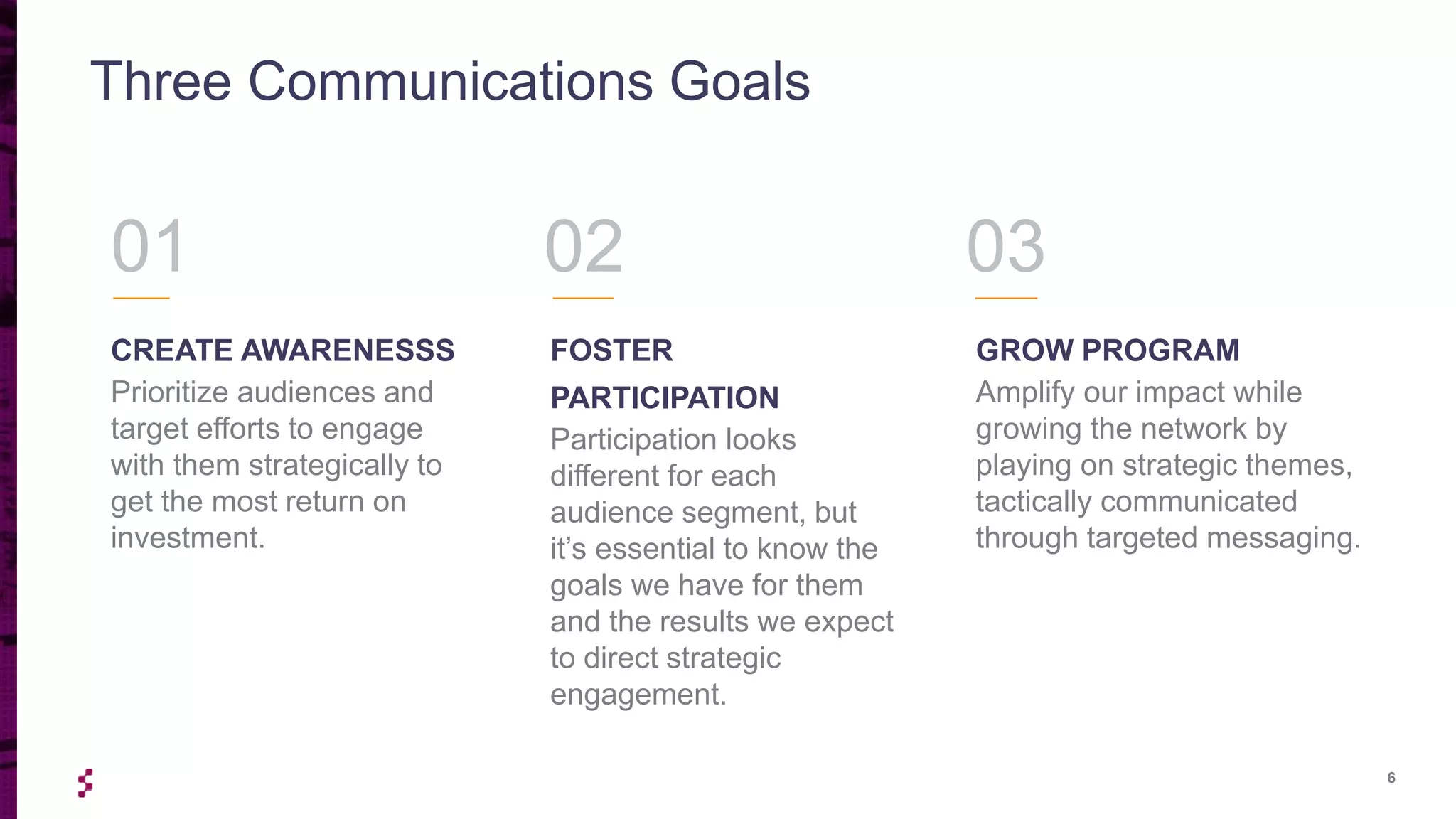
Three Communications Goals
CREATE AWARENESSS
Prioritize audiences and
target efforts to engage
with them strategically to
get the most return on
investment.
FOSTER
PARTICIPATION
Participation looks
different for each
audience segment, but
it’s essential to know the
goals we have for them
and the results we expect
to direct strategic
engagement.
GROW PROGRAM
Amplify our impact while
growing the network by
playing on strategic themes,
tactically communicated
through targeted messaging.
01 02 03
7
Path to Participation
A traditional marketing
funnel illustrates the
path an audience must
take for us to engage
with them. Everyone
starts at “Unaware,” and
we move them along
the funnel with the goal
of getting them to
“Participating,” which is
the Inner Circle. The
second half of the
funnel where each
engagement amplifies
the Program’s efforts.
By meeting an audiences’
needs through engagement, we
can move them through the
funnel to our mutual benefit.
INNER
CIRCLE
Audience-First Approach
03
9
Every communication or interaction is an opportunity to
engage audiences to build your relationship with them.
Effective engagement relies on knowing the audience and
focusing on their needs. Using a human-centered design
approach to strategies puts the audience at the core of
comprehensive, holistic, scalable, and flexible solutions.
Know Your Audience. Focus on Your Audience.
10
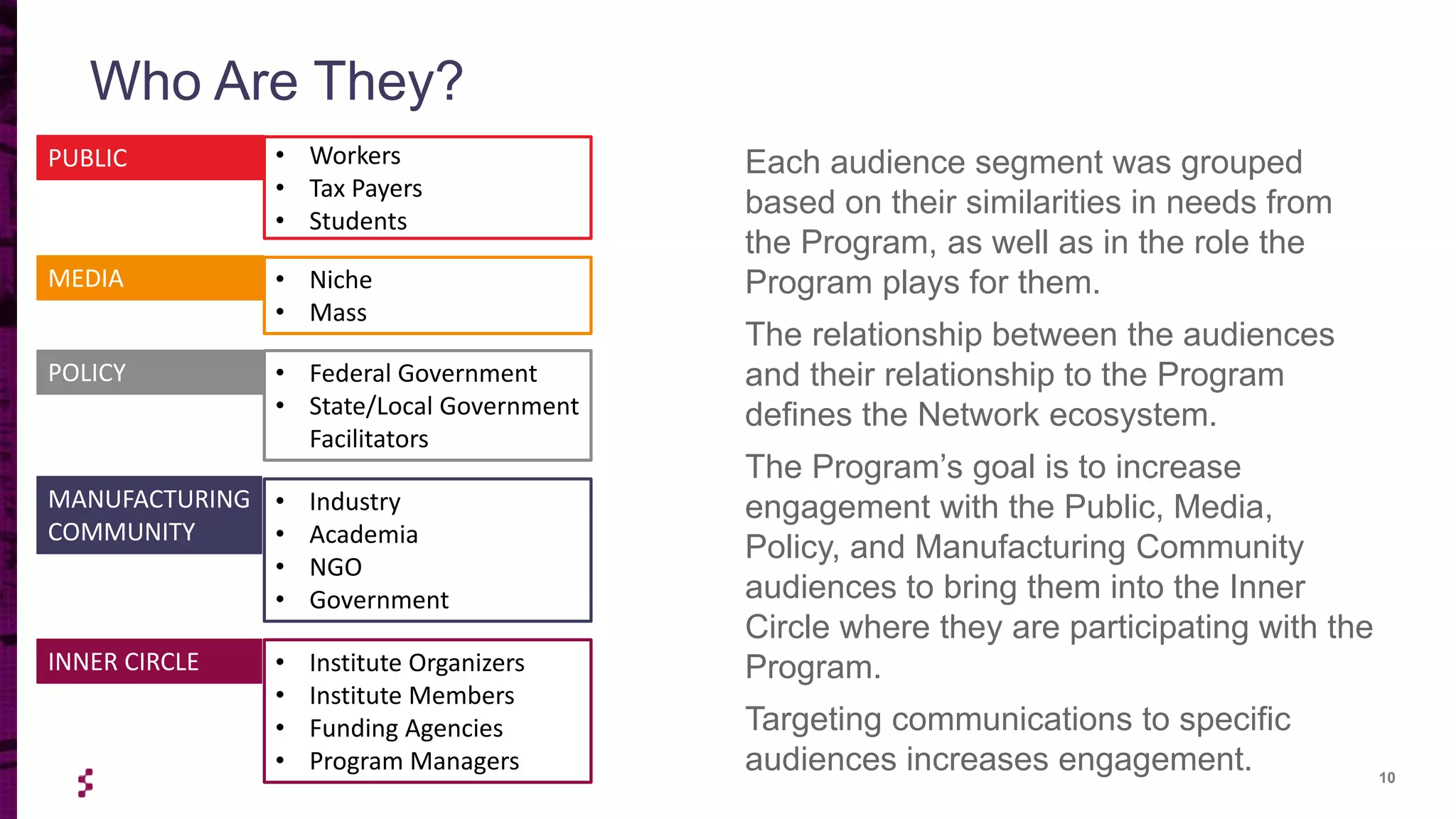
Who Are They?
• Workers
• Tax Payers
• Students
• Federal Government
• State/Local Government
Facilitators
• Industry
• Academia
• NGO
• Government
• Niche
• Mass
• Institute Organizers
• Institute Members
• Funding Agencies
• Program Managers
PUBLIC
MEDIA
POLICY
MANUFACTURING
COMMUNITY
INNER CIRCLE
Each audience segment was grouped
based on their similarities in needs from
the Program, as well as in the role the
Program plays for them.
The relationship between the audiences
and their relationship to the Program
defines the Network ecosystem.
The Program’s goal is to increase
engagement with the Public, Media,
Policy, and Manufacturing Community
audiences to bring them into the Inner
Circle where they are participating with the
Program.
Targeting communications to specific
audiences increases engagement.
11
Often referred to as the “Valley of Death,”
the gap between a great idea and its
commercial application is significant,
especially in the complex ecosystem of
manufacturing. The technology supporting
the new processes and new materials
needed to make new products, as well as
the talent to produce and operate the
entire supply chain faces huge hurdles.
Manufacturing USA seeks to not only build
a bridge between TRL/MRL 4 and
TRL/MRL 7, but also to put rocket
boosters on the travelers to accelerate
their journey.
Our Audiences’ Reality
Source: AMP Steering Committee
12
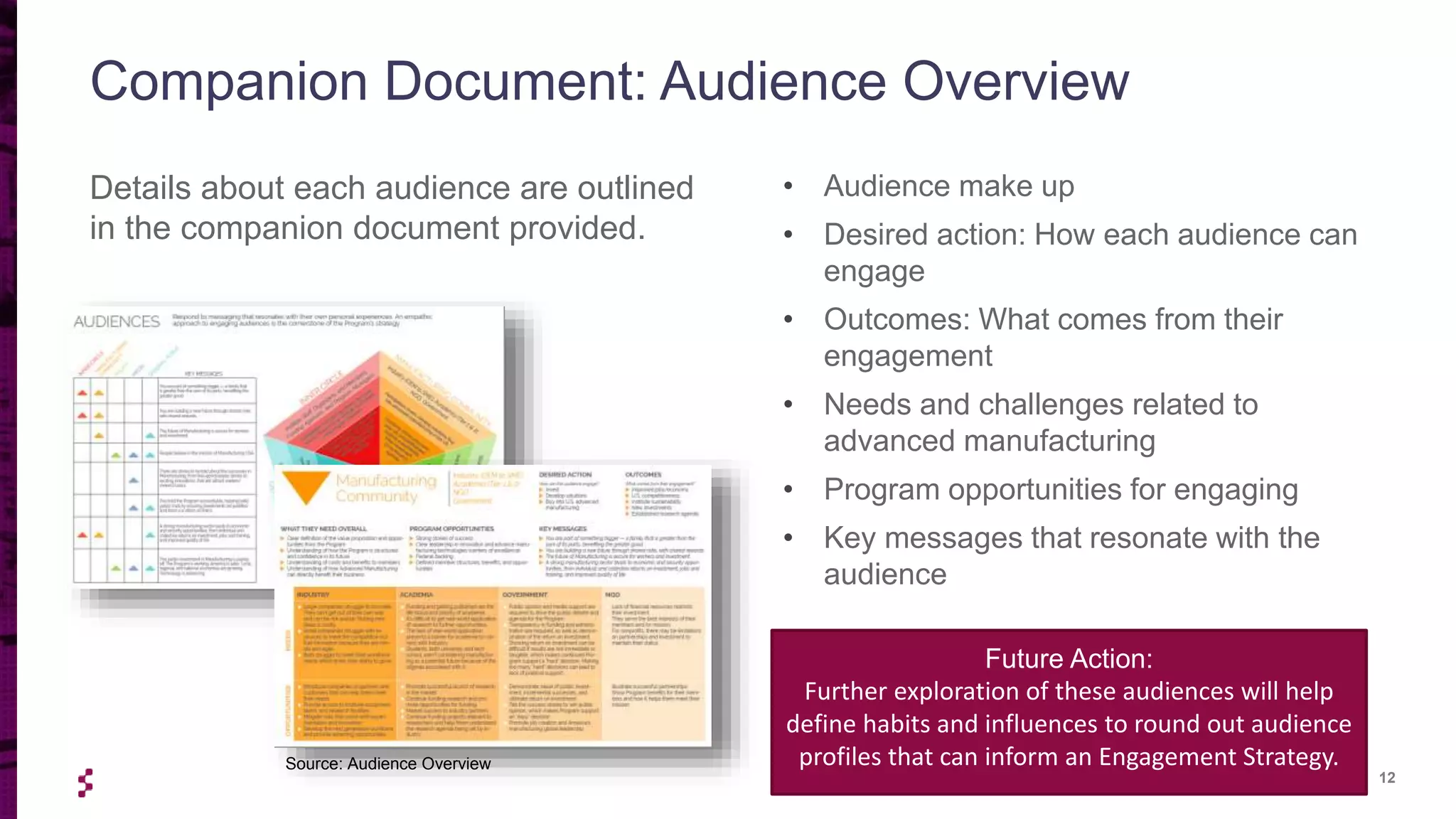
Details about each audience are outlined
in the companion document provided.
Companion Document: Audience Overview
• Audience make up
• Desired action: How each audience can
engage
• Outcomes: What comes from their
engagement
• Needs and challenges related to
advanced manufacturing
• Program opportunities for engaging
• Key messages that resonate with the
audience
Future Action:
Further exploration of these audiences will help
define habits and influences to round out audience
profiles that can inform an Engagement Strategy.Source: Audience Overview
Strategic themes delivered
via tactical messaging
engage audiences and
encourage their
participation.
How Do We Get These
Audiences to Participate?
Guiding Principles
04
15
Manufacturing USA Brand Platform
Vision U.S. global leadership in advanced manufacturing
Mission
Connecting people, ideas, and technology to solve industry-related advanced
manufacturing challenges, thereby enhancing industrial competitiveness and
economic growth and strengthening our national security
Brand Promise
Reinvigorate American manufacturing by fostering integrated collaboration to smartly
and efficiently advance technology that leads to cutting-edge products and services
built by American workers
Brand Pillars
(How we make good on
our promise)
Collaboration, Technology Advancement, and Workforce Development
Personality
Trusted leader, evolution facilitator, collaborative, inspirational, forward thinking, and
approachable
Value Proposition
(Consumer-facing
expression of a brand’s
value proposition)
Secure America’s future through manufacturing innovation, collaboration and
education
Source: Sapient
The brand platform defines what the Program does, as well as how and why.
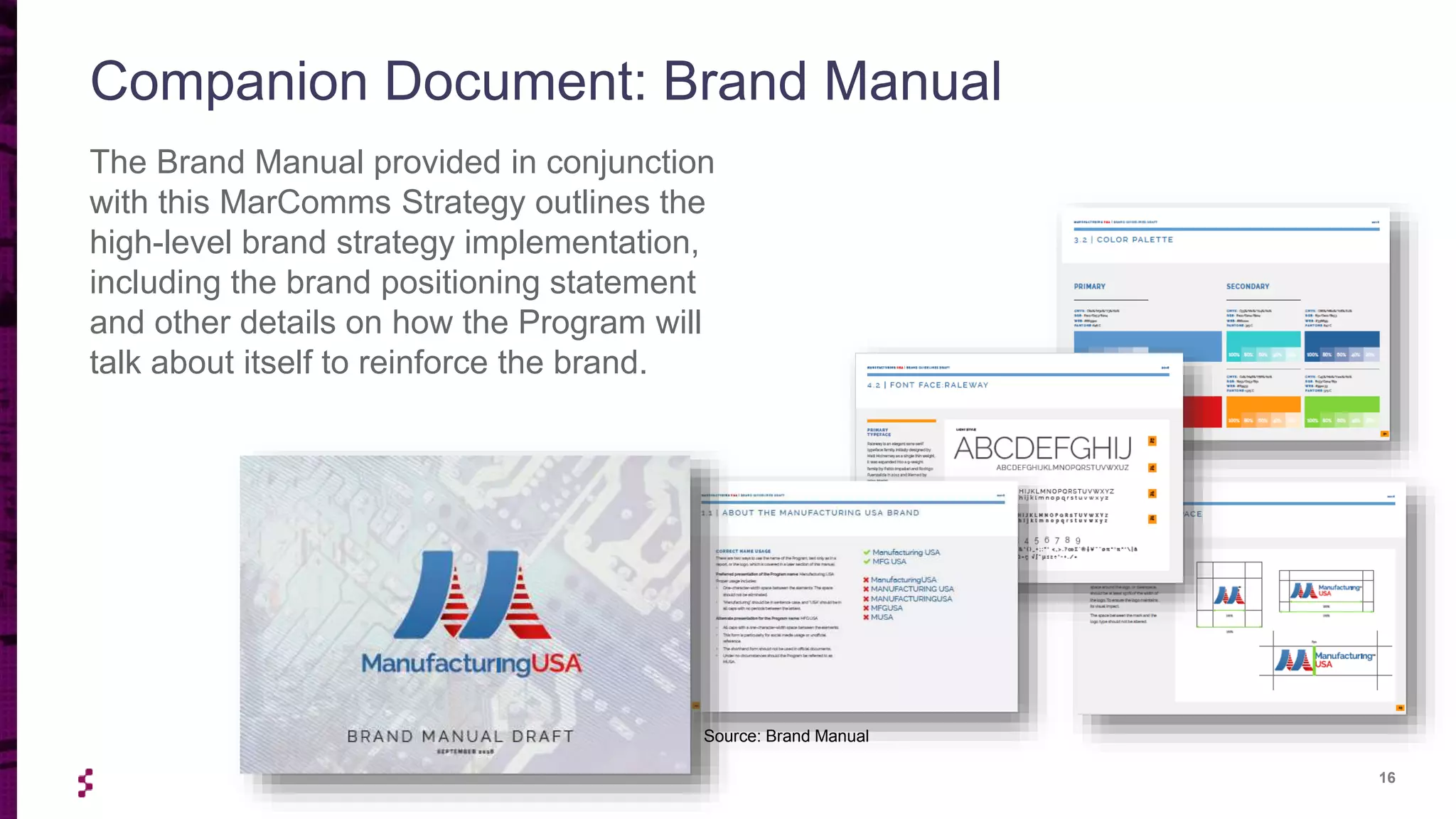
16
The Brand Manual provided in conjunction
with this MarComms Strategy outlines the
high-level brand strategy implementation,
including the brand positioning statement
and other details on how the Program will
talk about itself to reinforce the brand.
Companion Document: Brand Manual
Source: Brand Manual
17
• Key themes emerged from the
analysis of concepts communicated
in the stakeholder interviews
regarding what the Manufacturing
USA brand should evoke.
• These four themes strengthen the
brand and focus communications.
They guide strategic messages
developed to reinforce the brand
promise and value proposition.
Strategic Themes
SOURCE: Sapient
SYNERGY
“We are stronger
together, greater than
the sum of our parts.”
INNOVATION
“We find better solutions
that redefine the future.”
CATALYST
“Our unique combination
of actors speeds
progress.”
PUBLIC GOOD
“Our work benefits the
greater good.”
Companion document called “Messaging”
provided as a quick reference of strategic
themes and messages covered here.
18
Strategic Messages (1 of 2)
Message
Themes
Audiences
You are part of something bigger — a family that is greater than
the sum of its parts, benefiting the greater good.
• Synergy, Catalyst
• Inner Circle, Manufacturing Community
You are building a new future through shared risks, with shared
rewards.
• Innovation, Synergy
• Inner Circle, Manufacturing Community
A strong Manufacturing sector leads to economic and security
opportunities, from individual and collective returns on
investment, to jobs and training, and to improved quality of life.
• Catalyst
• General Public, Manufacturing Community,
Inner Circle
The future of Manufacturing is secure for workers and
investment.
• Innovation, Synergy
• General Public, Manufacturing Community
These messages strategically reinforce key themes and illuminate the brand.
While each one resonates with particular audiences, they are appealing across
all of our audiences. They are the foundation for the storylines the Program will
develop to communicate its progress and success.
19
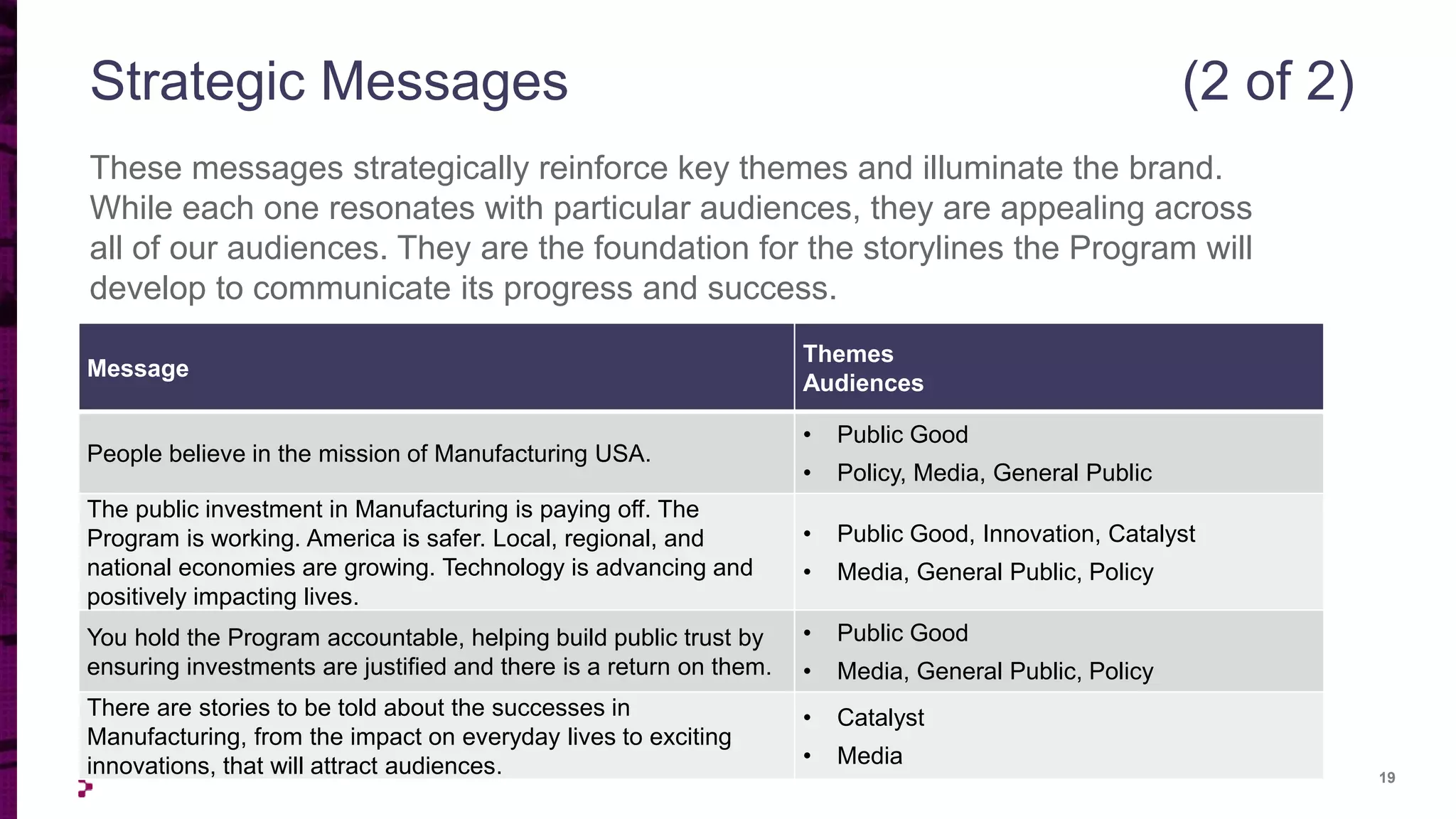
Strategic Messages (2 of 2)
Message
Themes
Audiences
People believe in the mission of Manufacturing USA.
• Public Good
• Policy, Media, General Public
The public investment in Manufacturing is paying off. The
Program is working. America is safer. Local, regional, and
national economies are growing. Technology is advancing and
positively impacting lives.
• Public Good, Innovation, Catalyst
• Media, General Public, Policy
You hold the Program accountable, helping build public trust by
ensuring investments are justified and there is a return on them.
• Public Good
• Media, General Public, Policy
There are stories to be told about the successes in
Manufacturing, from the impact on everyday lives to exciting
innovations, that will attract audiences.
• Catalyst
• Media
These messages strategically reinforce key themes and illuminate the brand.
While each one resonates with particular audiences, they are appealing across
all of our audiences. They are the foundation for the storylines the Program will
develop to communicate its progress and success.
20
Capture & Measure: Make Data-Driven Decisions
Set Goals
• Select KPIs for
web, email, and
social
• Establish
benchmarks
• Set goals
Report
• Establish timing
for regular reports,
as well as special
time frames
• Ensure metrics are
circulated to the
whole team
Follow-up
• Celebrate
successes
• Ask leadership and
team for lessons
learned
Tactics
05
22
The work of building and reinforcing the brand into maturity started with the Brand
Rollout Plan which outlined five streams of work. That document is a template for how
the Program should approach hooks or impact moments, such as the introduction of a
new institute or other events like IMTS. Coordinating these streams into
comprehensive plans that integrate with and complement each other is part of the
strategic approach defined here.
Delivering the Message
23
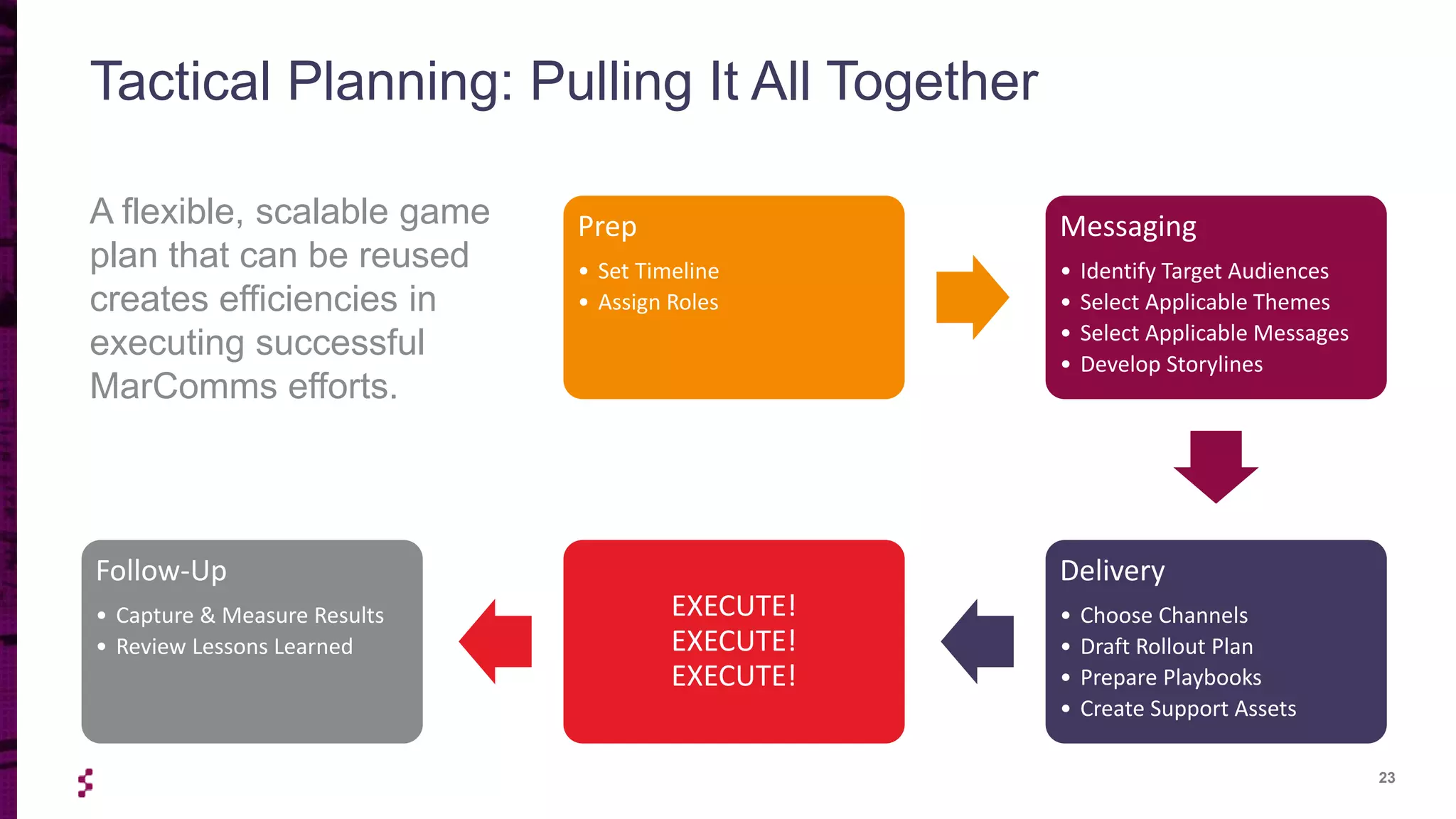
Tactical Planning: Pulling It All Together
Prep
• Set Timeline
• Assign Roles
Messaging
• Identify Target Audiences
• Select Applicable Themes
• Select Applicable Messages
• Develop Storylines
Delivery
• Choose Channels
• Draft Rollout Plan
• Prepare Playbooks
• Create Support Assets
EXECUTE!
EXECUTE!
EXECUTE!
Follow-Up
• Capture & Measure Results
• Review Lessons Learned
A flexible, scalable game
plan that can be reused
creates efficiencies in
executing successful
MarComms efforts.
24
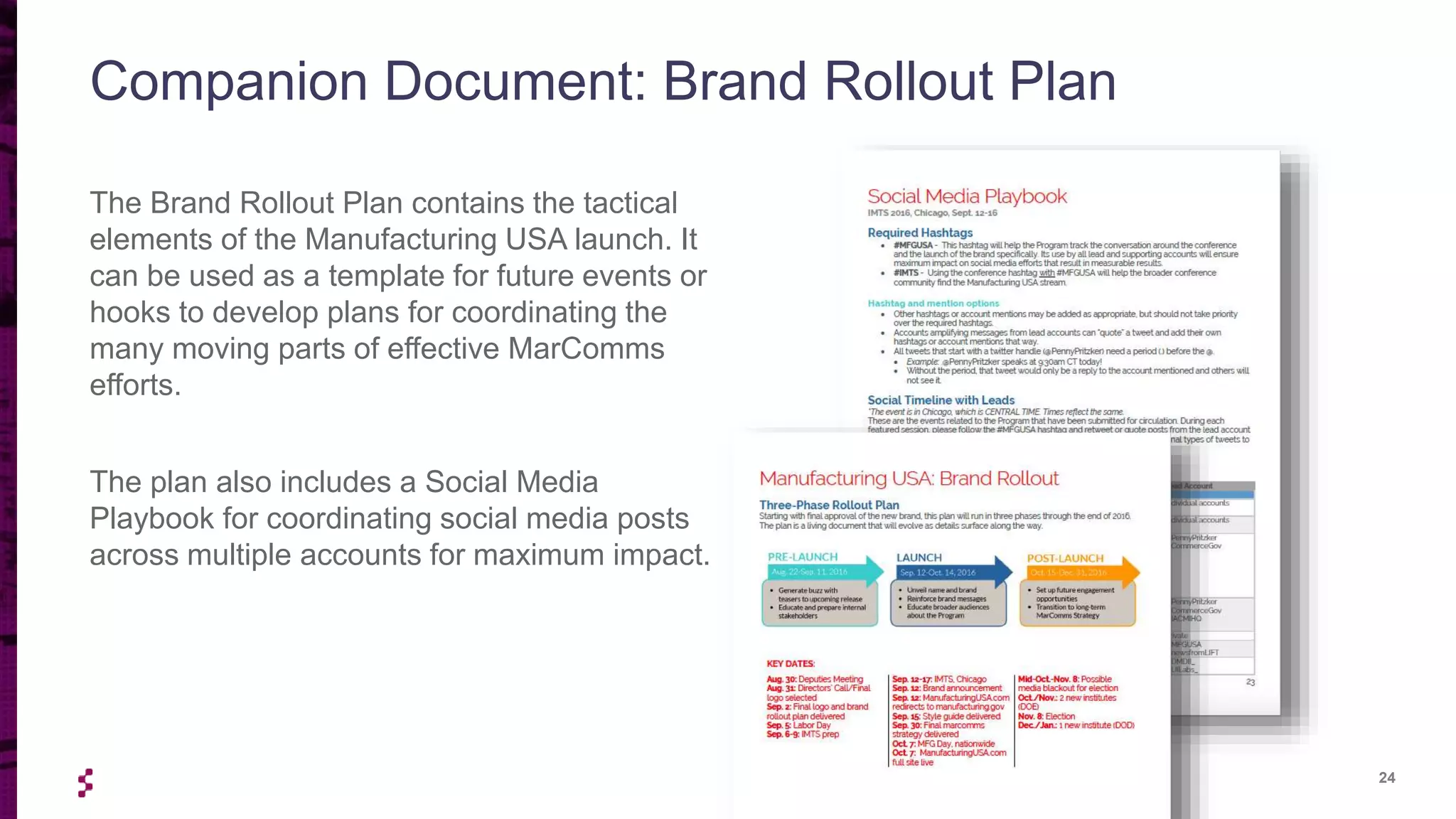
The Brand Rollout Plan contains the tactical
elements of the Manufacturing USA launch. It
can be used as a template for future events or
hooks to develop plans for coordinating the
many moving parts of effective MarComms
efforts.
The plan also includes a Social Media
Playbook for coordinating social media posts
across multiple accounts for maximum impact.
Companion Document: Brand Rollout Plan
Activate the Brand
Next steps for growing and strengthening Manufacturing USA
06
26
Brands must be nurtured for
growth and strength. Marketing
and Communications are a key
component, setting the direction
for how the brand comes to life.
Other elements are needed to
establish engagement with
audiences, and develop, deliver,
and promote content to increase
that engagement.
Next Steps for Activating Manufacturing USA
MarComms
Digital
Engagemen
t
Outreach
Content
27
Roadmap: Where are you now?
MarComms
Set the
message
direction for
building and
strengthening
the brand
through
engagement
Engagement
Content
Digital
Outreach
28
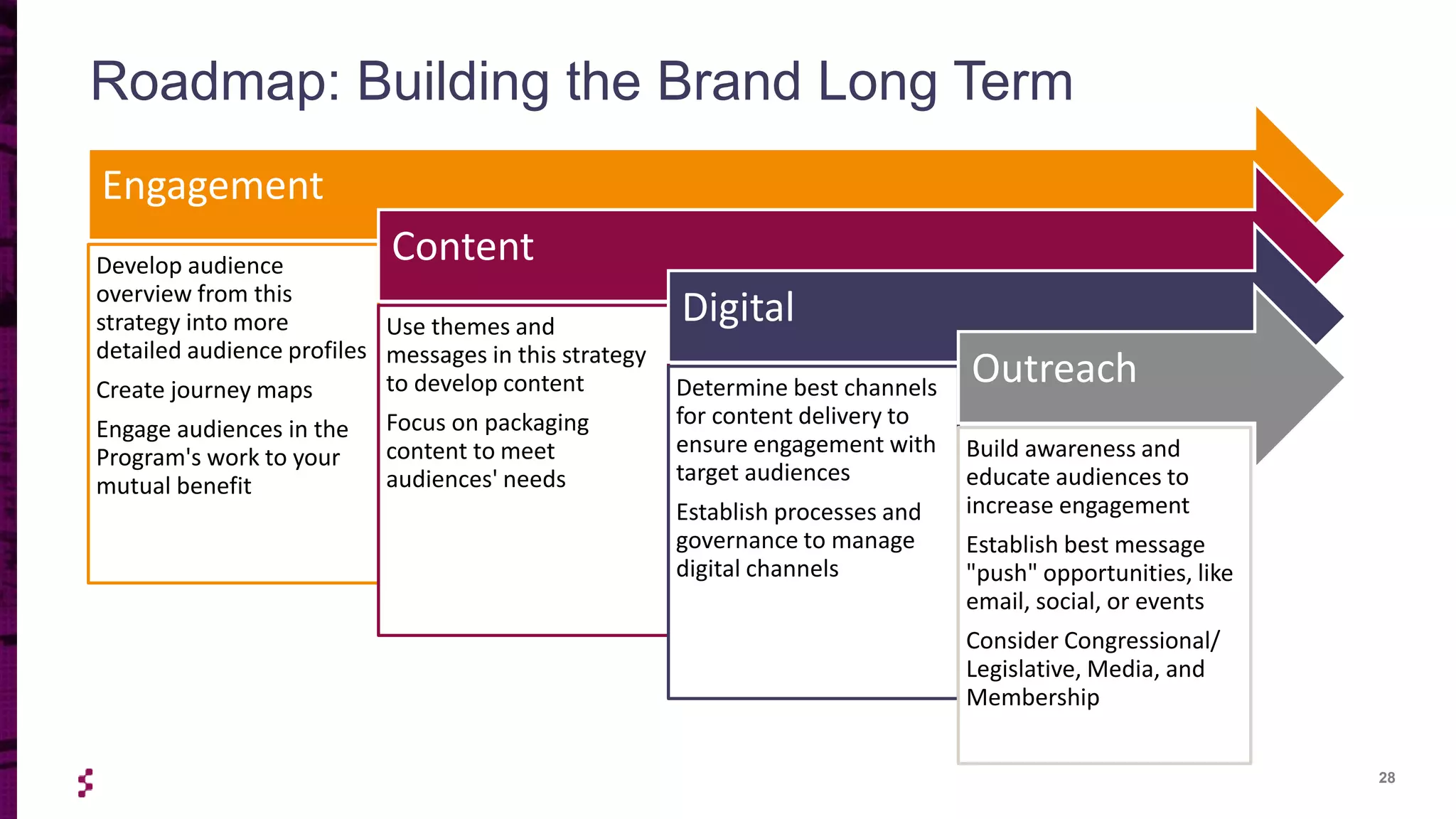
Roadmap: Building the Brand Long Term
Engagement
Develop audience
overview from this
strategy into more
detailed audience profiles
Create journey maps
Engage audiences in the
Program's work to your
mutual benefit
Content
Use themes and
messages in this strategy
to develop content
Focus on packaging
content to meet
audiences' needs
Digital
Determine best channels
for content delivery to
ensure engagement with
target audiences
Establish processes and
governance to manage
digital channels
Outreach
Build awareness and
educate audiences to
increase engagement
Establish best message
"push" opportunities, like
email, social, or events
Consider Congressional/
Legislative, Media, and
Membership
Arlington Office
1515 N. Courthouse Rd
4th Floor
Arlington, VA 22201
sapientgov.com
/sapientgov @LifeatSapient@sapientgo
v
/company/sapient-government-
services
Christina Frederick
703.908.2488
cfrederick@sapient.com

Marketing/Communications Strategy

  • 1.
  • 2.
    1. Overview 2. Goalsand Objectives 3. Audience-First Approach 4. Guiding Principles 5. Tactics 6. Activating the Brand Table of Contents
  • 3.
  • 4.
    4 The Manufacturing USAMarComm Strategy establishes the WHO, WHAT, WHY, and HOW the Program will communicate and promote content across channels. The strategy provides the foundation for prioritizing and optimizing marketing and communications efforts to reinforce the brand and the Program’s mission and vision based on established success metrics. Overview
  • 5.
  • 6.
    6 Three Communications Goals CREATEAWARENESSS Prioritize audiences and target efforts to engage with them strategically to get the most return on investment. FOSTER PARTICIPATION Participation looks different for each audience segment, but it’s essential to know the goals we have for them and the results we expect to direct strategic engagement. GROW PROGRAM Amplify our impact while growing the network by playing on strategic themes, tactically communicated through targeted messaging. 01 02 03
  • 7.
    7 Path to Participation Atraditional marketing funnel illustrates the path an audience must take for us to engage with them. Everyone starts at “Unaware,” and we move them along the funnel with the goal of getting them to “Participating,” which is the Inner Circle. The second half of the funnel where each engagement amplifies the Program’s efforts. By meeting an audiences’ needs through engagement, we can move them through the funnel to our mutual benefit. INNER CIRCLE
  • 8.
  • 9.
    9 Every communication orinteraction is an opportunity to engage audiences to build your relationship with them. Effective engagement relies on knowing the audience and focusing on their needs. Using a human-centered design approach to strategies puts the audience at the core of comprehensive, holistic, scalable, and flexible solutions. Know Your Audience. Focus on Your Audience.
  • 10.
    10 Who Are They? •Workers • Tax Payers • Students • Federal Government • State/Local Government Facilitators • Industry • Academia • NGO • Government • Niche • Mass • Institute Organizers • Institute Members • Funding Agencies • Program Managers PUBLIC MEDIA POLICY MANUFACTURING COMMUNITY INNER CIRCLE Each audience segment was grouped based on their similarities in needs from the Program, as well as in the role the Program plays for them. The relationship between the audiences and their relationship to the Program defines the Network ecosystem. The Program’s goal is to increase engagement with the Public, Media, Policy, and Manufacturing Community audiences to bring them into the Inner Circle where they are participating with the Program. Targeting communications to specific audiences increases engagement.
  • 11.
    11 Often referred toas the “Valley of Death,” the gap between a great idea and its commercial application is significant, especially in the complex ecosystem of manufacturing. The technology supporting the new processes and new materials needed to make new products, as well as the talent to produce and operate the entire supply chain faces huge hurdles. Manufacturing USA seeks to not only build a bridge between TRL/MRL 4 and TRL/MRL 7, but also to put rocket boosters on the travelers to accelerate their journey. Our Audiences’ Reality Source: AMP Steering Committee
  • 12.
    12 Details about eachaudience are outlined in the companion document provided. Companion Document: Audience Overview • Audience make up • Desired action: How each audience can engage • Outcomes: What comes from their engagement • Needs and challenges related to advanced manufacturing • Program opportunities for engaging • Key messages that resonate with the audience Future Action: Further exploration of these audiences will help define habits and influences to round out audience profiles that can inform an Engagement Strategy.Source: Audience Overview
  • 13.
    Strategic themes delivered viatactical messaging engage audiences and encourage their participation. How Do We Get These Audiences to Participate?
  • 14.
  • 15.
    15 Manufacturing USA BrandPlatform Vision U.S. global leadership in advanced manufacturing Mission Connecting people, ideas, and technology to solve industry-related advanced manufacturing challenges, thereby enhancing industrial competitiveness and economic growth and strengthening our national security Brand Promise Reinvigorate American manufacturing by fostering integrated collaboration to smartly and efficiently advance technology that leads to cutting-edge products and services built by American workers Brand Pillars (How we make good on our promise) Collaboration, Technology Advancement, and Workforce Development Personality Trusted leader, evolution facilitator, collaborative, inspirational, forward thinking, and approachable Value Proposition (Consumer-facing expression of a brand’s value proposition) Secure America’s future through manufacturing innovation, collaboration and education Source: Sapient The brand platform defines what the Program does, as well as how and why.
  • 16.
    16 The Brand Manualprovided in conjunction with this MarComms Strategy outlines the high-level brand strategy implementation, including the brand positioning statement and other details on how the Program will talk about itself to reinforce the brand. Companion Document: Brand Manual Source: Brand Manual
  • 17.
    17 • Key themesemerged from the analysis of concepts communicated in the stakeholder interviews regarding what the Manufacturing USA brand should evoke. • These four themes strengthen the brand and focus communications. They guide strategic messages developed to reinforce the brand promise and value proposition. Strategic Themes SOURCE: Sapient SYNERGY “We are stronger together, greater than the sum of our parts.” INNOVATION “We find better solutions that redefine the future.” CATALYST “Our unique combination of actors speeds progress.” PUBLIC GOOD “Our work benefits the greater good.” Companion document called “Messaging” provided as a quick reference of strategic themes and messages covered here.
  • 18.
    18 Strategic Messages (1of 2) Message Themes Audiences You are part of something bigger — a family that is greater than the sum of its parts, benefiting the greater good. • Synergy, Catalyst • Inner Circle, Manufacturing Community You are building a new future through shared risks, with shared rewards. • Innovation, Synergy • Inner Circle, Manufacturing Community A strong Manufacturing sector leads to economic and security opportunities, from individual and collective returns on investment, to jobs and training, and to improved quality of life. • Catalyst • General Public, Manufacturing Community, Inner Circle The future of Manufacturing is secure for workers and investment. • Innovation, Synergy • General Public, Manufacturing Community These messages strategically reinforce key themes and illuminate the brand. While each one resonates with particular audiences, they are appealing across all of our audiences. They are the foundation for the storylines the Program will develop to communicate its progress and success.
  • 19.
    19 Strategic Messages (2of 2) Message Themes Audiences People believe in the mission of Manufacturing USA. • Public Good • Policy, Media, General Public The public investment in Manufacturing is paying off. The Program is working. America is safer. Local, regional, and national economies are growing. Technology is advancing and positively impacting lives. • Public Good, Innovation, Catalyst • Media, General Public, Policy You hold the Program accountable, helping build public trust by ensuring investments are justified and there is a return on them. • Public Good • Media, General Public, Policy There are stories to be told about the successes in Manufacturing, from the impact on everyday lives to exciting innovations, that will attract audiences. • Catalyst • Media These messages strategically reinforce key themes and illuminate the brand. While each one resonates with particular audiences, they are appealing across all of our audiences. They are the foundation for the storylines the Program will develop to communicate its progress and success.
  • 20.
    20 Capture & Measure:Make Data-Driven Decisions Set Goals • Select KPIs for web, email, and social • Establish benchmarks • Set goals Report • Establish timing for regular reports, as well as special time frames • Ensure metrics are circulated to the whole team Follow-up • Celebrate successes • Ask leadership and team for lessons learned
  • 21.
  • 22.
    22 The work ofbuilding and reinforcing the brand into maturity started with the Brand Rollout Plan which outlined five streams of work. That document is a template for how the Program should approach hooks or impact moments, such as the introduction of a new institute or other events like IMTS. Coordinating these streams into comprehensive plans that integrate with and complement each other is part of the strategic approach defined here. Delivering the Message
  • 23.
    23 Tactical Planning: PullingIt All Together Prep • Set Timeline • Assign Roles Messaging • Identify Target Audiences • Select Applicable Themes • Select Applicable Messages • Develop Storylines Delivery • Choose Channels • Draft Rollout Plan • Prepare Playbooks • Create Support Assets EXECUTE! EXECUTE! EXECUTE! Follow-Up • Capture & Measure Results • Review Lessons Learned A flexible, scalable game plan that can be reused creates efficiencies in executing successful MarComms efforts.
  • 24.
    24 The Brand RolloutPlan contains the tactical elements of the Manufacturing USA launch. It can be used as a template for future events or hooks to develop plans for coordinating the many moving parts of effective MarComms efforts. The plan also includes a Social Media Playbook for coordinating social media posts across multiple accounts for maximum impact. Companion Document: Brand Rollout Plan
  • 25.
    Activate the Brand Nextsteps for growing and strengthening Manufacturing USA 06
  • 26.
    26 Brands must benurtured for growth and strength. Marketing and Communications are a key component, setting the direction for how the brand comes to life. Other elements are needed to establish engagement with audiences, and develop, deliver, and promote content to increase that engagement. Next Steps for Activating Manufacturing USA MarComms Digital Engagemen t Outreach Content
  • 27.
    27 Roadmap: Where areyou now? MarComms Set the message direction for building and strengthening the brand through engagement Engagement Content Digital Outreach
  • 28.
    28 Roadmap: Building theBrand Long Term Engagement Develop audience overview from this strategy into more detailed audience profiles Create journey maps Engage audiences in the Program's work to your mutual benefit Content Use themes and messages in this strategy to develop content Focus on packaging content to meet audiences' needs Digital Determine best channels for content delivery to ensure engagement with target audiences Establish processes and governance to manage digital channels Outreach Build awareness and educate audiences to increase engagement Establish best message "push" opportunities, like email, social, or events Consider Congressional/ Legislative, Media, and Membership
  • 29.
    Arlington Office 1515 N.Courthouse Rd 4th Floor Arlington, VA 22201 sapientgov.com /sapientgov @LifeatSapient@sapientgo v /company/sapient-government- services Christina Frederick 703.908.2488 cfrederick@sapient.com