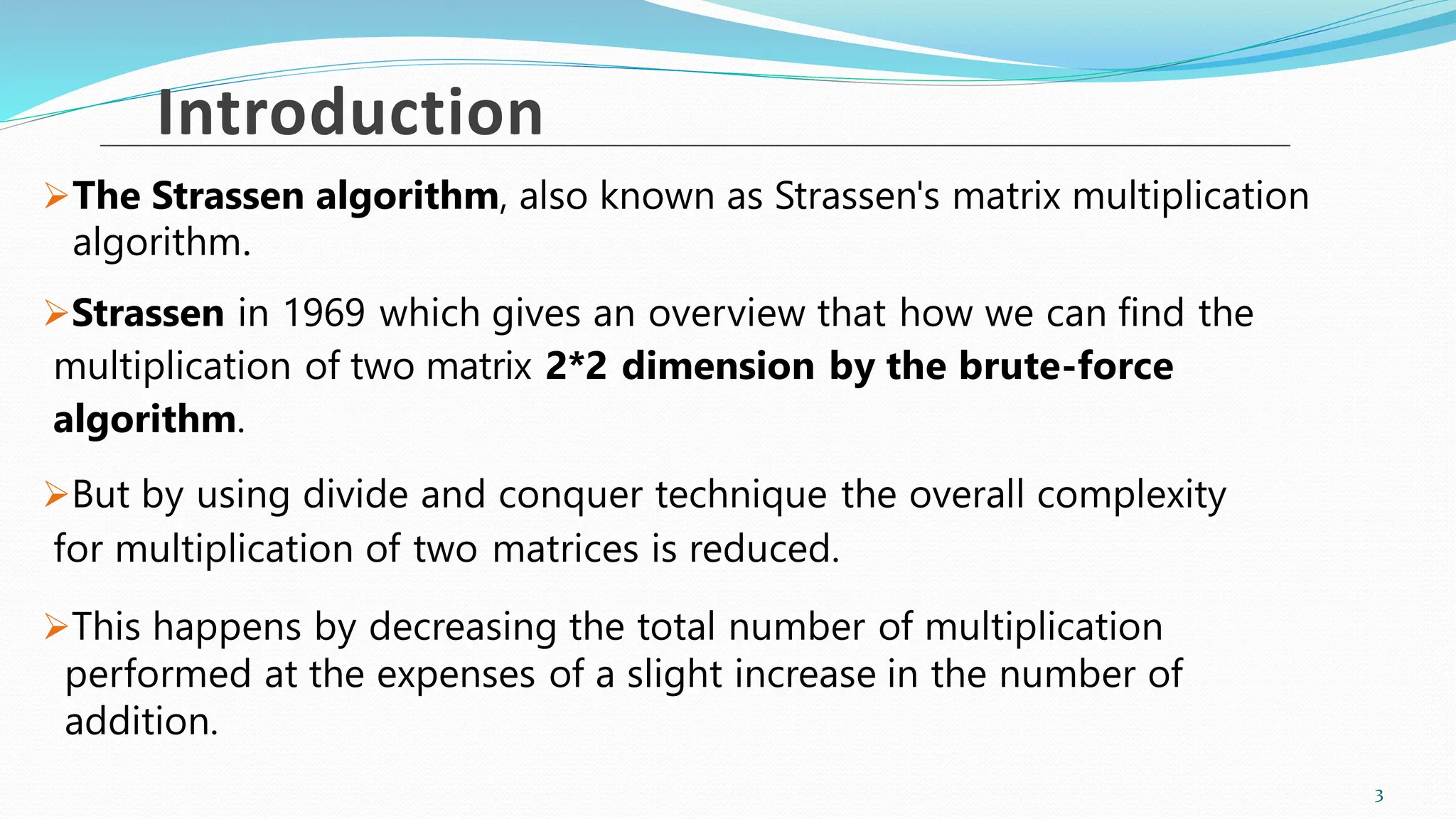
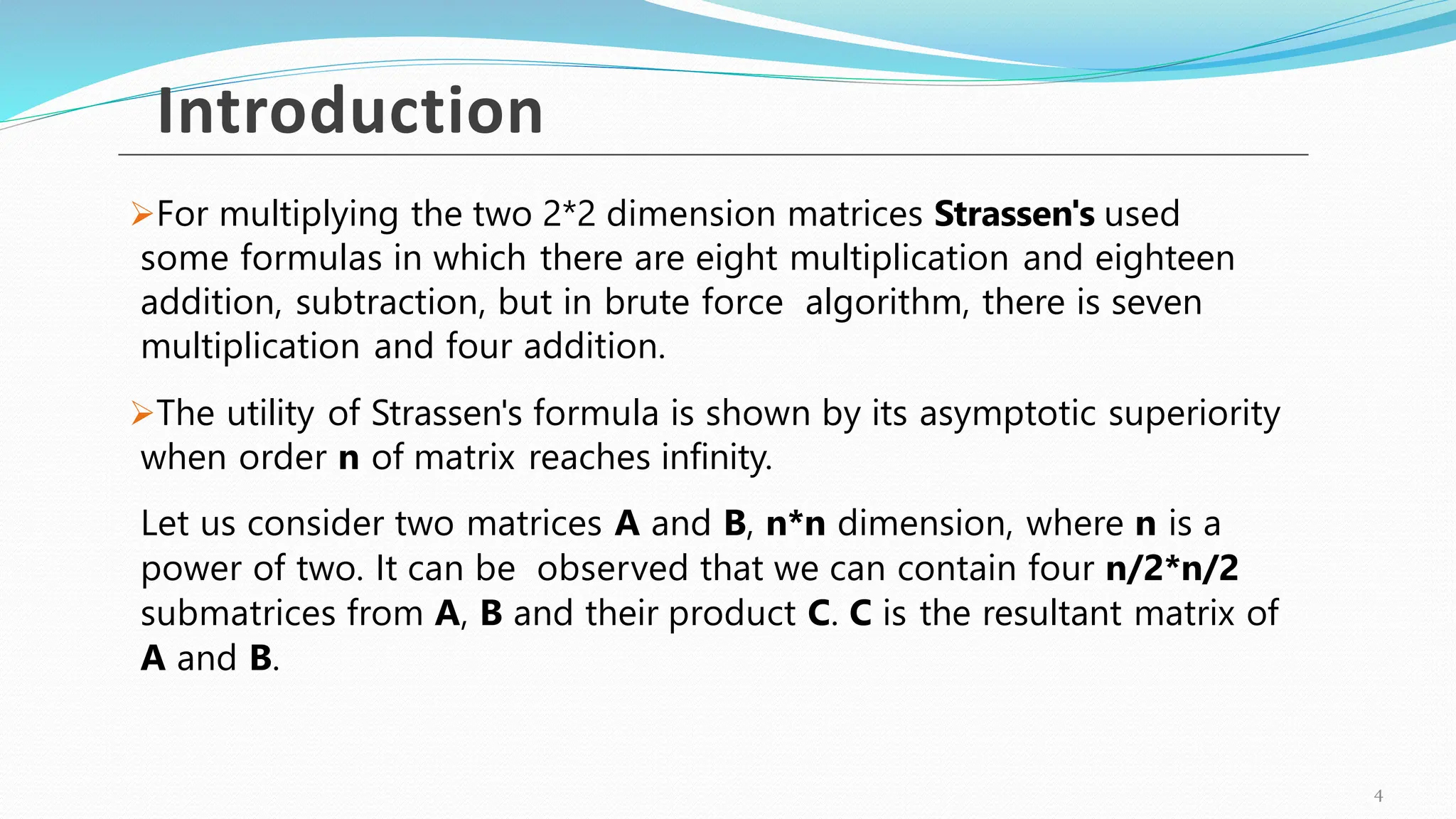
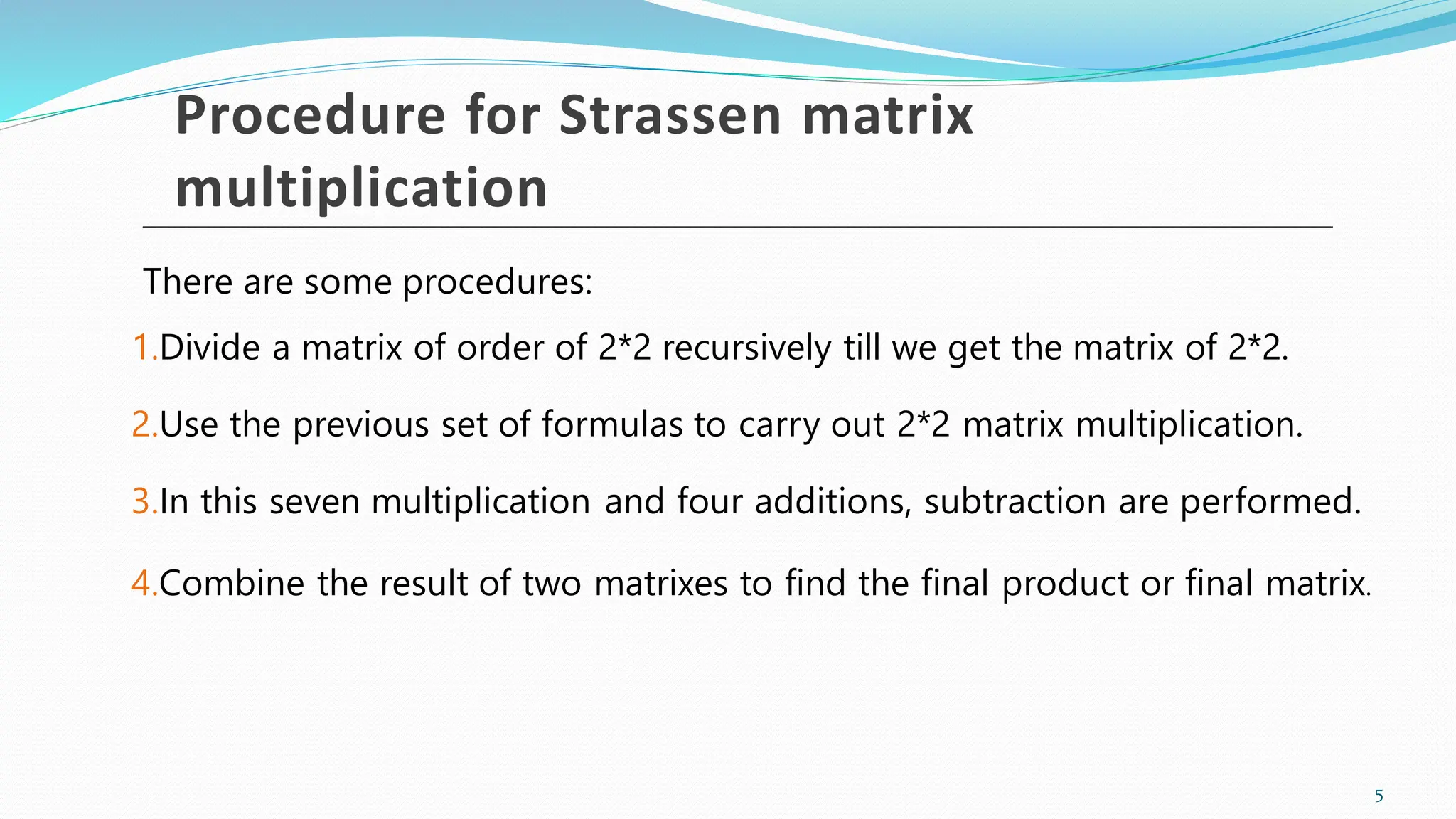
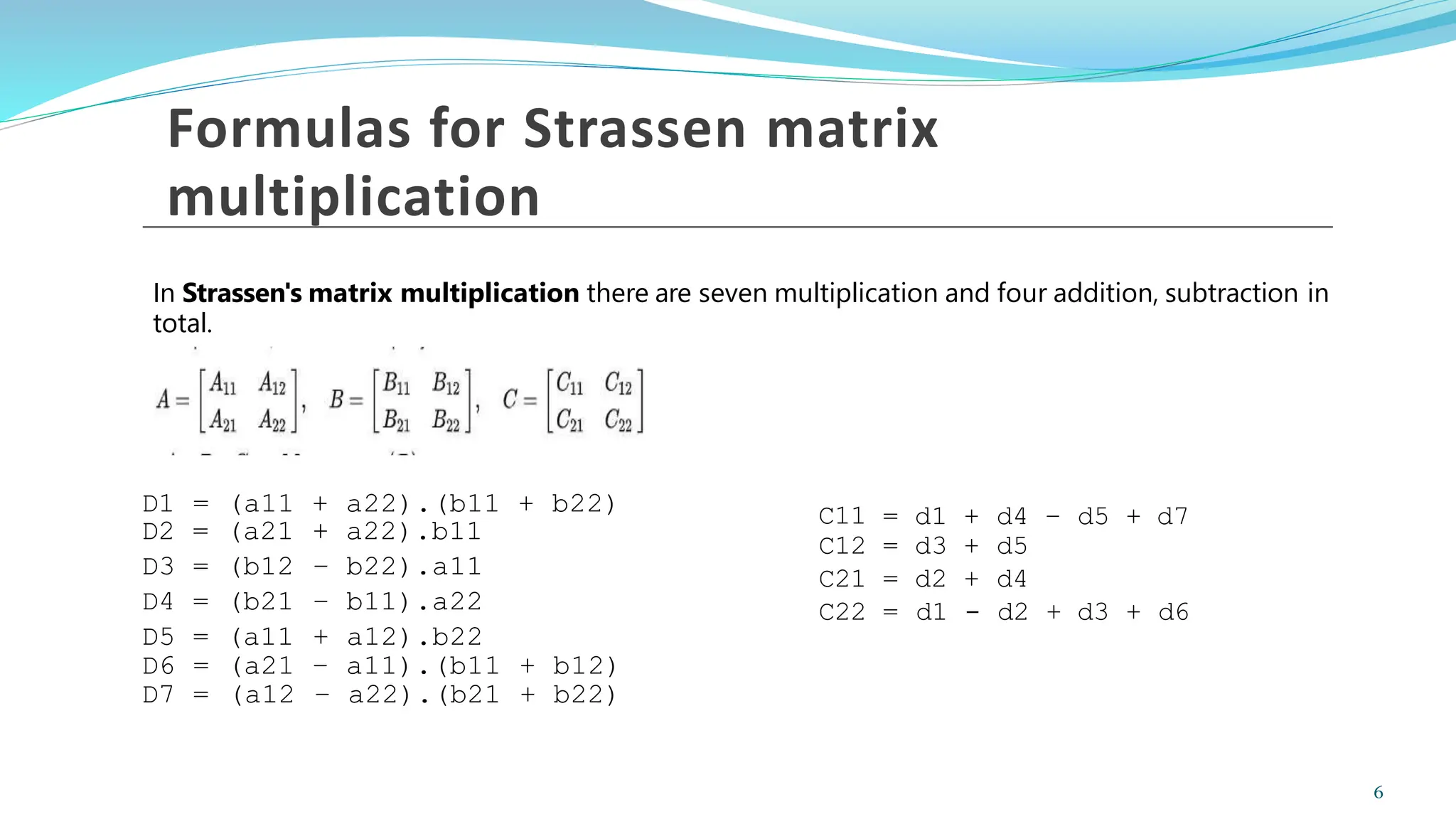
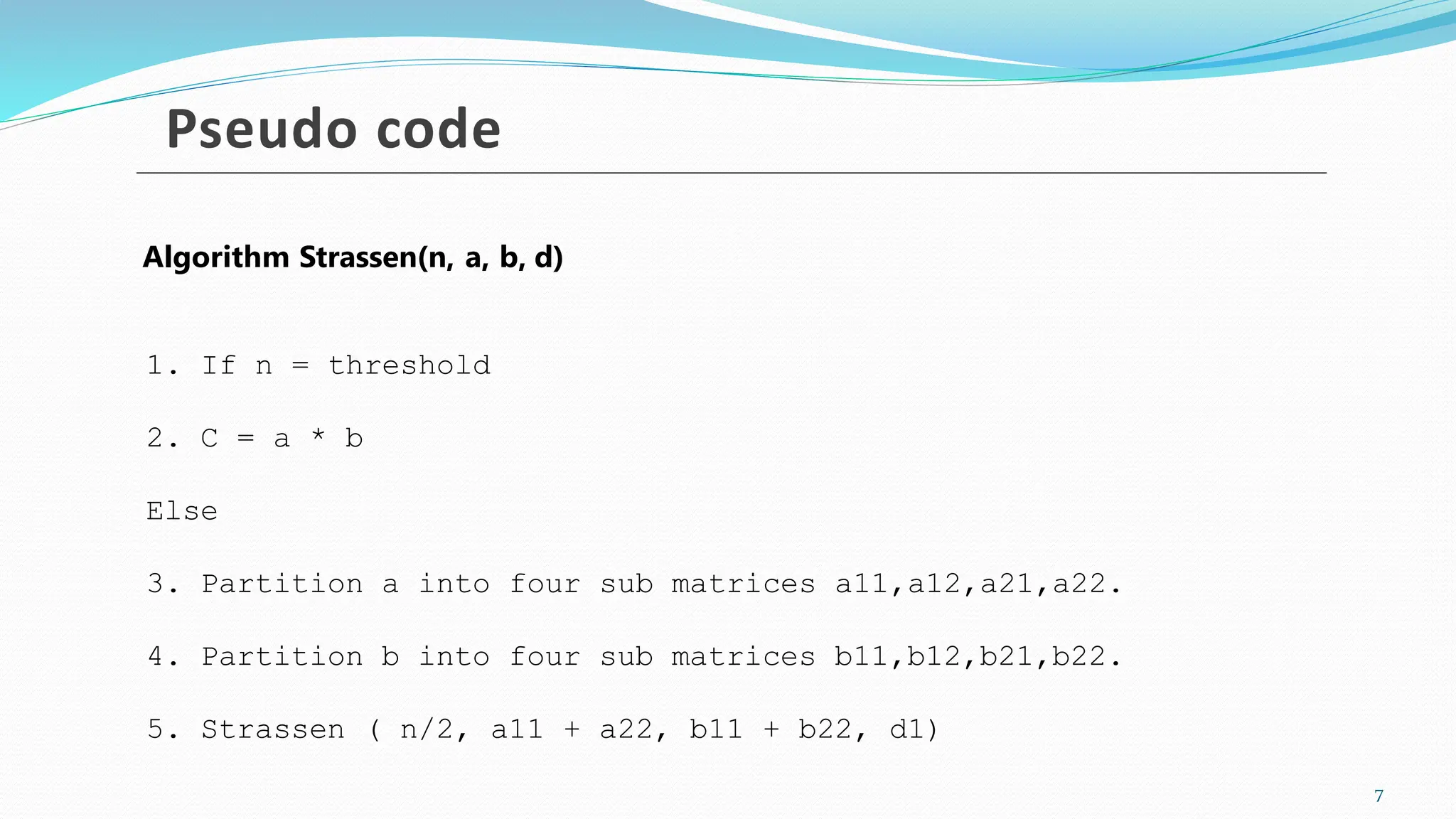
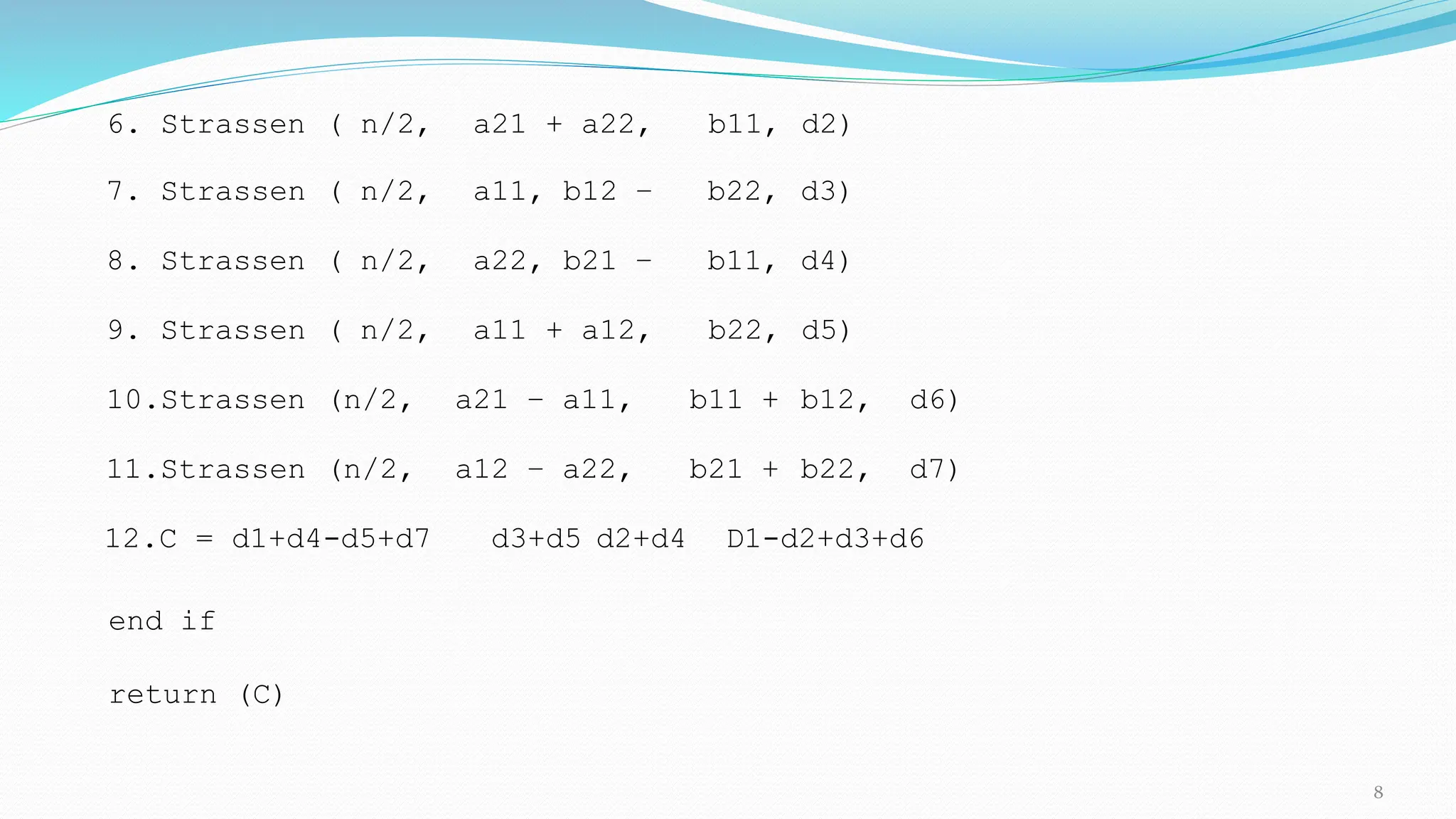
Strassen's algorithm is an efficient method for multiplying matrices that reduces the number of multiplications from eight in standard methods to seven, enhancing performance through a divide and conquer approach. It is implemented using specific formulas and a pseudo code algorithm that recursively divides matrices until 2x2 matrices are achieved. The time complexity of Strassen's algorithm is O(n^2.8074), showcasing its advantage as the matrix size grows.
![Code:
#include <stdio.h>
int main()
{
int a[2][2],b[2][2],c[2][2],i,j;
int m1,m2,m3,m4,m5,m6,m7;
printf("Enter the 4 elements of first matrix: ");
for(i=0;i<2;i++)
for(j=0;j<2;j++)
scanf("%d",&a[i][j]);
printf("Enter the 4 elements of second matrix: "); for(i=0;i<2;i++)
for(j=0;j<2;j++)
scanf("%d",&b[i][j]);
printf("nThe first matrix isn");
for(i=0;i<2;i++)
{ printf("n");
for(j=0;j<2;j++)
printf("%dt",a[i][j]); }
printf("nThe second matrix isn");
9](https://image.slidesharecdn.com/strassensalgorithm-231029084135-96f5c551/75/Strassen-s-Algorithm-pptx-9-2048.jpg)
![for(i=0;i<2;i++) {
printf("n");
for(j=0;j<2;j++)
printf("%dt",b[i][j]); }
m1= (a[0][0] + a[1][1])*(b[0][0]+b[1][1]);
m2= (a[1][0]+a[1][1])*b[0][0];
m3= a[0][0]*(b[0][1]-b[1][1]);
m4= a[1][1]*(b[1][0]-b[0][0]);
m5= (a[0][0]+a[0][1])*b[1][1];
m6= (a[1][0]-a[0][0])*(b[0][0]+b[0][1]);
m7= (a[0][1]-a[1][1])*(b[1][0]+b[1][1]);
c[0][0]=m1+m4-m5+m7;
c[0][1]=m3+m5;
c[1][0]=m2+m4;
c[1][1]=m1-m2+m3+m6;
printf("nAfter multiplication using n");
for(i=0;i<2;i++) {
printf("n");
for(j=0;j<2;j++)
printf("%dt",c[i][j]); }
return 0;
}
62 51
Output:
Complexity: The time complexity is O(N2.8074).
10](https://image.slidesharecdn.com/strassensalgorithm-231029084135-96f5c551/75/Strassen-s-Algorithm-pptx-10-2048.jpg)



![[DSC Europe 25] Imai Jen-La Plante - The New Generation: AI and the Future of...](https://cdn.slidesharecdn.com/ss_thumbnails/kxi8t2l5rggivgcenyba-1-jenlaplante-dsc-251208152532-d1e076c2-thumbnail.jpg?width=640&height=640&fit=bounds)


![[DSC Europe 25] Marko Krstic - Understanding the AI Threat Landscape - Risks,...](https://cdn.slidesharecdn.com/ss_thumbnails/tiyim1ins5jvbrvzpzla-2-251209104645-c69d3553-thumbnail.jpg?width=640&height=640&fit=bounds)

![[DSC Europe 25] Bassam Maharmeh - Artificial Intelligence: Opportunities and ...](https://cdn.slidesharecdn.com/ss_thumbnails/thhfmr2fqpawzj7hsjpg-5-251211083048-2c23204f-thumbnail.jpg?width=640&height=640&fit=bounds)
![[DSC Europe 25] Branko Dzakula - From Defense to Attack: How AI Redefines Cyb...](https://cdn.slidesharecdn.com/ss_thumbnails/80bdzdxpr3ky2g0qvyk9-8-251211083048-ce5fc1ee-thumbnail.jpg?width=640&height=640&fit=bounds)
![[DSC Europe 25] Marija Vlajkovic & Andrea Radonjanin - Integration of AI tool...](https://cdn.slidesharecdn.com/ss_thumbnails/qf1jrglttoc3bm8s3aop-final-integration-of-ai-tools-251208151905-394f3a6a-thumbnail.jpg?width=640&height=640&fit=bounds)
![[DSC Europe 25] Debmalya Biswas - Agentification: the art of transforming man...](https://cdn.slidesharecdn.com/ss_thumbnails/r5azlggvtqiaiiusrqdr-4-251212103249-5a12c89b-thumbnail.jpg?width=640&height=640&fit=bounds)
![[DSC Europe 25] Jovan Bogicevic - Legacy to AI-Driven Defense: Transforming D...](https://cdn.slidesharecdn.com/ss_thumbnails/rsarluadt563hntyfc8q-3-251211083849-3e7bc4c0-thumbnail.jpg?width=640&height=640&fit=bounds)
![[DSC Europe 25] Miodrag Pesovic & Vladislav Radonjic - Federated Data Archite...](https://cdn.slidesharecdn.com/ss_thumbnails/gsbe3y5it5uhndi4e08e-1-251212103249-f1008e0c-thumbnail.jpg?width=640&height=640&fit=bounds)
![[DSC Europe 25] Nikolay Burlutskiy - Best Practices for Building Enterprise M...](https://cdn.slidesharecdn.com/ss_thumbnails/uirvaiuvq8y1w8hzd9tx-7-251212103249-2619edb4-thumbnail.jpg?width=640&height=640&fit=bounds)
![[DSC Europe 25] Jon Dajci - Bridging TradFi and DeFi: Building the Future of ...](https://cdn.slidesharecdn.com/ss_thumbnails/fqmhfvlbqhkihjvqvhmu-7-251211083849-6af7e325-thumbnail.jpg?width=640&height=640&fit=bounds)