Matrix Multiplication Using
Divide And Conquer
1
Presented by: Ayush Jajoo
Roll No : MCA25016/22
MCA-Second Semester
Presented To: Dr. Madhavi Sinha
Matrix multiplication
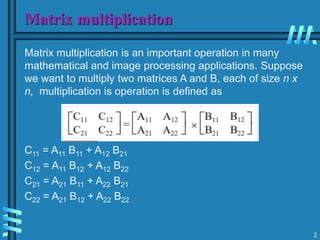
Matrix multiplication is an important operation in many
mathematical and image processing applications. Suppose
we want to multiply two matrices A and B, each of size n x
n, multiplication is operation is defined as
C11 = A11 B11 + A12 B21
C12 = A11 B12 + A12 B22
C21 = A21 B11 + A22 B21
C22 = A21 B12 + A22 B22
2
Algorithm for matrix multiplication
Algorithm MATRIX_MULTIPLICATION(A, B, C)
// A and B are input matrices of size n x n
// C is the output matrix of size n x n
for i ← 1 to n do
for j ← 1 to n do
C[i][j] ← 0
for k ← 1 to n do
C[i][j] ← C[i][j] + A[i][k]*B[k][j]
end
end
end
3
4
Divide-and-Conquer
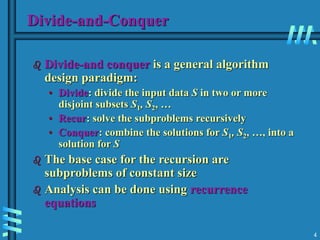
 Divide-and conquer is a general algorithm
design paradigm:
• Divide: divide the input data S in two or more
disjoint subsets S1, S2, …
• Recur: solve the subproblems recursively
• Conquer: combine the solutions for S1, S2, …, into a
solution for S
 The base case for the recursion are
subproblems of constant size
 Analysis can be done using recurrence
equations
5
Divide-and-Conquer
The most-well known algorithm design strategy:
1. Divide instance of problem into two or more
smaller instances
2. Solve smaller instances recursively
3. Obtain solution to original (larger) instance by
combining these solutions
6
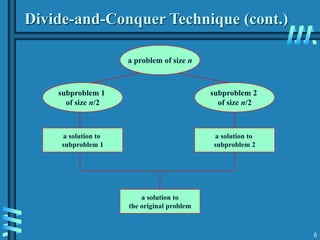
Divide-and-Conquer Technique (cont.)
subproblem 2
of size n/2
subproblem 1
of size n/2
a solution to
subproblem 1
a solution to
the original problem
a solution to
subproblem 2
a problem of size n
7
Divide-and-Conquer Examples
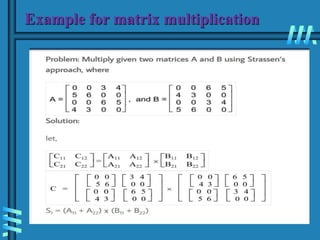
 Matrix multiplication: Strassen’s algorithm
 Example for matrix Multiplication
8
Strassens’s Matrix Multiplication
 Belongs to divide and conquer Approach
 Strassen has used some formulas for multiplying the two 2*2
dimension matrices where the number of multiplications is
seven, additions and subtractions are is eighteen, and in brute
force algorithm, there is eight number of multiplications and four
addition.
9
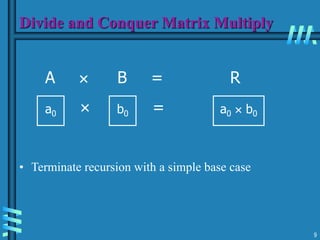
Divide and Conquer Matrix Multiply
 =
a0 b0 a0  b0
A  B = R
• Terminate recursion with a simple base case
10
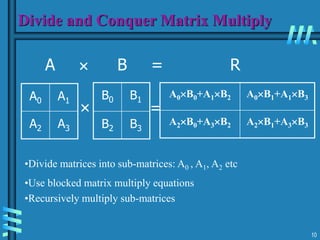
Divide and Conquer Matrix Multiply
A  B = R
A0 A1
A2 A3
B0 B1
B2 B3
A0B0+A1B2 A0B1+A1B3
A2B0+A3B2 A2B1+A3B3
 =
•Divide matrices into sub-matrices: A0 , A1, A2 etc
•Use blocked matrix multiply equations
•Recursively multiply sub-matrices
11
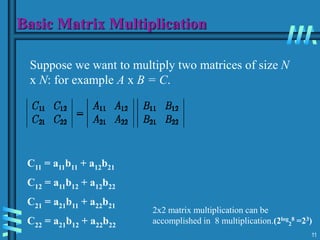
Basic Matrix Multiplication
Suppose we want to multiply two matrices of size N
x N: for example A x B = C.
C11 = a11b11 + a12b21
C12 = a11b12 + a12b22
C21 = a21b11 + a22b21
C22 = a21b12 + a22b22
2x2 matrix multiplication can be
accomplished in 8 multiplication.(2log
2
8 =23)
12
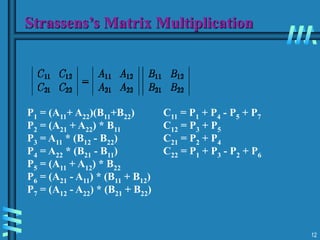
Strassens’s Matrix Multiplication
P1 = (A11+ A22)(B11+B22)
P2 = (A21 + A22) * B11
P3 = A11 * (B12 - B22)
P4 = A22 * (B21 - B11)
P5 = (A11 + A12) * B22
P6 = (A21 - A11) * (B11 + B12)
P7 = (A12 - A22) * (B21 + B22)
C11 = P1 + P4 - P5 + P7
C12 = P3 + P5
C21 = P2 + P4
C22 = P1 + P3 - P2 + P6
13
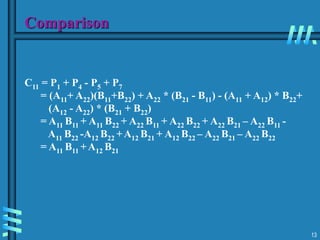
C11 = P1 + P4 - P5 + P7
= (A11+ A22)(B11+B22) + A22 * (B21 - B11) - (A11 + A12) * B22+
(A12 - A22) * (B21 + B22)
= A11 B11 + A11 B22 + A22 B11 + A22 B22 + A22 B21 – A22 B11 -
A11 B22 -A12 B22 +A12 B21 + A12 B22 – A22 B21 – A22 B22
= A11 B11 +A12 B21
Comparison
14
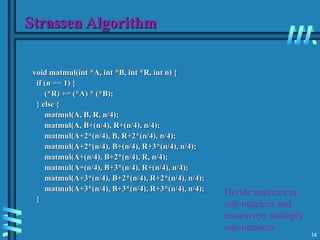
Strassen Algorithm
void matmul(int *A, int *B, int *R, int n) {
if (n == 1) {
(*R) += (*A) * (*B);
} else {
matmul(A, B, R, n/4);
matmul(A, B+(n/4), R+(n/4), n/4);
matmul(A+2*(n/4), B, R+2*(n/4), n/4);
matmul(A+2*(n/4), B+(n/4), R+3*(n/4), n/4);
matmul(A+(n/4), B+2*(n/4), R, n/4);
matmul(A+(n/4), B+3*(n/4), R+(n/4), n/4);
matmul(A+3*(n/4), B+2*(n/4), R+2*(n/4), n/4);
matmul(A+3*(n/4), B+3*(n/4), R+3*(n/4), n/4);
}
Divide matrices in
sub-matrices and
recursively multiply
sub-matrices
15
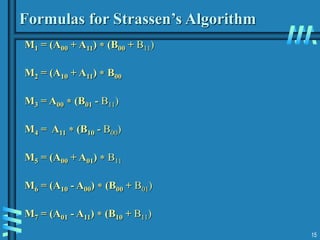
Formulas for Strassen’s Algorithm
M1 = (A00 + A11)  (B00 + B11)
M2 = (A10 + A11)  B00
M3 = A00  (B01 - B11)
M4 = A11  (B10 - B00)
M5 = (A00 + A01)  B11
M6 = (A10 - A00)  (B00 + B01)
M7 = (A01 - A11)  (B10 + B11)
16
Strassen’s Matrix Multiplication
Strassen observed [1969] that the product of two matrices can
be computed as follows:
C00 C01 A00 A01 B00 B01
= *
C10 C11 A10 A11 B10 B11
M1 + M4 - M5 + M7 M3 + M5
=
M2 + M4 M1 + M3 - M2 + M6
17
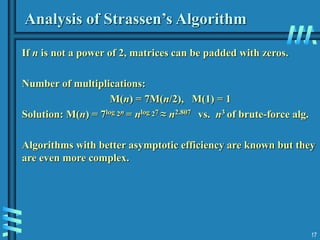
Analysis of Strassen’s Algorithm
If n is not a power of 2, matrices can be padded with zeros.
Number of multiplications:
M(n) = 7M(n/2), M(1) = 1
Solution: M(n) = 7log 2n = nlog 27 ≈ n2.807 vs. n3 of brute-force alg.
Algorithms with better asymptotic efficiency are known but they
are even more complex.
18
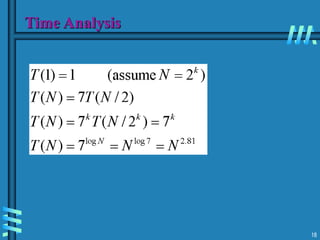
Time Analysis
Example for matrix multiplication
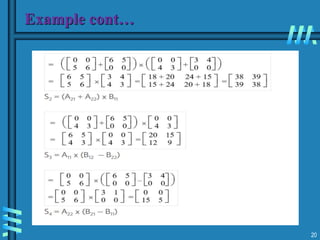
Example cont…
20
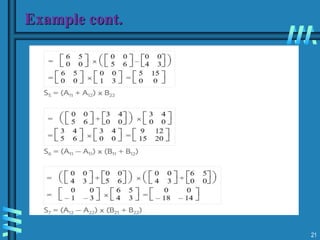
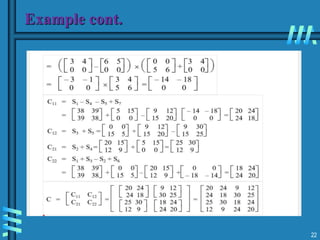
Example cont.
21
Example cont.
22
23
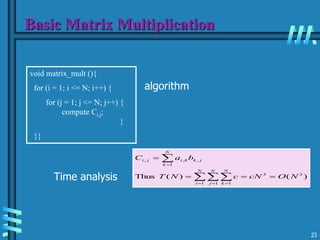
Basic Matrix Multiplication
)
(
)
(
Thus 3
1 1
3
1
,
1
,
,
N
O
cN
c
N
T
b
a
C
N
i
N
j
N
k
j
k
N
k
k
i
j
i






  

void matrix_mult (){
for (i = 1; i <= N; i++) {
for (j = 1; j <= N; j++) {
compute Ci,j;
}
}}
algorithm
Time analysis
24
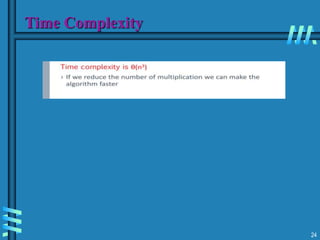
Time Complexity
25
Thank you

Ayush Jajoo(MCA2501622) AOA .pptx

  • 1.
    Matrix Multiplication Using DivideAnd Conquer 1 Presented by: Ayush Jajoo Roll No : MCA25016/22 MCA-Second Semester Presented To: Dr. Madhavi Sinha
  • 2.
    Matrix multiplication Matrix multiplicationis an important operation in many mathematical and image processing applications. Suppose we want to multiply two matrices A and B, each of size n x n, multiplication is operation is defined as C11 = A11 B11 + A12 B21 C12 = A11 B12 + A12 B22 C21 = A21 B11 + A22 B21 C22 = A21 B12 + A22 B22 2
  • 3.
    Algorithm for matrixmultiplication Algorithm MATRIX_MULTIPLICATION(A, B, C) // A and B are input matrices of size n x n // C is the output matrix of size n x n for i ← 1 to n do for j ← 1 to n do C[i][j] ← 0 for k ← 1 to n do C[i][j] ← C[i][j] + A[i][k]*B[k][j] end end end 3
  • 4.
    4 Divide-and-Conquer  Divide-and conqueris a general algorithm design paradigm: • Divide: divide the input data S in two or more disjoint subsets S1, S2, … • Recur: solve the subproblems recursively • Conquer: combine the solutions for S1, S2, …, into a solution for S  The base case for the recursion are subproblems of constant size  Analysis can be done using recurrence equations
  • 5.
    5 Divide-and-Conquer The most-well knownalgorithm design strategy: 1. Divide instance of problem into two or more smaller instances 2. Solve smaller instances recursively 3. Obtain solution to original (larger) instance by combining these solutions
  • 6.
    6 Divide-and-Conquer Technique (cont.) subproblem2 of size n/2 subproblem 1 of size n/2 a solution to subproblem 1 a solution to the original problem a solution to subproblem 2 a problem of size n
  • 7.
    7 Divide-and-Conquer Examples  Matrixmultiplication: Strassen’s algorithm  Example for matrix Multiplication
  • 8.
    8 Strassens’s Matrix Multiplication Belongs to divide and conquer Approach  Strassen has used some formulas for multiplying the two 2*2 dimension matrices where the number of multiplications is seven, additions and subtractions are is eighteen, and in brute force algorithm, there is eight number of multiplications and four addition.
  • 9.
    9 Divide and ConquerMatrix Multiply  = a0 b0 a0  b0 A  B = R • Terminate recursion with a simple base case
  • 10.
    10 Divide and ConquerMatrix Multiply A  B = R A0 A1 A2 A3 B0 B1 B2 B3 A0B0+A1B2 A0B1+A1B3 A2B0+A3B2 A2B1+A3B3  = •Divide matrices into sub-matrices: A0 , A1, A2 etc •Use blocked matrix multiply equations •Recursively multiply sub-matrices
  • 11.
    11 Basic Matrix Multiplication Supposewe want to multiply two matrices of size N x N: for example A x B = C. C11 = a11b11 + a12b21 C12 = a11b12 + a12b22 C21 = a21b11 + a22b21 C22 = a21b12 + a22b22 2x2 matrix multiplication can be accomplished in 8 multiplication.(2log 2 8 =23)
  • 12.
    12 Strassens’s Matrix Multiplication P1= (A11+ A22)(B11+B22) P2 = (A21 + A22) * B11 P3 = A11 * (B12 - B22) P4 = A22 * (B21 - B11) P5 = (A11 + A12) * B22 P6 = (A21 - A11) * (B11 + B12) P7 = (A12 - A22) * (B21 + B22) C11 = P1 + P4 - P5 + P7 C12 = P3 + P5 C21 = P2 + P4 C22 = P1 + P3 - P2 + P6
  • 13.
    13 C11 = P1+ P4 - P5 + P7 = (A11+ A22)(B11+B22) + A22 * (B21 - B11) - (A11 + A12) * B22+ (A12 - A22) * (B21 + B22) = A11 B11 + A11 B22 + A22 B11 + A22 B22 + A22 B21 – A22 B11 - A11 B22 -A12 B22 +A12 B21 + A12 B22 – A22 B21 – A22 B22 = A11 B11 +A12 B21 Comparison
  • 14.
    14 Strassen Algorithm void matmul(int*A, int *B, int *R, int n) { if (n == 1) { (*R) += (*A) * (*B); } else { matmul(A, B, R, n/4); matmul(A, B+(n/4), R+(n/4), n/4); matmul(A+2*(n/4), B, R+2*(n/4), n/4); matmul(A+2*(n/4), B+(n/4), R+3*(n/4), n/4); matmul(A+(n/4), B+2*(n/4), R, n/4); matmul(A+(n/4), B+3*(n/4), R+(n/4), n/4); matmul(A+3*(n/4), B+2*(n/4), R+2*(n/4), n/4); matmul(A+3*(n/4), B+3*(n/4), R+3*(n/4), n/4); } Divide matrices in sub-matrices and recursively multiply sub-matrices
  • 15.
    15 Formulas for Strassen’sAlgorithm M1 = (A00 + A11)  (B00 + B11) M2 = (A10 + A11)  B00 M3 = A00  (B01 - B11) M4 = A11  (B10 - B00) M5 = (A00 + A01)  B11 M6 = (A10 - A00)  (B00 + B01) M7 = (A01 - A11)  (B10 + B11)
  • 16.
    16 Strassen’s Matrix Multiplication Strassenobserved [1969] that the product of two matrices can be computed as follows: C00 C01 A00 A01 B00 B01 = * C10 C11 A10 A11 B10 B11 M1 + M4 - M5 + M7 M3 + M5 = M2 + M4 M1 + M3 - M2 + M6
  • 17.
    17 Analysis of Strassen’sAlgorithm If n is not a power of 2, matrices can be padded with zeros. Number of multiplications: M(n) = 7M(n/2), M(1) = 1 Solution: M(n) = 7log 2n = nlog 27 ≈ n2.807 vs. n3 of brute-force alg. Algorithms with better asymptotic efficiency are known but they are even more complex.
  • 18.
  • 19.
    Example for matrixmultiplication
  • 20.
  • 21.
  • 22.
  • 23.
    23 Basic Matrix Multiplication ) ( ) ( Thus3 1 1 3 1 , 1 , , N O cN c N T b a C N i N j N k j k N k k i j i           void matrix_mult (){ for (i = 1; i <= N; i++) { for (j = 1; j <= N; j++) { compute Ci,j; } }} algorithm Time analysis
  • 24.
  • 25.