IKEA- SWOT
SWOT ANALYSIS AND SUSTAINABLE
BUSINESS PLANNING FOR IKEA
PRESENTED BY
IBRAHIM ZUBAIRU ABUBAKAR
ABBA SHEHU
EDITH JURA
INTRODUCTION
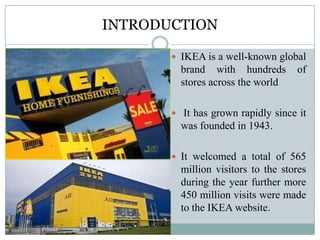
 IKEA is a well-known global

brand with hundreds
stores across the world

of

 It has grown rapidly since it

was founded in 1943.
 It welcomed a total of 565

million visitors to the stores
during the year further more
450 million visits were made
to the IKEA website.
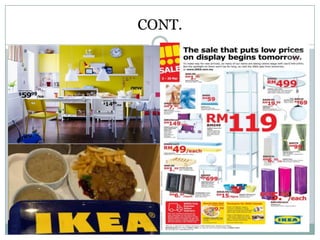
CONT.
 It

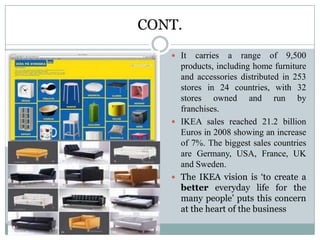
carries a range of 9,500
products, including home furniture
and accessories distributed in 253
stores in 24 countries, with 32
stores owned and run by
franchises.
 IKEA sales reached 21.2 billion
Euros in 2008 showing an increase
of 7%. The biggest sales countries
are Germany, USA, France, UK
and Sweden.
 The IKEA vision is ‘to create a
better everyday life for the
many people’ puts this concern
at the heart of the business
CONT.
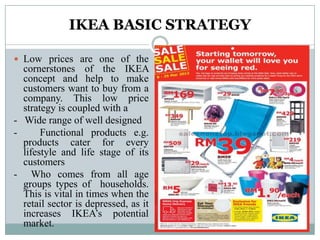
IKEA BASIC STRATEGY
 Low prices are one of the

cornerstones of the IKEA
concept and help to make
customers want to buy from a
company. This low price
strategy is coupled with a
- Wide range of well designed
Functional products e.g.
products cater for every
lifestyle and life stage of its
customers
- Who comes from all age
groups types of households.
This is vital in times when the
retail sector is depressed, as it
increases IKEA’s potential
market.
ENVIRONMENTAL STANCE (SWOT
ANALYSIS)
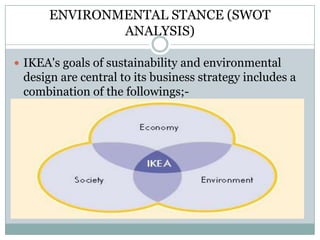
 IKEA's goals of sustainability and environmental

design are central to its business strategy includes a
combination of the followings;-
CONT.
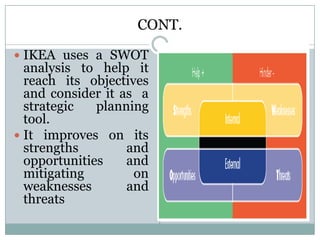
 IKEA uses a SWOT

analysis to help it
reach its objectives
and consider it as a
strategic
planning
tool.
 It improves on its
strengths
and
opportunities
and
mitigating
on
weaknesses
and
threats
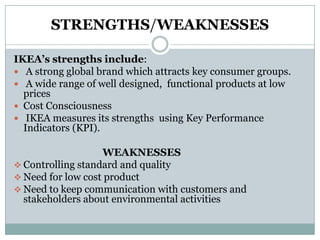
STRENGTHS/WEAKNESSES
IKEA’s strengths include:
 A strong global brand which attracts key consumer groups.
 A wide range of well designed, functional products at low
prices
 Cost Consciousness
 IKEA measures its strengths using Key Performance
Indicators (KPI).
WEAKNESSES
 Controlling standard and quality
 Need for low cost product
 Need to keep communication with customers and
stakeholders about environmental activities
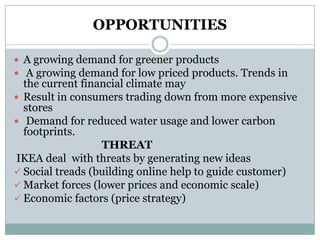
OPPORTUNITIES
 A growing demand for greener products
 A growing demand for low priced products. Trends in

the current financial climate may
 Result in consumers trading down from more expensive
stores
 Demand for reduced water usage and lower carbon
footprints.
THREAT
IKEA deal with threats by generating new ideas
 Social treads (building online help to guide customer)
 Market forces (lower prices and economic scale)
 Economic factors (price strategy)
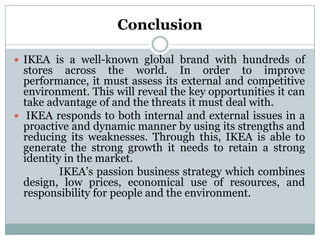
Conclusion
 IKEA is a well-known global brand with hundreds of

stores across the world. In order to improve
performance, it must assess its external and competitive
environment. This will reveal the key opportunities it can
take advantage of and the threats it must deal with.
 IKEA responds to both internal and external issues in a
proactive and dynamic manner by using its strengths and
reducing its weaknesses. Through this, IKEA is able to
generate the strong growth it needs to retain a strong
identity in the market.
IKEA’s passion business strategy which combines
design, low prices, economical use of resources, and
responsibility for people and the environment.

SWOT ANALYSIS FOR IKEA

  • 1.
    IKEA- SWOT SWOT ANALYSISAND SUSTAINABLE BUSINESS PLANNING FOR IKEA PRESENTED BY IBRAHIM ZUBAIRU ABUBAKAR ABBA SHEHU EDITH JURA
  • 2.
    INTRODUCTION  IKEA isa well-known global brand with hundreds stores across the world of  It has grown rapidly since it was founded in 1943.  It welcomed a total of 565 million visitors to the stores during the year further more 450 million visits were made to the IKEA website.
  • 3.
    CONT.  It carries arange of 9,500 products, including home furniture and accessories distributed in 253 stores in 24 countries, with 32 stores owned and run by franchises.  IKEA sales reached 21.2 billion Euros in 2008 showing an increase of 7%. The biggest sales countries are Germany, USA, France, UK and Sweden.  The IKEA vision is ‘to create a better everyday life for the many people’ puts this concern at the heart of the business
  • 4.
  • 5.
    IKEA BASIC STRATEGY Low prices are one of the cornerstones of the IKEA concept and help to make customers want to buy from a company. This low price strategy is coupled with a - Wide range of well designed Functional products e.g. products cater for every lifestyle and life stage of its customers - Who comes from all age groups types of households. This is vital in times when the retail sector is depressed, as it increases IKEA’s potential market.
  • 6.
    ENVIRONMENTAL STANCE (SWOT ANALYSIS) IKEA's goals of sustainability and environmental design are central to its business strategy includes a combination of the followings;-
  • 7.
    CONT.  IKEA usesa SWOT analysis to help it reach its objectives and consider it as a strategic planning tool.  It improves on its strengths and opportunities and mitigating on weaknesses and threats
  • 8.
    STRENGTHS/WEAKNESSES IKEA’s strengths include: A strong global brand which attracts key consumer groups.  A wide range of well designed, functional products at low prices  Cost Consciousness  IKEA measures its strengths using Key Performance Indicators (KPI). WEAKNESSES  Controlling standard and quality  Need for low cost product  Need to keep communication with customers and stakeholders about environmental activities
  • 9.
    OPPORTUNITIES  A growingdemand for greener products  A growing demand for low priced products. Trends in the current financial climate may  Result in consumers trading down from more expensive stores  Demand for reduced water usage and lower carbon footprints. THREAT IKEA deal with threats by generating new ideas  Social treads (building online help to guide customer)  Market forces (lower prices and economic scale)  Economic factors (price strategy)
  • 10.
    Conclusion  IKEA isa well-known global brand with hundreds of stores across the world. In order to improve performance, it must assess its external and competitive environment. This will reveal the key opportunities it can take advantage of and the threats it must deal with.  IKEA responds to both internal and external issues in a proactive and dynamic manner by using its strengths and reducing its weaknesses. Through this, IKEA is able to generate the strong growth it needs to retain a strong identity in the market. IKEA’s passion business strategy which combines design, low prices, economical use of resources, and responsibility for people and the environment.