IKEA
THE LIFE IMPROVEMENT STORE
Presented By
Syed Maktoom Hassan
Ambreen Sami
Hafiza Khizra
Muhammad Umair Majeed
Abdul Qadir Sayani
INTRODUCTION
• IKEA was founded by Ingvar Kamprad a native of Sweden in 1943,
when the founder, at the age of 17 was given money by his father in
return for doing well in his studies.
• The company initially sold basic items such as pens, picture frames,
table runners, wallets, jewelry, nylons stockings and watches, at a low
price.
• The main business are manufacture and selling of a wide range of
home furnishing products at an affordable price
• The company has 230 stores, with operations carried out in over 42
countries with well over 70 000 employees.
VISION
The vision at IKEA is to
“create a better everyday life for the many
people”
IKEA STRATEGY
Ikea's forward-thinking strategy made it the top
furniture seller in the world.
Key Points of their Strategy are:
• Solving the worst part of buying furniture.
• Hitting the right demographic. (Resonate with young
people)
• Not expensive, but not too cheap.
• Stores are a destination.
INTERNATIONAL STRATEGY
• Increased market size: They are entering to new geographical markets
with their Swedish designed furniture.
• Greater returns on major capital investments: On initial expansion,
IKEA earned greater return from other countries than their home
country. Therefore they explored different markets. Currently they
have identified US, China and Russia as their main markets which
generate better returns.
• Economies of scale: This can be exploited by expanding into markets
that contain homogeneous consumer tastes and do not require much
adaptation, by using standardized products all over the world.
VALUE CHAIN ANALYSIS
PRIMARY ACTIVITIES
ACTIVITY IMPLEMENTATION BY IKEA
Inbound
Logistics
• Distribution of products to the stores from 42 distribution
centers.
• 10,000 item product line manufactured by over 1,000 suppliers.
Outbound
Logistics
• Preferred method for customer to transport their products
themselves.
Operations • Operations in more than 40 countries, 208 companies operated
stores in 26 countries while remaining stores operated by
franchisees
• IKEA does not manufacture its own products
VALUE CHAIN ANALYSIS
PRIMARY ACTIVITIES
ACTIVITY IMPLEMENTATION BY IKEA
Marketing
and Sales
• Targeted at families with lower income, students and singles
• Low prices.
• Family-friendly store environment.
Services • Information provided through catalogues and displays.
• Self-help service.
• Support Activities
• Low number of sales assistants in stores
VALUE CHAIN ANALYSIS
SECONDARY ACTIVITIES
ACTIVITY IMPLEMENTATION BY IKEA
Firm Infrastructure • Hierarchical organizational structure.
• Large scale stores in size.
Human Resource
Management
• High level of commitment to HR practices
• Effective staff training and development programs
Technology
Development
• Research and development activities initiated in Sweden.
• Extensive use of information technologies in various business
processes and research and development.
Procurement • No need for raw materials as IKEA does not produce own brand
products
• Long strategic relationships with all suppliers
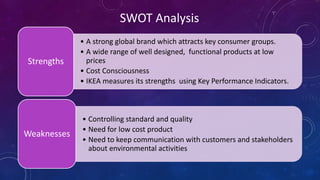
• A strong global brand which attracts key consumer groups.
• A wide range of well designed, functional products at low
prices
• Cost Consciousness
• IKEA measures its strengths using Key Performance Indicators.
Strengths
• Controlling standard and quality
• Need for low cost product
• Need to keep communication with customers and stakeholders
about environmental activities
Weaknesses
SWOT Analysis
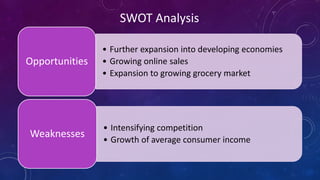
• Further expansion into developing economies
• Growing online sales
• Expansion to growing grocery market
Opportunities
• Intensifying competition
• Growth of average consumer income
Weaknesses
SWOT Analysis
PORTER FIVE FORCES:
Threat of New
Entrants
• Low
• Saturation in
market
• High investment
cost
Bargaining power
of suppliers
• High
• Factories around
the globe.
• Maintain long term
relationships.
Bargaining power
of buyers
• High
• Wide choice
• Imported Furniture
PORTER FIVE FORCES:
Threat of
substitute products
• Low
• No other products substitute
Furniture.
• Constant Demand
Rivalry among
competing firms
• High
• Highly competitive industry.
• Presence in China and Japan to
sustain competitive advantage.
COMPETITIVE EDGE
• Entering in Economies of Scale – Standardization
• In Economies of Scope – Furniture and Restaurant Share Facilities
• Economic Design – Inbound and Outbound Logistics
• Great Network of Supply – More than 1300 suppliers in 55 countries
• Large Warehouse Showroom in Sub-Urban centers
• Customers included in the value chain – minimum staff
• Strength of Brand Image and Name, Global Marketing Strategy
• Distinctiveness in design, promoting designers’ concepts, eco design
• Diversity in Assortment
CONCLUSION
• IKEA’s vision has contributed in improving lives for the many
people in practicing sustainable environment.
• IKEA plays a vital role in ensuring its products are sustainable
and takes the leadership role to educate its suppliers to
understand how and why sustainable production is vital.
• These factors are the key differentiators that has made IKEA’s
different from its competitors. IKEA is one of the trustworthy
company that is responsible for their product and its impact on
the environment

Ik ea

  • 1.
    IKEA THE LIFE IMPROVEMENTSTORE Presented By Syed Maktoom Hassan Ambreen Sami Hafiza Khizra Muhammad Umair Majeed Abdul Qadir Sayani
  • 2.
    INTRODUCTION • IKEA wasfounded by Ingvar Kamprad a native of Sweden in 1943, when the founder, at the age of 17 was given money by his father in return for doing well in his studies. • The company initially sold basic items such as pens, picture frames, table runners, wallets, jewelry, nylons stockings and watches, at a low price. • The main business are manufacture and selling of a wide range of home furnishing products at an affordable price • The company has 230 stores, with operations carried out in over 42 countries with well over 70 000 employees.
  • 3.
    VISION The vision atIKEA is to “create a better everyday life for the many people”
  • 4.
    IKEA STRATEGY Ikea's forward-thinkingstrategy made it the top furniture seller in the world. Key Points of their Strategy are: • Solving the worst part of buying furniture. • Hitting the right demographic. (Resonate with young people) • Not expensive, but not too cheap. • Stores are a destination.
  • 5.
    INTERNATIONAL STRATEGY • Increasedmarket size: They are entering to new geographical markets with their Swedish designed furniture. • Greater returns on major capital investments: On initial expansion, IKEA earned greater return from other countries than their home country. Therefore they explored different markets. Currently they have identified US, China and Russia as their main markets which generate better returns. • Economies of scale: This can be exploited by expanding into markets that contain homogeneous consumer tastes and do not require much adaptation, by using standardized products all over the world.
  • 7.
    VALUE CHAIN ANALYSIS PRIMARYACTIVITIES ACTIVITY IMPLEMENTATION BY IKEA Inbound Logistics • Distribution of products to the stores from 42 distribution centers. • 10,000 item product line manufactured by over 1,000 suppliers. Outbound Logistics • Preferred method for customer to transport their products themselves. Operations • Operations in more than 40 countries, 208 companies operated stores in 26 countries while remaining stores operated by franchisees • IKEA does not manufacture its own products
  • 8.
    VALUE CHAIN ANALYSIS PRIMARYACTIVITIES ACTIVITY IMPLEMENTATION BY IKEA Marketing and Sales • Targeted at families with lower income, students and singles • Low prices. • Family-friendly store environment. Services • Information provided through catalogues and displays. • Self-help service. • Support Activities • Low number of sales assistants in stores
  • 9.
    VALUE CHAIN ANALYSIS SECONDARYACTIVITIES ACTIVITY IMPLEMENTATION BY IKEA Firm Infrastructure • Hierarchical organizational structure. • Large scale stores in size. Human Resource Management • High level of commitment to HR practices • Effective staff training and development programs Technology Development • Research and development activities initiated in Sweden. • Extensive use of information technologies in various business processes and research and development. Procurement • No need for raw materials as IKEA does not produce own brand products • Long strategic relationships with all suppliers
  • 11.
    • A strongglobal brand which attracts key consumer groups. • A wide range of well designed, functional products at low prices • Cost Consciousness • IKEA measures its strengths using Key Performance Indicators. Strengths • Controlling standard and quality • Need for low cost product • Need to keep communication with customers and stakeholders about environmental activities Weaknesses SWOT Analysis
  • 12.
    • Further expansioninto developing economies • Growing online sales • Expansion to growing grocery market Opportunities • Intensifying competition • Growth of average consumer income Weaknesses SWOT Analysis
  • 14.
    PORTER FIVE FORCES: Threatof New Entrants • Low • Saturation in market • High investment cost Bargaining power of suppliers • High • Factories around the globe. • Maintain long term relationships. Bargaining power of buyers • High • Wide choice • Imported Furniture
  • 15.
    PORTER FIVE FORCES: Threatof substitute products • Low • No other products substitute Furniture. • Constant Demand Rivalry among competing firms • High • Highly competitive industry. • Presence in China and Japan to sustain competitive advantage.
  • 17.
    COMPETITIVE EDGE • Enteringin Economies of Scale – Standardization • In Economies of Scope – Furniture and Restaurant Share Facilities • Economic Design – Inbound and Outbound Logistics • Great Network of Supply – More than 1300 suppliers in 55 countries • Large Warehouse Showroom in Sub-Urban centers • Customers included in the value chain – minimum staff • Strength of Brand Image and Name, Global Marketing Strategy • Distinctiveness in design, promoting designers’ concepts, eco design • Diversity in Assortment
  • 18.
    CONCLUSION • IKEA’s visionhas contributed in improving lives for the many people in practicing sustainable environment. • IKEA plays a vital role in ensuring its products are sustainable and takes the leadership role to educate its suppliers to understand how and why sustainable production is vital. • These factors are the key differentiators that has made IKEA’s different from its competitors. IKEA is one of the trustworthy company that is responsible for their product and its impact on the environment