
• IKEA has Swedish roots dating back to the 1920s.
• They have focused on high quality, functional, innovative, low
priced home furnishings.
• Over six decades, they have introduced products for everyday
living (not just furniture), broadening their brand’s meaning.
• Sustainability has become an important part of their mission.
• As of 2013, they have a presence in 40 countries.
• Positioning
• Key Marketing activities
• Opportunities to Enhance
• Brand Resonance
• Brand Architecture
• Brand Hierarchy
• Market Channels
• Growth Strategy
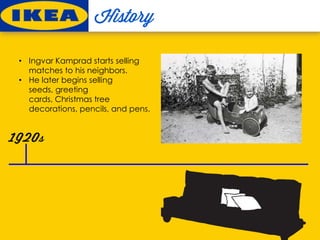
• Ingvar Kamprad starts selling
matches to his neighbors.
• He later begins selling
seeds, greeting
cards, Christmas tree
decorations, pencils, and pens.
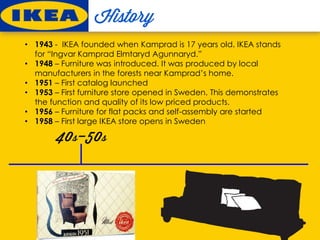
• 1943 - IKEA founded when Kamprad is 17 years old. IKEA stands
for “Ingvar Kamprad Elmtaryd Agunnaryd.”
• 1948 – Furniture was introduced. It was produced by local
manufacturers in the forests near Kamprad’s home.
• 1951 – First catalog launched
• 1953 – First furniture store opened in Sweden. This demonstrates
the function and quality of its low priced products.
• 1956 – Furniture for flat packs and self-assembly are started
• 1958 – First large IKEA store opens in Sweden
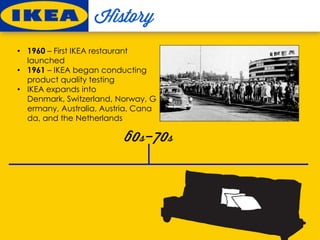
• 1960 – First IKEA restaurant
launched
• 1961 – IKEA began conducting
product quality testing
• IKEA expands into
Denmark, Switzerland, Norway, G
ermany, Australia, Austria, Cana
da, and the Netherlands
• 1984 –IKEA family is launched, IKEA
STOCKHOLM range is launched, and
the catalog reached 45 million copies
in 9 languages
• 1985 – IKEA arrives in the US
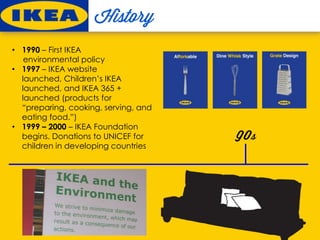
• 1990 – First IKEA
environmental policy
• 1997 – IKEA website
launched, Children’s IKEA
launched, and IKEA 365 +
launched (products for
“preparing, cooking, serving, and
eating food.”)
• 1999 – 2000 – IKEA Foundation
begins. Donations to UNICEF for
children in developing countries
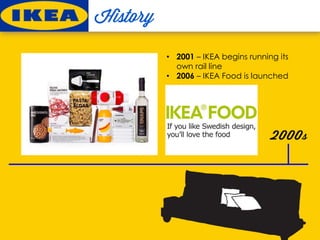
• 2001 – IKEA begins running its
own rail line
• 2006 – IKEA Food is launched
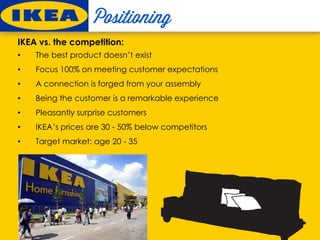
• The best product doesn’t exist
• Focus 100% on meeting customer expectations
• A connection is forged from your assembly
• Being the customer is a remarkable experience
• Pleasantly surprise customers
• IKEA’s prices are 30 - 50% below competitors
• Target market: age 20 - 35
IKEA vs. the competition:
• Image and functional-related considerations in terms of
brand associations.
• Leveraging of secondary associations (country of origin)
• Product offerings
IKEA’s points of difference:
• Category points of parity: home furnishings
• Correlational points of parity: “High quality AND low price”
• A key part of IKEA’s positioning
IKEA’s points of parity:
• “Plant a Tree”
• 100% renewable energy
used in Sweden
• Wind energy on the rise
• Steam engine used for
transportation
• 74% of all products are
recyclable
• No more plastic
• Many stores use solar
panels on the roofs
Environmentally friendly company: Expanding the Line:
• Move into other
specified field
• Consumers one-stop-shop
• Introducing new lines of
products
• – Televisions
• – Food
• – Beer (in Sweden)
• Store Inaugurations enhance the IKEA experience
• Associations of their Swedish heritage adds credibility
• Products assigned Scandinavian proper names
• Consistency in global strategy and company mission and values
• Limiting channels of distribution adds value to shopping at IKEA
• Innovation on all levels
• Revolutionizing product distribution
• One-stop-shop
• Passing savings onto consumers
• Giving consumers products immediately
Key Marketing Activities:
Opportunities to Enhance Positioning:
• Increase awareness about social and environmental
responsibility as a significant POD for IKEA’s brand and
products
• Introduce category extension with IKEA electronics
• IKEA has such a unique offering that it is very hard for
businesses to compete
• Continue to build on the idea of improving the everyday life of
people everywhere
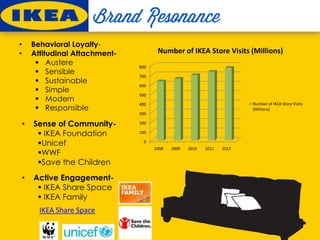
0
100
200
300
400
500
600
700
800
2008 2009 2010 2011 2012
Number of IKEA Store Visits (Millions)
Number of IKEA Store Visits
(Millions)
• Behavioral Loyalty-
• Attitudinal Attachment-
 Austere
 Sensible
 Sustainable
 Simple
 Modern
 Responsible
• Sense of Community-
 IKEA Foundation
Unicef
WWF
Save the Children
• Active Engagement-
 IKEA Share Space
 IKEA Family
IKEA Share Space
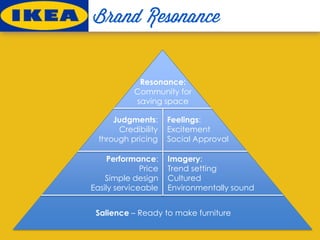
Salience – Ready to make furniture
Imagery:
Trend setting
Cultured
Environmentally sound
Performance:
Price
Simple design
Easily serviceable
Feelings:
Excitement
Social Approval
Judgments:
Credibility
through pricing
Resonance:
Community for
saving space
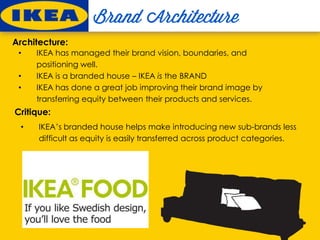
• IKEA has managed their brand vision, boundaries, and
positioning well.
• IKEA is a branded house – IKEA is the BRAND
• IKEA has done a great job improving their brand image by
transferring equity between their products and services.
Critique:
• IKEA’s branded house helps make introducing new sub-brands less
difficult as equity is easily transferred across product categories.
Architecture:
Textiles
&
Rugs
Bedroom
Kitchen
&
appliances
Living
Room
IKEA
shopping
services
Children’s
IKEA
IKEA
365+
IKEA
furniture
IKEA
Food
Lighting
Coffee
& side
tables
TV +
media
furniture
Storage
Sofas
&
armchairs
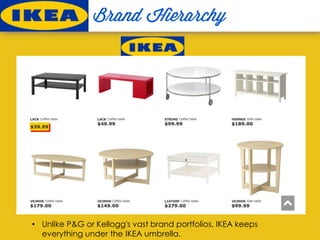
• Unlike P&G or Kellogg's vast brand portfolios, IKEA keeps
everything under the IKEA umbrella.
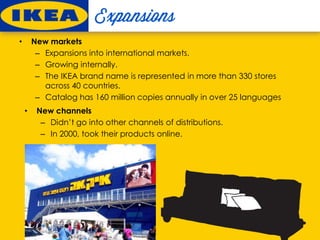
• New markets
– Expansions into international markets.
– Growing internally.
– The IKEA brand name is represented in more than 330 stores
across 40 countries.
– Catalog has 160 million copies annually in over 25 languages
• New channels
– Didn’t go into other channels of distributions.
– In 2000, took their products online.
• Growth Strategy
- Good pace of introduction of IKEA into other markets.
- Didn’t expand into new channels so they have more
control over their product.
Ikea Brand Audit

Ikea Brand Audit

  • 2.
    • IKEA hasSwedish roots dating back to the 1920s. • They have focused on high quality, functional, innovative, low priced home furnishings. • Over six decades, they have introduced products for everyday living (not just furniture), broadening their brand’s meaning. • Sustainability has become an important part of their mission. • As of 2013, they have a presence in 40 countries. • Positioning • Key Marketing activities • Opportunities to Enhance • Brand Resonance • Brand Architecture • Brand Hierarchy • Market Channels • Growth Strategy
  • 3.
    • Ingvar Kampradstarts selling matches to his neighbors. • He later begins selling seeds, greeting cards, Christmas tree decorations, pencils, and pens.
  • 4.
    • 1943 -IKEA founded when Kamprad is 17 years old. IKEA stands for “Ingvar Kamprad Elmtaryd Agunnaryd.” • 1948 – Furniture was introduced. It was produced by local manufacturers in the forests near Kamprad’s home. • 1951 – First catalog launched • 1953 – First furniture store opened in Sweden. This demonstrates the function and quality of its low priced products. • 1956 – Furniture for flat packs and self-assembly are started • 1958 – First large IKEA store opens in Sweden
  • 5.
    • 1960 –First IKEA restaurant launched • 1961 – IKEA began conducting product quality testing • IKEA expands into Denmark, Switzerland, Norway, G ermany, Australia, Austria, Cana da, and the Netherlands
  • 6.
    • 1984 –IKEAfamily is launched, IKEA STOCKHOLM range is launched, and the catalog reached 45 million copies in 9 languages • 1985 – IKEA arrives in the US
  • 7.
    • 1990 –First IKEA environmental policy • 1997 – IKEA website launched, Children’s IKEA launched, and IKEA 365 + launched (products for “preparing, cooking, serving, and eating food.”) • 1999 – 2000 – IKEA Foundation begins. Donations to UNICEF for children in developing countries
  • 8.
    • 2001 –IKEA begins running its own rail line • 2006 – IKEA Food is launched
  • 9.
    • The bestproduct doesn’t exist • Focus 100% on meeting customer expectations • A connection is forged from your assembly • Being the customer is a remarkable experience • Pleasantly surprise customers • IKEA’s prices are 30 - 50% below competitors • Target market: age 20 - 35 IKEA vs. the competition:
  • 10.
    • Image andfunctional-related considerations in terms of brand associations. • Leveraging of secondary associations (country of origin) • Product offerings IKEA’s points of difference: • Category points of parity: home furnishings • Correlational points of parity: “High quality AND low price” • A key part of IKEA’s positioning IKEA’s points of parity:
  • 11.
    • “Plant aTree” • 100% renewable energy used in Sweden • Wind energy on the rise • Steam engine used for transportation • 74% of all products are recyclable • No more plastic • Many stores use solar panels on the roofs Environmentally friendly company: Expanding the Line: • Move into other specified field • Consumers one-stop-shop • Introducing new lines of products • – Televisions • – Food • – Beer (in Sweden)
  • 12.
    • Store Inaugurationsenhance the IKEA experience • Associations of their Swedish heritage adds credibility • Products assigned Scandinavian proper names • Consistency in global strategy and company mission and values • Limiting channels of distribution adds value to shopping at IKEA • Innovation on all levels • Revolutionizing product distribution • One-stop-shop • Passing savings onto consumers • Giving consumers products immediately Key Marketing Activities:
  • 13.
    Opportunities to EnhancePositioning: • Increase awareness about social and environmental responsibility as a significant POD for IKEA’s brand and products • Introduce category extension with IKEA electronics • IKEA has such a unique offering that it is very hard for businesses to compete • Continue to build on the idea of improving the everyday life of people everywhere
  • 14.
    0 100 200 300 400 500 600 700 800 2008 2009 20102011 2012 Number of IKEA Store Visits (Millions) Number of IKEA Store Visits (Millions) • Behavioral Loyalty- • Attitudinal Attachment-  Austere  Sensible  Sustainable  Simple  Modern  Responsible • Sense of Community-  IKEA Foundation Unicef WWF Save the Children • Active Engagement-  IKEA Share Space  IKEA Family IKEA Share Space
  • 15.
    Salience – Readyto make furniture Imagery: Trend setting Cultured Environmentally sound Performance: Price Simple design Easily serviceable Feelings: Excitement Social Approval Judgments: Credibility through pricing Resonance: Community for saving space
  • 16.
    • IKEA hasmanaged their brand vision, boundaries, and positioning well. • IKEA is a branded house – IKEA is the BRAND • IKEA has done a great job improving their brand image by transferring equity between their products and services. Critique: • IKEA’s branded house helps make introducing new sub-brands less difficult as equity is easily transferred across product categories. Architecture:
  • 17.
  • 18.
    • New markets –Expansions into international markets. – Growing internally. – The IKEA brand name is represented in more than 330 stores across 40 countries. – Catalog has 160 million copies annually in over 25 languages • New channels – Didn’t go into other channels of distributions. – In 2000, took their products online.
  • 19.
    • Growth Strategy -Good pace of introduction of IKEA into other markets. - Didn’t expand into new channels so they have more control over their product.