CREATIVE ARTS SPORTS
GRADE 7
STRAND 1.0 FOUNDATIONS
OF CREATIVE ARTS AND
SPORTS
SUB STRAND: 1.1. INTRODUCTION TO
CREATIVE ARTS AND SPORTS
SPECIFIC LEARNING OUTCOMES
By the end of the Sub Strand, the learner should be
able to:
• Describe categories of Creative Arts and Sports.
• Outline the relationships among the categories of
Creative Arts and Sports.
• Create a chart on the categories of the Creative Arts
and Sports.
• Appreciate the categories of Creative Arts and Sports.
INTRODUCTION TO CREATIVE ARTS AND
SPORTS.
•What is creative arts?
• Creative Arts is a description of various artistic
activities that allow performers to use their
imaginations, creativity, and express ideas through a
variety of mediums to passage a message to the
audience.
CATEGORIES OF CREATIVE ARTS
Include;
•Visual arts
•Music and dance
•Drama and film
•Sport
1. MUSIC AND DANCE
•Dance: Various styles such as ballet,
contemporary, hip-hop, jazz, etc.
•Music: Instrumental and vocal
performances, encompassing genres like
classical, jazz, rock, pop, etc.
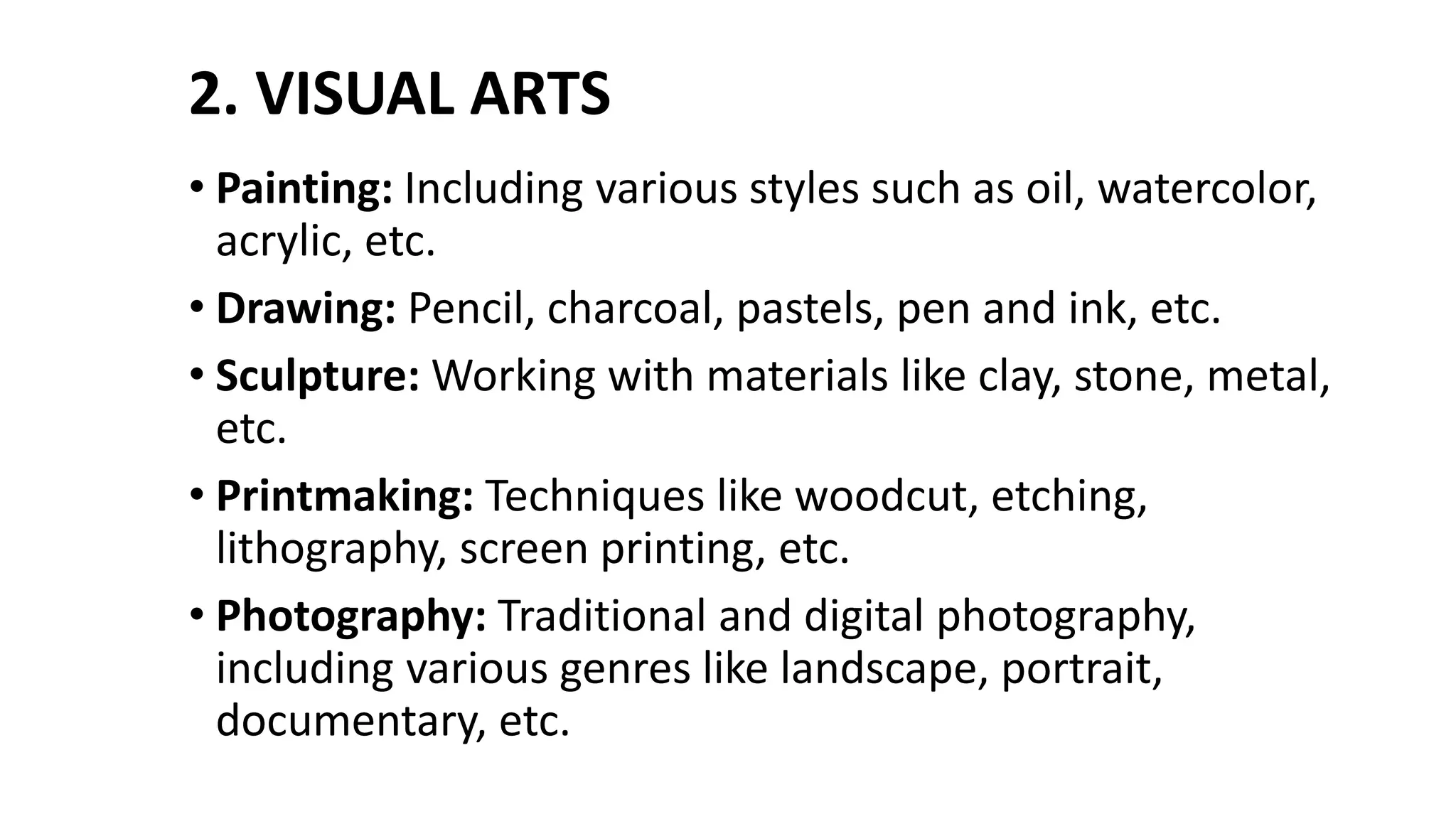
2. VISUAL ARTS
• Painting: Including various styles such as oil, watercolor,
acrylic, etc.
• Drawing: Pencil, charcoal, pastels, pen and ink, etc.
• Sculpture: Working with materials like clay, stone, metal,
etc.
• Printmaking: Techniques like woodcut, etching,
lithography, screen printing, etc.
• Photography: Traditional and digital photography,
including various genres like landscape, portrait,
documentary, etc.
3. DRAMA AND FILM
•Drama: Plays, screenplays, scripts for
various mediums.
•Film: Including narrative films,
documentaries, animations, etc.
WHAT IS SPORTS?
•A sport is any activity involving
physical or mental effort combined
with skills in which an individual or a
team or teams compete against
another or others for entertainment.
4. SPORT
•Swimming: Various strokes and
distances.
•Soccer (Football)
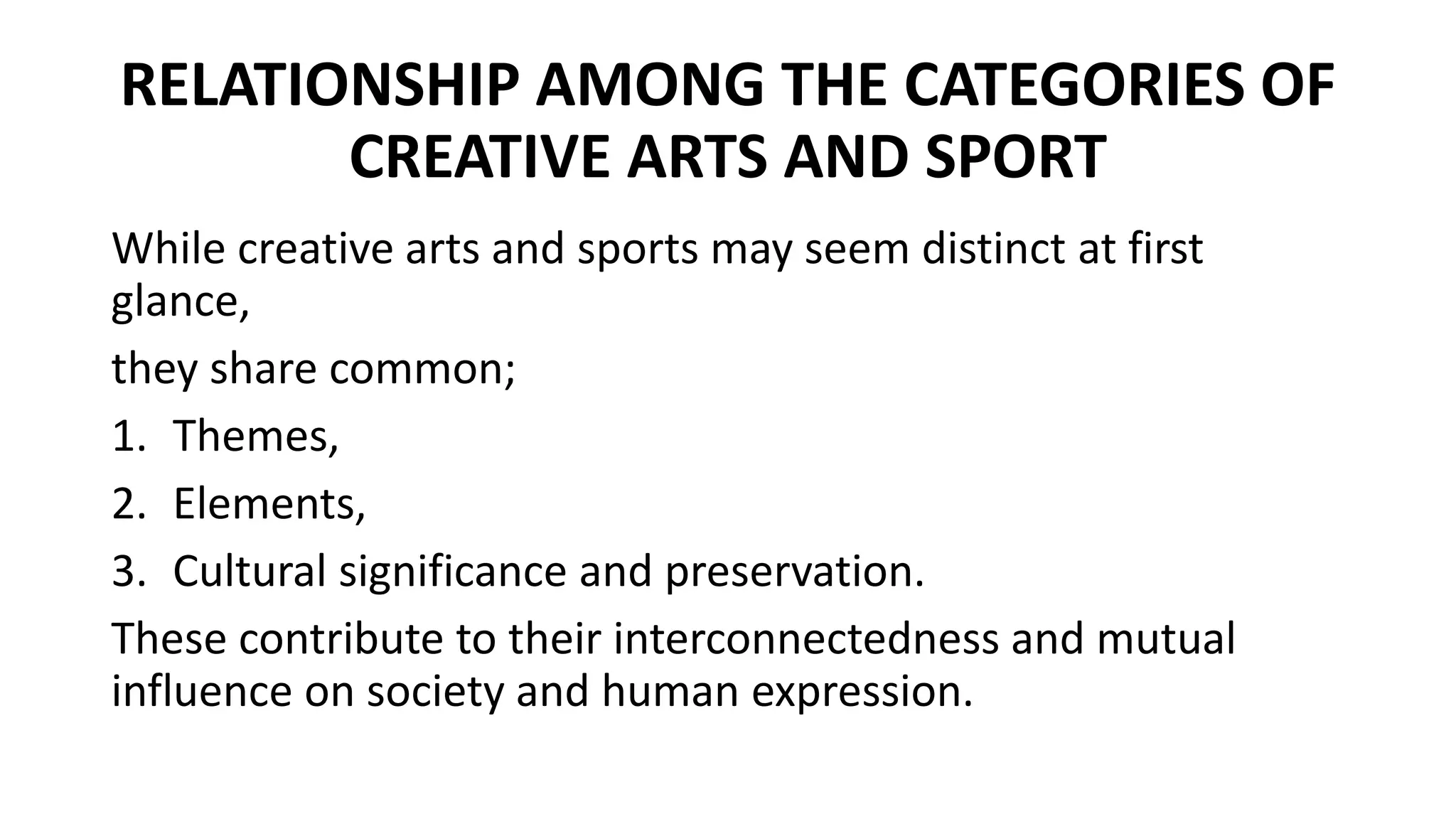
RELATIONSHIP AMONG THE CATEGORIES OF
CREATIVE ARTS AND SPORT
While creative arts and sports may seem distinct at first
glance,
they share common;
1. Themes,
2. Elements,
3. Cultural significance and preservation.
These contribute to their interconnectedness and mutual
influence on society and human expression.
ACTIVITY I
1. Create a chart on categories of creative arts
and sport
2. Decorate the chart using found to a collage
illustration
3. Display the chart
ACTIVITY II
• In groups of four discuss relationships among the categories of
creative arts and sport focusing on;
a) Function
b) Execution
c) Visual presentation
d) Competition
e) Audience
f) Attire
g) Themes
h) Team effort
1.2. COMPONENTS OF
CREATIVE ARTS AND
SPORTS
SPECIFIC LEARNING OUTCOME
By the end of the Sub Strand, the learner should be able to:
• Describe elements of a story,
• Perform activities demonstrating the components of fitness,
• Write note values on a treble staff,
• Name pitches on treble staff,
• Group music notes in simple time 2/4
• Appreciate the components of Creative Arts and Sports.
COMPONENTS OF CREATIVE ARTS AND
SPORTS.
Creative arts is made of the following components:
• Visual arts -creative art forms appreciated through sense of sight
such as
• Play - a written work that tells a story through action and speech
and is meant to be acted on a stage.
• Music - Music is a collection of coordinated sound or sounds.
Making music is the process of putting sounds and tones in an
order, often combining them to create a unified composition
• Dance – dance is the movement of the body in a rhythmic way,
usually to music and within a given space, for the purpose of
expressing an idea or emotion.
DESCRIBE ELEMENTS OF A STORY
1. Characters:
• Protagonist: The main character who drives the story
forward and undergoes the most significant development
or change.
• Antagonist: The character or force that opposes the
protagonist, creating tension and conflict.
• Supporting Characters: Other characters who interact
with the protagonist and contribute to the development
of the plot.
2. Setting and plot:
• Time and Place: The setting establishes the time
period and location in which the story takes place.
It creates the backdrop against which the events
unfold and can influence the mood and
atmosphere of the narrative.
3. Theme:
• Central Idea: The theme is the underlying message
or central idea that the story explores. It can be a
universal truth, moral lesson, or commentary on
human nature, society, or life.
COORDINATION AND STRENGTH IN
PHYSICAL FITNESS
•Coordination
•Definition: Coordination refers to the ability
to execute smooth, controlled movements
that involve multiple body parts working
together harmoniously.
•Strength:
•Definition: Strength refers to the ability of
muscles to generate force against resistance.
RELATIONSHIP BETWEEN COORDINATION
AND STRENGTH:
• Mutual Enhancement: Improved coordination can enhance
strength training by optimizing movement patterns and increasing
the effectiveness of exercises.
• Functional Fitness: Both coordination and strength are essential
for functional fitness, allowing individuals to perform daily tasks
with ease.
• Integrated Training: Effective fitness programs often incorporate
both coordination and strength training components to achieve
well-rounded physical fitness and overall health.
SUMMARY
•In conclusion, coordination and strength
are interrelated aspects of physical fitness,
each contributing to functional movement,
performance, and overall well-being.
Incorporating exercises and activities that
target both coordination and strength can
lead to improved fitness levels and
enhanced quality of life.
NOTES VALUES
PITCH NAMES ON TREBLE STAFF
•The treble clef, also known as the G clef, is a
symbol that appears at the beginning of
lines of sheet music to indicate the notes of
the staff.
•The notes on the lines of the treble clef
are E, G, B, D, and F, from lowest to
highest. The spaces are F, A, C, and E, from
lowest to highest.
PITCH NAMES ON A TREBLE CLEF
• Lines
• Every Good Boy Deserves Favor
• Spaces
• FACE
TREBLE CLEF IN RELATION TO KEYBOARD
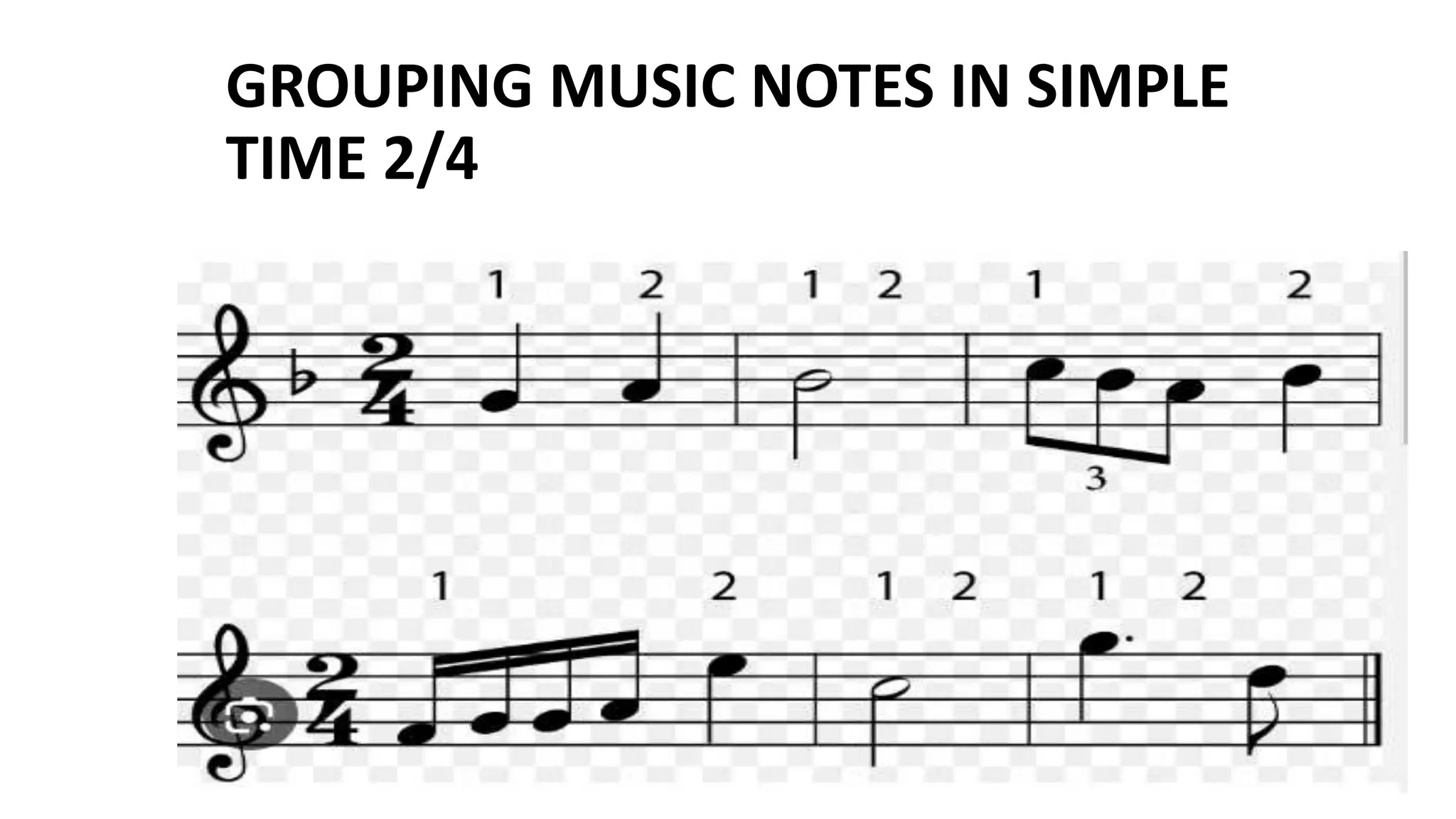
GROUPING MUSIC NOTES IN SIMPLE TIME
2/4
•In 2/4 time there are two crotchet beats
per bar. There is one strong beat, which
is the first beat of the bar.
•The second crotchet beat is the weak
beat. Notes are normally beamed
together to make up one crotchet beat.
GROUPING MUSIC NOTES IN SIMPLE
TIME 2/4
ASSESSMENT
1.How are the components of
creative arts and sport
interrelated
2.How are the components of
creative arts and sport applied

STRAND 1.0 FOUNDATIONS OF CREATIVE ARTS AND SPORTS.pptx

  • 1.
  • 2.
    STRAND 1.0 FOUNDATIONS OFCREATIVE ARTS AND SPORTS
  • 3.
    SUB STRAND: 1.1.INTRODUCTION TO CREATIVE ARTS AND SPORTS
  • 4.
    SPECIFIC LEARNING OUTCOMES Bythe end of the Sub Strand, the learner should be able to: • Describe categories of Creative Arts and Sports. • Outline the relationships among the categories of Creative Arts and Sports. • Create a chart on the categories of the Creative Arts and Sports. • Appreciate the categories of Creative Arts and Sports.
  • 5.
    INTRODUCTION TO CREATIVEARTS AND SPORTS. •What is creative arts? • Creative Arts is a description of various artistic activities that allow performers to use their imaginations, creativity, and express ideas through a variety of mediums to passage a message to the audience.
  • 6.
    CATEGORIES OF CREATIVEARTS Include; •Visual arts •Music and dance •Drama and film •Sport
  • 7.
    1. MUSIC ANDDANCE •Dance: Various styles such as ballet, contemporary, hip-hop, jazz, etc. •Music: Instrumental and vocal performances, encompassing genres like classical, jazz, rock, pop, etc.
  • 8.
    2. VISUAL ARTS •Painting: Including various styles such as oil, watercolor, acrylic, etc. • Drawing: Pencil, charcoal, pastels, pen and ink, etc. • Sculpture: Working with materials like clay, stone, metal, etc. • Printmaking: Techniques like woodcut, etching, lithography, screen printing, etc. • Photography: Traditional and digital photography, including various genres like landscape, portrait, documentary, etc.
  • 9.
    3. DRAMA ANDFILM •Drama: Plays, screenplays, scripts for various mediums. •Film: Including narrative films, documentaries, animations, etc.
  • 10.
    WHAT IS SPORTS? •Asport is any activity involving physical or mental effort combined with skills in which an individual or a team or teams compete against another or others for entertainment.
  • 11.
    4. SPORT •Swimming: Variousstrokes and distances. •Soccer (Football)
  • 12.
    RELATIONSHIP AMONG THECATEGORIES OF CREATIVE ARTS AND SPORT While creative arts and sports may seem distinct at first glance, they share common; 1. Themes, 2. Elements, 3. Cultural significance and preservation. These contribute to their interconnectedness and mutual influence on society and human expression.
  • 13.
    ACTIVITY I 1. Createa chart on categories of creative arts and sport 2. Decorate the chart using found to a collage illustration 3. Display the chart
  • 14.
    ACTIVITY II • Ingroups of four discuss relationships among the categories of creative arts and sport focusing on; a) Function b) Execution c) Visual presentation d) Competition e) Audience f) Attire g) Themes h) Team effort
  • 15.
  • 16.
    SPECIFIC LEARNING OUTCOME Bythe end of the Sub Strand, the learner should be able to: • Describe elements of a story, • Perform activities demonstrating the components of fitness, • Write note values on a treble staff, • Name pitches on treble staff, • Group music notes in simple time 2/4 • Appreciate the components of Creative Arts and Sports.
  • 17.
    COMPONENTS OF CREATIVEARTS AND SPORTS. Creative arts is made of the following components: • Visual arts -creative art forms appreciated through sense of sight such as • Play - a written work that tells a story through action and speech and is meant to be acted on a stage. • Music - Music is a collection of coordinated sound or sounds. Making music is the process of putting sounds and tones in an order, often combining them to create a unified composition • Dance – dance is the movement of the body in a rhythmic way, usually to music and within a given space, for the purpose of expressing an idea or emotion.
  • 18.
    DESCRIBE ELEMENTS OFA STORY 1. Characters: • Protagonist: The main character who drives the story forward and undergoes the most significant development or change. • Antagonist: The character or force that opposes the protagonist, creating tension and conflict. • Supporting Characters: Other characters who interact with the protagonist and contribute to the development of the plot.
  • 19.
    2. Setting andplot: • Time and Place: The setting establishes the time period and location in which the story takes place. It creates the backdrop against which the events unfold and can influence the mood and atmosphere of the narrative. 3. Theme: • Central Idea: The theme is the underlying message or central idea that the story explores. It can be a universal truth, moral lesson, or commentary on human nature, society, or life.
  • 20.
    COORDINATION AND STRENGTHIN PHYSICAL FITNESS •Coordination •Definition: Coordination refers to the ability to execute smooth, controlled movements that involve multiple body parts working together harmoniously. •Strength: •Definition: Strength refers to the ability of muscles to generate force against resistance.
  • 21.
    RELATIONSHIP BETWEEN COORDINATION ANDSTRENGTH: • Mutual Enhancement: Improved coordination can enhance strength training by optimizing movement patterns and increasing the effectiveness of exercises. • Functional Fitness: Both coordination and strength are essential for functional fitness, allowing individuals to perform daily tasks with ease. • Integrated Training: Effective fitness programs often incorporate both coordination and strength training components to achieve well-rounded physical fitness and overall health.
  • 22.
    SUMMARY •In conclusion, coordinationand strength are interrelated aspects of physical fitness, each contributing to functional movement, performance, and overall well-being. Incorporating exercises and activities that target both coordination and strength can lead to improved fitness levels and enhanced quality of life.
  • 23.
  • 24.
    PITCH NAMES ONTREBLE STAFF •The treble clef, also known as the G clef, is a symbol that appears at the beginning of lines of sheet music to indicate the notes of the staff. •The notes on the lines of the treble clef are E, G, B, D, and F, from lowest to highest. The spaces are F, A, C, and E, from lowest to highest.
  • 25.
    PITCH NAMES ONA TREBLE CLEF • Lines • Every Good Boy Deserves Favor • Spaces • FACE
  • 26.
    TREBLE CLEF INRELATION TO KEYBOARD
  • 27.
    GROUPING MUSIC NOTESIN SIMPLE TIME 2/4 •In 2/4 time there are two crotchet beats per bar. There is one strong beat, which is the first beat of the bar. •The second crotchet beat is the weak beat. Notes are normally beamed together to make up one crotchet beat.
  • 28.
    GROUPING MUSIC NOTESIN SIMPLE TIME 2/4
  • 29.
    ASSESSMENT 1.How are thecomponents of creative arts and sport interrelated 2.How are the components of creative arts and sport applied