Optical Design Using Stop-Shift Theory
Dave Shafer
•

The use of first and 3rd order stop shift theory can lead to
new types of designs and a better understanding of existing
designs.

•

No computations are necessary to benefit from stop-shift
theory – it just involves a few basic principles and some
temporary changes in aperture stop position.

•

Experiments can be carried out in your head. Computer
calculations only happen after you are done with the
conceptual work.
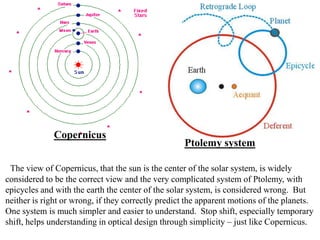
Copernicus

Ptolemy system

The view of Copernicus, that the sun is the center of the solar system, is widely
considered to be the correct view and the very complicated system of Ptolemy, with
epicycles and with the earth the center of the solar system, is considered wrong. But
neither is right or wrong, if they correctly predict the apparent motions of the planets.
One system is much simpler and easier to understand. Stop shift, especially temporary
shift, helps understanding in optical design through simplicity – just like Copernicus.
Let’s start out with 1st order stop-shift theory, which
relates lateral and axial color.
1) If a system has axial color then lateral color is linear
with stop position. That means that there must be a stop
position that makes primary (1st-order) lateral color be zero.

2) If a system is corrected for primary axial color, then
primary lateral color is independent of stop position.
3) A thin lens with the stop in contact has no lateral color.
4) A thin lens at a focus has no axial or lateral color.
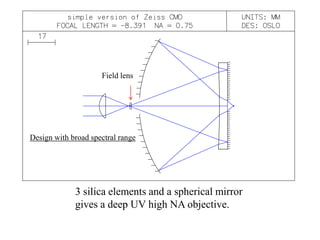
Field lens

Design with broad spectral range

3 silica elements and a spherical mirror
gives a deep UV high NA objective.
What is the aberration theory behind
this very simple design?
Answer – it involves stop-shift theory
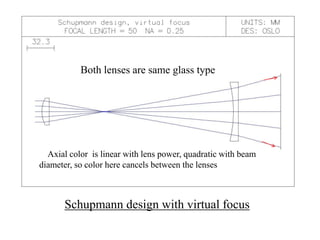
Both lenses are same glass type

Axial color is linear with lens power, quadratic with beam
diameter, so color here cancels between the lenses

Schupmann design with virtual focus
Field lens

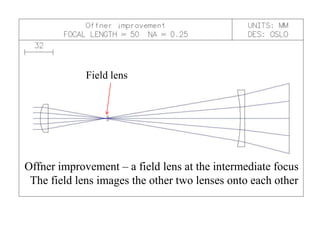
Offner improvement – a field lens at the intermediate focus
The field lens images the other two lenses onto each other
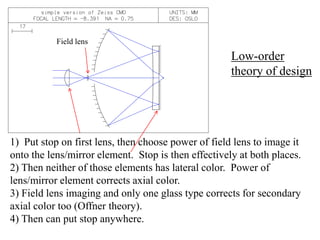
Field lens

Low-order
theory of design

1) Put stop on first lens, then choose power of field lens to image it
onto the lens/mirror element. Stop is then effectively at both places.
2) Then neither of those elements has lateral color. Power of
lens/mirror element corrects axial color.
3) Field lens imaging and only one glass type corrects for secondary
axial color too (Offner theory).
4) Then can put stop anywhere.
•

A key point – the aperture stop was only
temporarily located at a place where the theory is
simple to understand and the aberration correction
method becomes obvious.

• Then later the stop is moved to where it needs to be
– like in order to have a telecentric system.
• Once the aberrations are well-corrected they do not
change (at the lower-order levels) when the stop is
moved.
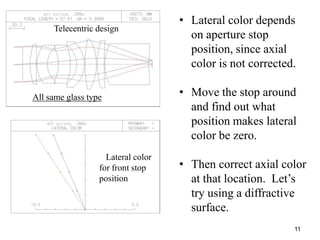
Telecentric design

All same glass type

Lateral color
for front stop
position

• Lateral color depends
on aperture stop
position, since axial
color is not corrected.
• Move the stop around
and find out what
position makes lateral
color be zero.
• Then correct axial color
at that location. Let’s
try using a diffractive
surface.
11
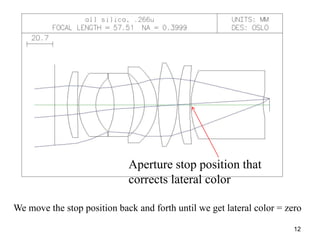
Aperture stop position that
corrects lateral color
We move the stop position back and forth until we get lateral color = zero
12
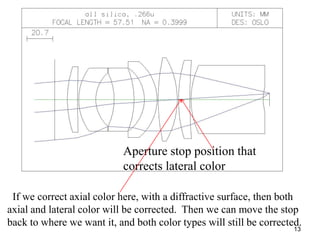
Aperture stop position that
corrects lateral color
If we correct axial color here, with a diffractive surface, then both
axial and lateral color will be corrected. Then we can move the stop
back to where we want it, and both color types will still be corrected.
13
• This same design method indicates where to add
lenses for color correction

• It minimizes the number of extra lenses needed for
color correction
• But it may indicate adding color correcting lenses
where we don’t want them, because of space
constraints

• Then we rely on conventional color correcting
techniques
14
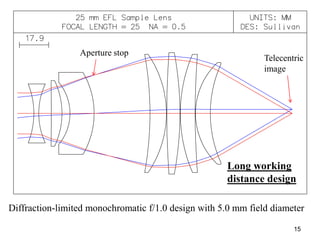
Aperture stop

Telecentric
image

Long working
distance design
Diffraction-limited monochromatic f/1.0 design with 5.0 mm field diameter
15
Aperture stop
position for no
lateral color

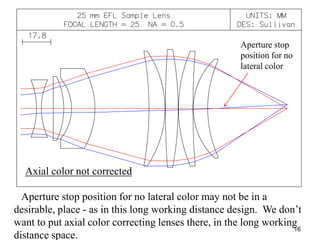
Axial color not corrected
Aperture stop position for no lateral color may not be in a
desirable, place - as in this long working distance design. We don’t
want to put axial color correcting lenses there, in the long working
16
distance space.
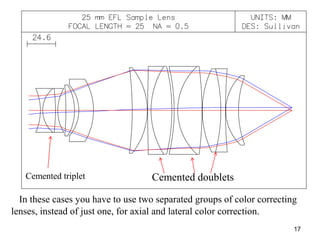
Cemented triplet

Cemented doublets

In these cases you have to use two separated groups of color correcting
lenses, instead of just one, for axial and lateral color correction.
17
Correcting secondary lateral color
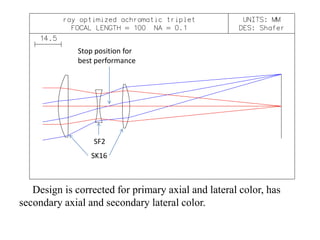
Stop position for
best performance

SF2
SK16

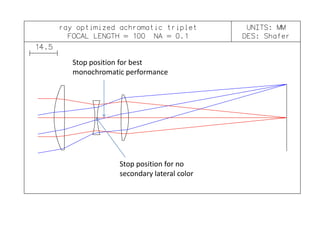
Design is corrected for primary axial and lateral color, has
secondary axial and secondary lateral color.
• Suppose primary axial and lateral color are corrected.
• If a design has secondary axial color then secondary
lateral color is linear with stop position.
• So there must be a stop position then that corrects for secondary
lateral color.

• If you fix secondary axial color at that stop position, then both
secondary axial and lateral color will be corrected.
• Then you can put the stop anywhere with no effect.
Stop position for best
monochromatic performance

Stop position for no
secondary lateral color
Semiconducter wafer metrology inspection design
• KLA-Tencor in 2005 wanted a “perfect” .80 NA design for
.488u - .720u
• Requires correction of primary, secondary, and tertiary axial
color to get .999 polychromatic Strehl over that spectral range.
• Needs correction of primary lateral color, and secondary lateral
color is a very big problem – doesn’t hurt image quality but
gives wafer measurement error.
• Olympus, Tropel, and ORA all worked on this and could not get
any better than 10 to 20X more secondary lateral color than was
acceptable (needed = 1.0 nanometer over a 80u field diameter).
• I tried a design and also was about 10X too much lateral color
• The solution – use stop-shift theory
• I corrected primary axial and lateral color and partially
corrected secondary axial color.
• I found out where the stop position is then where
secondary lateral color is zero
• I corrected the remaining secondary axial color at that stop
position
• Then I moved the stop back to its telecentric position
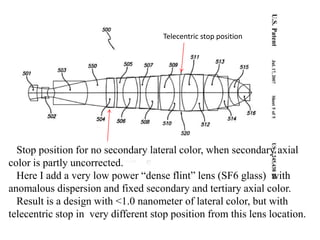
Telecentric stop position

Stop position for no secondary lateral color, when secondary axial
color is partly uncorrected.
Here I add a very low power “dense flint” lens (SF6 glass) with
anomalous dispersion and fixed secondary and tertiary axial color.
Result is a design with <1.0 nanometer of lateral color, but with
telecentric stop in very different stop position from this lens location.
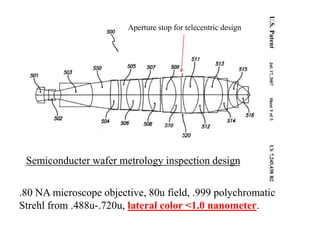
Aperture stop for telecentric design

Semiconducter wafer metrology inspection design

.80 NA microscope objective, 80u field, .999 polychromatic
Strehl from .488u-.720u, lateral color <1.0 nanometer.
A 1.0X catadioptric relay system
developed using stop shift theory
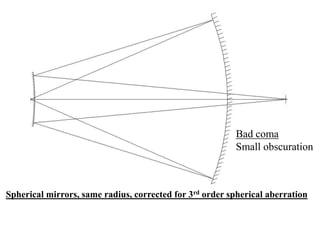
Bad coma
Small obscuration

Spherical mirrors, same radius, corrected for 3rd order spherical aberration
• If a design has spherical aberration then coma is
linear with stop position and astigmatism is
quadratic with stop position
• If spherical aberration is corrected then coma is
constant with stop position and astigmatism is
linear with stop position. Then, for non-zero
coma, there is always a stop position that corrects
for astigmatism.
• If both spherical aberration and coma are
corrected then astigmatism is a constant
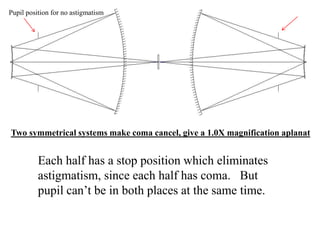
Pupil position for no astigmatism

Two symmetrical systems make coma cancel, give a 1.0X magnification aplanat

Each half has a stop position which eliminates
astigmatism, since each half has coma. But
pupil can’t be in both places at the same time.
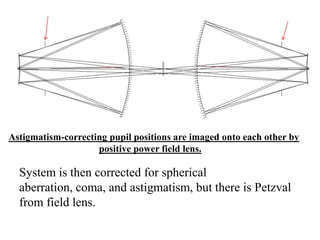
Astigmatism-correcting pupil positions are imaged onto each other by
positive power field lens.

System is then corrected for spherical
aberration, coma, and astigmatism, but there is Petzval
from field lens.
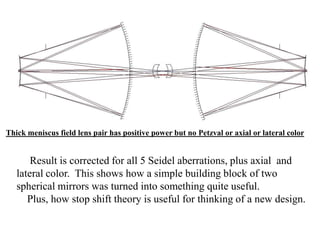
Thick meniscus field lens pair has positive power but no Petzval or axial or lateral color

Result is corrected for all 5 Seidel aberrations, plus axial and
lateral color. This shows how a simple building block of two
spherical mirrors was turned into something quite useful.
Plus, how stop shift theory is useful for thinking of a new design.
Aft-Schmidt Design
• If spherical aberration is uncorrected then coma is linear
with stop position and astigmatism is quadratic with stop
position.
• So then, for non-zero spherical aberration, there is always
a stop position that corrects for coma and either 2 or none
that correct for astigmatism.
• In some cases (like the Schmidt telescope) the stop
position which corrects coma also corrects astigmatism.
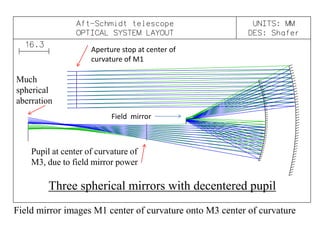
Aperture stop at center of
curvature of M1

Much
spherical
aberration
Field mirror

Pupil at center of curvature of
M3, due to field mirror power

Three spherical mirrors with decentered pupil
Field mirror images M1 center of curvature onto M3 center of curvature
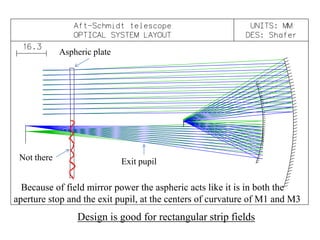
Aspheric plate

Not there

Exit pupil

Because of field mirror power the aspheric acts like it is in both the
aperture stop and the exit pupil, at the centers of curvature of M1 and M3

Design is good for rectangular strip fields
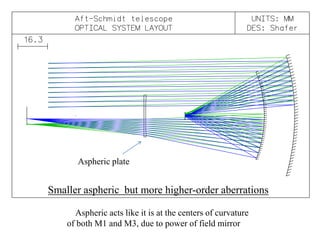
Aspheric plate

Smaller aspheric but more higher-order aberrations
Aspheric acts like it is at the centers of curvature
of both M1 and M3, due to power of field mirror
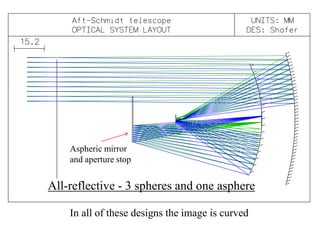
Aspheric mirror
and aperture stop

All-reflective - 3 spheres and one asphere
In all of these designs the image is curved
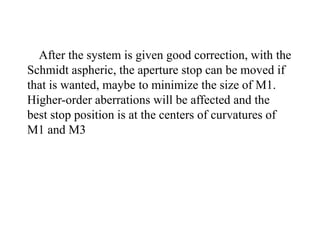
After the system is given good correction, with the
Schmidt aspheric, the aperture stop can be moved if
that is wanted, maybe to minimize the size of M1.
Higher-order aberrations will be affected and the
best stop position is at the centers of curvatures of
M1 and M3
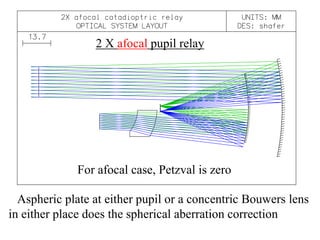
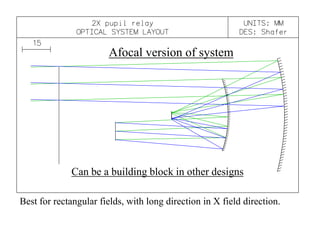
2 X afocal pupil relay

For afocal case, Petzval is zero
Aspheric plate at either pupil or a concentric Bouwers lens
in either place does the spherical aberration correction
Afocal version of system

Can be a building block in other designs
Best for rectangular fields, with long direction in X field direction.
Infrared Target Simulator Design
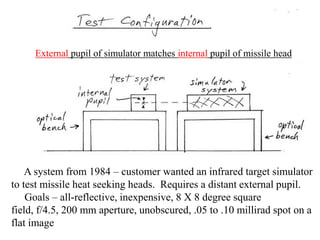
External pupil of simulator matches internal pupil of missile head

A system from 1984 – customer wanted an infrared target simulator
to test missile heat seeking heads. Requires a distant external pupil.
Goals – all-reflective, inexpensive, 8 X 8 degree square
field, f/4.5, 200 mm aperture, unobscured, .05 to .10 millirad spot on a
flat image
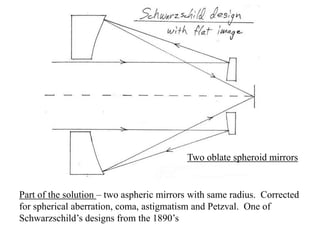
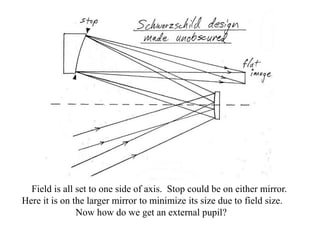
Two oblate spheroid mirrors

Part of the solution – two aspheric mirrors with same radius. Corrected
for spherical aberration, coma, astigmatism and Petzval. One of
Schwarzschild’s designs from the 1890’s
Field is all set to one side of axis. Stop could be on either mirror.
Here it is on the larger mirror to minimize its size due to field size.
Now how do we get an external pupil?
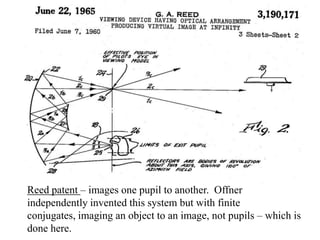
Reed patent – images one pupil to another. Offner
independently invented this system but with finite
conjugates, imaging an object to an image, not pupils – which is
done here.
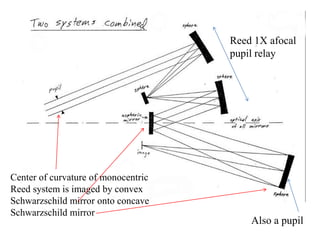
Reed 1X afocal
pupil relay

Center of curvature of monocentric
Reed system is imaged by convex
Schwarzschild mirror onto concave
Schwarzschild mirror

Also a pupil
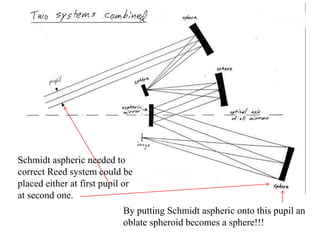
Schmidt aspheric needed to
correct Reed system could be
placed either at first pupil or
at second one.
By putting Schmidt aspheric onto this pupil an
oblate spheroid becomes a sphere!!!
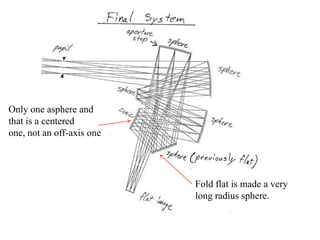
Only one asphere and
that is a centered
one, not an off-axis one

Fold flat is made a very
long radius sphere.
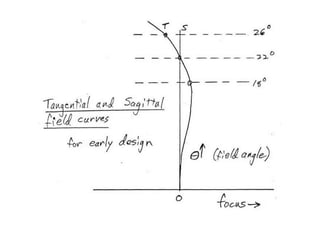
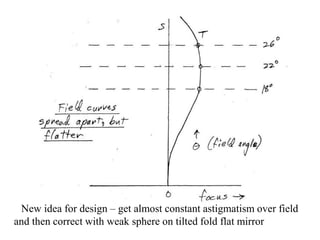
New idea for design – get almost constant astigmatism over field
and then correct with weak sphere on tilted fold flat mirror
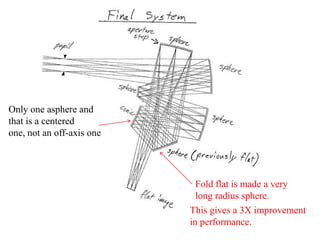
Only one asphere and
that is a centered
one, not an off-axis one

Fold flat is made a very
long radius sphere.
This gives a 3X improvement
in performance.
Two-Axis Asphere Design
Hard to
baffle
image

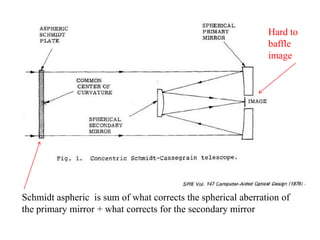
Schmidt aspheric is sum of what corrects the spherical aberration of
the primary mirror + what corrects for the secondary mirror
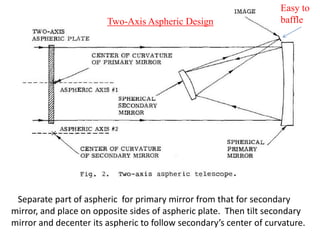
Two-Axis Aspheric Design

Easy to
baffle

Separate part of aspheric for primary mirror from that for secondary
mirror, and place on opposite sides of aspheric plate. Then tilt secondary
mirror and decenter its aspheric to follow secondary’s center of curvature.
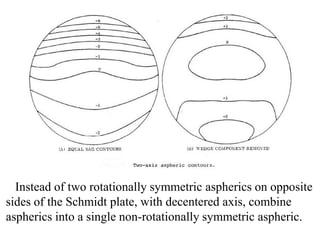
Instead of two rotationally symmetric aspherics on opposite
sides of the Schmidt plate, with decentered axis, combine
aspherics into a single non-rotationally symmetric aspheric.
Early warning missile defense system
Work I did in 1972, 40 years ago.
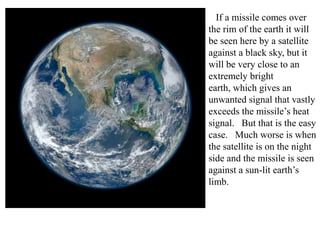
If a missile comes over
the rim of the earth it will
be seen here by a satellite
against a black sky, but it
will be very close to an
extremely bright
earth, which gives an
unwanted signal that vastly
exceeds the missile’s heat
signal. But that is the easy
case. Much worse is when
the satellite is on the night
side and the missile is seen
against a sun-lit earth’s
limb.
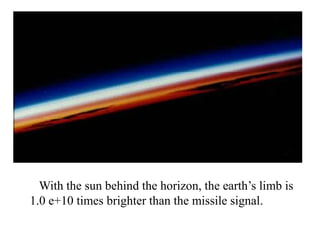
With the sun behind the horizon, the earth’s limb is
1.0 e+10 times brighter than the missile signal.
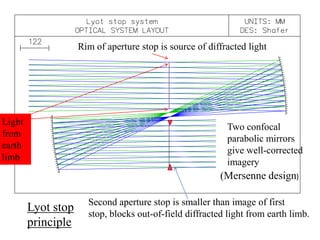
Rim of aperture stop is source of diffracted light

Light
from
earth
limb

Two confocal
parabolic mirrors
give well-corrected
imagery

(Mersenne design)

Lyot stop
principle

Second aperture stop is smaller than image of first
stop, blocks out-of-field diffracted light from earth limb.
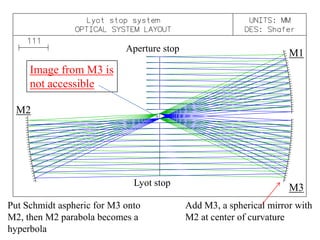
Aperture stop

M1

Lyot stop

M3

Image from M3 is
not accessible
M2

Put Schmidt aspheric for M3 onto
M2, then M2 parabola becomes a
hyperbola

Add M3, a spherical mirror with
M2 at center of curvature
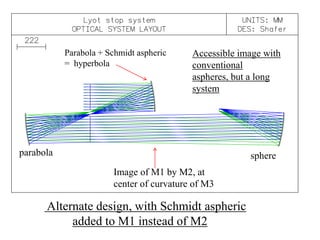
Parabola + Schmidt aspheric
= hyperbola

Accessible image with
conventional
aspheres, but a long
system

parabola

sphere
Image of M1 by M2, at
center of curvature of M3

Alternate design, with Schmidt aspheric
added to M1 instead of M2
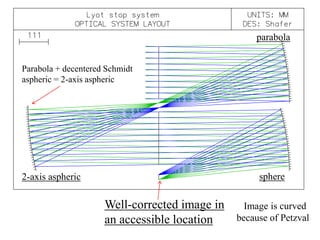
parabola
Parabola + decentered Schmidt
aspheric = 2-axis aspheric

sphere

2-axis aspheric

Well-corrected image in
an accessible location

Image is curved
because of Petzval
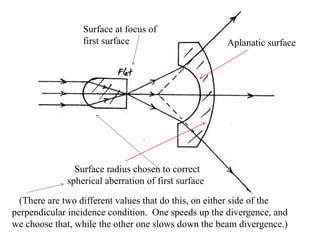
High NA laser beam expander
Surface at focus of
first surface

Aplanatic surface

Surface radius chosen to correct
spherical aberration of first surface
(There are two different values that do this, on either side of the
perpendicular incidence condition. One speeds up the divergence, and
we choose that, while the other one slows down the beam divergence.)
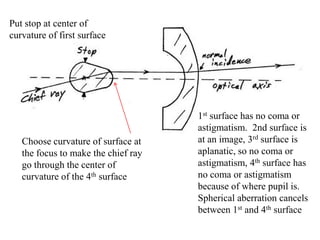
Put stop at center of
curvature of first surface

Choose curvature of surface at
the focus to make the chief ray
go through the center of
curvature of the 4th surface

1st surface has no coma or
astigmatism. 2nd surface is
at an image, 3rd surface is
aplanatic, so no coma or
astigmatism, 4th surface has
no coma or astigmatism
because of where pupil is.
Spherical aberration cancels
between 1st and 4th surface
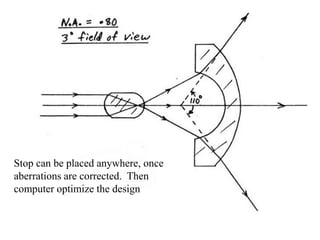
Stop can be placed anywhere, once
aberrations are corrected. Then
computer optimize the design
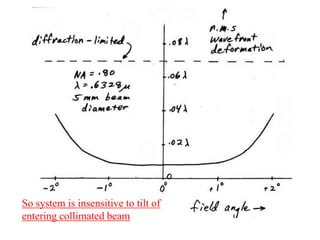
So system is insensitive to tilt of
entering collimated beam
Cascaded Conic Mirrors
•

A conic mirror with the aperture stop at
either of its focii has no astigmatism of any
order.

•

This can be proven mathematically with
the Coddington equations.

•

Some interesting designs are possible
using this fact.
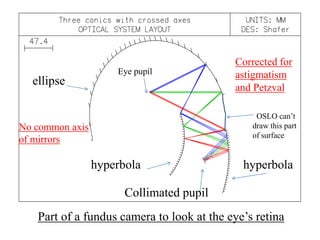
Eye pupil

ellipse

Corrected for
astigmatism
and Petzval
OSLO can’t
draw this part
of surface

No common axis
of mirrors

hyperbola

hyperbola

Collimated pupil
Part of a fundus camera to look at the eye’s retina
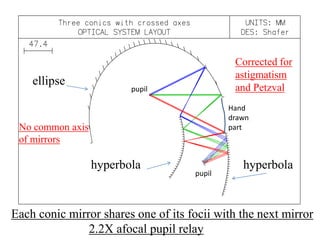
ellipse

Corrected for
astigmatism
and Petzval

pupil

Hand
drawn
part

No common axis
of mirrors

hyperbola

pupil

hyperbola

Each conic mirror shares one of its focii with the next mirror
2.2X afocal pupil relay
• Spherical aberration and coma are uncorrected in this
design but the pupil size is very small so they don’t
matter very much
• But still this means that the aperture stop and pupils
cannot be moved from the mirror focii without
hurting the zero astigmatism situation of the system
Conclusion
• Stop shift theory gives insight into the aberration theory
of a design and also suggests new design possibilities
• Temporary stop shift is a powerful design tool and does
not usually require changing the actual final position of
the stop, which may be set by the telecentric condition
or other constraints
Optical Design using stop shift theory

Optical Design using stop shift theory

  • 1.
    Optical Design UsingStop-Shift Theory Dave Shafer
  • 2.
    • The use offirst and 3rd order stop shift theory can lead to new types of designs and a better understanding of existing designs. • No computations are necessary to benefit from stop-shift theory – it just involves a few basic principles and some temporary changes in aperture stop position. • Experiments can be carried out in your head. Computer calculations only happen after you are done with the conceptual work.
  • 3.
    Copernicus Ptolemy system The viewof Copernicus, that the sun is the center of the solar system, is widely considered to be the correct view and the very complicated system of Ptolemy, with epicycles and with the earth the center of the solar system, is considered wrong. But neither is right or wrong, if they correctly predict the apparent motions of the planets. One system is much simpler and easier to understand. Stop shift, especially temporary shift, helps understanding in optical design through simplicity – just like Copernicus.
  • 4.
    Let’s start outwith 1st order stop-shift theory, which relates lateral and axial color. 1) If a system has axial color then lateral color is linear with stop position. That means that there must be a stop position that makes primary (1st-order) lateral color be zero. 2) If a system is corrected for primary axial color, then primary lateral color is independent of stop position. 3) A thin lens with the stop in contact has no lateral color. 4) A thin lens at a focus has no axial or lateral color.
  • 5.
    Field lens Design withbroad spectral range 3 silica elements and a spherical mirror gives a deep UV high NA objective.
  • 6.
    What is theaberration theory behind this very simple design? Answer – it involves stop-shift theory
  • 7.
    Both lenses aresame glass type Axial color is linear with lens power, quadratic with beam diameter, so color here cancels between the lenses Schupmann design with virtual focus
  • 8.
    Field lens Offner improvement– a field lens at the intermediate focus The field lens images the other two lenses onto each other
  • 9.
    Field lens Low-order theory ofdesign 1) Put stop on first lens, then choose power of field lens to image it onto the lens/mirror element. Stop is then effectively at both places. 2) Then neither of those elements has lateral color. Power of lens/mirror element corrects axial color. 3) Field lens imaging and only one glass type corrects for secondary axial color too (Offner theory). 4) Then can put stop anywhere.
  • 10.
    • A key point– the aperture stop was only temporarily located at a place where the theory is simple to understand and the aberration correction method becomes obvious. • Then later the stop is moved to where it needs to be – like in order to have a telecentric system. • Once the aberrations are well-corrected they do not change (at the lower-order levels) when the stop is moved.
  • 11.
    Telecentric design All sameglass type Lateral color for front stop position • Lateral color depends on aperture stop position, since axial color is not corrected. • Move the stop around and find out what position makes lateral color be zero. • Then correct axial color at that location. Let’s try using a diffractive surface. 11
  • 12.
    Aperture stop positionthat corrects lateral color We move the stop position back and forth until we get lateral color = zero 12
  • 13.
    Aperture stop positionthat corrects lateral color If we correct axial color here, with a diffractive surface, then both axial and lateral color will be corrected. Then we can move the stop back to where we want it, and both color types will still be corrected. 13
  • 14.
    • This samedesign method indicates where to add lenses for color correction • It minimizes the number of extra lenses needed for color correction • But it may indicate adding color correcting lenses where we don’t want them, because of space constraints • Then we rely on conventional color correcting techniques 14
  • 15.
    Aperture stop Telecentric image Long working distancedesign Diffraction-limited monochromatic f/1.0 design with 5.0 mm field diameter 15
  • 16.
    Aperture stop position forno lateral color Axial color not corrected Aperture stop position for no lateral color may not be in a desirable, place - as in this long working distance design. We don’t want to put axial color correcting lenses there, in the long working 16 distance space.
  • 17.
    Cemented triplet Cemented doublets Inthese cases you have to use two separated groups of color correcting lenses, instead of just one, for axial and lateral color correction. 17
  • 18.
  • 19.
    Stop position for bestperformance SF2 SK16 Design is corrected for primary axial and lateral color, has secondary axial and secondary lateral color.
  • 20.
    • Suppose primaryaxial and lateral color are corrected. • If a design has secondary axial color then secondary lateral color is linear with stop position. • So there must be a stop position then that corrects for secondary lateral color. • If you fix secondary axial color at that stop position, then both secondary axial and lateral color will be corrected. • Then you can put the stop anywhere with no effect.
  • 21.
    Stop position forbest monochromatic performance Stop position for no secondary lateral color
  • 22.
  • 23.
    • KLA-Tencor in2005 wanted a “perfect” .80 NA design for .488u - .720u • Requires correction of primary, secondary, and tertiary axial color to get .999 polychromatic Strehl over that spectral range. • Needs correction of primary lateral color, and secondary lateral color is a very big problem – doesn’t hurt image quality but gives wafer measurement error. • Olympus, Tropel, and ORA all worked on this and could not get any better than 10 to 20X more secondary lateral color than was acceptable (needed = 1.0 nanometer over a 80u field diameter). • I tried a design and also was about 10X too much lateral color
  • 24.
    • The solution– use stop-shift theory • I corrected primary axial and lateral color and partially corrected secondary axial color. • I found out where the stop position is then where secondary lateral color is zero • I corrected the remaining secondary axial color at that stop position • Then I moved the stop back to its telecentric position
  • 25.
    Telecentric stop position Stopposition for no secondary lateral color, when secondary axial color is partly uncorrected. Here I add a very low power “dense flint” lens (SF6 glass) with anomalous dispersion and fixed secondary and tertiary axial color. Result is a design with <1.0 nanometer of lateral color, but with telecentric stop in very different stop position from this lens location.
  • 26.
    Aperture stop fortelecentric design Semiconducter wafer metrology inspection design .80 NA microscope objective, 80u field, .999 polychromatic Strehl from .488u-.720u, lateral color <1.0 nanometer.
  • 27.
    A 1.0X catadioptricrelay system developed using stop shift theory
  • 28.
    Bad coma Small obscuration Sphericalmirrors, same radius, corrected for 3rd order spherical aberration
  • 29.
    • If adesign has spherical aberration then coma is linear with stop position and astigmatism is quadratic with stop position • If spherical aberration is corrected then coma is constant with stop position and astigmatism is linear with stop position. Then, for non-zero coma, there is always a stop position that corrects for astigmatism. • If both spherical aberration and coma are corrected then astigmatism is a constant
  • 30.
    Pupil position forno astigmatism Two symmetrical systems make coma cancel, give a 1.0X magnification aplanat Each half has a stop position which eliminates astigmatism, since each half has coma. But pupil can’t be in both places at the same time.
  • 31.
    Astigmatism-correcting pupil positionsare imaged onto each other by positive power field lens. System is then corrected for spherical aberration, coma, and astigmatism, but there is Petzval from field lens.
  • 32.
    Thick meniscus fieldlens pair has positive power but no Petzval or axial or lateral color Result is corrected for all 5 Seidel aberrations, plus axial and lateral color. This shows how a simple building block of two spherical mirrors was turned into something quite useful. Plus, how stop shift theory is useful for thinking of a new design.
  • 33.
  • 34.
    • If sphericalaberration is uncorrected then coma is linear with stop position and astigmatism is quadratic with stop position. • So then, for non-zero spherical aberration, there is always a stop position that corrects for coma and either 2 or none that correct for astigmatism. • In some cases (like the Schmidt telescope) the stop position which corrects coma also corrects astigmatism.
  • 35.
    Aperture stop atcenter of curvature of M1 Much spherical aberration Field mirror Pupil at center of curvature of M3, due to field mirror power Three spherical mirrors with decentered pupil Field mirror images M1 center of curvature onto M3 center of curvature
  • 36.
    Aspheric plate Not there Exitpupil Because of field mirror power the aspheric acts like it is in both the aperture stop and the exit pupil, at the centers of curvature of M1 and M3 Design is good for rectangular strip fields
  • 37.
    Aspheric plate Smaller asphericbut more higher-order aberrations Aspheric acts like it is at the centers of curvature of both M1 and M3, due to power of field mirror
  • 38.
    Aspheric mirror and aperturestop All-reflective - 3 spheres and one asphere In all of these designs the image is curved
  • 39.
    After the systemis given good correction, with the Schmidt aspheric, the aperture stop can be moved if that is wanted, maybe to minimize the size of M1. Higher-order aberrations will be affected and the best stop position is at the centers of curvatures of M1 and M3
  • 40.
    2 X afocalpupil relay For afocal case, Petzval is zero Aspheric plate at either pupil or a concentric Bouwers lens in either place does the spherical aberration correction
  • 41.
    Afocal version ofsystem Can be a building block in other designs Best for rectangular fields, with long direction in X field direction.
  • 42.
  • 43.
    External pupil ofsimulator matches internal pupil of missile head A system from 1984 – customer wanted an infrared target simulator to test missile heat seeking heads. Requires a distant external pupil. Goals – all-reflective, inexpensive, 8 X 8 degree square field, f/4.5, 200 mm aperture, unobscured, .05 to .10 millirad spot on a flat image
  • 44.
    Two oblate spheroidmirrors Part of the solution – two aspheric mirrors with same radius. Corrected for spherical aberration, coma, astigmatism and Petzval. One of Schwarzschild’s designs from the 1890’s
  • 45.
    Field is allset to one side of axis. Stop could be on either mirror. Here it is on the larger mirror to minimize its size due to field size. Now how do we get an external pupil?
  • 46.
    Reed patent –images one pupil to another. Offner independently invented this system but with finite conjugates, imaging an object to an image, not pupils – which is done here.
  • 47.
    Reed 1X afocal pupilrelay Center of curvature of monocentric Reed system is imaged by convex Schwarzschild mirror onto concave Schwarzschild mirror Also a pupil
  • 48.
    Schmidt aspheric neededto correct Reed system could be placed either at first pupil or at second one. By putting Schmidt aspheric onto this pupil an oblate spheroid becomes a sphere!!!
  • 49.
    Only one asphereand that is a centered one, not an off-axis one Fold flat is made a very long radius sphere.
  • 51.
    New idea fordesign – get almost constant astigmatism over field and then correct with weak sphere on tilted fold flat mirror
  • 52.
    Only one asphereand that is a centered one, not an off-axis one Fold flat is made a very long radius sphere. This gives a 3X improvement in performance.
  • 53.
  • 54.
    Hard to baffle image Schmidt asphericis sum of what corrects the spherical aberration of the primary mirror + what corrects for the secondary mirror
  • 55.
    Two-Axis Aspheric Design Easyto baffle Separate part of aspheric for primary mirror from that for secondary mirror, and place on opposite sides of aspheric plate. Then tilt secondary mirror and decenter its aspheric to follow secondary’s center of curvature.
  • 56.
    Instead of tworotationally symmetric aspherics on opposite sides of the Schmidt plate, with decentered axis, combine aspherics into a single non-rotationally symmetric aspheric.
  • 57.
    Early warning missiledefense system Work I did in 1972, 40 years ago.
  • 58.
    If a missilecomes over the rim of the earth it will be seen here by a satellite against a black sky, but it will be very close to an extremely bright earth, which gives an unwanted signal that vastly exceeds the missile’s heat signal. But that is the easy case. Much worse is when the satellite is on the night side and the missile is seen against a sun-lit earth’s limb.
  • 59.
    With the sunbehind the horizon, the earth’s limb is 1.0 e+10 times brighter than the missile signal.
  • 60.
    Rim of aperturestop is source of diffracted light Light from earth limb Two confocal parabolic mirrors give well-corrected imagery (Mersenne design) Lyot stop principle Second aperture stop is smaller than image of first stop, blocks out-of-field diffracted light from earth limb.
  • 61.
    Aperture stop M1 Lyot stop M3 Imagefrom M3 is not accessible M2 Put Schmidt aspheric for M3 onto M2, then M2 parabola becomes a hyperbola Add M3, a spherical mirror with M2 at center of curvature
  • 62.
    Parabola + Schmidtaspheric = hyperbola Accessible image with conventional aspheres, but a long system parabola sphere Image of M1 by M2, at center of curvature of M3 Alternate design, with Schmidt aspheric added to M1 instead of M2
  • 63.
    parabola Parabola + decenteredSchmidt aspheric = 2-axis aspheric sphere 2-axis aspheric Well-corrected image in an accessible location Image is curved because of Petzval
  • 64.
    High NA laserbeam expander
  • 65.
    Surface at focusof first surface Aplanatic surface Surface radius chosen to correct spherical aberration of first surface (There are two different values that do this, on either side of the perpendicular incidence condition. One speeds up the divergence, and we choose that, while the other one slows down the beam divergence.)
  • 66.
    Put stop atcenter of curvature of first surface Choose curvature of surface at the focus to make the chief ray go through the center of curvature of the 4th surface 1st surface has no coma or astigmatism. 2nd surface is at an image, 3rd surface is aplanatic, so no coma or astigmatism, 4th surface has no coma or astigmatism because of where pupil is. Spherical aberration cancels between 1st and 4th surface
  • 67.
    Stop can beplaced anywhere, once aberrations are corrected. Then computer optimize the design
  • 68.
    So system isinsensitive to tilt of entering collimated beam
  • 69.
  • 70.
    • A conic mirrorwith the aperture stop at either of its focii has no astigmatism of any order. • This can be proven mathematically with the Coddington equations. • Some interesting designs are possible using this fact.
  • 71.
    Eye pupil ellipse Corrected for astigmatism andPetzval OSLO can’t draw this part of surface No common axis of mirrors hyperbola hyperbola Collimated pupil Part of a fundus camera to look at the eye’s retina
  • 72.
    ellipse Corrected for astigmatism and Petzval pupil Hand drawn part Nocommon axis of mirrors hyperbola pupil hyperbola Each conic mirror shares one of its focii with the next mirror 2.2X afocal pupil relay
  • 73.
    • Spherical aberrationand coma are uncorrected in this design but the pupil size is very small so they don’t matter very much • But still this means that the aperture stop and pupils cannot be moved from the mirror focii without hurting the zero astigmatism situation of the system
  • 74.
    Conclusion • Stop shifttheory gives insight into the aberration theory of a design and also suggests new design possibilities • Temporary stop shift is a powerful design tool and does not usually require changing the actual final position of the stop, which may be set by the telecentric condition or other constraints