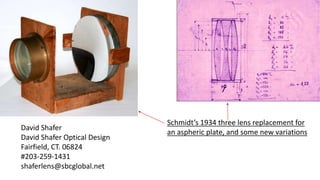
Schmidt’s 1934 three lens replacement for
an aspheric plate, and some new variations
David Shafer
David Shafer Optical Design
Fairfield, CT. 06824
#203-259-1431
shaferlens@sbcglobal.net
Recently a fascinating story from lens design history was chronicled in
this journal article here, about how Schmidt designed and built in 1934 a
three lens replacement for the aspheric plate in a f/1.0 Schmidt camera.
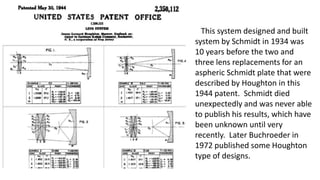
This system designed and built
system by Schmidt in 1934 was
10 years before the two and
three lens replacements for an
aspheric Schmidt plate that were
described by Houghton in this
1944 patent. Schmidt died
unexpectedly and was never able
to publish his results, which have
been unknown until very
recently. Later Buchroeder in
1972 published some Houghton
type of designs.
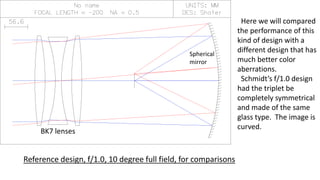
Here we will compared
the performance of this
kind of design with a
different design that has
much better color
aberrations.
Schmidt’s f/1.0 design
had the triplet be
completely symmetrical
and made of the same
glass type. The image is
curved.
Reference design, f/1.0, 10 degree full field, for comparisons
BK7 lenses
Spherical
mirror
On-axis
+/- 5 degrees off-axis
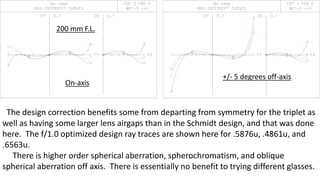
The design correction benefits some from departing from symmetry for the triplet as
well as having some larger lens airgaps than in the Schmidt design, and that was done
here. The f/1.0 optimized design ray traces are shown here for .5876u, .4861u, and
.6563u.
There is higher order spherical aberration, spherochromatism, and oblique
spherical aberration off axis. There is essentially no benefit to trying different glasses.
200 mm F.L.
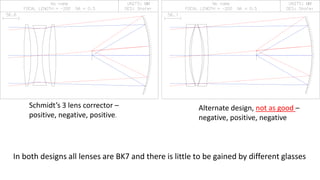
Schmidt’s 3 lens corrector –
positive, negative, positive.
Alternate design, not as good –
negative, positive, negative
In both designs all lenses are BK7 and there is little to be gained by different glasses
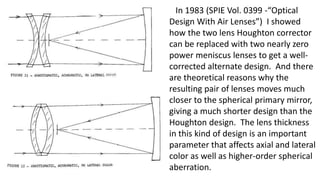
In 1983 (SPIE Vol. 0399 -“Optical
Design With Air Lenses”) I showed
how the two lens Houghton corrector
can be replaced with two nearly zero
power meniscus lenses to get a well-
corrected alternate design. And there
are theoretical reasons why the
resulting pair of lenses moves much
closer to the spherical primary mirror,
giving a much shorter design than the
Houghton design. The lens thickness
in this kind of design is an important
parameter that affects axial and lateral
color as well as higher-order spherical
aberration.
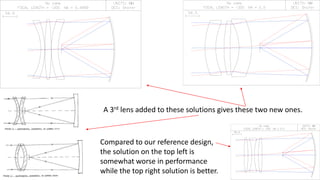
A 3rd lens added to these solutions gives these two new ones.
Compared to our reference design,
the solution on the top left is
somewhat worse in performance
while the top right solution is better.
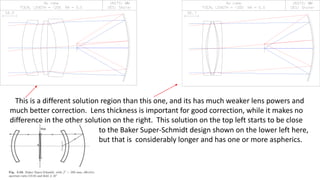
This is a different solution region than this one, and its has much weaker lens powers and
much better correction. Lens thickness is important for good correction, while it makes no
difference in the other solution on the right. This solution on the top left starts to be close
to the Baker Super-Schmidt design shown on the lower left here,
but that is considerably longer and has one or more aspherics.
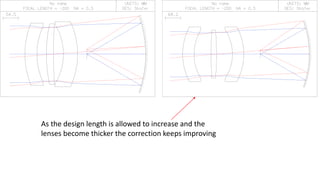
As the design length is allowed to increase and the
lenses become thicker the correction keeps improving
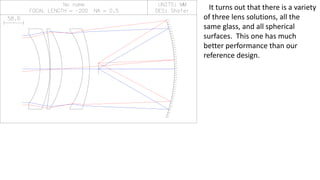
It turns out that there is a variety
of three lens solutions, all the
same glass, and all spherical
surfaces. This one has much
better performance than our
reference design.
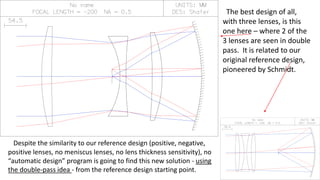
The best design of all,
with three lenses, is this
one here – where 2 of the
3 lenses are seen in double
pass. It is related to our
original reference design,
pioneered by Schmidt.
Despite the similarity to our reference design (positive, negative,
positive lenses, no meniscus lenses, no lens thickness sensitivity), no
“automatic design” program is going to find this new solution - using
the double-pass idea - from the reference design starting point.
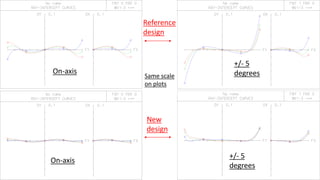
Reference
design
New
design
On-axis
On-axis
+/- 5
degrees
+/- 5
degrees
Same scale
on plots
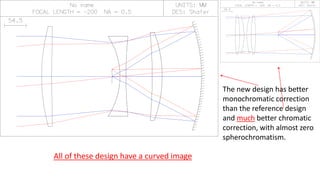
The new design has better
monochromatic correction
than the reference design
and much better chromatic
correction, with almost zero
spherochromatism.
All of these design have a curved image
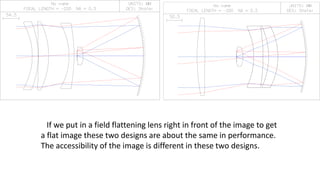
If we put in a field flattening lens right in front of the image to get
a flat image these two designs are about the same in performance.
The accessibility of the image is different in these two designs.
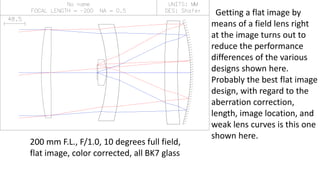
Getting a flat image by
means of a field lens right
at the image turns out to
reduce the performance
differences of the various
designs shown here.
Probably the best flat image
design, with regard to the
aberration correction,
length, image location, and
weak lens curves is this one
shown here.
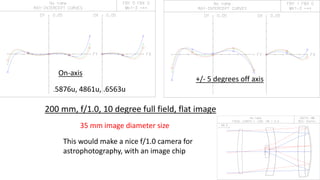
200 mm F.L., F/1.0, 10 degrees full field,
flat image, color corrected, all BK7 glass
200 mm, f/1.0, 10 degree full field, flat image
On-axis
+/- 5 degrees off axis
.5876u, 4861u, .6563u
This would make a nice f/1.0 camera for
astrophotography, with an image chip
35 mm image diameter size
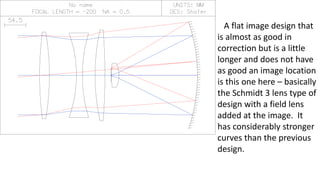
A flat image design that
is almost as good in
correction but is a little
longer and does not have
as good an image location
is this one here – basically
the Schmidt 3 lens type of
design with a field lens
added at the image. It
has considerably stronger
curves than the previous
design.
In summary, Schmidt’s 1934 design makes a good starting
point for finding other simple catadioptric designs. Of
course adding more lenses to the design, or aspherics, will
further improve performance beyond these examples here.

Schmidt's three lens corrector for a spherical mirror

  • 1.
    Schmidt’s 1934 threelens replacement for an aspheric plate, and some new variations David Shafer David Shafer Optical Design Fairfield, CT. 06824 #203-259-1431 shaferlens@sbcglobal.net
  • 2.
    Recently a fascinatingstory from lens design history was chronicled in this journal article here, about how Schmidt designed and built in 1934 a three lens replacement for the aspheric plate in a f/1.0 Schmidt camera.
  • 3.
    This system designedand built system by Schmidt in 1934 was 10 years before the two and three lens replacements for an aspheric Schmidt plate that were described by Houghton in this 1944 patent. Schmidt died unexpectedly and was never able to publish his results, which have been unknown until very recently. Later Buchroeder in 1972 published some Houghton type of designs.
  • 4.
    Here we willcompared the performance of this kind of design with a different design that has much better color aberrations. Schmidt’s f/1.0 design had the triplet be completely symmetrical and made of the same glass type. The image is curved. Reference design, f/1.0, 10 degree full field, for comparisons BK7 lenses Spherical mirror
  • 5.
    On-axis +/- 5 degreesoff-axis The design correction benefits some from departing from symmetry for the triplet as well as having some larger lens airgaps than in the Schmidt design, and that was done here. The f/1.0 optimized design ray traces are shown here for .5876u, .4861u, and .6563u. There is higher order spherical aberration, spherochromatism, and oblique spherical aberration off axis. There is essentially no benefit to trying different glasses. 200 mm F.L.
  • 6.
    Schmidt’s 3 lenscorrector – positive, negative, positive. Alternate design, not as good – negative, positive, negative In both designs all lenses are BK7 and there is little to be gained by different glasses
  • 7.
    In 1983 (SPIEVol. 0399 -“Optical Design With Air Lenses”) I showed how the two lens Houghton corrector can be replaced with two nearly zero power meniscus lenses to get a well- corrected alternate design. And there are theoretical reasons why the resulting pair of lenses moves much closer to the spherical primary mirror, giving a much shorter design than the Houghton design. The lens thickness in this kind of design is an important parameter that affects axial and lateral color as well as higher-order spherical aberration.
  • 8.
    A 3rd lensadded to these solutions gives these two new ones. Compared to our reference design, the solution on the top left is somewhat worse in performance while the top right solution is better.
  • 9.
    This is adifferent solution region than this one, and its has much weaker lens powers and much better correction. Lens thickness is important for good correction, while it makes no difference in the other solution on the right. This solution on the top left starts to be close to the Baker Super-Schmidt design shown on the lower left here, but that is considerably longer and has one or more aspherics.
  • 10.
    As the designlength is allowed to increase and the lenses become thicker the correction keeps improving
  • 11.
    It turns outthat there is a variety of three lens solutions, all the same glass, and all spherical surfaces. This one has much better performance than our reference design.
  • 12.
    The best designof all, with three lenses, is this one here – where 2 of the 3 lenses are seen in double pass. It is related to our original reference design, pioneered by Schmidt. Despite the similarity to our reference design (positive, negative, positive lenses, no meniscus lenses, no lens thickness sensitivity), no “automatic design” program is going to find this new solution - using the double-pass idea - from the reference design starting point.
  • 13.
  • 14.
    The new designhas better monochromatic correction than the reference design and much better chromatic correction, with almost zero spherochromatism. All of these design have a curved image
  • 15.
    If we putin a field flattening lens right in front of the image to get a flat image these two designs are about the same in performance. The accessibility of the image is different in these two designs.
  • 16.
    Getting a flatimage by means of a field lens right at the image turns out to reduce the performance differences of the various designs shown here. Probably the best flat image design, with regard to the aberration correction, length, image location, and weak lens curves is this one shown here. 200 mm F.L., F/1.0, 10 degrees full field, flat image, color corrected, all BK7 glass
  • 17.
    200 mm, f/1.0,10 degree full field, flat image On-axis +/- 5 degrees off axis .5876u, 4861u, .6563u This would make a nice f/1.0 camera for astrophotography, with an image chip 35 mm image diameter size
  • 18.
    A flat imagedesign that is almost as good in correction but is a little longer and does not have as good an image location is this one here – basically the Schmidt 3 lens type of design with a field lens added at the image. It has considerably stronger curves than the previous design.
  • 19.
    In summary, Schmidt’s1934 design makes a good starting point for finding other simple catadioptric designs. Of course adding more lenses to the design, or aspherics, will further improve performance beyond these examples here.