Design starting points for freeform aspheric telescopes
David Shafer
David Shafer Optical Design
1) One approach to a good reflective telescope design with
freeform aspherics is to base it on a good design with
conventional aspherics
2) Just as is the case with camera lenses, a combination of wide
angle and fast speed is best served by the retrofocus
configuration, with a negative power first element
3) We will look at a simple three mirror design
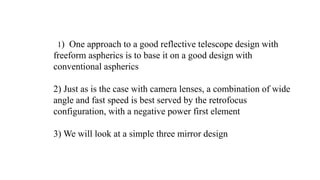
The Baker-Paul design
combines the great aberration
correction of two confocal
parabolic mirrors with the
Schmidt principle and a spherical
third mirror to get an image with
good correction. The parabolic
secondary mirror becomes a
sphere when the Schmidt
aspheric has its deformation
superimposed on it.
This design is only good for small field
sizes and the image is not accessible.
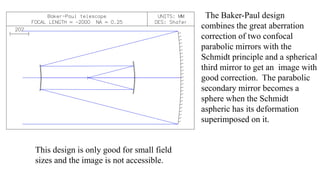
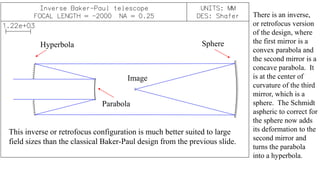
Parabola
Hyperbola Sphere
Image
There is an inverse,
or retrofocus version
of the design, where
the first mirror is a
convex parabola and
the second mirror is a
concave parabola. It
is at the center of
curvature of the third
mirror, which is a
sphere. The Schmidt
aspheric to correct for
the sphere now adds
its deformation to the
second mirror and
turns the parabola
into a hyperbola.
This inverse or retrofocus configuration is much better suited to large
field sizes than the classical Baker-Paul design from the previous slide.
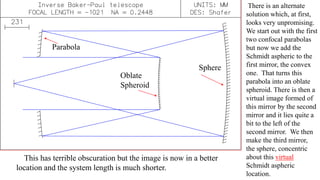
There is an alternate
solution which, at first,
looks very unpromising.
We start out with the first
two confocal parabolas
but now we add the
Schmidt aspheric to the
first mirror, the convex
one. That turns this
parabola into an oblate
spheroid. There is then a
virtual image formed of
this mirror by the second
mirror and it lies quite a
bit to the left of the
second mirror. We then
make the third mirror,
the sphere, concentric
about this virtual
Schmidt aspheric
location.
This has terrible obscuration but the image is now in a better
location and the system length is much shorter.
Sphere
Parabola
Oblate
Spheroid
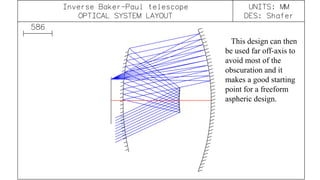
This design can then
be used far off-axis to
avoid most of the
obscuration and it
makes a good starting
point for a freeform
aspheric design.
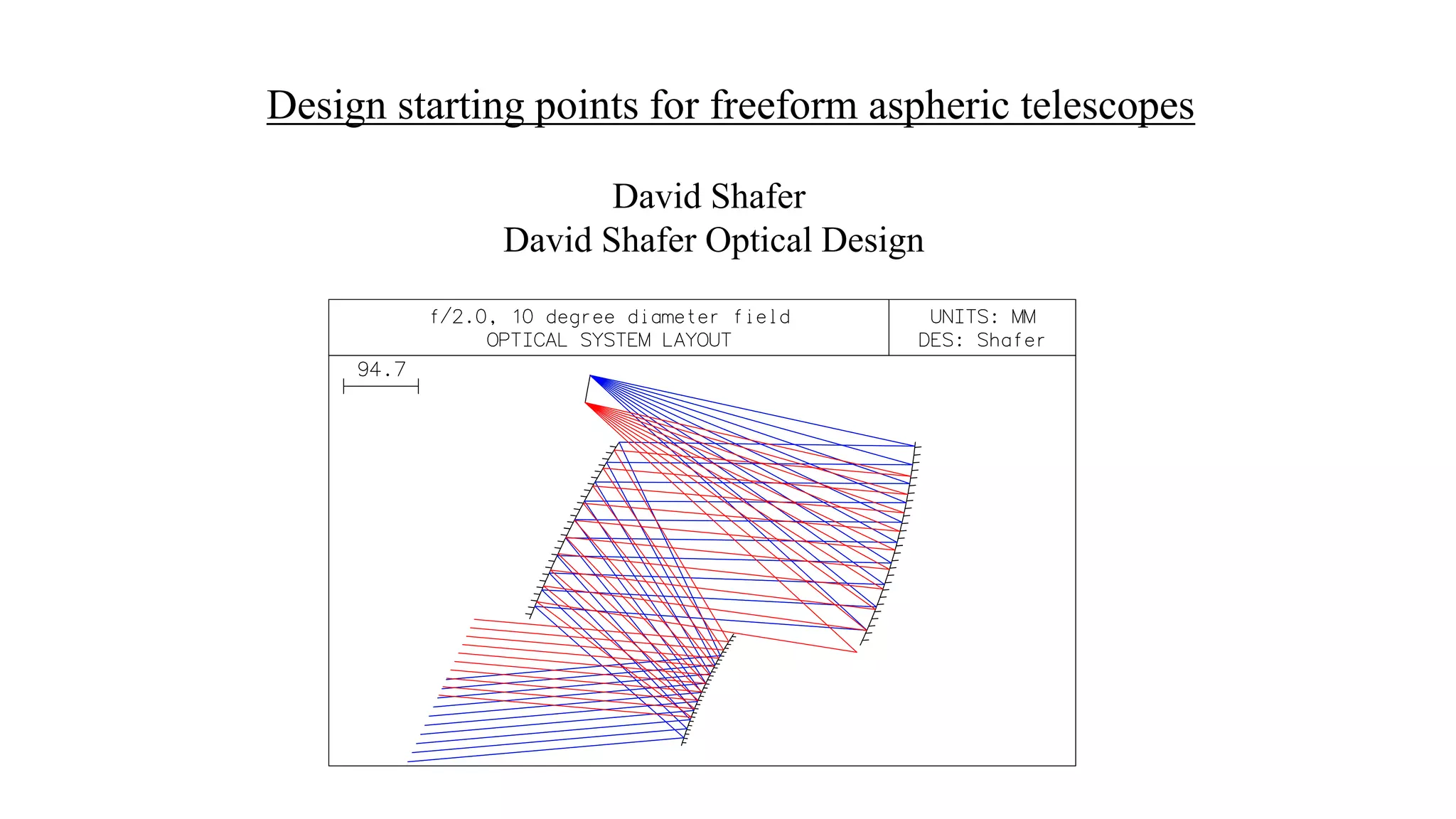
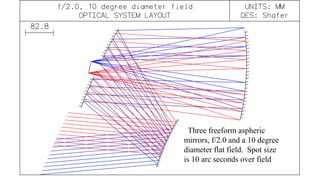
Three freeform aspheric
mirrors, f/2.0 and a 10 degree
diameter flat field. Spot size
is 10 arc seconds over field
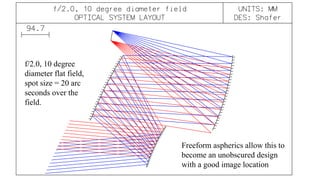
Freeform aspherics allow this to
become an unobscured design
with a good image location
f/2.0, 10 degree
diameter flat field,
spot size = 20 arc
seconds over the
field.
These designs are only partially optimized and
better performance is probably possible
This shows how a design with conventional
aspherics can make for a good starting point
for a freeform aspheric design

Freeform aspherics in telescope design, #2

  • 1.
    Design starting pointsfor freeform aspheric telescopes David Shafer David Shafer Optical Design
  • 2.
    1) One approachto a good reflective telescope design with freeform aspherics is to base it on a good design with conventional aspherics 2) Just as is the case with camera lenses, a combination of wide angle and fast speed is best served by the retrofocus configuration, with a negative power first element 3) We will look at a simple three mirror design
  • 3.
    The Baker-Paul design combinesthe great aberration correction of two confocal parabolic mirrors with the Schmidt principle and a spherical third mirror to get an image with good correction. The parabolic secondary mirror becomes a sphere when the Schmidt aspheric has its deformation superimposed on it. This design is only good for small field sizes and the image is not accessible.
  • 4.
    Parabola Hyperbola Sphere Image There isan inverse, or retrofocus version of the design, where the first mirror is a convex parabola and the second mirror is a concave parabola. It is at the center of curvature of the third mirror, which is a sphere. The Schmidt aspheric to correct for the sphere now adds its deformation to the second mirror and turns the parabola into a hyperbola. This inverse or retrofocus configuration is much better suited to large field sizes than the classical Baker-Paul design from the previous slide.
  • 5.
    There is analternate solution which, at first, looks very unpromising. We start out with the first two confocal parabolas but now we add the Schmidt aspheric to the first mirror, the convex one. That turns this parabola into an oblate spheroid. There is then a virtual image formed of this mirror by the second mirror and it lies quite a bit to the left of the second mirror. We then make the third mirror, the sphere, concentric about this virtual Schmidt aspheric location. This has terrible obscuration but the image is now in a better location and the system length is much shorter. Sphere Parabola Oblate Spheroid
  • 6.
    This design canthen be used far off-axis to avoid most of the obscuration and it makes a good starting point for a freeform aspheric design.
  • 7.
    Three freeform aspheric mirrors,f/2.0 and a 10 degree diameter flat field. Spot size is 10 arc seconds over field
  • 8.
    Freeform aspherics allowthis to become an unobscured design with a good image location f/2.0, 10 degree diameter flat field, spot size = 20 arc seconds over the field.
  • 9.
    These designs areonly partially optimized and better performance is probably possible This shows how a design with conventional aspherics can make for a good starting point for a freeform aspheric design