ALOK MISHRA
Applied Physics ( LEOC )
15-05-06
ELECTRO-OPTICS
TRAKING SYSTEM
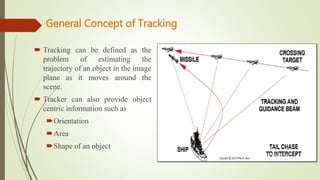
General Concept of Tracking
 Tracking can be defined as the
problem of estimating the
trajectory of an object in the image
plane as it moves around the
scene.
 Tracker can also provide object
centric information such as
Orientation
Area
Shape of an object
www.okieboat.com
An Electro-Optical Tracking System can be viewed as having certain
essential elements which can be structured in a variety of configurations to
meet specific mission requirements. As a minimum, a tracking system
contains:
 A sensor package for detection of the target’s radiated energy,
 A positioning system to follow the target trajectory, and
 A method of commanding the positioning system.
E-O tracking systems can also contain other instrumentation, such as
 laser range finders,
 laser radars, and range-only radars,
which complement the system architecture in providing precise spatial
position data.
General Concept of Tracking
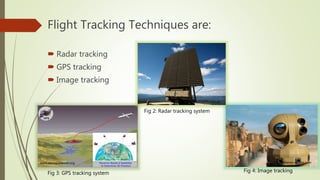
Flight Tracking Techniques are:
 Radar tracking
 GPS tracking
 Image tracking
www.defense-update.comwww.aerospaceweb.org
Fig 2: Radar tracking system
www.lockheedmartin.com.au
Fig 3: GPS tracking system Fig 4: Image tracking
The operational requirements on an E-O tracking system are:
 Target detection
 Target auto-track
 Data collection
 Real-time data reduction
Operational Requirements
Basic Block Diagram
Cont….
The primary performance factors are:
 Target characteristics
 Acquisition range
 Tracking accuracy
 Metric accuracy
 Data resolution
The target characteristics which must be considered in the tracking system are:
 Size
 Target radiance
 Background radiance
 Dynamics
 Range
Performance Factor and Target Characteristics
SENSOR SUBSYSTEM-
Sensor system analysis (Visible)
The following section looks at the effects on pointing accuracy and target
detectability based on the spatial characteristics of the target, optical system focal
length and sensor characteristics. To demonstrate these effects a set of requirements
listed in Table will be used in illustrating a techniques for analyzing system
performance.
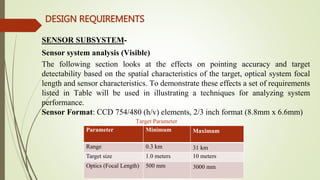
Sensor Format: CCD 754/480 (h/v) elements, 2/3 inch format (8.8mm x 6.6mm)
DESIGN REQUIREMENTS
Parameter Minimum Maximum
Range 0.3 km 31 km
Target size 1.0 meters 10 meters
Optics (Focal Length) 500 mm 3000 mm
Target Parameter
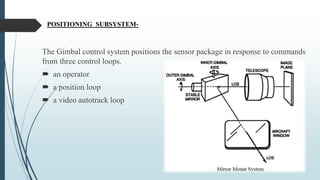
POSITIONING SUBSYSTEM-
The Gimbal control system positions the sensor package in response to commands
from three control loops.
 an operator
 a position loop
 a video autotrack loop
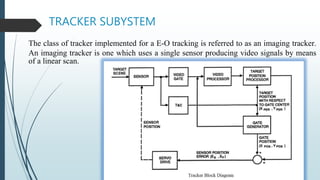
TRACKER SUBYSTEM
The class of tracker implemented for a E-O tracking is referred to as an imaging tracker.
An imaging tracker is one which uses a single sensor producing video signals by means
of a linear scan.
Cont……..
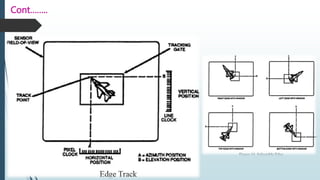
Tracking Techniques-
Various algorithms are available for generating the system tracking errors-
 An edge tracker seeks the first point on the selected target of interest occurring
within the gate and maintains track on that point.
 The gate is used to reject a major portion of the target background and allow
processing of only the selected track point area. Thus, the gate of the edge
tracker may be used to reject unwanted background signals.
 Correlation Tracking
 Correlation algorithms measure the positional difference between a reference
image which contains the target signature and a
 search area within which the target signature is now contained.
Cont……..
 The problem of interfacing the display system to the observer must be
addressed far more critically than other hardware areas.
 since it is the last interface in the system and introduces the human into the
system as a decisions port.
 Brightness.
 Distortion.
 Contrast.
 Accuracy.
 Resolution.
 Size.
Display Subsystem
Ancillary equipment are those subsystems, when integrated into the basic E-O tracking
system, enhance the system’s ability.
 Laser Ranging System
Integration of a Laser Rangefinder (LRF) into an E-O tracking system provides a high-
accuracy, single-station solution in determining a target’s spatial position. The LRF can
replace the triangulation method for position determination or a radar system which has
poor positional accuracies.
 Range-Only-Radar (ROR)
 Range-only-radar allows the tracking system a method of ranging and tracking targets
outside the visible range of the E-O system or when the target is observed by
atmospheric conditions.
 In this mode, the gimbal is placed in the directed position mode and slaved to the
radar’s positional data.
 Depending on beam width and the radar’s encoder resolution/accuracies, varying
degrees of tracking accuracy can be realized.
ANCILLARY EQUIPMENT
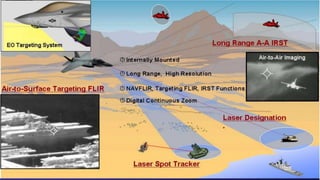
The numerous applications for E-O tracking systems can be divided into five
major categories as follows:
 Real time surveillance
 Homing missile guidance
 Laser designation systems
 Weapon fire control
 Range instrumentation
APPLICATIONS
SUMMARY
Cont…
 E-O tracking systems usually consist of an imaging sensor, gimbal
assembly, video tracker and control system which acquires and maintains
a selected target in the sensor field-of-view.
 a wide variety of applications such as ranging from laser designation to
SDI test instrumentation.
 The principal areas of development in tracking systems are (1) video
tracker algorithms and hardware implementations, (2) sensor fusion, and
(3) applications of modern control techniques such as Kalman filtering.
Electro optical tracking system

Electro optical tracking system

  • 1.
    ALOK MISHRA Applied Physics( LEOC ) 15-05-06
  • 2.
  • 3.
    General Concept ofTracking  Tracking can be defined as the problem of estimating the trajectory of an object in the image plane as it moves around the scene.  Tracker can also provide object centric information such as Orientation Area Shape of an object www.okieboat.com
  • 4.
    An Electro-Optical TrackingSystem can be viewed as having certain essential elements which can be structured in a variety of configurations to meet specific mission requirements. As a minimum, a tracking system contains:  A sensor package for detection of the target’s radiated energy,  A positioning system to follow the target trajectory, and  A method of commanding the positioning system. E-O tracking systems can also contain other instrumentation, such as  laser range finders,  laser radars, and range-only radars, which complement the system architecture in providing precise spatial position data. General Concept of Tracking
  • 5.
    Flight Tracking Techniquesare:  Radar tracking  GPS tracking  Image tracking www.defense-update.comwww.aerospaceweb.org Fig 2: Radar tracking system www.lockheedmartin.com.au Fig 3: GPS tracking system Fig 4: Image tracking
  • 6.
    The operational requirementson an E-O tracking system are:  Target detection  Target auto-track  Data collection  Real-time data reduction Operational Requirements
  • 7.
  • 8.
  • 9.
    The primary performancefactors are:  Target characteristics  Acquisition range  Tracking accuracy  Metric accuracy  Data resolution The target characteristics which must be considered in the tracking system are:  Size  Target radiance  Background radiance  Dynamics  Range Performance Factor and Target Characteristics
  • 11.
    SENSOR SUBSYSTEM- Sensor systemanalysis (Visible) The following section looks at the effects on pointing accuracy and target detectability based on the spatial characteristics of the target, optical system focal length and sensor characteristics. To demonstrate these effects a set of requirements listed in Table will be used in illustrating a techniques for analyzing system performance. Sensor Format: CCD 754/480 (h/v) elements, 2/3 inch format (8.8mm x 6.6mm) DESIGN REQUIREMENTS Parameter Minimum Maximum Range 0.3 km 31 km Target size 1.0 meters 10 meters Optics (Focal Length) 500 mm 3000 mm Target Parameter
  • 12.
    POSITIONING SUBSYSTEM- The Gimbalcontrol system positions the sensor package in response to commands from three control loops.  an operator  a position loop  a video autotrack loop
  • 13.
    TRACKER SUBYSTEM The classof tracker implemented for a E-O tracking is referred to as an imaging tracker. An imaging tracker is one which uses a single sensor producing video signals by means of a linear scan.
  • 14.
    Cont…….. Tracking Techniques- Various algorithmsare available for generating the system tracking errors-  An edge tracker seeks the first point on the selected target of interest occurring within the gate and maintains track on that point.  The gate is used to reject a major portion of the target background and allow processing of only the selected track point area. Thus, the gate of the edge tracker may be used to reject unwanted background signals.  Correlation Tracking  Correlation algorithms measure the positional difference between a reference image which contains the target signature and a  search area within which the target signature is now contained.
  • 15.
  • 16.
     The problemof interfacing the display system to the observer must be addressed far more critically than other hardware areas.  since it is the last interface in the system and introduces the human into the system as a decisions port.  Brightness.  Distortion.  Contrast.  Accuracy.  Resolution.  Size. Display Subsystem
  • 17.
    Ancillary equipment arethose subsystems, when integrated into the basic E-O tracking system, enhance the system’s ability.  Laser Ranging System Integration of a Laser Rangefinder (LRF) into an E-O tracking system provides a high- accuracy, single-station solution in determining a target’s spatial position. The LRF can replace the triangulation method for position determination or a radar system which has poor positional accuracies.  Range-Only-Radar (ROR)  Range-only-radar allows the tracking system a method of ranging and tracking targets outside the visible range of the E-O system or when the target is observed by atmospheric conditions.  In this mode, the gimbal is placed in the directed position mode and slaved to the radar’s positional data.  Depending on beam width and the radar’s encoder resolution/accuracies, varying degrees of tracking accuracy can be realized. ANCILLARY EQUIPMENT
  • 18.
    The numerous applicationsfor E-O tracking systems can be divided into five major categories as follows:  Real time surveillance  Homing missile guidance  Laser designation systems  Weapon fire control  Range instrumentation APPLICATIONS
  • 20.
    SUMMARY Cont…  E-O trackingsystems usually consist of an imaging sensor, gimbal assembly, video tracker and control system which acquires and maintains a selected target in the sensor field-of-view.  a wide variety of applications such as ranging from laser designation to SDI test instrumentation.  The principal areas of development in tracking systems are (1) video tracker algorithms and hardware implementations, (2) sensor fusion, and (3) applications of modern control techniques such as Kalman filtering.