Extreme pixels/volume optical design
Dave Shafer
David Shafer Optical Design
Fairfield, CT 06824
203-259-1431
shaferlens@sbcglobal.net
1) The image aberration that causes the most
design complexity, size, length, and limits
performance is Petzval curvature. Requiring a flat
image = Petzval curvature is corrected, dominates
the evolution of a new design.
2) A diffractive surface has no Petzval curvature
and can have a lot of focusing power without
causing image curvature.
3) Combining lenses and a diffractive surface, with
most of the focusing power in the diffractive
surface, can give flat image designs that are very
simple and with very high performance.
4) The catch is that the diffractive surface gives a
very large amount of color and the design is
limited to a very narrow spectral band.
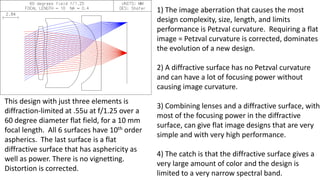
This design with just three elements is
diffraction-limited at .55u at f/1.25 over a
60 degree diameter flat field, for a 10 mm
focal length. All 6 surfaces have 10th order
aspherics. The last surface is a flat
diffractive surface that has asphericity as
well as power. There is no vignetting.
Distortion is corrected.
When diffractive asphericity is
superimposed on top of refractive
asphericity on a surface some
unusual beneficial effects are
possible. Diffractive asphericity is
due to a changing spacing of the
surface fringes or grooves, but they
have a constant height, whereas
refractive asphericity is due to a
changing surface sag relative to a
base sphere. These two independent
types of asphericity, on the same
surface, mean that a ray’s direction
and phase can be controlled
independently. That cannot be done
by either refractive or diffractive
asphericity alone but together the
combination can do it.
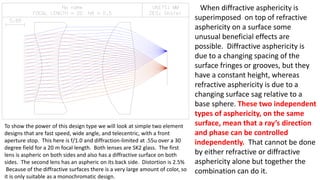
To show the power of this design type we will look at simple two element
designs that are fast speed, wide angle, and telecentric, with a front
aperture stop. This here is f/1.0 and diffraction-limited at .55u over a 30
degree field for a 20 m focal length. Both lenses are SK2 glass. The first
lens is aspheric on both sides and also has a diffractive surface on both
sides. The second lens has an aspheric on its back side. Distortion is 2.5%
Because of the diffractive surfaces there is a very large amount of color, so
it is only suitable as a monochromatic design.
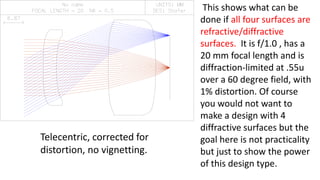
This shows what can be
done if all four surfaces are
refractive/diffractive
surfaces. It is f/1.0 , has a
20 mm focal length and is
diffraction-limited at .55u
over a 60 degree field, with
1% distortion. Of course
you would not want to
make a design with 4
diffractive surfaces but the
goal here is not practicality
but just to show the power
of this design type.
Telecentric, corrected for
distortion, no vignetting.
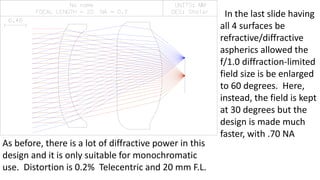
In the last slide having
all 4 surfaces be
refractive/diffractive
aspherics allowed the
f/1.0 diffraction-limited
field size is be enlarged
to 60 degrees. Here,
instead, the field is kept
at 30 degrees but the
design is made much
faster, with .70 NA
As before, there is a lot of diffractive power in this
design and it is only suitable for monochromatic
use. Distortion is 0.2% Telecentric and 20 mm F.L.
The f/1.0 and 60 degrees field design is diffraction limited at
.55u over a 23 mm diameter field, with no vignetting. That is a
whole lot of Airy disks and yet the design is both extremely
simple – just two elements – and also very small – about 34 mm
in diameter and 45 mm long. Much smaller in volume than any
conventional design with many more elements. If distortion
correction and/or telecentricity correction is dropped then
even larger amounts of information can be collected. The goal
here has been to show the power of this refractive/diffractive
aspheric combination on the same surface, not to show
practical designs. It is remarkable what can be done with just
two elements.

Extreme pixels per volume optical design

  • 1.
    Extreme pixels/volume opticaldesign Dave Shafer David Shafer Optical Design Fairfield, CT 06824 203-259-1431 shaferlens@sbcglobal.net
  • 2.
    1) The imageaberration that causes the most design complexity, size, length, and limits performance is Petzval curvature. Requiring a flat image = Petzval curvature is corrected, dominates the evolution of a new design. 2) A diffractive surface has no Petzval curvature and can have a lot of focusing power without causing image curvature. 3) Combining lenses and a diffractive surface, with most of the focusing power in the diffractive surface, can give flat image designs that are very simple and with very high performance. 4) The catch is that the diffractive surface gives a very large amount of color and the design is limited to a very narrow spectral band. This design with just three elements is diffraction-limited at .55u at f/1.25 over a 60 degree diameter flat field, for a 10 mm focal length. All 6 surfaces have 10th order aspherics. The last surface is a flat diffractive surface that has asphericity as well as power. There is no vignetting. Distortion is corrected.
  • 3.
    When diffractive asphericityis superimposed on top of refractive asphericity on a surface some unusual beneficial effects are possible. Diffractive asphericity is due to a changing spacing of the surface fringes or grooves, but they have a constant height, whereas refractive asphericity is due to a changing surface sag relative to a base sphere. These two independent types of asphericity, on the same surface, mean that a ray’s direction and phase can be controlled independently. That cannot be done by either refractive or diffractive asphericity alone but together the combination can do it. To show the power of this design type we will look at simple two element designs that are fast speed, wide angle, and telecentric, with a front aperture stop. This here is f/1.0 and diffraction-limited at .55u over a 30 degree field for a 20 m focal length. Both lenses are SK2 glass. The first lens is aspheric on both sides and also has a diffractive surface on both sides. The second lens has an aspheric on its back side. Distortion is 2.5% Because of the diffractive surfaces there is a very large amount of color, so it is only suitable as a monochromatic design.
  • 4.
    This shows whatcan be done if all four surfaces are refractive/diffractive surfaces. It is f/1.0 , has a 20 mm focal length and is diffraction-limited at .55u over a 60 degree field, with 1% distortion. Of course you would not want to make a design with 4 diffractive surfaces but the goal here is not practicality but just to show the power of this design type. Telecentric, corrected for distortion, no vignetting.
  • 5.
    In the lastslide having all 4 surfaces be refractive/diffractive aspherics allowed the f/1.0 diffraction-limited field size is be enlarged to 60 degrees. Here, instead, the field is kept at 30 degrees but the design is made much faster, with .70 NA As before, there is a lot of diffractive power in this design and it is only suitable for monochromatic use. Distortion is 0.2% Telecentric and 20 mm F.L.
  • 6.
    The f/1.0 and60 degrees field design is diffraction limited at .55u over a 23 mm diameter field, with no vignetting. That is a whole lot of Airy disks and yet the design is both extremely simple – just two elements – and also very small – about 34 mm in diameter and 45 mm long. Much smaller in volume than any conventional design with many more elements. If distortion correction and/or telecentricity correction is dropped then even larger amounts of information can be collected. The goal here has been to show the power of this refractive/diffractive aspheric combination on the same surface, not to show practical designs. It is remarkable what can be done with just two elements.